with High Density Polyethylene
Shankar. G. K. Raju. K
UG Student UG Student
Vi Institute of Technology, Sirunkundram – 603108, India Vi Institute of Technology, Sirunkundram – 603108, India
Ramkumar. M Tamilarasu. T
UG Student UG Student
Vi Institute of Technology, Sirunkundram – 603108, India Vi Institute of Technology, Sirunkundram – 603108, India
Sarathkumar. R Assistant Professor
Vi Institute of Technology, Sirunkundram – 603108, India
Abstract
This study proposes melt-blending polypropylene (PP) and high density polyethylene (HDPE) that have a similar melt flow index (MFI) to form PP/HDPE polyblends. Polypropylene plays a vital role in polymers. It is affected by some superior properties likewise related to the thermal and mechanical property so that by blending with high density polyethylene (HDPE) we will satisfy that characteristics and it will be efficient in economically too. The influence of the content of HDPE on the properties and compatibility of polyblends is examined by using a differential scanning calorimetry (DSC). A technique whereby the weight of a substance, in an environment heated or cooled at a controlled rate, is recorded as a function of time or temperature by using Thermogravimetry (TG). The transition between the solid and liquid states is examined by using Glass transition temperature (Tg). Keywords: Polypropylene(PP), High Density Polyetylene (HDPE), Polyblending, Melt-blending, Differential Scanning Calorimetry(DSC), Thermogravimetry (TG)
________________________________________________________________________________________________________
I. INTRODUCTION
A polymer is a chemical compound or mixture of compounds consisting of repeating structural units created through a process of polymerization. Many commercially important polymers are synthesized by chemical modification of naturally occurring polymers. Ways in which polymers can be modified include oxidation, cross-linking and end-capping. Especially in the production of polymers, the gas separation by membranes has acquired increasing importance in the petrochemical industry and is now a relatively well-established unit operation. The process of polymer degassing is necessary to suit polymer for extrusion and pelletizing, increasing safety, environmental, and product quality aspects. Nitrogen is generally used for this purpose, resulting in a vent gas primarily composed of monomers and nitrogen. Polymer properties are broadly divided into several classes based on the scale at which the property is defined as well as upon its physical basis. The most basic property of a polymer is the identity of its constituent monomers. A second set of properties, known as microstructure, essentially describe the arrangement of these monomers within the polymer at the scale of a single chain. These basic structural properties play a major role in determining bulk physical properties of the polymer, which describe how the polymer behaves as a continuous macroscopic material. Chemical properties, at the nano-scale, describe how the chains interact through various physical forces. At the macro-scale, they describe how the bulk polymer interacts with other chemicals and solvents.
II. EXPERIMENTAL PROGRAMME
Fig. 2: High Density Polyetylene
Polyblend:
Polyblends are a product by melt-blending or solvent-blending two or more polymers. The mechanical or physical properties of polyblends depend on the phase morphology, action between continuous and dispersed phase, and the component ratios. In terms of processing technique, phase morphology relies on the processing technique, including extrusion, injection moulding, and manufacturing conditions, such as temperature and shear force.
DSC (Differential Scanning Calorimetry):
Differential scanning calorimetry (DSC) monitors heat effects associated with phase transitions or chemical reactions as a function of temperature. In a DSC the differences in heat flow. to the sample and a reference at the same temperature is recorded as a function of temperature. Determine the enthalpy of melting (fusion) of polyethylene and the heat capacity, glass transition temperature, and the change in heat capacity for the glass transition in pp/hdpe blending samples
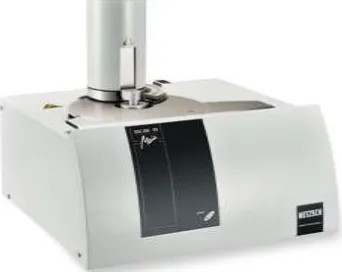
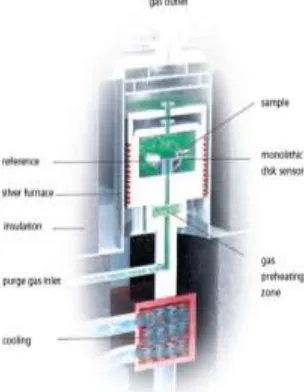
Fig. 4: Elaborate View of Instrument
Table – 1 Operating Parameters
Crucible Al, pierced lid Temperature Program -70°C …30°C Heating /Cooling rate [K/min] 10
Purge gas N2 (60 ml/min) Protective gas N2 (60 ml/min)
Selection of Crucible:
The aluminium crucibles, pierced lid are used in the differential scanning calorimetry because they do not react with the PP,HDPE and PP/HDPE Blend materials while heating and cooling in the vacuum chamber.
Fig. 5: Aluminium crucibles
Crucibles and their covers are made of high temperature-resistant materials, usually porcelain, alumina or an inert metal. The lids are typically loose-fitting to allow gases to escape during heating of a sample inside.
Air Tight Sealing of Crucibles:
The high-speed furnace allows for high sample throughput for quality control as well as kinetic studies. Linear heating rates of up to 1000 K/min can be achieved at the sample with a final temperature of 250°C.
Fig. 7: Balancing of crucibles in furnace
Detection of Phase Transition:
When the sample undergoes a physical transformation such as phase transitions, more or less heat will need to flow to it than the reference to maintain both at the same temperature. Whether less or more heat must flow to the sample depends on whether the process is exothermic or endothermic.
Detection of Mass Change at Various Heating Rate:
Depending upon the heating rate of the material, its mass changes at various temperatures so it is necessary to determine the exact melting point, boiling point and glass transition.
III. RESULT AND ANALYSIS
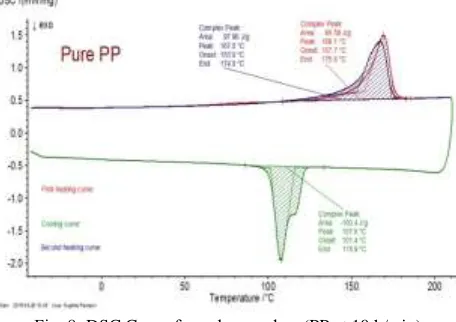
DSC Curve for Polypropylene(PP at 10 k/min):
Fig. 8: DSC Curve for polypropylene(PP at 10 k/min)
DSC Curve for High Density Polyethelene (HDPE at 10k/min):
Fig. 9: DSC Curve for High density polyetylene(HDPE at 10 k/min)
Figure 7 represents temperature dependant mass and energy change of blended sample measured at 10K/min heating rate. TGA heating is represented by curve 2 and DSC heating curve is represented by curve 1. There is a single mass loss step corresponding to 100% due to decomposition of the polymer. An exothermic peak observed at 132.7°C and the heat of fusion for this process is 184.5J/g. Peaks also observed at 136.2°C respectively.
DSC Curve for Polypropylene and HDPE Blend (PP/HDPE at 10k/min):
Figure 8 represents temperature dependant mass and energy change of blended sample measured at 10K/min heating rate. TGA heating is represented by curve 2 and DSC heating curve is represented by curve 1. There is a single mass loss step corresponding to 100% due to decomposition of the polymer. An exothermic peak observed at 171.1°C and the heat of fusion for this process is 70.85J/g. Peaks also observed at 169.9°C, 137.7°C and 133.5°C respectively.
Table – 2
Fig. 10: DSC Curve for PP/HDPE blend (PP/HDPE blend at 10 k/min)
Non-Isothermal Crystallization and Melting Behaviors of PP/HDPE Polyblend:
Table 2shows that the melting temperatures of PP and HDPE are 167 and 110 ̊C, respectively. Shows that PP/HDPE polyblends possess two melting peaks, indicating that PP and HDPE co-exist. Furthermore, from Table, even though the polyblends are composed of various contents of HDPE and PP, the melting temperatures of PP and HDPE do not distinctly fluctuate, which proves that the combination of HDPE does not influence the crystallinity and stability of PP and HDPE in the polyblends.
The degree of crystallinity PP and HDPE in the PP/HDPE polyblends is calculated by the following equation
Where Xc is the crystallinity, ΔHm is the apparent enthalpy of crystallization, ΔHm° is the enthalpy corresponding to the melting of 100% crystalline PP and HDPE, and ∅ is the weight fraction of the matter. According to previous studies, the ΔHm of PP is 209 J/g and that of HDPE is 280 J/g.
Table 2 shows that the crystallization temperatures of PP and HDPE are 112 and 103.5̊C, respectively, and both of the temperatures are different. However, the crystallization orders of PP and HDPE are quite close when the non-isothermal temperature goes down. Their crystallization peaks cannot be distinguished. This is due to the quick crystallinity rate of HDPE. HDPE has a faster crystallization than PP does. Moreover, the combination of HDPE also accelerates the heterogeneous nucleating of PP in the polyblends. As a result, PP can also have a quick crystallization, and thus the crystallization peaks of PP and HDPE cannot be distinguished from one other.
IV. CONCLUSION
From this study we came to know that, Polypropylene blended with HDPE is a polymer that exhibits outstanding properties. It has exceptionally good weather aging resistance as well as resistance to water, chemicals, and ozone. This also shows an excellent resistance to gas permeability and aging due to steam exposure. It is an excellent polymer to use in high temperature applications as it is heat resistant up to 350°C. Ethylene, Propylene provides poor resistance to oil and solvents; however it is fairly good in its resistance to ketones and alcohols. This is also recommended for usage in food applications or those that expose it to aromatic hydrocarbons. The phase change temperature is dependent on heating rate of Polypropylene blended with HDPE material. On analyzing the, Polypropylene blended with HDPE material at various heating rate, it is concluded that mass was optimum at the minimum heating rate of material.
REFERENCES
[1] Bertin, S.; Robin, J.J. Study and characterization of virgin and recycled LDPE/PP blends. Eur. Polym. J.2002, 38, 2255–2264.
[2] Laoutid, F.; Estrada, E.; Michell, R.M.; Bonnaud, L.; Müller, A.J.; Dubois, P. The influence of nanosilicaon the nucleation, crystallization and tensile properties of PP–PC and PP-PA blends. Polymer 2013, 54,3982–3993
[3] Xie, B.-H.; Huang, X.; Zhang, G.-J. High thermal conductive polyvinyl alcohol composites with hexagonalboron nitride microplatelets as fillers. Compos.
Sci. Technol. 2013, 85, 98–103.