Image Forgery Detection using SIFT and PCA
Classifiers for Panchromatic Images
Shivani Thakur Ramanpreet Kaur
M. Tech Student Assistant Professor
CGCTC, Jhanjeri, Mohali CGCTC, Jhanjeri, Mohali
Jasmeet Kaur M. Tech Student CGCTC, Jhanjeri, Mohali
Abstract
The image forgery is the technique in which pixels are marked in the image which are not similar to other pixels of the images. In the base paper technique of PCA is applied for the detection of image forgery. The PCA is the classification of neural networks which will analyze each pixel of the image and classify pixels according to pixel type. The PCA algorithm takes training and trained dataset as input and drive new values according to input image. In this work, improvement is proposed in PCA algorithm for image forgery and proposed improvement is based on SIFT algorithm. The SIFT algorithm is the algorithm which analyze each pixel of the image and define type of pixels in the image. The output of the SIFT algorithm is given as input to PCA algorithm for data classification. The PCA algorithm will classify the data according to SIFT algorithm output. The results show that proposed algorithm performs well in terms of PSNR, MSE, and fault detection rate and accuracy value.
Keywords: PCA, SIFT, PSNR
________________________________________________________________________________________________________
I. INTRODUCTION
A digital image which is defined in a[m,n] which is defined as a 2D discrete space is derived from an analog image a(x,y) in a continuous space using sampling process which is known as a digitalization. A digital remotely sensed image is composed of picture elements located at the intersection of row and column for k bands of imagery. The digital image processing generally refers to processing of 2D pictures by digital computers [1]. A digital image is an array of real numbers represented by a finite number of bits. Various techniques are proposed in this paper. Image processing is a technique which is used to enhance raw images which are received from cameras, sensors placed on satellites and air craft. Image processing is a common name for operations with images at the lowest levels of abstraction both input and outputs are intensity images. The main objective of this scheme is to have a closer view of the closer or zooming image for the interested part of the image [2]. Rotation is used in image mosaic and image registration. In image enhancement, the objective is to complement certain image features for consequent examination or for showing image. The enhancement process does not increase the intrinsic information content in the data itself. Segmentation techniques are used to isolate desired objects from the scene to make them perfect [3].
Region based segmentation can be defined as partitioning the image into regions [4]. Edge segmentation can be defined as that in which each object is surrounded by a border. Edge detection is used to identify the edges and edge pixels. Histogram based Method requires only one pass through the pixels. In this technique, a histogram is registered from the majority of the pixels in the image, and the peaks and valleys in the histogram are utilized to find the clusters in the image. Color or intensity can be utilized as the measure. Region Growing Method takes number of seeds as an input along with the image. The seeds mark each object to be segmentation. It is grown by comparing the entire allocated region for segmentation [5]. Edge detection techniques have in this way been utilized as the base of another segmentation technique. The watershed transformation considers the gradient magnitude of an image as a topographic surface.
recognition, video tracking, individual identification of wildlife and match moving. SIFT algorithm is less time consuming algorithm and produce results better than any other algorithms.
II. LITERATURE REVIEW
T. Blaschke et al,” Object based image analysis for remote sensing,” 2009 In this paper [6] they clarified that there is additionally a need of environmental monitoring which should be possible through the image receivables from specific areas. These images can give information which is further helpful for exploratory purposes. The moderating of certain characteristic things, the maintainability variable, preservation objectives all such can be further made with the assistance of the specific image information. The Object-based analysis is being utilized now which is another technique and can be useful to give the data required. The extensive pixel images give considerably more information which is much for informatory. The extraction of image data is utilized for spatial arranging. This data can likewise be utilized for monitoring programs. The data that is gotten can grow significantly more changes which can be useful for different fields moreover. Such changes that are should be made can be watched additionally from far distances and can be overviewed every once in a while.
K. Anitha and P. Leveenbose, “Edge Detection based Salient Region Detection for Accurate Image Forgery Detection”, 2014 In this paper [7] they clarified that image forgery is a noteworthy issue in today's time and huge test for the general public. This is simple because of the adjustments utilizing software's. The forgery image incorporates object evacuation, medications, object colors. There are numerous techniques which are accessible to conquer this issue like precision need, bigger hash qualities and insufficiency in little area tampering. In this proposed technique, image is preprocessed to the altered size. The objects are extracted from the last image and edge pixels are recognized and mapped to the first image, sensitive hash is developed for those identified regions. This future technique outflanks the current framework by precisely recognizing saliency regions, expands the affectability of the hash, decreasing hash length so that even the little area tampering can be identified correctly.
Ashwin Swaminathan et.al, “Digital Image Forensics via Intrinsic Fingerprints”, 2008 In this paper [9] they proposed a strategy which is based on the perception that numerous preparing operations, both inside and outside securing gadgets, leave unmistakable intrinsic follows on digital images, and these intrinsic fingerprints can be recognized and utilized to check the honesty of digital data. The intrinsic fingerprints of the different in-camera handling operations can be accessed through a point by point imaging model and its component analysis. The nonattendance of camera-forced fingerprints from a test image demonstrates that the test image is not a camera yield and is conceivably created by other image generation forms. Any change or irregularities among the assessed camera-forced fingerprints, or the nearness of new sorts of fingerprints propose that the image has experienced some sort of handling after the underlying catch, for example, tampering or steganographic embedding. Through analysis and broad test thinks about, this paper shows the adequacy of the proposed system for nonintrusive digital image criminology.
Krystian Mikolajczyk and Cordelia Schmid, “A performance evaluation of local descriptors”, 2005 In this paper [10] the execution of descriptors figured for nearby intrigue regions. Be that as it may, it is hazy which descriptors are more proper and how their execution relies on upon the interest region detector. The descriptors ought to be unmistakable and in the meantime robust to changes in survey conditions and in addition to errors of the detector. They thought about shape context, steerable filters, PCA-SIFT, differential invariants, spin images, SIFT, complex filters, minute invariants, and cross-relationship for various sorts of interest regions. They additionally proposed an extension of the SIFT descriptor, and demonstrate that it outflanks the first strategy. Besides, it is watched that the positioning of the descriptors is generally independent of the interest region detector and that the SIFT based descriptors perform best. Minutes and steerable filters demonstrate the best execution among the low dimensional descriptors.
Gajanand Gupta, “Improved Median Filter and Comparison of Mean, Median and Improved Median Filter”, 2010 In this paper [11] creator has examined around an enhanced median filter algorithm is executed for the de-noising of highly corrupted images and edge preservation. Mean, Median and enhanced mean filter is utilized for the noise detection. Crucial of image handling, image degradation and restoration procedures are outlined. The photos are corrupted with various noise densities and recreated. The noise is Gaussian and impulse (salt-and pepper) noise. An algorithm is intended to compute the PSNR and MSE. A novel strategy based on proficient noise detection algorithm is contemplated here for viably de-noising to a great degree corrupted images and better edges preservation. In addition, the concentrated on technique utilizes basic settled length window, and consequently, it requires altogether bring down handling time contrasted and different strategies. The recreation results demonstrate that the concentrated on strategy can be connected to various sorts of image and give exceptionally fulfilling results. Kazuki Maeno, Hajime Nagahara, Atsushi Shimada, Rin-ichiro Taniguchi, “Light Field Distortion Feature for Transparent Object Recognition”, 2013
feature, for distinguishing a straightforward object. The proposition fuses this LFD feature into the pack of-features approach for perceiving straightforward objects. They assessed its execution in research facility and real settings.
III. PCA CLASSIFIER FOR IMAGE FORGERY
The specialty of making an image forgery is just about as old as photography itself. In its initial years, photography rapidly turned into the picked technique for making portraits, and representation photographers discovered that they could enhance deals by retouching their photographs to satisfy the sitter. Photo manipulation has turned out to be more regular in the time of digital cameras and image editing software. Accumulated beneath are cases of a portion of the striking instances of photo manipulation ever. So the principle center is on the instances that have been most disputable or infamous, or ones that bring up the most intriguing ethical issues. The photographers have additionally tried different things with composition, i.e., consolidating numerous images into one. Foremost component analysis (PCA) approaches have been extremely effective in image representation and recognition. PCA is a statistical and unsupervised approach utilized for feature extraction and data compression. The motivation behind PCA is to extend the feature from high-dimensional to an extraordinary failure dimensional space where the inferred tomahawks known as central component are having diminishing request of significance. The objective of PCA is to augment the variance between data without considering class separation.
There are different strategies proposed for a feature extraction piece. Distribution demonstrating of multidimensional raw data is frequently troublesome. Naturally, removing features that are intended to catch and speak to the distribution in a lower dimensional space may disentangle this assignment. PCA is routinely utilized for preprocessing of multispectral remote sensing images for the reasons for change detection. The idea of change, in any case, is unique in relation to the translation we use here. In remote sensing, change is comprehended as the procedure of recognizing contrasts in the state of an object in space by watching it at various times, for instance, a vegetable canopy. On the off chance that there is no knowledge of what the change might be, it is not clear whether the representation in a lower dimensional space will offer assistance.
IV. PROPOSED TECHNIQUE
The proposed technique will be based on to improve property analysis of the objects in the image. To analyze object properties, SIFT algorithm is used which use Gaussian function analyze object properties. The SVD algorithm is used to classify the similar objects. To reduce complexity and to improve analyze of object properties following modification has been proposed: -
1) The SIFT algorithm will be replaced with decision tree or with histogram technique to analyze image objects 2) To classify the similar type of objects technique of SVD classifier will be replaced with nearest neighbor classify 3) The proposed technique will lead to improvement in image object analysis and reduce complexity of classification.
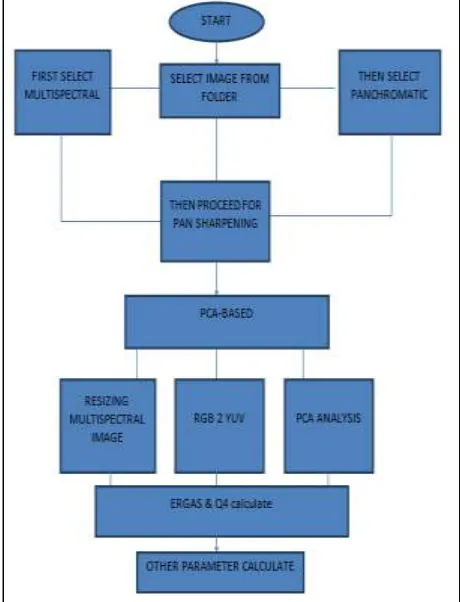
As shown in the flow chart, first of all the Multispectral images are selected. Further, from a given folder, select the panchromatic image. The careful selection of the required image is necessary. After the selection of panchromatic image, click in the pan sharpen button or select the pan sharpen automatically. When all the processing is done, a result of pan sharpening will be provided in the given window. Also ERGAS and Q4 are certain value parameters which calculate according to the methods used in base which is also named as PCA. Certain operations are performed simultaneously on the image, which provide the further analysis of the details. The image is made to undergo procedural analysis for extracting details required in the process. On the basis of these values only, the patch size is changed. When the value of patch size changes, so does the value of Q4.
V. EXPERIMENTAL GRAPHS
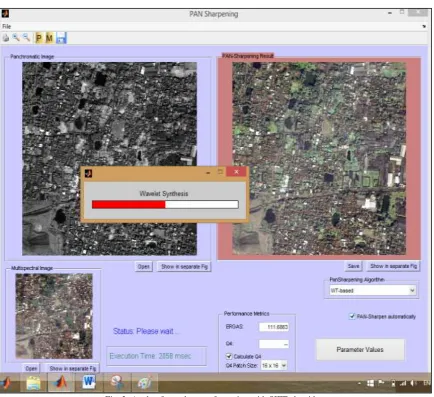
Fig. 2: Apply of wavelet transformation with SIFT algorithm
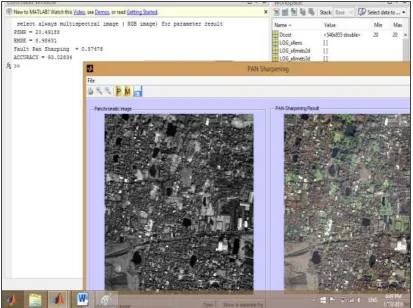
Fig. 2: Calculation of Q7 matrices
As shown in figure 2, the algorithm is applied which is the SIFT algorithm and wavelet transformation algorithm. The SIFT algorithm will select best features from the images which are different from the image and wavelet transformation algorithm will high light that features in the image.
As shown in the figure 3, after the SIFT algorithm will select best features from the images which are different from the image, the Q7 matrices are applied which will calculate features various parameters of the image like accuracy, fault detection rate and time for forgery detection. The result of the image is shown on command window in terms of PSNR, RMSE, fault detection rate and accuracy.
VI. CONCLUSION
The technique of image forgery is applied to mark the pixels from the image which are not similar to other image pixels. The panchromatic images are taken as input for the forgery detection. In the existing technique PCA algorithm is applied which will learn from the previous experience and drive new values based on training and trained datasets. The PCA algorithm will classify the images pixels according to their properties. In this work, improvement in been proposed in PCA algorithm for forgery detection. The proposed improvement is based on SIFT algorithm in the SIFT algorithm each pixel is analyzed according to pixel properties. The output of SIFT algorithm is given as input to PCA algorithm for classification. The simulation is performed in MATLAB and it is been analyzed that accuracy is improved, fault detection rate is reduced. In future further improvement can be applied in proposed algorithm by implement nearest neighbor classifier for image classification.
REFERENCES
[1] S.Murali, Govindraj B. Chittapur, Prabhakara H. S and Basavaraj S. Anami, “Comparison and Analysis of Photo Image Forgery Detection Techniques”,
International Journal on Computational Sciences & Applications (IJCSA) Vo2, No.6, December 2012
[2] Ms. P. G.Gomase, Ms. N. R. Wankhade, “Advanced Digital Image Forgery Detection- A Review”, IOSR Journal of Computer Science (IOSR-JCE)
e-ISSN: 2278-0661, p-e-ISSN: 2278-8727 PP 80-83 2014
[3] Rohini.A.Maind, Alka Khade, D. K. Chitre, “Image Copy Move Forgery Detection using Block Representing Method”, International Journal of Soft
Computing and Engineering (IJSCE) ISSN: 2231-2307, Volume-4, Issue-2, May 2014
[4] Shuiming Ye, Qibin Sun, and Ee-Chien Chang, “Detecting digital image forgeries by measuring inconsistencies of block artifact”, IEEE, 2007
[5] Saba Mushtaq and Ajaz Hussain Mir, “Digital Image Forgeries and Passive Image Authentication Techniques: A Survey”, International Journal of
Advanced Science and Technology Vol.73 (2014), pp.15-32
[6] T. Blaschke,” Object based image analysis for remote sensing,” 2009 ISPRS
[7] K. Anitha and P. Leveenbose, “Edge Detection based Salient Region Detection for Accurate Image Forgery Detection”, IEEE, 2014
[8] R.Moreno ,D.Puig ,C.Julia ,M.A.Garcia , “A new methodology for evaluation of edge detectors” ,in :Proceedings of the16th IEEE International Conference
on Image Processing (ICIP), 2009,pp. 2157–2160
[9] Ashwin Swaminathan, Min Wu and K. J. Ray Liu, “Digital Image Forensics via Intrinsic Fingerprints”, IEEE Transactions on Information Forensics and
Security, Vol. 3, No. 1, MARCH 2008
[10] Krystian Mikolajczyk and Cordelia Schmid (2005), “A performance evaluation of local descriptors”, Pattern Analysis and Machine Intelligence, IEEE Transactions on Pattern Analysis and Machine Intelligence, Volume 27, Issue 10 ,2005, pp 1615 – 1630.
[11] Gajanand Gupta, “Improved Median Filter and Comparison of Mean, Median and Improved Median Filter” International Journal of Soft Computing and
Engineering (IJSCE) SSN: 2231-2307, Volume-1, Issue-5, November 2011 Algorithm for Image Processing Using Matlab, 2011