Page 20 www.ijiras.com | Email: [email protected]
Application of the Fuzzy AHP Technique for Prioritization of
Requirements in Goal Oriented Requirements Elicitation Process
Rajesh Avasthi PG Scholar, Rajasthan
India
P. S. Sharma Research Scholar, Rajasthan
India
I. INTRODUCTION
Requirement Engineering is the branch of science that aims to make system requirements clear and understandable so that they reflect the actual needs of the customers. It is a multi-disciplinary approach which encompasses other fields also like the social and cognitive sciences to endow with theoretical grounds, practical knowledge and techniques for requirements elicitation and analysis. Requirements elicitation is the process through which the customer and the developer of a software system discover, review, articulate, and understand user needs and verifies user requirements through discussion. It is the earliest phase of software development and has the maximum impact on the product in the long run. Hence properly gathered requirements have great influence on the design phase of software development (Sommerville, 2001). In practice, only a limited set of requirements can be implemented in one release, but the product should also meet the stakeholders’ expectations.
Goals have long been recognized to be essential components involved in the requirements engineering(RE) process (Ross and Schoman, 1977). Goal-oriented requirements elicitation process is concerned with the use of goals for eliciting, elaborating, structuring, specifying, analyzing, negotiating, documenting, and modifying requirements. This Goal-oriented requirements elicitation process is very important because it helps in defining the main goal and capturing the various objectives that the system under consideration for development must achieve.
Requirements prioritization is a process that helps in identifying the most valuable requirements from the set that contains several requirements (Sommerville and Sawyer, 1997). The process of prioritizing requirements provides support for the stakeholders to decide the core requirements for the system and to plan and select an ordered, optimal set of software requirements for implementation (Karlsson, 1998). The ultimate goal of any software organization is to create systems that meet the stakeholder demands (Wiegers, 1999). Since there are usually more requirements than can be implemented, decision makers must face the problem of selecting the right set of requirements. By selecting a subset of the requirements that are valuable for the customers, and that can be implemented within budget, organizations can become more successful in the market (Yeh, 1992). Requirements prioritization plays an important role in the requirement engineering process. Selecting the right set of requirements for a product release largely depends on how successfully the requirements are prioritized.
II. FUZZY AHP TECHNIQUE
A major contribution of fuzzy set theory is its capability of representing vague data (Erensal et al., 2002). Fuzzy sets and fuzzy logic are powerful mathematical tools for modeling: uncertain systems in industry, nature and humanity; and facilitators for common-sense reasoning in decision making in the absence of complete and precise information (Saaty,
Abstract: Prioritizing software requirements could be viewed as a complex multi-criteria decision making technique
problem. The analytic hierarchy process (AHP), a multi-criteria decision making technique, is used in weighting the software requirements. Based on the collected customer requirements and engineering requirements of a product or a system that is to be developed, AHP can be applied in the determination of the importance measures. However, customer requirements may contain ambiguity and multiplicity of meaning. The descriptions of customer requirements may be linguistic and vague. In order to model this kind of uncertainty in human preference, fuzzy sets could be incorporated with the pairwise comparison as an extension of AHP. The fuzzy AHP approach allows a more accurate description of the decision-making process, in the cases when the descriptions of requirements are linguistic in nature. In this research
paper, a fuzzy AHP approach is used for the prioritization of requirements for an Institute Examination System.
Page 21 www.ijiras.com | Email: [email protected] 1994). The fuzzy set theory has been introduced by Zadeh and
it is oriented towards the rationality of uncertainty due to imprecision or vagueness (Zadeh, 1965).
A fuzzy number is a fuzzy quantity M that represents a generalization of a real number r. Fuzzy numbers is the special classes of fuzzy quantities. Intuitively, M(x) represents a measure of how well M(x) “approximates” r (Zimmermann, 1996 and Nguyen and Walker, 2000 and). A fuzzy number is characterized by a given interval of real numbers, each with a grade of membership between 0 and 1. It is possible to use different fuzzy numbers according to the situation. Generally in practice triangular fuzzy numbers are used (Klir et al., 1995 and Kahraman, 2001). In applications it is often convenient to work with triangular fuzzy numbers (TFNs) because of their computational simplicity, and they are useful in promoting representation and information processing in a fuzzy environment (Kahraman et al., 2002 and Ertugrul et al., 2007). TFNs are defined by three real numbers, expressed as ( l, m, u ). The parameters l, m, and u, respectively, indicate the smallest possible value, the most promising value, and the largest possible value that describe a fuzzy event (Zadeh, 1965 and Klir and Yuan, 1995). There are various operations that can be performed on triangular fuzzy numbers such as addition, subtraction, multiplication etc.
Let A1 = (a1, b1, c1) and A2 = (a2, b2, c2) then:
Addition:-
A1+A2 = (a1+a2, b1+b2, c1+c2)
(1)
Subtraction:-
A1-A2 = (a1-c2, b1-b2, c1-a2)
(2)
Multiplication:-
A1.A2 = (a1.a2, b1.b2, c1.c2)
(3) Division:-
A1/A2 = (a1/c2, b1/b2, c1/a2)
(4) Inverse:-
A1-1 = (1/c1, 1/b1, 1/a1)
(5) Negation:-
A1 = (-c1, -b1, -a1)
(6)
Analytic Hierarchy Process (AHP), proposed by Saaty is a powerful decision-making process in order to determine the priorities among different criteria (Saaty, 1980). However, this process is inadequate for dealing with the imprecise or vague nature of linguistic assessment. In FAHP, the pairwise comparisons of both criteria and the alternatives are performed through the linguistic variables. In this approach fuzzy numbers are used for the preferences of one criterion over another and then the synthetic extent value of the pairwise comparison is calculated (Saaty, 1980). Fuzzy Analytic Hierarchy Process embeds the fuzzy theory to Analytic Hierarchy Process. In fuzzy AHP, linguistic statements have been used in the pairwise comparison which can be represented by the fuzzy numbers (Erensal, 2006). The steps of FAHP technique working are described below:-
Step 1: The value of fuzzy synthetic extent with respect to the TFN is defined as-
= . [ (7)
where, = ( , , ) (8)
[ = [ 1/ , 1/ , 1/
(9)
Step 2: The degree of possibility of = ( , , ) and = ( , , ) is defined as-
V ( >= ) = hgt ( ∩ ) = (10)
= 1, if >= (10.1)
= 0, if >= (10.2)
= ( - )/ (( - ) – ( - )), otherwise (10.3)
Step 3: The degree possibility for a fuzzy number to be greater than equal to k fuzzy numbers
(i=1, 2, ..., k) is defined as-
V ( A >= , , …, ) = V [ ( A >= ) and ( A >= ) and, …, ( A >= )]
= min V ( A >= ) (11)
( ) = min V ( >= ) (12) The weight vector is given by-
= ( ( ), ( ), ..., ( ) (13)
Step 4: Via normalization, the normalized weight vectors are defined as-
W = ( d ( ), d ( ), ..., d ( ) (14)
Step 5: The fuzzy weight matrices with TFNs is defined as- ( , , ) = ( 1/n , 1/n , 1/n ) (15)
Step 5.1: The fuzzy ratings with quadratic membership function are aggregated in the form of-
( , , / / , , ) (16)
where, = ( - ) ( - ) (17) = ( - ) + ( - ) (18)
= (19)
= ( - ) ( - ) (20)
= ( - ) + ( - )(21)
= (22) = (23)
Step 5.2: The requirements are defined by means of extended addition and multiplication for
I = 1, 2, 3 in the form of-
( , , / / , , ) (24)
where, = 1/m (25) = 1/m (26)
= 1/m (27)
Step 5.3: The of the requirements are defined in the form of-
( , , / sum_ea/ , , ) (28)
where, = 1/n (29)
Page 22 www.ijiras.com | Email: [email protected] Step 5.4: The extended difference, - sum_ea, for each
requirement is defined in the form of-
(( - ),( + ),( - )/ - sum_ea /( - - ),( - )) (32)
Step 5.5: The ranking value of each requirement ( ԑ R ) is defined as-
if ( - ) < 0 , ( - ) >= 0 , >= sum_ea then
= µR ( - ea, 0 ) = / ( + ) (33) else if ( - ) <= 0 , ( - ) > 0 , <= sum_ea then
= µR ( - ea, 0 ) = / ( + ) (34) else if ( - ) = 0 , ( - ) = 0 , = sum_ea then
= µR ( - ea, 0 ) = 0.5 (35)
else if ( - ) >= 0 , ( - ) > 0 , >= sum_ea then
= µR ( - ea, 0 ) = 1 (36)
else if ( - ) < 0 , ( - ) <= 0 , <= sum_ea then
= µR ( - ea, 0 ) = 0 (37) where,
= [1/4( - ) – 1/3 + 1/2( - )] + [1/4( - )(1 - ) +
1/3( + )(1 - ) + 1/2( - )(1 - )] (38)
= -[1/4( - ) + 1/3( + ) + 1/2( - ) ] (39)
= [-( + ) + sqrt{( + - 4( - )( - )}]/[2( - )] (40)
= [1/4( - ) (- - ) + 1/2( - ) ] (41)
= -[1/4( - ) + 1/3( + ) + 1/2( - )] – [1/4( - )(1 - ) –
1/3( + ) + 1/2( - ) ] (42)
= [ + ) - sqrt{(- - - 4( - )( - )}]/[2( - ) (43)
Step 6: On the basis of highest to lowest ranking values, the requirements are arranged in the decreasing order of the priority.
III. A NUMERICAL EXAMPLE:
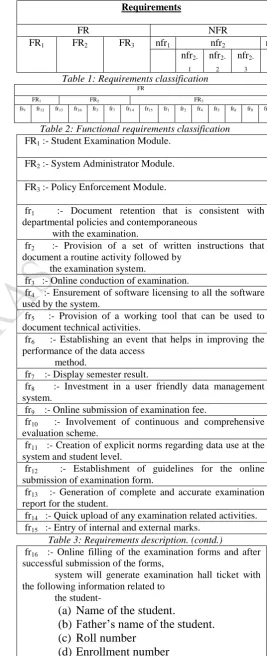
A numerical example is illustrated that implement the Fuzzy AHP technique for requirements prioritization of an Institute Examination System (IES). IES is an efficient, integrated and easy to use system for computerizing total examination work of an institute. The system is robust and able to handle large volume of data. This system is used to provide the facility to submit online examination form, conduct online examination and generate the result of the student. Table1 represent the classification of requirements into functional requirements (FR) and non-functional requirements (NFR). There is an AND decomposition among nfr1, nfr2 and nfr3 but there is an OR decomposition among
nfr2-1, nfr2-2 and nfr2-3 given in Table 1. Table 2 represents the
classification of functional requirements for IES. Table 3 describes the requirements. Table 4 represents the judgment matrix.
Requirements
FR NFR
FR1 FR2 FR3 nfr1 nfr2 nfr3
nfr 2-1
nfr 2-2
nfr 2-3
Table 1: Requirements classification
FR
FR1 FR2 FR3
fr9 fr12 fr13 fr16 fr3 fr7 fr14 fr15 fr1 fr2 fr4 fr5 fr6 fr8 fr10 fr11
Table 2: Functional requirements classification FR1 :- Student Examination Module.
FR2 :- System Administrator Module.
FR3 :- Policy Enforcement Module.
fr1 :- Document retention that is consistent with
departmental policies and contemporaneous with the examination.
fr2 :- Provision of a set of written instructions that
document a routine activity followed by the examination system.
fr3 :- Online conduction of examination.
fr4 :- Ensurement of software licensing to all the software
used by the system.
fr5 :- Provision of a working tool that can be used to
document technical activities.
fr6 :- Establishing an event that helps in improving the
performance of the data access method.
fr7 :- Display semester result.
fr8 :- Investment in a user friendly data management
system.
fr9 :- Online submission of examination fee.
fr10 :- Involvement of continuous and comprehensive
evaluation scheme.
fr11 :- Creation of explicit norms regarding data use at the
system and student level.
fr12 :- Establishment of guidelines for the online
submission of examination form.
fr13 :- Generation of complete and accurate examination
report for the student.
fr14 :- Quick upload of any examination related activities.
fr15 :- Entry of internal and external marks.
Table 3: Requirements description. (contd.)
fr16 :- Online filling of the examination forms and after
successful submission of the forms,
system will generate examination hall ticket with the following information related to
the student-
(a)
Name of the student.
(b)
Father’s name of the student.
(c)
Roll number
Page 23 www.ijiras.com | Email: [email protected]
(e)
Examination name
(f)
Subject name(s)
(g)
Subject code(s)
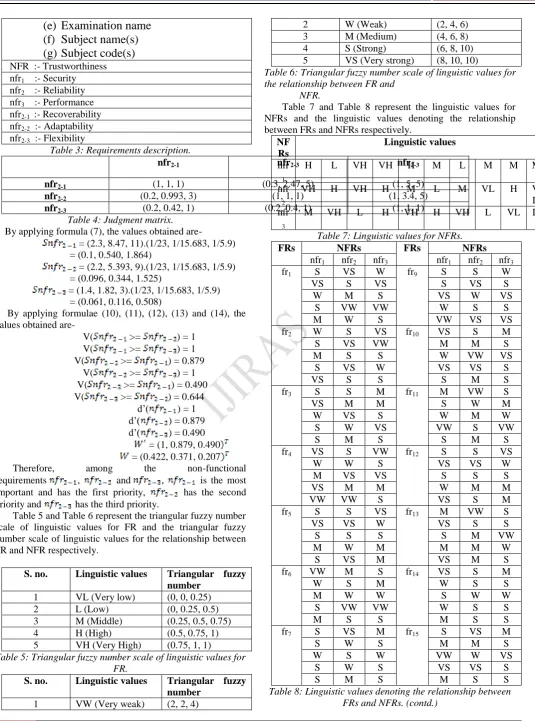
NFR :- Trustworthiness nfr1 :- Security
nfr2 :- Reliability
nfr3 :- Performance
nfr2-1 :- Recoverability
nfr2-2 :- Adaptability
nfr2-3 :- Flexibility
Table 3: Requirements description.
nfr2-1 nfr2-3 nfr2-3
nfr2-1 (1, 1, 1) (0.3, 2.47, 5) (1, 5, 5)
nfr2-2 (0.2, 0.993, 3) (1, 1, 1) (1, 3.4, 5)
nfr2-3 (0.2, 0.42, 1) (0.2, 0.4, 1) (1, 1, 1)
Table 4: Judgment matrix. By applying formula (7), the values obtained are-
= (2.3, 8.47, 11).(1/23, 1/15.683, 1/5.9) = (0.1, 0.540, 1.864)
= (2.2, 5.393, 9).(1/23, 1/15.683, 1/5.9) = (0.096, 0.344, 1.525)
= (1.4, 1.82, 3).(1/23, 1/15.683, 1/5.9) = (0.061, 0.116, 0.508)
By applying formulae (10), (11), (12), (13) and (14), the values obtained are-
V( >= ) = 1 V( >= ) = 1 V( >= ) = 0.879
V( >= ) = 1
V( >= ) = 0.490
V( >= ) = 0.644 d’( ) = 1 d’( ) = 0.879 d’( ) = 0.490 = (1, 0.879, 0.490 = (0.422, 0.371, 0.207
Therefore, among the non-functional
requirements , and , is the most
important and has the first priority, has the second priority and has the third priority.
Table 5 and Table 6 represent the triangular fuzzy number scale of linguistic values for FR and the triangular fuzzy number scale of linguistic values for the relationship between FR and NFR respectively.
S. no. Linguistic values Triangular fuzzy number
1 VL (Very low) (0, 0, 0.25)
2 L (Low) (0, 0.25, 0.5)
3 M (Middle) (0.25, 0.5, 0.75)
4 H (High) (0.5, 0.75, 1)
5 VH (Very High) (0.75, 1, 1)
Table 5: Triangular fuzzy number scale of linguistic values for FR.
S. no. Linguistic values Triangular fuzzy number
1 VW (Very weak) (2, 2, 4)
2 W (Weak) (2, 4, 6)
3 M (Medium) (4, 6, 8)
4 S (Strong) (6, 8, 10)
5 VS (Very strong) (8, 10, 10)
Table 6: Triangular fuzzy number scale of linguistic values for the relationship between FR and
NFR.
Table 7 and Table 8 represent the linguistic values for NFRs and the linguistic values denoting the relationship between FRs and NFRs respectively.
NF Rs
Linguistic values
nfr
1
H L VH VH H M L M M M
nfr
2
VH H VH H M L M VL H V
L nfr
3
M VH L H VH H VH L VL L
Table 7: Linguistic values for NFRs.
FRs NFRs FRs NFRs
nfr1 nfr2 nfr3 nfr1 nfr2 nfr3
fr1 S VS W fr9 S S W
VS S VS S VS S
W M S VS W VS
S VW VW W S S
M W S VW VS VS
fr2 W S VS fr10 VS S M
S VS VW M M S
M S S W VW VS
S VS W VS VS S
VS S S S M S
fr3 S S M fr11 M VW S
VS M M S W M
W VS S W M W
S W VS VW S VW
S M S S M S
fr4 VS S VW fr12 S S VS
W W S VS VS W
M VS VS S S S
VS M M W M M
VW VW S VS S M
fr5 S S VS fr13 M VW S
VS VS W VS S S
S S S S M VW
M W M M M W
S VS M VS M S
fr6 VW M S fr14 VS S M
W S M W S S
M W W S W W
S VW VW W S S
M S S M S S
fr7 S VS M fr15 S VS M
S W S M M S
W S W VW W VS
S W S VS VS S
S M S M S S
Page 24 www.ijiras.com | Email: [email protected]
fr8 VW M S fr16 S S W
S VS S VS S S
M S VW W VS VS
M M W S W S
M VS S VS VW VS
Table 8: Linguistic values denoting the relationship between FRs and NFRs.
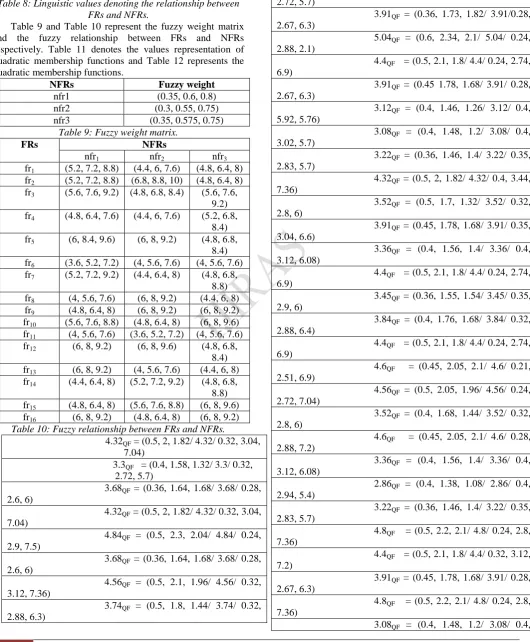
Table 9 and Table 10 represent the fuzzy weight matrix and the fuzzy relationship between FRs and NFRs respectively. Table 11 denotes the values representation of quadratic membership functions and Table 12 represents the quadratic membership functions.
NFRs Fuzzy weight
nfr1 (0.35, 0.6, 0.8)
nfr2 (0.3, 0.55, 0.75)
nfr3 (0.35, 0.575, 0.75)
Table 9: Fuzzy weight matrix.
FRs NFRs
nfr1 nfr2 nfr3
fr1 (5.2, 7.2, 8.8) (4.4, 6, 7.6) (4.8, 6.4, 8)
fr2 (5.2, 7.2, 8.8) (6.8, 8.8, 10) (4.8, 6.4, 8)
fr3 (5.6, 7.6, 9.2) (4.8, 6.8, 8.4) (5.6, 7.6,
9.2) fr4 (4.8, 6.4, 7.6) (4.4, 6, 7.6) (5.2, 6.8,
8.4) fr5 (6, 8.4, 9.6) (6, 8, 9.2) (4.8, 6.8,
8.4) fr6 (3.6, 5.2, 7.2) (4, 5.6, 7.6) (4, 5.6, 7.6)
fr7 (5.2, 7.2, 9.2) (4.4, 6.4, 8) (4.8, 6.8,
8.8) fr8 (4, 5.6, 7.6) (6, 8, 9.2) (4.4, 6, 8)
fr9 (4.8, 6.4, 8) (6, 8, 9.2) (6, 8, 9.2)
fr10 (5.6, 7.6, 8.8) (4.8, 6.4, 8) (6, 8, 9.6)
fr11 (4, 5.6, 7.6) (3.6, 5.2, 7.2) (4, 5.6, 7.6)
fr12 (6, 8, 9.2) (6, 8, 9.6) (4.8, 6.8,
8.4) fr13 (6, 8, 9.2) (4, 5.6, 7.6) (4.4, 6, 8)
fr14 (4.4, 6.4, 8) (5.2, 7.2, 9.2) (4.8, 6.8,
8.8) fr15 (4.8, 6.4, 8) (5.6, 7.6, 8.8) (6, 8, 9.6)
fr16 (6, 8, 9.2) (4.8, 6.4, 8) (6, 8, 9.2)
Table 10: Fuzzy relationship between FRs and NFRs.
4.32QF = (0.5, 2, 1.82/ 4.32/ 0.32, 3.04,
7.04)
3.3QF = (0.4, 1.58, 1.32/ 3.3/ 0.32,
2.72, 5.7)
3.68QF = (0.36, 1.64, 1.68/ 3.68/ 0.28,
2.6, 6)
4.32QF = (0.5, 2, 1.82/ 4.32/ 0.32, 3.04,
7.04)
4.84QF = (0.5, 2.3, 2.04/ 4.84/ 0.24,
2.9, 7.5)
3.68QF = (0.36, 1.64, 1.68/ 3.68/ 0.28,
2.6, 6)
4.56QF = (0.5, 2.1, 1.96/ 4.56/ 0.32,
3.12, 7.36)
3.74QF = (0.5, 1.8, 1.44/ 3.74/ 0.32,
2.88, 6.3)
4.37QF = (0.45, 1.96, 1.96/ 4.37/ 0.28,
2.81, 6.9)
3.84QF = (0.4, 1.76, 1.68/ 3.84/ 0.24,
2.48, 6.08)
3.3QF = (0.4, 1.58, 1.32/ 3.3/ 0.4,
2.72, 5.7)
3.91QF = (0.36, 1.73, 1.82/ 3.91/0.28,
2.67, 6.3)
5.04QF = (0.6, 2.34, 2.1/ 5.04/ 0.24,
2.88, 2.1)
4.4QF = (0.5, 2.1, 1.8/ 4.4/ 0.24, 2.74,
6.9)
3.91QF = (0.45 1.78, 1.68/ 3.91/ 0.28,
2.67, 6.3)
3.12QF = (0.4, 1.46, 1.26/ 3.12/ 0.4,
5.92, 5.76)
3.08QF = (0.4, 1.48, 1.2/ 3.08/ 0.4,
3.02, 5.7)
3.22QF = (0.36, 1.46, 1.4/ 3.22/ 0.35,
2.83, 5.7)
4.32QF = (0.5, 2, 1.82/ 4.32/ 0.4, 3.44,
7.36)
3.52QF = (0.5, 1.7, 1.32/ 3.52/ 0.32,
2.8, 6)
3.91QF = (0.45, 1.78, 1.68/ 3.91/ 0.35,
3.04, 6.6)
3.36QF = (0.4, 1.56, 1.4/ 3.36/ 0.4,
3.12, 6.08)
4.4QF = (0.5, 2.1, 1.8/ 4.4/ 0.24, 2.74,
6.9)
3.45QF = (0.36, 1.55, 1.54/ 3.45/ 0.35,
2.9, 6)
3.84QF = (0.4, 1.76, 1.68/ 3.84/ 0.32,
2.88, 6.4)
4.4QF = (0.5, 2.1, 1.8/ 4.4/ 0.24, 2.74,
6.9)
4.6QF = (0.45, 2.05, 2.1/ 4.6/ 0.21,
2.51, 6.9)
4.56QF = (0.5, 2.05, 1.96/ 4.56/ 0.24,
2.72, 7.04)
3.52QF = (0.4, 1.68, 1.44/ 3.52/ 0.32,
2.8, 6)
4.6QF = (0.45, 2.05, 2.1/ 4.6/ 0.28,
2.88, 7.2)
3.36QF = (0.4, 1.56, 1.4/ 3.36/ 0.4,
3.12, 6.08)
2.86QF = (0.4, 1.38, 1.08/ 2.86/ 0.4,
2.94, 5.4)
3.22QF = (0.36, 1.46, 1.4/ 3.22/ 0.35,
2.83, 5.7)
4.8QF = (0.5, 2.2, 2.1/ 4.8/ 0.24, 2.8,
7.36)
4.4QF = (0.5, 2.1, 1.8/ 4.4/ 0.32, 3.12,
7.2)
3.91QF = (0.45, 1.78, 1.68/ 3.91/ 0.28,
2.67, 6.3)
4.8QF = (0.5, 2.2, 2.1/ 4.8/ 0.24, 2.8,
7.36)
Page 25 www.ijiras.com | Email: [email protected] 3.02, 5.7)
Table 11: Values representation of quadratic membership functions. (contd.)
3.45QF = (0.36, 1.55, 1.54/ 3.45/
0.35, 2.9, 6)
3.84QF = (0.5, 1.8, 1.54/ 3.84/ 0.32,
2.88, 6.4)
3.96QF = (0.5, 1.9, 1.56/ 3.96/ 0.4,
3.34, 6.9)
3.91QF = (0.45, 1.78, 1.68/ 3.91/
0.35, 3.04, 6.6)
3.84QF = (0.4, 1.76, 1.68/ 3.84/
0.32, 2.88, 6.4)
4.18QF = (0.5, 2, 1.68/ 4.18/ 0.24,
2.66, 6.6)
4.6QF = (0.45, 2.05, 2.1/ 4.6/ 0.28,
2.88, 7.2)
4.8QF = (0.5, 2.2, 2.1/ 4.8/ 0.24,
2.8, 7.36)
3.52QF = (0.4, 1.68, 1.44/ 3.52/
0.32, 2.8, 6)
4.6QF = (0.45, 2.05, 2.1/ 4.6/ 0.21,
2.51, 6.9)
Table 11: Values representation of quadratic membership functions.
FRs NFRs
fr1 4.32QF 3.3QF 3.68QF
fr2 4.32QF 4.84QF 3.68QF
fr3 4.56QF 3.74QF 4.37QF
fr4 3.84QF 3.3QF 3.91QF
fr5 5.04QF 4.4QF 3.91QF
fr6 3.12QF 3.08QF 3.22QF
fr7 4.32QF 3.52QF 3.91QF
fr8 3.36QF 4.4QF 3.45QF
fr9 3.84QF 4.4QF 4.6QF
fr10 4.56QF 3.52QF 4.6QF
fr11 3.36QF 2.86QF 3.22QF
fr12 4.8QF 4.4QF 3.91QF
fr13 4.8QF 3.08QF 3.45QF
fr14 3.84QF 3.96QF 3.91QF
fr15 3.84QF 4.18QF 4.6QF
fr16 4.8QF 3.52QF 4.6QF
Table 12: Quadratic membership functions.
After applying the steps 5.2 and 5.3, the ea of requirements is in the form of-
3.963QF = (0.445, 1.834, 1.683/ 3.963/ 0.309, 2.921,
6.400)
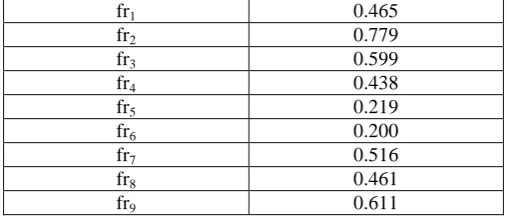
After applying the steps 5.4 and 5.5, the requirements ranking values are shown in Table 13.
fr1 0.465
fr2 0.779
fr3 0.599
fr4 0.438
fr5 0.219
fr6 0.200
fr7 0.516
fr8 0.461
fr9 0.611
fr10 0.597
fr11 0.294
fr12 0.635
fr13 0.473
fr14 0.512
fr15 0.593
fr16 0.617
Table 13: Requirements ranking values.
In our case study, fr2 has the highest priority and fr6 has
the lowest priority. Table 14 represents the ranking values of the requirements arranged in the decreasing order of the priority.
fr2 0.779
fr12 0.635
fr16 0.617
fr9 0.611
fr3 0.599
fr10 0.597
fr15 0.593
fr7 0.516
fr14 0.512
fr13 0.473
fr1 0.465
fr8 0.461
fr4 0.438
fr11 0.294
fr5 0.219
fr6 0.200
Table 14: List of the requirements after prioritization.
IV. CONCLUSION
A software development organization invests resources such as capital and human effort in software product development and expects maximal added value from their investments. This means that the providing value to the stakeholders and end users is a necessity for the business of software development companies. However, providing value requires implementing the prioritized set of requirements within the software product. The Fuzzy AHP (FAHP) is the fuzzy extension of AHP to efficiently handle the fuzziness of the data involved in the decision making. FAHP is an effective requirements prioritization technique that involves comparing all the requirements. Hence, FAHP takes the whole system into account during prioritization of requirements. In further studies, the integration of FAHP with some other requirements prioritization techniques can be used to solve multi attribute decision making problems.
V. ACKNOWLEDGMENT
Page 26 www.ijiras.com | Email: [email protected] experienced knowledge and whatever required at all
stages of writing the research paper.
REFERENCES
[1] Erensal, Y.C., Oncan, T., and Dernircan, M.L., (2006), Determining Key Capabilities in Technology Management using Fuzzy Analytic Hierarchy Process, Information Science, vol. 176, no. 18, pp.2755-2770.
[2] Ertugrul, D., Karakasoglu, N., (2007), Expert systems, Fuzzy logics and Fuzzy analytic hierarchy process, Application and Science, no. 9, pp.207-214. [3] Kahraman, C., (2001), Capital budgeting, Risk
Evaluation and Management using Fuzzy Analytic Hierarchy Process, Physica-Verlag, Heidelberg, 375– 396.
[4] Kahraman, C., Ruan, D., and Tolga, E., (2002), Fuzzy Logic Application, Information Sciences, vol.4, pp.57–76.
[5] Karlsson J., (1998), A Systematic Approach for Prioritizing Software Requirements, Linkoping Institute of Technology.
[6] Klir G.J., Yuan B., (1995), Fuzzy Sets and Fuzzy Logic: Theory and Application , Prentice Hall, New Jersey.
[7] Nguyen, H.T., Walker, E.A., (2000), A first course in fuzzy logic, Chapman&Hall/CRC, Florida.
[8] Saaty, T.L., (1980), The analytic hierarchy process, McGraw- Hill, New York.
[9] Saaty, T.L., (1994), How to Make a Decision: The Analytic Hierarchy Process, Interfaces, vol. 24, no. 6, pp.19-43.
[10] Ross, D.T., Schoman, K.E., (1977), Structured Analysis for Requirements Definition, IEEE Transactions on Software Engineering, Vol. 3, NO. 1, pp.6-15.
[11] Sommerville, I., (2001), Software Engineering, 6th Edition, Pearson Education, London.
[12] Sommerville, I., Sawyer, P., (1997), Requirements Engineering – A Good Practice Guide, Pearson Education, London.
[13] Wiegers, K., (1999), Software Requirements, Microsoft Press, Redmond.
[14] Yeh, AC., (1992), Requirements Engineering Support Technique, Proceedings of Second Symposium of Quality Software Development Tools, IEEE Computer Society, Piscataway, pp.211-223.
[15] Zadeh, L.A., (1965), Fuzzy sets, Information Control, vol. 8, pp.338–353.