VOL.6 ISSUE 2, 2018; 84 – 88 ; http://ijpda.com; ISSN: 2348-8948
Research Article
Degradation Study of
Dapagliflozin in API by
Spectroscopic Method
Dr.(Mrs.)M.D. Game, Naglaxmi Bopudi*
Department of Pharmaceutical Quality Assurance, Vidayabharti College of Pharmacy, C. K. Naidu Road, Sant Gadge Baba Amravati
University, 444602, Maharashtra, India
Date Received: 9th February 2018; Date accepted:
13th February 2018; Date Published: 14th February
2018
Abstract
A simple, sensitive, precise, accurate, economic and rapid visible spectroscopic method has been developed for estimation of dapagliflozin in API.Dapagliflozin was subjected to different stress conditions as per ICH guideline Q1A (R2). A stabil-ity- indicating UV Spectroscopic method has been developed for analysis of the drug in the presence of the degradation products. Degradation of Da-pagliflozin was studied in acid, alkaline, hydrogen peroxide, photolytic, thermal and neutral condi-tions. The amount of degraded drug was calcu-lated by taking absorbance at 272 nm.The drug was found to be more liable to decompositions in acid-ic,alkaline,oxidative , neutral medium than in pho-tolytic and thermal conditions.
Key words: Dapagliflozin, UV- Spectroscopy, API,
International Conference on Harmonization
INTRODUCTION
Dapagliflozin belongs to a new class of oral anti diabetic drugs, called Sodium Glucose Co-Transporter 2 (SLGT2) inhibitors. These sodium glucose co-transporters are responsible for glucose reabsorption in the kidney. Hence inhibiting the SLGT2 have been proposed as a new strategy in
the treatment of diabetes.[1,2,3] suppressing the
SLGT2,dapagliflozin plasma glucose concentra-tion intern by elevating the renal glucose excreconcentra-tion by the kidney. It is chemically known as (1s)-1,5-
anhydro-1-C-[4-chloro-3-[(4-ethoxy-phenyl)
me-thyl] phenyl]-D-glucitol(fig.1).It has a molecular
formula C24H33CLO8 with molecular weight 408.98.
Dapagliflozin is a white crystalline powder which is soluble in water, ethanol, methanol and dimethyl formamide.
The aim of present work was to develop the
de-gradation of DAPA in its API by UV-spectroscopic method.
Material and Methods:
Materials & Reagents:
• Pharmaceutical grade Dapagliflozin
stan-dard was obtained as generous gift from Indogo Remedies, Mumbai, Maharashtra, India. All the chemicals and solvents used were of analytical grade.
• The solution of 0.1 N NaOH , 0.1 N HCL,
5% hydrogen peroxide was prepared in double distilled water as per IP 1996 pro-cedure.
• Methanol and other chemicals used which
were of analytical grade and were pro-cured from local market.
Instruments:
• Shimadzu UV-1800, double beam
• Analytical balance (Acculab ALC-2014, Huntigdon Valley, PA)
Results :
Sample Conc’n used (µg/ml) Conc’n after Degradation (µg/ml) % Recovery Acid hydrolysis
10 7.14 78
Alkaline hydrolysis
10 7.8 71.4
Oxidation 10 7.38 73.8
Photolytic 10 9.52 95.2
Thermal 10 4.28 42.8
Neutral 10 6.42 64.2
Preparation of Standard Stock Solution:
The standard stock solution was prepared by dis-solving 10.0 mg of Dapagliflozin in 10.0 ml of me-thanol to acquire a concentration of 1000µg/mL. The working standard solution of 10 µg/mLwas prepared by appropriate dilution of the stock
solu-tion with distilled water.[4,5]
Preparation of Working Standard Stock Solution:
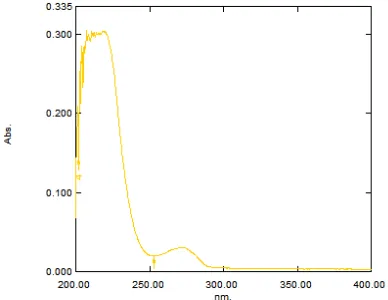
10 ml of standard stock solution was pipette out and made up to 100 ml to get a concentration 100 µg/ml and was treated as the working stan-dard.(fig:1)
Fig 1 : UV spectrum of standard Dapagliflozin
Forced Degradation Studies
To assess the stability indicating property of the developed HPLC method stress studies were car-ried out under ICH recommended condi-tions.Forced degradation of Dapagliflozin was
car-ried out by exposing the bulk sample of acidic, alkaline, oxidative, photolytic, neutral conditions. The aim was to study the ability of the proposed method to, measure the analyte response in
pres-ence of its degradation products.[6,7,8,9]
Acidic Degradation
10 mg of drug sample was transferred to 10 mL volumetric flask. To this sufficient quantity of me-thanol (2 mL) was added to dissolve the drug. To this 2 mL of 0.1 N HCL was added and was kept at room temperature, and further diluted with water to get concentration of 10 µg/mL.(fig:2)
Alkali Degradation
10 mg of drug sample was transferred to 10 mL volumetric flask. To this sufficient quantity of me-thanol (2mL) was added to dissolve the drug. To this 2 mL of 0.1 N NAOH was added and kept at room temperature, and further diluted with water to get concentration of 10 µg/mL.(fig:3)
Oxidative Degradation
10 mg of drug sample was transferred to 10 mL volumetric flask. To this sufficient quantity of me-thanol (2 mL ) was added to dissolve the drug. To
this 2 mL of 5 % H2O2 was added and was kept at
room temperature for 2 hr, and further diluted with water to get a concentration of 10 µg/ mL.(fig:4)
Photolytic Degradation
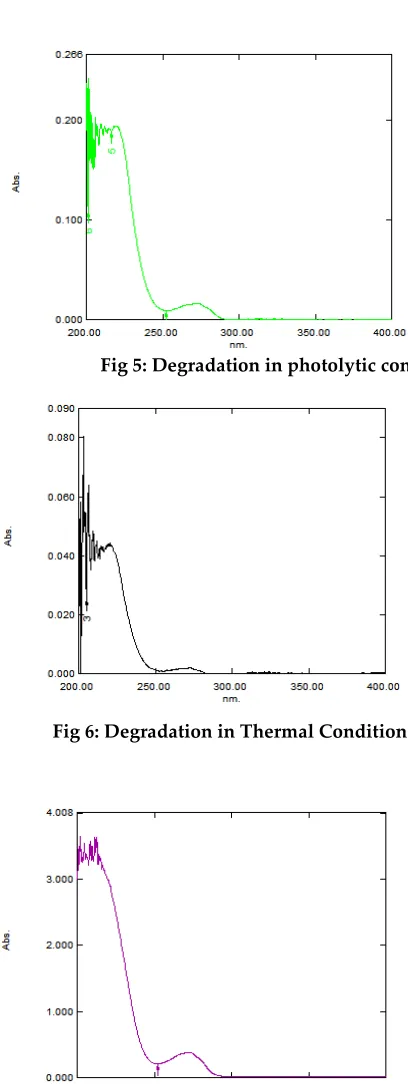
10 mg of drug sample was placed in closed petri dish and was exposed to sunlight for 4 hrs.and further the solution was dissolved in water to get a concentration of 10 µg/mL. (fig:5)
Thermal Degradation
The bulk sample was exposed to dry heat 80⁰C. in oven at for 2 hrs. by placing 10 mg of dapagliflozin in closed petri dish. All the stress conditions sam-ples were appropriately diluted to get a final con-centration of 10 µg/mL solution and were scanned over a range of 400 to 200 nm by placing respective solvents as blank.(fig:6)
Neutral Degradation
this 2 mL of water was added and was kept at room temperature for 12 hr, and further diluted
with water to get a concentration of 10 µg /ml.(fig:7)
Fig 2 : Degradation in acidic condition
Fig 3 : Degradation in alkaline condition
Fig 5: Degradation in photolytic condition
Fig 6: Degradation in Thermal Condition
Fig 7: Degradation in Neutral Condition
Conclusion:
The method was successfully applied for the esti-mation of Dapagliflozin in API and pharmaceutical dosage form. Study the quality of the marketed drug with this method. Study the applicability of
the method for formulation containing dapagliflo-zin in multicomponent dosage form.
Acknowledgements:
Mumbai, for providing the Dapagliflozin API as a gift sample and also to the principle and manage-ment of Vidayabharti College of Pharmacy, Sant Gadge Baba Amravati University, India for provid-ing the quipmentand facilities to complete research work.
References:
1. Edward Chao C, Robert Henry R. SGLT2
inhi-bitors a novel strategy for diabetes treatment. Nature Reviews Drug Discovery 2010; 10: 1-9.
2. Sanagapati M, Dhanalakshmi K, Reddy NG,
Sreenivasa S. Method Development and Vali-dation of Dapagliflozin in API by RP- HPLC and UV-Spectroscopy. Int J Pharm Sci and drug Res.2014;6(3):250-2.
3. Aubry AF, Gu H, Magnier R, Morgan L, Xu X,
Tirmenstein M, Wang B, Deng Y, Cai J, Couerbe P, Arnold M. Validated LC-MS/MS methods for the determination of dapagliflo-zin, a sodium-glucose co-transporter 2 inhibi-tor in normal and ZDF rat plasma. Bioanalysis 2010;2(12):2001-2009.
4. Beckett AH, Stenlake JB. Practical
pharmaceut-ical chemistry part II, New Delhi: CBS
pub-lishers and distributers. 1997, 4th ed,281-306.
5. A. Kasture, S. Wadodkar, Practical
Pharma-ceutical Chemistry – II: Nirali Prakashan four-teenth edition; 2007; 9-10
6. Validation of Analytical Procedures: Text and
Methodology (Q2R1), ICH Harmonised Tri-partite Guideline.
7. Stability Testing of New Drug Substances and
Produts (Q1AR2), ICH Harmonised Tripartite Guideline.
8. T. Snape, A. Astles, J. Davies. Understanding
the chemical basis of drug stability and degra-dation. The pharmaceutical Journal 2010: 285: p.416.
9. S. Singh, M. Bakshi. Guidance on conduct of
stress tests to determine inherent stability of drugs, pharm. Technol 2000: 24: p.1-14.
10. Q1 A (R2) ICH guidelines, Stability Testing of