Privacy-Preserving Group Matching Protocol
Takuya Ibaraki*, Yoshifumi Manabe
Faculty of Informatics, Kogakuin University 1-24-2, Nishi-Shinjuku, Shinjuku, Tokyo, 163-8677 Japan.
* Corresponding author. Email: [email protected] [email protected] Manuscript submitted November 10, 2017; accepted January 18, 2018.
doi: 10.17706/jcp.13.9.1037-1041
Abstract: Many works have been done for privacy-preserving matching protocols. Most of them obtain
one-to-one privacy-preserving matching. However, when we consider forming a group of people or objects by their similarity, matching can be applied to problems using many data, such as recommendation systems and a lot of similar communities. In this paper, we consider the characteristics of each user as a vector. We obtain the similarity by securely computing the inner product of vectors. Also, we define a group’s characteristics by the members’ average characteristics. We propose a privacy-preserving group matching protocol. We show computation cost of the proposed protocol and show simulation results.
Key words: Privacy-preserving computation, group matching, homomorpic encryption.
1.
Introduction
Many works have been done for privacy-preserving matching protocols. The private matching protocol begins with Freedman et. al proposing the Private Set Intersection(PSI) protocol [1]. PSI is realized using additive homomorphic encryption and Oblivious Polynomial Evaluation(OPE). Zhu et al. proposed Blind Vector Transforming (BVT) which makes a set corresponds to a vector [2]. In addition, Kim et. al proposed Map To Prime (MTP) which converts each element of a set to a prime number [3]. In these researches, they protect the user's private information by converting the user's profile into a vector or prime number so as to execute the protocol without directly handling the user's profile.
Most of them assume one-to-one privacy-preserving matching. In this paper, we propose a privacy-preserving matching protocol that forms multiple people as a group. When we consider forming a group of people or objects by their similarity, matching can be applied to problems using many data, such as when there are recommendation systems and a lot of similar communities. In this paper, we consider the characteristics of each user as a vector. We obtain the similarity by securely computing an inner product of vectors. Also, we define a group’s characteristics by the members’ average characteristics.. We propose a privacy-preserving group matching protocol. We show computation cost of the proposed protocol and show simulation results.
2.
Definition
2.1.
Notation
The notations are used in this paper is as follows. Set of users : I = {i1,i2,…,in}
The characteristic norm of user ij : ||rj|| = C2(j,1)+…+C2(j,p)
Tentative groups : g = {g1,g2,…,ga}
Final groups : c = {c1,c2,…,cb}
Threshold of similarity : v
Security parameter: ℓ
2.2.
Degree of Similarity
The following formula defines the degree of similarity between user ij and ik. The degree of similarity is
multiplied by a large constant and rounded off to an integer value. In general, the inner product is used to evaluate the similarity between items to recommend goods [4].
The similarity between groups is obtained by a similar calculation using the average value of the characteristics of users belonging to the group.
2 ) , ( 2 ) 1 , ( 2 ) , ( 2 ) 1 , ( 1 ) , ( ) , ( ) , ( p k k p j j p m m k m j k j C C C C C C i i s
(1)2.3.
Encryption Scheme
In this paper, we use an encryption scheme that satisfies additive homomorphic[5]. E (x) is the value obtained by encrypting x. Also, the public key and secret key are generated by the server. The server compares the degree of similarity.
2.4.
Semi-Honest Model
Throughout this paper, we assume that the players are semi-honest. All players take actions in accordance with the protocol, but try to obtain another player’s secret data. However, the personal characteristics must be disclosed among the members of each group. It is assumed that all communication is secure. Also assume the server is semi-honest to prevent collusion with malicious users.
3.
Proposed Protocol
3.1.
Preparation
Gonda et al. proposed a method to compare the magnitude relation of the two numbers while keeping them secret [6]. They use the fact that the computation result X-Y of the two numbers X, Y becomes a negative number on the finite field when X<Y. In addition since the value X-Y is camouflaged by the random numbers and , no one knows the value X-Y.
The bit length of modulus N is defined tN. The bit lengths of random numbers α and β are denoted tα and
tβ, respectively. The bit length of n + ℓ is denoted t’.
3.2.
Comparison Protocol of Threshold and Similarity
Gonda et al. proposed a protocol to compare the number of matches in vectors [6]. In this paper we use this protocol as a subroutine. Suppose, B obtains an encrypted value from A and computes similarity E(s(A,B)) in advance.
1. B generates random numbers αb of tα bitsand βb of tβ bits.
2. B computes E(αb
(s(A,B)-v)+ βb) to compare the similarity value and the threshold value whileβb. The server verifies the bit length. If the result tN bit, the server sends false to B otherwise sends
true to B.
The result is determined by the bit length, so s(A,B) is never known to anyone.
3.3.
Comparison Protocol of Similarities
In 3.2, we compared the threshold and the similarity. It is possible to compare similarities between each users by a similar procedure. C obtains encrypted values from A and B, and computes each the similarities E(s(A,C)) and E(s(B,C)) in advance.
1. C generates random numbers αc of tα bitsand βc of tβ bits.
2. C computes E(αc
(s(A,C)-s(B,C))+ βc) to compare the similarity values while keeping the similarity values encrypted. This result is sent to the server.3. The server receives E(αc
(s(A,C)-s(B,C))+ βc) sent from C. The server decrypts it to obtainαc
(s(A,C)-s(B,C))+ βc. The server verifies the bit length. If the result tN bit, the server sends false to C otherwise sends true to C. True means that s(A,C) is larger than s(B,C). False means that s(B,C) is larger than s(A,C).The result is determined by the bit length, so s(A,C) and s(B,C) are never known to anyone.
Property 1[6]. The protocol correctly outputs the result when the bit length of each parameter satisfies the following conditions.
t t
t t t
t N
' 1
(2)
3.4.
Our Main Protocol
1. Each user in computes ||rn||. Let a be the number of tentative groups. Initially, set a=1.
2. Let a new tentative group ga={ik} (k is the minimum index of the user who does not belong to any
tentative group.) . User ik computes E(C(k.1)/||rk||),…,E(C(k,p)/||rk||)and sends them to the users who
do not belong to any tentative group. Note that C(k,p)/||rk|| are integer values.
3. User im computes E(C(k.1)/||rk||)(C(m,1)/||rm||)+…+E(C(k,p)/||rk||)(C(m,p)/||rm||) using the
homomorphism of the encryption scheme. This result is E(s(ik,im)).
4. im compares the similarity and the threshold v using the algorithm in 3.2
5. If the similarity is more than the threshold v, im belongs to the tentative group ga.
6. The tentative group ga updates the average value of the characteristics. Set it the representative
value of the group.
7. If all users do not belong to some tentative group, then set a = a+1 and return to step 2. 8. The first b tentative groups g1,…,gb obtained in steps 1 to 7 are denoted c1,…,cb.
9. Repeat the following step 10-15 from q=b+1 to q=a. 10. Each group ci{c1,…,cb}computes ||ri|| as in step1.
11. Group ci {c1,…,cb}computes E(C(i.1)/||ri||),…,E(C(i,p)/||ri||)and sends them to the users who do not
belong to any tentative group.
12. Group gqcomputes E(C(i.1)/||ri||)(C(q,1)/||rq||)+…+E(C(i,p)/||ri||)(C(q,p)/||rq||). This reslult is
E(s(ci,gq)).
13. gq finds the group with the highest similarity from s(c1,gq),…,s(cb,gq) by repeatedly using the
algorithm of 3.3.
14. gq belongs to the group cb having the highest similarity.
4.
Discussion
In this section, we evaluate the proposed protocol using simulation. The simulation was made in C language. Set the number of users n = 100. Set the dimension of the user's characteristics p = 10. Also, the characteristics of each user are generated by random numbers. We show the average result of 1000 executions each with changing the threshold from 0.85 to 0.95 and the group number from 3 to 7.
Table 1. Average Tentative Group Number
Threshold 0.85 0.86 0.87 0.88 0.89 0.90 0.91 0.92 0.93 0.94 0.95 Tentative group number 20.69 23.58 26.82 30.93 35.73 41.61 48.40 56.29 65.39 74.78 83.92
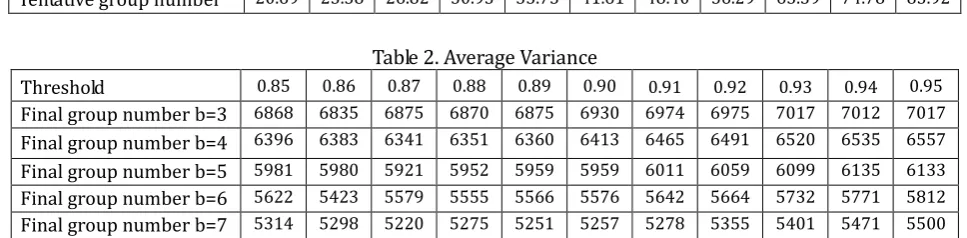
Table 2. Average Variance
Threshold 0.85 0.86 0.87 0.88 0.89 0.90 0.91 0.92 0.93 0.94 0.95 Final group number b=3 6868 6835 6875 6870 6875 6930 6974 6975 7017 7012 7017 Final group number b=4 6396 6383 6341 6351 6360 6413 6465 6491 6520 6535 6557 Final group number b=5 5981 5980 5921 5952 5959 5959 6011 6059 6099 6135 6133 Final group number b=6 5622 5423 5579 5555 5566 5576 5642 5664 5732 5771 5812 Final group number b=7 5314 5298 5220 5275 5251 5257 5278 5355 5401 5471 5500
Table 1 shows the average of the number of tentative groups. It can be seen that the tentative group number increases with the threshold value. Table 2 shows the average variance of the final groups. From Table 2, it can be seen that the average variance value decreases as the final group number increases. Also, it can be seen that the average variance increases slightly as the threshold increases.
First, we consider the computation cost. The proposed protocol performs matching in two stages. The first stage depends on the number of users. In the worst case that all tentative groups consist of one person, the computation cost is O(n2). For the second stage, computation cost is determined by the number of
tentative groups. Each tentative group computes the similarity value with each final group. The computation cost is O(n). Thus, it is better to have fewer tentative groups, since the amount of computation cost can be reduced by decreasing the number of tentative groups. However, if the threshold is set too small, the average variance becomes large. It is necessary to set the threshold appropriately.
Second, we consider the relationship between the threshold and average variance. In the simulation results, the average variance is the lowest for the cases when the number of in the final groups is 4-7 if the threshold value is 0.87. Therefore, it is necessary to appropriately set the threshold in order to reduce the average variance. Random networks often become scale-free networks, thus randomly-generated users' similarity (and users' similarity in the real world) can be modeled as a scale-free network[7]. The scale-free networks have a structure in which similar users are formed as clusters and the connections between clusters are sparse. Therefore, we consider that it is better to merge groups of moderate sizes than merging groups whose sizes are too small. Thus, if the threshold is too large, the variance of the final groups becomes large. On the other hand, if the threshold is too small, tentative groups consist of not so similar users, thus the variance increases. Thus the threshold value must be set appropriately. In the simulation results, when the threshold value was 0.86-0.87, the average variance was the minimum value in each of the final groups 3-7.
5.
Conclusion
the average variance using simulation. The threshold value was 0.86-0.87, the average variance was the minimum value in each of the final groups 3-7. Therefore, it is necessary to appropriately set the threshold in order to reduce the average variance.
Future challenges is the propose of the protocol that is reduced computation cost, and the method of a better similarity evaluation.
References
[1] Freedman, M. J., Nissim, K., & Pinkas, B. (2004). Efficient private matching and set intersection.
Eurocrypt, 3027, 1-19.
[2] Zhu, H. J., Du, S. G., Li, M. Y., & Gao, Z. Y. (2013). Fairness-aware and privacy-preserving friend matching protocol in mobile social networks. IEEE Transactions on Emerging Topic in Computing, 1(1), 192-200. [3] Kim, M., Tae Lee, H., & Hee Cheon, J. (2011). Mutual private set intersection with linear complexity.
WISA 2011, 219-231.
[4] Sarwar, B., Karypis, G., Konstan, J., & Riedl, J., (2001). Item-based collaborative filtering recommendation algorithms. Proceedings of the 10th International Conference on World Wide Web(WWW10) (pp. 285-295). Hong Kong.
[5] Paillier, P. (1999). Public-key cryptosystems based on composite degree RESIDUOSITY classes.
Advances in Cryptology-EUROCRYPT 1999, 223-238.
[6] Gonda, A., & Omote, K. (2016). Consideration of privacy-preserving matching protocol with threshold.
Proceedings of Symposium on Cryptography and Information Security 2016.
[7] Barabási, A. L., Albert, R., & Jeong, H. (2000). Scale-free characteristics of random networks: The topology of the world-wide web. Physica A, 281, 2115.
Takuya Ibaraki was born in Tokyo, Japan in 1993. He received his bachelor of informatics
from Kogakuin University, Japan, in 2016. Currently, he is a master course student in the
Faculty of Informatics, Kogakuin University. His research interests include privacy-preserving computation.
Yoshifumi Manabe was born in Osaka, Japan in 1960. He received B.E., M.E. and Dr. E.
degrees from Osaka University, Osaka, Japan in 1983, 1985, and 1993, respectivery.