Vol. 07, Issue 06 (June. 2017), ||V1|| PP 61-67
The Development of Vehicle Brake Pad Using Local Materials -
(Palm Kernel, Coconut And Cashew Shells As Base Materials).
Ufuoma Peter Anaidhuno
1; Solomon Ologe
2, Francis Maduike
3, Chika Edith
Mgbemena
4Department Of Mechanical Engineering, Federal University Of Petroleum Resources, Effurun, Nigeria
Department of Mechanical Engineering, Delta State School of Marine Technology, Burutu, Nigeria,
Department of Industrial/Production Engineering, Nnamdi Azikiwe University, Awka, Nigeria,
Corresponding author:[email protected], [email protected], [email protected],
Abstract:
The development of motor vehicle brake pad using locally available raw material is presented. The disc brake friction lining with the geometrical specifications of a Toyota Camry 2000 model was produced using palm kernel and coconut shells powder as base materials, epoxy resin (araldite) as binder materials and carbon as fibre reinforcement, aluminum, copper, zinc and cashew nut shell were used as abrasives rubber dust from shoe as filler.The experiment conducted, it was revealed that the co-efficient of friction of the pad material ranged from0.4-0.65, scratch hardness of 80-85, bonding strength of 25-27Kg/cm2 and wear rate of 0.025mm/min to 0.06mm/min as compared to the conventional brake pad material that has hardness of 80-85, bonding strength of 25-27kg/cm2and wear rate of 0.03-0.08mm/minKeywords :Break Pad, Local Materials, Wear Resistance, Strength, Friction
I.
INTRODUCTION
There are desired mechanical properties, and chemical properties which some materialspossess that make them suitable for brake pads and brake lining. Examples of such properties are hardness, resistance to abrasion, environmental friendliness, Rabinowioze (1956) reported that friction arises form surface interactions between two contacting material and is affected by volume and surface dependent properties. Volume dependent properties are elastic and it modifies the hardness and thermal characteristics, Iloeje et al. (1989). Surface properties of importance are the chemical reactivity, surface energy, tendency to absorb molecules from the environmental and compatibility of the contacting surface forces which causes friction due to adhesion, local fusion asperity and interlocking, Iloeje (1989). Any or all of these forces can cause fracture of the surface material, which implies the occurrence of wear. Therefore, a friction material needs to have shear strength. The hardness of a material particularly its scratch hardness, is an indication of its resistance to wear, however hardness decrease with temperature and since friction linings attain elevated temperature during operations their production materials should have high hot hardness.
II.
MATERIALS SELECTION
Figure 1: Brake pad designs
Figure 2. Moulds design
Equipment And Tools Used
After materials selection exercise, different types of processing equipment and tools were used for the preparation of the brake pad materials and testing of the mechanical properties of the materials. These include the following underneath described equipment.
Equipment And Tools Used
After materials selection exercise, different types of processing equipment and tools were used for the preparation of the brake pad materials and testing of the mechanical properties of the materials. These include the following underneath described equipment.
Crushing of Materials (Hammer Mills)
A hammer mill is a machine that is universally used for the crushing of different materials to different grit sizes as desired. The palm kernel and coconut shell were crushed to powdered condition of different grit sizes.
See Fig 4. diagram of the hammer mill.
Hardness Test
The hardness of the palm kernel and coconut shells was tested using Rockwell hardness testing machine
Compression Test
The compressive strength of the palm kernel and coconut shells was tested using hydraulically operated compression testing machine and compressive strength of both materials ascertained and recorded
Abrasion Test
The abrasion resistance test of the palm kernel and coconut shells was carried out using abrasion testing machine
The values gotten are as written under. Palm kernel shells:
Quantity charged to the machine = 4.0kg = 4000grams. Quantity crushed to powder = 0.5kg = 500grams Q1 = Original quantity charged
Q2 = Final quantity uncrushed Qc = Final quantity crushed to powder
Resistance to abrasion = Q1 – Q2 = ……….. (1) Q2
= 4000g – 500g = 3500g Q2
3500gX 100% = 87.5% 4000
Coconut shell
4000grams of this material was charged into the abrasion test machine. 1500grams was crushed to powder. = Q1 – Q2 =
Q2 4000g – 1500g = 2500g
4000 4000 250 = 0.65 X 100 = 65% 4000
Table 1: Mechanical properties of palm kernel shell and coconut shell.
Material Hardness in Rockwell Abrasion resistance Compression strength
Palm kernel shell 35kg/cm2 87.5% 30kg/cm2
Coconut shell 20kg/cm2 65.0%
65%
5kg/cm2 5.0kg/cm2 Sieving operation (using sieving tray)
The crushed palm kernel and coconut shells were subsequently sieved using sieving tray of different mesh sizes to get five different grit sizes for the production of fifty (50) different samples of brake pads for comparative analysis. The grit sizes selected for the brake pad production are as written underneath; 0.25mm, 0.35mm, 0.45mm, 0.55mm, 0.65mm.
The Binding Components
In the sample preparation it is well understood that the quality and compactness of any lining is due mainly to the binding chemical and size of particle of raw materials. Basically the binding component has to be a thermosetting polymer resin. Epoxy-modified phenolic resin is used as a binding agent because it has better heat resistance than the pure phenolic resin.
The Abrasive Components
The ability of the material to clean up the surface and simultaneously dissipate heat was what informed the choice that was made while selecting the abrasive materials which include, aluminum, copper, and zirconium oxide. Since the material used need not wear out the brake drum, the need to introduce a material with relatively high strength which can protect the brake drum during use was considered. Coconut shells rubber and palm kernel shell were used for this purpose because of the high strength they possesses as compared to asbestos, paper and wood.
Mixture Composition
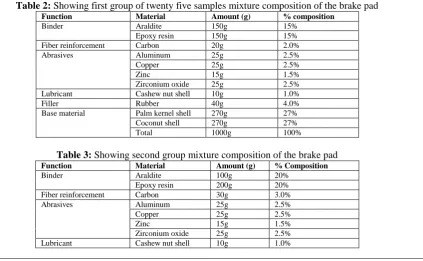
As the coconut and palm kernel shell were crushed into five different grit/mesh sizes of 0.25mm and 0.35mm, 0.45mm, 0.55mm, 0.65 respectively. Then the copper and aluminum particles were produced by using electrically operated hand held grinding machine. The binder chosen was epoxy resin and other additives included are aluminum, copper, and zirconium oxide for abrasiveness, carbon black for strength and rubber dust for vibration absorption. Measured out quantities which gave a total weight of 1000g or one kilogram (1kg) of the constituent materials is shown in Table below. The internal surface of the mould and the lower surface of the brake pad backs plate were cleaned with emery cloth.
Table 2: Showing first group of twenty five samples mixture composition of the brake pad Function Material Amount (g) % composition
Binder Araldite 150g 15%
Epoxy resin 150g 15%
Fiber reinforcement Carbon 20g 2.0%
Abrasives Aluminum 25g 2.5%
Copper 25g 2.5%
Zinc 15g 1.5%
Zirconium oxide 25g 2.5%
Lubricant Cashew nut shell 10g 1.0%
Filler Rubber 40g 4.0%
Base material Palm kernel shell 270g 27%
Coconut shell 270g 27%
Total 1000g 100%
Table 3: Showing second group mixture composition of the brake pad Function Material Amount (g) % Composition
Binder Araldite 100g 20%
Epoxy resin 200g 20%
Fiber reinforcement Carbon 30g 3.0%
Abrasives Aluminum 25g 2.5%
Copper 25g 2.5%
Zinc 15g 1.5%
Zirconium oxide 25g 2.5%
Filler Rubber 30g 3.0%
Base material Palm kernel shell 340g 34%
Coconut shell 200g 20%
Total 1000g 100%
Fabrication Process Of Brake Pad Selection of the Mould
In producing the mould, the shape of an already existing brake pad was used. Already existing brake pad shapes were used to facilitate quality test of the product specimen. The two arcs were cut into a curvature of are 1200 with a radius of about 127.5mm each. These arcs are to accommodate both leading and trailing lining of area 117mm2. Similarly the two metal strips of width 45mm each were prepared from mild steel and one of these was placed between the two plates to the desired curvature of the desired pad. See table 4 below for the configuration dimension of mild steel plate
Table 4: Configuration dimension of mild steel plate Material Dimension
Radius of curvature of metal plate 127.5mm
Arc (total length of arc) 120mm
Width of metal strip 45mm
Depth of mould 5.25mm
Productions of Pad Specimen and Laminating Procedure
The moulds were waxed thoroughly using mirror glaze wax, and allowed to dry for about 6 minutes. This was evenly polished using a dry towel. This was repeated three times to ensure even distribution on mould. The release agent, polyvinyl alcohol was applied on the two moulds and allowed to dry for about 30 minutes. As the drying progressed, mixing of the resin formulation was carried out as follows. Firstly, the coat resin was formulated using small qualities of the catalyst araldite. Special care was taken in mixing the gel coat in the mixing tank or mixing basin to avoid air bubbles being entrapped in the resin. This is the most vulnerable part because it gives the mixture a good surface finish and good wear properties. They are then thoroughly mixed together with the resin formulation and applied to the mould gently until the required depth of 5.25mm is covered with the material. A locally produced hydraulic press was then applied to compress the mixture together to the back platefirmly at a pressure of 250kgf/cm.This was the means of applying pressure to the mixture while still in the mould as at the time of production. The sample produced was then left to flow and harden for one hour (60minutes).
Table 5: Shows the duration at room temperature of different stages of production of brake pad Operation Duration at room temperature
Matting stage (exposed under sun 25 hours
Coat resin with 30% solution of a medium 10 minutes
Gel point of a the resin 22.4 minutes
Hardening time of the composite 42 minutes
Demoulding Operation
The demoulding process involves removing the sample from the mould gently; such that crack will not be induced on the mould. This operation was done after 25hours of the last production process when the laminate has fully cured.
Diagnosis of Faults that Arose During the Processing
Most of the faults that arose during processing resulted from under curing of the resin. These flaws affect both the appearance and performance of the laminate. These include;
- De- laminating of gel wax - Yield
- Cracks
Curing
Table 6: Summary of bonding result
Property Specimen 1 Specimen 2 Specimen 3 Specimen 4 Specimen 5
Coefficient of dynamic friction
0.35 0.4 0.45 0.5 0.55
Wear (mm) 0.05 0.055 0.065 0.075 0.085
Bonding (kg/cm3) 27 26 25 24 23
Scratch hardness 84 85 86 80 75
Coefficient of static friction
0.4 0.45 0.5 0.55 0.65
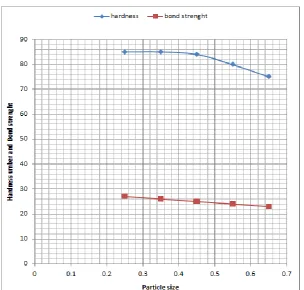
Fig. 5: The graph of bond strength and hardness number against particle size
Pictures Of Break Pad
III.
CONCLUSION
The design and fabrication of an automobile brake pad using locally available materials have been successfully undertaken in this research work. Palm kernel shell and coconut shell were locally sourced for this project and were used as a base materials, epoxy (araldite) resin as binder material, carbon as fiber reinforcement, aluminum, copper, zinc were used as abrasives and rubber dust from shoe as filler. However, from the analysis of the experiment conducted, it was revealed that the co-efficient of friction of the pad material ranged from0.4-0.65, scratch hardness of 80-85, bonding strength of 25-27Kg/cm2 and wear rate of 0.025mm/min to 0.06mm/min as compared to the conventional brake pad material that has hardness of 80-85, bonding strength of 25-27kg/cm2and wear rate of 0.03-0.08mm/min. These results are in agreement with those of asbestos friction materials produced.It is therefore deducible that this material can be used on Toyota Camry. The graph of wear against particle/grit size show that particle/grit size of the palm kernel shell and coconut shell influences the bond strength of the break pad. This confirms the scientific theory and practical evidence by Chapman (1979) concerning bond strength, he stated that large particle size (grit size) give open structure bond and that the particles break away easily from the bond on force or pressure application on the break pad. Small grit (small particle size) give close structure bond and enhance strength, that the particles withstand higher force or pressure before breakage. Therefore the samples with 0.25mm and 0.35mm particle/grit size give better/commendable wear resistance and enhance bond strength characteristic properties.
REFERENCES
[1]. Avallone, E. A. and Bauneisetr III T. (1997). Marks Handbook for Mechanical Engineers, 10th edition, page 6-142 (McGraw-Hill, New York).
[2]. Blau, P. (2001). Compositions, Functions and Testing of Friction Brake materials and their Additives. Technical Report ORNL/TM-2001/64, oaK Ridge National Laboratory, P29 available through NTIS, Spring field, Virginia.
[3]. Brinzey, A. E. (1991). Friction Material with Universal Core of Non- Asbestos Fibres. US pat 5041471. (United State Patent and Trademark Office).
[4]. Iloeje, O.C. Enetanya, A.N and Omenkukwu, R.C (1989). Development of Locally Sourced Friction Material. Sc. Ass of Nigeria Conf., Nsukka.
[5]. Seki, K. (1993).Non Asbestos Friction Material.Us Pad 5217528 (United States Patent and Trademark Office).
[6]. Rabinowioze (1965). Friction and Wear of Materials (John Wiley and Sons Inc. NY).rhee, S.K (1970) Wear Equation for Polymers Sliding against Metal Surface. Wear 16, Page 431-445.
[7]. Rhee, S.K. (1974). Wear Mechanisms for asbestos-Reinforced Automotive Friction Materials, Wear, 29, Page 391-393. [8]. Thomson (1996).Mechanical Design and System Handbook.