
A Review on Feature Extraction Techniques to
Aid Content Based Image Retrieval System
Sheetal R. Valand Ms. Parul V. Bakaraniya
Department of Computer Engineering Department of Computer Engineering
S.V.I.T, Gujarat Technological University Vasad, India S.V.I.T, Gujarat Technological University Vasad, India
Abstract
Content-Based Image Retrieval (CBIR), also known as retrieving query by image content is one of very demanding and challenging applications of computer vision. In CBIR, the contents derived from the image like color, shapes, and textures are analyzed rather than the metadata such as keywords, tags, and/or descriptions associated with the image. The complexity of multimedia contents is significantly increasing in the current digital world. This yields an exigent demand for developing highly effective retrieval systems to satisfy human needs. Recently, extensive research efforts have been presented and conducted in the field of content-based image retrieval (CBIR). Majority efforts that are being practiced on CBIR focuses on increasing Speed, reducing complexity and increasing accuracy of the retrieval issues. Based on the growing research in the recent years, this paper provides a comprehensive review on the state-of-the-art methods that are being developed in the field of CBIR. The paper here will give you a detailed description or we can say overview of the CBIR framework and also image preprocessing, feature extraction techniques.
Keywords: CBIR, Image Features
________________________________________________________________________________________________________
I. INTRODUCTION
As the technology growing throughout the society, the digital images, multimedia files, visual objects are also increasing. This huge amount of images requires novel methods to search and access the images. Advances in medical and other technologies have provided extensive image generation, its storage and transmission capabilities.
Images and videos are now became the quality sources of information and due to this there have been noticed a drastic increase in the usage of these images in various fields, researchers are focusing on new ways by which images can be easily, quickly and accurately retrieved and accessed from large databases. CBIR is now almost practiced in majority fields to name a few engineering, science, geography, history, architecture, advertising, design, publishing, fashion and medicine. So the retrieval mechanism and processing of the desired image from the database has become important and constant efforts are being made by researchers across the globe to improvise the same. The two methods that are being very much practiced in CBIR since last few decades are Text based image retrieval and Content based image retrieval[16].
Text based image retrieval system is sometimes also called as concept based retrieval system. Here for retrieval the user enters the query using a language text, subject, keywords or related tag of the image. These systems has nothing to do with the basic content of the image and it does fetch the image or retrieve the image based on any property of the image related to its content but the annotation or tag that it has. Metadata is used for image indexing in concept based system. Concept retrieval system. Also indexing of the images or we can say assigning labels to these huge bulk of images is very time consuming and we can say not at all possible and hence a new it is very much required that some new or hybrid methods need to be developed for image retrieval and the human intervention in the retrieval process should be somewhat minimized as far as annotation task is considered.
But today also majority search engines on the web work upon the above discussed method to fetch the information from the web or large data bases across the globe[16].
Content-based image retrieval is a bit modern and effective image retrieval system. The Content based image retrieval systems are used to extract image features, and many feature descriptor algorithm have been developed in the recent years which are aiding to the Content based image retrieval system and helping them improving the speed and accuracy of the retrieval system keeping the complexity low. The query processing includes segments and features extraction and search in the feature space for similar images. Content based image retrieval system is sometimes also called as query-by-image content and content-based visual information retrieval [16].
II. CBIR FRAMWORK
Normally the Content Based Image Retrieval process beings by applying Image preprocessing so as bring the data into same domain and sometimes also enhancing data or suppressing the same so as to full fill the three most crucial parameters of the retrieval system. Secondly, some preprocessing methods might be applied to the image which mainly depends on the aim of the retrieval application, for example segmented process can be applied so as to make many smaller blocks or regions that are further processed to represent some image objects.
Fig. 1: The general framework of CBIR system [9].
Further the smaller parts of the image can be clustered together so as to increase speed and classified accuracy. Also the preprocessing techniques include denoising, image enhancement, registration. Few preprocessing or Image Segmentation techniques that will aid to your Content Based Image Retrieval System.
In computer vision, image segmentation is the process of partitioning a digital image into multiple segments (sets of pixels, also known as super pixels). The goal of segmentation is to simplify and/or change the representation of an image into something that is more meaningful and easier to analyze. Image segmentation is typically used to locate objects and boundaries (lines, curves, etc.) in images. More precisely, image segmentation is the process of assigning a label to every pixel in an image such that pixels with the same label share certain characteristics. The result of image segmentation is a set of segments that collectively cover the entire image, or a set of contours extracted from the image (see edge detection). Each of the pixels in a region are similar with respect to some characteristic or computed property, such as color, intensity, or texture[9].
Image segmentation methods are categorized into eight groups as shown in Fig. 2.
Fig. 2: Image segmentation method[9].
As an integral part of the CBIR framework, data visualization has recently witnessed a considerable utilization. This addresses the problem of designing graphical user interfaces (GUI) for image representations, query submission and refinement, relevance feedback, and browsing mechanisms. A proper visualization during human–machine interactions guarantees the improvement of retrieval accuracy, maximum flexibility with minimum complexity, and intuitive retrieval environment[9]. In the following subsections, we will deeply present steps of this framework, adopted techniques.
Feature Discriptors
Over the last years, assortments of low-level image descriptors have been proposed in the literature for image representation and indexing. The extracted image features are generally categorized into two types: global and local. Global image features (e.g. Color, texture and shape) usually describe the whole image and contain representative information obtained after analyzing image pixels. Local image features specifically describe some parts or key points in the image such as corners and edges that commonly obtained by the segmentation process [1].
Global Image Features
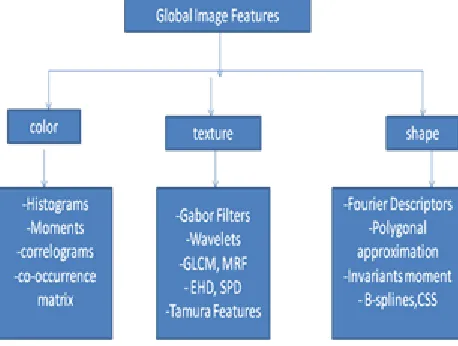
The most commonly extracted features in image retrieval systems are color, texture, and shape. This section presents and discusses these features as follows Fig.3:
Fig. 3: global image feature.
a) Color Features
1) Color Descriptors
These descriptors extract the proportion of colors in the images, and then the images in the database having more or less the same proportion of the colors can be retrieved using the similarity measure. Color coherence vector (CCV), color histogram, color correlogram, color moments are normally used to represent the color descriptions of an image [1].
2) Color Histogram
When the color distribution is unique in an image, color content of an image is effectively represented by color histogram. Proportion of pixels of each color within the image is represented as a histogram. It is in variant to rotation and translation. 3) Color Moments
When the image contains just an object, color moment values are useful in many retrieval applications. The mean called as first order moment, the variance called as second order moment and the scenes called as third order color moments are calculated from the image
4) Color coherence vector
This descriptor combines color histogram with spatial information. CCV partition the histogram bin into two different types of bins such as coherent, incoherent by measuring part of colored similar large region. The size of the large region is fixed by the user. When the images have the uniform color texture regions, then CCV provides better performance compared to color histogram.
5) Color Correlogram
Color correlogram combines the both c o l o r distributions of p i xe l s and spatial correlation of pairs of colors.
b) Texture Features
1) Texture Descriptors
The common texture features like regularity, contrast, directionality, coarseness, line-likeness, and roughness are used to extract the texture information in the image [1].
To analyze the size and number texture patterns coarseness used as a fundamental feature descriptor. It divide s the texture patterns into coarse texture and fine texture. A Coarse texture contains large texture patterns in small range while fine texture contains a small texture patterns in large range.
3) Contrast
This feature represents the intensity difference between the adjacent pixels. When the intensity difference is large then the texture primitives has the high contrast while the difference in low then the texture primitives has the low contrast.
4) Directionality
This feature refers the global property about the region. It provides the shape and placement of the texture primitives. 5) Line likeness
This feature refers the shape of the texture patterns. When the texture patterns are in the form of straight or wave, it can be represented by line likeness feature.
6) Regularity
It divides the texture pattern into two type’s namely regular texture and irregular texture based on arrangement of variations in texture patterns. Regular texture patterns are arranged in a uniform manner but texture patterns are randomly arranged in irregular texture patterns.
c) Shape Features
It represents the visual characteristics of the image Objects and used for similarity matching and image retrieval. Shape features are described and represented by two classes namely Region- based methods and boundary based also called as Contour based methods. In each class, methods are
Further classified into structural approach and global approach. The whole hierarchy of the classification is shown in Fig. 4[1]. Region based methods treats shape region in terms of 2D perspective region but boundary based methods uses the one dimensional approach. Specific characteristics of Shapes are measured by number of corners, perimeter, area, curvature, Orientation and so on. Further shape descriptor is obtained by calculating the predefined Fourier coefficients using Fourier transform.
Fig. 4 Shape feature descriptor [1].
III. LOCAL IMAGE FEATURES
Local image descriptors describe local information using key points of some image parts such as region, object of interest, edges, or corners. Recently, local descriptors have shown their superiority for various types of applications in computer vision, and they also have advanced the research efforts in CBIR domain.
Scale-Invariant Feature Transform (SIFT)
Theoretically, SIFT algorithm has the ability to extract features invariant to scale and rotation. In fact, owing to some additional special processing during the computation, these features are also robust to noise, occlusion, some forms of affine distortion, shift in 3D perspective and illumination changes[18].
1) Step 1: Scale-space Extrema Detection. The first step of SIFT algorithm is to search over all scales and image locations by using a cascade filtering approach and a Difference Of Gaussian (DoG) function so as to identify potential feature points, which are the local maximum and minimum points invariant to scale and rotation.
2) Step 2: Feature Point Localization. For all candidate feature points found in step 1, a detailed model is generated to determine their locations and scales. Those points with low contrast and poorly localized edge points are discarded due to their instability.
3) Step 3: Orientation Assignment. One or more orientations are assigned to each meaningful feature point identified in step 2 based on local image gradient directions.
4) Step 4: Feature Descriptor Generation. This is accomplished by sampling image gradient magnitudes and orientations around each feature point and putting them in an array of orientation histograms covering the region around the feature point. Gradients are measured at the scale of the feature point (providing scale invariance), and all orientations are relative to feature point orientation assigned in step 3 (providing rotation invariance). The entries of all histograms are then put in a 128-dimensional vector to form the feature descriptor which is normalized to reduce the effects of illumination changes.
Speeded Up Robust Features (SURF)
SURF (Speeded up Robust Features) is a robust local feature detector; first presented by Herbert Bay et al in 2006; that can be used in computer vision tasks like object recognition or 3D reconstruction. This is partly inspired by the SIFT descriptor. Therefore standard version of SURF is several times faster than SIFT and claimed by its authors to be more robust against different image transformations than SIFT. And SURF is based on sums of 2D Haar wavelet responses and makes an efficient use of integral images. This uses an integer approximation to the determinant of Hessian blob detector; which can be computed extremely quickly with an integral image (3 integer operations). SURF used in this approach to extract relevant features and descriptors from images [8, 10, 12].
Detection
In order to detect interest points the Hessian matrix is approximated using a set of box-type filters (Fig.5). These 9 x 9 box filters approximate second order Gaussian derivatives in y- and xy-direction with s = 1.2 and represent the lowest scale for computing blob response maps. These derivatives are referred as Dyy and Dxy respectively The singular points calculation of the Hessian matrix of SURF is based on the computation of the determinant of the Hessian matrix .
Fig. 5: shows the filters used to find the Hessian in SURF[12].
The white areas correspond to the value +1, the black ones –2 (in the third filter – 1), gray – zero. So the Hessian calculation of SURF can be calculated as:
Local patterns
Some other methods based on local patterns of qualitative level differences have been proposed. The local binary patterns (LBPs) one of the widely used approaches for texture discrimination. It derives a generalized grayscale and rotation invariant operator presentation that detects the ‘‘uniform’’ patterns for any quantization of angular space and for any spatial resolution. The LBP approach uses eight neighboring pixels and the value of the center pixel as a threshold, and these values form the LBP code after some weighted calculations. Since the operator is invariant against any monotonic transformation of the gray scale, the LBP is very robust[9].
Histograms of Oriented Gradients (HOG)
Generally, some of aforementioned local detectors are computed on the dense grid of uniformly spaced cells, and the performance is improved using overlapping local contrast normalizations. Dalal and Friggs [9] have proposed locally normalized HOG descriptors to provide better performance compared to other existing features including wavelets. Basically, this method characterizes the local object appearance and shape by edge directions or the distribution of local intensity gradients, even without an accurate knowledge of edge positions or the corresponding gradient. The HOG divides the image window into small spatial cells as regions, and accumulates edge orientations over the pixels of each cell or a local l-D histogram of gradient directions. As a result, image representation is formed by the combined histogram entries.
Fast
Features from accelerated segment test (FAST) is a corner detection method, which could be used to extract feature points and later used to track and map objects in many computer vision tasks. FAST corner detector was originally developed by Edward Rosten and Tom Drummond, and published in 2006. The most promising advantage of FAST corner detector is its computational efficiency. Referring to its name, it is fast and indeed it is faster than many other well-known feature extraction methods, such as difference of Gaussians (DoG) used by SIFT, SUSAN and Harris. Moreover when machine learning method is applied, a better performance could be achieved which takes less time and computational resources.
MSER
In computer vision, maximally stable extremal regions (MSER) are used as a method of blob detection in images. This technique was proposed by Matas et al. to find correspondences between image elements from two images with different viewpoints. This method of extracting a comprehensive number of corresponding image elements contributes to the wide-baseline matching, and it has led to better stereo matching and object recognition algorithms.
IV. COMPARATIVE ANALYSIS
A comparative analysis of features extraction methods and The main characteristics of local image features are shown in table I and table II respectively.
Table - 1
Comparison Features Extraction Methods
Detector Detected features Image1 Image2
Time(MS) Image1 Image2
SIFT 1279 1538 1.48 1.79
SURF 573 628 0.58 0.67
ORB 94 94 0.14 0.14
FAST 412 568 0.04 0.05
MSER 122 126 0.27 0.3
Table – 2
The Main Characteristic of Local Image Features [9].
Features Main Attributes Limitations Examples/Variants
SIFT
– Robust matching across a range of noise addition, affine distortion, and change in illumination/ viewpoints
– Invariant to scale and rotation
– High dimensional at matching – Need to be encoded in fixed size
vectors for image matching
PCA-SIFT , GLOH
SURF
– Hessian matrix-based detectors
– Relies on integral images to reduce the computation cost
– Poor approximation of key point orientations
– Poor performance on a rotational invariance
Accelerated SURF
Local Patterns
– Robustness to monotonic gray scale changes – Computational simplicity
Sensitivity to noise in near uniform image regions
DLBP, LBPV, CLBP,LDP, LTP, LTrP,LOCTP HOG – No need of accurate edge positions
–Local contrast normalization
Multiple bounding boxes at
object detection CHoG
ORB –Binary valued and compact feature
– Robust to lighting, blur, and perspective distortion Low degree of scale invariance Approximate matching
V. CONCLUSION
ACKNOWLEDGMENT
I take this opportunity to express my sincere thanks and deep sense of gratitude to Ms. Parul Bakaraniya for CBIR me valuable guidance. I am also thankful to all faculties of CO/IT department, my colleagues and family who encouraged me to do such a research.
REFERENCES
[1] Ms.A.Bhagyalaksluni, Dr.V.Vijayachamun deeswari.“A Survey on Content Based Image Retrieval Using Various Operators” International Conference on
Computer Communication and Systems Chennai, IEEE ,2014.
[2] Roshi Choudhary, Nikita Raina, Neeshu Chaudhary, Rashmi Chauhan, Dr. R H Goudar. “An Integrated Approach to Content Based Image Retrieval”
International Conference on Advances in Computing, Communications and informatics (lCACC1),IEEE,2014.
[3] Swati Agarwal, A. K. Verma, Preetvanti Singh. “Content Based Image Retrieval using Discrete Wavelet Transform and Edge Histogram Descriptor”
International Conference on Information Systems and Computer Networks, IEEE,2013.
[4] Mohammad Ali Soltanshahi Gholam Ali Montazer Davar Giveki. “Content Based Image Retrieval System Using Clustered Scale Invariant Feature
Transforms” International Journal for Light and Electron Optics (Accepted Manuscript), May 2015.
[5] Kommineni Jenni, Satria Mandala, Mohd Shahrizal Sunar. “Content Based Image Retrieval Using Colour Strings Comparison” 2nd International
Symposium on Big Data and Cloud Computing (ISBCC’15), ELSEVIER,2015.
[6] Somen Ghosh and Ajay Ghosh .“Content Based Retrieval of Malaria Positive Imagesfrom a Clinical Database VIA Recognition in RGB Colour Space”
Springer International Publishing Switzerland ,2014.
[7] A. Ambika , Dr.J.Jennifer Ranjani, K.B. Srisathya, P. Deepik. “Content Based Image Retrieval using Ripplet Transform and Kullback-Leibler Distance”
International Conference on Computer Communication and Informatics (ICCCI),2014.
[8] Alexandra Alfanindya, Noramiza Hashim, Chikannan Eswaran “Content Based Image Retrieval And ClassificationUsing Speeded-Up Robust Features
(SURF) and Grouped Bag-of-Visual-Words (GBoVW)”IEEE,2013.
[9] Ahmad Alzu’bi , Abbes Amira , Naeem Ramzan. “Semantic content-based image retrieval: A comprehensive study” Elsevier, 2015.
[10] Christoer Valgren, Achim J. Lilienthal“SIFT, SURF &Seasons: Appearance-based Long-term Localization in Outdoor Environments“Elsevier,2009.
[11] Jianshu Chao, Anas Al-Nuaimi, Georg Schroth and Eckehard Steinbach “Performance Comparison of Various Feature Detector-Descriptor Combinations
for Content-based Image Retrieval with JPEG-encoded Query Images”IEEE,2013.
[12] Edouard Oyallon, Julien Rabin ” An analysis and implementation of the SURF method, and its comparison to SIFT” article,2013.
[13] Nenad Tomaˇsev, Doni Pracner “Object Recognition in WIKImage Data Based on Local Invariant Image Features”IEEE 2013.
[14] Amit Singh, parag sohoni, manoj kumar, “A Review of Different Content Based Image Retrieval Techniques” International Journal of Engineering
Research and General Science Volume 2, Issue 5, August – September 2014.
[15] Deepak S. Shete, Dr. M.S. Chavan. “Content Based Image Retrieval: Review” International Journal of Emerging Technology and Advanced Engineering,
ISSN 2250-2459, Volume 2, Issue 9, September 2012.
[16] Suman Lata, Parul Preet Singh. “A Review on Content Based Image Retrieval System” International Journal of Advanced Research in Computer Science
and Software Engineering, Volume 4, Issue 5, May 2014.
[17] Neha. “CONTENT BASED IMAGE RETRIEVAL:A REVIEW” International Journal of Science, Engineering and Technology Research (IJSETR),
Volume 3, Issue 5, May 2014.
[18] Xu Wangming, Wu Jin, Liu Xinhai, Zhu Lei, Shi Gang “Application of Image SIFT Features to The Context of CBIR” International Conference on
![Fig. 2: Image segmentation method[9].](https://thumb-us.123doks.com/thumbv2/123dok_us/7828706.1666570/2.612.105.513.109.357/fig-image-segmentation-method.webp)
![Fig. 4 Shape feature descriptor [1].](https://thumb-us.123doks.com/thumbv2/123dok_us/7828706.1666570/4.612.177.446.331.586/fig-shape-feature-descriptor.webp)
![Fig. 5: shows the filters used to find the Hessian in SURF[12].](https://thumb-us.123doks.com/thumbv2/123dok_us/7828706.1666570/5.612.146.466.368.472/fig-shows-filters-used-hessian-surf.webp)
![Table – 2 126 The Main Characteristic of Local Image Features [9].](https://thumb-us.123doks.com/thumbv2/123dok_us/7828706.1666570/6.612.41.572.386.655/table-main-characteristic-local-image-features.webp)
