An Accelerated ISAF Algorithm with the Fast
Mapping Strategy
Gongming Wang
Institute of Computing Technology, Chinese Academy of Sciences, Beijing, China. 100190 Graduate University of Chinese Academy of Sciences, Beijing, China. 100190
Email: [email protected]
Fa Zhang (Corresponding author)
Institute of Computing Technology, Chinese Academy of Sciences, Beijing, China. 100190 Email: [email protected]
Fei Sun
Institute of Biophysics, Chinese Academy of Science, Beijing, China, 100101 Email: [email protected]
Zhiyong Liu (Corresponding author)
Institute of Computing Technology, Chinese Academy of Sciences, Beijing, China. 100190 Email: [email protected]
Abstract—ISAF (icosahedral symmetry-adapted functions) is a new approach used for 3D reconstruction of icosahedral macromolecules, which can achieve better resolutions compared with the commonly used Fourier-Bessel algorithm. However, ISAF is significantly slow. Among all reasons, the operation that rotating each image sixty times costs lots of running time. By analyzing the sixty symmetrical characteristics of icosahedrons in Fourier space, we proved that the positions of sixty mapped points derived from one sampling point are all the same in asymmetric unit. Thus, the sixty symmetrical rotating of each image can be removed and the reconstruction speed is increased. This accelerating strategy was validated by means of experiments with simulated data and experimental Cryo-EM data. The results showed that the speedup of this strategy was up to 41 times and it could grow up with the increase of the maximum Fourier radius and the number of images at the premise of maintenance of accuracy. Its running speed is about 9 times as great as that of Fourier-Bessel algorithm and is about 3 times than that of recISAFs algorithm.
Index Terms—3D reconstruction, mapping, asymmetric unit, ISAF, speedup
I.INTRODUCTION
Crowther and Klug et.al proposed the theories of 3D reconstruction for protein molecules based on EM (electron microscopy) images in late 1960s [1]. After about 50 years development, the EM reconstruction methods have formed three main kinds: electron crystallography, electron tomography, single particle technology.
Currently, single particle technology based Cryo-EM (cryo-electron microscopy) has played an increasingly important role for determining structures of frozen and non-crystalline state macromolecules [2,3]. Among all
kinds of molecules, the icosahedral molecule has been widely studied [4]. The icosahedral single particle reconstruction methods are divided into two kinds [5]. One is called direct Fourier inversion method which is the most computationally efficient, but may have large memory requirement and is generally more sensitive to noise. The other is called the synthesis method which is less sensitive to image noise and has less memory requirement, but less computationally efficient. Two representatives of synthesis method are the Fourier-Bessel algorithm [1] and the ISAF algorithm [6, 7]. The difference between them is the basis function and interpolation coordinate system. The Fourier-Bessel algorithm uses the cylindrical coordinate system and exponential function, while the ISAF algorithm uses spherical coordinate system and symmetry-adapted functions. Because icosahedral molecules have sixty symmetrical characteristics in Fourier space [1,5, 6], one FFT image is rotated sixty times to get the sixty equivalent FFT images in ISAF algorithm. Subsequently, the sampling points in the sixty FFT images must be mapped onto the asymmetric unit. The purpose of this rotating operation is increasing SNR (Signal to Noise Ratio). Then the resolution of reconstructed map is improved [6]. However, since the number of processed images has to be increased sixty times, significantly more computing resources are required. Some previous studies have shown an exponential relationship between the number of Cryo-EM images and the resolution [9,10]. Therefore, rotating each image sixty times would become a bottle-neck in 3D reconstruction. So, it is very important to reduce the complexity from this rotating operation.
mapped onto asymmetric unit in Fourier space. With the help of sixty symmetrical characteristics of icosahedral molecules in Fourier space, we proved that the positions of sixty mapped points in asymmetric unit are all the same. That is to say, after rotating sixty times, the structure information in asymmetric unit is similar to that without rotating sixty times. Thus, this complex rotating operation can be removed at the premise of maintenance of accuracy. The accelerated ISAF algorithm is proposed according to this point. With this method, the speed of mapping sampling points onto asymmetric unit can be improved 60 times. The speed of the whole 3D reconstruction could be enhanced to a certain extent. To verify this point, the experiments were carried out with simulated data and experimental Cryo-EM data. The Fourier-Bessel algorithm and recISAFs [6] algorithm were used for comparison with our accelerated ISAF algorithm. The experimental results show that the reconstructed map without rotating sixty times is identical with the one with rotating sixty times. The speedup in the stage of mapping molecular images is 60 times and the whole speedup is up to 41 times. Its running speed is about 9 times as great as that of Fourier-Bessel algorithm and is about 3 times than that of recISAFs algorithm.. In addition, the speedup of this method is increasing with the increase of the maximum Fourier radius and the number of images. This method can also be extended for 3D reconstruction of other polyhedral molecules.
II.METHODS
The processing steps of synthesis method include three stages: mapping molecular images, solving fitting coefficients and calculating density function. The main operation in mapping molecular images is rotating each FFT images sixty times and then mapping sampling points in the sixty FFT images onto asymmetric unit. It is known that this operation seriously affect the speed of ISAF algorithm. If the rotating operation is simplified, the speed of ISAF algorithm can be accelerated significantly. In this section, this accelerated ISAF algorithm and its mathematical proof are proposed.
A. Uniqueness Mapping Analysis
In the course of 3D reconstruction based on synthesis algorithm, the above rotating operation is common used both in the cylindrical coordinate and in the spherical coordinate systems. The purpose of this operation is enhancing SNR by averaging a number of images [1,6]. However, with the help of theories of crystal symmetry group, it is found that this operation is redundant in spherical coordinate system as follows.
In real space, icosahedral molecule has 5-2 symmetrical characteristics in the cylindrical coordinate system and has 5-3-2 symmetrical characteristics in the spherical coordinate system. In Fourier space, icosahedral molecule has the identical symmetrical characteristics in the cylindrical coordinate and in the spherical coordinate systems because Fourier transform has the rotational invariance.
In the cylindrical coordinate system, the sixty symmetrical points
(
Ri,Φi,Zi)(
1≤i≤60)
are mapped ontothe 5-2 symmetrical unit
{
(
R,Φ,Z)(
R>0,0≤Φ ≤72)
}
. The positions of them in 5-2 symmetrical unit are different according to the difference between 5-3-2 symmetrical characteristics and the 5-2 symmetrical characteristics of icosahedral molecule. Thus, the SNR is enhanced because the structure information in 5-2 symmetrical unit increases sixty times.On the contrary, for one sampling point in spherical coordinate system, it is found that the positions of the sixty mapped points are all the same in the 5-3-2 symm- etrical unit (commonly referred to as 'asymmetric unit')
(
)(
)
{
R,Θ,Φ R≥0,69.09≤Θ ≤90,−31.72≤Φ ≤31.72}
.The brief analysis is as follows.
The spherical surface whose radius is R can be divided into 60 identical regionsUi
(
1≤i≤60)
. The area of each region is the same as the area of the asymmetrical triangle:(
)(
)
{
R, , R 0,69.09 90, 31.72 31.72}
U = Θ Φ ≥ ≤Θ ≤ − ≤Φ≤
Here, U is one of the sixty regions and is denoted as
1
U . The point from one region can be mapped onto another and the number of mapped points in the corresponding region is only one. A1=
(
R,Θ,Φ)
denotes one point in the region Ui. Its 59 symmetrical points A2,A3"A60 is distributed to the rest of the 59 regions and one point belongs to one region. Ak denotes the symmetrical points of A1 in region U1. According to the sixty symmetrical characteristics, the sixty symmetrical points A1,A2"A60 can be all mapped onto the region.U1. From the uniqueness mapping property, it is found that the 60 mapped points are allAk. That is to say, the positions of 60 mapped points are all the same.B. The Accelerating Strategy Based on Uniqueness Mapping
As describe above, all positions of the sixty mapped points are identical in the asymmetric unit. Therefore, the equivalent point of the sixty mapped points by averaging is equal to one of them. So, the SNR has not increased as shown in (1).
(
1 i 60)
F60 F F P 60
P
P i
60 1
i i
i 60
1
i i = ≤ ≤
∑
= =
∑
= = = (1)
(
1 i 60)
Pi ≤ ≤ are the same due to the proof of above section. Under this condition, formula 1 is hold.
The positions and structure factor values of mapped points are used for constructing fitting coefficients equation set. From the above statement, it is known that getting rid of this operation has no effect on constructing fitting coefficients equation set. Thus, whether carrying out the sixty symmetrical operations or not has no effect on the following step. Besides, removing this redundant operation can speed up the computation process.
For the purpose of expression briefly, the ISAF algorithm with sixty symmetrical operations is called original ISAF algorithm and the one without sixty symmetrical operations is called accelerated ISAF algorithm for short.
III.RESULTS
The theorem of uniqueness mapping is proved and the accelerated ISAF algorithm is proposed in the previous section. In this section, the 3D reconstruction experiments are carried out with simulated data and experimental Cryo-EM data, respectively. The goal is to validate accelerated ISAF algorithm. The recISAFs algorithm proposed by Hongrong liu [6] is selected for comparison because it can achieve the resolution of 3.88 Å [8]. The Fourier-Bessel algorithm is selected for comparison also. The experimental results are analyzed in terms of accuracy and speed. Besides, the Fourier-Bessel algorithm is compared with our new algorithm to demonstrate the advantages of 3D reconstruction for icosahedral molecular in spherical coordinate system. The following experiments are all implemented on one PC whose CPU is AMD Dual-Core 2.6G Hz, with DDR 2G.Byte memory.
A. The reconstruction experiment with simulated data
(a) (b)
Figure1. Simulated projection images of the melon necrotic spot virus. (a) Without noise. (b) with an SNR of 0.1.
The simulated data are the projections of the map generated from the melon necrotic spot virus structure (PDB ID 2ZAH), which is solved by X-ray crystallography to 2.81 Å [11] and has icosahedral symmetrical characteristics. Firstly, this model was generated at a resolution of 4 angstrom by using pdb2mrc [12] from EMAN's procedure library. The key parameters were apix=1.4 and res=4. The size of model is 264×264 ×264 pixels. Secondly, 2000 projections with random
orientations were generated by using prjectIcosFile [13] from the EMAN's package. Finally, the random noise whose SNR was equal to 0.1 is added to each of the
projections. The images with and without noises were shown in Fig. 1 respectively. In the following experiments, original ISAF algorithm, accelerated ISAF algorithm, Fourier-Bessel algorithm and recISAFs algorithm were all tested. The maximum Fourier radius was 1/33.6Å-1
,1/18.48Å-1
,1/9.24Å-1
and 1/4.2Å-1
, respectively. For the purpose of comparison, the Fourier transform was applied to the original structure of melon necrotic spot virus. After that, the Fourier coefficients were disposed if the corresponding Fourier radius was greater than 1/33.6Å-1
,1/18.48Å-1
,1/9.24Å-1
and 1/4.2Å-1
, respectively. Finally, the Fourier inverse transform was performed on the truncated Fourier coefficients. Thus, the original maps at a resolution of 33.6Å, 18.48Å, 9.24Å and 4.2Å were generated.
(a)
(b)
(c)
(d)
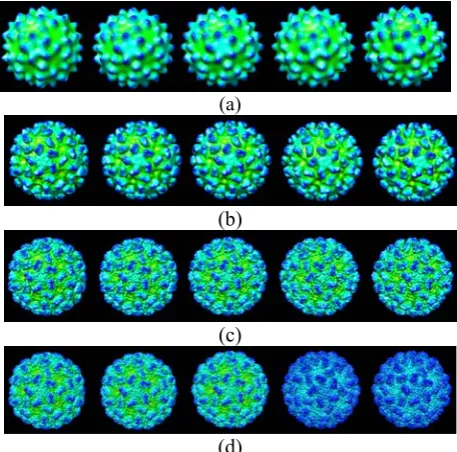
Figure 2. The reconstructed maps at different maximum Fourier radiuses. From left to right, the first column is the original map. The other columns are the reconstructed maps with original ISAF algorithm, accelerated ISAF algorithm, Fourier-Bessel algorithm and recISAFs algorithm respectively. From top to bottom, the corresponding maximum Fourier radiuses are 1/33.6Å-1,1/18.48Å-1, 1/9.24Å-1 and
1/4.2Å-1
Fig. 2 show the comparison of reconstructed maps by the original ISAF algorithm (the second column), the accelerated ISAF algorithm (the third column), the Fourier-Bessel algorithm (the fourth column) and the recISAFs algorithm (the last column), and the maximum Fourier radius used in testing equals to 1/33.6Å-1
,1/18.48Å-1
,1/9.24Å-1
and 1/4.2Å-1
0.2 0.3 0.4 0.5 0.6 0.7 0.8 0.9 1
0 0.05 0.1 0.15 0.2 0.25 Spatial Frequency(1/angstrom)
FSC
Original ISAF algorithm Accelerated ISAF algorithm Fourier-Bessel algorithm recISAFs algorithm
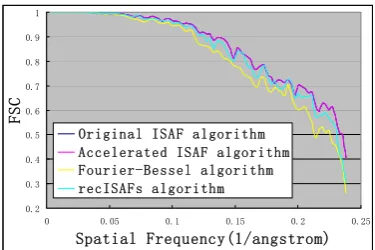
Figure 3. The FSC curves of the reconstructed maps with four methods at the maximum Fourier radius of 1/4.2Å-1
The FSC (Fourier Shell Correlation) [14] curves at the maximum Fourier radius of 1/4.2Å-1
were used for calculating the resolution of maps generated using original ISAF algorithm, accelerated ISAF algorithm, Fourier-Bessel algorithm and recISAFs algorithm, which are shown in Fig. 3. The FSC curves using original ISAF algorithm and accelerated ISAF algorithm are coincident with each other and they are drop to 0.5 at 1/4.23Å-1
.The FSC curve using Fourier-Bessel algorithm is below them and it drops to 0.5 at 1/4.66Å-1
. The FSC curve using recISAFs algorithm is between them and it drops to 0.5 at 1/4.28Å-1
. It indicates that the effective resolution using original ISAF algorithm and accelerated ISAF algorithm are both 4.23Å, the one using Fourier-Bessel algorithm is 4.66Å and the one using recISAFs algorithm is 4.28Å. In light of this, the maps generated using original ISAF algorithm and accelerated ISAF algorithm are identical, which are better than that using Fourier-Bessel algorithm and recISAFs algorithm.
Equation (2) is used for computing the speedup of our acceleration strategy. In this formula,
t
icos is the timespent calculating the structure factors with rotating sixty times and
t
nonicos is the time spent on anything else (e.g.reading and writing images).
cos noni cos
i
cos noni cos i
t 60 / t
t t A
+ +
= (2) The reconstruction speedups with different number of projections at the maximum Fourier radius of 1/4.2Å-1
are shown in Tab. 1. The reconstruction speedups with 2000 projections at the different maximum Fourier radius are shown in Tab. 2. In Tab. 1 and Tab. 2, the meanings of the column items are as follows: No is the number of projections, ticos, tnonicos and A are the meanings in equation (2), tA, tF and tR are the running times with accelerated ISAF algorithm, Fourier-Bessel algorithm, recISAFs algorithm respectively. The unit in Tab. 1 and Tab. 2 is second. From the two tables, it is found that the speedup of accelerated ISAF algorithm is increasing with the increase of the maximum Fourier radius and the number of projections. Under the circumstance of high resolution (less than 10Å), the speedup is often over 20 times and up to 26 times. Its running speed is 6 times as fast as Fourier-Bessel algorithm and is about 2.5 times than that of recISAFs algorithm.
TABLE 1THE SPEEDUP WITH DIFFERENT NUMBERS OF PROJECTIONS AT THE MAXIMUM FOURIER RADIUS OF 1/4.2Å-1
No.
t
icost
nonicost
AA
t
F Rt
250 305.42 111.97 117.06 3.57 329.19 362.27 500 612.31 117.02 127.22 5.73 419.31 369.70 1000 1237.55 123.53 144.157 9.44 597.71 375.92 2000 2533.83 134.77 177.77 15.01 1033.52 396.77
TABLE 2THE SPEEDUP AT THE DIFFERENT MAXIMUM FOURIER RADIUS WITH 2000 PROJECTIONS
B. The reconstruction experiment with experimental Cryo-EM data
In this section, the experimental data are the Cryo-EM images of HBV (Human Hepatitis B Virus) from R.A.Crowther, which are consist of 4588 HBV particles recorded on 11 electron micrographs. The triangulation is T=4 and the diameter is about 360Å. Fig.4 shows 12 images at the different defocus. The imaging parameters are as follows: the size of each particle is 256×256
pixels, the step of sampling is 2.5Å/pixel, the type of electron microscopy is FEI F30, the speed voltage is 300kV, the spherical-aberration coefficient is 2mm, the defocus is between 1.3µm and 2.4µm. These parameters are used for CTF correction [15].
Figure 4. 12 CryoEM images of HBV at different defocus.
Like the previous section, the 3D reconstruction experiments are carried out by using four algorithms (the original ISAF algorithm, the accelerated ISAF algorithm, the Fourier-Bessel algorithm and the recISAFs algorithm) at the different maximum Fourier radius (1/30.36Å-1
, 1/21.25Å-1
, 1/12.5Å-1
, and 1/7.5Å-1
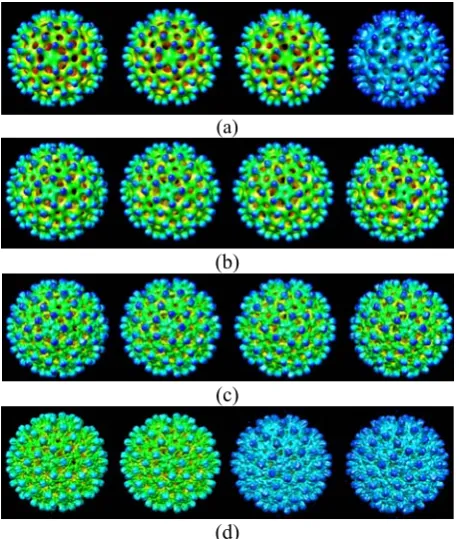
). The experimental results are shown in Fig. 5. It is found that the reconstructed maps with and without sixty symmetrical operations are both identical and are better than that using Fourier-Bessel algorithm and recISAFs algorithm.
Res
t
icost
nonicost
AA
t
Ft
R1/33.6Å-1
333.75 15.33 20.89 16.71 15.02 110.66 1/18.48Å-1 459.24 17.03 24.69 19.29 30.99 118.67
1/9.24Å-1
1084.02 24.31 42.38 26.15 125.74 144.70 1/4..2Å-1
(a)
(b)
(c)
(d)
Figure 5. The reconstructed maps at different maximum Fourier radiuses. From left to right, they are the reconstructed maps with original ISAF algorithm, accelerated ISAF algorithm, Fourier-Bessel algorithm, and recISAFs algorithm respectively. From above to below, the corresponding maximum Fourier radiuses are 1/30.36Å-1, 1/21.25Å-1,
1/12.5Å-1, 1/7.5Å-1.
0 0.1 0.2 0.3 0.4 0.5 0.6 0.7 0.8 0.9 1
0 0.02 0.04 0.06 0.08 0.1 0.12 0.14
Spatial Frequency(1/angstrom)
FSC
original ISAF algorithm accelerated ISAF algorithm Fourier-Bessel algorithm recISAFs algorithm
Figure 6. The FSC curves of the reconstructed maps with four methods at the maximum Fourier radius of 1/7.5Å-1
TABLE 3 THE SPEEDUP WITH DIFFERENT NUMBERS OF CRYO-EM IMAGES AT THE MAXIMUM FOURIER RADIUS OF 1/7.5Å-1
No.
t
icost
nonicost
AA
t
Ft
R573 975.24 13.93 30.19 32.77 367.981 249.69 1147 1488.66 17.85 42.66 35.32 531.847 259.80 2294 2469.06 25.87 67.02 37.23 856.088 280.14 4588 5686.32 41.70 136.47 41.97 1545.77 313.52
The FSC curves of maps generated from these algorithms are shown in Fig. 6 at the maximum Fourier radius of 1/7.5Å-1
. The effective resolution using original ISAF algorithm and accelerated ISAF algorithm are both 7.97Å, the one using Fourier-Bessel algorithm is 8.38Å, and the one using recISAFs algorithm is 8.27Å. So, removing rotation sixty times has no influence on reconstruction and the reconstruction algorithm in the
spherical coordinate system is better than that in the cylindrical coordinate system.
Like the previous section, the equation (2) is used for computing the speedups of this accelerating strategy. The computing results are shown in Tab. 3 and Tab. 4. Tab. 3 illustrates the speedups with different number of projections at the maximum Fourier radius of 1/7.5Å-1
. Tab. 4 shows speedups with 4588 projections at the different maximum Fourier radius. The meanings of column items in Tab. 3 and Tab. 4 are equivalent to that in in Tab. 1 and Tab. 2. The unit in Tab. 3 and Tab. 4 is second. From Tab. 3 and Tab. 4, it is found that the speedup is increasing with the increase of the maximum Fourier radius and the number of images. Under the circumstance of high resolution, the speedup is often over 35 times and up to 41 times. Its running speed is about 9 times as great as that of Fourier-Bessel algorithm and is about 3 times than that of recISAFs algorithm.
In summary, removing sixty symmetrical operations of 3D reconstruction of icosahedral molecule in spherical coordinate system has no effect on accuracy. Thus removing this step can enhance the speed of reconstruction greatly. In addition, this accelerated ISAF algorithm is better than the Fourier-Bessel algorithm in terms of both speed and accuracy.
TABLE 4THE SPEEDUP AT THE DIFFERENT MAXIMUM FOURIER RADIUS WITH 4588CRYO-EM IMAGES
Res
t
icost
nonicost
AA
t
Ft
R1/30.36Å-1
186.48 4.61 7.72 24.76 60.44 117.06 1/21.25Å-1
641.7 6.86 17.55 36.95 118.00 128.48 1/12.5Å-1
1666.08 13.28 41.04 40.9 409.01 162.73 1/7.5Å-1
5402.52 41.88 131.92 41.3 1545.77 313.52
IV.CONCLUSIONS
experimental Cryo-EM data of HBV are used for validating our accelerated ISAF algorithm. The results show that this accelerated ISAF algorithm can speed up significantly at the premise of maintenance of accuracy. Its running speed is about 9 times as great as that of Fourier-Bessel algorithm and is about 3 times than that of recISAFs algorithm. More importantly, the speedup of this strategy is increasing with the increase of the maximum Fourier radius and the number of images.
In addition, the reconstruction process of other polyhedrons molecule -- such as tetrahedral molecule, hexahedral molecule, octahedral molecule and so on – is similar.to that of icosahedral molecule. In this sense, our accelerating strategy can be extented to these new circumstances. Therefore, we will study its application to other-hedron symmetrical molecules.
ACKNOWLEDGEMENT
The authors are grateful to Zhongjun Hu, Lingpeng Cheng, etc. for solving relative problems occured in the course of software development, to RA Crowther for providing the HBV data. In addition, this work is the basic research, so none of the authors have a financial interest related to this paper. Furthermore, this research is supported by knowledge innovation project of CAS (Grant No. KGCX1-YW-13), and National Science Fundation of China (Grant No. 61070129, 61003164).
REFERENCES
[1] De Rosier D J, Klug A: Reconstruction of three-dimensional structures from electron micrographs. Nature (London)1968, 217:130-134.
[2] Bottcher B, Wynne S A, Crowther R A: Determination of the fold of the core protein of hepatitis B virus by electron cryomicroscopy. Nature 1997, 386:88-91.
[3] Conway J F, Cheng N, Zlotnick A, Wingfield P T, Stahl S J, Steven A C: Visualization of a 4-helix bundle in the hepatitis B virus capsid by cryo-electron microscopy. Nature 1997, 386:91-94.
[4] Caspar D L D, Klug A: Physical Principles in the Construction of Regular Viruses. Cold Spring Harbor Symposia on Quantitative Biology 1962, 27:1-24.
[5] Z Hong Zhou: Towards atomic resolution structural determination by single particle cryo-electron microscopy. Current Opinion in Structural Biology 2008, 18(2):218–228. [6] Hongrong Liu, Lingpeng Cheng, et al: Symmetry-adapted
spherical harmonics method for high-resolution 3D single-particle reconstructions. Journal of Structural Biology 2008, 161(1): 64-73.
[7] Gongming Wang, Fa Zhang, Qi Chu, Liya Fan, Fei Sun, Zhiyong Liu. A Fast Calculation Strategy of Density Function in ISAF Reconstruction Algorithm. SCIENCE CHINA, F Series. (Accepted)
[8] Xuekui Yu, Lei Jin1, Z. Hong Zhou; 3.88 Å structure of cytoplasmic polyhedrosis virus by cryo-electron microscopy; Nature 453, 415-419 (15 May 2008)
[9] Zhou Z H, Dougherty M, Jakana J, He J, Rixon F J, Chiu W. 2000. Seeing the herpesvirus capsid at 8.5 Å. Science 2000, 288(5467):877–880.
[10] Gabashvili I S, Agrawal R K, Spahn C M, Grassucci R A, Svergun D I, Frank J, Penczek P. Solution structure of the E. coli 70S ribosome at 11.5 Å. Cell 2000, 100(5):537–549. [11] Wada Y, Tanaka H, et al. The structure of melon necrotic
spot virus determined at 2.8 A resolution. Acta Crystallogr, Sect.F 2008, 64:8-13.
[12] Ludtke, S.J., Baldwin, P.R., Chiu, W., 1999. EMAN: semi-automated software for high resolution single particle reconstructions. J. Struct. Biol. 128, 82–97.
[13] Liang, Y., Ke, E.Y., Zhou, Z.H., 2002. IMIRS: a high-resolution 3D reconstruction package integrated with a relational image database. J. Struct. Biol. 137, 292–304. [14] Harauz G., Van Heel M:Exact filters for general geometry
three dimensional reconstruction. Optik 1986, 73:146–156. [15] Penczek P A, Zhu J, Schroder R, Frank J.
Three-dimensional reconstruction with contrast transfer compensation from defocus series. Scanning Microscopy 1997, 11:147-154.
Gongming Wang: was born in 1981. He
is a Ph. D candidate of Institute of Computing Technology, Chinese Academy of Sciences. His research interests include computer graphics, digital image processing and visualization.
Fa Zhang: was born in 1974. He is an
associate professor of Institute of Computing Technology, Chinese Academy of Sciences. His research interests include high performance algorithms and bioinformatics.
Fei Sun: was born in 1979. He is a
professor in the Institute of Biophysics, Chinese Academy of Sciences. His research interests include combining cryo-electron microscopy, 3D reconstruction, crystallogr- aphy and other biophysical technology to investigate the structure and function of membrane proteins and supra bio-macromolecular complexes.
Zhiyong Liu: was born in 1946. He is a