Abstract
The performance gap between compute and storage is fairly considerable. This results in a mismatch between the application needs from storage and what storage can deliver. The full potential of storage devices cannot be harnessed till all layers of I/O hierarchy function efficiently. Despite advanced optimizations applied across various layers along the odyssey of data access, the I/O stack still remains volatile. The prob-lems associated due to the inefficiencies in data management get amplified in Big Data shared resource environments. The Linux OS (host) block layer is the most critical part of the I/O hierarchy, as it orchestrates the I/O requests from different applica-tions to the underlying storage. Unfortunately, despite it’s significance, the block layer, essentially the block I/O scheduler, hasn’t evolved to meet the needs of Big Data. We have designed and developed two contention avoidance storage solutions, collectively known as “BID: Bulk I/O Dispatch” in the Linux block layer specifically to suit multi-tenant, multi-tasking shared Big Data environments. Hard disk drives (HDDs) form the backbone of data center storage. The data access time in HDDs is majorly governed by disk arm movements, which usually occurs when data is not accessed sequentially. Big Data applications exhibit evident sequentiality but due to the contentions amongst other I/O submitting applications, the I/O accesses get multiplexed which leads to higher disk arm movements. BID schemes aim to exploit the inherent I/O sequentiality of Big Data applications to improve the overall I/O completion time by reducing the avoidable disk arm movements. In the first part, we propose a dynamically adaptable block I/O scheduling scheme BID-HDD for disk based storage. BID-HDD tries to recreate the sequentiality in I/O access in order to provide performance isolation to each I/O submitting process. Through trace driven simulation based experiments with cloud emulating MapReduce benchmarks, we show the effectiveness of BID-HDD which results in 28–52% lesser time for all I/O requests than the best performing Linux disk schedulers. In the second part, we propose a hybrid scheme BID-Hybrid to exploit SCM’s (SSDs) superior random performance to further avoid contentions at disk based storage. BID-Hybrid is able to efficiently offload non-bulky interruptions from HDD request queue to SSD queue using BID-HDD for disk request processing and multi-q FIFO architecture for SSD. This results in performance gain of 6–23% for MapReduce workloads when compared to BID-HDD and 33–54% over best performing Linux scheduling scheme. BID schemes as a whole is aimed to avoid contentions for disk based storage I/Os following system constraints without compromising SLAs. Keywords: Multi-tier, Hard disk drives, Solid state drives, MapReduce, Hadoop, Hdfs, Contention avoidance, Big Data, Storage, Block I/O layer, I/O scheduler
© The Author(s) 2017. This article is distributed under the terms of the Creative Commons Attribution 4.0 International License (http://creativecommons.org/licenses/by/4.0/), which permits unrestricted use, distribution, and reproduction in any medium, provided you give appropriate credit to the original author(s) and the source, provide a link to the Creative Commons license, and indicate if changes were made.
Introduction
Data Centers today cater to a wide diaspora of applications, with workloads varying from data science batch and streaming applications to decoding genome sequences. Each application can have different syntax and semantics, with varying I/O needs from storage. With highly sophisticated and optimized data processing frameworks, such as Hadoop and Spark, applications are capable of processing large amounts of data at the same time. Dedicating physical resources for every application is not economically feasi-ble [1]. In cloud environments, with the aid of server and storage virtualization, multiple processes contend for the same physical resource (namely, compute, network and stor-age) [2]. This causes contentions. In-order to meet their service level agreements (SLAs), cloud providers need to ensure performance isolation gaurantees for every application [3].
With multi-core computing capabilities, CPUs have scaled to accommodate the needs of “Big Data”, but storage still remains a bottleneck. The physical media characteristics and interface technology are mostly blamed for storage being slow, but this is partially true. The full potential of storage devices cannot be harnessed till all the layers of the I/O hierarchy function efficiently. The performance of storage devices depend on the order in which the data is stored and accessed. This order is multiplexed due to interfer-ences from other contending applications. Therefore, in large scale distributed systems (“cloud”), data management plays a vital role in processing and storing petabytes of data among hundreds of thousands of storage devices [4]. The problems associated due to the inefficiencies in data management get amplified in multi-tasking, and shared Big Data environments.
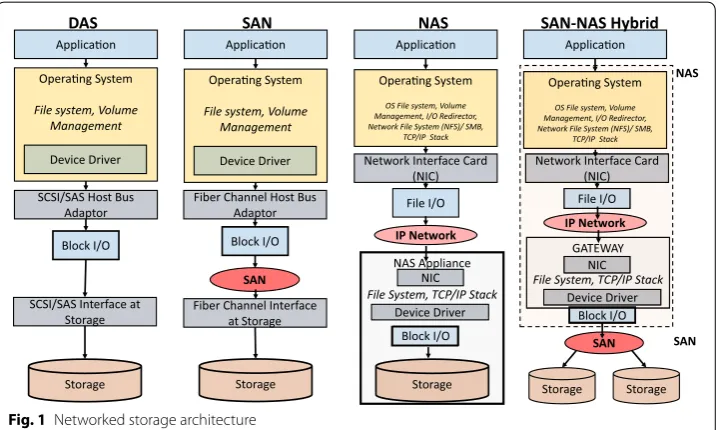
Despite advanced optimizations applied across various layers along the odyssey of data access, the I/O stack still remains volatile. The Linux OS (Host) block layer is the most critical part of the I/O hierarchy as it orchestrates the I/O requests from different appli-cations to the underlying storage. The key to the performance of the block layer is the Block I/O scheduler, which is responsible for dividing the I/O bandwidth amongst the contending processes as well as determines the order of requests sent to storage device. Figure 1 shows the importance of the block layer. We observe that irrespective of the data-center storage architecture, i.e. SAN, NAS or DAS, the final interaction with the physical media is in blocks (sectors in HDD, pages in SSD). The block layer is employed to manage I/Os to the storage device.
Unfortunately, despite it’s significance, the block layer, essentially the block I/O sched-uler hasn’t evolved to meet the volume and contention resolution needs of data cent-ers experiencing Big Data workloads. We have designed and developed two Contention Avoidance Storage solutions in the Linux block layer, collectively known as “BID: Bulk I/O Dispatch”, specifically to suit multi-tenant, multi-tasking Big Data shared resource environments.
phenomenons such as multiplexing and interleavings, thereby breaking of large data accesses [5–7]. The increase in latency of storage devices (HDDs) adversely affects over-all system performance (CPU wait time increase) [8].
In the first solution, we propose a dynamically adaptable Block I/O scheduling scheme BID-HDD, for disk based storage. BID-HDD tries to recreate the sequentiality in I/O access in order to provide performance isolation to each I/O submitting process. Through trace driven simulation based experiments with cloud emulating MapReduce benchmarks, we show effectiveness of BID-HDD which results in 28–52% I/O time per-formance gain for all I/O requests than the best performing Linux disk schedulers.
With recent developments in NVMe (non-volatile memory) devices such as solid state drives (SSDs), commonly known as storage class memories (SCM) [9], with supporting infrastructure, and, virtualization techniques, a hybrid approach of using heterogeneous tiers of storage together such as those having HDDs and SSDs coupled with workload-aware tiering to balance cost, performance and capacity have become increasingly popu-lar [1, 3]. In the second part, we propose a novel hybrid scheme BID-Hybrid to exploit SCM’s (SSDs) superior random performance to further avoid contentions at disk based storage. The main goal of Hybrid is to further enhance the performance of BID-HDD scheduling scheme, by offloading interruption causing non-bulky I/Os to SSD and thereby making the “HDD request queue” available for bulky and sequential I/Os.
Contrary to the existing literature of tiering, where data is tiered based on deviation of adjacent disk block locations in the device “request queue”, BID-Hybrid profiles process I/O characteristics (bulkiness) to decide on the correct candidates for tiering. The cur-rent literature might cause unnecessary deportations to SSDs, due to I/Os from an appli-cation, which might be sequential but appear random due to the contention by other applications in submitting I/O to the “request queue”. While BID-Hybrid uses staging capabilities and anticipation time for judicious and verified decisions. BID-Hybrid serves I/Os from bulky processes in HDD and tiers I/Os from non-bulky (lighter) interrup-tion causing processes to SSD. BID-Hybrid is successfully able to achieve its objective of
SCSI/SAS Interface at Storage
SAN
Fiber Channel Interface at Storage
Storage Storage
Block I/O File System, TCP/IP StackNIC
Device Driver
File System, TCP/IP Stack Device Driver
Block I/O
SAN SAN
Storage Storage Storage
further reducing contention at disk based storage device. BID-Hybrid results in perfor-mance gain of 6–23% for MapReduce workloads over BID-HDD and 33–54% over the best performing Linux scheduling schemes.
Broader impact of this research would aid Data Centers to achieve their SLAs as well keeping total-cost of ownership (TCO) low. Apart from performance improvements of storage devices, the over-all deployment of BID schemes in data centers would also lead to energy footprint reduction as well as increase in the lifespan expectancy of disk based storage devices.
The rest of the paper is organized as follows. “Background” section provides a brief overview of the working of the I/O stack, secondary memory devices and their ineffi-ciencies in shared large data processing infrastructure. “Requirements from a block I/O scheduler in Big Data deployments” section lays down the expectation from a block I/O scheduler in Big Data deployments as well as points out the issues with the current Linux scheduling schemes. In “Our approach: BID Bulk I/O Dispatch” and “Experiments and performance evaluation” sections, we present our Contention Management schemes fol-lowed by our design of experiments and performance evaluation, respectively. “Related works” section provides an in-depth survey of related literature. We conclude the paper in “Conclusion and future works” section with a discussion on future work.
Background
In this section, we first briefly present the working of the Linux I/O stack in “Linux I/O stack” section followed by the additional features of the OS block layer in “OS block layer: additional features” section. In “Secondary storage (block device) characteristics” section , we discuss the physical characteristics of secondary storage devices like HDDs
and SCMs used in modern data centers. “Hadoop MapReduce: working and workload
characteristics” and “Requirements from a block I/O scheduler in Big Data deploy-ments” sections discuss the I/O workload characteristics of Hadoop deployments and the requirements from a I/O scheduler in such environments, respectively. “Issues with current I/O schedulers” section describes the working of the current state-of-the-art Linux disk schedulers deployed in shared Big Data infrastructure.
Linux I/O stack
The I/O stack of the data center architectures as shown in Fig. 1, can fundamentally be broadly broken into Applications, Host (OS) and Storage. The difference between each of these solutions is in the layers of abstractions (storage virtualization) and the networking interconnects (Fibre Channel, RCoE, RDMA, etc.) between the storage and host [8, 10,
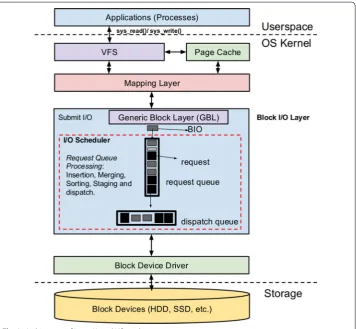
11]. Figure 2 is the simplistic representation of the Linux I/O stack [10, 12].
In this section, we briefly present the working of the Linux I/O stack, focusing on the OS block layer. The block layer mediates and orchestrates I/O requests from multiple applications to the underlying storage simultaneously. The following steps are taken to serve application’s I/O request:
1. The virtual file system (VFS) provides abstractions for applications (processes) to access storage devices via system calls. The calls include a file descriptor and the
system hosting the data, starting from a relative location. VFS provides an uniform
interface to access multiple file systems [15].
2. While reading or writing from a file, the VFS checks if the data is present in the memory or page cache. If the data is not present, then a page fault occurs and the Mapping Layer is initiated to locate the data in the block device.
3. Kernel uses the “Mapping layer” to map the logical locations provided by the applica-tion (file descriptor) to the physical locaapplica-tion in the respective block device. The Map-ping Layer figures out the number of disk blocks required to be accessed. It should be noted that a file is stored in multiple blocks which may be distributed across multiple devices using logical volumes and on different devices may or may not be physically contiguous in the media. We assume that the logical volume on the physical media is sequential.
The Mapping Layer and VFS enables storage virtualization functionalities such as logical volumes, heterogeneous storage pools or “tiers”, etc.
4. After determining the physical locations of the blocks, the kernel uses the block layer to map I/O calls from the “Mapping layer” to the I/O operations [data-structures
known as block I/O (BIO)].
The I/O Scheduler in the block layer initializes the data structures called “requests”, which represent I/O operations, to be sent to the device. I/O operations accessing non contiguous disk blocks (sectors) are broken into several I/O operations each accessing a contiguous set of blocks.
5. “Request” structures are then staged in a linked-list called request queue. The request
queue allows I/O schedulers to sort, merge and coalesce the requests depending
on the locations they access. Appendix (“Conclusion and future works” section)
describes the relationships between the block I/O kernel data-structures used by the block layer to perform I/O operations.
6. Depending on the I/O Scheduling policies, “requests” scheduled to be sent to the device are dequeued from the “request queue” and enqueued to a structure known as “dispatch queue”. I/O Scheduler maintains the dispatch queue and it’s size is
deter-mined by the block device. “Issues with current I/O schedulers” section briefly
dis-cusses different schedulers currently employed in Linux block layer.
7. The “device driver” dequeues “requests” from the “dispatch queue” via service rou-tines, which are then issued to the block device (HDDs, SSDs, etc.) using DMA (Direct Memory Access) operations.
The final interaction with the physical media is always in blocks (sectors in HDD, pages in SSD) and storage performance depends on the way storage is accessed. The block layer employs the I/O Scheduler, which provides the opportunity to coalesce requests and determines the order (and size) in which data is accessed from the block device. Therefore, the block layer is the most critical part of the I/O hierarchy.
OS block layer: additional features
Software defined storage (SDS) is the means of delivering storage services for a plethora of data center applications and environments. Storage virtualization is the building block for SDS as it aids in provisioning storage (LUN, LVMs, etc.) with heterogeneous devices, automated tiering, increasing storage utilization and providing software solutions for data management.
In order to deliver SDS for current and future needs of Big Data, apart from efficient tuning up of the block layer’s current capabilities like the I/O scheduler, I/O data-struc-ture management, accounting, etc., additional functionalities like automated workload based tiering, etc. need to be added. The importance of the block layer in the I/O stack for its role in managing I/Os and resolution of contentions amongst applications (I/O Scheduling) is discussed in detail throughout the paper. Additionally, the block layer has the following benefits which make it suitable for developing SDS solutions:
• Hardware agnostic The block layer is the point of entry for I/O requests for a block storage device (HDDs or SSDs), except for direct I/Os (Direct Memory Access) which are handled by strict interrupts. Any solution or optimization in the block layer can be applied to a diverse range of storage devices, making the solution inde-pendent of the underlying physical media.
tions like SAN, while in the case of NAS, it lies inside the NAS device. Therefore, any solution built in the block layer can be applied to any data-center storage infrastruc-ture.
Very recently, an important piece of work Bjørling et al. [10] tries to extend the capa-bilities of the block layer for utilizing internal parallelism of NVMe SSDs to enable fast computation for multi-core systems. It proposes changes to the existing OS block layer with support for per-CPU software and hardware queues for a single storage device. It is imperative to develop solutions to harness the potential of such multi-queue block layer architecture.
The block layer for disk based storage (HDDs) has still remained highly volatile as the mechanical disks cannot support multiple hardware queues due to their physical constraints. Therefore, HDDs can have multiple software queues but single Hardware queue. The objective function of block layer for disk based storage is to optimize the request order from various applications in-order to recreate sequentiality of disk access and manage the I/O bandwidth for every application. BID schemes utilize multiple soft-ware queues in the block layer, but single hardsoft-ware queue for delivering SDS solutions for disk based storage devices.
Secondary storage (block device) characteristics
Disk based storage devices (hard disk drives, HDDs) are the back-bone of data center storage. HDDs provide the perfect blend of cost and capacity as needed to accommodate the volume requirement of Big Data. The main research focus for a long time has been in improving physical media characteristics like increasing areal density of hard drives, read/write technology, etc. [for ex: shingled magnetic recording (SMR), heat-assisted magnetic recording (HAMR)] [16].
The block layer I/O scheduler tries to sequentialize the requests to reduce both the number of seeks as well as the disk head traversal to the desired track. The time in pro-cessing the requests is important as they consume the I/O bandwidth of the device as well as increase the CPU wait times. This creates blocking (in the case of reads) in which the CPU waits for the data and doesn’t issue more I/Os as well as doesn’t do any mean-ingful work while waiting for the data [5, 8, 10].
Due to the physical limitations of HDDs, there have been recent efforts [1, 2, 11, 18–
21] in incorporating flash based storage such as SSDs in data centers. The high-speed, non-volatile storage devices like SSDs typically referred to as SCMs access data via elec-trical signals, as opposed to physical disk arm movement in the case of HDDs [3, 9]. Data is organized in 4 kB pages, while a group of 128 or 256 pages is known as block in SCMs. The data in SCMs is written at granularity of pages but the deletion happens at the block granularity.
SCMs used to work on legacy disk based interface such as SATA/SAS. Recently there has been great industrial and academic focus to utilize faster PCIe bus technology (also known as NVMe Express) as an interface for SSDs [3]. NVM Express is becoming the de-fact standard to interact with SCMs over PCI Express. NVMe over RDMA (fabrics), PCIe switches, Linux block layer redesign are few of the solutions being developed for enabling NVMe express driver for data-centers [12, 22].
Despite superior random performance of SCMs (or SSDs) over HDDs, replacing slower disks with SCMs doesn’t seem to be economically feasible for data center applica-tions [1, 9]. Few of the major disadvantages of SCMs are enumerated below:
• Cost and lifespan The main disadvantage of SCMs over HDD is their high cost and
limited lifespan. SCMs can endure limited write-erase cycles, i.e. after a threshold of writes, the pages becomes dysfunctional. Therefore SCMs increase the total cost of ownership (TCO). Unless majority of the data is uniformly “hot” it is highly inef-ficient to store the data in high-value SCMs as they are underutilized and do not
justify the high investment [3, 4, 23].
• Write amplification To increase life-time of SCM pages, the firmware tries to
spread the writes throughout the device. Additionally, due to physical constraints, SCMs cannot over-write at the same location (page). As deletion or erase happens in the granularity of blocks, therefore a single page update requires a complete block erase and out-of-place write. These result into unwanted phenomenons such as write amplification (wear-leveling) and garbage collection (faulty block
manage-ment) [9, 19, 24]. These activities consume a lot of CPU time as well as the SSD
controller and the File System have additional jobs such as book-keeping than sim-ple data access.
• Skewed write performance The superior performance of SCMs over HDDs is highly
dependent on the workload. For write-intensive scientific and industrial workloads,
the performance of HDDs and SSDs have been shown to be nearly same [9]. The
skew in performance makes it more economically feasible to use HDDs.
the stored files into fixed size (generally 64 MB/128 MB) file system blocks, known as chunks, which are usually tri-replicated across the storage nodes for fault tolerance and performance [27].
Hadoop is designed in such a way that the processes access the data in chunks. When a process opens a file, it reads/writes in multiples of these chunks. Enterprise Hadoop workloads have highly skewed characteristics making the profiling tough with the “hot” data being really large [23]. Thus, the effects of file system caching is negligible in HDFS [23, 29]. Most of the data access is done from the underlying disk (or solid state) based storage devices. Therefore, a single chunk causes multiple page faults, which eventually would result in creation and submission of thousands of I/O requests to the block layer for further processing before dispatching them to the physical storage.
Each MapReduce application consists of multiple processes submitting I/Os concur-rently, possibly in different interleaving stages, i.e. Map, Shuffle and Reduce, each hav-ing skewed I/O requirements [28]. Moreover, these applications run on multi-tenant infrastructure which is shared by a wide diaspora of such applications, each having dif-ferent syntax and semantics. For Big Data multi-processing environments, although the requests from each concurrent process results into large number of sequential disk accesses, they face contention at the storage interface from other applications. These contentions are resolved by the OS Block Layer, more essentially the I/O scheduler. The inherent sequential operations of applications becomes non-sequential due to the working of the current disk I/O schedulers, which thereby result into unwanted phe-nomenons like multiplexing and interleaving of requests [5, 6, 28, 29]. This also results in higher CPU wait/idle time as it has to wait for the data [3, 5, 8, 10]. In order to pro-vide performance isolation to each process as well as improve system performance, it is imperative to remove or avoid contentions.
“Issues with current I/O schedulers” section describes the working of the current state-of-the-art Linux disk schedulers deployed in shared Big Data infrastructure. In the next section, we discuss the requirements of a block I/O scheduler most suited for Hadoop deployments.
Requirements from a block I/O scheduler in Big Data deployments
1. Capitalize on large I/O access Data is accessed in large data chunks [27] (64/128 MB in HDFS), which have a high degree of sequentiality in the storage media. The I/O scheduler should be able to capitalize on large I/O access and should not break these large sequential requests.
2. Adaptiveness Multiple CPUs (or applications) try to access the same storage media
in a shared infrastructure, which causes skewed workload patterns [2]. Additionally,
each MapReduce task itself has varying and interleaving I/O characteristics in its
Map, Reduce and Shuffle phases [28]. Therefore it is imperative for an I/O scheduler
to dynamically adapt to such skewed and changing I/O patterns.
3. Performance isolation In-order to meet the SLAs, it is highly imperative to provide
I/O performance isolation for each application [2, 7]. For ex: A single MapReduce
application consists of multiple of tasks, each consisting of multiple processes, each having different I/O requirements. Therefore, a I/O scheduler through process-level segregation should ensure I/O resource isolation to every I/O contending process. 4. Regular I/O scheduler features Reducing CPU wait/idle time by serving blocking I/
Os (reads) quickly; avoid starvation of any requests; improve sequentiality to reduce disk arm movements.
Issues with current I/O schedulers
Since version 2.6.33, Linux [2, 6, 28] currently employs three disk I/O Schedulers namely Noop, Deadline and Completely Fair Queuing CFQ.
As observed in “Linux I/O stack” section, the main functionalities of the block I/O schedulers are as follows:
1. Lifecycle Management of the block I/O “requests” (which may consist of multiples
of BIO structures) in the “request queue”. Refer to Appendix (“Conclusion and future
works” section) for details regarding the relationship of Block I/O data-structures. 2. Moving requests from “request queue” to the “dispatch queue”. The dispatch queue is
the sequence of requests ready to be sent to the block device driver.
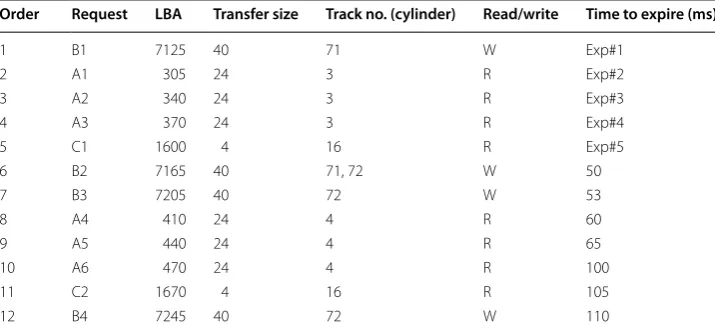
The following example highlights the issues with the current Linux I/O Schedulers. For simplicity, we assume a HDD with geometry of 1 platter, 100 sectors/track and 100 tracks/platter (see Fig. 3). Consider three processes with process id’s (pid) A, B, C sub-mitting I/O requests to the disk block layer in the order shown in Table 1 (from top to bottom).
We assume that process A and B submit large I/O requests (transfer size) in short time intervals, while C submits small I/O requests in long time intervals.
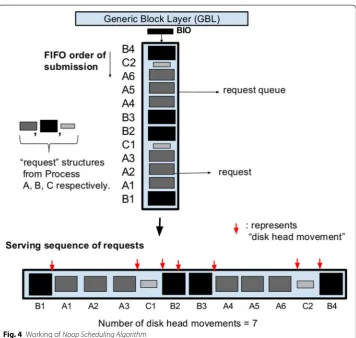
The working of the three scheduling schemes of the current Linux block I/O Schedul-ers for this example are shown below:
Observation Noop is suitable for those environments where the number of processes submitting large I/O requests (A and B) concurrently is small. Noop can perform well in such a scenario where applications themselves submit large requests which have inherent sequentiality. For large number of applications contending for the same stor-age media, Noop would cause large number of seeks due to multiplexing of requests from these processes. Adjacent requests (according to LBA) which arrive interleaved at the block layer (for ex: requests C1 and C2), are not provided the opportunity to coalesce and form sequences. Moreover, due to presence of requests from process C in between requests from bulky processes A and B, there is additional sequentiality loss of these bulky process. Also, if there are large number of processes like C (i.e. data trans-fer/seek is low) the disk I/O access time would increase significantly due to the FIFO nature of Noop.
Fig. 3 Geometry of the HDD with 1 platter, 100 sectors/track and 100 tracks/platter
Table 1 I/O request submission order to the block layer
An, Bn, Cnnth request of processes A, B, C submitted to the “request queue”, LBA starting logical block address (LBA) of the sorted “request” structure, Transfer size number of disk blocks required for data transfer, Track no. the track (or tracks) where the entire request spans, Read/write type of operation read ‘r’ or write ‘w’ performed by the request, Time to expire time left in milliseconds at system time ‘k’ for the request to expire as per the deadline determined by the Deadline Scheduling Algorithm, Exp#‘x’ Exp. denotes that the request has already expired and ‘x’ is the order in which it has expired
Order Request LBA Transfer size Track no. (cylinder) Read/write Time to expire (ms)
1 B1 7125 40 71 W Exp#1
2 A1 305 24 3 R Exp#2
3 A2 340 24 3 R Exp#3
4 A3 370 24 3 R Exp#4
5 C1 1600 4 16 R Exp#5
6 B2 7165 40 71, 72 W 50
7 B3 7205 40 72 W 53
8 A4 410 24 4 R 60
9 A5 440 24 4 R 65
10 A6 470 24 4 R 100
11 C2 1670 4 16 R 105
Deadline Scheduler The Deadline Scheduler tries to prevent starvation of requests. Each request is assigned an expiration time (reads = 500 ms, writes = 5000 ms) [6,
28]. There are two kinds of queues: Sorted Queues, where requests are sorted by disk access location and FIFO Queues, where requests are ordered according to deadline [2,
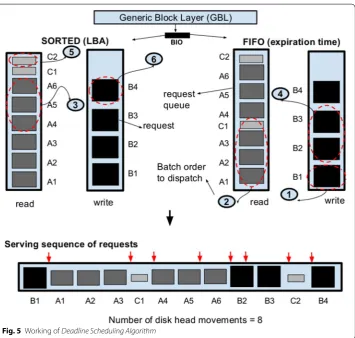
30]. Some implementation have just three queues: 2 FIFO queues and a common Sorted Queue [6]. For simplicity, we consider the former implementation with both FIFO and Sorted queues having separate Read and Write queues as shown in Fig. 5. The requests in the sorted queues are processed in batches (fifo_batch). The deadline scheduler keeps issuing request batches to the dispatch queue from the sorted queues unless the request at the head of the Read/Write FIFO queue expires [6, 13, 31].
Deadline Scheduler, despite its name, does not provide strict deadlines and actual I/O waiting times can be much higher. The selection of batches of requests from the queues is based on expiry of requests, otherwise requests are served from the sorted queues.
For the given example, we consider at system time ‘k’ the time to expire, i.e., the time left for expiration of each request, as determined by the Deadline Scheduling Algorithm. Deadline Scheduler tries to first dispatch those requests whose deadlines have already expired.
The “requests” from all the processes are staged in sorted (according to LBA) and FIFO (according to time_to_expire), in respective read and write queues, as shown in Fig. 5.
The selection of batches in which the requests are served as per Deadline Scheduling scheme is as follows:
batch1: {B1} →writeFIFO;
batch2: {A1,A2,A3,C1} →readFIFO;
batch3: {A4,A5,A6} →readSORTED; batch4: {B2,B3} →writeFIFO; batch5: {C2} →readSORTED; batch6: {B4} →writeSORTED.
Hence, batchj is the selection order of dispatch of a batch of request. Also, the arrow
“→” points to the I/O queue from which the batch is selected.
Here we see that batch1 has only 1 request ‘B1’ as its expiration is earlier than any other
request in the write FIFO queue as well as requests (batch2) in the read FIFO queue have
already expired. Once the expired requests are served, the scheduler picks batches from sorted queues (batch3). While serving all these requests, B2 and B3 expire, hence they
are scheduled (batch4). We observe that batch5 and batch6 also contain just one request
C2 and B4, respectively. This is due to all the requests already been scheduled from their respective batches. The switching of batches causes high number of disk seeks. Moreo-ver, when multiple processes of the same type submit I/O requests at the same time, this also adds to increased latency.
Observation For processes (such as A and B), which submit large I/O requests in short time intervals, deadlines of the requests would expire at the same time. The FIFO queues would have large number of requests whose deadlines have expired. Moreover, smaller processes such as C, might still suffer from long waiting time because of a large number of pending requests from other processes. With multiple processes submitting requests at the same time and expiration time being close, deadline scheduler would cause deceptive idle-ness [32]. Deceptive idleness is a condition when the scheduler would select requests from processes, leading to increased disk head seeks to disjoint locations in the disk. Thereby, Deadline based I/O scheduling leads to reduced throughput and result in large number of seeks [2, 6] for highly sequential and multi-process workloads like Hadoop MapReduce.
Completely fair queuing (CFQ) CFQ is the default disk I/O scheduler in the current Linux distribution [2, 7]. It divides the available I/O bandwidth among all the contending I/O request submitting processes [6]. CFQ maintains a location sorted queue for every process for synchronous (blocking) I/O requests and batches together asynchronous (non-blocking) requests from all processes in a single queue. During its time slice, a pro-cess submits requests to the dispatch queue which is governed by setting the param-eter quantum [31]. CFQ is suitable for environments where all processes need equal and periodic share of the block device like interactive applications.
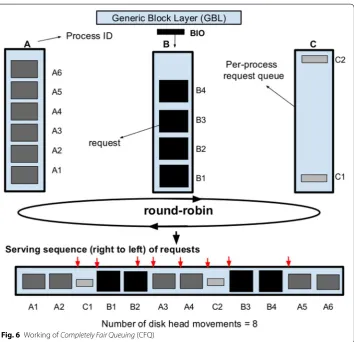
In Fig. 6, we see that CFQ maintains per-process queues and requests from each pro-cess (For ex: A, B, C).
The requests in the per-process request queue RQpid, where pid is the process id, are
as follows:
RQA: {A1,A2,A3,A4,A5,A6};
RQB: {B1,B2,B3,B4};
RQC: {C1,C2};
CFQ inserts requests to the dispatch queue in a round robin fashion according to “quantum,” which are then sorted in the dispatch queue. Thereby, in the first cycle (A1, A2), (B1, B2) and (C1) are selected in round-robin from each process request queue
RQA , RQB, and, RQC, respectively. Similarly {(A3, A4), (B3, B4), (C2)} & {(A5, A6)} in
the second and third cycle, respectively. In the “dispatch queue”, the requests are sorted according to their LBA values.
The final order of requests being served using CFQ is as follows: {A1, A2, C1, B1, B2, A3, A4, C2, B3, B4, A5, A6}
is undesirable for a multi-process environment with diverse disk I/O characteristics within request queue contending processes [2, 6, 7].
A fourth I/O Scheduling scheme, Anticipatory Scheduler has been discontinued from the Linux kernel. It associates a fixed waiting time (6 ms) for every synchronous (read) request [2, 6, 28]. In MapReduce environments, this would lead to increased CPU wait-ing time as well as lead to starvation of large number of requests.
Takeaway In summary, due to contention amongst different processes submitting
I/O to the storage device and the working of the current I/O schedulers, the inherent sequentiality of MapReduce processes are lost. They result into unwanted phenomenons such as interleavings and multiplexing [5] of requests sent to the device, thereby also adversely affecting system performance (CPU wait time, etc.) and increasing latency in disk based (HDDs) storage systems. We observe that the existing Block I/O schedulers do not support the set of requirements laid down in “Requirements from a block I/O scheduler in Big Data deployments” section and there is a clear need of new I/O sched-uling scheme for such Big Data deployments.
Figure 7 shows a sequence of requests that would be dispatched by an “Ideal” scheduler suitable for MapReduce type applications. We notice, that this scheduler has minimal disk head movements as well as provides high throughput (maximizing sequentiality). Such a scheduling scheme needs to be intelligent and dynamically adaptable to changing
I/O patterns. Further, such a scheduler should take into consideration all the require-ments laid out earlier in this section.
Our approach: BID “Bulk I/O Dispatch”
HDDs form the backbone of data centers storage. The effects of caching is negligible in an enterprise Big Data environment [23, 29] (refer to “Hadoop MapReduce: working and workload characteristics” section), therefore large number of page faults occur, which in turn result in most of the data accesses from the underlying storage. Hence, it is impera-tive to tune the data management software stack to harness the complete potential of the physical media in highly skewed and multiplexing Big Data deployments. As discussed in earlier sections, the block layer is the most performance critical component to resolve disk I/O contentions along the odyssey of I/O path. Unfortunately, despite its signifi-cance in orchestrating the I/O requests, the block layer essentially the I/O Scheduler has not evolved much to meet the needs of Big Data.
We have designed and developed two Contention Avoidance Storage solutions, col-lectively known as “BID: Bulk I/O Dispatch” in the Linux block layer specifically to suit multi-tenant, multi-tasking shared Big Data environments. In the first part of this sec-tion, we propose a Block I/O scheduling scheme BID-HDD for disk based storage. BID-HDD tries to recreate the sequentiality in I/O access in order to provide performance isolation to each I/O submitting process.
In the second part, we propose a hybrid scheme BID-Hybrid to exploit SCM’s (SSDs) superior random performance to further avoid contentions at disk based storage. In the hybrid approach, dynamic process level profiling in the block layer is done for decid-ing the candidates for tierdecid-ing to SSD. Therefore, I/O blocks belongdecid-ing to interruption causing processes are offloaded to SSD, while bulky I/Os are served by HDD. BID-HDD scheduling scheme is used for disk request processing and multi-q [10] FIFO architec-ture for SSD I/O request processing.
BID schemes are designed taking into consideration the requirements laid out earlier in “Requirements from a block I/O scheduler in Big Data deployments” section. BID as a whole is aimed to avoid contentions for storage I/Os following system constraints with-out compromising the SLAs.
BID‑HDD: contention avoiding I/O scheduling for HDDs
BID-HDD aims to avoid multiplexing of I/O requests from different processes running concurrently. To achieve this, we segregate the I/O requests from each process into con-tainers. The idea is to introduce dynamically adaptable and need-based anticipation time for each process, i.e. “time to wait for adjoining I/O request”. This allows coalescing of the bulky data accesses and avoid starvation of any requests. Each process container has a wait timer, based on inter-arrival time of requests and deadline associated with it. The
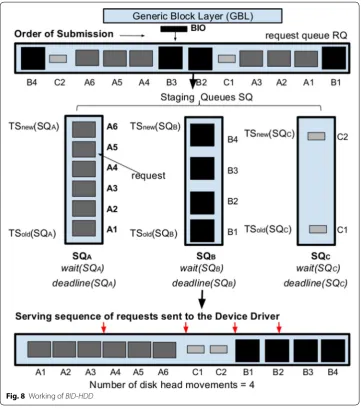
cess, BID uses separate containers known as staging queues for each process. BID-HDD groups the I/O requests into staging queues on the basis of the process id (pid) they belong to. The staging queue for a process p is denoted by SQp. SQp’s are not permanent
queues and are only created whenever the I/O requests of process p present in RQ are ready to be staged and there is no existing SQp. The staging queue for a process holds
the requests which are ready to be sent to the dispatch queue of the device (based on block device driver specifications.) The staging queue is important multi-fold: (1) for segregating I/O requests from each process; (2) provide more coalescing oppurtunuties under the assumption that bulky processes, send a large number of requests to adjoining locations in the physical media (for ex: 64 MB HDFS blocks); (3) provides BID dynamic adaptability to changing workload patterns. This is achieved through the following parameter associated with each staging queue SQp.
• Time stamp of the oldest request present in the queue, denoted by TSold(SQp).
• Time stamp of the newest request present in the queue, denoted by TSnew(SQp).
• Wait timer for next I/O request wait(SQp).
• Flush deadline timer deadline(SQp).
Dispatch queue DQ The dispatch queue DQ holds the requests which are ready to be
sent to the block device. The order of requests sent to the dispatch queue is managed by the I/O Scheduler, while the device driver specifications decide the number of requests the dispatch queue can hold at a time. The requests inside the dispatch queue are sorted according to LBAs. The requests from the dispatch queue are dequeued according to the
disk controller on the physical device.
Figure 8 shows the working of BID-HDD with the help of the I/O submission order as in Table 1. We now describe the working of BID1 in terms of the path the I/O requests
follow from the generic block layer to the device driver:
Enqueuing I/O request in request queue (RQ) The block layer synchronizes the access to shared exclusive resource, i.e. the request queue. The lock needs to be acquired by the process which inserts the block I/O request structures to the request queue [10]. Enqueuing in the request queue depends on the free space of the “request queue” and a block I/O request can only be inserted if the request queue RQ is not full. If the block I/O request can be merged with any existing requests, it is merged otherwise it forms a separate request structure.
ALGORITHM 1:Stage Requests
forevery processp∈P do
ifSQpnot presentthen
CreateSQp;
Create and setwait(SQp)anddeadline(SQp)with default values; ifSQpnot marked for flushingthen
DequeueRpfromRQand enqueue inSQp; Reset wait timerwait(SQp);
ifRpcontains a blocking I/O requestthen
ifRemaining time indeadline(SQp)>500ms.then
Reset deadline timerdeadline(SQp) = 500ms;
Dequeuing I/O request from request queue (RQ) to staging queues (SQ) Let R denote the set of requests currently present in “request queue”. Let P denote the set of processes which have their requests currently enqueued in request queue. Let Rp denote the set of I/O requests out of R which belong to process p∈P. The I/O requests are dequeued from request queue and enqueued in the corresponding staging queue as described in Algorithm 1.
weighted mean as the wait timer value. Whenever SQp is created, i.e. when the historic k
time difference values are not available, the value of wait timers is set to a default value. The main idea here is to exploit the inter-arrival time of batches of requests from a process to profile the processes I/O characteristics. The wait timer, therefore provides more opportunity to coalesce adjoining requests from a process for maintaining sequen-tiality as well as in the same time avoid multiplexing from other processes.
It can be seen that the wait timer wait(SQp) is dynamic and adapts to the
chang-ing process I/O characteristics. However, the wait timer is also deleted along with SQp
after flushing. Whenever the wait timer wait(SQp) for SQp is expired, SQp is marked for
flushing.
Deadline timer for staging queue Use of wait timer alone can cause starvation, as stag-ing queue SQp which always gets enqueued with request(s) before wait(SQp) expires
will never be flushed. Additionally, a non-bulky process might suffer due to large wait time. To avoid such situations BID employs a deadline timer. The deadline timer
deadline(SQp) of a staging queue SQp indicates maximum allowable time the queue
SQp can exists before marked for flushing. The deadline of a staged queue SQp depends
on the type of requests in the staging queue SQp. If there are only non-blocking I/Os
(writes) in SQp, deadline(SQp) is set initially to 5000 ms. Whenever a blocking I/O (read)
request is enqueued to SQp, the deadline(SQp) is set to 500 ms if its current value is
more than 500 ms. The reseting of deadline deadline(SQp) ensures that blocking I/Os do
not encounter higher delays. Whenever deadline(SQp) expires, SQp is marked for
flush-ing. The deadline timer also ensures that a process with high disk I/O (bulky) does not starve another process with lighter disk I/O (non-bulky).
ALGORITHM 2:Flush Requests: Pipelining
forevery “staging queue” marked for flushing, selectSQp which was marked earliest.do
Dispatch all I/O requests fromSQptoDQ; DeleteSQp;
Deletewait(SQp)anddeadline(SQp);
Marking staging queue for flushing BID-HDD marks a staging queue for flushing
whenever any of the timers (wait(SQp) or deadline(SQp)) expires. Flushing denotes the
process of sending the I/O requests currently enqueued in SQp to the dispatch queue
in Algorithm 2, BID dispatches the requests from the earliest marked staging queue and follows the marking sequence. The size of dispatch queue depends on the device driver specification and all the I/O requests from staging queue may not get dispatched at once. BID ensures that a staging queue is fully flushed before considering the next marked staging queue. This prevents multiplexing of I/O requests, thereby involves less movement of the disk arm to disjoint locations in the physical media.
In BID-HDD, the efficient pipelining of large data blocks groups (as shown in Fig. 8) from adjoining locations in the disk leads to reduction in disk arm movements (lever-aging sequentiality performance) along with dynamic and need-based anticipation time ensures performance isolation to each I/O contending processing following system con-straints without compromising the SLAs. BID-HDD is essentially a contention avoid-ance technique which can be modeled to cater different objective functions (storage media type, performance characteristics, etc.).
BID‑hybrid: contention avoidance utilizing multi‑tier architecture
Due to physical limitation of HDDs, there have been recent efforts to incorporate flash based high-speed, non-volatile secondary memory devices, known as SCMs in data centers. Despite superior random performance of SCMs (or SSDs) over HDDs, replac-ing disks with SCMs completely for data center deployments doesn’t seem to be feasible economically as well as due to other associated issues discussed briefly in “Secondary storage (block device) characteristics” section [1, 9].
With recent developments in NVMe devices, with supporting infrastructure, and, virtualization techniques, a hybrid approach of using heterogeneous tiers of storage together such as those having HDDs and SSDs coupled with workload-aware tiering to balance cost, performance and capacity have become increasingly popular [1, 3, 12,
25].
Data centers consists of many tiers of storage devices. All storage devices of the same type form a tier [21]. For example: all HDDs across the data-center form the HDD tier and all SSD form SSD tier, and similarly for other SCMs. Based on profiling of workloads, balanced utility value of data usage, the data is managed between the tiers of storage for improved performance. Workload-aware Storage Tiering, or simply Tiering [3, 4] is the automatic classification of how data is managed between heterogeneous tiers of storage in enterprise data-center environment [33]. It is vital to develop automated and dynamic tiering solutions to utilize all the tiers of storage. BID-Hybrid aims to deliver the capability of dynamic and judicious automated tiering in the block layer as a SDS solution.
Initial tier placement and BID-hybrid Our solution, BID-Hybrid, lies in the “initial tier placement” class of problem in tiering. The main objective function of “initial tier place-ment” problem is the balanced decision of which tier the data is to be initially written in-order to reap the maximum performance benefits.
on deviation of LBAs, BID-Hybrid profiles process I/O characteristics by utilizing dynamic anticipation and I/O packing. BID-Hybrid uses similar concepts of staging as BID-HDD. Due to the staging capabilities in the Host (OS) block layer, bulkiness of pro-cesses can be calculated and verified on-the fly in-order to avoid unnecessary depor-tations to SSD. The key idea is to offload I/O blocks belonging to non-bulky processes to SSD (managed by multi-q block layer architecture [10]) and the bulky I/Os to HDD (handled by BID-HDD). This serves multi-fold: (1) maximal sequentiality in HDD is ensured, i.e “HDD request queue” is made free from unnecessary contention and inter-ruption causing blocks; (2) the future references to the non-bulky blocks are prevented from causing contentions for HDD disk I/O, as the semantic blocks have a high prob-ability to appear in the same pattern [8, 28, 34]. Therefore, BID-Hybrid aims to further reduce contention (more than BID-HDD) at disk based storage by offloading interrup-tion causing blocks to SSD, while ensuring uninterrupted sequential access to HDDs.
Figure 9 shows the architecture of BID-Hybrid in multi-tier storage environments with the help of the I/O submission order as in Table 1. To show the effectiveness in offloading non-bulky requests to SSD during initial write, we change the type of opera-tion from “reads” to “writes” of requests C1, C2 belonging to process C. In Fig. 9, we have shown the VFS, Volume Manager, Mapping Layer and VFS-SSD as a single layer, to imply that it spans across the cluster and provides the storage virtualization functionali-ties of abstracting data locality from the applications and unwrapping data location for execution of I/O to the appropriate storage device. A file can span across multiple stor-age devices but appear to the applications to be stored on a single device.
BID-Hybrid modifies the block layer (extend the capabilities of BID-HDD modifica-tions) in-order to take tier-placement decision as well as leverage storage virtualizations such as VFS for infrastructural support for offloading and locating tiered SSD blocks. The working of BID-Hybrid is described as follows:
is found in the VFS-SSD table, it is enqueued to the block layer of the respective SSD device. After the data location filtration, those I/O access requests which are not present in VFS-SSD table are enqueued to the block layer of the respective HDD.
Tier categorization and placement Those accesses intended for HDDs, follow the
steps exactly as BID-HDD, i.e. enqueuing I/O request in request queue RQ, dequeu-ing I/O request from RQ to respective process staging queue SQP, compute the wait
and deadline timer, mark staging queue SQP for flushing (see “BID-HDD: conten-tion avoiding I/O scheduling for HDDs” section and Algorithm 1). Once the staging queue SQP is marked for flushing, the tier placement and categorization decisions for
the writes is performed. The placement decisions are made once the anticipation time
wait(SQP)or deadline(SQP)timer has expired. Each staging queue SQP has ample
time to merge adjoining requests as well as processes also have time to submit I/Os to the request queue RQ. This makes the profiling of staging queue SQP’s more judicious,
thereby making tier categorization decisions more accurate. Please note, the read only staging queues by-pass the Tier-Categorization and Placement layer as they are those requests which have already been written and the tier placement decision had consid-ered them HDD favorable.
For performing the tiering classification, BID-Hybrid uses a quantity called
Packing Fraction PF(SQP) for determining the bulkiness of any process. PF(SQp) is
associated with every staging queue SQP and is defined as the ratio of cumulative I/O
access size of all write requests (in units of 512 byte disk blocks) and the total number of write requests present in SQP (in terms of “request” kernel I/O structures). The tier
placement and categorization decision and dispatch of I/Os follows Algorithm 3. Process A
Applications Host (OS) VFS-SSD
Storage
Device Interface Layer
(Drivers, Switch, HBAs, PCIe Express (NVMe), etc.)
Process B Process C
Mapping Layer Volume Manager
(LUN, LVM, etc.)
VFS
Data Location Filtering Layer
Process Xn
HDDy
HDDp
HDD1 HDD2
Block Layer HDDp Submit I/O
BID Scheduling
Tier Categorization & Placement
Staging Queues SQ Request Queue RQ
Block Layer SSDq SQA SQB SQC
wait(SQA) wait(SQB) wait(SQC) deadline(SQA) deadline(SQB) deadline(SQC) Packing Fraction PF(SQA) PF(SQB) PF(SQC)
Dispatch Queue DQ SQA, SQB to HDD
Number of head movements = 3
SQCoffloaded to SSD
Multi-q architecture
Per-core Software & Hardware Queue Management
I/O Scheduling (Per-queue FIFO.).
SQC
HDD Tier SSD Tier
C2 C1
SQC Queues for other processes
SSD1 SSD2 SSDq SSDx
I/O requests inSQpare SSD favorable;
Transfer write I/O requests to SSD I/O request queue; MarkSQpfor flushing to HDD dispatch queue;
Key intuition It is based on the working of the block layer and kernel sub-structures in coalescing maximum adjoining BIO (block I/O) structures in a request structure. Big Data applications access data in large chunks. For example, MapReduce processes access data in 64 MB HDFS chunks. Therefore, the resultant “request” structures tend to be bulky (more data per request), i.e. high Packing Fraction PF(SQP). However due to time varying I/O characteristics and nature of application some MapReduce applications might have stages (processes) in which data accesses are small and random (for eg: small intermediate writes subsequent reads, shuffle and combine intermediate data, etc.) [23,
28]. Therefore, the resultant I/O “request” structures tend to be lighter or non-bulky, i.e. have low Packing Fraction PF(SQP). The I/Os from non-bulky light processes, culminate into increasing contentions resulting into breaking the sequentiality of I/Os from bulky processes. Moreover, future references to these interruptions have a high probability to occur in the same fashion [23].
Once the tiering decisions are made, the bulky or HDD favorable staging queues are marked for flushing to the HDD dispatch queue. The flushing of the HDD favorable stag-ing queues follows the pipeline as described in Algorithm 2. The management of non-bulky SSD favorable I/O requests is done as follows:
The transfer of data is managed as per the tier migration model, i.e. the Host (OS) initiates a process to transfer the I/O requests belonging to non-bulky or SSD favora-ble staging queues via the network through peer-to-peer data transfer protocol to the Host (OS)-of targeted SSD. Storage virtualization provides additional features for move-ment of data between tiers and machines via efficient inter-connect technologies such as RDMA (Remote Direct Memory Access), Infiniband, RCoE (RDMA over converged Ethernet), etc. [35].
Consider Fig. 9, amongst the I/O access requests for processes A, B, C,
staging queue SQC is found to be an ideal candidate for tiering. The I/O requests for
process C are determined to be “non-bulky”, due to its low Packing Fraction PFC. While processes A and B are determined to be bulky. Therefore, the staging queues SQA&SQB flush request as per BID-HDD, while requests belonging to process C is managed by the SSD block layer using Multi-q [10] architecture via per queue FIFO based scheduling.
Using the above for contention avoidance storage solutions, BID schemes are capable of delivering higher performance. In the next section, through trace-driven simulation experiments using cloud emulating Hadoop benchmarks, the performance of BID-HDD and BID-Hybrid is evaluated and compared with the current Linux scheduling schemes.
Experiments and performance evaluation
Through trace-driven simulations and in-house developed system simulators, we con-ducted experiments for evaluating the performance of our schemes, i.e. BID-HDD and BID-Hybrid.
Testbed: emulating cloud Hadoop workloads and capturing block layer activities
For our experiments, we select industry and academia wide used Hadoop benchmarks considering a wide diaspora of I/O workload characteristics, as specified in HiBench [36]
and TPC Express Benchmark (TPCx-HS)-Hadoop suite [37]. These benchmarks have
been designed to recreate enterprise Hadoop cloud environments, stressing the hard-ware and softhard-ware resources (storage, network and compute) as observed in production environment. For example, TeraSort is a popular compute and disk intensive MapRe-duce benchmark used for emulating cloud environment workloads under heavy load with multiple chained MapReduce processes running concurrently. Consider Table 2 for the set of Hadoop workloads with varying I/O characteristics we used for the capturing the block I/O layer activities.
Our experimental testbed, see Fig. 10, consist of our Hadoop cluster and Trace collec-tion nodes. We ran the benchmarks on our Hadoop cluster having Hadoop v2.6.5 with latest implementation of YARN resource negotiator. The cluster topology consists of one NameNode and 8 DataNodes, each with two 4-core AMD Operon 2354 processor, 8 GB Memory and 250 GB Serial ATA (SATA) HDD.
System simulator
We have designed and developed a system simulator using Python v2.7.3 to replicate the working of the system level components (Host OS, Storage devices, etc.). We use the trace file (as discussed in “Testbed: emulating cloud Hadoop workloads and capturing block layer activities” section) for application I/O submission order. The Simulator has three major modules: (a) VFS Simulator performs VFS for locating and book-keeping; (b) OS Simulator takes the order of I/O submissions and performs Linux Kernel block layer functions (contains pluggable I/O Scheduler sub-module); and (c) Storage Simula-tor takes input from OS Simulator and returns performance metrics. The details of each of the components (see Fig. 11) is discussed below.
• OS Simulator This module takes the collected workload I/O traces (Trace File) as
input and recreates the Kernel Block Layer functions after the stage from which
the traces were collected (refer to “Testbed: emulating cloud Hadoop workloads
and capturing block layer activities” section). It performs Kernel block I/O
opera-tions such as: (1) making block I/O (BIO) structure from traces; (2) enqueuing BIO
request structures to the “request queue RQ” based on RQ limitations; (3) plugga-ble I/O Scheduling: merging, sorting, re-ordering, staging, etc. as per the Scheduling scheme; (4) managing the I/O requests inflow and outflow in the “dispatch queue” as per the device driver specifications; (5) dispatching requests from dispatch queue to the block device. The I/O Scheduling sub-module is made pluggable so that differ-ent scheduling schemes can be tested. Simulator provides the flexibility to configure parameters like: data holding size of each BIO structure, request queue size, dispatch
queue size and block device driver parameters. In the case of the Hybrid Approach, the OS Simulator (1) makes Tier Placement decisions; (2) interacts with the VFS to map the LBA entries offloaded to SSD for future reference; (3) spawns the process on
the block layer for appropriate SSD as per the multi-queue architecture [10]. To
pre-serve the I/O characteristics of the workloads, the requests are submitted based on the timestamp from the trace file to the kernel block layer.
• VFS Simulator The main function of VFS is to locate the blocks required by applica-tions. The VFS and the Mapping layer along with abstractions such as logical volume manager provide storage virtualization. This enables storage pooling, capacity utiliza-tion and unifying storage with heterogeneous devices which aids data migrautiliza-tion and placement policies. As the traces already have the LBA and targeted block device, so the simulator is designed to work in case of Hybrid “tier placement” decisions, as the change of target device is taken on the fly. The VFS-SSD sub-module stores in a table, which data is stored in which block device. This aids in finding the location of future reference to already written data.
• Storage Simulator This module takes the I/O requests from the dispatch queue of
the OS Block Simulator and based on the device type (HDD or SSD), return per-formance metrics like completion time depending on the current state of the block device. The module takes block device configuration parameters as inputs (device driver) such as drive capacity, block device type (HDD or SSD), etc. For HDDs, drive parameters include geometry, no. of disk heads, no. of tracks (cylinders), sectors/ track, rotations per minute (RPM), command processing time, settle time, average
with different devices as well as drive architectures.
Performance evaluation: results and discussions
We compare the effectiveness of our Contention Avoidance or I/O Scheduling schemes, BID-HDD and BID-Hybrid, with the two best performing Linux kernel block I/O sched-ulers used in the enterprise deployments, namely, CFQ and Noop. CFQ performs well in almost all workloads in terms of I/O bandwidth fairness, while Noop is selected due to its superior performance in some MapReduce workloads which have high degree of sequentiality [6, 28]. Deadline I/O Scheduling leads to reduced throughput and result in large number of seeks [2, 6] for highly sequential and multi-process workloads like Hadoop MapReduce. As the processes submit large number of I/Os in short interval of time, therefore, this leads to expiry of most of the requests in the queue and it eventually acts as a FIFO queue (refer to “Issues with current I/O schedulers” section). Hence, we compare our solutions with CFQ and Noop.
For our experiments, we use the default parameters as shown in Table 3, which is based on the storage devices and driver specifications.
Based on trace-driven simulations, we analyze the performance of different block level contention avoidance schemes, i.e. BID-HDD, BID-Hybrid, CFQ, and Noop.
Cumulative I/O completion time
Figure 12 represents the cumulative time taken (x-axis) by the block device (in case of Hybrid approach, devices) to fulfill all the I/O requests2 using different schemes. This
graph shows the effectiveness of the scheduling schemes, as the order in which the I/O requests are submitted to a block device plays a significant time in deciding the time taken to fulfill them.
Figure 12 demonstrates that BID-HDD outperforms CFQ and Noop for all the work-loads. The savings in cumulative I/O completion time is maximum for WordStandard-Deviation & Grep, which have a relatively higher degree of sequentiality than others. BID-HDD requires only about 50% of the time taken by CFQ to serve the same set of I/O requests.
An interesting observation is that Noop outperforms CFQ, requiring 12% lesser time for workloads with higher inherent sequentiality in I/O accesses. The FIFO characteris-tics of Noop, tends to preserve the sequentiality of processes, whereas CFQ in the advent
of being fair to all contending processes (in terms of I/O bandwidth), multiplexes the requests. This nature of CFQ is evident from Fig. 13, which shows the disk arm move-ments in terms of HDD track accesses (y-axis) during the course of WordStandardDe-viation workload. CFQ results in higher number of disk arm movements between tracks (more vertical lines), thereby resulting in higher I/O completion time due to round-robin switching of per-process queue.
Figure 13b, c, show very similar track or I/O access pattern in Noop and BID-HDD, respectively, yet there is a significant difference in the cumulative I/O access times. A careful examination reveals that though the number of long distance track changes could be similar, the number of short distance track changes (density of black lines) are much larger in Noop than in BID-HDD. From Fig. 13a, c, it is observed that BID reduces both the long strokes as well as the short strokes as compared to CFQ. Due to staging capabil-ities and dynamic adaptability, BID-HDD makes justified decisions, thereby reducing the number of head movements as well as increasing the opportunity to coalesce requests together. This is evident from Fig. 14, which shows the magnified view of Fig. 13a–c between timestamps t1 and t2.
We believe there is some kind of Amortization effect occurring due to bulkiness of I/ Os. We notice from Fig. 14, that Noop has rigorous disk head movements3, while
BID-HDD linearizes depicting the serving of I/Os in bulk to storage and reducing preventable
3 We use the terms “Disk Arm Movements” and “Disk Head Movements” interchangeably in this document.
Table 3 Block device parameters in use for performance evaluation
Block device Default parameters
HDD Maximum “request” structure size = 512 kB
Request queue size = 256 BIO structures (128 reads, 128 writes) Max. size of each block I/O (BIO) structure = 128 × 4K pages 1 page (bio vec) = 8 × 512-byte disk sectors (block) Access granularity (disk block sector size) = 512 bytes Specification based exactly as our 250 GB Hadoop cluster HDD SSD Block size = 256 pages; page size = 4 kB = access granularity
Access time: read = 0.025 ms; write = 0.5 ms Specification based on SLC Flash SSD [9]
disk arm movements. Few initial I/Os of the sequential group might experience a higher latency, however, due to lower latencies experienced by the later I/Os, their overall aver-age latency is reduced. We also observe the dynamic adaptable capability of BID-HDD especially in skewed workload environments. For every process the I/O bandwidth time changes depending on the workload characteristics and process I/O profiling.
BID-Hybrid is able to further improve the performance of BID-HDD for all workloads by 6 to 23%, with maximum gain in the case of WordCount workload (see Table 2). In WordCount, the sequentiality of the reads is preserved due to the displacing of interrup-tions, i.e. large number of small writes, which would have contended for HDD I/O time. The bulky processes are handled in HDD via BID-HDD scheduling scheme, while the
Fig. 13 Disk arm movements for WordStandardDeviation workload. a CFQ, b Noop, c BID-HDD
Fig. 14 Disk head movements for Noop, CFQ and BID-HDD between timestamps t1 and t2 for
non-bulky (small) write I/O submitting processes are deported to SSD (by Tier Catego-rization Layer), which is served by the Multi-queue [10] block layer of SSD. This serves multi-fold, first maximal sequentiality in HDD is ensured, i.e. preventing the avoidable disk arm movements (interruptions). Secondly, preventing future interruptions in HDDs sequentiality, as the blocks which are non-bulky have a high probability to appear in the same pattern [8, 28, 34]. This in turn would lead to further smoothening of the BID-HDD graph of Fig. 14, with spikes in the graph being leveled.
Takeaway 1 BID-HDD handles the contention at the block layer while preserving the inherent sequentiality (bulkiness) of processes in all MapReduce workloads. This results in fewer disk arm movements, leading to reduction in I/O access time as compared to other scheduling schemes.
Takeaway 2 BID-Hybrid is further able to reduce the contention at the HDD block
layer by taking displacement decisions for small (in terms of I/O request size) but perfor-mance incongruous processes to SSD. Thereby providing more opportunity to sequen-tialize processes submitting bulky I/Os as well as avoiding preventable disk seeks. The impact of this reduced I/O access time on total application execution time can be much higher, as the CPU wait times is reduced [5, 8, 10].
Takeaway 3 Noop can result in better I/O performance than CFQ for highly sequential workloads, as Noop can maintains the sequential order but CFQ in the effort of being fair to all processes leads to more disk seeks thereby higher I/O completion time.
Number of disk arm movements
Figure 15 shows the disk arm movements incurred by all workloads. BID-HDD and
BID-Hybrid leads to fewer disk head movements as compared to all other scheduling schemes in all the MapReduce workloads. The amortization affect of BID attributes to the reduction in disk arm movements, as discussed in “Cumulative I/O completion time” section and Fig. 14. In BID-HDD, the dynamically adaptable anticipation and the efficient pipelining of flushed requests from staging queues of processes are responsible for capitalizing the sequentiality, thereby reducing the disk arm movements. Workloads which have a high degree of sequentiality experience the maximum reduction in entropy of disk arm movements.
In Hybrid solution, we observe that the disk head movement reduction w.r.t. BID-HDD, is maximum in workloads like TeraSort (gain 50%), with mixed I/O
characteris-tics, Sequential reads/writes along with large number of small (random) reads/writes. Therefore, BID-Hybrid is able to successfully capture the deviation causing lighter I/O accesses during the initial tier placement (write) and offload them to SSD. These lighter I/O requests potentially could have adversely affected the sequentiality of bulky processes. They also prevents future contentions on HDD request queue arising from these I/O accesses, in turn providing the higher opportunity to maintain the inherent sequentiality.
High rate of disk arm movements adversely affects the SLAs as well as the TCO. It is extremely imperative to reduce the disk arm movements in-order to avoid disk failures (also the risk of data loss).
Disk head movement (seek) distance
Figure 16 shows the average seek distance per disk head movement (ADseek) in terms of number of disk cylinders (tracks) crossed. An interesting observation is that, CFQ outperforms all other schemes in most of the workloads. The main reason for the low average ADseek is higher number of cumulative head movements “n” (see Fig. 15), which occur due to round-robin nature of CFQ.
where, SeekTrackNumberi is the track or cylinder number of the ith request. The error bars (standard deviation) for every scheduling scheme is fairly large. This is due to the nature of distribution of disk arm movement distances. For the considered workloads, the disk arm movement distance is either much larger than mean distance or much smaller than mean distance. Therefore, the total distance traversed by the disk arm and number of disk head movements have no direct correlation. This is attributed to the skewness in the workload patterns as well as layout of the data stored in the disk, i.e. dif-ferent applications store data in difdif-ferent zones (regions) in the disk.
Figure 17 shows the total seek distance (TDsweep) traversed by the disk head in the course of serving all I/Os for different workloads. The distance is not shown in terms of number of tracks (cylinders), as the values tend to be very large. Instead, we chose the unit of distance to be one full disk sweep worth of tracks.
For example, consider the I/O submission order in Table 1. The output sequence (in terms of track numbers) by employing CFQ is as follows:
{3, 3, 16, 71, (71, 72), 3, 4, 16, 72, 72, 4, 4}. ADseek=
Cumulative Track Movement Distance“TMDseek” Cumulative Head Movements“n”
TMDseek= i=n
i=0
|SeekTrackNumberi+1−SeekTrackNumberi|
TMDseek= |16−3| + |71−16| + |72−71| + |3−72| + |4−3|
Thus, the total distance of disk arm movements to serve the grep workload when CFQ is employed is same as the distance the disk arm will move when HDD is sweeped fully for 380 times (refer to Fig. 17). Figure 17 shows the overall impact of employing a scheduler. It also shows that both, BID-HDD and BID-Hybrid drastically reduce the total distance traversed by the disk arm. Similar justification of the amortization effect in BID schemes, as discussed in previous sections, can be given for the reduction in disk arm movement distances. Distance traveled is related to the work done, or energy expended, therefore, BID schemes can also result in reduction in the energy footprint of storage systems.
It can be argued that the scheduler performance pattern observed in Cumulative I/O Completion Time, Fig. 12 and total distance covered Fig. 17 should be similar. However, the relationship between distance traveled by disk arm and time taken is non-linear. For example, disk head movement between tracks 100 cylinders apart doesn’t take 100 times the time taken between adjoining cylinders. There are few disk seeks which are non-preventable, which depend on which zone/regio