Open Access
Review
Holoprosencephaly
Christèle Dubourg*
1,2, Claude Bendavid
1,2, Laurent Pasquier
3,
Catherine Henry
4, Sylvie Odent
3and Véronique David*
1,2Address: 1UMR 6061 CNRS, Institut de Génétique et Développement de Rennes, Université de Rennes1, IFR 140 GFAS, Faculté de Médecine,
Rennes, 35000, France, 2Laboratoire de Génétique Moléculaire et Hormonologie, Centre Hospitalier et Universitaire de Pontchaillou, Rennes,
35000, France, 3Service de Génétique Médicale, Hôpital Sud, Rennes, 35000, France and 4Laboratoire de Cytogénétique, Centre Hospitalier et
Universitaire de Pontchaillou, Rennes, 35000, France
Email: Christèle Dubourg* - [email protected]; Claude Bendavid - [email protected];
Laurent Pasquier - [email protected]; Catherine Henry - [email protected]; Sylvie Odent - [email protected]; Véronique David* - [email protected]
* Corresponding authors
Abstract
Holoprosencephaly (HPE) is a complex brain malformation resulting from incomplete cleavage of the prosencephalon, occurring between the 18th and the 28th day of gestation and affecting both the forebrain and the face. It is estimated to occur in 1/16,000 live births and 1/250 conceptuses. Three ranges of increasing severity are described: lobar, semi-lobar and alobar HPE. Another milder subtype of HPE called middle interhemispheric variant (MIHF) or syntelencephaly is also reported. In most of the cases, facial anomalies are observed in HPE, like cyclopia, proboscis, median or bilateral cleft lip/palate in severe forms, ocular hypotelorism or solitary median maxillary central incisor in minor forms. These latter midline defects can occur without the cerebral malformations and then are called microforms. Children with HPE have many medical problems: developmental delay and feeding difficulties, epilepsy, instability of temperature, heart rate and respiration. Endocrine disorders like diabetes insipidus, adrenal hypoplasia, hypogonadism, thyroid hypoplasia and growth hormone deficiency are frequent. To date, seven genes have been positively implicated in HPE: Sonic hedgehog (SHH), ZIC2, SIX3, TGIF, PTCH, GLI2 and TDGF1. A molecular diagnosis can be performed by gene sequencing and allele quantification for the four main genes
SHH, ZIC2, SIX3 and TGIF. Major rearrangements of the subtelomeres can also be identified by multiplex ligation-dependent probe amplification (MLPA). Nevertheless, in about 70% of cases, the molecular basis of the disease remains unknown, suggesting the existence of several other candidate genes or environmental factors. Consequently, a "multiple-hit hypothesis" of genetic and/ or environmental factors (like maternal diabetes) has been proposed to account for the extreme clinical variability. In a practical approach, prenatal diagnosis is based on ultrasound and magnetic resonance imaging (MRI) rather than on molecular diagnosis. Treatment is symptomatic and supportive, and requires a multidisciplinary management. Child outcome depends on the HPE severity and the medical and neurological complications associated. Severely affected children have a very poor prognosis. Mildly affected children may exhibit few symptoms and may live a normal life. Published: 2 February 2007
Orphanet Journal of Rare Diseases 2007, 2:8 doi:10.1186/1750-1172-2-8
Received: 1 September 2006 Accepted: 2 February 2007
This article is available from: http://www.OJRD.com/content/2/1/8
© 2007 Dubourg et al; licensee BioMed Central Ltd.
Disease name and synonyms
Holoprosencephaly (HPE)
Midline cleft syndrome
DeMyer sequence
Isolated HPE (non syndromic, non chromosomic)
Familial HPE
Arhinencephaly
Cyclopia
Definition
Holoprosencephaly (HPE, MIM 236100) is a complex human brain malformation resulting from incomplete cleavage of the prosencephalon into right and left hemi-spheres, occurring between the 18th and the 28th day of gestation. Three levels of increasing severity are described [1]: lobar HPE, where the right and left ventricles are sep-arated, but with some continuity across the frontal cortex; semilobar HPE with a partial separation, and the most severe form, alobar HPE, with a single brain ventricle and no interhemispheric fissure. Another milder subtype of HPE called the middle interhemispheric variant (MIHF) or syntelencephaly, has now been recognized [2,3] (Table 1). There is a continuous spectrum of abnormal separa-tion of the hemispheres rather than clearly distinct divi-sion into these three types of malformation [4]. The forebrain malformations are generally associated with facial anomalies, ranging from anophthalmia, cyclopia or proboscis in the most severe cases, to midline cleft lip, a simple hypotelorism or even no anomalies in the less severe HPE forms [5,6] (Table 2). The HPE phenotypic spectrum also encompasses microforms including facial midline anomalies with a normal brain. This wide spec-trum can be observed within the same family [7].
HPE is a genetically heterogeneous anomaly and this phe-notype is known to be part of different syndromes or chromosomal anomalies.
Epidemiology
Holoprosencephaly is the most common forebrain devel-opmental anomaly in humans with prevalence of 1/ 16,000 in live borns [8-11], an incidence as high as 1:250 in conceptuses [12], and a worldwide distribution. But considering the advances in neuroimaging with magnetic resonance imaging (MRI), children with less severe forms, like the recently described MIHF or lobar forms, who were undiagnosed, should be now identified leading to an increasing prevalence of the disease [13].
Clinical description
As mentioned above, HPE is a complex brain malforma-tion resulting from incomplete cleavage of the prosen-cephalon, affecting the forebrain. Therefore, clinical manifestations involve the central nervous system with possible facial dysmorphism and various complications [14]. Due to recent molecular data, the HPE phenotypic spectrum is very large ranging from severe cerebral malfor-mations to a microform. This latter form can be defined by MRI normal brain, but with facial anomalies including ocular hypotelorism, midline cleft lip and/or flat nose.
Nowadays, most of severe HPE cases are detected by sys-tematic ultrasound scan and MRI during pregnancy. This prenatal diagnosis often leads to termination of preg-nancy, after genetic counseling, regarding to the severity of the malformations. Milder HPE cases or microforms are usually not available to prenatal diagnosis due to macro-scopic normal brain. Nevertheless, these children show clinical spectrum of HPE described below.
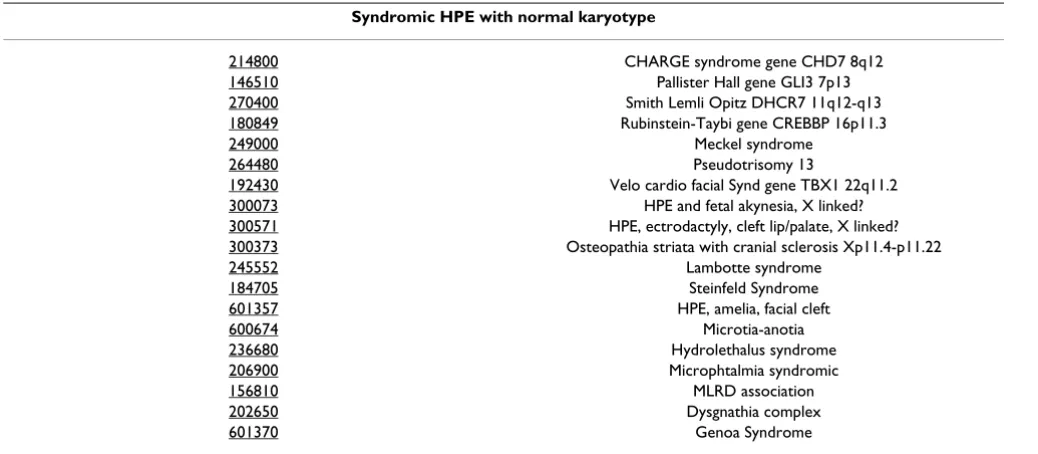
In any case, it is important to establish whether the HPE is an isolated brain malformation or part of a syndrome with other systemic manifestations (Table 3)[15] to con-sider genetic counseling.
Anatomical description
The HPE brain malformation is an incomplete cleavage of the forebrain, with three classical levels of decreasing severity, alobar, semilobar and lobar, described in the def-inition and whose anatomic features are given in Table 1. This classic definition is not ambiguous, but problems are encountered at less severe ends of the phenotypic spec-trum, which includes absent olfactory tracts and bulbs (arrhinencephaly), agenesis of the corpus callosum, hypo-pituitarism, single maxillary central incisor [16]. Less clas-sical features were also described associated with HPE genes like hypoplasia of the pyriform aperture, ocular anomalies or anomalies of the extremities [7]. Simon et al. [4] established that the degree of deep gray nuclei non-separation parallels the degree of hemispheric non-sepa-ration.
most of the time members of a family who only share a mutation with the proband but do not present any brain MRI anomalies.
Clinical evaluation in HPE children and complications Children with HPE experience many medical problems that need to be detected:
Neurological signs
Developmental delay is present in all live born HPE patients, and seems in agreement with the severity of the brain malformation. Approximately half of the patients with HPE develop epilepsy. Hydrocephaly can occur dur-ing pre- or postnatal development. Many others signs like mental retardation, hypotonia, weakness, spasticity, dys-tonia and abnormal movements are described.
Craniofacial malformations
Microcephaly, hypotelorism or hypertelorism, midline or lateral cleft lip and/or palate, flat nose, iris coloboma, sin-gle maxillary central incisors and hypoplasia of the pyri-form aperture are often noticed.
Endocrine disorders
Diabetes insipidus, growth hormone deficiency, adrenal hypoplasia, hypogonadism, or thyroid hypoplasia are very frequent in HPE because the midline malformation affects the development of the hypothalamus and the pituitary gland.
Oromotor dysfunction
Feeding and swallowing difficulties are frequent and gen-erally correlate with the grade of HPE, leading to a
require-Table 1: Anatomic classification of HPE -Different levels of severity [1] [6]
ALOBAR (complete) Small single forebrain ventricle No interhemispheric division Absence of olfactory bulbs and tracts Absence of corpus callosum Non separation of deep gray nuclei
SEMI-LOBAR Rudimentary cerebral lobes Incomplete interhemispheric division
Absence or hypoplasia of olfactory bulbs and tracts Absence of corpus callosum
Varying non separation of deep gray nuclei
LOBAR Fully-developed cerebral lobes Distinct interhemispheric division Midline continuous frontal neocortex Absent, hypoplasic or normal corpus callosum Separation of deep gray nuclei
MIHF Failure of separation of the posterior frontal and parietal lobes Callosal genu and splenium normally formed
Absence of corpus callosum
Hypothalamus and lentiform nuclei normally separated Heterotopic gray matter
Table 2: "The face often predicts the brain" [5, 110]. Parallelism of face and brain phenotypes generally observed in HPE.
Group Morphology HPE degree
(I) Cyclopia Single or double eye
Proboscis
Alobar
(II) Ethmocephaly Distinct sockets
Extreme ocular hypotelorism Proboscis
Alobar
(III) Cebocephaly Ocular hypotelorism Proboscis, with single nostril
Alobar
(IVA) Ocular hypotelorism
Midline cleft lip Flat nose
Alobar or Semi-lobar
(IVB) Ocular hypotelorism
Midline cleft lip (complete or partial) Flat nose
ment for gastrostomy tubes in about two thirds of patients with alobar or semilobar HPE [13]. These complications can be due to axial hypotonia, cleft lip and/or palate, gas-tro esophageal reflux, choking, slowness in eating and fre-quent pauses and often lead to failure to thrive.
Dysautonomic dysfunction
Instability of temperature, heart and/or breath rate.
Prognosis
It is clear that neurodevelopmental outcome and mortal-ity risk depend on the severmortal-ity of HPE. Reports from the "Carter Centers for Brain Research in Holoprosencephaly and Related Malformations" (a national North American consortium funded by a not-for-profit foundation) on 83 children [20-22] and from Rennes (France) on 47 chil-dren [7] summarized some of the clinical problems and neurological disorders observed in HPE children. In these two series, less than half of the children had semilobar HPE; approximately 15% each had alobar, lobar or MIHF in the American series, while these forms represented respectively 17.8%, 27.3% and 17% in the French series.
It is generally reported that HPE children do not survive beyond early infancy [13,23], but this is essentially true for severe forms of HPE associated with severe craniofacial anomalies like cyclopia or ethmocephaly or chromo-somal anomalies. A retrospective study of perinatal risk factors of 104 children living with HPE (Carter Center), performed by Stashinko et al. [24], showed that the mean age was 4 years and 15% of these children were between 10 and 19 years of age. In this case, children had normal
vision and hearing, and could memorize in spite of their mental delay [11,25-27].
This underscores the importance of the Carter Neurocog-nitive Assessment, a new specific evaluation tool designed for children with HPE [28] and an accurate neuroradio-logic classification of HPE [13] to help physicians and families in determining that outcome. Recently, a positive correlation was found out between the degree of non sep-aration of the deep grey nuclei and expressive speech skills [20] but none regarding social awareness, visual attention and auditory comprehension [29].
However, the prognosis in Holoprosencephaly depends also on its etiology and is much poorer for those with cytogenetic abnormalities, with only 2% surviving beyond one year [11].
Etiology
The etiology of HPE is very heterogeneous. First, this pathology can be caused by environmental or metabolic factors. The only formally recognized environmental fac-tors are insulin-dependent diabetes mellitus (1% risk of HPE) [30] and maternal alcoholism with a risk that cumu-lates with smoking (RR 1.4) [31]. HPE in humans has also been noted in association with prenatal exposure to drugs (retinoic acid, cholesterol biosynthesis inhibitors [32] or to infections (cytomegalovirus [33,34], toxoplasma [35,36], rubella [36,37]). The OMIM classification shows that HPE can also be associated in about 25% of the cases with several defined multiple malformation syndromes with a normal karyotype, like Smith-Lemli-Opitz [38],
Table 3: Syndromic HPE with normal karyotype
Syndromic HPE with normal karyotype
214800 CHARGE syndrome gene CHD7 8q12
146510 Pallister Hall gene GLI3 7p13
270400 Smith Lemli Opitz DHCR7 11q12-q13
180849 Rubinstein-Taybi gene CREBBP 16p11.3
249000 Meckel syndrome
264480 Pseudotrisomy 13
192430 Velo cardio facial Synd gene TBX1 22q11.2
300073 HPE and fetal akynesia, X linked?
300571 HPE, ectrodactyly, cleft lip/palate, X linked?
300373 Osteopathia striata with cranial sclerosis Xp11.4-p11.22
245552 Lambotte syndrome
184705 Steinfeld Syndrome
601357 HPE, amelia, facial cleft
600674 Microtia-anotia
236680 Hydrolethalus syndrome
206900 Microphtalmia syndromic
156810 MLRD association
202650 Dysgnathia complex
Pallister Hall [39] or velo-cardio-facial syndrome [40] (Table 3).
HPE can be due to chromosomal abnormalities, with a higher prevalence observed in trisomy 13 (70%), trisomy 18 and triploidy. Analysis of recurrent chromosomal anomalies led to the identification of 12 candidate regions (named HPE1 to HPE12) on 11 chromosomes that may contain genes involved in HPE [41]. Large dele-tions involving HPE loci, like HPE3, are responsible for contiguous genes syndromes (e.g. del 7qter, Currarino syndrome).
Finally, HPE may be a solitary manifestation (neither chromosomal nor syndromic) and several genes are implicated in this isolated form of HPE.
Genetics of isolated HPE 1) Mode of transmission
This pathology was first described as autosomal dominant (MIM# 142945), with an incomplete penetrance and a variable expression [42]. The penetrance in autosomal dominant HPE is estimated to be 80%, but recent data also suggest a multigenic and multihit origin [43].
2) Genes
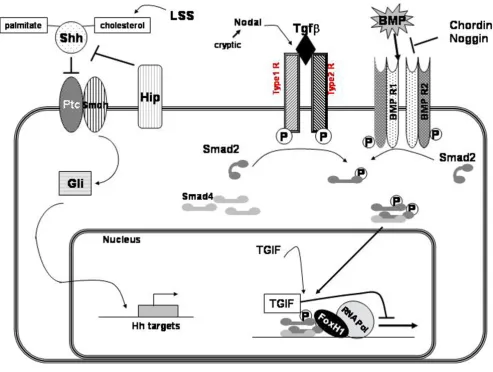
The first genes positively implicated in HPE were identi-fied from recurrent chromosomal rearrangements. Other genes were described by studying the SHH signaling path-way actors or the Nodal/TGFβ pathway, summarized in Figure 1.
Sonic hedgehog(SHH) (MIM# 600725; 7q36; HPE3) [44,45]
SHH was isolated from the human critical region HPE3 on chromosome 7q36. It plays a critical role in early fore-brain and central nervous system development. SHH is expressed in the human embryo in the notochord, the floorplate of the neural tube, the posterior limb buds and the gut [46]. The SHH protein is a secreted intercellular signaling molecule, which is synthesized as a precursor that undergoes autocatalytic cleavage into N-terminal domain (SHH-N) and C-terminal domain (SHH-C). Dur-ing the autoprocessDur-ing reaction, a cholesterol moiety is covalently attached to the C-terminus of SHH-N [47]. Mouse and chicken embryos cultured in vitro and exposed to cyclopamine, an alkaloid blocker of Sonic hedgehog signaling, exhibit craniofacial anomalies and display
phe-notypes of HPE [48]. Homozygous Shh mutant mice
present with cyclopia and often die during embryonic development, whereas the heterozygous mouse appears normal [49].
SHH is the major gene implicated in holoprosencephaly (12.7% of HPE cases: 50% of overall point mutations and 38% of overall large deletions) [50,51]. Some of the mutants were functionally characterized by studying the production of the active SHH-N fragment and the signal-ing activity in a reporter cell-based assay [52,53]. In fami-lies with SHH mutation, an incomplete penetrance and extremely wide phenotypic variability are observed [7]. Large deletions in 7q36, resulting in the loss of not only
the SHH gene but also the HLXB9 gene have been
observed in patients presenting HPE and Curarrino (sacral agenesia). Nevertheless, one study reported that only 50% of patients with del(7)(q36), including SHH, have HPE [43]. HPE can also be caused by apparently balanced translocations near the SHH locus, which might be as much as 200 kb away from the gene, due to position effect [45].
ZIC2 (MIM# 603073; 13q32; HPE5) [54]
The second gene identified was ZIC2, which encodes a member of a transcription factor family that includes the Drosophila odd-paired gene (opa), and contains zinc finger DNA binding motifs similar to the GLI protein binding domains. ZIC2 plays an important role in neurulation.
Zic2 knockdown mice show a strong holoprosencephaly phenotype in which the cerebral hemispheres are fused, and structures derived from the dorsal midline of fore-brain are missing or reduced [55].
ZIC2 is the second HPE gene by order of involvement (9.2% of HPE cases: 31% of overall point mutations and 38% of overall large deletions). Small mutations identi-fied include a significant part of complex mutations that are not just base substitutions but up to 30 base-pairs deletions, insertions or duplications, probably because of the gene sequence composition. Large deletions in 13q, including ZIC2, were narrowed by Comparative Genomic Hybridisation (CGH) array, which allows an inkling of correlations between the size of the rearrangement and the phenotype: one fetus with a typical HPE strictly lim-ited to cerebral anomalies was found to have a deletion of 1, 5 Mb, while another fetus presenting an HPE in a poly-malformative context carried a 30 Mb deletion.
Most of the time, alterations in ZIC2 correlate with a nor-mal face and, in some cases, are associated with neural tube defects or syntelencephaly (MIHF). Spina bifida or anencephaly have been also described as being associated with HPE in the same patient or in the same family by sev-eral authors [7,8,56].
SIX3 is an homeobox-containing gene which is homolo-gous to the Drosophila sine oculis gene; it is involved in head midline and eye formation.
Mice with reduced levels of Six3 expression present a fail-ure of forebrain and eye development [57].
Point mutations and large deletions in SIX3 represent 3% and 1% of HPE cases respectively. They are generally found in severe phenotypes. New phenotypes like atelen-cephaly – absence of telencephalon – or syntelenatelen-cephaly – failure of separation of the posterior frontal and parietal right and left lobes [14,58] – may be associated; these phenotypes can be considered as a continuum of the HPE spectrum, based on embryological arguments and molec-ular results involving SIX3 [59].
TGIF (MIM# 602630; 18p11.3; HPE4) [60].
TGIF (TG-interacting factor) is another homeodomain transcription factor that inhibits signaling through Nodal/ Transforming Growth Factor beta (TGFβ) pathways by blocking the action of SMAD proteins. Moreover, TGIF is a repressor of retinoic acid regulated gene transcription (Figure 1).
Mutations in TGIF account for 1% of studied cases and large deletions for nearly 1%. These data suggest that TGIF
alterations explain only a very small proportion of HPE cases, and TGIF involvement in HPE can be discussed since only 10% of patients carrying a 18p deletion
(including the TGIF gene) present HPE [61,62] and
mouse models with disrupted entire Tgif do not present an HPE phenotype [63]. However, recent studies report
Signaling pathways of the main HPE genes or candidate genes
Figure 1
that heterozygous and homozygous deletions of the third exon of Tgif in mice can result in a defined spectrum of brain developmental defects including exencephaly, microcephaly, holoprosencephaly, and abnormalities in embryonic brain ventricle formation and cleavage [64]. The variable expression observed in families with one
TGIF mutation makes genotype-phenotype correlations more difficult: both severe forms and labial/palate cleft are reported to be associated with mutations in this gene. Several hypotheses can be produced to explain these observations. First, it is possible that the TGIF2 gene (in 20q11.2-q12) provides redundancy for TGIF activity in the forebrain, even if Tgif2 does not have the same activity as Tgif in the neural tube in chick [65]. Additional studies will be required to elucidate the role of TGIF in prosen-cephalic neural development and HPE.
PATCHED1 (MIM# 601309; 9q22) [66]
PATCHED-1 (PTCH) is the receptor for SHH, and nor-mally acts to repress SHH signaling. This repression is relieved when SHH binds to PTCH. Four different muta-tions of the gene were described in five unrelated HPE-affected individuals. These mutations may affect the abil-ity of PTCH to bind SHH, or perturb the intracellular interactions of PTCH with other proteins involved in SHH signaling. They could subsequently enhance the repressive activity of PTCH on the SHH pathway and so decrease SHH signaling.
GLI2 (MIM# 165230; 2q14)
GLI2 is one of three vertebrate transcription factors impli-cated as obligatory mediators of SHH signal transduction. Mutations in this gene are preferentially involved in a dis-tinctive phenotype (within the HPE spectrum) whose main features include defective anterior pituitary forma-tion and pan-hypopituitarism [67], not necessarily with obvious abnormalities of the prosencephalon cleavage.
TDGF1/CRIPTO (MIM# 187395; 3p21.31)
TDGF1 (Teratocarcinoma Derived Growth Factor), also called CRIPTO, is an EGF-CFC family member and an obligate co-receptor involved in NODAL signaling, a developmental program implicated in midline, forebrain, and left-right axis development in model organisms. CFC1 (CRYPTIC), another member of this family, has been demonstrated to be required for proper laterality development in humans.
Zebrafish rescue assays indicate a role for TDFG1 in mid-line and forebrain development. One mutation in TDGF1
(3p21.3) has been described in a patient with midline anomalies of the forebrain [68].
3) Other candidate genes
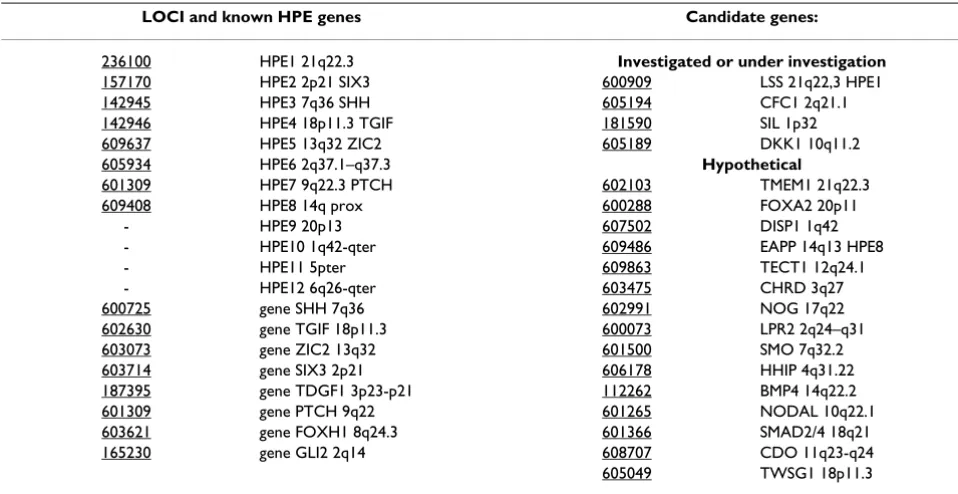
Numerous candidate loci and candidate genes have been suggested for HPE (Table 4) (Figure 1). Among these genes, some were already investigated in HPE.
FOX-H1 (FAST1) (MIM# 603621; 8q24.3) is a co-tran-scriptional factor of SMAD2 and SMAD4, and intervenes in TGF-β, activin and nodal signaling pathways. These fac-tors control early development in vertebrates and are vital for specification of the anterior-posterior axis. Recent studies on Fox-H1 null mutant mice showed that embryos failed to pattern the anterior-posterior axis, form the node, prechordal mesoderm, notochord and definitive endoderm. These mutants presented aberrant anterior head structures and abnormal cardiac development.
Mutations in FOX-H1 in HPE with cardiac malformations were only described in an abstract [69]; these variants would affect the DNA-binding domain or the SMAD inter-acting domain.
The lanosterol synthase gene (MIM# 600909; 21q22.3; HPE1) is located in the HPE1 critical region, where partial monosomy 21q was described in several HPE cases (.) [70-74]. Lanosterol synthase catalyzes a key step in the biosynthesis of cholesterol, essential in the maturation of the SHH protein. A previous study reported no mutation in a small cohort of 30 patients [75], but further investiga-tions are needed before definitely ruling out this candi-date.
CFC1 (CRYPTIC) (MIM# 605194; 2q21.1) is a member of the EGF-CFC family. EGF-CFC genes encode extra cel-lular proteins that act as essential cofactors for Nodal, a member of the transforming growth factor beta (TGF-beta) family, and play key roles in intercellular signaling pathways during vertebrate embryogenesis (germ-layer formation, anterior-posterior axis orientation and left-right axis specification) [76-80]. CFC1 could be consid-ered as a candidate gene for HPE, even if loss-of-function mutations in human CFC1 (encoding the CRYPTIC pro-tein) were identified only in patients with heterotaxic phe-notypes (randomized organ positioning).
SIL(SCL-interrupting locus) (MIM# 181590; 1p32), was considered by Karkera et al. [81] as a candidate HPE gene, as Sil mutants displayed prominent midline neural tube defects including delay or failure of neural tube closure and holoprosencephaly. SIL mutations were searched in a panel of HPE patients, but only several common poly-morphisms were identified, suggesting that SIL is not a common factor in HPE pathogenesis in humans.
observed in frogs lacking dkk-1. The Dkk gene family has been recently described as coding for secreted proteins of a novel class of proteins that act during development to bind and sequester members of the Bmp and Wnt fami-lies, establishing developmental zones free of the effects of these powerful morphogenes [83]. Search for muta-tions in a cohort of 100 HPE patients revealed four mis-sense mutations with preserved activity in head induction assays in frogs, suggesting a limited role for this gene in HPE pathogenesis.
TMEM1 (Transmembrane protein 1) (MIM# 602103; 21q22.3; HPE1) was designated EHOC-1 for epilepsy, holoprosencephaly candidate-1 as it was isolated from contigs of the candidate region HPE1. The protein is pre-dicted to present multiple putative transmembrane domains that share partial homology with transmem-brane proteins including sodium channel proteins [84].
FOXA2 (MIM# 600288; 20p11); in zebrafish, the winged-helix transcription factor FoxA2 is involved in floor plate development and differentiation in conjunction with Cyclops (Nodal) signaling, and FoxA2 may be one com-ponent of the regulatory circuit controlling expression in the floor plate [85,86]. Moreover, Collignon et al. [87] showed that some mice manifest left-right axis malforma-tions when doubly heterozygous for null mutamalforma-tions in FoxA2 and in Nodal.
DISP1 (MIM# 607502; 1q42; HPE10) [88-91]. The encoded protein DISPATCHED (DISP1) presents twelve
transmembrane domains and shares structural homology with the Patched Drosophila and vertebrates' gene in the form of a sterol-sensing domain. Disp functions to release cholesterol-anchored Hh and could be involved in mul-timeric Shh formation in membrane rafts [92].
EAPP/C14ORF11 (MIM# 609486; 14q13; HPE8) was defined as a HPE potential candidate gene on chromo-some 14 [93].
TECT1/TECTONIC (MIM# 609863; 12q24.1). In mouse embryos, tectonic is expressed in regions that participate in hedgehog signaling. It is first expressed during gastrula-tion stages in the ventral node, and then in the gut endo-derm, limb buds, notochord, somites, neural tube, and floor plate. Tectonic modulated hedgehog signaling downstream of smoothened and Rab23, and is required for maximal hedgehog activation [94].
CHRD (MIM# 603475; 3q27) and NOG (MIM# 602991; 17q22). Chordin is a key developmental protein that dor-salizes early vertebrate embryonic tissues by binding to ventralizing TGF-beta-like bone morphogenetic proteins and sequestering them in latent complexes. Its dorsalizing effects are counteracted by BMP1 [75,95,96].
The Noggin gene was first discovered as an important fac-tor in brain and nerve development. The secreted polypeptide noggin binds and inactivates members of the TGF-beta superfamily signaling proteins, such as bone morphogenetic protein 4 [97].
Table 4: Known genes and candidate genes for HPE
LOCI and known HPE genes Candidate genes:
236100 HPE1 21q22.3 Investigated or under investigation
157170 HPE2 2p21 SIX3 600909 LSS 21q22,3 HPE1
142945 HPE3 7q36 SHH 605194 CFC1 2q21.1
142946 HPE4 18p11.3 TGIF 181590 SIL 1p32
609637 HPE5 13q32 ZIC2 605189 DKK1 10q11.2
605934 HPE6 2q37.1–q37.3 Hypothetical
601309 HPE7 9q22.3 PTCH 602103 TMEM1 21q22.3
609408 HPE8 14q prox 600288 FOXA2 20p11
- HPE9 20p13 607502 DISP1 1q42
- HPE10 1q42-qter 609486 EAPP 14q13 HPE8
- HPE11 5pter 609863 TECT1 12q24.1
- HPE12 6q26-qter 603475 CHRD 3q27
600725 gene SHH 7q36 602991 NOG 17q22
602630 gene TGIF 18p11.3 600073 LPR2 2q24–q31
603073 gene ZIC2 13q32 601500 SMO 7q32.2
603714 gene SIX3 2p21 606178 HHIP 4q31.22
187395 gene TDGF1 3p23-p21 112262 BMP4 14q22.2
601309 gene PTCH 9q22 601265 NODAL 10q22.1
603621 gene FOXH1 8q24.3 601366 SMAD2/4 18q21
165230 gene GLI2 2q14 608707 CDO 11q23-q24
Some chordin/noggin double-null embryos present holo-prosencephaly, with a single nasal pit, a cyclopic eye, and agnathia, and resembled embryos lacking sonic hedge-hog. At embryonic day 12.5, double-mutant embryos were recovered with more severe phenotypes resembling aprosencephaly. In double-mutant embryos dissected at embryonic day 8.5, forebrain reduction was clearly evi-dent. Chordin and noggin are not necessary for establish-ing the anterior visceral endoderm but are required for subsequent elaboration of anterior pattern [98]. BMP antagonists chordin and noggin compensate for each other during early mouse development. When both gene products are removed, antero-posterior, dorso-ventral, and left-right patterning are all affected.
LPR2 (Low Density Lipoprotein Receptor-Related Protein 2) (MIM# 600073; 2q24–q31) is also called glycoprotein 330 or megalin. Homozygous knockout mice manifest abnormalities in epithelial tissues [99]. In brain, impaired proliferation of neuroepithelium produces a holoprosen-cephalic syndrome, characterized by lack of olfactory bulbs, forebrain fusion, and a common ventricular sys-tem.
SMOH (MIM# 601500; 7q32.2)
Smoothened mediate with Patched the cellular response to the Hedgehog secreted protein signal; the binding of Sonic hedgehog to its receptor Patched prevents normal inhibition by PTCH of Smoothened (SMOH).
HHIP (Human Hedgehog Interacting protein) (MIM# 606178; 4q31.22) is involved in the attenuation of hedge-hog signaling since ectopic expression of Hip in transgenic mice results in severe skeletal defects similar to those observed in Indian hedgehog mutants [100].
BMP4 (MIM# 112262; 14q22.2) is a vital regulatory mol-ecule that functions throughout development in meso-derm induction, tooth development, limb formation, bone induction, and fracture repair. In expression studies in mouse, it was demonstrated that BMP4 activates the expression of Msx1, leading to incisor tooth development [101]. In chick embryos, the first signs of left-right asym-metry are detected in Hensen's node, essentially by left-sided Sonic hedgehog expression, and Bmp4 is necessary to maintain Shh asymmetry within the node [102].
NODAL (MIM# 601265; 10q22.1) is a member of the TGF-beta gene family and is expressed during mouse gas-trulation [76]. Nodal has a left-sided expression pattern that is disrupted in mouse models of LR axis development [76]. Moreover, Collignon et al. [87] showed that some mice manifest left-right axis malformations when doubly heterozygous for null mutations in Nodal and in FoxA2.
SMAD2/4 (MIM# 601366; 18q21). SMAD proteins medi-ate TGF-beta signaling to regulmedi-ate cell growth and differ-entiation. TGF-beta induces activation and nuclear translocation of SMAD2 which forms complexes with SMAD4 and regulate transcription of target genes.
CDO/CDON (MIM# 608707; 11q23-24) is another HPE candidate gene since mice lacking the transmembrane protein Cdo/Cdon, previously implicated in myogenesis, display HPE with strain-specific severity and without limb defects, modeling human HPE and implicating modifier genes as a cause of variability [103].
The Twisted gastrulation(TWSG 1) gene (MIM# 605049; 18p11.3; HPE4) is located near the TGIF gene. The TWSG protein is able to either enhance or inhibit signaling by the bone morphogenetic protein (BMP) subfamily of TGF-β type factors. All Twsg1 mutant mice, irrespective of genetic background, exhibit deletions of neural arches in the cervical vertebrae, and C57BL/6 ones present pro-nounced forebrain defects including rostral truncations, holoprosencephaly, cyclopia, agnathia [104].
4) Debate on the multi-hit origin of HPE
HPE seems nowadays to be a multihit pathology, that may require two or more events involving several genes and/or environmental factors [43]. Indeed, some of mutations are found in a heterozygous state with a variable pheno-typic penetrance in the same family, and double hetero-zygous mutations have already been identified (in SHH
However the number of instances with double hits clearly identified and confirmed by functional studies remains relatively restricted to a few cases for the time being, unlike classic recessive disorders. HPE still behaves as an apparent autosomal dominant disorder with reduced penetrance and variable expression, associated with fam-ily-specific genetic alterations. These deleterious muta-tions give a susceptibility for developing HPE, upon which other factors (either genetic either environmental) modulate expression [107]. The genetic background would have an influence on the incidence of brain abnor-malities, as it was described in the mutant mice with dele-tion of the third exon of Tgif, suggesting that genetic modifiers functionally interact with the mutant protein during embryonic brain development [64]. Whether or not these factors constitute a second hit remains to be debated.
Diagnostic methods
Based on denaturing high performance liquid chromatog-raphy (DHPLC) and sequencing, point mutations are found in the four main HPE genes (SHH, ZIC2, SIX3 and
TGIF) in about 20% of the cases (25% in living children and 15% in fetuses) [50]; mutations are distributed all over these genes. Mutations in the 5' regulatory regions of these genes are also suspected [107] and are under inves-tigation. All kinds of mutations have been reported but missense mutations are more frequent than nonsense ones, which makes the interpretation complex. Whenever a missense mutation is found, it should be validated using a functional test suitable for the gene to assess its deleteri-ous effect on the protein structure and/or function [52].
Recently, gene dosage methods like Quantitative Multi-plex PCR of Short Fluorescent Fragments (QMPSF) or Multiplex Ligation Probe Amplification (MLPA) (MRC-Holland), were added to the molecular diagnosis process [108]. Large deletions in SHH, ZIC2, SIX3 and TGIF are found in 8% of the cases (4% in alive children and 12% in fetuses) [51,109]. While the proportion of point muta-tions is higher in living children than in fetuses, part of deletions is, on the contrary, higher in fetuses than in liv-ing patients, which may explain the more severe pheno-type in fetuses leading to termination of pregnancy.
A systematic search for gains or losses in the subtelomeres by MLPA led to the identification of about 4.3% novel rearrangements involving known but also novel HPE loci. But, at the moment, this approach still concerns research field.
These data lead to perform for each patient the successive molecular tests as described in the algorithm (Figure 2) as several hits are suspected to induce HPE.
Management including treatment
The care of the child with HPE requires a multidisciplinary management. This aims to detect complications described above to avoid an added handicap and improve their quality of life.
Neurologic complications' management of a child with HPE is not specific and requires anticonvulsive, physical and occupational therapies, as for children with other brain malformations. It is important to consider endo-crine disorders testing blood and urines samples and look after dysautonomic dysfunction. Surgery is needed to repair cleft lip and/or palate.
Genetic counseling and prenatal diagnosis
The severity of HPE requires a genetic counseling, which is made difficult by the extreme phenotypic variability, the genetic heterogeneity, the multihit origin and a high risk of recurrence (13%) in apparently sporadic cases [42].
When a patient presents two associated subtelomeric rear-rangements and, in particular, duplication associated with a deletion, it can be inherited from one of the parents car-rying a balanced translocation, and so far, this could be a great help in the genetic counseling because of the high rate of recurrence.
On the contrary, when a mutation is identified in a patient but is not retrieved in his parents, the HPE onset involves a de novo mutation, and the recurrence rate cannot be cal-culated but is lower.
Prenatal ultrasound can detect the central nervous system and facial abnormalities of severe HPE as early as the first trimester, but is less sensitive for detection of milder forms of HPE. Fetal MRI will provide better characterization of the malformations in the third trimester of the pregnancy.
The greatest care must be taken for molecular prenatal diagnosis in HPE. Even if a mutation has been identified and seems to be transmitted with clinical manifestations in the family, another event, like a mutation in another gene (not yet identified) or an environmental factor, may be necessary to generate the holoprosencephaly pheno-type [43]. In this case, molecular biology performed at the 10–12th week of amenorrhea provides only an additional
criterion with regard to prenatal ultrasound or MRI, which still takes precedence over molecular analysis. Neverthe-less, the absence of a familial known mutation in the fetal DNA may be reassuring, before MRI imaging.
Unresolved questions
65% of the cases remain unexplained, suggesting the involvement of many other genes in HPE. The research project should comprise the search for genomic rearrange-ments all over the genome, using a pangenomic approach like CGH array to identify further candidate genes. More-over, epidemiologic investigations should be done to check off environmental factors that could act in coordi-nation with genetic events to give rise to holoprosenceph-aly.
References
1. Demyer W, Zeman W: Alobar holoprosencephaly (arhinen-cephaly) with median cleft lip and palate: clinical, electroen-cephalographic and nosologic considerations. Confin Neurol 1963, 23:1-36.
2. Barkovich AJ, Quint DJ: Middle interhemispheric fusion: an unu-sual variant of holoprosencephaly. AJNR Am J Neuroradiol 1993,
14(2):431-440.
3. Simon EM, Hevner RF, Pinter JD, Clegg NJ, Delgado M, Kinsman SL, Hahn JS, Barkovich AJ: The middle interhemispheric variant of holoprosencephaly. AJNR Am J Neuroradiol 2002, 23(1):151-156. 4. Simon EM, Hevner R, Pinter JD, Clegg NJ, Miller VS, Kinsman SL,
Hahn JS, Barkovich AJ: Assessment of the deep gray nuclei in holoprosencephaly. AJNR Am J Neuroradiol 2000,
21(10):1955-1961.
5. Demyer W, Zeman W, Palmer CG: The Face Predicts the Brain: Diagnostic Significance of Median Facial Anomalies for Hol-oprosencephaly (Arhinencephaly). Pediatrics 1964, 34:256-263. 6. Delezoide AL, Narcy F, Larroche JC: Cerebral midline develop-mental anomalies: spectrum and associated features. Genet Couns 1990, 1(3-4):197-210.
7. Lazaro L, Dubourg C, Pasquier L, Le Duff F, Blayau M, Durou MR, de la Pintiere AT, Aguilella C, David V, Odent S: Phenotypic and molecular variability of the holoprosencephalic spectrum.
Am J Med Genet A 2004, 129(1):21-24.
8. Roach E, Demyer W, Conneally PM, Palmer C, Merritt AD: Holo-prosencephaly: birth data, benetic and demographic analy-ses of 30 families. Birth Defects Orig Artic Ser 1975, 11(2):294-313. 9. Cohen MM Jr.: Perspectives on holoprosencephaly: Part III. Spectra, distinctions, continuities, and discontinuities. Am J Med Genet 1989, 34(2):271-288.
Molecular diagnosis of HPE
Figure 2
10. Cohen MM Jr.: Perspectives on holoprosencephaly: Part I. Epi-demiology, genetics, and syndromology. Teratology 1989,
40(3):211-235.
11. Croen LA, Shaw GM, Lammer EJ: Holoprosencephaly: epidemio-logic and clinical characteristics of a California population.
Am J Med Genet 1996, 64(3):465-472.
12. Matsunaga E, Shiota K: Holoprosencephaly in human embryos: epidemiologic studies of 150 cases. Teratology 1977,
16(3):261-272.
13. Hahn JS, Plawner LL: Evaluation and management of children with holoprosencephaly. Pediatr Neurol 2004, 31(2):79-88. 14. Picone O, Hirt R, Suarez B, Coulomb A, Tachdjian G, Frydman R,
Senat MV: Prenatal diagnosis of a possible new middle inter-hemispheric variant of holoprosencephaly using sonographic and magnetic resonance imaging. Ultrasound Obstet Gynecol 2006, 28(2):229-231.
15. OMIM [http://www.ncbi.nlm.nih.gov/omim]
16. Cohen MM Jr.: Holoprosencephaly: clinical, anatomic, and molecular dimensions. Birth Defects Res A Clin Mol Teratol 2006,
76(9):658-673.
17. Baba Y, Nakamura T, Takizawa K, Nishimura J, Suzuki M: [Perioper-ative considerations for a holoprosencephaly patient]. Masui 1999, 48(9):997-1002.
18. Elias DL, Kawamoto HK Jr., Wilson LF: Holoprosencephaly and midline facial anomalies: redefining classification and man-agement. Plast Reconstr Surg 1992, 90(6):951-958.
19. Cohen MM Jr., Sulik KK: Perspectives on holoprosencephaly: Part II. Central nervous system, craniofacial anatomy, syn-drome commentary, diagnostic approach, and experimental studies. J Craniofac Genet Dev Biol 1992, 12(4):196-244.
20. Plawner LL, Delgado MR, Miller VS, Levey EB, Kinsman SL, Barkovich AJ, Simon EM, Clegg NJ, Sweet VT, Stashinko EE, Hahn JS: Neuro-anatomy of holoprosencephaly as predictor of function: beyond the face predicting the brain. Neurology 2002,
59(7):1058-1066.
21. Lewis AJ, Simon EM, Barkovich AJ, Clegg NJ, Delgado MR, Levey E, Hahn JS: Middle interhemispheric variant of holoprosenceph-aly: a distinct cliniconeuroradiologic subtype. Neurology 2002,
59(12):1860-1865.
22. Carter Center [http://www.cartercenter.org]
23. Muenke M, Cohen MM Jr.: Genetic approaches to understand-ing brain development: holoprosencephaly as a model. Ment Retard Dev Disabil Res Rev 2000, 6(1):15-21.
24. Stashinko EE, Clegg NJ, Kammann HA, Sweet VT, Delgado MR, Hahn JS, Levey EB: A retrospective survey of perinatal risk factors of 104 living children with holoprosencephaly. Am J Med Genet A 2004, 128(2):114-119.
25. Barr M Jr., Cohen MM Jr.: Holoprosencephaly survival and per-formance. Am J Med Genet 1999, 89(2):116-120.
26. Olsen CL, Hughes JP, Youngblood LG, Sharpe-Stimac M: Epidemiol-ogy of holoprosencephaly and phenotypic characteristics of affected children: New York State, 1984-1989. Am J Med Genet 1997, 73(2):217-226.
27. Whiteford ML, Tolmie JL: Holoprosencephaly in the west of Scotland 1975-1994. J Med Genet 1996, 33(7):578-584.
28. Leevers HJ, Roesler CP, Flax J, Benasich AA: The Carter Neuro-cognitive Assessment for children with severely compro-mised expressive language and motor skills. J Child Psychol Psychiatry 2005, 46(3):287-303.
29. Jing H, Flax J, Roesler CP, Choudhury N, Benasich AA: Auditory event-related responses in children with semi-lobar holo-prosencephaly. Brain Dev 2006, 28(4):207-214.
30. Barr M Jr., Hanson JW, Currey K, Sharp S, Toriello H, Schmickel RD, Wilson GN: Holoprosencephaly in infants of diabetic moth-ers. J Pediatr 1983, 102(4):565-568.
31. Croen LA, Shaw GM, Lammer EJ: Risk factors for cytogenetically normal holoprosencephaly in California: a population-based case-control study. Am J Med Genet 2000, 90(4):320-325. 32. Repetto M, Maziere JC, Citadelle D, Dupuis R, Meier M, Biade S,
Quiec D, Roux C: Teratogenic effect of the cholesterol synthe-sis inhibitor AY 9944 on rat embryos in vitro. Teratology 1990,
42(6):611-618.
33. Frenkel LD, Gaur S, Tsolia M, Scudder R, Howell R, Kesarwala H:
Cytomegalovirus infection in children with AIDS. Rev Infect Dis 1990, 12 Suppl 7:S820-6.
34. Byrne PJ, Silver MM, Gilbert JM, Cadera W, Tanswell AK: Cyclopia and congenital cytomegalovirus infection. Am J Med Genet 1987, 28(1):61-65.
35. Lison MP, Armbrust-Figueiredo J, Mega D: [Arhinencephalia: con-siderations apropos of a case diagnosed during life]. Acta Neu-rol Psychiatr Belg 1967, 67(1):25-36.
36. Castel Y, Riviere D, Toudic L, Nouaille Y, L'Henoret J, Duparcmeur H, Leroy JP, Balouet G: [Two cases of cyclopia]. Ann Pediatr (Paris) 1976, 23(10):647-651.
37. Probst C: [Cerebral edema: neurosurgical aspects of patho-logical, diagnostic and therapeutic problems (author's transl)]. Schweiz Rundsch Med Prax 1976, 65(31):948-956. 38. Kelley RL, Roessler E, Hennekam RC, Feldman GL, Kosaki K, Jones
MC, Palumbos JC, Muenke M: Holoprosencephaly in RSH/Smith-Lemli-Opitz syndrome: does abnormal cholesterol metabo-lism affect the function of Sonic Hedgehog? Am J Med Genet 1996, 66(4):478-484.
39. Hall JG, Pallister PD, Clarren SK, Beckwith JB, Wiglesworth FW, Fra-ser FC, Cho S, Benke PJ, Reed SD: Congenital hypothalamic hamartoblastoma, hypopituitarism, imperforate anus and postaxial polydactyly--a new syndrome? Part I: clinical, causal, and pathogenetic considerations. Am J Med Genet 1980,
7(1):47-74.
40. Wraith JE, Super M, Watson GH, Phillips M: Velo-cardio-facial syn-drome presenting as holoprosencephaly. Clin Genet 1985,
27(4):408-410.
41. Roessler E, Muenke M: Holoprosencephaly: a paradigm for the complex genetics of brain development. J Inherit Metab Dis 1998, 21(5):481-497.
42. Odent S, Le Marec B, Munnich A, Le Merrer M, Bonaiti-Pellie C: Seg-regation analysis in nonsyndromic holoprosencephaly. Am J Med Genet 1998, 77(2):139-143.
43. Ming JE, Muenke M: Multiple hits during early embryonic devel-opment: digenic diseases and holoprosencephaly. Am J Hum Genet 2002, 71(5):1017-1032.
44. Belloni E, Muenke M, Roessler E, Traverso G, Siegel-Bartelt J, Frumkin A, Mitchell HF, Donis-Keller H, Helms C, Hing AV, Heng HH, Koop B, Martindale D, Rommens JM, Tsui LC, Scherer SW: Identification of Sonic hedgehog as a candidate gene responsible for holo-prosencephaly. Nat Genet 1996, 14(3):353-356.
45. Roessler E, Ward DE, Gaudenz K, Belloni E, Scherer SW, Donnai D, Siegel-Bartelt J, Tsui LC, Muenke M: Cytogenetic rearrangements involving the loss of the Sonic Hedgehog gene at 7q36 cause holoprosencephaly. Hum Genet 1997, 100(2):172-181.
46. Odent S, Attie-Bitach T, Blayau M, Mathieu M, Auger J, Delezoïde AL, Gall JY, Le Marec B, Munnich A, David V, Vekemans M: Expression of the Sonic hedgehog (SHH ) gene during early human development and phenotypic expression of new mutations causing holoprosencephaly. Hum Mol Genet 1999,
8(9):1683-1689.
47. Wallis DE, Muenke M: Molecular mechanisms of holoprosen-cephaly. Mol Genet Metab 1999, 68(2):126-138.
48. Nagase T, Nagase M, Osumi N, Fukuda S, Nakamura S, Ohsaki K, Harii K, Asato H, Yoshimura K: Craniofacial anomalies of the cultured mouse embryo induced by inhibition of sonic hedgehog signaling: an animal model of holoprosencephaly.
J Craniofac Surg 2005, 16(1):80-88.
49. Chiang C, Swan RZ, Grachtchouk M, Bolinger M, Litingtung Y, Rob-ertson EK, Cooper MK, Gaffield W, Westphal H, Beachy PA, Dlugosz AA: Essential role for Sonic hedgehog during hair follicle morphogenesis. Dev Biol 1999, 205(1):1-9.
50. Dubourg C, Lazaro L, Pasquier L, Bendavid C, Blayau M, Le Duff F, Durou MR, Odent S, David V: Molecular screening of SHH, ZIC2, SIX3, and TGIF genes in patients with features of hol-oprosencephaly spectrum: Mutation review and genotype-phenotype correlations. Hum Mutat 2004, 24(1):43-51. 51. Bendavid C, Dubourg C, Gicquel I, Pasquier L, Saugier-Veber P,
Durou MR, Jaillard S, Frebourg T, Haddad BR, Henry C, Odent S, David V: Molecular evaluation of foetuses with holoprosen-cephaly shows high incidence of microdeletions in the HPE genes. Hum Genet 2006, 119(1-2):1-8.
53. Maity T, Fuse N, Beachy PA: Molecular mechanisms of Sonic hedgehog mutant effects in holoprosencephaly. Proc Natl Acad Sci U S A 2005, 102(47):17026-17031.
54. Brown LY, Hodge SE, Johnson WG, Guy SG, Nye JS, Brown S: Pos-sible association of NTDs with a polyhistidine tract polymor-phism in the ZIC2 gene. Am J Med Genet 2002, 108(2):128-131. 55. Nagai T, Aruga J, Minowa O, Sugimoto T, Ohno Y, Noda T, Mikoshiba
K: Zic2 regulates the kinetics of neurulation. Proc Natl Acad Sci U S A 2000, 97(4):1618-1623.
56. Lowry RB: Letter: Holoprosencephaly. Am J Dis Child 1974,
128(6):887.
57. Carl M, Loosli F, Wittbrodt J: Six3 inactivation reveals its essen-tial role for the formation and patterning of the vertebrate eye. Development 2002, 129(17):4057-4063.
58. Kinsman SL: White matter imaging in holoprosencephaly in children. Curr Opin Neurol 2004, 17(2):115-119.
59. Pasquier L, Dubourg C, Gonzales M, Lazaro L, David V, Odent S, Encha-Razavi F: First occurrence of aprosencephaly/atelen-cephaly and holoprosenaprosencephaly/atelen-cephaly in a family with a SIX3 gene mutation and phenotype/genotype correlation in our series of SIX3 mutations. J Med Genet 2005, 42(1):e4.
60. Gripp KW, Wotton D, Edwards MC, Roessler E, Ades L, Meinecke P, Richieri-Costa A, Zackai EH, Massague J, Muenke M, Elledge SJ: Muta-tions in TGIF cause holoprosencephaly and link NODAL sig-nalling to human neural axis determination. Nat Genet 2000,
25(2):205-208.
61. Nanni L, Ming JE, Bocian M, Steinhaus K, Bianchi DW, Die-Smulders C, Giannotti A, Imaizumi K, Jones KL, Campo MD, Martin RA, Mei-necke P, Pierpont ME, Robin NH, Young ID, Roessler E, Muenke M:
The mutational spectrum of the sonic hedgehog gene in hol-oprosencephaly: SHH mutations cause a significant propor-tion of autosomal dominant holoprosencephaly. Hum Mol Genet 1999, 8(13):2479-2488.
62. Maranda B, Lemieux N, Lemyre E: Familial deletion 18p syn-drome: case report. BMC Med Genet 2006, 7:60.
63. Shen J, Walsh CA: Targeted disruption of Tgif, the mouse ortholog of a human holoprosencephaly gene, does not result in holoprosencephaly in mice. Mol Cell Biol 2005,
25(9):3639-3647.
64. Jin L, Zhou Y, Kuang C, Lin L, Chen Y: Expression pattern of TG-interacting factor 2 during mouse development. Gene Expr Patterns 2005, 5(4):457-462.
65. Knepper JL, James AC, Ming JE: TGIF, a gene associated with human brain defects, regulates neuronal development. Dev Dyn 2006, 235(6):1482-1490.
66. Ming JE, Kaupas ME, Roessler E, Brunner HG, Golabi M, Tekin M, Stratton RF, Sujansky E, Bale SJ, Muenke M: Mutations in PATCHED-1, the receptor for SONIC HEDGEHOG, are associated with holoprosencephaly. Hum Genet 2002,
110(4):297-301.
67. Roessler E, Du YZ, Mullor JL, Casas E, Allen WP, Gillessen-Kaesbach G, Roeder ER, Ming JE, Ruiz i Altaba A, Muenke M: Loss-of-function mutations in the human GLI2 gene are associated with pitu-itary anomalies and holoprosencephaly-like features. Proc Natl Acad Sci U S A 2003, 100(23):13424-13429.
68. de la Cruz JM, Bamford RN, Burdine RD, Roessler E, Barkovich AJ, Donnai D, Schier AF, Muenke M: A loss-of-function mutation in the CFC domain of TDGF1 is associated with human fore-brain defects. Hum Genet 2002, 110(5):422-428.
69. Ouspenskaia M Karkera JP, Roessler E, Shen MM, Goldmunts E, Bow-ers P, Towbin J, Belmont J, Muenke M.: Role of FAST1 gene in the development of holoprosencephaly and congenital cardiac malformations in humans.: Baltimore USA. ; 2002. 70. Aronson DC, Jansweijer MC, Hoovers JM, Barth PG: A male infant
with holoprosencephaly, associated with ring chromosome 21. Clin Genet 1987, 31(1):48-52.
71. Hoovers JM, Jansweijer MC: Holoprosencephaly associated with ring chromosome 21. Clin Genet 1987, 32(3):207.
72. Berry SM, Gosden C, Snijders RJ, Nicolaides KH: Fetal holoprosen-cephaly: associated malformations and chromosomal defects. Fetal Diagn Ther 1990, 5(2):92-99.
73. Estabrooks LL, Rao KW, Donahue RP, Aylsworth AS: Holoprosen-cephaly in an infant with a minute deletion of chromosome 21(q22.3). Am J Med Genet 1990, 36(3):306-309.
74. Muenke M, Bone LJ, Mitchell HF, Hart I, Walton K, Hall-Johnson K, Ippel EF, Dietz-Band J, Kvaloy K, Fan CM, et al.: Physical mapping
of the holoprosencephaly critical region in 21q22.3, exclu-sion of SIM2 as a candidate gene for holoprosencephaly, and mapping of SIM2 to a region of chromosome 21 important for Down syndrome. Am J Hum Genet 1995, 57(5):1074-1079. 75. Roessler E, Mittaz L, Du Y, Scott HS, Chang J, Rossier C, Guipponi M,
Matsuda SP, Muenke M, Antonarakis SE: Structure of the human Lanosterol synthase gene and its analysis as a candidate for holoprosencephaly (HPE1). Hum Genet 1999, 105(5):489-495. 76. Zhou X, Sasaki H, Lowe L, Hogan BL, Kuehn MR: Nodal is a novel
TGF-beta-like gene expressed in the mouse node during gas-trulation. Nature 1993, 361(6412):543-547.
77. Feldman B, Gates MA, Egan ES, Dougan ST, Rennebeck G, Sirotkin HI, Schier AF, Talbot WS: Zebrafish organizer development and germ-layer formation require nodal-related signals. Nature 1998, 395(6698):181-185.
78. Bamford RN, Roessler E, Burdine RD, Saplakoglu U, dela Cruz J, Splitt M, Goodship JA, Towbin J, Bowers P, Ferrero GB, Marino B, Schier AF, Shen MM, Muenke M, Casey B: Loss-of-function mutations in the EGF-CFC gene CFC1 are associated with human left-right laterality defects. Nat Genet 2000, 26(3):365-369. 79. Schier AF, Shen MM: Nodal signalling in vertebrate
develop-ment. Nature 2000, 403(6768):385-389.
80. Shen MM, Schier AF: The EGF-CFC gene family in vertebrate development. Trends Genet 2000, 16(7):303-309.
81. Karkera JD, Izraeli S, Roessler E, Dutra A, Kirsch I, Muenke M: The genomic structure, chromosomal localization, and analysis of SIL as a candidate gene for holoprosencephaly. Cytogenet Genome Res 2002, 97(1-2):62-67.
82. Roessler E, Du Y, Glinka A, Dutra A, Niehrs C, Muenke M: The genomic structure, chromosome location, and analysis of the human DKK1 head inducer gene as a candidate for holo-prosencephaly. Cytogenet Cell Genet 2000, 89(3-4):220-224. 83. Glinka A, Wu W, Delius H, Monaghan AP, Blumenstock C, Niehrs C:
Dickkopf-1 is a member of a new family of secreted proteins and functions in head induction. Nature 1998,
391(6665):357-362.
84. Yamakawa K, Mitchell S, Hubert R, Chen XN, Colbern S, Huo YK, Gadomski C, Kim UJ, Korenberg JR: Isolation and characteriza-tion of a candidate gene for progressive myoclonus epilepsy on 21q22.3. Hum Mol Genet 1995, 4(4):709-716.
85. Rastegar S, Albert S, Le Roux I, Fischer N, Blader P, Muller F, Strahle U: A floor plate enhancer of the zebrafish netrin1 gene requires Cyclops (Nodal) signalling and the winged helix transcription factor FoxA2. Dev Biol 2002, 252(1):1-14. 86. Lehmann C, Naumann WW: Axon pathfinding and the floor
plate factor Reissner's substance in wildtype, cyclops and one-eyed pinhead mutants of Danio rerio. Brain Res Dev Brain Res 2005, 154(1):1-14.
87. Collignon J, Varlet I, Robertson EJ: Relationship between asym-metric nodal expression and the direction of embryonic turning. Nature 1996, 381(6578):155-158.
88. Caspary T, Garcia-Garcia MJ, Huangfu D, Eggenschwiler JT, Wyler MR, Rakeman AS, Alcorn HL, Anderson KV: Mouse Dispatched homolog1 is required for long-range, but not juxtacrine, Hh signaling. Curr Biol 2002, 12(18):1628-1632.
89. Nakano Y, Kim HR, Kawakami A, Roy S, Schier AF, Ingham PW: Inac-tivation of dispatched 1 by the chameleon mutation disrupts Hedgehog signalling in the zebrafish embryo. Dev Biol 2004,
269(2):381-392.
90. Tian H, Jeong J, Harfe BD, Tabin CJ, McMahon AP: Mouse Disp1 is required in sonic hedgehog-expressing cells for paracrine activity of the cholesterol-modified ligand. Development 2005,
132(1):133-142.
91. Tiang MM, Lau BH, Lee TX, Ling MI: Holoprosencephaly present-ing as membranous aplasia cutis and diabetes insipidus: report of one case. Acta Paediatr Taiwan 2004, 45(3):181-183. 92. Zeng X, Goetz JA, Suber LM, Scott WJ Jr., Schreiner CM, Robbins DJ:
A freely diffusible form of Sonic hedgehog mediates long-range signalling. Nature 2001, 411(6838):716-720.
93. Kamnasaran D, Chen CP, Devriendt K, Mehta L, Cox DW: Defining a holoprosencephaly locus on human chromosome 14q13 and characterization of potential candidate genes. Genomics 2005, 85(5):608-621.
Publish with BioMed Central and every scientist can read your work free of charge
"BioMed Central will be the most significant development for disseminating the results of biomedical researc h in our lifetime."
Sir Paul Nurse, Cancer Research UK
Your research papers will be:
available free of charge to the entire biomedical community
peer reviewed and published immediately upon acceptance
cited in PubMed and archived on PubMed Central
yours — you keep the copyright
Submit your manuscript here:
http://www.biomedcentral.com/info/publishing_adv.asp
BioMedcentral 95. Scott IC, Steiglitz BM, Clark TG, Pappano WN, Greenspan DS:
Spa-tiotemporal expression patterns of mammalian chordin dur-ing postgastrulation embryogenesis and in postnatal brain.
Dev Dyn 2000, 217(4):449-456.
96. Scott IC, Blitz IL, Pappano WN, Imamura Y, Clark TG, Steiglitz BM, Thomas CL, Maas SA, Takahara K, Cho KW, Greenspan DS: Mam-malian BMP-1/Tolloid-related metalloproteinases, including novel family member mammalian Tolloid-like 2, have differ-ential enzymatic activities and distributions of expression relevant to patterning and skeletogenesis. Dev Biol 1999,
213(2):283-300.
97. McMahon JA, Takada S, Zimmerman LB, Fan CM, Harland RM, McMa-hon AP: Noggin-mediated antagonism of BMP signaling is required for growth and patterning of the neural tube and somite. Genes Dev 1998, 12(10):1438-1452.
98. Anderson RM, Lawrence AR, Stottmann RW, Bachiller D, Klingen-smith J: Chordin and noggin promote organizing centers of forebrain development in the mouse. Development 2002,
129(21):4975-4987.
99. Willnow TE, Hilpert J, Armstrong SA, Rohlmann A, Hammer RE, Burns DK, Herz J: Defective forebrain development in mice lacking gp330/megalin. Proc Natl Acad Sci U S A 1996,
93(16):8460-8464.
100. Chuang PT, McMahon AP: Vertebrate Hedgehog signalling modulated by induction of a Hedgehog-binding protein.
Nature 1999, 397(6720):617-621.
101. Tucker AS, Al Khamis A, Sharpe PT: Interactions between Bmp-4 and Msx-1 act to restrict gene expression to odontogenic mesenchyme. Dev Dyn 1998, 212(4):533-539.
102. Monsoro-Burq A, Le Douarin NM: BMP4 plays a key role in left-right patterning in chick embryos by maintaining Sonic Hedgehog asymmetry. Mol Cell 2001, 7(4):789-799.
103. Zhang W, Kang JS, Cole F, Yi MJ, Krauss RS: Cdo functions at mul-tiple points in the sonic hedgehog pathway, and cdo-deficient mice accurately model human holoprosencephaly. Dev Cell 2006, 10(5):657-665.
104. Petryk A, Anderson RM, Jarcho MP, Leaf I, Carlson CS, Klingensmith J, Shawlot W, O'Connor MB: The mammalian twisted gastrula-tion gene funcgastrula-tions in foregut and craniofacial development.
Dev Biol 2004, 267(2):374-386.
105. Bendavid C DC Pasquier L, Gicquel I, Le Gallou S, Mottier S, Durou MR, Jaillard S, Henry C, Odent S, David V.: MLPA screening reveals novel subtelomeric rearrangements in holoprosen-cephaly - Unpublished Data. 2007.
106. Aguilella C, Dubourg C, Attia-Sobol J, Vigneron J, Blayau M, Pasquier L, Lazaro L, Odent S, David V: Molecular screening of the TGIF gene in holoprosencephaly: identification of two novel muta-tions. Hum Genet 2003, 112(2):131-134.
107. Jeong Y, El-Jaick K, Roessler E, Muenke M, Epstein DJ: A functional screen for sonic hedgehog regulatory elements across a 1 Mb interval identifies long-range ventral forebrain enhancers.
Development 2006, 133(4):761-772.
108. MLPA MRC Holland [http://www.mlpa.com]
109. Bendavid C, Haddad BR, Griffin A, Huizing M, Dubourg C, Gicquel I, Cavalli LR, Pasquier L, Long R, Ouspenskaia M, Odent S, Lacbawan F, David V, Muenke M: Multicolor FISH and quantitative PCR can detect submicroscopic deletions in holoprosencephaly patients with a normal karyotype. J Med Genet 2005.
![Table 2: "The face often predicts the brain" [5, 110]. Parallelism of face and brain phenotypes generally observed in HPE.](https://thumb-us.123doks.com/thumbv2/123dok_us/761919.1573048/3.612.57.560.98.335/table-predicts-brain-parallelism-brain-phenotypes-generally-observed.webp)