DOI 10.1007/s13174-011-0039-6 O R I G I N A L PA P E R
Analysis on the current and the future Internet structure
regarding multi-homed and multi-path routing
Hiroshi Fujinoki·Andrew Hauck
Received: 22 December 2010 / Accepted: 27 September 2011 / Published online: 21 October 2011 © The Brazilian Computer Society 2011
Abstract We analyzed how reliability will be improved by adopting inter-domain multi-path and multi-homing routing when the structure in the Internet changes. We identified the properties of the ideal network structure that will maximize the advantage of multi-path and multi-home routing using mathematical analyses. We focused on how each end-to-end path is built, how many multi-paths exist and how each multi-path consists of multi-path and multi-homing seg-ments. Second, we analyzed the trends in the recent changes in how the Internet is structured from the view point of inter-domain multi-path routing. The mathematical analyses sug-gest that a large number of multi-paths or multi-homing is not necessary to effectively benefit from multi-path routing. However, it will be important to keep the path length short in the segments where multiple paths are not available. The analyses on the recent changes in the Internet structure sug-gest that multi-path routing will contribute to improvement of reliability in two different ways. For the autonomous sys-tems away from the Internet core, multi-path routing will improve the reliability by going around the busy Internet core, while it will improve the reliability by distributing network traffic load through the Internet core for the au-tonomous systems close to the core.
Keywords Multi-path routing·Multi-homing·
Inter-domain routing·Reliability·Internet routing·Border gateway routing protocol
H. Fujinoki (
)·A. HauckDepartment of Computer Science, Southern Illinois University Edwardsville, Edwardsville, IL 62026-1656, USA
e-mail:[email protected] A. Hauck
e-mail:[email protected]
1 Introduction
Border Gateway Protocol (BGP) has been the default rout-ing protocol for routrout-ing inter-domain network traffic in the Internet. As a path-vector routing protocol, BGP does not recognize all the links in each route [17]. Each exterior BGP speaker (simply called “BGP router” hereafter) knows only the next hop autonomous system (AS) to a specific destina-tion. Although this property has been known to cause rout-ing loops, there are two other significant problems [16].
The first problem is incapability of multi-path routing. The multi-path routing is a set of routing capabilities. It per-forms the following three functions. First, it discovers mul-tiple paths available from an origin network to a destination network, where either one or both can be a multi-homed net-work. Second, it distributes network traffic from an origin network to a destination network over multiple paths. Fi-nally, it performs dynamic load-balancing on the network traffic over the multiple paths. There are two major advan-tages in multi-path routing. First, it will enhance reliability, since multi-path routing does not depend on a path for data transmission. Multi-path routing sustains data transmission from an origin network to a destination network even when the current network path selected by the existing single-path BGP fails. The second advantage is that it will optimize link bandwidth utilization by dynamically distributing network traffic from over-utilized paths to those that are underuti-lized.
Fig. 1 Simplified AS-interconnection structure in the Internet
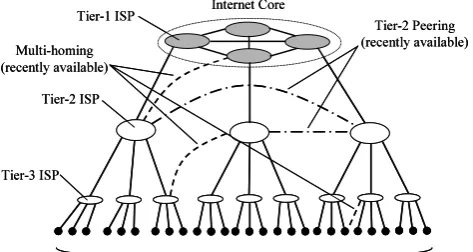
Lack of support for multi-path routing has not been a se-rious problem, since most of the Internet was structured as a tree, where there was not much multi-path routing could do to take its advantages. Figure1shows a simplified struc-ture in the interconnections of network carriers in the Inter-net. The Internet is known to have three layers of tier-1, -2, and -3 Internet service providers (ISPs). Tier-1 layer consists of world-wide “settlement-free” long distance carriers. The ISPs who belong to this group are called “tier-1 ISPs”. Tier-2 ISPs are typically continent-wide or even country wide network carriers while tier-3 ISPs are typically regional car-riers. It used to be that each tier-2 ISP was connected only to a tier-1 ISP, but not to any other tier-2 ISPs. Thus, only the tier-1 layer used to have a network structure, while others formed “stubs” from the network of the tier-1 ISPs. Despite some differences in details, the terms, “network carriers”, “internet service providers”, and “autonomous systems” are used interchangeably in this paper, since their differences do not have essential significance in the rest of discussions.
The model shown in Fig.1 has recently changed. Many tier-2 and 3 ISPs recently added connections to other ISPs in the same layer. This type of connection is called “peering” (shown as dotted links in Fig.1). Peering has been popularly adopted by content delivery networks to reduce end-to-end delay to their users. Peering invalidates the simple tree struc-ture that has been used as an assumption to not adopt inter-domain multi-path routing in the Internet. Although the de-viations from the long-assumed tree structure due to peering have been often discussed in the past, their impacts to the po-tential of multi-path routing have not been studied enough.
The second problem is lack of BGP’s support to multi-path routing to multi-homed networks [4]. Multi-homed net-works are tier-3 or -2 ISPs that are connected to more than one higher-layer ISP. When a network transmits its traffic to a multi-homed destination, existing BGP does not al-low multi-path routing to multi-homed networks because the existing BGP forwards only the selected best path to other ISPs. Lack of multi-path routing to multi-homed net-works is a serious problem even in the cost effectiveness.
According to Goldenberg, a full-rate OC3 up-link connec-tion costs $28K to $43K per month and, without an efficient multi-path routing support, having multiple connections will only increase the charge to users in multi-homed networks because the capacity of redundant connections brought by multi-homing will not be efficiently utilized [7].
Multi-path routing has become more important than ever for the following reasons. First, ability to sustain data trans-mission on link failures becomes critical since many of the Internet users are now business users. Even network down for a few minutes can cause tremendous financial losses to such users. Although BGP is capable of detecting alterna-tive paths and switching to another on a link failure, existing TCP connections will be dropped due to BGP’s long conver-gence delay, which necessitates human end users to restart the transmissions [8,17]. Network users demand a high level of reliability while accidental wire disconnections, intense denial-of-service attacks, and flash crowds are often causing loss of application-level connectivity. As a result, reliability, as we defined to be the capability to sustain application-level connectivity, is one of the vital factors for data transmission quality.
Second, the traffic load has continued to increase and the network resource is never enough to handle such huge vol-ume of the ever increasing network traffic. Use of multi-path routing can maximize network hardware resource utilization by offloading excess network traffic from over-utilized paths to under-utilized ones. If BGP can dynamically divert bur-den on some already over-utilized resources to less utilized ones, it will realize Internet-wide load balancing.
The rest of this paper is organized as follows. Section2 discusses the existing related work on analyzing the struc-ture of the AS interconnections in the Internet. In Sect.3, we studied major network properties, such as the path length, number of multiple paths, degree of multi-homing and com-position of multi-paths, which are expected to have impact to the performance of future multi-path routing in the Inter-net. In Sect.4, we identified the trends in the recent changes in how the Internet is structured by examining the BGP UP-DATE messages obtained at four observation points for ap-proximately three years. Section5summarizes the conclu-sions, followed by a list of the selected references.
2 Existing related work
The structure of the Internet has been actively studied es-pecially since the mid-1990s [18]. One major area in the study has been modeling the Internet structure by applying graph theory to the structure of AS interconnections [3,6, 19,23]. This group of work tries to represent the structure using a few parameters typically used in graph theory, such as degree of connectivity and its distribution. For example, Faloutsos argued that the degree of AS connectivity follows power laws [3]. Zhang developed a technique to improve accuracy of modeling the AS-topology using BGP routing tables obtained from multiple observation points [23]. Sub-ramanian [19] made a step further by developing methods to infer different types of inter-AS relationship, which adds more insight to the structure in the Internet. The concept of multi-path routing [22] and load balancing based on multi-homing [9,10] have been introduced, but, by the best knowl-edge of the authors, there has not been a formal study that analyzed the impact of the network topology to multi-path and multi-homing, especially from a view point of enhanc-ing reliability.
Another approach focused on compositions of each end-to-end path [5,21]. For example, Gao developed a method that infers types of AS interconnection in BGP paths [5]. Oliveira combined the above two approaches to improve the accuracy in modeling the AS interconnections in the Internet
by understanding what types of AS interconnection tend to be undetected by BGP routing table scans and why [14].
Some of the recent work focused on dynamisms in the Internet structure. Oliveira studied how ASes and their in-terconnections were newly created and disappeared [15]. Chang observed increases in establishing peering relations and found that the majority of peering was established through public peering, which is peering through an ex-change point, while private peering is a dedicated peering connection between two ISPs [2].
3 Mathematical analyses on the ideal network structure for multi-path routing
In quantifying an expected benefit from adoption of multi-path routing to the Internet, we focused on the reliability in data transmissions. We defined the reliability in data trans-missions to be the probability of continuing transtrans-missions on link failures. In multi-path routing, it is the probability that one of the multiple paths between two end ASes sur-vives.
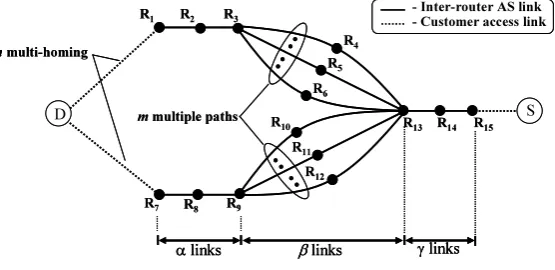
In modeling the multi-path structure that emerges as the results of the existing multi-homing and peering in the Inter-net today (as shown in Fig.1), we built a simplified model for our reliability analysis as shown in Fig.2. The model was built to capture the general structure in a multiple-path rout-ing configuration between two terminal hosts at the same time it is tractable in quantifying reliability using multi-path routing. The model assumes that the transmitting side is a single-home network and that multiple paths exist between the single-home origin network and a multi-homed desti-nation network, which will be a common configuration for many networks in the Internet today.
In the model, nodeS indicates a source end host com-puter, while D indicates a destination end host computer. To simplify the model, we assumed that each ISP is repre-sented by an exterior BGP router (thus,R1represents an ISP, R2does another, and so on).S is subscribed to an ISP and connected to the ISP’s router,R15.Dis multi-homed to two different ISPs. It is connected toR1 in its first ISP and to
R7in its second ISP. Although each ISP can have multiple egress/ingress points to another ISP, we model each ISP as a node, where two ISPs are always connected by an AS link even though there can be multiple AS links between them.
It is assumed that each route from S to D consists of multiple links. We assumed that the term “route” means a logical connection from a source to a destination ISP (thus there are two routes fromStoDin Fig.2: fromR15toR1 and fromR15 toR7). The term “link” is defined to mean a logical connection between two exterior BGP routers, thus between two ISPs. Since the two terms, “ISP” and “AS”, are interchangeable, we use a term “AS link” for “link”. A par-tial sequence of links within a route is called a “path”. For example, there aremmultiple paths betweenR13andR3in the route fromR15toR1.
We considered only AS links in our analysis. It is also assumed that a section in a route may have multiple parallel paths as Gao argued [5]. Each route is assumed to consist of three sections. The first section corresponds to the source side’s edge links, where there is no multiple path exists (the section is called “source side single-path section” here-after). The second section is the one where multiple parallel paths are available (“multi-path section”). “Multiple parallel paths” are called “multiple paths” hereafter. The third sec-tion corresponds to the destinasec-tion side’s edge links (“desti-nation side single-path section”). Similar to the source side single-path section, the destination side single-path section has only one path (i.e., no multiple path exists).
Based on the above model, the following control param-eters are used in our analysis:
• m: degree of multiple paths available in the multi-path section
• n: degree of multi-homing in the destination side • α,β,γ: number of AS links in the destination side
sin-gle path, multi-path, and source side sinsin-gle-path sections, respectively
• p: link-failure rate for each link(0<p<1).
Using the above parameters, the reliability in data trans-missions fromS toD (called “the reliability” hereafter) is defined as the probability that at least one route survives when each link will fail at a probability ofp. The reliability is quantified by
1−1−1−1−(1−p)βm×(1−p)αn
×(1−p)γ (1)
We analyzed the reliability for different m, n, and p, while we changed the values ofα, β, andγ, as well as their relative ratio for understanding their impact to the reliability.
Analysis #1 (“path length analysis”): The impact of the path length to the reliability was analyzed for different link-failure rates. The reliability was calculated using (1) while a
set ofα, β, andγ was changed from (α, β, γ )=(1,1,1)to (6,6,6). To increase the path length without modifying the ratio of the three sections, the same value was applied toα, β, andγ. For the degree of multiple paths,m=4 was ap-plied. The reliability was calculated for three different cases ofn=1 (no multi-homing), 2, and 3. We analyzed the im-pact using the minimum case (α, β, γ )=(1,1,1)through (6,6,6)based on the observation that most of the BGP path length is less than 20 hops [6]. We also applied this assump-tion to other analyses, Analysis #2, #3 and #4.
Analysis #2 (“length of multi-path section analysis”): The reliability was calculated while the length of multi-path sec-tion (β)was changed from 1 to 8 to see the effect of the different ratios ofβ toαandγ. While β was changed,α andγ remained unchanged (α=2 andγ =2 were used). Same as Analysis #1, m=4 was used and the reliability was calculated forn=1, 2, and 3.
Analysis #3 (“degree of multi-path analysis”): This anal-ysis estimates the impact of the degree of multiple paths to the reliability. The expected reliability was calculated for m=1 (no multiple path available) to 8. For (α, β, γ ) val-ues,(2,2,2)was applied. Similar to the previous analyses, the reliability was estimated forn=1, 2, and 3. For a multi-homed environment (i.e.,n >1), the same value ofmwas applied to each multi-home route to the destination network.
Analysis #4 (“length of single-path section analysis”): The reliability was calculated while the length of the single-path sections (α, γ )was changed. While β was fixed, the values of α and γ were changed from (α, γ )=(1,1) to (8,8). The reliability was calculated for n=1, 2, and 3. β=2 andm=4 were used in this analysis.
3.1 Observations and analysis for Analysis #1
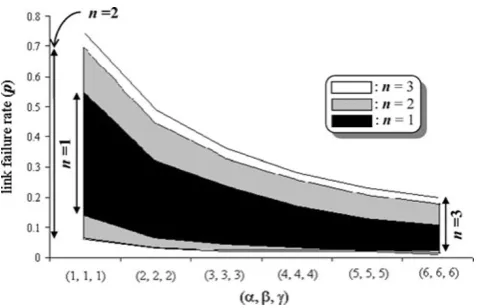
Figure3shows the ranges of the link-failure probability (p) that yielded 10%+improvement in the raw (absolute)
ference in reliability for the existing single-path BGP rout-ing and for the multi-path routrout-ing. For the srout-ingle-path BGP routing, it was assumed that data transmission using a path fails if any AS link in the path fails, while data transmission fails only if all the mmulti-paths fail (i.e., at least one AS link in each of m multi-paths fails). At (α, β, γ )=(1,1,1), the range of pthat yielded 10%+improvement forn=1 (no multi-homing) was p=0.14 through 0.52. For n=2 (multi-homing with degree of 2), it was p=0.06 through 0.69. Forn=3, it was 0.06 through 0.74. The range rapidly shrunk when the path length was increased from (1,1,1) to(3,3,3), followed by gradual, but monotonic decreases to(6,6,6). At(6,6,6), the ranges of 10%+improvement were reduced top=0.03 through 0.11 forn=1, p=0.01 through 0.17 forn=2, and 0.01 through 0.20 forn=3.
The results of Analysis #1 suggest that the path length should be short to maximize the reliability by multi-path routing. The width of p that yielded 10%+difference for n=1, 2, and 3 at (α, β, γ )=(1,1,1)was 0.38 (0.52–0.14) forn=1, it was 0.63 and 0.68 forn=2 and 3. The ranges of pshrunk to 0.15, 0.30, and 0.34 at(3,3,3)and 0.08, 0.16, and 0.19 at (6,6,6)for n=1,2, and 3, respectively. The ratio ofpforn=1, 2, and 3 at(1,1,1)was approximately 1.0:1.67:1.74, while the ratio was 1.0:2.0:2.26 at (3,3,3) and 1.0:2.0:2.4 at(6,6,6). These results imply that multi-homing will be more effective in improving the reliability when the path length is longer, while multi-path routing will be more effective when the path length is shorter. Assum-ing that the ASes away from the Internet core have a longer average path length to other ASes, multi-homing will be an effective technique to improve the reliability for those ASes away from the Internet core, while multi-path routing will be effective for those close to the Internet core.
3.2 Observations and analysis for Analysis #2
Figure 4 shows how the range of p that yielded 10%+ difference between no multi-path and multi-path routing
Fig. 4 Ranges of link failure rate (p)that yielded 10%+improvement in Analysis #2
changed when the length of the multi-path section (β)was increased from 1 to 8 whileαandγ were fixed at 2. When β=1, the ranges ofpwas 0.04 through 0.44 forn=2, and p=0.04 through 0.50 forn=3. Forn=1, the reliability was completely the same as that of no multi-path routing, which validated (1). Whenβ=8, the ranges ofpwere 0.02 through 0.26 for n=1, 0.02 through 0.32 forn=2, and 0.02 through 0.36 forn=3. Afterβ=5,β did not signifi-cantly affect the ranges of the 10%+improvement.
The multi-homed networks with degree of two or larger are connected to the Internet backbone using at least two different paths. Therefore, we did not expect that the length of the multi-path section (sectionβ)would have a signifi-cant impact to the reliability for such multi-homed networks. That is because such multi-homed networks can switch to a backup link on a failure of their primary access link. Contrary to our prediction, these results suggest that multi-homing will significantly improve the reliability if used with multi-path routing when the length of the multi-path section (sectionβ)is long. These outcomes imply that multi-homed networks that are “distant” from the Internet core will bene-fit more from multi-path routing, compared to those who are “close” to the Internet core.
3.3 Observations and analysis for Analysis #3
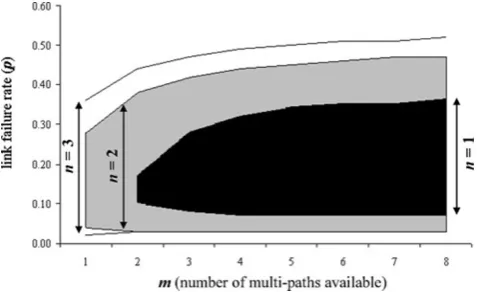
Figure 5 shows how the range of p that yielded 10%+ difference changed when the degree of multi-path was in-creased fromm=1 to 8. When m=1 (no multi-path ex-ists), the ranges werep=0.04 through 0.28 forn=2 and 0.02 through 0.36 forn=3. The single-home configuration resulted in no improvement whenm=1 by the same reason for Analysis 2. Atm=5, the ranges forn=1,2, and 3 were 0.07 through 0.33, 0.03 through 0.45, and 0.03 through 0.50, respectively. Afterm=5, increase in the range was minor (at most 2.4% increase fromm=5 to 6 forn=2).
The results indicate that a relatively small number of multiple paths will significantly contribute to improvement
Fig. 6 Ranges of link failure rate (p)that yielded 10%+improvement in Analysis #4
of the reliability. The results also suggest that the reliabil-ity will not be improved proportionally when the number of multiple paths continues to increase. For example, from m=1 to 4, the range ofpincreased forn=1, 2, and 3 by 242.9% (fromm=2 to 4 forn=1), 70.8% and 35.3%, re-spectively, while from m=4 to 8, the increases were only 16.7%, 7.3%, and 6.5%. At and abovem=4, the improve-ment significantly slowed down. These results suggest that a small number (three to four, especially three) of multiple paths will be most cost effective.
3.4 Observations and analysis for Analysis #4
Figure6 shows the ranges ofp that yielded 10%+ differ-ence whenαandγ were changed from 1 to 8 (always the same value was assigned toαandγ )while the value ofβ was fixed to 2. At (α, β, γ )=(1,2,1), the ranges ofpwere 0.06 through 0.51 for n=1,0.04 through 0.62 forn=2, and 0.04 through 0.66 forn=3. At (α, β, γ )=(3,2,3)and above, the single-home configuration did not improve the reliability more than 10%. The ranges ofpforn=2 and 3 shrunk rather rapidly whenαandγ were increased. When αandγwere increased from(1,2,1)to(5,2,5), the ranges shrunk by 29.3, 26.8, 26.6, and 18.2% each time forn=2. The range shrunk by 25.8, 26.1, 20.6, and 18.5% forn=3. After (α, β, γ )=(5,2,5), the rate of shrink in the 10% im-provement ranges slowed down though.
As the length of the single-path sections (α andγ ) in-creased, the advantage of multi-path routing rapidly de-creased. When αandγ were four or higher, the range of link-failure rate that produced 10%+ improvement disap-peared for the single-homed configuration, while for the multi-homed configurations, the ranges slowly decreased in Fig.6. These results suggest that the length of the single-path sections (αandγ )should be short if multi-homing is not used. If the length of the single-path sections is relatively longer than that of the multi-path section, multi-homing will be effective to taking the advantages of multi-path routing.
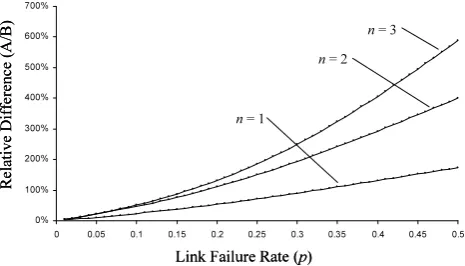
Figures 7 and8 show the absolute and differences be-tween the reliability of no multi-path routing (noted as
sym-Fig. 7 Absolute differences for the transmission reliability
Fig. 8 Relative differences for the transmission reliability
bol “B” in the y-axis) and that of the three multi-homing configurations ofn=1, 2, and 3 (noted as “A”) form=4 and (α, β, γ )=(2,2,2)for a range ofp:0.01≤p≤0.50. The absolute difference (“A–B”) was calculated as
RM(n)−RN (2)
and the relative difference (“A/B”) was calculated as
(RM(n)−RN)/RN (3)
whileRM(n)refers to the reliability of a multi-path routing with the degree of multi-homing ofnwheren=1, 2, or 3 andRNrefers to the reliability of no multi-path routing.
4 Analyses on the trends in the past changes in the Internet’s inter-domain structure
This section describes our analyses on the present state of the existing connections in ASes in the Internet to observe if the past and the current changes in its structure are along the ideal network structure for multi-path routing identified in the previous section. Its primary objective is in understand-ing the present state of the available multi-path connections in the Internet to observe if the past and the current changes in its structure are along the ideal network structure identi-fied in the previous section.
For the above objectives, we performed two different analyses. In the first analysis (Analysis #5), we investigated how the number of available multiple paths differs for ASes in different locations in the Internet. We counted the number for ASes that are close to the Internet core and ASes that are away from the Internet core. The primary objective in this analysis is to assess who will most or least benefit from fu-ture multi-path routing. In the second analysis (Analysis #6), we investigated who are contributing to future multi-path routing and how. We first classified network carriers as tier-1, tier-2, and CATV carriers, and analyzed how much of the existing BGP paths are carried out by which type of carrier. We then observed how the carriers are expanding their BGP peering paths in the Internet. The primary objective in this analysis is to study if the Internet has enough BGP multiple paths to take the advantage of multi-path routing.
We performed the analyses using the AS links extracted from the BGP path update messages collected by Route-Views Project [20]. We used the BGP updates archive from RouteView project, since it publishes the largest existing BGP updates archive. The data sets contained BGP UP-DATE messages announced in the global Internet as ob-served by multiple observation points. Its data sets are also considered one of the most representative archives and many research projects, such as CAIDA’s (CAIDA is for the Coop-erative Association for Internet Data Analysis) NetGeo and AS Path Visualization funded by the US National Science Foundation, are using the data sets [20].
The path update messages are the information two BGP routers in the Internet exchange to propagate available paths to reach other ASes over the global Internet. Each update message contains the AS_PATH field that contains a se-quence of ASes, through which a remote network domain can be reached. For example, in the following example of the AS_PATH field, the AS_PATH field indicates that the BGP router that receives this message can reach a network domain of 146.163.255.255/16 by following the path of AS-920, 701, 4425, and 10854 in that order. The existing ASes in the Internet periodically or dynamically exchange the up-date messages to advertise the existing paths to other ASes. 146.163.255.255/16 AS_PATH: 920 701 4425 10854
In the above example, two consecutive ASes in the se-quence imply that there exists a logical or physical unidirec-tional link between the two ASes in the global Internet. The existing links are extracted from the update messages and they are used to detect the AS interconnections in the Inter-net. We used the AS interconnections to understand which AS is connected to other ASes and how they are connected. The data sets we used for the analyses were from EQIX (Equinix), ISC, LINX, and WIDE for the following time windows:
• ISC (route-views.isc.routeviews.org) for January 2004 through November 2008
• LINX (route-views.linx.routeviews.org) for July 2004 through November 2008
• WIDE (route-views.wide.routeviews.org) for September 2003 through November 2008
• Equinix Ashburn (route-views.eqix.route-views.org) as EQIX for October 2005 through November 2008.
We reconstructed a BGP routing table, Adj-RIB-in (Ad-jacent Routing Information Base, Incoming) table, from the BGP UPDATE messages based on the following concepts:
AS link: For any two consecutive ASes that appear in the AS_PATH field, we assumed that there is an AS link from the former to the latter (in the order of their appearances in the AS_PATH field). Although AS links are unidirectional in the current BGP, we assume that they are bidirectional. We adopted this assumption mainly because the physical con-nections in each AS link are usually capable of bidirectional transmissions and also because the bidirectional capability most probably will be utilized when multi-path routing is adopted in the future to maximize the benefits of the multi-path routing.
BGP path: Each BGP path is a sequence of one or more AS links from a source AS to a destination AS. We used not only the actual BGP paths but potential BGP paths in discovering multiple paths. The actual BGP paths are those that appeared in the AS_PATH field of Adj-RIB-in table, while the potential paths are those that can be synthesized by combinations of any existing AS links in Adj-RIB-in table.
Multiple BGP paths: Multiple BGP paths are a set of BGP paths that have the same origin and the destination ASes, each of which contains at least one AS link that does not appear in other BGP paths in the set (except for AS-prepending).
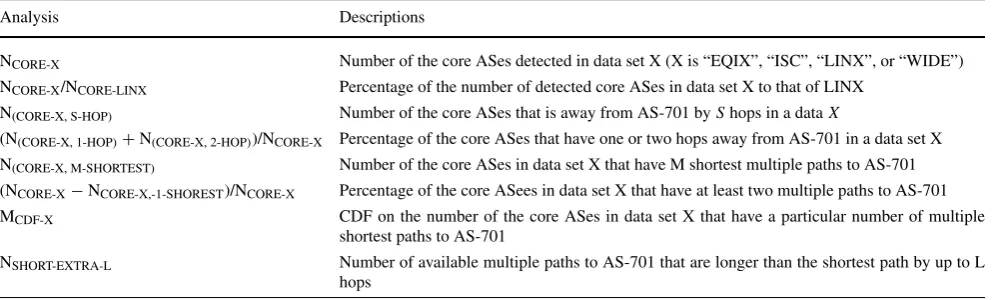
Table 1 List of the analyses performed in Analysis #5
Analysis Descriptions
NCORE-X Number of the core ASes detected in data set X (X is “EQIX”, “ISC”, “LINX”, or “WIDE”) NCORE-X/NCORE-LINX Percentage of the number of detected core ASes in data set X to that of LINX
N(CORE-X, S-HOP) Number of the core ASes that is away from AS-701 byShops in a dataX
(N(CORE-X, 1-HOP)+N(CORE-X, 2-HOP))/NCORE-X Percentage of the core ASes that have one or two hops away from AS-701 in a data set X N(CORE-X, M-SHORTEST) Number of the core ASes in data set X that have M shortest multiple paths to AS-701 (NCORE-X−NCORE-X,-1-SHOREST)/NCORE-X Percentage of the core ASees in data set X that have at least two multiple paths to AS-701 MCDF-X CDF on the number of the core ASes in data set X that have a particular number of multiple
shortest paths to AS-701
NSHORT-EXTRA-L Number of available multiple paths to AS-701 that are longer than the shortest path by up to L hops
Core ASes: Core ASes are those that satisfy both of the following two conditions. (i) The ASes that have a cycle BGP path using which an AS can reach itself without go-ing through the same AS more than once (except the origin AS) and (ii) The cycle contains AS-701. As a result, with all AS links being bidirectional, the core ASes are those that have multiple BGP paths to the Internet core.
Analysis #5 (BGP multi-path analysis): Availability of multiple BGP paths from an AS to another in the global In-ternet was analyzed. Table1defines and describes the anal-yses performed on the number of multiple paths from each core AS to the Internet core (i.e., AS-701).
Analysis #6 (ISP classification analysis): In this analysis, each core AS that appears in a BGP path is classified to a tier-1, tier-2, cable-TV (CATV), or other ISP. For Tier-1 and tier-2 ISP’s, we used a list of the tier 1 and 2 ISP’s published by the Cooperative Association for Internet Data Analysis project [1]. For CATV carriers in the North America, we used a list of the major cable operators in the North America region compiled by National Cable & Telecommunication Association [12].
Based on the classifications, BGP paths from each core AS to the Internet core (i.e., AS 701) are categorized in the following criteria:
• Tier-1 paths: the paths that go through at least one tier-1 ISP
• Non-tier-1 paths: the paths that do not go through any tier-1 ISP
• Tier-2 paths: the paths that go through at least one tier-2 ISP
• Non-tier-2 paths: the paths that do not go through any tier-2 ISP
• CATV paths: the paths that go through at least one CATV ISP
• Non-CATV paths: the paths that do not go through any CATV ISP.
Note that some categories are not antagonistic to each other. For example, a BGP path can be a tier-1 path at the same time it is a tier-2 path, while one cannot be a tier-1 path at the same time it is a non-tier-1 path. Table2lists the terms considered in Analysis #6.
4.1 Observations and analysis for Analysis #5
Figures9through14show the results from Analysis #5. Fig-ure9shows the number of the core ASes detected in EQIX, ISC, LINX, and WIDE and their ratio to LINX, which re-sulted in the largest number of the core ASes. The figure shows the ratio of the core ASes in each data set that can reach the Internet core in one, two, three, and four or more AS-hops using their shortest path. For example, 1.7% of the core ASes detected in WIDE could reach AS-701 using only one hop, 53.1% of them could reach AS-701 using two hops, and so on.
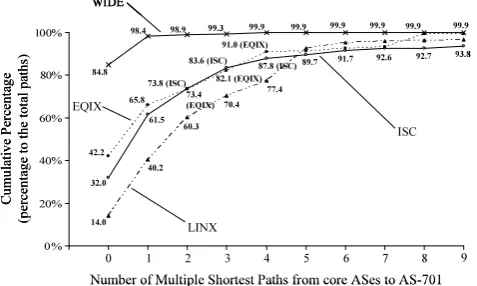
Figure10shows the observed cumulative distribution for the number of multiple shortest BGP paths from each core AS to AS-701 in the four data sets. In the figure, the num-ber of multiple paths of zero (“0” on the x axis) means those that have only one shortest path to AS-701. For example, in LINX, 14.0% of its core ASes have only one shortest BGP path to AS-701, while 60.3% of them have up to two ad-ditional (i.e., a total of three) BGP shortest paths to reach AS-701.
Figure11(a) shows the ratio of the number of the core ASes detected in WIDE, ISC, and EQIX to that of LINX, the percentage of the core ASes that are either one or two hops away from AS-701 (based on their shortest paths) to all the detected core ASes in each data set, and the percentage of the core ASes that have at least two shortest paths to AS-701 in each data set. The figure indicates strong correlations among the three statistics, especially between the ratio of the core ASes, and the percentage of the core ASes that are either one or two hops away from AS-701.
Table 2 List of the analyses performed in Analysis #6
Term Description
NTOTAL Number of the distinct BGP paths from a core AS to the Internet core (AS-701) detected in each of the data sets (EQIX, ISC, LINX, WIDE)
PT1, PT2, PCATV The set of the paths detected in a data set that go through at least a tier-1, tier-2 and CATV ISP, respectively
PNT1, PNT2, PNCATV The set of the paths detected in a data set that do not go through any tier-1, tier-2 and CATV ISP, respectively
N(PT1), N(PT2), N(PCATV) Number of the BGP paths in a data set that go through at least a tier-1, tier-2 and a CATV ISP, respectively
N(PNT1), N(PNT2), N(PNCATV) Number of the BGP paths in a data set that do not go through any tier-1, tier-2, and CATV ISP, respectively
RT1, RT2, RCATV = N(PT1)/NTOTAL, N(PT2)/NTOTAL,N(PCATV)/NTOTAL RNT1, RNT2, RNCATV = N(PNT1)/NTOTAL, N(PNT2)/NTOTAL, N(PNCATV)/NTOTAL
N(PT2∩PNT1)/N(PT2∩PT1) Ratio of the tier-2 paths without going through a tier-1 ISP to the tier-2 paths that go through a tier-1 ISP
N(PCATV∩PNT1)/N(PCATV∩PT1) Ratio of the CATV paths without going through a tier-1 ISP to the CATV paths that go through a tier-1 ISP
Fig. 9 Number of detected core ASes in each data set (NCORE-X) and composition of BGP paths with different path length (N(CORE-X, S-HOP)for
S=1, 2, 3 and 4)
Fig. 10 Observed CDF for the number of multiple shortest BGP paths to AS-701 (MCDF)
percentage of the core ASes which are close (in terms of AS interconnections) to the Internet core (those that reach
the core in one or two AS links) proportionally increased when the number of the core ASes increases. The figure also shows a similar result for the percentage of the core ASes that have at least two shortest paths to the core of the Inter-net.
Figures12and13show the number of multiple shortest paths, those with one extra hop over the shortest path, and two extra hops, from each core AS to AS-701 in EQIX and WIDE. Their y-axis shows the number of the core ASes in each data set. The logarithm of base 10 is applied to the y-axis for EQIX (but not for WIDE). ISC and LINX showed a similar result as EQIX. The number of detected multiple paths increased by an order of magnitude each time the hop count was relaxed by one over the shortest path for EQIX, ISC, and LINX, while the numbers increased much slower in WIDE.
Fig. 11 (a) and (b)—Observed correlation in the three analyses
Fig. 12 NSHORT-EXTRA-LforL=1, 2, 3 in EQIX
Fig. 13 NSHORT-EXTRA-LforL=1, 2, 3 in WIDE
and those with two extra hops, from each of the core ASes to the Internet core (i.e., AS 701) in WIDE (the plots over 150 on the y axis are not shown). In the figure the core ASes are sorted on the x-axis in the ascending order of their “AS number”. The trend line is for the number of the paths with one extra hop.
The graphs show that the core ASes with a small AS number tend to have more multiple BGP paths than those with a large AS number. It is likely that the ASes with a low AS number are those that participated in the Internet in
Fig. 14 Number of multiple BGP paths in WIDE, ordered in the as-cending AS numbers
its early stage and that they occupy the majority of its core. The above observations, which are consistent with the power law predicted by Faloutsos [3], indicate uneven distribution of AS links.
We speculated on why the numbers of detected core ASes are different in the four data sets to understand what the cor-relations of the three statistics in Fig.11(b) mean. One of the possible ways to explain the correlation is as follows. At each AS, BGP-4, as a path-vector routing protocol, propa-gates only the selected best path to each destination to other ASes. In this process, when an AS propagates BGP UP-DATE messages, the messages will go through more inter-mediate ASes before they reach ASes that are far away from the Internet core. As a result, many multiple BGP paths to each destination will be filtered out at intermediate ASes, while only the selected best paths will be forwarded farther to other ASes. With less multiple BGP paths advertised to other ASes, the number of the core ASes will be reduced too.
Fig. 15 An example of AS connections that demonstrates reductions of the core ASes
Fig. 16 Ratio of the tier-1 BGP paths (WIDE)
ASes, since each of them will have a cycle that contains AS 701, assuming that each AS link is bidirectional. For exam-ple, AS 1 will have three cycles 1-701-2 (3, 4)-10-1 and it will detect four core ASes. The same will happen to AS 2, 3, 4, and 10. However, since AS 10 propagates only its selected best path for AS 701 to AS 100, AS 100 will detect only two core ASes of AS 10 and (1, 2, 3, or 4). If this hypothesis is correct, ASes far away (i.e., more hops to the Internet core) will have fewer core ASes. This can also explain the results in Figs.9,10, and11.
If the above hypothesis is correct, the results shown by Figs. 9 through13can be considered as the aftermaths of filtering multiple paths at intermediate ASes before they are propagated to those away from the Internet core. The ASes that have a larger number of multiple shortest paths to the Internet core are considered to be those “closer” to the Inter-net core. For example, LINX is the one closest to the InterInter-net core, followed by ISC, EQIX, and WIDE.
4.2 Observations and analysis for Analysis #6
Figures16through25show the results of Analysis #6. Fig-ure16shows how the ratio of the tier-1 paths (RT1) and the ratio of the non-tier-1 paths (RNT1) in WIDE has changed
Fig. 17 Ratio of the tier-2 paths (EQIX)
Fig. 18 Ratio of the tier-2 paths (ISC)
in the past. The ratio continuously decreased over the past years, and only 52.1% of its BGP paths are currently going through a tier-1 ISP. The trend in the graph suggests that the majority of its BGP paths will most probably bypass the tier-1 ISPs in the near future. Although it was in WIDE that the trend was most clearly observed, a similar result was ob-served in other three datasets of EQIX, ISC, and LINX. In EQIX, ISC, and LINX, 38.9, 36.2, and 37.7% of their BGP paths are not using a tier-1 ISP.
Figure17shows the ratio of the tier-2 paths (RT2) and the ratio of the non-tier-2 paths (RNT2) in EQIX, in which the tier-2 paths already dominated. The ratio continues to have increased in the recent years (75.1% of its BGP paths go through a tier-2 ISP in October 2008). Figure18shows that the ratios of the tier-2 paths and the non-tier-2 paths in ISC inversed around April 2005. In ISC, 55.7% of its BGP paths go through a tier-2 ISP in October 2008. We observed a similar result in LINX, where 61.9% of its BGP paths go through a tier-2 ISP in May 2008 and inversion of the ratio happened at the end of 2004. In WIDE, although the major-ity of its BGP paths are still non-tier-2 paths, its ratio con-tinued to increase in the recent years. In September 2008 the ratio was 30.3% (Fig.19).
Fig. 19 Ratio of the tier-2 paths (WIDE)
Fig. 20 Ratio of the CATV paths in LINX
paths, the availability of tier-2 paths is steadily increasing in the four data sets. Especially from the hypothesis resulted from Analysis #5, it seems that the progress of adopting tier-2 paths is faster for those that are closer to the Internet core (EQIX, ISC, and LINX), meaning that more tier-2 paths will be available to the ASes closer to the Internet core than those away from the Internet core (WIDE).
Figure 20shows the ratio of the CATV paths (RCATV) and the ratio of the non-CATV paths (RNCATV) in LINX. Although the ratio is still quite low (13.0% in May 2008) compared to its tier-2 paths, the ratio has been steadily in-creasing. Quite similar results are also observed in WIDE (7.4% in September 2008). EQIX and ISC showed a similar pattern except that a sudden increase in the ratio occurred (9.4% and 23.4% in October 2008, respectively).
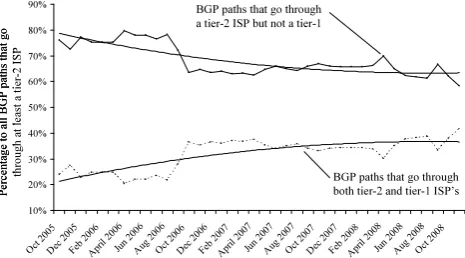
Figure21shows the ratio of the tier-2 paths without go-ing through a tier-1 ISP to the tier-2 paths that go through a tier-1 ISP (N(PT2∩PNT1)/N(PT2∩PT1)) in WIDE. The fig-ure shows that 82.2% of its tier-2 paths bypass the tier-1 ISPs. In ISC (Fig.22), the majority of its tier-2 paths still go through a tier-1 ISP, but its ratio is gradually, but constantly decreasing. The ratio has decreased from 80.0% in January 2004 to 57.6% in October 2008. EQIX and LINX showed an opposite pattern, but the tier-2 paths that do not go through any tier-1 ISP currently occupy the majority in both EQIX
Fig. 21 Ratio of the tier-2 paths without going through any tier-1 ISP to the tier-2 paths that go through a tier-1 ISP in WIDE
Fig. 22 Ratio of the tier-2 paths without going through any tier-1 ISP to the tier-2 paths that go through a tier-1 ISP in ISC
Fig. 23 Ratio of the tier-2 paths without going through any tier-1 ISP to the tier-2 paths that go through a tier-1 ISP in EQIX
(58.2%) and LINX (58.5%). Figure23shows the results of EQIX.
Fig. 24 Ratio of the CATV paths without going through any tier-1 ISP to the CATV paths that go through a tier-1 ISP in WIDE
Fig. 25 Ratio of the CATV paths without going through any tier-1 ISP to the CATV paths that go through a tier-1 ISP in ISP
peering links that bypass the tier-1 ISPs. What this means is that for the ASes away from the Internet core, more tier-2 peering links bypass the tier-1 ISPs, which, like the new inter-state highways that go around the center of big (and therefore busy) cities, lets such ASes avoid traffic conges-tion in the Internet core.
Figures24and25show the ratio of the CATV paths with-out going through any tier-1 ISP to the CATV paths go-ing through a tier-1 ISP (N(PCATV∩PNT1)/N(PCATV∩PT1)) in WIDE and ISC, respectively. Although the number of BGP paths that go through a CATV ISP is still limited, the two figures suggest that more BGP paths that go through a CATV ISP tend to bypass tier-1 ISPs. LINX showed a simi-lar result to ISC, while EQIX was simisimi-lar to WIDE. Regard-ing bypassRegard-ing tier-1 ISPs, the same tendency appeared in the two figures. For WIDE and EQIX, which are considered ASes away from the Internet core, the tendency of avoiding tier-1 ISPs is more obvious than ISC and LINX, which are ISPs close to the Internet core.
5 Conclusions
The results of the mathematical analyses on the properties of the ideal network structure for multi-path routing brought us the following conclusions. First, to take the advantage of multiple-path routing, the end-to-end path length should be short (from Analysis #1). The results from Analysis #1 also suggested that multi-homing will be an effective tech-nique to improve the reliability for those ASes away from the Internet core, while multi-path routing will be effective for those close to the Internet core. However, these results suggest that multi-homing will significantly improve the re-liability if used with multi-path routing, especially when the length of the multi-path section is increased.
Second, the results from Analysis #3 suggest that a large number of multiple paths will not be necessary to take the advantage of multi-path routing. The results showed that three to four multiple paths will be most cost effective.
Third, the length of the single-path sections (α andγ ) should be short if multi-homing is not used. Multi-path rout-ing will benefit to multi-homed networks when the srout-ingle- single-path sections are relatively longer than the multi-single-path sec-tion (Analysis #4). This means that multi-path routing will be effective for the multi-homed networks away from the Internet core, which manifests an advantage in combining multi-homing and multi-path routing.
Finally, similar to the degree of multiple paths, multi-homing to two ISPs will be most cost effective, since reli-ability will not be improved proportionally to the increase in the degree of multi-homing over two. The results of our analyses on the recent changes in the Internet’s structure are as follow. Although the current inter-domain routing proto-col, BGP-4, still assumes a tree structure, the results of our analyses revealed that structure of the Internet today signif-icantly deviates from a simple tree structure. We found that especially tier-2 providers are now playing a significant role in increasing multiple paths, and that many of them bypass the tier-1 ISPs.
The results of Analysis #6 suggest that for the ASes away from the Internet core, more tier-2 and CATV peering by-pass the tier-1 ISPs, which means that multi-path routing will effectively let such ASes to avoid traffic congestion in the Internet core, like the new inter-state highways that go around the center of big (and therefore busy) cities. In con-trast to the ASes away from the Internet core, more tier-2 and CATV paths are available to those ASes close to the Internet core, meaning that multi-path routing will be effec-tive for such ASes to distribute network traffic through the Internet core, especially when the core is congested.
will be spread over multiple carriers using the built-in load-balancing capability in the multi-path routing, which im-plies that path selections will be less controlled by orig-inating ISP and their customers, it is not hard to imag-ine that the load-balancing capability will be counter uti-lized by attacking side, using black-hole routers, bogus BGP path advertises, and DNS hijacking. Another essential future work will be reducing the BGP routing table. At the end of 2010, typical BGP table size approached 300,000 des-tination prefixes, which made a BGP routing table several hundred megabytes. Huston argued that adoptions of multi-homing are one of the major drivers of the growth [11], which implies that multi-homing is a probable threat to core routers in the future. In order for multi-homing to be popu-larly adopted in the future, this problem must be addressed.
References
1. The Cooperative Association for Internet Data Analysis project, URL:http://as-rank.caida.org(last accessed: February 20, 2011) 2. Chang H, Jamin S, Willinger W (2006) To peer or not to peer:
modeling the evolution of the Internet’s AS-level topology. In: Proceedings of the twenty-fifth IEEE international conference on computer communications (INFOCOM), pp 1–12
3. Faloutsos C, Faloutsos P, Faloutsos M (1999) On power-law rela-tionships of the Internet topology. In: Proceedings of ACM special interest group on data communications (SIGCOMM), pp 251–262 4. Fujinoki H (2009) Improving reliability for multi-home inbound
traffic: MHLB/I packet-level inter-domain load-balancing. In: Proceedings of the forth international conference on availability, reliability and security (ARES), pp 248–256
5. Gao L (2001) On inferring autonomous system relationships in the Internet. IEEE/ACM Trans Netw 9(6):733–745
6. Ge Z, Figueiredo DR, Jaiwal S, Gao L (2001) On the hierarchical structure of the logical Internet graph. In: Proceedings of SPIE information technologies and communications, pp 208–222 7. Goldenberg D, Qiuy L, Xie H, Yang R, Zhang Y (2004)
Optimiz-ing cost and performance for multihomOptimiz-ing. Comput Commun Rev 34(4):79–92
8. Griffin T, Premore B (2001) An experimental analysis of BGP convergence time. In: Proceedings of the ninth IEEE international conference on network protocols, p 53
9. Gummadi R, Govindan R (2005) Practical routing-layer support for scalable multihoming. In: Proceedings of the twenty-forth IEEE international conference on computer communications (IN-FOCOM), pp 248–259
10. Guo F, Chen J, Li W, Chiueh T (2004) Experiences in build-ing a multihombuild-ing load balancbuild-ing system. In: Proceedbuild-ings of the twenty-third IEEE international conference on computer commu-nications (INFOCOM), pp 1241–1251
11. Huston G (2001) Analyzing the Internet BGP routing table. Inter-net Protoc J 4(1):25
12. Cable National, Telecommunication Association URL http:// www.ncta.com(last accessed: February 20, 2011)
13. Norton W (2005) The Evolution of the U.S. Internet peering ecosystem. Presented at North American Network Operators’ Group Conference, URL: http://drpeering.net/white-papers/ Ecosystems/Evolution-of-the-U.S.-Peering-Ecosystem.html, lat accessed: August 29, 2010
14. Oliveira R, Pei D, Willinger W, Zhnag B, Zhang L (2008) In search of the elusive ground truth: the Internet’s AS-level connectivity structure. ACM SIGMETRICS Perform Eval Rev 36(1):217–228 15. Oliveira R, Zhnag B, Zhang L (2007) Observing the evolution of
AS topology. Comput Commun Rev 37(4):313–324
16. Paxson V (1997) End-to-end routing behavior in the Internet. IEEE/ACM Trans Netw 5(5):601–615
17. Rekhter Y, Li T (2006) A border gateway protocol 4 (BGP-4). Request for comments 4271
18. Shakkottai S, Fomenkov M, Koga R, Krioukov D, Claffy K (2009) Evolution of the Internet AS-level ecosystem. In: Proceedings of the first international conference on complex sciences: theory and applications, pp 1605–1616
19. Subramanian L, Agarwal S, Rexford J, Katz R (2002) Charac-terizing the Internet hierarchy from multiple vantage points. In: Proceedings of the twenty-first IEEE international conference on computer communications (INFOCOM), pp 618–627
20. University of Oregon Route Views Project, URL: http://www. routeviews.org/(last accessed: August 29, 2010)
21. Xia J, Gaon L (2004) On the evaluation of AS relationship in-ferences. In: Proceedings of the twenty-third IEEE international conference on computer communications (INFOCOM), pp 1373– 1377
22. Yannuzzi M, Masip-Bruin X (2005) Open issues in interdomain routing: a survey. IEEE Netw 49–56