IJIRT 146806
INTERNATIONAL JO URNAL OF INNOVATIVE RESEARCH IN TECHNOLOGY70
A Review on Heat Transfer Augmentation in A Heat
Exchanger Using Active and Passive Method
Swati Sharma
1, Pooja Kaushal
2, Vikash Siddhu
31, 2, 3
Government Polytechnic College, Lecturer, ITARSI, MP, INDIA
Abstract- In most of the industrial application including power plants, chemical, refrigerator and air conditioning systems use heat exchangers is most common. Heat exchangers have several industrial and engineering applications. In recent years, the high cost of energy and material has resulted in an increased effort aimed at producing more efficient heat exchange equipment. The usual goals are to reduce the size of a heat exchanger required for a specified heat duty, to upgrade the capacity of an existing heat exchanger, to reduce the approach temperature difference of the fluids, or to reduce the pumping power. The study of improved heat transfer performance is referred to as heat transfer augmentation, enhancement, or intensification.
Heat transfer augmentation techniques refer to different methods used to increase rate of heat transfer without affecting much overall performance of the system. Active and passive cooling are the two possible methods for removing heat. In the past decade, several studies on the active and passive techniques of heat transfer augmentation have been reported. The present paper is a review on progress with the active and passive augmentation techniques in the recent past and will be useful to designers implementing these augmentation techniques in heat exchange.
Index Terms- Heat Exchanger, Heat Transfer
Augmentation, Active Techniques, Passive Techniques, Compound Techniques.
I. INTRODUCTION
Heat is a form of energy. Heat transfer may be defined as the transmission of energy from one region to another as a result of temperature gradient. Heat exchangers are an essential part in an assortment of mechanical settings, for example, cooling frameworks, force plants, refineries, and in this way ceaseless endeavor are made to expand their heat transfer efficiencies. In late decades while there has been constant advance in enhancing the execution
of heat exchangers by tending to their development and format issues, the poor heat transfer properties of the working liquids utilized as a part of the heat exchangers have still remained an essential execution constraining element for these frameworks.
In most of the practical applications of enhancement techniques, the following performance objectives, along with a set of operating constraints and conditions, are usually considered for evaluating the thermo hydraulic performance of a heat exchanger:
Increase in the heat duty of an existing heat
exchanger without altering the pumping power or flow rate requirements.
Reduction in the approach temperature
difference between the two heat exchanging fluid streams for a specified heat load and size of exchanger.
Reduction in the size or heat transfer surface area
requirements for a specified heat duty and pressure drop.
Reduction in the process stream’s pumping
power requirements for a given heat load and exchanger surface area.
Heat transfer inside flow passages can be enhanced by using passive surface modifications such as rib tabulators, protrusions, pin fins, and dimples. These heat transfer enhancement techniques have practical. Application for internal cooling of turbine airfoils, combustion chamber liners and electronics cooling devices, biomedical devices and heat exchangers. The heat transfer can be increased by the following different Augmentation Techniques. They are broadly classified into three different categories: (i)Passive Techniques
(ii)Active Techniques (iii)Compound Techniques.
IJIRT 146806
INTERNATIONAL JO URNAL OF INNOVATIVE RESEARCH IN TECHNOLOGY71
This method does not need any external power input and the additional power needed to enhance the heat transfer is taken from the available power in the system, which ultimately leads to a fluid pressure drop. The heat exchanger industry has been striving for improved thermal contact (enhanced heat transfer coefficient) and reduced pumping power in order to improve the thermo hydraulic efficiency of heat exchangers. A good heat exchanger design should have an efficient thermodynamic performance, i.e.
minimum generation of entropy or minimum
destruction of available work (exergy) in a system incorporating a heat exchanger. It is almost impossible to stop exergy loss completely, but it can be minimized through an efficient design.
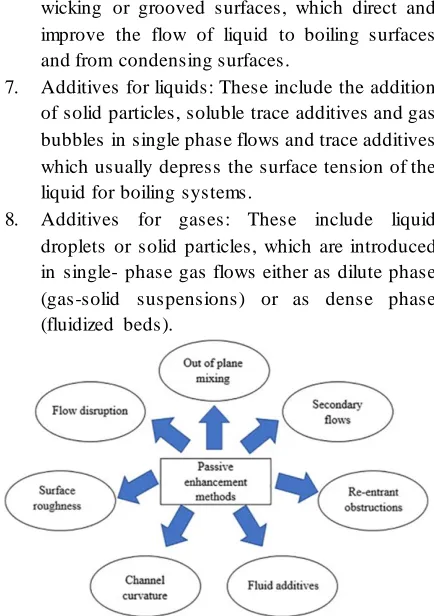
Heat transfer augmentation by these techniques can be achieved by using;
1. Treated Surfaces: Such surfaces have a fine scale
alteration to their finish or coating which may be continuous or discontinuous. They are primarily used for Boiling and condensing duties.
2. Rough surfaces: These are the surface
modifications that promote turbulence in the flow field in the wall region, primarily in single phase flows, without increase in heat transfer surface area.
3. Extended surfaces: They provide effective heat
transfer enlargement. The newer developments have led to modified finned surfaces that also tend to improve the heat transfer coefficients by disturbing the flow field in addition to increasing the surface area.
4. Displaced enhancement devices: These are the
inserts that are used primarily in confined forced convection, and they improve energy transport indirectly at the heat exchange surface by displacing the fluid from the heated or cooled surface of the duct with bulk fluid from the core flow.
5. Swirl flow devices: They produce and
superimpose swirl flow or secondary
recirculation on the axial flow in a channel. These include helical strip or cored screw type tube inserts, twisted tapes. They can be used for single phase and two-phase flows.
Coiled tubes: These lead to relatively more compact heat exchangers. It produces secondary flows and vortices which promote higher heat
transfer coefficients in single phase flows as well as in most regions of boiling.
6. Surface tension devices: These consist of
wicking or grooved surfaces, which direct and improve the flow of liquid to boiling surfaces and from condensing surfaces.
7. Additives for liquids: These include the addition
of solid particles, soluble trace additives and gas bubbles in single phase flows and trace additives which usually depress the surface tension of the liquid for boiling systems.
8. Additives for gases: These include liquid
droplets or solid particles, which are introduced in single- phase gas flows either as dilute phase (gas-solid suspensions) or as dense phase (fluidized beds).
Figure 1. Passive Techniques for Heat Transfer Augmentation
1.1 Active techniques
This method involves some external power input for the enhancement of heat transfer and has not shown much potential owing to complexity in design. Furthermore, external power is not easy to provide in several applications. Some examples of active methods are induced pulsation by cams and reciprocating plungers, the use of a magnetic field to disturb the seeded light particles in a flowing stream, etc. In these cases, external power is used to facilitate the desired flow modification and the concomitant
improvement in the rate of heat transfer.
Augmentation of heat transfer by this method can be achieved by:
1. Mechanical Aids: Such instruments stir the fluid
IJIRT 146806
INTERNATIONAL JO URNAL OF INNOVATIVE RESEARCH IN TECHNOLOGY72
2. Surface vibration: They have been applied in
single phase flows to obtain higher heat transfer coefficients.
3. Fluid vibration: These are primarily used in
single phase flows and are considered to be perhaps the most practical type of vibration enhancement technique.
4. (Electrostatic fields: It can be in the form of electric or magnetic fields or a combination of the two from dc or ac sources, which can be applied in heat exchange systems involving dielectric fluids. Depending on the application, it can also produce greater bulk mixing and induce forced convection or electromagnetic pumping to enhance heat transfer
5. Injection: Such a technique is used in single
phase flow and pertains to the method of injecting the same or a different fluid into the main bulk fluid either through a porous heat transfer interface or upstream of the heat transfer section.
6. Suction: It involves either vapor removal through
a porous heated surface in nucleate or film boiling, or fluid withdrawal through a porous heated surface in single-phase flow.
7. Jet impingement: It involves the direction of
heating or cooling fluid perpendicularly or obliquely to the heat transfer surface.
1.2 Compound techniques
A compound augmentation technique is the one where more than one of the above mentioned techniques is used in combination with the purpose of further improving the thermo-hydraulic performance of a heat exchanger. When any two or more of these techniques are employed simultaneously to obtain enhancement in heat transfer that is greater than that produced by either of them when used individually, is termed as compound enhancement. This technique involves complex design and hence has limited applications.
II. LITERATURE REVIEW
The significant increase in the number of research articles dedicated to this subject thus far shows a noticeable growth and the importance of heat transfer enhancement technology to date; more research has been done in this area than in any other for heat
transfer purposes. A logical analysis to increase the heat exchanger performance is given by the series of steps namely, the first step considers if the exchanger is initially operating correctly. Several different approaches have been devised to the study heat exchangers are as follows:
Glicksman et al. (1973) have been found out that, by placing strips of Teflon or other non-wetting material in a helical or axial arrangement around the circumference of horizontal tubes, the average condensation heat transfer coefficients of steam on horizontal tubes can be improved by 20 to 50%. The application of hydrophobic coatings of self-assembled monolayers, formed by chemisorption of alkylthiols on metallic surfaces, to promote drop wise condensation has been proposed by Das et al. (2000). It was found that steam condensation on coated corrugated tubes with gold and copper-nickel alloy surfaces under atmospheric and sub-atmospheric pressure conditions with wall sub-cooling of about 16°C and 6°C respectively showed that condensation heat transfer coefficients increased by factors of 2.3 to 3.6 compared to those for un-coated tubes. The use of helical ribbed tubes in high -pressure power boilers, as considered by Bergles, (1998) found to increase the heat transfer coefficient and critical heat flux (CHF) in once through boiling of water. Commercially structured rough surfaces in the form of corrugated tubing have extensively employed in refrigerant evaporators.
Rozzi et al (2007) worked on convective heat transfer and friction losses in helically enhanced tubes for both Newtonian and non-Newtonian fluids. Four fluid foods, namely, whole milk, cloudy orange juice, apricot and apple puree, are tested in a shell and tube heat exchanger. Both fluid heating and cooling conditions are considered. The experimental outcome
confirms that helically corrugated tubes are
particularly effective in enhancing convective heat transfer for generalized Reynolds number ranging from about 800 to the limit of the transitional flow regime.
Manag et al.[2011]: Investigated the friction factor
and heat transfer rate of CuO-Water and Al2o3-water
Nano fluid using micro channel heat sink. Dimension
of test section is 100x100x20000micrometter,
IJIRT 146806
INTERNATIONAL JO URNAL OF INNOVATIVE RESEARCH IN TECHNOLOGY73
5000 W/cm2. As the result of increasing nusselt
number with increasing the Reynolds number and concentration but decreased the friction factor of
Nano fluid. Compared the CuO-water and Al2O3
-water Nano fluids the CuO--water Nano fluid showed better enhancement and low friction factor.
K.S Dhanawade, H. S. Dhanawade(2013) The paper reports, an experimental study to investigate the heat transfer enhancement in rectangular fin arrays with circular perforation equipped on horizontal flat surface in horizontal rectangular duct. The data used
in performance analyses were obtained
experimentally by varying flow, different heat inputs and geometrical conditions. The experiment covered Reynolds number range from 3000-6000, based on the flow average inlet velocity and hydraulic diameter. Clearance ratio (C/H) 0.45, inter-fin spacing ratio (S/H) 0.22, duct width 150mm, height100mm and fin size of both solid and perforated (weight reduction) were 100mm x 55mm x 3mm. For various heat inputs and flow rates values of Reynolds and Nusselt number were obtained. The results of perforated fin arrays have been compared with its external dimensionally equivalent solid fin arrays. It shows that enhancement in heat transfer of perforated fin arrays than solid fin arrays.
Smith and Promvonge (2014) conducted experiments on heat transfer enhancement using diamond shaped inserts. Due to the flow blockage, the inserts caused high frictional losses.
Dean and Peter (2015) used stainless steel pall rings for insertion into a copper tube of 20 mm inside diameter. The pall rings were easily inserted into the tube to create roughness at the tube wall. They postulated that for small ring spacing, the fluid would rapidly become mixed upon entering the packed length.
Betul and Bali (2016) conducted experimental investigations to determine the heat transfer and friction factor characteristics in a horizontal pipe by the insertion of vortex generators with Reynolds numbers ranging from 5000 to 30000. Nusselt numbers were increased from 18% to 163% compared to smooth pipe.
Min Zeng (2015) Equipment with rotating heat exchanger tube is found in commercial practice. They involve gripping the fluid by mechanical means or spin the surface. Mechanical surface Scrapers can be
applied to tube flow of gases, viscous liquids in the chemical process industry.
III. CONCLUSIONS
Based on the above literature review obtained by the study of different types of techniques it is found that;
Although for better heat transfer, combination of
all the three or any two techniques can be used.
Active techniques are identified as a possibility
for enhancement. The active technique depends on external power or activation, this technique have power cost .power cost must be considered and micro system designer have to carefully consider their implementation
It is observed that between all three one passive
techniques are more reliable and effective for better heat transfer performance.
Although numerous investigations have been
conducted on the compound heat transfer augmentations, to our best knowledge, the combination of two techniques consisting of utilizing Nano fluid and inserting coiled insert has been more promising one.
REFERENCES
[1] Khwanchit Wongcharee , Smith Eiamsa-ard,
Heat transfer enhancement by using CuO/water nanofluid in corrugated tube equipped with twisted tape. International Communications in Heat and Mass Transfer 39 (2012) 251–257
[2] Heydar Maddah, Mostafa Alizadeh, Nahid
Ghasemi, Sharifah Rafidah Wan Alwi ,
Experimental study of Al2O3/water nanofluid turbulent heat transfer enhancement in the horizontal double pipes fitted with modified twisted tapes, International Journal of Heat and Mass Transfer 78 (2014) 1042–1054
[3] N. Kannadasan, K. Ramanathan, S. Suresh,
Comparison of heat transfer and pressure drop in horizontal and vertical helically coiled heat exchanger with CuO/water based nano fluids, Experimental Thermal and Fluid Science 42 (2012) 64–70
[4] A.E. Kabeel, T. Abou El Maaty , Y. El
IJIRT 146806
INTERNATIONAL JO URNAL OF INNOVATIVE RESEARCH IN TECHNOLOGY74
Applied Thermal Engineering 52 (2013)
221e229
[5] Mohammad Hemmat Esfe, Seyfolah Saedodin,
Omid Mahian, Somchai Wongwises, Heat transfer characteristics and pressure drop of COOH-functionalized DWCNTs/water nanofluid in turbulent flow at low concentrations, International Journal of Heat and Mass Transfer 73 (2014) 186–194.
[6] A.A. Rabienataj Darzi, Mousa Farhadi , Kurosh