IJIRT 145406
INTERNATIONAL JO URNAL OF INNOVATIVE RESEARCH IN TECHNOLOGY466
Custom-made HIPEC System
Miss.Forum Thakker
1, Prof. Sanjay Patil
2,
Department of Electronics Engineering, PVPIT Budhgaon ,Sangli
Abstract- Cytoreductive surgery (CRS ) plus Hyperthermic Intraperitoneal Chemotherapy (HIPEC) has emerged as a main comprehensive treatment of peritoneal malignancies. However, current data on the literature are very heterogeneous in terms of its technical particularities, which require some efforts to standardization of practices. In these setting, we present some early data from a engineered trial to explore the dynamic relationships between flow rates and temperature parameters in our study, which may help in selecting better technical parameters during HIPEC procedures.
Index Terms- Control Algorithm, Flow Rate, Heating Element Hyperthermic Intraperitoneal Chemotherapy (HIPEC), Temperature Control Mechanism, Thermal Conductivity, Temperature S ensor.
I. INTRODUCTION
This manuscript describes the assembly and use of a custom made HIPEC machine, the results obtained with its trials and compares the technical and engineer aspects with some of the used HIPEC machines. This manuscript also explores the different flow rates that can be utilized in order to achieve and maintain the required temperature range throughout the course of the procedure.
II. PROCESS
Delivery of HIPEC requires an apparatus that heats and circulates the chemotherapeutic solution so that a stable temperature is maintained in the peritoneal cavity during the procedure. An closed abdomen or open abdomen (Coliseum) technique may be used, with no significant differences in efficacy proven to date. The principal aim of the latter is to give the surgeon access to the peritoneal cavity. The major difference between the two techniques involves the increased risk of exposure to cytostatics for the staff in the operating room in the case of the open technique. Specific technical training and a solid
knowledge of regional chemotherapy management are required. Concerns about safety of the procedure for operating room personnel are expected but are manageable if universal precautions and standard
chemotherapy handling procedures are used.
Different HIPEC drug regimens and dosages are currently in use. [3]
Typically, in HIPEC and related procedures,
chemotherapeutic agents are heated and circulated by a heat exchanger and hyperthermia pump, and circulated into, and then out of, the patient's abdomen and finally back through the same cycle (forming a circuit). This procedure typically lasts for 90 to 120 minutes. The goal of this is to kill remaining cancer cells that the surgeon was not able to extract during debulking surgery. [5],[6]
Tubing and catheters are typically assembled to form a circuit from the patient to the HIPEC device, approximately three to five feet from the surgical table. The surgeon places two catheters into the patient's abdomen through one or more laparotomy incisions. These catheters, (typically called in-flow catheters), are used to pump the HIPEC solution into the patient's abdominal cavity. Catheters used to
drain the solution, (typically called out-flow
catheters), are placed in the opposite end of the abdominal cavity through one or more laparotomy incisions. The laparotomy incision(s) is closed with one or more sutures and the skin is typically pulled tightly around the in-flow and out-flow catheters to inhibit leakage of the solution. Tubing, or similar material, is connected to the catheters in order to form a closed circuit between the subject's peritoneal space and the heating and pumping devices . [2],[3] Once the tubing is connected to the device, the solution can now be pumped in to, and out of, the patient, and then back to the HIPEC device. Typical flow rates within this circuit are approximately 1.5 to 2 liters per minute.
IJIRT 145406
INTERNATIONAL JO URNAL OF INNOVATIVE RESEARCH IN TECHNOLOGY467
solution temperature range within the therapeuticwindow. [11]
III. BENEFITS OF HIPEC
The combination of Cytoreductive surgery (CRS) and hyperthermic intraperitoneal chemotherapy (HIPEC) prolong survival significantly in selected patients with peritoneal metastases (PM) either primary or secondary to digestive or gynecologic malignancy compared with systemic chemotherapy alone and provides the chance for long-term survival. [12]
IV. HIPEC INSIGHTS
HIPEC combines the pharmacokinetic advantage inherent to the intracavitary delivery of certain cytotoxic drugs, which results in regional dose intensification, with the direct cytotoxic effect of hyperthermia. Heat has a direct cytotoxic effect, potentiates the action of certain antimitotic agents. Hyperthermia exhibits a selective cell-killing effect in malignant cells by itself, potentiates the cytotoxic effect of certain chemotherapy agents and enhances the tissue penetration of the administered drug. The chemotherapeutic agents employed in HIPEC need to have a cell cycle nonspecific mechanism of action and should ideally show a heat-synergistic cytotoxic effect. Similarly, hyperthermia can also reduce the mechanisms of tumoral resistance to chemotherapy and induce efficient anticancer immune response. [7]
V. THE CUSTOM MADE HIPEC SYSTEM
This model combines two parallel circulation circuits: both for fluids one from the system to the peritoneal cavity and other from peritoneal cavity to the system. Flow rate at 1,500–2,400 mL/min and
temperature 42–43 °C are maintained. Fluid
temperature was tested at the entrance and exit tubes. The usual volume necessary to fill-up the circuit was 3 ± 0.5 L .
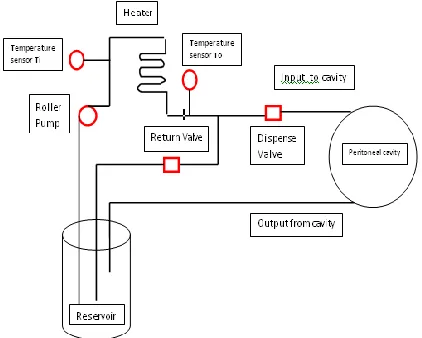
A Combination of series of heating devices ,a fluid reservoir , a peristaltic pump, 2 temperature sensors were used. The machine has peristaltic pump that can circulate fluid at a maximum flow rate of 4 liters/ min. We have designed a inbuilt temperature control mechanism that does not allow the fluid temperature to exceed 43°C using SMT172 T018 smartec sensors.
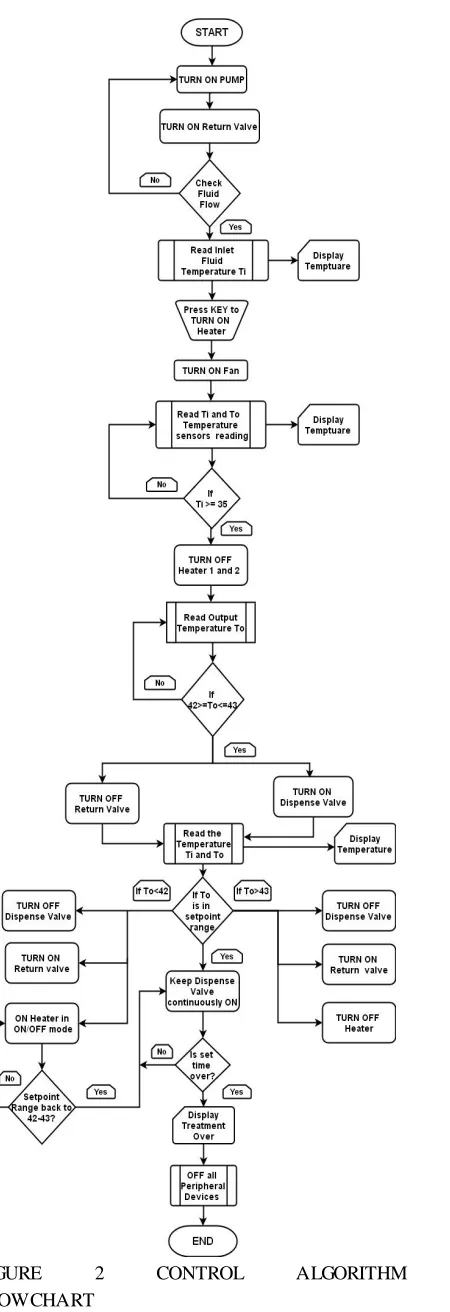
Initially we used 3 heaters for heating the fluid, flowing through the silicon tubing wounded on a steel chamber. This fluid is pumped through reservoir 1 back into the same reservoir until the setpoint of 42 o
C is reached. Only when the temperature of the fluid is in the desired temperature window of 42- 43oC, a dispense valve is actuated and now the solution is allowed to be entered in the peritoneum. This fluid has alternative passage back to the reservoir if the setpoint temperature value is not achieved.
As the fluid at the outlet reaches a certain setpoint temperature value, we switch off two heaters and maintain the desired temperature window using 1 heater and a cooling fan to avoid any further rise in temperature.
Figure 1 schematic diagram of custom made HIPEC system
From this reservoir it is the pumped back to the peritoneal cavity using pinch valves and pump. The fluid in the reservoir is recirculated using pump We used one inflow and two outflow channels connect through a “T” connector to a s ingle roller pump which maintains the perfusion efficiently. It also prevented clogging of the outflow channels. The flow rate was fixed at 1 L/min. We aimed to maintain the temperature between 42 and 43°C.
IJIRT 145406
INTERNATIONAL JO URNAL OF INNOVATIVE RESEARCH IN TECHNOLOGY468
FIGURE 2 CONTROL ALGORITHM
FLOWCHART
It was observed that there is a heat loss of 1–2 degrees in the tubing depending on the length and flow rate and the depth tumour tissue. With this set up alone, an intra-abdominal temperature of 41–42°C was achieved.
Knowledge of the perfusion behavior of tissues is important in that the flow of blood can have a direct quantitative effect on the temperature distribution within living tissue. The tabulation includes values for thermal conductivity of biomaterials and specific tissues and organs.[1]
TABLE I
THERMAL CONDUCTIVITY COEFFICIENTS OF DIFFERENT TISSUES
TISSUE k (W/mK)
Tumor periphery 0.511
Core 0.561
Colon Cancer (human) 0.545
VI. PECULARITIES OF HIPEC TREATMENT
A. Equipment and technique of HIPEC
There are several types of devices for HIPEC [22, 23], but most of the equipment is based on the principle and the technical scheme proposed, as early as 1980, by Spratt [24]: heat exchanger, thermal sensors, pump, reservoir and tubing to ensure the cytostatic solution circuit.
B. Technique open/close
The surgeon is not only responsible for surgery itself, but he must also have the skills required for conducting and supervising HIPEC, regardless of the technique used (closed or open). The efficiency of treatment depends on the maintenance of an intraperitoneal temperature between 41-43°C and on the “washing” of the entire peritoneal serosal surface with cytostatic solution [34]. In the case of the open technique (or its variants), the surgeon directly performs the thermal and spatial homogenization of the cytostatic solution in the peritoneal cavity, while in the closed technique, this mechanism is achieved by the control of the inflow and outflow of the cytostatic solution or by changing the position of the operating table. [8]
C. Process parameters and their dynamic
relationship
IJIRT 145406
INTERNATIONAL JO URNAL OF INNOVATIVE RESEARCH IN TECHNOLOGY469
also critical to improve chemotherapy effects andsurvival outcomes. In this setting, we aimed to explore the dynamic relationship between flow rates
and temperature parameters during HIPEC
procedures to help selecting a target flow rate set up. Differences between inlet and outlet temperature probes were about 3°C at a flow rate of 600ml/min, and 1°C at 1000ml/min. The temperature lost to peritoneal cavity remained virtually stable by about 2°C at flow rates of 700, 800 and 900 ml/min. Table 2 summarizes these temperature parameters in regards to flow rates. [7]
D. HIPEC Variables
A number of variables have been described, which condition the obtaining of the expected results of HIPEC:
choice of drugs, the type and volume of the cytostatic solution, the duration of the procedure, the level (degree) of hyperthermia, the flow rate, and the
technique –open or closed, intraperitoneal
temperature; the intraperitoneally administered dose of cytostatic drugs; the duration of contact between the cytostatic and the peritoneum, the use of vasoactive agents, and macromolecules . [10]
Temperature is monitored in the peritoneal cavity in a variable number of sites, as well as at the entrance/exit of the cytostatic solution to and from the peritoneal cavity. The time allocated to HIPEC varies between 30-90 minutes, depending on the cytostatic used. Though there is no ideal target level for the fluid volume, the degree of heat used or the flow rate- the procedure is performed using 1.5–3 L of fluid at a flow rate of 1–2 l/min maintaining an intra-abdominal temperature of 41–43°C.
E. Discussion
HIPEC is now a preferred treatment of many peritoneal surface malignancies. HIPEC involves the continuous heating and circulation of chemotherapy throughout the abdominal cavity in an attempt to enhance cytotoxicity. Accordingly, flow rate is an important variable in achieving and maintaining goal temperatures during HIPEC, and a temperature threshold above 40°C is also critical to significantly enhance chemotherapy effects and improve survival outcomes. By exploring the dynamic relationship between temperature parameters and flow rates in the first cases of our clinical trial, we noted that a higher flow rate may minimize the exchanging of heat from the system to the perfusate solution (i.e.: the mean
inlet temperature was lower at 1000ml/min) and from the solution to the peritoneal cavity (i.e.: the mean of temperature losses was also lower at 1000ml/ min). Conversely, a lower rate resulted in higher inlet temperatures and temperature losses. These findings confirm that heat exchanges are mitigated by higher flow rates, and that the peritoneal cavity may absorb . [4],[9]
TABLE II.
SUMMARY OF RELATIONSHIP BETWEEN
FLOW RATES AND TEMPERATURE
PARAMETERS IN HIPEC PROCEDURES
VII. MATERIALS AND METHODS
From November 2016 to January 2018, HIPEC system was developed using components des cribed below. The temperature range maintained during each trial, the volume of fluid and the flow rate was recorded and this was reviewed retrospectively for this study. We performed a comparison of the cost of setting up the machine, maintenance, expenses per procedure as well as technical aspects like achieving and maintaining target temperature and flow rate, safety aspects, technical failures and the technical support required to run the customized HIPEC system.
3 Tungsten heating filament,1 Axial cooling fan, 1 Peristaltic pump, 2 fluid valves, 2 temperature sensors, 2 reservoirs.
The comparison with customized HIPEC system was based on the manufacturer information and published reports and not on personal experience.
VIII. STERILIZATION AND MAINTENANCE
IJIRT 145406
INTERNATIONAL JO URNAL OF INNOVATIVE RESEARCH IN TECHNOLOGY470
every procedure. Or the machine can be kept in theoperating room during the post- procedure
fumigation process. There is no other maintenance required for the machine.
REFERENCES
[1] APPENDIX A , Thermal Conductivity Data For Specific Tissues And Organs For Humans And Other Mammalian Species, Professor Kenneth R. Holmes
[2] US20140228801A1 Body cavity drainage device
and methods for using the same, Gary Keeling
[3] US9669053B2 Compositions and methods for
enhancing the effectiveness of systemic, HIPEC, IP, and related cancer treatments ,Gary Keeling and Keith B. Hoffman
[4] Exploring flow rate selection in HIPEC
procedures Thales Paulo Batista, TCBC-PE2,3; Levon Badiglian Filho1; Cristiano Souza Leão2. DOI: 10.1590/0100-69912016006014
[5] Hyperthermic Intraperitoneal Chemotherapy
Approach Based on Cyber-Physical System Paradigm Corneliu Lungoci*, Daniel Moga**,
Vlad Muresan**, Dorin Petreus**,Nicoleta
Stroia**,Rozica Moga**, Mihai Munteanu**, Iulian Raus*, Valentin Muntean*, Aurel Ion Mironiuc* CEAI, Vol.17, No.3 pp. 50-59, 2015
[6] Advanced temperature control for innovative
HIPEC equipment C. Lungocia, V. Muresanb, D. Mogab, I. Clitanb*, R. Mogab,V. Sitab, T.
Oniua, A. Mironiuca Conference on
ENTERprise Information Systems / International
Conference on Project MANagement /
Conference on Health and Social Care
Information Systems and
Technologies,CENTERIS / ProjMAN /HCist 2015 October 7-9, 2015
[7] Hyperthermic intraperitoneal chemotherapy:
Rationale and technique Santiago González-Moreno, Luis A González-Bayón, Gloria Ortega-Pérez World J Gastrointest Oncol 2010 February 15; 2(2): 68-75
[8] Technical Handbook for the Integration of
Cytoreductive Surgery and Perioperative
Intraperitoneal Chemotherapy into the Surgical
Management of Gastrointestinal and
Gynecologic Malignancy, 4th Edition, Paul H. Sugarbaker, MD, FACS, FRCS
[9] A Theoretical Model for Intraperitoneal Delivery of Cisplatin and the Effect of Hyperthermia on Drug Penetration Distance Ardith W. El-Kareh*
and Timothy W. Secomby
ARL-Microcirculation Division, University of
Arizona, PO Box 245051, Tucson, AZ 85724-5051, USA
[10]The “homemade” HIPEC machine – a
cost-effective alternative in low-resource countries Aditi Bhatt*, Robin Prabhu, Kayomarz Sethna, Sajin Tharayil and Madhan Kumar Pleura and Peritoneum 2017; aop
[11]Higher flow rates improve heating during
hyperthermic intraperitoneal chemoperfusion.
Furman MJ1, Picotte RJ, Wante MJ,
Rajeshkumar BR, Whalen GF, Lambert LA J
Surg Oncol. 2014 Dec;110(8):970-5. doi:
10.1002/jso.23776. Epub 2014 Aug 29.
[12]Cytoreductive surgery and HIPEC for peritoneal carcinomatosis. A review on morbidity and
mortality Evgenia Halkia1, Nikolaos
Kopanakis2, Georgios Nikolaou2, John