Abstract
Toward a green building constructions, the under floor heating using evacuated tubes solar collectors for multi-apartment buildings were considered. After many practical implementations, the use of evacuated tubes solar collectors for under-floor heating did not prove its feasibility for high heating loads. Many authors reported that the evacuated tube solar collector's efficiency decreases as the water temperature increases in the system. The poor insulation and the low efficiency of evacuated tube solar collectors at high temperatures limited the use of evacuated tube solar collectors with under floor heating systems. As the technology improves there is a possibility of controlling the evacuated tubes under-floor heating system governing parameters to ensure high system efficiency and adequate heating for the building. In this paper, the Multi-Pass Under-Floor Heating System (MPUFHS) heated with Evacuated Tubes Solar Collector (ETSC) and controlled with Programmable Logic Control (PLC) is thermally analyzed to supply an adequate heat to space and ensure that the ETSC work with its maximum possible efficiency.
Keywords: Solar Collector, Evacuated Tubes, Underfloor Heating, PLC, Multi-Pass, Green Buildings, Energy saving.
1. INTRODUCTION
In the twenty first century there is no substance such as energy, which controls the economy, policy, and development of nations, which is the reason of many wars, tragedies, and fatal mistakes. Energy becomes a tool of political pressure on non-petroleum developing countries. Nations are losing their independency of their countries because of energy. This was the problem attached in many research papers in the last century, proposing depending on different renewable energy sources, and using different energy saving techniques.
One of the main sectors that consume energy is the residential sector Ref. [1]. The increase in the population and the limited areas in the cities forced people to live in multi-apartment buildings. Multi-apartment buildings are good in that it maximize the number of people in a specific area, thus allowing more areas for farming, but it is also characterized by the difficulty in orienting all flats for passive heating. So it consumes more energy for heating and cooling purposes. Architects and engineers who are working with the sustainable buildings designs still aim to have the zero heating building, which almost possible if the engineering regulations are followed strictly and the renewable energy is implemented. Sun is a huge source of energy, solar energy may cover all the human needs if it is efficiently collected and used. Many scientists worked on calculating the solar intensity on different surfaces under
different circumstances at any point on the earth Ref. [5, 9], where the global daily solar radiation on horizontal surfaces for Amman city is modeled, short formulas were suggested for the monthly mean solar radiation and the duration of the sun shine per day. As solar energy is found to be high in most of the Arab countries (see table 1), it is always proposed to use the solar energy to reduce the hot water and heating requirements in the residential buildings Ref. [2].
The thermal performance of the evacuated tube solar collectors was analyzed by Arora (2011) Ref. [3]. The thermal efficiency of the evacuated tube collectors is high compared to flat plate collectors, the ETC are used for different applications starting from water heating to space heating Ref. [6]. Air and water heating systems, steam generation, desalination, thermal power generation, solar furnaces, and other applications that all get use of the available solar energy are discussed by Kalogirou (2004) Ref [11].
purposes. In this study, the Multi-Pass Under-Floor Heating System (MPUFHS) heated with Evacuated Tubes Solar Collector (ETSC) and controlled with Programmable Logic Control (PLC) is thermally analyzed to supply an adequate heat to space and ensure that the ETSC work with its maximum possible efficiency.
2. MATERIALS AND METHODS
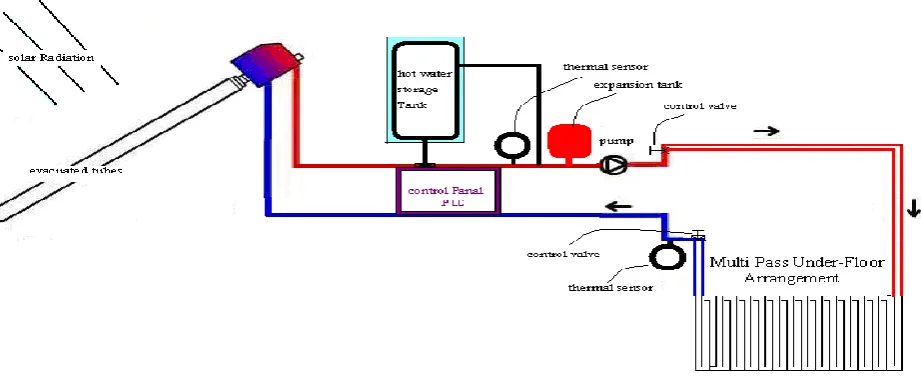
The Multi-Pass Under floor Heating System (MPUFHS) is a system that allows the variation of the hot water mass flow rate and the underfloor heat transfer area for a quite control of heat transfer to the building and to cover the high heating loads of small areas Fig. 1.
Figure 1: Schematic diagram of the proposed multi-pass under floor -heating system.
Figure.1 shows the MPUFHS with PLC, it uses the evacuated tubes solar collector as the heating source of the system. The MPUFHS consists of,
Under floor Heating Plate, consisting of counter flow lines of the heating passages lined up side to side, the counter flow arrangement provide the optimum uniform floor temperature, the high surface area allow for reducing the flow rate and reduce the water inlet temperature required to satisfy the heating load of the space.
Variable Speed Pump, this pump circulates the required amount of water in the UFH plate to keep the room temperature constant, the pump speed is determined upon the inlet water and exit water
Storage Tank, if the water temperature is higher than required the controller allow a part of the hot water to flow to the storage tank, this hot water is stored for a later use.
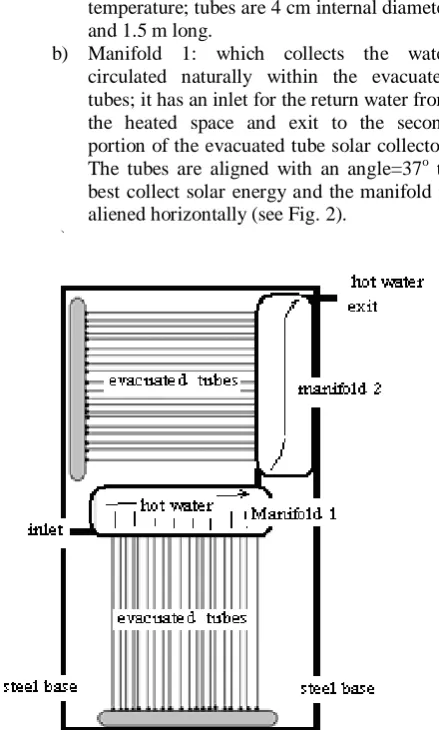
A special type evacuated tube collector (see Fig. 2). a) Evacuated tubes: 8 tubes are used to collect the solar energy in the first part of the collector. The aim of these tubes is to rise the temperature in the manifold 1 to a medium temperature; tubes are 4 cm internal diameter and 1.5 m long.
b) Manifold 1: which collects the water circulated naturally within the evacuated tubes; it has an inlet for the return water from the heated space and exit to the second portion of the evacuated tube solar collector. The tubes are aligned with an angle=37o to best collect solar energy and the manifold is aliened horizontally (see Fig. 2).
c)
Figure 2: Arrangement of the solar collector used in this study.
Outer diameter 47 mm
Inner diameter 37 mm
Length of the tube 1500 mm
Manifold dimensions 200X200X800
Glass Transitivity 0.92
Table 2: Characteristics of the Evacuated Tube Solar collector.
Solenoid Valves, a number of solenoid valves 2-way 3-2-way valves are used to control the flow direction of the working fluid.
The device was proposed to reduce the need for fossil fuels consumed by the residential sector and reduce the green house emissions and its bad effects on the environment. Also the device will give a wider area for the use of under floor heating systems, as it is expected to reduce the required inlet temperature.
3. THERMAL ANALYSIS
The proposed device for MPUFH system consist of double solar energy collectors one for preheating and the other is for super-heating of the working fluid. The PLC control unit with the Multi-Pass option optimizes the inlet-exit temperatures with mass flow rates to achieve the highest efficiency from the solar collector.
3.1 Evacuated Tubes Solar Collector Performance
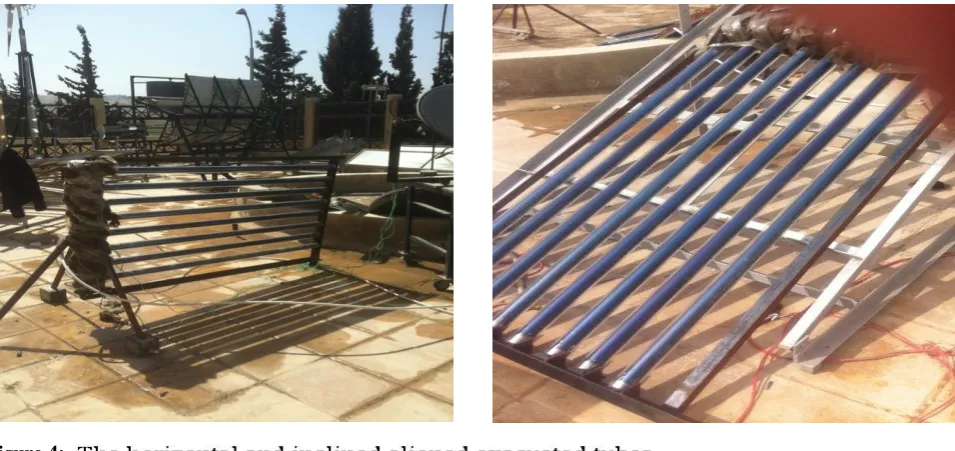
Figure 3. shows the performance of evacuated tubes with temperature, it is clear that as the temperature inside the tubes increases the efficiency of the evacuated tube. Both the horizontall and inclined alignment almost have the same equation, which emphasize the accuracy of the readings
Figure 3: The performance of evacuated tubes with temperature.
Figure 4:
horizontally y = -0.1768x + 12.493
Inclined y = -0.179x + 12.732
0 2 4 6 8 10 12
25 30 35 40 45 50 55 60
horizontally allgined tubes
inclined evacuated tubes
Figure 5: Thermal Efficiency of the evacuated tube.
From the experimental data, the thermal efficiency of the evacuated tube could be written as;
= -18*Ln(T) + 97 (2)
Thus from the conservation of energy, the heat gained by water is
I
Ew in * * (3)
The overall heat transfer coefficient between water temperature Tw and the room air temperature is {Ref 8],
U=8.19 W/m2K
The heat transfer from the water to air is
dA T T U Q
d ( w a)
(4)
The floor surface temperature can be calculated by taking the inside floor air resistance as 0.08 m2oC/W.
The difference in the heat transfer from water to air and from room air to outside determines the change in the room air temperature.
3.2 Multi-Pass UnderFloor Heating System Operation
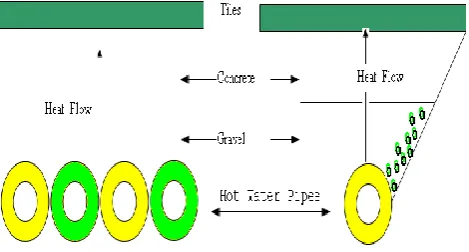
The proposed system is an improvement to the already exist underfloor pipes heating system. In the already exist system the heat transfer from the underfloor pipes to the floor area is performed between the 2 cm diameter pipes to the usually 20 cm floor surface area. This heat transfer configuration requires a 1 cm2 to heat a 10 cm2 area that requires a high water temperature in the pipes. In the
temperature at the set point.
The system is characterized by high thermal efficiency, thus in the case of access energy the PLC controller will direct the hot water to a hot water reservoir to store the water for other applications or for a later use.
Figure 6: Single Pass versus the Multi-Pass underfloor heating configurations.
5. RESULT AND CONCLUSION
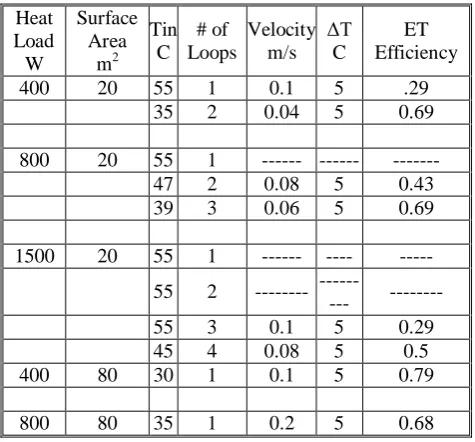
A computer program has been written to simulate the two different cases, for different heating conditions (i.e. high heating loads, small heating loads, large floor area and small floor area). Table 3. includes the results of the simulation.
It is clear from the simulation results that when the heating load is high and the floor area is limited the single pass underfloor heating does not apply. Thus there is a need to implement the multi-pass underfloor heating system, which solves the problem and even gives a better evacuated tubes efficiency. The implementation of multi-pass underfloor heating system gave the possibility to reduce the hot water input temperature, this ability widen the applications of underfloor heating system with renewable energies such as solar energy. Working with low hot water temperature reduces the heat losses from the system and thus increase the system overall thermal efficiency, another advantage of low temperature underfloor heating system is the increase in the safety aspects in the public or childhood appliances such as dormitories, hospitals, nursing homes, schools and old age people homes.
0 10 20
20 25 30 35 40 45 50 55 60 65
ET Temperature C
E
ff
Heat Load W Surface Area m2 Tin C # of Loops Velocity m/s ΔT C ET Efficiency
400 20 55 1 0.1 5 .29
35 2 0.04 5 0.69
800 20 55 1 --- --- --- 47 2 0.08 5 0.43 39 3 0.06 5 0.69
1500 20 55 1 --- ---- ---
55 2 ---
--- --- 55 3 0.1 5 0.29 45 4 0.08 5 0.5 400 80 30 1 0.1 5 0.79
800 80 35 1 0.2 5 0.68
Table 3: Simulation results for different floor surface areas and heating loads.
An analysis of the multi-pass underfloor system based on the available area is shown in table (4 a) and (4 b), for both low temperature and high temperature applications.
The water input temperature = 35 C and the solar system efficiency range 60%-70% Floor surface area m2 Multi-Pass System W Single-Pass System W
20 1220 244
50 3023 604
100 5952 1190
150 8789 1757
200 11538 2307
Table 4a: Single Pass versus Multi Pass systems for high efficiency low hot water temperature.
The water input temperature = 55 C and the solar system efficiency range 20%-30% Floor surface area m2 Multi-Pass System W Single-Pass System W
20 2848 570
50 7054 1410
100 13888 2778
150 20508 4101
200 26922 5384
Table 4b: Single Pass versus Multi Pass systems for low efficiency high hot water temperature.
The low efficiency in table 4b. is caused by the high water temperature in the solar system, and the increase in the heat transfer losses from the underfloor system.
As shown in table 4 a and b, practical high heating loads with a admirable efficiency can be achieved by using multi pass system with low water temperature, for high heating loads applications the water temperature can be increased to achieve maximum heat transfer. The system may show high initial cost right now, but with the increase in its application new materials and lower initial cost can be obtained.
ACKNOWLEDGEMENTS
The author is grateful for Applied Science Private University for their financial support of this research.
REFERENCES
[1] N. Beithou, "Green Buildings and the Use of Biogas in Jordan", Journal of Jordan Engineering Association. (2012).
[2] A. Yadav, V.K. Bajpai, "An Experimental Study on Evacuated Tube Solar Collector for Heating of air in India", World Academy of Science, Engineering and Technology, 79, (2011).
[3] S. Arora, S. Chitkara, R. Udayakumar, M. Ali," Thermal Analysis of Evacuated Solar Tube Collectors", Journal of Petrolium and Gas Engineering Vol. 2 (4), pp. 74-82, (2011)
[4] N. Beithou, Y. Abdellatif, M. Al-Taani, M. Abu Hilal,"Proposed Energy Saving Techniques for Multi-Apartment Buildings in Jordan ", International Journal of Thermal & Environmental Engineering Volume 3, No. 1 (2011) 27-36.
[5] M. R. Abdelkader, A. Salaymeh, Z. Al-Hamamre, F. Shraf, "A Comparative Analysis of the Performance of Monocrystaline and Multicrystaline PV Cells in Semi Arid Climate Conditions: the Case of Jordan", JJMIE, volume 4, number 5, November (2010), pages 543-552.
[6] M. D. Islam, I. Kubo, M. Ohadi, A. A. Alili,"Meaurement of Solar Energy Radiation in Abu Dhabi, UAE", Applied Energy 86, (2009), 511-515.
[7] M. Belhamel, F. Mokhtari, N. Messaoudene, A. Hamid," Study of Solar Control System Intended for Space Heating", Arab Regional Solar Energy Conference (2007).
[8] M. Alsaad, M. Hammad," Heating and Air Conditioning for Residential Buildings", 4th edition , National Library department, (2007).