ROBUST DATA COLLECTION IN WIRELESS SENSOR
NETWORKS WITH FIXED PATH AND CONTROLLED
SPEED MOBILE SINKS
Mr. Shrikant D. Dhamdhere
Assistant Professor , Department of Computer Engineering
Paravatibai Genba Moze College of Engineering, Wagholi , Pune, Maharstra, (India)
ABSTRACT
Recent work has shown that sink movement along a fixed path and speed control can minimize the energy
utilization in wireless sensor networks. Due to the fixed path, a movable sink with fixed speed has limited
communication time to collect data from the subsink and member nodes deployed randomly. This method poses
significant challenges in jointly improving the amount of data collected and reducing the energy consumption. To
tackle this issue, we propose a new method for data collection, called the Maximum Amount Shortest Path
(MASP) that increases network throughput as well as conserves energy by optimizing the assignment of sensor
nodes to the subsinks. Two phase communication method based on efficiently assignment of the member node to
subsinks. Current work also implements a practical distributed approximate algorithm to solve the subsinks
selection and member node assignment problem. Our aim is to collect maximum data efficiently in wireless sensor
networks by utilizing minimum energy using MASP with different scenario (MASP-WDS) of controllable movable
sink. Which increase also network life time.
Keywords:
Sensor Networks, Movable Sinks, Fixed Path, Speed Control, Data Collection, Minimum
Energy Utilization.
I
INTRODUCTION
real world applications, such as ecological environment monitoring and health monitoring of large buildings. As shown in Fig. 1, let a mobile sink M installed on a transportation vehicle move along a fixed trajectory L periodically. Let us assume that sensor nodes are randomly deployed in the neighborhood of the trajectory. When M arrives at the end point of its path once and returns back to the start point, we say that it has completed one round.
Fig1. An example of path-constrained mobile WSNs
II RELATED
WORK
2.1
Data Collection Methods
Different data collection methods are suggested in WSN. Our work focuses on shortest path tree data collection and Rendezvous Based Data Collection to collect the efficient data in WSN. Types of data collection methods are discussed below.
Direct-Contact Data Collection: Mobile sink collects data directly from data sources by one hop communication. Sinks may retransmit data or, if needed, physically carry the data to a fixed base station.
Fig.2. Data Gathering in delay tolerant WSN Direct Contact data collection
Sink Trajectory Methods: Sensors buffered their measurements locally and wait for the arrival of a mobile sink. Energy consumption at sensor side is only due to sink discovery and subsequent data transfer. Sink broadcasts a beacon message while moving. Sensors monitor the wireless communication channel. Whenever a sensor hears the beacon message it concludes that a sink arrives. Constant channel monitoring is very expensive. If sinks move along regular path, then sensors can predict their arrival after being allowed a learning curve for their movement pattern. Data transfer should start in an intelligent way, if a sensor simply transmits as soon as it discovers the sink, data may not be successfully delivered or may be delivered with many retrials, wasting energy. Data transfer should take place in the time interval with minimum message loss probability, which is exactly around the minimum sensor-sink distance point. With controllable sink mobility and knowledge of sensor locations, data collection delay can be reduced by properly selecting sink trajectory. The sink traveling problem as a variant of TSP, known as traveling salesman with neighborhood(TSPN)where a sink needs to visit the neighborhood of each sensor exactly once.
labels. Cost is defined as Euclidean length of the edge; the label set represents the set of sensors whose communication ranges intersect with this edge. The objective is to find a shortest (minimum-cost) tour whose associated label set covers all sensors. They proved that the shortest label-covering tour problem is NP-hard, and presented an approximation algorithm to solve it. The algorithm finds a TSP tour by any TSP solver. Then, by dynamic programming, it finds the shortest label covering tour that can be obtained by applying shortcutting to the TSP tour.
Shortest Path Tree: The Shortest Path Tree (STP) method is proposed to choose subsinks and relay data from members. Each member chooses the closest subsink in terms of hop distance as its destination and then sends its own data or forwards data from downstream nodes to upstream nodes along shortest path trees. However, the number of members associated with each subsink is independent of its communication time, which may cause imbalance in the assignment of members among the subsinks. It is possible that some subsinks with longer communication time own fewer members, implying that the mobile sink may collect less data than expected. On the other hand, some subsinks with very short communication time may own too many members. Consequently, the excess data traffic may result in oversaturated subsinks which are not able to transmit all data to the mobile sink in the limited communication duration. In other words, the SPT method has low energy efficiency for data collection. Aiming at the data delivery problem in large-scale wireless sensor networks with mobile sinks which move along fixed paths with constant speed, we propose an efficient data collection scheme that simultaneously improves the total amount of data and reduces the energy consumption. In our scheme, the members within the MCA are assigned to the corresponding subsinks within the DCA according to the length of the communication time between the mobile sink and the subsinks, thus improving the network throughput.
Fig.3. Data Gathering in delay tolerant WSN Rendezvous Based data collection
The rendezvous points buffer and aggregate data originated from the source nodes through multi hop relay and transfer to the mobile element when it arrives. A problem similar to the one is based on multiple mobile elements. A distributed and network assisted sink navigation framework is to balance energy consumption and collection delay by choosing appropriate number of multiple hops. A distributed and localized solution to decide sinks movements when the movement paths are not predetermined in WSNs supporting multi hop communication.
2.2
Sink Mobility Types
Sink Mobility has different types for efficient data collection strategies. Our work focuses on the path constrained sink mobility and Path controllable sink mobility.
1) Random Path: In sensor networks where the path is random the mobile sinks are often mounted on some people or animals moving randomly to collect interested information sensed by the sensor nodes. Due to random mobility, it is difficult to bound the data transfer latency and the data delivery ratio.
lifetime and improve the packet delivery ratio, where the sink sojourns at some anchor points and the pause time is much longer than the movement time. Accordingly, the mobile sink has enough time to collect data, which is different from our scenario. Moreover, in MobiRoute all sensor nodes need to know the topological changes caused by the sink mobility. While in our approach, only the subsinks need to know the change of the sink location and the members just send their data to their respective subsinks chosen in advance. One thing that should be noted is that the routing protocol can only be used in sensor networks with a single mobile sink. The work is extended to exploit multiple mobile sinks to solve the scalability problem, which assumes that all sensor nodes are located within the direct communication range of at least one mobile sink. The data collection scheme proposed in this paper can be used to support multihop communication in sensor networks with multiple mobile sinks.
3) Path-Controllable Sink Mobility: Most of the current work about path-controllable sink mobility has focused on how to design the optimal trajectories of mobile sinks to improve the network performance. Mobile element scheduling problem is studied, where the path of the mobile sink is optimized to visit each node and collect data before buffer overflows occur. The work is extended to support more complex scenario with multiple sinks. A partitioning-based algorithm is presented to schedule the movements of the mobile element to avoid buffer overflow. The mobile sinks need to visit all sensor nodes to collect data and the path optimization is based on the constraint of buffer and data generation rate of each node. The path selection problem of a mobile device is focused to achieve the smallest data delivery latency in the case of minimum energy consumption at each sensor. It is assumed that each sensor node sends its data directly to the mobile device.
Fig.4. Rendezvous Based Data Collection
predetermined in WSNs supporting multihop communication. With the help of shortest path tree and Rendezvous Based Data Collection methods collect the efficient data and also use the methods of sink mobility to collect the data. Path constrained and limited Path controllable sink mobility types are used for robust data collection.
III IMPLEMENTATION DESIGN
3.1
Proposed System
1) MASP-D with Two-Phase Communication Protocol: A centralized communication protocol to support the MASP data collection scheme, MASP consists of two main phases: discover phase and data collection phase.
Phase 1: Discover Phase the main tasks of the discover phase include learning the topology information and assigning the members to their corresponding subsinks. To complete the tasks, the discover phase is performed through two different rounds described below.
Fig.5. Flowchart of the proposed two-phase communication protocol
Round 1. In this round, the mobile sink transmits broadcast messages continuously. All nodes receiving the broadcast messages from the mobile sinks are automatically selected as subsinks. Then the subsinks start building the shortest path trees (SPTs) rooted from themselves in entire network. As a result, each node obtains the shortest hop information from themselves to all subsinks and then send the related hop information to the corresponding subsink. The latter will transmit the hop information to the mobile sink.
again to broadcast the results of member assignment to the monitored area. The broadcast message consists of the list of the mapping relation between each member and its destination subsink. Each node receiving the broadcast message will get a subsink as its destination. Then the node will delete its own item in the broadcast message and rebroadcast it. Finally, the optimized member assignment information will be disseminated to the entire network.
Phase 2: Data Collection Phase In this phase, all nodes start collecting data from the monitored area formally. The members send the sensed data or forward data to the destination subsinks according to the routing table built in Round 1 of the discover phase. Subsinks precache all data from their members and themselves before the mobile sink enters into their communication range. During the actual data collection, we adopt a handoff method to partition the overlapping time which is consistent with the one used in Round 2. In order to load balance the data originated from members, a roundbin scheme is used to transmit data at the subsinks.
3.2
Project Scope
An efficient data collection scheme called MASP for wireless sensor networks with path-constrained mobile sinks. MASP has good scalability to support sensor networks with low density and multiple mobile sinks. Design a communication protocol that supports MASP and adapts to dynamic topology changes. Two practical algorithms, a zone partitioning based solution and a distributed solution (MASP-D). Also study the impacts of different overlapping time partitioning methods and present an optimal partitioning scheme (Opt- ShareOT). MASP improves the energy utilization efficiency and outperforms SPT and static sink methods in terms of total amount of data with almost the same energy consumption. Also plan to validate the proposed schemes on different scenarios with various movement trajectories of mobile sinks.
3.3
Mathematical model
1) Let S be a system that describes Robust Data Collection in WSN with Path-Constrained Mobile Sink S={ ...}.
2) Identify input as I S= {I...
I= {M | where M is Broad Casted Message from Mobile Sink or Broad Cast message to member} 3) Identify output as O.
S= {I, O ...
O= { Output | Output is Routing Information about subsink} 4) Identify the processes as P.
MS is MobileSink process. MF is MemberFunction
5) SS= {BroadCasted Message From MobileSink, BroadCast message to member}
6) MF= {BroadCasted Message From SubSink, Output Routing Information about subsink, Info}
7) Identify failure cases as F. S = {I, O, P, F...
Failure occurs when incorrect routing information about subsink is generated due to inefficient data collection 8) Identify Success cases as s
S= {I O, P, F, s...}
Success means correct routing information about subsink is generated with efficient data collection. 9) Identify initial condition IC S= {I, O, P, F, s, IC}
There is no initial condition IC= {All Members must be active}
3.4
Computation of Energy module and data module
Formula for Data collection,
(1)
.
Total Amount of Data = Amount of Data from subsink i =
Formula for energy consumption, (2) Total Energy Consumption=
p
totalEnergy consumption per Bit =
Total amount of data sensed by each node= Shortest hops from sensor node to its Subsink=
ns i i totalq
q
1 totalq
iq
e
q
ih
q
h
e
p
n i i total
IV RESULT
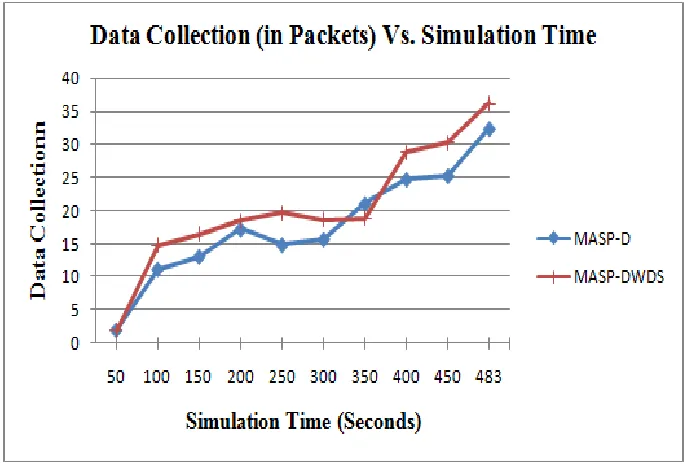
Result analysis in Table 1 shows comparative analysis based on data collection and energy utilization of network using Maximum Amount Shortest Path- Distributed (MASP-D) vs Maximum Amount Shortest Path- Distributed with different scenario (MASP-DWDS).
Table 1 represents comparative result analysis by considering lifetime of network.
Table 1: Result analysis
Protocol Time in ms
Data collection
in kb
Energy Utilization
in Joules
MASP-D 483.00 32 272
MASP-DWDS 483.00 36 276
MASP-DWDS also uses the speed of mobile sink which is useful for increasing the network lifetime. In congested area mobile sink moves slowly and collects maximum data thus it reduces the congestion in the network and also increases the network lifetime.
Figure 6 shows graph of Simulation Time Vs Data Collection in MASP-D and MASP-DWDS
Fig.6. Simulation Time Vs Data Collection in MASP-D and MASP-DWDS
Fig.7. Simulation Time Vs Energy utilization in MASP-D
IV CONCLUSION
AND
FUTURE
WORK
MASP is efficient data collection scheme in wireless sensor networks. In MASP, the mapping between sensor nodes (members) and subsinks is optimized to maximize the amount of data collected by mobile sinks and also balance the energy consumption. MASP has good scalability to support sensor networks with low density and multiple mobile sinks. A heuristic based on genetic algorithm and local search is presented to solve the MASP optimization problem. Design a communication protocol that supports MASP and adapts to dynamic topology changes. To reduce the computational complexity, we have used distributed solution (MASP-D) method. We proposed the schemes (MASP-D) on different scenarios with various movement trajectories and controlling the speed of mobile sinks for robust data collection. To study the dynamic subsink selection problem with network lifetime maximization as the optimization objective as future work.
ACKNOWLEDGMENT
I am Shrikant Dhamdhere and would like to thank the publishers, researchers for making their resources available. I also thank the college authorities Dr. Ayesha Butalia: Research Dean and Dr. N. S. Narawade: Principal of Paravatibai Genba Moze College of Engineering for providing the required infrastructure and support. Finally, we would like to extend a heartfelt gratitude to friends and family members.
REFERENCES
[1] R.C. Shah, S. Roy, S. Jain, and W. Brunette, “Data MULEs: Modeling a Three-Tier Architecture for Sparse Sensor Networks”, Proc. First IEEE Intl Workshop Sensor Network Protocols and Applications, pp. 30-41,2003.
[3] A. Chakrabarti, A. Sabharwal, and B. Aazhang “Communication Power Optimization in a Sensor Network with a Path-Constrained Mobile Observer”, ACM Trans. Sensor Networks, vol. 2, no. 3, pp. 297-324, Aug. 2006
[4] L. Song and D. Hatzinakos “Architecture of Wireless Sensor Networks with Mobile Sinks: Sparsely Deployed Sensors”, IEEE Trans. VehicularTechnology, vol. 56, no. 4, pp. 1826-1836, July 2007.
[5] D. Jea, A. Somasundara, and M. Srivastava ,“Multiple Controlled Mobile Elements (Data Mules) for Data Collection in Sensor Networks”, Proc. First IEEE/ACM Intl Conf. Distributed Computing in Sensor Systems (DCOSS), pp. 244-257, 2005.
[6] A. Kansal, A. Somasundara, D. Jea, M. Srivastava, and D. Estrin ,“Intelligent Fluid Infrastructure for Embedded Networks”, Proc. ACM MobiSys, pp. 111-124, 2004.
[7] A. Somasundara, A. Kansal, D. Jea, D. Estrin, and M. Srivastava,“ Controllably Mobile Infrastructure for Low Energy Embedded Networks”, IEEE Trans. Mobile Computing, vol. 5, no. 8, pp. 958-973,Aug. 2006. [8] Shuai Gao, Hongke Zhang, and Sajal K. Das, Senior Member, “Efficient Data Collection in Wireless Sensor
Networks with Path-Constrained Mobile Sinks”, IEEE Transactions on Mobile Computing, vol. 10, no [9] Arun A. Somasundara, Aman Kansal, Student Member, IEEE, David D.Jea, Student Member, IEEE,
Deborah Estrin, Fellow, IEEE, and Mani B.Srivastava, Senior Member, IEEE, “Controllably Mobile Infrastructure for Low Energy Embedded Networks”, IEEE TRANSACTIONS ON MOBILE COMPUTING, VOL. 5, NO. 8, AUGUST 2006.
[10] Ryo Sugihara and Rajesh K. Gupta,“Improving the Data Delivery Latency in Sensor Networks with Controlled Mobility”, S. Nikoletseas et al. (Eds.): DCOSS 2008, LNCS 5067, pp. 386399, 2008.c Springer-Verlag Berlin Heidelberg 2008.
[11] Yaoyao Gu, Doruk Bozdag, Robert W. Brewer, Eylem Ekici , “Data harvesting with mobile elements in wireless sensor networks”, 2006 Elsevier.
[12] Guoliang Xing, Member, IEEE, Tian Wang, Student Member, IEEE, Zhihui Xie, and Weijia Jia, Senior Member, IEEE,“Rendezvous Planning in Wireless Sensor Networks with Mobile Elements”, IEEE TRANSACTIONS ON MOBILE COMPUTING, VOL. 7, NO. 12, DECEMBER 2008.
[13] Yaoyao Gu, Doruk Bozdag, Eylem Ekici, Fusun O zguner, Chang-Gun Lee,“Partitioning Based Mobile Element Scheduling in Wireless Sensor Networks”, 2005 IEEE.
[14] Hugues Smeets, Chia-Yen Shih, Marco Zuniga, Tobias Hagemeier, and Pedro Jose Marron, “TrainSense: A Novel Infrastructure to Support Mobility in Wireless Sensor Networks”, IEWSN 2013, LNCS 7772, pp. 1833, 2013. Springer-Verlag Berlin Heidelberg 2013.