Graphical and Computational Analysis of
the Vibrations of Triatomic Molecules.
by
Nicholas G. Fulton
A thesis subm itted to the
U N IV ER SITY OF LONDON
for the degree of
DOCTOR OF PHILOSOPHY
ProQuest Number: 10016820
All rights reserved
INFORMATION TO ALL USERS
The quality of this reproduction is dependent upon the quality of the copy submitted.
In the unlikely event that the author did not send a complete manuscript and there are missing pages, these will be noted. Also, if material had to be removed,
a note will indicate the deletion.
uest.
ProQuest 10016820
Published by ProQuest LLC(2016). Copyright of the Dissertation is held by the Author.
All rights reserved.
This work is protected against unauthorized copying under Title 17, United States Code. Microform Edition © ProQuest LLC.
ProQuest LLC
789 East Eisenhower Parkway P.O. Box 1346
A b stra ct
T h e v ib ra tio n a l m o tion s of tria to m ic m olecules a t low energies are well s tu d ie d
b o th e x p erim en tally and th eoretically. A dvances in co m p u te r c ap a b ility hav e
m a d e it possible to perform fully q u a n ta l calcu lation s a t ever higher energies,
w here th e m otions are less well know n an d often classically chaotic. E x p e rim e n ts
a t th e se energies freq u en tly give very co m plicated resu lts, for ex am p le th e p h o
to d isso ciatio n s p e c tru m of w hich has yet to be fully exp lained. T ra d itio n a lly
m uch th e o re tic al effort has been co n ce n trate d in rep ro d u cin g tra n sitio n energies
seen ex p erim en tally. G rap h ical an d c o m p u ta tio n a l tech n iq u es p resen ted h ere are
aim ed a t th e analysis of th e w avefunctions, w hich are often calcu la ted w ith th e
eigenenergies, b u t n o t stu d ie d so thoroughly.
A d iscrete variable re p re se n ta tio n (D V R ) m e th o d for c alcu la tin g large a m p li
tu d e v ib ratio n s in sy m m e trised R ad au co ord inates is p resen te d an d ap p lied to
w ater. T h e eigenenergies are com pared w ith o th e r calcu latio n s, and w avefunc
tions analysed g rap h ically to find th e im p o rta n t m otion s. Possible convergence
pro blem s are th e n discussed w ith reference to th e local m od e 0 - H s tre tc h .
A nalysis of n o rm al an d local m ode v ib ratio n al b eh av io u r of H3 an d D3 is p re
sen ted w ith discussion as to how topological con sid eration s of th e con fig uration
p o te n tia l can p re d ic t th e likely typ es of m otion a t low energies. W avefunctions
are ex am in ed g rap h ically an d lo calisation is co m pared to th a t of a sim ilar clas
sical sy stem .
M etho ds for stu d y in g high a m p litu d e v ib ratio n s are p resen ted an d ap p lied
to H ^. New typ es of w avefunction localisation are show n, an d th e ir lifetim es
and period s in v estig ated . A new fu n ctio n is defined w hich gives a m easu re of
th e degree of lo calisatio n an d th e way in w hich w avefunction a m p litu d e m ay
tra n sfe r betw een different m odes of localisation.
C lassical analysis of is perfo rm ed in 2D an d co m p ared to q u a n ta l cal
cu latio ns. T h e b eh av io u r of th e sy stem at different energies is discussed an d
b ifu rcatio n d iag ram s are ex am in ed , showing th e a p p e a ra n c e of new m otions.
I m p o rta n t m otio ns are th e n discussed an d considered in th e e x p lan atio n of th e
C o n ten ts
A b stra ct
3
List o f F igures
7
List o f Tables
11
A ck n ow led gem en ts
12
1 In trod u ction
13
1 . 1 M odern A pproaches to T h e o r y ... 13
1.2 M olecular S p e c tro s c o p y ... 14
1.3 V ib ratio n al S p e c t r a ... 16
1.4 C a l c u la t io n s ...18
1.5 Hg an d th e C a rrin g to n -K e n n ed y s p e c tru m ...22
1 . 6 C o m p u ta tio n a l A d v a n c e s ... 28
2 Q uantum M eth o d s
30
2.1 V ib ra tio n a l S ep aratio n an d C oo rd in ates ... 302.2 F B R H a m i lto n i a n ... 31
2.3 Basis F u n c t i o n s ...32
2.4 F B R to D V R T r a n s f o r m a t i o n ... 33
2.5 Solution S c h e m e ...35
2.6 Q u a n ta l P h a se S p a c e ...36
3.2 P h ase S p a c e ...40
3.3 Lyapunov E x p o n en ts ... 41
3.4 Successive C rossing P l o t s ...42
3.5 B i f u r c a t i o n s ... 42
3.6 R e tu rn M aps ... 43
4 W ater
44
4.1 I n t r o d u c t i o n ... 444.2 B a c k g r o u n d ... 45
4.3 A S y m m etrised R ad au D V R ... 46
4.4 R esults an d D is c u s s i o n ...49
4.5 C o n c l u s i o n s ... 75
5
Hg and D j N orm al and Local M odes
76
5.1 I n t r o d u c t i o n ... 765.2 B a c k g r o u n d ... 77
5.3 T h e o r y ...79
5.4 R esults a n d D is c u s s i o n ...81
5.5 C o n c l u s i o n s ... 89
6
Q uantum P h a se Space S tru ctu res
91
6.1 W avepacket D ynam ics, C o rrelatio n F unctions an d Pow er S p ectra. 91 6.2 Jacobi H a m i l t o n i a n ... 936.3 R e s u l t s ...94
6.4 P h ase Space S tru c tu re , C orrelatio n F unctions an d Power S p ectra. 95 6.5 B and W a v e f u n c t i o n s ... 99
6 . 6 R ep ea ted P h ase Space F e a tu re s... 107
6.7 S y m m e try C on sideratio ns ... 108
6 . 8 R o bu stn ess of P o t e n t i a l s ... 109
7 R ecu rren ce and T ransport fu nction s
115
7.1 I n t r o d u c t i o n ... 115
7.2 T h e o r y ...116
7.3 R e s u l t s ...116
7.4 R ecu rrence F u n ctio n as a L ocalisation Searching Tool ... 117
7.5 O dd P a rity E ig e n sta te A n a l y s i s ...123
7.6 T ran sp o rt an d D issociation M echanism s ... 130
7.7 B ending M otions an d Q u a n tu m B if u r c a t i o n s ... 133
7.8 C arrin g to n -K e n n ed y S p e c t r u m ...137
7.9 C o n c l u s i o n s ... 141
8 C lassical C alculations: B ifu rcation and R etu rn M aps
143
8.1 T ra je c to ry P ro g ra m ... 1438.2 P oincare Surfaces of S e c t i o n ... 144
8.3 B ending P erio dic O rb its an d B i f u r c a t i o n ...151
8.4 T ra je c to ry R e tu rn M a p s ...159
8.5 Q u an tal-C lassical C o r r e s p o n d e n c e ...160
8 . 6 P o te n tia l R o b u s t n e s s ...166
8.7 C o n c l u s i o n s ... 168
9
Further P o ssib ilities
169
9.1 Q u an tal C a l c u l a t i o n s ...1699.2 Q u a n ta l P h ase S p a c e ...169
9.3 C lassical an d Q u a n ta l B i f u r c a t i o n s ... 170
9.4 C lassical C a lc u la tio n s ... 171
9.5 S u m m a r y ...171
List o f F igu res
1 . 1 C arrin g to n -K en n ed y H3 p h o to disso ciation e x p e rim e n ta l a p p a ra tu s , 23
2 . 1 G eneral co o rd in a te s y ste m ...31
4.1 F in ite D V R grid p r o b l e m s ...50
4.2 B ending s ta te s of w a t e r ...69
4.3 S y m m etric s tre tc h sta te s of w a t e r ...69
4.4 O dd an d even p a rity a n tisy m m e tric stre tc h s ta te s of w ater . . . . 70
4.5 Even p a rity local m ode s ta te s of w a t e r ... 71
4.6 O dd p a rity local m ode w avefunctions of w a t e r ...72
4.7 C om parison of D V R grid r a n g e s ... 74
5.1 C lassical m otio ns in th e H enon-H eiles s y ste m ...78
5.2 C om bined D j w avefunctions showing I li,2 , 3 lo calisation: iV = 4 . 83 5.3 C om bined D j w avefunctions showing IIi,2 , 3 lo calisation: TV = 5 . 85 5.4 C om bined D j w avefunctions showing IIi,2 , 3 lo calisation: TV = 6 . 85 5.5 D3 w avefunctions w ith circu lar localisation: TV = 5 ...8 6 5.6 D3 w avefunctions w ith circu lar localisation: TV = 6 ... 87
5.7 D3 (0, 4^) F p a ir w avefunctions...87
5.8 D3 (1,3^) E p a ir w avefu nctio ns...8 8 5.9 D3 co m b in atio n of (1,3^) an d (0, s ta te s ...8 8 5.10 D3 co m b in atio n of (0,6~^) an d (0,6^) s ta te s ... 89
6.1 H usim i d is trib u tio n an d w avefunction of a horseshoe sta te . . . 96
6.3 C o rrelatio n functio ns of w avepackets cen tred on horseshoe a n d
elep h an t foot m o tio n s ... 98
6.4 Power s p e c tra of w avepackets cen tred on horseshoe an d elep h an t
foot m o tio n s...1 0 0
6.5 B an d w avefunctions of horseshoe an d elep h an t foot b end ing m o tio n s 101
6 . 6 H usim i d is trib u tio n a n d w avefunction of a sy m m e tric s tre tc h s ta te 103
6.7 C o rrelatio n fun ctio n an d pow er sp e c tru m of sy m m e tric s tre tc h
m o tio n ...104
6 . 8 B an d w avefunctions showing sy m m e tric s tre tc h m o t i o n ... 105
6.9 C o rrelatio n fu n ctio n an d pow er sp e c tru m of th e o re tic a l sy m m e tric
s tre tc h m o tio n ...106
6.10 H usim is an d eigenfunctions of four sta te s in a pow er sp e c tru m b an d . 107
6.11 H usim i d is trib u tio n an d w avefunction of a ele p h a n t foot band
w avefu nction...108
6.12 Power s p e c tra for sy m m e trised horseshoe ben d in g m o tio n ...110
6.13 S y m m etrised horseshoe b en d in g m o tio n w avefu nction s...I l l
6.14 C o rrelatio n fu n ctio n an d pow er sp e c tru m of D IM elep h an t foot
m o tio n ...1 1 2
6.15 B and w avefunctions of DIM p o te n tia l elep h an t foot m otion. , . .1 1 3
7.1 H3 recu rren ce fu n ctio n plot arou nd th e ab so lu te m in im u m ...119
7.2 H3 co rrelatio n fu n ctio n and pow er sp e c tru m of horseshoe m o tio n 120
7.3 D iagram to show how localisation increases w ith fin ite m o m en tu m . 120
7.4 H3 recu rren ce fu n ctio n plot for po int n ear d isso ciation channel. . 121
7.5 H3 co rrelatio n fu n ctio n an d pow er sp e c tru m of e le p h a n t foot m o tio n 122
7.6 H3 co rrelatio n fu n ctio n an d pow er sp e c tru m of unknow n m otio n. 124
7.7 H3 b an d w avefunctions of a new m o tio n ... 125
7.8 H3 recu rren ce fu n ctio n plot for p o in t n ear eq u ilib riu m po in t. . . . 126
7.9 H3 co rrelatio n fu nctio ns and pow er s p e c tra of tw o m o tio n s...127
7.10 H3 b an d w avefunctions of ex cited horseshoe m o tio n s ...129
7.12 b a n d w avefunctions of in v erted h y p ersp h erical m o tio n ... 132
7.13 H3 tra n s p o rt fu n ctio n for ben ding m o tio n w avep ack ets...134
7.14 H3 co rrelatio n fu n ctio n an d pow er sp e c tru m of n o d al horseshoe
m o tio n ...135
7.15 H3 b an d w avefunctions of n o d al horseshoe m o tio n ... 136
7.16 T h eo re tic al sp e c tru m of horseshoe to n o d al horseshoe tra n sitio n s. 140
8.1 H3 P o in care surfaces of section a t T2 = 0, ^ = 90° for energies of
19600 an d 23200 c m “ ^... 145
8.2 H3 tra je c to ry a t 19600 c m “ ^ showing a ‘b ra id e d ’ horseshoe. . . . 146
8.3 H3 tra je c to ry a t 23200 c m “ ^ showing a ‘b ra id e d ’ horseshoe. . . . 147
8.4 H3 P o in care surfaces of section a t T2 = 0, 0 = 90° for energies of
26800 an d 30400 c m “ ^...148
8.5 H3 tra je c to ry a t 26800 c m “ ^ showing th e sim ple horseshoe m o tio n , 149
8 . 6 H3 P o in care surface of section a t t2 = 0, ^ = 90°... 150
8.7 H3 tra je c to ry a t 30400 c m “ ^ showing th e elep h an t foot m o tion . , 151
8 . 8 H3 P o in care surfaces of section at T2 = 0, 0 = 90° for energies of
34000 an d 37600 c m “ ^... 152
8.9 H3 tra je c to ry a t 37600 cm~^ showing th e b en t horseshoe m otio n. 153
8.10 H3 P o in care surface of section a t T2 = 0, ^ = 90° for an energy of
41200... 153
8.11 H3 P o in caré surface of section a t T2 = 0, ^ = 90°: en larged region
a t 41200 c m “ ^... 154
8.12 H3 successive crossing diag ram s at 38520 c m “ ^ an d 40210 cm ~ h . 155
8.13 H3 T -sh ap ed ben d in g tra je c to ry b ifu rcatio n d ia g ra m ...157
8.14 H3 tra je c to rie s a t 40000 c m “ ^ showing th e two ele p h a n t foot m o
tio n s... 158
8.15 H3 tra je c to rie s a t 48000 cm~^ showing th e Feshbach b en d in g m o
tio n s... 159
8.16 H3 T -sh ap ed b en d in g tra je c to ry re tu rn m a p ... 161
8.18 no dal horseshoe H usim i d istrib u tio n an d P S O S a t 33698 cm~^. 164
8.19 B ifu rcatio n m a p of th e recu rren ce fun ctio n for H j T -sh a p e d b e n d
ing m o tio n ... 165
List o f T ables
4.1 E x p erim en tal and th e o re tic a l even p a rity b an d origins of w ater . . 51
4.2 E x p erim en tal and th e o re tic a l odd p a rity b an d origins of w ater . . 60
4.3 Energies of th e 201-404 w ater even p a rity s ta te s ...67
4.4 Energies of th e 138-324 odd p a rity w ater s ta te s ...6 8
4.5 Energies of odd an d even p a rity local m o d e 0 -H s tr e t c h e s ... 72
5.1 C alcu lated b an d origins, in cm~^, for D3 below th e b arrie r to
linearity. H j b an d origins are given for a sim ilar energy region. . 82
5.2 Q uasi-deg enerate v ib ratio n al tria d s in th e s tru c tu re of ben ding
[ v i =0^V2= N ) polyads of H3 an d D3 ... 84
7.1 Energies of b an d centres in th e sm o othed pow er s p e c tra for th e
A ck n o w led g em en ts
I d like to s ta r t by th a n k in g J o n a th a n Tennyson for being a g re a t sup ervisor. His
en co u rag em en t a n d friendliness have m ad e m y P hD b o th fru itfu l an d enjoyable
an d allowed m e th e freedom to try ou t new techniques an d ideas.
I ’d also like to th a n k Jam es H enderson for supplying m e w ith his H3 w ave
fu n ctio n s w hich w ere th e invaluable source of d a ta for g rap h ic al and n u m erical
analysis. I also th a n k him for being th e m an on th e inside a t U LCC .
I w ould like to th a n k D im a Sadovskii for help in th e w ritin g of c h a p te r five
an d th e enjoyable co llab oratio n on th e non-linear m odes of Hj" and D3 . T h e
correspo nd en ce a n d results were co m m u n icated solely by e-m ail, and I hope one
day I will m eet h im face to face.
I w ould like to express m y th a n k s to all th e people th a t I have sh ared a
ro om w ith d u rin g m y P h D , and w ould especially like to th a n k R u th Le S ueur
w hose help an d advice on m an y different su b jects has been inv aluable, a n d for
proo f-read ing th e final d ra ft of th is thesis.
I w ould like to th a n k S E R C /E P S R C for a stu d e n tsh ip , an d several g ra n ts
th a t have helped m e to a tte n d conferences. I would also like to th a n k m y p a re n ts
w ho have helped m e to survive th e expense of London by keeping th e re n t on
th e ir flat a t a m inim u m .
F in ally I ’d like to th a n k G onzalo G arcia de P o lav ieja for help in w ritin g
c h ap ters 6 and 7. His visit to E ng land in 1993 led to a co llab o ratio n a n d a
frien d sh ip w hich has given m e m uch insight into th e d y n am ics of m o lecu lar
C h ap ter 1
In tro d u ctio n
1.1
M o d e r n A p p r o a c h e s to T h e o r y
In m an y fields of th e o re tic al physics an d ch em istry th e re has been a change of
em p h asis on how solutions to problem s are d eterm in ed . T h is change has been
fueled alm o st en tirely by th e availab ility of m o d e rn co m p u ters. In th e p a s t,
tim e was sp en t w ith ‘pen an d p a p e r ’ deriving a n aly tic solutions to p rob lem s,
an d proposing ap p ro x im atio n s th a t w ould m ake a calcu latio n possible. Now,
a lth o u g h m any of th e m e th o d s used are based heavily on th e a n a ly tic solu tion s,
we can often use th e sheer pow er of co m p u ters to ‘n u m b er c ru n c h ’ a solution
w ith o u t having to spend so m uch tim e deriving an efficient m e th o d .
T h e lim its of th e ap p ro x im atio n s th a t were m a d e are b eg in ning to b e reach ed
because calculatio ns are so a c c u ra te th a t com parison w ith ex p erim en ts show
slight d eviation s w hich can n o t be a ttr ib u te d to th e calculation s them selves. O ne
such ex am p le is th e failure of th e B o rn -O p p en h eim er a p p ro x im a tio n [1] in vi
b ra tio n a l calcu lation s on H j an d its isotopom ers [2 ]. Also we are now able to
p erfo rm calculatio ns u n d re a m t of in previous years, o pening up new fields of
research.
T h e new app ro ach has no t only given us m ore d a ta to w ork w ith b u t also th e
tools to analyse th e d a ta . In spectroscopy, w here originally th e aim of th e o ry
th e in ten sities of tra n sitio n s, an d assign te m p e ra tu re s an d p o p u la tio n d en sities
to a sp e c tru m .
T h e increase in c o m p u ter technology has also allow ed us to ta k e a far m o re
grap h ic al ap p ro ach in w hich a b s tra c t concepts such as w avefunctions can be
p lo tte d . T h is can give us m uch insight in to th e physical m ech an ism s w hich
m ak e tra n sitio n s occur th a t e x p e rim e n ta l an d sim pler calcu latio n s could only
p red ic t.
1.2
M o le c u la r S p e c tr o s c o p y
M olecular sp ectroscopy spans an enorm ous range of th e ele c tro m a g n e tic sp ec
tr u m d ep en d in g on th e typ es of tran sitio n s th a t th e sy stem of s tu d y is u n
dergoing. In th e high frequency rang e electron e x c ita tio n occurs, w ith s p e c tra
ran g in g from th e visible light ran ge for o u te r electron s to X -rays for e x c ita tio n of
th e in n e r shell electrons. A t in frared w avelengths m o lecular s p e c tra a re p re d o m i
n a n tly d u e to ro -v ib ratio n al tran sitio n s; a t m icrow ave frequencies th e tra n s itio n s
are m a in ly due to ro ta tio n s, an d a t lower energies still, changes in th e spin of th e
electro n s an d nuclei can be found in th e rad io frequency range. T h e tra n s itio n s
are usu ally due to e ith e r changes in th e overall dipole of a m olecule, or changes
in its polarisability . T h e second of these is know n as R am an sp ectro sco p y a fte r
its founder.
T h e m o tiv atio n s for p erform in g calculations an d m easu rin g th e s p e c tra of
m olecules com e from m any fields. P ro b ab ly th e first im p o rta n t use of sp e c tra l
d a ta was in m olecular s tru c tu re work. T h e way in w hich a m o lecule v ib ra te s
an d u nd ergoes tra n sitio n s is very d ep en d e n t on th e sy m m e try an d sh a p e of th e
m olecule, an d also on th e way in w hich it is bonded. By carefully stu d y in g th e
tra n s itio n frequencies an d overall p a tte rn s of th e s p e c tru m , in fo rm atio n a b o u t
th e m olecule can be e x tra c te d . For exam ple th e s tre n g th of a b o n d d ire c tly af
fects th e frequency of v ib ratio n al tra n sitio n s along th a t bond, an d th e s y m m e try
of th e m olecule can give c e rta in p a tte rn s in th e sp ectru m .
calcu la tio n an d co m parin g th e resu lt w ith e x p erim en tal d a ta . W h en th e tw o
m a tc h , average b o nd length s, fu n d a m e n ta l frequencies an d overall s tr u c tu re can
b e confirm ed.
O ne of th e n ex t m o st im p o rta n t uses of sp ectra l d a ta is in a tm o sp h eric m o d
eling. T h e s p e c tra of n itro g en , oxygen, carbon dioxide, w ater, and m an y tra c e
gases including su lp h u r dioxide, m e th a n e , ozone an d C F C s, are exten sively used
to e s tim a te op acities a t different heigh ts in th e atm o sp h ere. T his in fo rm atio n
helps in th e u n d e rsta n d in g of how h eat is tran sferred to an d from th e E a r t h ’s
surface.
T h e well know n greenhouse effect is caused essentially by th e dense s p e c tru m
of c arb o n dioxide. Light en terin g th e E a r th ’s a tm o sp h ere from th e sun, be
ing co n c e n tra te d m ainly in th e visible sp e c tru m and n ear-in frared , passes easily
th ro u g h th e atm o sp h ere and w arm s th e surface. T h e w arm surface th e n ra d ia te s
a t m u ch longer w avelengths, w hich do no t find th e a tm o sp h ere so tra n s p a re n t.
N itrog en an d oxygen, th e two m ost ab u n d a n t atm o sp h eric gases, are b o th di
a to m ic m olecules an d do no t have very dense s p e c tra giving th e m a low opacity.
C arb o n dioxide, w hich only accounts for ab o u t 0.5 % of th e atm o sp h ere, has a
m u c h denser ro -v ib ratio n al sp e c tru m w hich absorbs stron gly in th e far in frared .
T h is m akes it abso rb th e h e a t th a t th e surface ra d ia te s, tra p p in g th e energy
in th e atm o sp h ere. A ccu rate know ledge of th e ab so rp tio n sp e c tru m of carb o n
diox id e is essential in e s tim a tin g th e m echanism s of te m p e ra tu re balan ce an d
th e effects of changes in its abu n d an ce.
Spectroscopy is also used in d eterm in in g th e po llu tio n effects of m o to r v ehi
cles by ta k in g s p e c tra of th e gases released from ex h au st pipes. T his can a ctu ally
be d one from th e side of th e ro ad as cars drive p ast, by m o n ito rin g th e sig n a tu re
ab so rp tio n and em ission features of p a rtic u la r m olecules one can e s tim a te q u a n
titie s of th e b y -p ro d u cts of com b ustion . Sim ilar tech niqu es are also im p o rta n t
in th e design of engines an d fuels w here different o p e ra tin g te m p e ra tu re s and
fuel co n ce n tratio n s can affect th e efficiency of th e b u rn in g process.
In astro n o m y th e need for a c c u ra te m olecular spectroscopic d a ta has in
scarce in space, b u t ob servations have challenged th is id ea a n d m a d e it necessary
to form new th eories to accou nt for th e ab u n dance.
In th e stu d y of stellar s tr u c tu re it was assum ed th a t sta rs are to o h o t for
m olecules to be boun d, and m odels w ere based on th e o p acity of a to m s an d th e ir
ions. T h e op acity p ro jec t [3], w hich has now been co m p lete d , was an a tte m p t to
calcu la te all th e tra n sitio n s of th e possible ato m ic species w hich could exist in
stars. T his p ro jec t calcu la ted over a m illion tra n sitio n s an d is used ex ten siv ely
in s te lla r s tru c tu re m odels, how ever in cool sta rs m olecules are now know n to
ex ist, an d p relim in ary e stim a te s for w a te r alone in d ic a te th a t th e re m ay be as
m an y as 2 0 m illion im p o rta n t ro -v ib ratio n al tra n sitio n s, w ater being on ly one of
th e m an y sm all m olecules w hich m ay b e found [4].
In th e in te rste lla r m e d iu m th e re a re also rich sources of m olecules. T h e
large neb ulae which are found in th e space betw een sta rs a re of g re a t in te re st
to astro n o m ers as th ey are th e b irth place of new stars. T h e te m p e r a tu r e of
th ese clouds is betw een 5 a n d 100 K, so m any m olecules w ould be s ta b le if th e y
ex isted . So far m an y exo tic species h ave been fo und in th e se regions, in clu d in g
long chain carb on m olecules. K now ledge of th e c h em istry of th e se regions is still
very poor, and a m ore co m p lete know ledge can only be o b ta in e d by ex am in in g
th e ab so rp tio n , an d em ission s p e c tra of th e regions to search for th e fin g erp rin ts
of c e rta in m olecules.
A t high energies th e processes w hich lead to d isso ciatio n are of in te re s t to
scien tist in vestigating reac tio n m echanism s. S pectroscopy is a v aluab le tool in
th e stu d y of how it m ay b e possible to excite a p a rtic u la r m olecule to a s ta te
w here it will yield p red ic tab le p ro d u c ts as it breaks up. T h is stu d y m a y o p en th e
doors to p ro d u ctio n line tech n iq u es in w hich a series of ex c ita tio n s can control
th e progress of a reactio n.
1.3
V ib r a tio n a l S p e c tr a
In th e calculatio n of any m o lecu lar sp e c tru m , it is n ecessary to m ak e ap p ro x
Born-O p p en h eim er a p p ro x im atio n [1] is critica l in any v ib ra tio n a l c alcu la tio n since
it sep arates electro n m o tio n from th e nu clear m o tio n. E lectro n s are very m uch
lig h te r th a n nuclei, an d th erefo re tra v e l ‘fa ste r’. T h e a p p ro x im a tio n assum es
th a t for any nuclear m otion th e electro n s will always find a con fig uratio n w hich
m inim ises th e energy in such a sh o rt tim e th a t we need n o t w orry a b o u t th e ir
m o tio n . T h is ap p ro x im atio n m akes it possible to consider a p o te n tia l energy
su rface w hich rep resents th e energy of any configuration of th e ato m s for a
p a rtic u la r electronic state. T h e v ib ratio n al p ro blem can th e n be solved using
a p u rely n uclear m o tion H am ilto n ian w ith a p o te n tia l for th e given electro n ic
s ta te . T h e p o te n tia l can be derived from e ith e r nb initio calcu latio n s of th e
electro n ic energy of a given n u clear configuration, or by fittin g to ex p e rim e n ta l
d a ta .
T h e lim its of th is fu n d a m e n ta l ap p ro x im atio n are now being reached as cal
cu latio n s becom e m o re and m ore a cc u rate. In ex p erim en ts on HD'*' disso ciation
[5] th e am o u n t of and D"*" frag m en ts d etecte d was n ot th e sam e. T h is effect
is d u e to th e preference of th e electro n to be bound to th e d e u te riu m . W ith in
th e B o rn -O p p en h eim er ap p ro x im atio n th e electron does n o t feel a difference b e
tw een th e two ato m s. In fact th e resu lt is due to th e difference in th e ra tio of
m ass betw een th e electrons an d th e ato m s for hydrogen an d d e u te riu m . T h is
gives a slightly higher bind ing energy for D th a n H and so th e electro n prefers
th e d e u te riu m to th e hydrogen ato m .
In p o te n tia l fittin g of H j , w here for a tria to m ic th e ra tio of th e m ass of th e
electro n s to th a t of th e nuclei is sm allest, fitting a single v ib ra tio n a l p o te n tia l
to th e ro -v ib ratio n al sp e c tra of th e isotopom ers H j , H2D""", D2H''' an d D j has
failed [2] due to th e breakdow n of th e B orn O p p en h eim er ap p ro x im atio n . In
sim ilar work on fittin g a p o te n tia l to w ater [6] th e ap p ro x im atio n has also been
show n to breakdow n.
O th e r problem s can arise w hen th e electronic m otion is n o t sep arab le from th e
n u clear m otion. O ne case is th a t of th e p seu d o -ro tatio n of Nag. T h is m olecule
has a d eg en e rate electron ic gro un d s ta te from which it un derg oes a Ja h n -T e lle r
e x c ita tio n th e m olecule can ‘h o p ’ from one m in im u m to a n o th e r [8 ]. W ith in
th e B o rn -O p p en h eim er a p p ro x im a tio n th is is allowed, b u t becau se th e m olecule
suffers a Jah n -T eller d isto rtio n , th e assu m ed grou nd electro n ic s ta te is a c tu a lly
m ad e up of two electro n ic sta te s. If th e m olecule undergoes one p se u d o -ro ta tio n ,
i.e. m o tio n from m in im u m one, to tw o, to th re e an d back to one, th e m olecule
does n o t re tu rn to th e original electro n ic surface an d an ad d itio n a l p h ase facto r,
know n as B erry p h ase [9], m u st be in tro d u ced to correct for th is.
1 .4
C a lc u la tio n s
T h e re are m any m odels w hich are used to ap p ro x im ate v ib ra tio n a l a n d r o ta
tio n al b ehaviou r, an d allow sim ple s p e c tra to be ex plain ed. T h e co m m o n est of
th e se m odels is th e harm o n ic oscillator m odel w hich considers v ib ra tio n s as sm all
d isp lacem en ts of th e ato m s from a global m in im u m along th e re s u lta n t n o rm al
m odes. N orm al m odes can be th o u g h t as th e basic ty pes of v ib ra tio n th a t a
m olecule can undergo. Q u a n tu m n u m b e rs can th e n be assigned to th e se m odes
an d sp e c tra l lines assigned to ce rta in tran sitio n s. T h e ro ta tio n a l b eh av io u r can
be calcu la ted using th e rig id -ro to r a p p ro x im atio n w hich assum es sim p le q u a n ti
satio n of th e ro ta tio n a l levels, w hich is th e n sup erim p o sed o n to th e energies of
th e v ib ra tio n a l tra n sitio n s.
T h e idea th a t m o tio n is q u an tised along th e n o rm al m odes does n o t alw ays
apply, an d alth o u g h th e h arm o n ic ap p ro x im atio n is only ex p ec ted to w ork a t low
energies, for som e m olecules sy m m e try p ro p erties of th e p o te n tia l or reso nan ces
betw een linear n o rm al m odes m ake th is break dow n even a t th e en erg y of th e
fu n d a m e n ta l frequencies. In th ese cases it is useful to use a n o n -lin ear n o rm al
m o d e m odel [1 0] w here th e re is im p lic it coupling betw een th e n o rm a l m odes.
T h e a p p licatio n of th is m odel to th e v ib ratio n s of H j is in v e stig ated in c h a p te r
5. In a sim ilar fashion to th e no n-linear norm al m od e m od el, local m o des can
arise a t low energies w here th e h arm o n ic ap p ro x im atio n is assu m ed to valid.
T h is s itu a tio n arises in th e v ib ratio n s of w ater an d is discussed in c h a p te r 4.
was p e rtu rb a tio n theory. W ith in th e h arm o n ic o scillator-rigid ro to r m o d el for a
given v ib ratio n al m ode, or ro ta tio n , successive ex citatio n s give reg u larly spaced
energy levels. P e rtu rb a tio n theory, for v ib ratio n s, considers sm all a d d itio n a l
te rm s in th e p o te n tia l to account for an h arm o n icities. T hese are th e n ex p a n d e d
as a Taylor series aro u n d eq u ilib riu m to give force co n stan ts th a t can be fitte d to
observed sp ectra . In a sim ilar way ro ta tio n a l co n stan ts are fitte d to th e ro ta tio n a l
beh av io u r, to in clud e effects such as Coriolis coupling. T h e te rm s them selv es give
d irec t in fo rm atio n on th e form of th e p o te n tia l an d its deriv atives a ro u n d th e
eq u ilib riu m geom etry.
O ne of th e m a in problem s of p e rtu rb a tio n th eo ry is th e assu m p tio n th a t th e
corrections to o ur ap p ro x im ate H am ilto n ian are sm all an d so th e a m p litu d e s of
v ib ratio n s m u st rem a in sm all. For som e m olecules w hich are p a rtic u la rly ‘flo p p y ’
even a t low energies th e am p litu d e of v ib ratio n s can be large. A t higher energies
all m olecules m u st undergo high a m p litu d e v ib ratio n s and m ay ex p erien ce m ore
c o m p licated m o tion s. For th is reason o th e r m eth o d s, especially th e v aria tio n a l
m e th o d [1 1], have gained favour as m o re th a n ju s t th e fu n d a m e n ta l frequencies
are in v estig ated .
B y rep resen tin g th e w avefunctions as sum s of p ro d u c ts of basis fu n ctio n s,
an d th e n diagonalising a H am ilto n ian m a trix w hich couples th e basis fu n ctio n s
to g e th e r, solutions can be found. T h e v ariatio n al p rin cip le s ta te s th a t for a
given basis set, th e calcu lated grou nd s ta te energy is an u p p e r b ou n d to th e
ex ac t energy. An im p rov em en t in th e basis set, by inclusion of m ore fu n ctio n s or
o p tim isa tio n of th e fu n ctio n al form , will give a lower energy. T h is is th e n a lower
u p p e r b o u n d to th e ex act energy. It can also be shown th a t for a p p ro p ria te ly
fo rm u la te d pro blem s th e calcu lated ex cited s ta te energies are also u p p e r bo u n d s
to th e ir corresponding ex act energies [1 2].
F ro m th is we can say th a t th e en ergy always app ro ach th e correct energ y
from above. It is th erefore possible to o ptim ise convergence by im pro vin g th e
basis sets for a given size prob lem , i.e. nu m b er of basis fun ctio ns, u n til th e
c a lc u la te d energy is m inim ised. O nce an o p tim ised basis set is found m ore basis
converges no m ore, th e exact energy is assum ed to have b een reached. T h e re are
possible pitfalls if th e energy ap p ears to be converged b u t is in fact on a ‘k n ee’
of th e convergence curve. However th is situ a tio n is n o t n o rm ally th e case for th e
grou nd sta te .
For stric t variation al beh av io u r th e in teg ratio n of th e p o te n tia l an d basis
fun ctio ns m u st be exact. If th e p o te n tia l is very com p licated a n a ly tic in te g ra tio n
m ay n o t be possible and G aussian q u a d ra tu re is em ployed.
T h e m e th o d of using o rth og on al basis functions to rep resen t a w avefunction
is n o rm ally referred to as a finite basis rep resen tatio n (F B R ) [13]. O th e r m e th o d s
exist w hich use non -o rtho go nal basis fun ctio ns, such as th e d is trib u te d G aussian
basis (D G B ) m e th o d . T his rep resen ts th e w avefunctions as G aussian fu n ctio n s
on a grid of p oints. T h e ad van tage of th is is w hen th e p o te n tia l is n o t su ite d
to a set of basis functio ns for each coo rd in ate, e.g. if th e p o te n tia l has a lot of
coupling betw een co ordin ates. T h is m e th o d is also used to c alcu la te ap p ro x im a te
q u an tisa tio n values of classical p erio dic orbits by placing th e G aussians aro u n d
th e perio dic o rb it [15].
F in ite basis m e th o d s have had m uch success in calcu la tin g energies in m an y
different ty p es of problem s. H owever one lim ita tio n w ith th e ap pro ach is th a t
only th e ground s ta te an d a b o u t th e low est 5 % of th e eigenvalues o b ta in e d are
well converged. To converge m ore v ib ratio n al levels it is necessary to ad d m ore
basis fun ction s to rep resen t th e m o tio n b e tte r an d in crease th e to ta l n u m b e r of
eigenvalues. However, if th is is done th e H am ilto n ian m a trix becom es u n m a n
ageably large an d w ith th e cu rren t c o m p u te r technology, unsolvable. To p erfo rm
th e calculatio ns it is necessary to use a techn iq ue originally developed in o th e r
fields [14] based on a finite elem en t approach.
B y tran sfo rm in g th e basis fu n ctio n so th a t th e w avefunctions are now rep
resen ted as am p litu d es a t po in ts, one can approach th e pro blem s slig htly dif
ferently. T his m e th o d is known as th e discrete variable re p re se n ta tio n m e th o d
(D V R ) allows tru n c a tio n of th e w avefunction in regions w here it will have no
m a g n itu d e because th e p o te n tia l is very high, an d hence reduces th e overall size
w avefunctions, a n d up to 50 % of calcu la ted eigenvalues m ay be converged. O ne
d raw back of th e D V R m e th o d is th a t it is n ot stric tly v aria tio n a l since th e in te
g ra tio n is not ex ac t. T h e tru n c a tio n stag e m u st also be carefully p erfo rm ed since
th e re m ay be a te m p ta tio n to in tro d u c e m an y basis fun ctio n , i.e. D V R p o in ts,
th e n tru n c a te th e pro blem to a m an ag eab le size. T h is can increase th e in accu
racy of th e rep re se n ta tio n since som e regions of th e p o te n tia l will be ignored in
th e tru n c a tio n . T h e energies can th e n be un reliable an d w rongly converged.
C lassical calcu latio n s of m o lecular v ib ratio n s form a good com p lim en t to
q u a n ta l calcu latio n s since th e y allow different asp ects of th e physical sy stem to
be in v estig ated . H owever th e m ain reason for doing classical calcu latio n s is th a t
th e y are often a quick an d easy way to g et an in itia l id ea of th e b eh av io u r of a
system .
A t low energies th e classical-q u an tal correspondence p rin cip le is n o t stro ng,
b u t classical p erio d ic o rb its often reflect th e fu n d am e n tal m o tion s. T h e n o rm al
m o de to local m o d e tran sitio n s can be p red ic ted [16] an d n on-linear m o tio n
in v e stig ated [1 0].
A t higher energies th e q u a n ta l b eh av io u r m ore closely resem bles th e classical
b e h av io u r and it is h ere th a t classical p eriod ic m otions are im p o rta n t since th e y
‘s c a r’ th e w avefunctions [17], and can give rise to stro ng spectroscopic featu res.
In sy stem s w hich are classically chaotic th e stu d y of q u a n tu m featu res has been
n ick n am ed q u a n tu m chaology.
A co m plete u n d e rsta n d in g of th e m echanism s w hich give rise to w avefunc
tio n scarring has n o t yet been found. B erry [18] and Voros [19] proposed th e
m icro can on ical h y p o th esis to ex plain th e a m p litu d e e n h an c em en t. However, it
was found to fail since clear scars were found in a classical chao tic sy stem [2 0]. A
m ore co m p lete e x p la n a tio n was th e n p u t forw ard by Bogom olny [21] to ex plain
scars in th e w avefunctions. T h is was th e n ex ten d ed into p hase space by B erry
[2 2] using a W igner d istrib u tio n [23]. A m e th o d for q u an tify in g th e stre n g th of
scarrin g has been given by A gam and F ish m an [24].
For m ore a c c u ra te an d q u an tal-lik e stu dies classical m e th o d s often becom e
rep-resen tin g a w avepacket as an ensem ble of classical tra je c to rie s [25] [26] a n d th e n
stu d y in g th e recu rren ce to e x tra c t eigenenergies. In a 2D s tu d y of C O2 a classi
cal ap p ro ach too k 2 days to ru n , w hereas th e e s tim a te for a equ ivalent q u a n ta l
calcu latio n was 10 m in u tes [27] on th e sam e co m p u ter.
1.5
a n d th e C a r r in g to n -K e n n e d y s p e c tr u m .
T h e H3 ion was first d e te c te d in discharge ex p erim en ts by J .J . T h o m p so n [28]
who m e asu re d a p a rtic le w ith a m ass to charge ra tio of 3. T h e c u rre n t th e o ry a t
th e tim e could not exp lain th e discovery an d w hen d e u te riu m was discovered th e
p a rtic le was th o u g h t to be HD"^ [29]. L ater, when ab initio th e o ry h ad im p ro v ed ,
a s ta b le s tru c tu re of was p re d ic te d [30], an d it rep laced as th e likely
c u lp rit to exp lain th e earlier observations. Now we know a lot m ore a b o u t th e
m o lecular ion, an d th e ease w ith w hich it can form in gas discharges.
In its grou nd s ta te H j is an e q u ila te ra l trian g le, w ith ato m ic se p a ra tio n s
of 1.65ao' It is easily form ed by th e collision of H2 and H2 in an ex o th e rm ic
reactio n ,
H2 + H+ H+ + H + 1.7 eV
H3 is th o u g h t to be a very im p o rta n t m olecule in th e in te rs te lla r m e d iu m as
it is a p ro to n donor, read ily giving u p in chem ical reactio n s, an d m ay be
responsible for trig gerin g m an y of th e chains of reactio n s w hich occur in th e
diffuse clouds, an d n ebu lae betw een th e stars. So far, how ever, it has n o t b een
d e te c te d in th e in te rste lla r m ed iu m , b u t by chance was found on J u p ite r [31], an d
la te r U ranus [32], S a tu rn [33] and a su sp ected sighting in S up ernova 1987a [34].
T h e m o st well stu d ie d of these cases is J u p ite r, w here is form ed in a u ro ra e
a t th e n o rth an d so u th m ag n etic poles, w ith an e s tim a te d colum n d e n sity of
30 X 10^^ m olecules cm~^, and a te m p e ra tu re varying from 800K to 1200K [35].
In th e la b o ra to ry th e sp e c tru m of H3 was first observed by O ka [36], an d
now a large n u m b e r of im p o rta n t tra n sitio n s have been record ed an d c a lc u la te d
[37]. T h eo re tic al calculatio ns of th e sp e c tru m were first p erfo rm ed by C arn ey
Figure 1.1: C arrington-K ennedy H j photodissociation exp erim ental a p p ara tu s
[40]. This is a simplified diagram to show th e m ain experim ental
features. Ions enter on the left, are m ass/ch arg e selected and then
en ter th e drift cham ber. A tu nable laser excites the ions and if
they dissociate th e products can be m ass selected in th e ESA on
th e right and detected by th e two detectors which can also estim ate
their kinetic energy. M odulation of th e laser allows a red uction in
th e noise due to norm al dissociation and reaction processes.
leaser
Intennediate slit
Drift tube
D etector 1
Laser
Ion Beam M agnetic
ESA
Doctector 2
Ion Source
to very high energies [39], which have aided in the discovery of H j in astronom y.
In much of th e work presented here th e driving force has been an a tte m p t to
in terp ret th e results of the photodissociation sp ectru m of H3 first m easured in
1982 by C arrington et al [40].
T he C arrington-K ennedy photodissociation sp ectru m of was rem arkable
because in only a 220 cm “ ^ window, 870 cm “ ^ from the origin, they m easured
nearly 27000 absorption lines due to transitions leading to dissociation [41]. Even
m ore surprising was th e discovery th a t, on ‘roarse-graining’ about 2 0 0 0 of th e
strongest lines, th e sm oothed spectrum had 4 very d istinct peaks separated by
ab ou t 50 c m “ b Since th e original results much analysis and m any new results
have been published which investigate th e dependence of th e spectrum on th e
kinetic energy of the dissociating ions, the role of isotopic su b stitu tio n , and
the different dissociation m echanism s [41], [42].
T h e exp erim ental ap p aratu s in a simplified diag ram m atic form is shown in
figure 1 .1. H3 ions are produced by electron b om bardm ent, and then accelerated
up to th e m a g n e tic secto r w hich is tu n e d to tra n s m it ions. T hese th e n e n te r
th e d rift ch am b er w hich can accelerate th e ions fu rth e r. A m ech anically chopped
laser beam passes along th e d rift ch am b er an d is sw ept th ro u g h th e frequency
range from a b o u t 870 c m “ ^ to 1095 c m “ ^. P ro to n s, w hich are released from
dissociation, are d e te c te d by th e m u ltip lier. To s e p a ra te th e m from th e p a re n t
H J b eam an d frag m en ts a e le c tro sta tic an aly ser, or ESA , is used. T h e
ESA has sufficient m ass-to-velocity resolu tion th a t it can b e used to d e te rm in e
th e a p p ro x im a te k in etic energy of th e frag m ents. A bias voltage in th e d rift
tu b e can also b e set so th a t p ro to n s d e te c te d m u st have been p ro du ced in th e
d rift tu b e . W ith o u t th e laser b o th H"*" an d frag m en ts are d etecte d w hich
are g en era ted by collision ind uced d issociation [41], an d n o t by uni m o lecu lar
decay of th e H3 . W ith th e laser on a n d locked to th e m echanical chopping
frequency th e p re d o m in a n t ions d e te c te d are H'*’. A line is recorded w hen th e
frequency of th e laser causes an increase in th e r a te of d etectio n of p ro to n s,
co rrespo nd in g to e x c ita tio n from a sta b le or m e ta -sta b le s ta te , to a s ta te w hich
leads to dissociation.
T h e m ain featu res of th e sp e c tru m can be su m m arised as follows.
• 27000 lines observed in th e range 874 - 1094 cm "^. Each line was recorded
by d e te c tin g frag m en t pro d u ced by predissociatio n.
• ‘C o arse-g rain in g ’ of th e h ighest 1934 lines gave a sm o o th ed sp e c tru m w ith
four clear p eaks cen tred a t 875.65, 928.02, 978.45 an d 1033.62 cm~^.
• T h e sp e c tru m is d ep en d e n t on th e kinetic energy of th e H'*' frag m en ts
released. T h e k in etic energy of th e released frag m en t can be as high as
4000 c m “ ^. T his im plies th a t th e in itia l an d final sta te s which give th e
tra n s itio n are m e ta s ta b le states.
• T h e in itia l s ta te of H3 before e x citatio n m u st have a lifetim e longer th a n
lO '^ s for it to reach th e d rift tu b e , and th e final d issociatin g s ta te s m u st
have lifetim es sh o rte r th a n 7 x 10“ 's for dissociation to occur in th e d rift
• T h e s p e c tra of th e isotopom ers H2D''' an d D2H''' gave different resu lts w hen
m o n ito rin g e ith e r frag m en t p ro to n s o r frag m en t deu tero n s.
T h e first th e o re tic al m odel proposed to exp lain th e s p e c tru m was given by
C a rrin g to n an d K ennedy in th e ex p e rim e n ta l p a p e r [41]. T h e y d escribe th e
sy stem as a H2 • -H"*" com plex since th e four peaks corresp on d very closely to
j = 3 ^ 5 tran sitio n s for = 0 ,1 ,2 ,3 in th e g round electro nic s ta te of H2. Since
th e final s ta te s in th e tra n sitio n s w hich give th e sp e c tru m lead to dissociation,
th e y m u st be m e ta sta b le . T h ree m odes w ere discussed to ex p lain th e ex isten ce of
th e pred isso ciatio n m echanism . T h e first, tu n n ellin g th ro u g h a centrifugal b a r
rier, gives only low k in etic energy releases and n ot enough possible tra n sitio n s.
T h e second, ro ta tio n a l predissociation , in w hich th e H"*" is b o u n d to an ex cited
H2 m olecule, gives tra n s itio n frequencies in th e rang e 0-900 c m “ h F in ally vi
b ra tio n a l pred isso ciation , in a sim ilar fashion to ro ta tio n a l p red isso ciatio n , gives
energies th a t are high, betw een 2400 an d 5000 cm~^. T h e ir m odel gives values
for lifetim es in th e correct range, b u t by no m eans conclusively fits th e o bserved
d a ta .
A second m odel was proposed by Pfeiffer and C hild [43] b ased on th e H2 -H"''
com plex m odel of C arrin g to n an d K ennedy. T his rigid ro to r m odel ex p lain ed
th e lifetim es of th e p redissociation s ta te s as caused by tu n n e llin g and to ok th e
com plex to be loosely coupled b u t bo un d by a high ro ta tio n a l an g u lar m o m e n tu m
b a rrie r. T h is could account for th e n u m b e r of lines b u t n o t th e stru c tu re , a n d
w ith o u t assum ing sa tu ra tio n , could n o t exp lain tra n sitio n s above a b o u t 900
cm “^.
U sing classical tra je c to ry analysis on th e DIM p o te n tia l B erblinger et al [44]
fo und regions of bou nd p h ase space in 2D calculatio ns w ith J — 0. In 3D th e se
w ere found to be u n sta b le excep t th e periodic o rb it nickn am ed th e ‘h o rsesh o e’
o rb it, w hich was a ty p e of b ending m o tion . By considering ./ > 0 they s tu d ie d
th e an g u lar m o m en tu m b a rrie r effects w hich m ay account for th e long lifetim es.
T h ey found th e sy stem to be q uasi-periodic or chaotic d ep end in g on th e a n g u la r
w ith th o se of th e ex p erim en t.
U sing M on te C arlo in teg ratio n th e y calcu la ted th e volum e of p h ase space
available an d hence e s tim a te d th e d en sity of sta te s. T h is d en sity th e y found to
b e very high w hich fitte d w ith th e large n u m b e r of lines m e asu re d in th e e x p e ri
m e n t. G om ez L lorente an d P oliak [45] ex ten d ed th e analysis by c o n c e n tra tin g on
th e ro ta tin g horseshoe p erio d ic o rb it a n d found th a t a n tis y m m e tric e x c ita tio n ,
p e rp e n d ic u la r to th e horseshoe m o tion , w ith ro ta tio n a l tra n sitio n s could be used
to ex p lain th e four b ro ad peaks in th e ‘co arse-g rain ed ’ sp e c tru m , describ ed as a
R b ran ch .
T h e o bserv atio n of different resu lts w hen m o n ito rin g p ro to n or d e u te ro n re
lease for th e iso to po m ers was analysed by C arrin g to n et al [42] a n d fitte d th e
o retical p red ictio n s. T h e y observed th a t for D2H"^ th e H'*' was th e d o m in a n t
d issociatio n p ro d u c t a t low k in etic energies an d d o m in atin g a t h ig h er K .E .
T his could be ex p lain ed by considering th e an g u lar m o m e n tu m b a rrie r in b o th
cases w hich w ould favour H"'" p ro d u ctio n a t low an g u lar m o m e n tu m a n d D'*’ for
h igher values. T his was also th e case for H2D'*', b u t w ith a less p ro n o u n ced
energy selection.
O bviously to confirm th e classica] p red ic tio n it is im p o rta n t to find th e q uan-
ta l c o u n te rp a rts to th e horseshoe and ex cited horseshoe m o tio n . H ow ever th e
s ta te s th a t are involved in th e sp e c tru m are n ear to and above th e d isso ciatio n
th resh o ld , an d co rresp o n d to a b o u t th e 8 00 th -f s ta te s co u ntin g from th e gro u n d
s ta te . T h e calcu latio n of such highly ex cited s ta te s is frau g h t w ith difficulty, an d
for a tria to m ic m olecule was p ractically im possible u n til only a few years ago.
U sing G aussians s c a tte re d along th e classical p eriodic o rb it, G om ez L loren te
et al [15] confirm ed th e ex istence of th e horseshoe sta te s in a q u a n ta l c alcu la tio n
an d e s tim a te d th e energies. However, th e se were 2D calculation s an d relied h eav
ily on th e fact th a t any q u a n ta l horseshoe would be tig h tly localised along th e
classical p erio d ic o rb it. U sing a new ly developed d iscrete variable re p re s e n ta tio n
(D V R ) T ennyson, B rass an d P oliak found strong lo calisation of th e h orseshoe in
full q u a n tu m calcu latio n s in b o th 2D [46] and 3D [47]. T h ey also fo und o th e r
existence of a q u a n tu m ex cited horseshoe sta te .
M ore recen t calculatio ns by a few groups relying heavily on th e D V R m e th o d
have m an ag ed to converge sta te s up to th e dissociatio n lim it [39], [48]. A tte m p ts
are now being m a d e to recrea te th e sp e c tru m from pu rely q u a n tu m m ech an ical
grounds. However, th e re are q u ite a n u m b e r of different p a ra m e te rs w hich need
to be in clud ed in th e m odel to m im ic th e ex p erim en tally o bserved resu lts, e.g. ion
b eam te m p e ra tu re and s ta te lifetim es. For a fully th eo re tic al rep ro d u ctio n of th e
resu lts th ese facto rs will have to be in cluded, an d so th e p ra c tic a l lim ita tio n s
m ay n ot be defined only by th e pow er of co m p u ters.
O ne of th e m a in problem s w ith m olecu lar v ib ratio n calcu lation s is th e ac
cu racy of th e p o te n tia l available. For H j th e re now ex ist arg u ab ly th e m o st
a c c u ra te p o te n tia ls for a tria to m ic m olecule [49], [2], [50], b u t th ese are only
a c c u ra te to a b o u t 24000 cm~^ above th e g round electro nic s ta te . In th e p h o
to d isso ciatio n sp e c tru m , b o th th e in itia l an d final s ta te s w hich give rise to th e
ab so rp tio n are n ear to or above th e d issociation lim it. T h is occurs a t a b o u t
36000 cm~^, d ep en d in g on th e p o te n tia l used, and th e sta te s are th erefore b ad ly
rep resen ted in th e p o te n tial. In ch a p te r 8 th e ro b ustness of p o te n tia ls is discussed
an d it is arg ued th a t q u a lita tiv e form , r a th e r th a n q u a n tita tiv e accuracy, m ay be
enough to find th e m otions an d sta te s responsible for th e C arrin g to n -K e n n ed y
sp e c tru m .
T h e ex act value of th e dissociation energy of H j is n ot certain . E x p e rim e n ta l
tech n iq u es used to e s tim a te th e value do n o t give th e sam e resu lt as ab initio
calcu latio n s [51]. However, it is im p o rta n t to u n d e rsta n d th e different definitions
of th e value. C lassically it is norm al to q u o te th e difference betw een th e a b so lu te
m in im u m of th e p o te n tia l of in terest, an d th e energy a t w hich th e p o te n tia l is no
longer b ou nd . T h is is in d icate d by D^. Q u an tally zero p o in t energies m u st be
considered, an d for H j on th e M BB p o te n tia l this value is a b o u t 4400 c m “ F T h e
low est energy a t w hich th e m olecule can dissociate is also higher th a n th e energy
a t w hich th e p o te n tia l is no longer bo u n d since th e re is a zero p oint energy for
th e rem a in in g H2, if we assum e a p ro to n is given off. T h is zero p oint energy
Dq.
In th is thesis m o st energies are q u o te d referred to th e g ro u n d s ta te , i.e. w ith
th e zero p o in t energy. For convenient com p arison of th e classical an d q u a n ta l
resu lts, th e classical resu lts are also p resen te d on th is energy scale, so th e classical
d issociatio n energy is given w ith respect to th e q u a n ta l g ro u n d sta te .
O n th e M B B p o te n tia l energy surface, w hich is used for m o st of th e c alcu la
tio n s p resen ted h ere, H j has a classical d isso ciation energy of a b o u t 36400 cm "*
above th e grou nd s ta te . T h e DIM p o te n tia l has a value of a b o u t 35500 cm~^.
T h e second definition w hich needs to be discussed is th e energy a t w hich
th e H3 can go linear. C lassically this b a rrie r to lin earity has a value of a b o u t
14000 cm~^ from th e ab so lu te m in im u m of th e p o te n tia l. Q u an tally , tu n n e llin g
can occur, so th e effect of lin earity m ay b e felt as low as 9000 cm~^ ab ov e th e
g ro u n d sta te . S tric tly speaking th e energy should be a b o u t 2000 c m “ ^ above
th e b a rrie r before th e m o tion can be said to be freely m oving th ro u g h lin earity ,
giving a value of a b o u t 1 2 0 0 0 cm~^ above th e g ro u n d s ta te .
1.6
C o m p u ta tio n a l A d v a n c e s
O ne of th e m a in changes in science in th e last decade has n o t been fueled by
new e x p e rim e n ta l discoveries, or by th e o re tic a l in novation, b u t by th e en o rm o u s
advances in co m p u tin g technology b o th in sheer calcu latin g sp eed and user in te r
faces. A com m on id ea am o ng st co m p u ter scien tists, w hich is som etim es know n
as ‘M o ore’s law ’, s ta te s th a t th e co m p u ter pow er available for a ce rta in am o u n t
of m on ey will dou ble every 18 m on th s. T his has ce rta in ly been th e case for
th e la st two decades, an d th e increase does not look likely to slow for a t least
th e n e x t decade, an d m ay b e even la ter. F in ite lim its im po sed by th e p hysical
technology itself can be avoided by sim ply squeezing m ore processors in to one
box. T h e tra n s itio n from scalar to v ecto r arc h ite c tu re s gave power increases
of u p to 1 0 0 tim es, an d now p arallel m e th o d s w here each processor itse lf m ay
be v ecto r looks set to increase th e available pow er fu rth e r. However w ith th e
m em o ry lim its, w hich m ay n o t be able to increase to su p p o rt th e d e m a n d s of
th e processors them selves.
T h e definition of co m p u ter pow er is som etim es a little vague b u t can be
th o u g h t of as th e n u m b er of m a th e m a tic a l o p eratio n s p er second. T h e increase
has n o t only affected th e speed of calcu latio n s, b u t also g rap h ic al cap ab ility.
T h is im p ro v em en t in th e ab ility to visualise resu lts has spaw ned new research
of its own. W avefunctions w hich h ad o ften been th o u g h t of as m a th e m a tic a l
con cepts can now be p lo tte d on th e screen in seconds allow ing in -d e p th analysis
of th e in fo rm atio n th e y convey. For a tria to m ic m olecule th e v ib ra tio n s fill a
th re e dim en sion al configuration space, a n d th e w avefunctions h ave values a t all
p o in ts. It is th erefo re necessary to select a ‘slice’ th ro u g h th is co nfig uration
space, for in sta n c e by fixing a co o rd in ate, before a plot of th e w av efunction can
be displayed. T h is selection of co o rd in ates an d slice is im p o rta n t, as in fo rm a tio n
can be easily d isto rte d , for ex am p le by p lo ttin g dow n a n od al plane. However,
th e graph ics interfaces can use th e pow er of th e processor to tra n sfo rm p lo ts
in to o th e r co o rd in ates quickly and hence p erfo rm , in effect, m u ltid im en sio n a l
plots. For te tra -a to m ic m olecules th e p rob lem is increased fu rth e r as th e re are
six v ib ra tio n a l degrees of freedom . T h e choice of co o rd in a te ‘slice’ in th is case
m ay be critica l in conveying any useful in fo rm atio n a t all. In ch a p te rs 4, 5, 6
an d 7 th e v aria tio n of coord inates is used ex tensively to display different ty p e s
of m o tio n an d sy m m e try for w ater an d H3 .
P re d ic tin g w h at will be ‘th e s ta te of th e a r t ’ co m p u tin g te ch n iq u es in a
decad e is n o rm ally left to science fiction w riter. It is likely th a t th e 100 h o u r
‘jo b s ’ needed to converge 1 0 0 0 v ib ra tio n a l s ta te s m ay take no m ore th a n a few
m in u tes. B u t it is also likely th a t th e pro blem s being tack led will increase in
c o m p u ta tio n a l d em an d to m a tc h th a t available. C u rren tly ex act H am ilto n ia n
v ib ra tio n a l calcu lation s are n o rm ally re stric te d to tria to m ic m olecules, alth o u g h
rece n tly work on te tra -a to m ic m olecules has begun. P erh ap s th e te tra -a to m ic
work will becom e com m on place an d m olecules w ith five ato m s will also be
C h a p ter 2
Q u an tu m M eth o d s
2.1
V ib r a tio n a l S e p a r a tio n a n d C o o r d in a te s
A tria to m ic m olecule has nine degrees of freedom . To consider th e v ib ra tio n s
an d ro ta tio n s only it is possible to rem ove th re e dim ensions w hich co rresp o n d
to sim ple tra n s la tio n of th e cen tre of m ass of th e m olecule. R o ta tio n s can th e n
be se p a ra te d from th e v ib ratio n s by tran sfo rm in g from space fixed co o rd in a tes
to b od y fixed co o rd in ates, an d considering th e ro ta tio n s of th e b o dy fixed fram e
w ith in th e space fixed fram e. T his reduces th e n u m b e r of v ib ra tio n a l degrees of
freedom to th re e for a n on -linear tria to m ic and four for a lin ear tria to m ic . T h e
difference being th a t th e re can be no ro ta tio n along th e lin ear axis as th is has
an effective m o m en t of in e rtia of zero.
Sutcliffe and T ennyson derived a set of general co o rd in ates w hich d escrib e
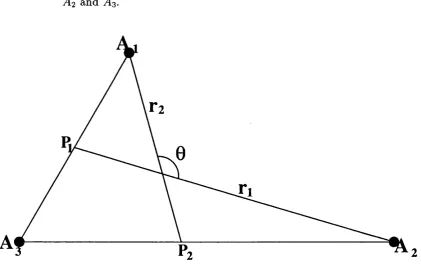
configurations of th e ato m s, A i, A2 an d A3, w ith tw o len gth s, a n d T2, a n d an
angle, 0. T hese are shown in figure 2.1, w here th e p oints P i an d P2 are defined
using tw o factors ffi an d ^2,
By choosing different values of ffi an d §2 different sets of co o rd in ates can be
selected. Jacob i o r sc a tte rin g coord inates are defined w hen g\ = ^ — , ^ 2 = 0-
For b o n d len g th bond angle coo rdin ates gi = q2 = 0, an d for R ad au c o o rd in a tes
F ig u re 2.1: G en eral co o rd in ate sy stem for v ib ratio n s d escribed by tw o len g th s,
Ti a n d T2, an d a angle, 6, T h e p o sitio n of P i a n d Pg is defined by th e choice of co o rd in a te system s an d th e m asses of th e ato m s, A i,
Â2 an d A3.
A'
O f th ese Jaco b i an d R ad au co o rd in ates are th e m o st useful as th e y are o rth o g o n al
so th e re is no r%-r2 coupling in th e k in etic energy o p erato r.
2.2
F B R H a m ilto n ia n
U sing a finite basis rep resen tatio n (F B R ), for th e o rth o g o n al co o rd in ates de
scribed above, th e Sutcliffe an d T ennyson ro tatio n less H am ilto n ian m a trix can
be w ritte n [52]
( m ,n , j | P | m ' , n ' , j ') = {m\h^^^\m')6n,n'Sj,j' +
-f + {n\g^^^\n')6m,m') j ( j +
i - { m , n J \ V { r i , r2,0) \ m ' , n J ' ) (2 .2 )
w here |m ) an d \n) are th e basis fu nctions for an d T2 m o tio n respectively, an d
th e a n g u la r basis fun ctions \j) are L egendre polynom ials rep resen tin g m o tio n in
are th e k in e tic energy in tegrals for an d T2. a n d a re th e a n g u la r
k in e tic energy in teg rals. T hese are given by
( 4 « |< '> = (2.3)
an d
(2.4)
w here |f) = |m ) for i = 1 an d |() = |n ) for i = 2 , is th e a p p ro p ria te red u ce d
m ass in th e rad ia l co ordinates. T hese are d e term in e d by th e choice of co o rd in a te
sy stem s an d th erefo re d ep en d on g\ an d g2\
= ^ 2 ^ - 1 + 7722^ + (l+5r2)^m 3^ , = g l m2^ ^ m X ^ - \ - { l - \ - g i f m '^ ^ . (2.5)
2 .3
B a s is F u n c tio n s
T h e choice of basis fu nctions is of g re a t im p o rta n c e to o b ta in good convergence
tow ards th e ‘e x a c t’ solution. T h e p ro b lem size is u ltim a te ly d e te rm in e d by th e
n u m b e r of basis fun ctio ns needed, an d so it is useful to m in im ise th is n u m b e r by
using fun ction s w hich give a good re p re se n ta tio n of th e m o tio n in th e given coor
d in a te. In th e an g u lar co o rd in ate th e T-S H am ilto n ian is d eriv ed w ith L egendre
polynom ials im p licitly used.
For th e rad ia l co ord in ates m an y facto rs influence th e ty p e of fu n ctio n s used.
For coordinates in w hich m otions do n o t go linear, e.g. r i in Jaco b i co o rd in ates,
T ennyson an d Sutcliffe [53] defined a set of o rth o n o rm a l fu n ctio n s based on
solutions to a M orse o scillator H am ilto n ian . T hese can be w ritte n
\t) = H t { n ) = ^ î A f , „ e x p ( - | ) ÿ ^ i r ( ÿ ) (2.6)
y = A exp[-/9(r,- - He)] ,
w here
A = /3 = uje (2^ ) ’ ^ “ i n t e g e r ( A ) . (2.7)
N t a L t ( y ) ^re n o rm alised asso ciated L aguerre polynom ials. O p tim isa b le p a ra m