A NOVEL AUTOMATIC WEB SERVICE
COMPOSITION FRAMEWORK FOR USER
DEPENDENT WEB MINING
Mrs. K. Krishna
1, Dr. D. Murugan
21
Department of Computer Application, Vivekananda College., Tamil Nadu, (India)
2
Department of Computer Science and Engineering, Manonmaniam Sundaranar University, (India)
ABSTRACT
Web data which started initially as a repository of information has evolved into a host providing multiple
contents and services like map-finding, weather-reporting, e-commerce etc. Real-time applications sense
temperature and monitor traffic. Businesses and government integrated data into existing Web applications to
provide new services. Web service mining, relatively new area of research is a process aimed at discovering
interesting and useful compositions in existing Web services. They are useful since primary goals are undefined.
Web services do not assume prior knowledge and rely on component services to explore data with varied
results. Organizations which realized this potential took advantage by sharing their data on the Web. This
Paper presents a new approach of Web service mining in, a General Purpose Web Composition Framework for
Web services.
Keywords: Composition Automatic Web Compositions, General Compositions, Framework, Web
Composition, Web Mining
I. INTRODUCTION
Compositions incorporate information from various sources and domains to achieve a task in a Service-Oriented
Architecture (SOA). A Single service becomes the basic unit of operation and may be unable to cater to all
functional requirements. The services when connected can satisfy complex requirements. Different functional
requirements require different compositions . Traditionally, web service composition has been performed
manually, making it a difficult and error prone task. Though manual Web compositions are time-consuming and
error prone, automatic compositions for composing services into a coherent task may not be available readily. It
is tricky to find a single web service that produces the desired output from inputs. A composite service with
process logic can be decomposed into subtasks that respond to web services. The Figure 1 is an example of a
workflow derived from high-level specifications. The task is subdivided into sub tasks and binding them to
single web services based on the logic of the workflow [1]. This paper examines various approaches and
proposes a general-purpose framework for automatic service composition.
II. MANUAL WEB SERVICE COMPOSITION PROCESS
In a manual composition a user creates an abstract specification of a high-level task. User manipulation provides
autonomy and control over execution but the user needs to possess enough domain knowledge to decompose the
standard web service languages like WS-BPEL [2] or [3]. The user then binds web services to the workflow.
Such methods are widely used in search and discovery services in a web service repository like UDDI [4]. The
services will have to be monitored to check if the service is bound to the task while handling faults as they arise.
Thus user domain knowledge plays a primary role in such compositions. It is a time-consuming and error-prone
process with no guarantees making it imperative to automate compositions.
III. AUTOMATIC WEB SERVICE COMPOSITION
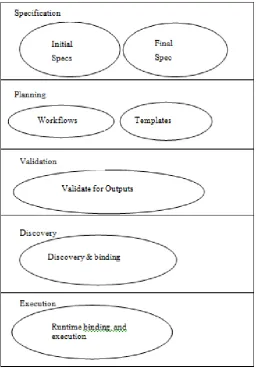
Automatic web composition is a five phase process involving specification, planning, validation, discovery and
execution. Specification is specifying user goals, requirements or constraints. Languages used for specifying
abstract specification can range from OWL-S, WS-BPEL [5]. Planning is automatically composing an abstract
workflow while Validation is using techniques to ensure proper outputs. AI planning techniques can generate
automatic processes with planning tools like WS-BPEL, OWL-S, or use proprietary languages which provide
logic validation like PDDL, CSSL. Validation of an abstract composite workflow is validating syntactically and
checking the workflow for proper structures based on the requirements. Many validation algorithms for
semantic validation are based on utility theory and path heuristics [6] or check models [7]. Discovery is
discovering services which satisfy task specifications. Discovered services are bound to the corresponding
subtasks in the workflow. Discovery tools are an open-industry initiative in XML and UDDI (web service
repository). The request is then executed using the created composite services. If a service fails during the
execution, the recovery can be done using a substituted web service. The substituted service should support
binding allowing discovery, selection and invocation of services at runtime in Web services technologies [9].
Web services are programmatically accessible and interoperate independently thus offering flexibility and
scalability needed by compositions. Such automated compositions can enrich the semantically enabled
service-oriented architectures. Fig. 2 depicts the phases in automatic web compositions while Table 1 lists the
Comparisons between Web Service Compositions.
Table 1 - Comparison between Web Service Compositions
BENCHMARKS
Approaches Connecti vity
Exception
Handling Scalability Correctness
E - Flow Low Low Low Low
PPM Low Low Low Low
BPEL4WS Good Good Average Low
OWL - S Good Average Good Low
IV. GENERAL PURPOSE WEB COMPOSITION FRAMEWORK (GPWCF)
GPWCF is a different angle for web compositions. It is a framework which has five stages and can be
implemented by organizations. The user selects a service and sets constraints. The required service is searched
in the services repository and selected. In case a corresponding service is found or not listed, an error message is
sent to the user and the error is trapped in the error log. A scope definition is constructed on the selected service
and user defined constraints. The scope definition also determines the search space and the return of information
sets to the user. All errors like Errors on execution of a service, errors in fetching of results, network failures are
logged in the error log, enabling improvement of the compositions in future versions. The error logging is a
simple and useful utility not found in many compositions. The GPWCF can be used by organizations as a
starting point for web services compositions and developed for future requirements. Fig. 3 depicts the GPWCF
framework.
4.1 GPWCF Scope Definition
The mining process begins with an evaluation of the user request. User constraints are considered for the
specified request and defined as a list of functional activity in the scope specifications of the service. For
Example a user request for a cheap travel with an upper limit of 1000, is a constraint to be considered. The
scope definition would build a constraint and filter all modes of travel, up to 1000 rupees. Similarly each
constraint or request may pertain to a different domain with separate functional parameters. The mining
perspective MP can be formally defined as.
MP = {f(C) | wd ∈ WD} (1)
where mining perspective is MP , WD is a set of Web service domains, C is a set of constraints and f(C) is the
constraints evaluated in the domain WD. Assume the symbol → denotes refers to and the set of all Results
R(MP) = {R | ∃f ∈ C ∧ f → Rs} (2)
4.2 GPWCF Search Space Determination
The search space for any mining operation can be defined from its scope. The resultant output of a search
space determination phase is a function library fromWeb service functions of a web service registry WR that
are involved in mining perspective MP, library Lb and set of operations o, defined as .
Lb = {o | o ∈ WR} (3)
4.3 GPWCF Service Selection
The most suitable web service is selected from the composite web service and executed. Selection of relevant
web services is performed by matching inputs of the user request to the web services which are operation unique
[10] and so the required services are selected from the composite. The service selection can be defined as
SP = {f(p) ∈ P} =Op (4)
where SP is the Services Perspective , P is a set of perspectives of Web services in the directory, f(p) is the
chosen service from a the select list of all services in the Directory and Op is the operations matching the scope
perspective
.Input: Service Selection SP = {f(p) ∈ P}
Output: Selected Service f(p)
for all P ∈ SP do
if service = f(p) do
add service to Op;
end if
end for
if Op = 0 then
add to error_log
return failure
end if
return Op;
4.4 GPWCF Function Selection with Filtering Based On Mining Perspective
Algorithms can select the functions required for mining and be a medium for the Web service. The filtering
algorithms can be applied to the mining Perspective.
Input: Mining context MP = {f(P) | d ∈ D}, Web service registry WR.
Output: Function library RLi.
Variable: Operation Perspective OP(MP)
for all f(P) ∈ MP do
for all OP∈ f(P) do
add OP to OP(MP);
end for
end for
for all r ∈ WR do
add r to RLi;
end if
end for
if operations count = 0 then
add to error_log
return failure
end if
return RLi;
V. SERVICES INTER-RELATIONS
Two services of a web service composition have a relationship if they can be plugged together to perform a
value added service or if one of the service can be substituted by the other. Relationships between services can
be of the following types.
Service A Service B // Calling the next service Service A // Service B // parallel execution Service A Service B // Service substitution Service A Э Service B // Inclusion
In a relationship between Services the first service has to finish before the other starts. In parallel processing
both execute in parallel but combine the results. In substitutions the services, substitute the functionalities with
each other, functionally. In Inclusion, one service includes the services functionalities. Web compositions use
JAXRPC and Java RMI services.
VI. RESULTS
Several parameters need to be considered while evaluating a Web Composition like Exception Handling,
Accuracy and constraint attributes of the composition. . Connectivity and Reliability in are the basic
requirements of a Composition and in its absence even the best composition cannot function. Exception
handling must deal with exceptional cases of failure for the system to adapt in future versions. Accuracy
pertains to the behavior of a composition and in matching the results. Constraints are user requirements passed
as parameters to produce the end results in a composition service. Automated compositions are perceived to be
intelligent processes with specifications on services and requirements, though design involves human
intervention. Performance evaluation of Web services can help implementers understand the behavior of the
services in a composed process[11]. The performance of a single Web service can potentially affect the overall
performance in a composition. It is customary to evaluate the performance of the services within a process
before making it line for usage. A common approach to obtain performance results of a given Web service is by
performance testing from a user‗s perspective the total execution time of a process is a measure of its efficiency.
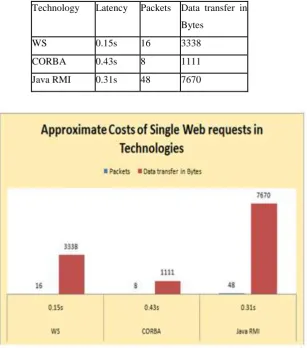
When a Web Service application client connects to a service, submits a request and terminates it is unlikely to
load server‗s CPU, or the network. Such services perform well compared to distributed object systems. Table 2 shows relative performances for three implementations an application with a request for a single data structure
retrieved according to an argument key and Fig. 3 shows the Throughput of different technologies graded
against time factor and depicts the performances of different technologies in web service composition in terms
Table 2 Approximate Costs of Single Web requests in Technologies
Technology Latency Packets Data transfer in
Bytes
WS 0.15s 16 3338
CORBA 0.43s 8 1111
Java RMI 0.31s 48 7670
VII. CONCLUSION
Web services mining has advantages in many fields and more so in the field of business intelligence. Process
mining can be used for automatic execution of web services and interoperations between web services. Efficient
mining algorithms and techniques are required to analyze and infer from the data collected from process logs.
This Paper proposes a new and novel framework for automatic web compositions. This framework can be
adapted in any technologies listed above in Fig. 3 for better or faster throughput. Manual web service
composition can be error-prone and a tedious process. Automatic web service composition frees the configurer
from the burdens of manual composition. Real-world applications need to find an acceptable middle stage
between manual and automatic composition that relieves the user from the complexity but gives the user enough
involvement and confidence for a predicted end result. Though there are many approaches to web service
compositions, there are very little proper solutions for the approaches. Guidelines on composition processes are
also varied. The approaches suggested enable the proactive discovery of interesting pathways for web services.
The suggested Web service mining framework allows the mining of interesting composite services to be carried
REFERENCES
[1] Anya Kim, Myong Kang and Catherine , ―A Framework for Automatic Web Service Composition‖, Naval
Research Laboratory, Washington, DC 20375-5320, NRL/MR/5540--09-9191, April 30, 2009.
[2] Martin, D., et al., OWL-S: Semantic Markup for Web Services. 2004
http://www.w3.org/Submission/OWL-S/.
[3] OWL-S [UDDI Spec Technical Committee, UDDI Version 3.0.2. 2004: http://www.uddi.org
[4] Agarwal, S., A Goal Specification Language for Automated Discovery and Composition of Web Services,
in Proceedings of the IEEE/WIC/ACM, International Conference on Web Intelligence (WI 07). 2007,
IEEE Computer Society: Silicon Valley, USA. p. 528—53.
[5] Agarwal, S., A Goal Specification Language for Automated Discovery and Composition of Web Services,
in Proceedings of the IEEE/WIC/ACM International Conference on Web Intelligence (WI 07). 2007, IEEE
Computer Society: Silicon Valley, USA. p. 528—53.
[6] Yue, P., et al. Semantics-enabled Metadata Generation, Tracking and Validation in Geospatial Web
Service Composition for Mining Distributed Images in Proceedings of the 2007 IEEE International
Geoscience and Remote Sensing Symposium (IGARSS07). 2007. Barcelona, Spain.
[7] Bianculli, D., C. Ghezzi, and P. Spoletini. A Model Checking Approach to Verify BPEL4WS Workflows
in International Conference on Service-Oriented Computing and Applications (SOCA 07). 2007.
Newport Beach, California, USA
[8] Pathak, J., S. Basu, and V. Honavar, On Context-Specific Substitutability of Web Services in 5th IEEE
Intl. Conference on Web Services (ICWS 2007). 2007: Salt Lake City, UT, USA
[9] Alonso, G., Casati, F., Kuno, H., Machiraju, V.: Web services: concepts, architectures and applications.
Springer-Verlag (2004).
[10] Pramodh N, Srinath V, Sri Krishna A, Optimization and Ranking in Web Service Composition using
Performance Index, International Journal of Engineering and Technology (IJET), ISSN : 0975-4024 Vol 4
No 4 Aug-Sep 2012
[11] Senthilanand Chandrasekaran, Gregory S. Silver, John A. Miller, Jorge Cardoso, and Amit P. Sheth. "Web
Service Technologies and Their Synergy with Simulation" Proceedings of the 2002 Winter Simulation