R E S E A R C H
Open Access
FlexiTerm: a flexible term recognition method
Irena Spasi
ć
1*, Mark Greenwood
1, Alun Preece
1, Nick Francis
2and Glyn Elwyn
2,3Abstract
Background:The increasing amount of textual information in biomedicine requires effective term recognition methods to identify textual representations of domain-specific concepts as the first step toward automating its semantic interpretation. The dictionary look-up approaches may not always be suitable for dynamic domains such as biomedicine or the newly emerging types of media such as patient blogs, the main obstacles being the use of non-standardised terminology and high degree of term variation.
Results:In this paper, we describe FlexiTerm, a method for automatic term recognition from a domain-specific corpus, and evaluate its performance against five manually annotated corpora. FlexiTerm performs term recognition in two steps: linguistic filtering is used to select term candidates followed by calculation of termhood, a frequency-based measure used as evidence to qualify a candidate as a term. In order to improve the quality of termhood calculation, which may be affected by the term variation phenomena, FlexiTerm uses a range of methods to neutralise the main sources of variation in biomedical terms. It manages syntactic variation by processing candidates using a bag-of-words approach. Orthographic and morphological variations are dealt with using stemming in combination with lexical and phonetic similarity measures. The method was evaluated on five biomedical corpora. The highest values for precision (94.56%), recall (71.31%) and F-measure (81.31%) were achieved on a corpus of clinical notes.
Conclusions:FlexiTerm is an open-source software tool for automatic term recognition. It incorporates a simple term variant normalisation method. The method proved to be more robust than the baseline against less formally structured texts, such as those found in patient blogs or medical notes. The software can be downloaded freely at http://www.cs.cf.ac.uk/flexiterm.
Background
Terms are means of conveying scientific and technical information [1]. More precisely, terms are linguistic repre-sentations of domain-specific concepts [2]. For practical purposes, they are often defined as phrases (typically nominal [3,4]) that frequently occur in texts restricted to a specific domain and have special meaning in a given domain. Terms are distinguished from other salient phrases by the measures of their unithood and termhood [4]. Unithood is defined as the degree of collocational stability (each term has a stable inner structure), while termhood refers to the degree of correspondence to domain-specific concepts (each term corresponds to at least one domain-specific concept). Termhood implies that terms carry heavier information load compared to other phrases used in a sublanguage, and as such they
can be used to: provide support for natural language understanding, correctly index domain-specific documents, identify text phrases to be useful for automatic summarisa-tion of domain-specific documents, efficiently skim through documents obtained through information retrieval, identify slot fillers for the information extraction tasks, etc. It is, thus, essential to build and maintain terminologies in order to enhance the performance of many natural language processing (NLP) applications.
Automatic term recognition
Bearing in mind the potentially unlimited number of different domains and the dynamic nature of some domains (many of which expand rapidly together with the cor-responding terminologies [5,6]), the need for efficient term recognition becomes apparent. Manual term recogni-tion approaches are time-consuming, labour-intensive and prone to error due to subjective judgement. Therefore, automatic term recognition (ATR) methods are needed to efficiently annotate electronic documents with a set * Correspondence:[email protected]
1
School of Computer Science & Informatics, Cardiff University, Queen's Buildings, 5 The Parade, Cardiff, UK
Full list of author information is available at the end of the article
of terms they mention [7]. Note that here ATR refers to automatic extraction of terms from a domain-specific corpus [2] rather than matching a corpus against a diction-ary of terms (e.g. [8]). Dictiondiction-ary-based approaches are too static for dynamic domains such as biology or the newly emerging types of media such as blogs, where lay users may discuss topics from a specialised domain (e.g. medicine), but may not necessarily use a standardised terminology. Therefore, many biomedical terms cannot be identified in text using a dictionary look-up approach [9]. It is also important to differentiate between two related problems: ATR and keyphrase extraction. Both approaches aim to extract terms from text. The ultimate goal of ATR is to extract all terms from a corpus of documents, whereas keyphrase extraction targets only those terms that can summarise and characterise a single document. The two tasks will have similar approaches to candidate selection (e.g. noun phrases), after which the respective methods will diverge. Keyphrase extraction typically relies on super-vised machine learning [10,11], while ATR is more likely to use unsupervised methods in order to explore the terminology space.
Manual term recognition is performed by relying on the conceptual knowledge, where human experts use tacit knowledge to identify terms by relating them to the corre-sponding concepts. On the other hand, ATR approaches resort to other types of knowledge that can provide clues about the terminological status of a given natural language utterance [12], e.g. morphological, syntactic, semantic and/or statistical knowledge about terms and/or their constituents (nested terms, words, morphemes). In general, there are two basic approaches to ATR [3]: linguistic (or symbolic) and statistical.
Linguistic approaches to ATR rely on the recognition of term formation patterns, but patterns alone are not sufficient for discriminating between terms and non-terms, i.e. there is no lexico-syntactic pattern according to which it could be inferred whether a phrase matching it is a term or not [2]. However, they provide useful clues that can be used to identify term candidates if not terms themselves. Linguistic ATR approaches usually involve pattern– matching algorithms to recognise candidate terms by checking if their internal syntactic structure conforms to a predefined set of morpho-syntactic rules [13], e.g.cyclic/JJ adenosine/NN monophosphate/NN matches the pattern (JJ | NN)+ NN(JJandNNare part-of-speech tags used to denote adjectives and nouns respectively). Others simply focus on noun phrases of certain length: 2 (word bigrams), 3 (word trigrams) and 4 (word quadgrams) [14]. However, both approaches depend strongly on the ability to reliably identify noun phrases, a task that has proven to be problematic in the biological domain mainly due to the lack of highly accurate part-of-speech (POS) taggers for biomedical text [15].
Statistical ATR methods rely on the following hypotheses regarding the usage of terms [4]: specificity (terms are likely to be confined to a single or few domains), absolute frequency (terms tend to appear frequently in their do-main), and relative frequency (terms tend to appear more frequently in their domain than in general). In most of the methods, two types of frequencies are used: frequency of occurrence in isolation and frequency of co-occurrence. One of the measures that combines this information is mutual information, which can be used to measure the unithood of a candidate term, i.e. how strongly its constit-uents are associated with one another [16]. Similarly, the Tanimoto's coefficient can be used to locate the words that appear more frequently in co-occurrence than isolated [17]. Statistical approaches are prone to extracting not only terms, but also other types of collocations: functional, semantic, thematic and other [18]. This problem is typic-ally remedied by employing linguistic filters in the form of morpho-syntactic patterns in order to extract candidate terms from a corpus, which are then ranked using statis-tical information. A popular example of such an approach is C-value [19], a method which combines linguistic knowledge and statistical analysis. First, POS tagging is performed, since the syntactic information is needed in order to apply syntactic pattern matching against a corpus. The role of these patterns is to extract only those words sequences that conform to syntactic rules that describe a typical inner structure of terms. In the statistical part of the C-value method, each term candidate is quantified by its termhood following the idea of a cost-criteria based measure originally introduced for automatic collocation extraction [20]. C-value is calculated as a combination of the term’s numerical characteristics: length as the number of tokens, absolute frequency and two types of frequencies relative to the set of candidate terms containing the nested candidate term (frequency of occurrence nested inside other candidate terms and the number of different term candidates containing the nested candidate term). Formally, ifTis a set of all candidate terms,t∈T, |t| is the number of words int,f: T→Nis the frequency function,P(T) is the power set ofT,S: T→P(T) is a function that maps a candidate term to the set of all other candidate terms containing it as a substring, then the termhood, denoted as
C-value(t), is calculated as follows:
C−value tð Þ ¼ Inj jt⋅f tð Þ
Inj jt⋅ðf tð Þ− 1
S tð Þ j j
X
s∈S tð Þ
f sð ÞÞ
;ifSð Þ¼t ∅
;ifSð Þ≠t ∅
8 > > < > >
: ð
1Þ
probability with which specific slots in a term candidate can be filled by other tokens, i.e. the tendency not to let other tokens occur in particular slots [14].
Term variation
Both methods will perform well to identify terms that are used consistently in the corpus, i.e. where their occurrences do not vary in structure and content. However, terms typically vary in several ways:
– morphological variation, where the transformation of the content words involves inflection
(e.g.lateral meniscusvs.lateral menisci) or derivation (e.g.meniscal tearvs.meniscus tear), – syntactic variation, where the content words are
preserved in their original form (e.g.stone in kidney
vs.kidney stone),
– semantic variation, where the transformation of the content words involves a semantic relation
(e.g.dietary supplementvs.nutritional supplement).
It is estimated that approximately one third of an English scientific corpus accounts for term variants, the majority of which (approximately 59%) are semantic variants, while morphological and syntactic variants account for around 17% and 24% respectively [1]. The large number of term variants emphasises the necessity for ATR to address the problem of term variation. In particular, statistically based ATR methods should include term normalisation (the process of associating term variants with one another) in order to aggregate occurrence frequencies at the semantic level rather than dispersing them across separate variants at the linguistic level [21].
Lexical programs distributed with the UMLS know-ledge sources [22] incorporate an effective method for neutralising term variation [23]. Orthographic, mor-phological and syntactic term variants are normalised simply by tokenising each term, lowercasing each token, converting each word to its base form (lemmatisation), ignoring punctuation, ignoring tokens shorter than three characters, removing stop words (i.e. common English words such asof, and, withetc.) and sorting the remaining tokens alphabetically. For example, the genitive (possessive) forms are neutralised by this approach:Alzheimer’s disease
is first tokenised to (Alzheimer,’, s, disease), then lowercased (alzheimer,’, s, disease), after which punctuation and short tokens are removed, and the remaining tokens finally sorted to obtain the normalised term representative (alzheimer, disease). The normalisation of the variant
Alzheimer diseaseresults in the same normalised form, so the two variants are matched through their normalised forms. Similarly, the genitive usage of the preposition of
can be neutralised. For example,aneurysm of splenic artery
and splenic artery aneurysm share the same normalised
form. Note that such an approach may lead to overgeneral-isation, e.g. Venetian blindand blind Venetianvary only in order, but have unrelated meanings. However, few such examples have been reported in practice [23]. Derivational and inflectional variation of individual tokens is addressed by rules which define mapping between suffixes across dif-ferent lexical categories. For example, the rule–a|NN|–al| JJ maps between nouns ending with –a and adjectives ending with–althat match on the remaining parts (e.g.
bacteria and bacterial), while the rule –us|NN|–i|NN
matches inflected noun forms that end with–usand–i
(e.g.fungusandfungi).
Methods
Method overview
FlexiTerm is an open-source, stand-alone application developed to address the task of automatically identifying terms in textual documents. Similarly to C-value [24], our approach performs term recognition in two stages. First, lexico–syntactic information is used to select term candidates, after which term candidates are scored using a formula that estimates their collocation stability, but taking into account possible syntactic, morphological, derivational and orthographic variation. What differentiates FlexiTerm from C-value is the flexibility with which term candidates are compared to one another. Namely, C-value relies on exact token matching to measure the overlap be-tween term candidates in order to identify the longest collocationally stable phrases, also taking into account the exact order in which these tokens occur. The order condition has been relaxed in later versions of C-value in order to address the term variation problem using transformation rules to explicitly map between different types of syntactic variants (e.g.stone in kidneyis mapped to kidney stone using the rule NN1 PREP NN2→NN2
NN1) [25]. FlexiTerm uses flexible comparison of term candidates by treating them as bags of words, thus com-pletely ignoring the order of tokens, following a more pragmatic approach to neutralising term variation, which has been successfully used in practice [23] (see the Background section for details). Still, the C-value approach relies on exact token matching, which may be too rigid for types of documents that are prone to typographical errors and spelling mistakes, e.g. medical notes [26] and patient blogs [27]. Therefore, FlexiTerm adds additional flexibility to term candidate comparison by allowing approximate token matching based on lexical and phonetic similarity, which often indicates not only semantically equivalent words (e.g.hemoglobinvs. haemoglobin), but also seman-tically related ones (e.g.hypoglycemiavs.hyperglycemia).
they contain and the order in which they appear. ED is defined as the minimal number (or cost) of changes needed to transform one string into the other. These changes may include the following edit operations: insertion of a single character, deletion of a single character, replacement (substitution) of two corresponding characters in the two strings being compared, and transposition (reversal or swap) of two adjacent characters in one of the strings [28]. This approach has been successfully utilised in NLP appli-cations to deal with alternate spellings, misspellings, the use of white spaces as means of formatting, the use of upper- and lower-case letters and other orthographic variations. For example, 80% of the spelling mistakes can be identified and corrected automatically by consider-ing a sconsider-ingle omission, insertion, substitution or reversal [28]. ED can be practically computed using a dynamic pro-gramming approach [29]. FlexiTerm applies ED to improve token matching, thus allowing different morphological, derivational and orthographic variants together with statis-tical information attached to them to be aggregated.
Linguistic pre-processing
Our approach to ATR takes advantage of lexico–syntactic information to identify term candidates. Therefore, the in-put documents need to undergo linguistic pre–processing in order to annotate them with relevant lexico–syntactic information. This process includes sentence splitting, tokenisation and POS tagging. Practically, text is first processed using the Stanford log-linear POS tagger [30,31], which splits text into sentences and tokens, which are then annotated with POS information, i.e. lexical categories such as noun, verb, adjective, etc. The output of linguistic pre-processing is a document in which sentences and lexical categories of individual tokens (e.g. nouns, verbs, etc.) are marked up. We used the Penn Treebank tag set [32] throughout this article (e.g.NN,JJ,NP, etc.).
Term candidate extraction and normalisation
Once input documents have been pre-processed, term candidates are extracted by matching patterns that specify the syntactic structure of targeted noun phrases (NPs). These patterns are the parameters of the method and may be modified if needed. In our experiments, we used the following three patterns:
1. (JJ | NN)+NN, e.g.chronic obstructive pulmonary disease
2. (NN|JJ)*NN POS(NN|JJ)*NN, e.g.Hoffa's fat pad
3. (NN|JJ)*NN IN(NN|JJ)*NN, e.g.acute exacerbation of chronic bronchitis
Further, lexical information is used to improve boundary detection of term candidates by trimming leading and trailing stop words, which include common English words
(e.g.any), but also frequent modifiers of biomedical terms (e.g.smallinsmall Baker's cyst).
In order to neutralise morphological and syntactic variation, all term candidates are normalised. The nor-malisation process is similar to the one described in [23] and consists of the following steps: (1) Remove punctuation (e.g. ' in possessives), numbers and stop words including prepositions (e.g. of) (2) Remove any lowercase tokens with≤2 characters. (3) Stem each remaining token. For example, this process would map term candidates such as hypoxia at rest and resting hypoxia to the same normalised form {hypoxia, rest}, thus neutralising both morphological and syntactic variation resulting in two linguistic representations of the same medical concept. The normalised candidate is used to aggregate the relevant information associated with the original candidates, e.g. their frequency of occurrence. This means that subsequent calculation of termhood is performed against normalised term candidates.
It should be noted that the step 2 removes only lowercase tokens. This approach effectively removes possessive s
inBaker's cyst, but notDinvitamin Das uppercase tokens generally convey more important information, which is therefore preserved in this approach. Also note that removing tokens longer than 2 characters would be too aggressive in deleting not only possessives and some prepositions (e.g.of), but also essential term constit-uents as it would be the case withfat pad, in which both tokens would be lost, thus completely ignoring it as a potential term.
Token-level similarity
While many types of morphological variation are effectively neutralised with stemming used as part of the normalisa-tion process (e.g. transplant and transplantation will be reduced to the same stem), exact token matching will still fail to match synonyms that differ due to orthographic variation (e.g.haemorrhageandhemorrhageare stemmed to haemorrhag and hemorrhag respectively). On the other hand, such variations can be easily identified using approximate string matching. For example, the ED between the two stems is only 1–a single insertion of the character
asymptomatic and symptomatic (one deletion operation) combined with the other two identical tokens indicates high similarity between the candidate terms, which can be used to aggregate the associated information and reduce the bias towards shorter terms.
The normalisation process continues by expanding previ-ously normalised term candidates with similar tokens found in the corpus. In the previous example, the two normalised candidates {asymptomat, hiv, infect} and {symptomat, hiv, infect} would both be expanded to the same normalised form {asymptomat, symptomat, hiv, infect}. In our imple-mentation, similar tokens are identified based on their phonetic and lexical similarity calculated with Jazzy [33] (a spell checker API). Jazzy is based on ED [28] described earlier in more detail, but it also includes two more edit operations to swap adjacent characters and to change the case of a letter. Apart from string similarity, Jazzy supports phonetic matching with the Metaphone algorithm [34], which aims to match words that sound similar without necessarily being lexically similar. This capability is important in dealing with new phenomena such as SMS language, in which the original words are often replaced by phonetically similar ones to achieve brevity (e.g.l8and
late). This phenomenon is becoming increasingly present in online media (e.g. patient blogs) and needs to be taken into account in modern NLP applications.
Termhood calculation
The termhood calculation is based on the C-value formula given in (1) [19]. A major difference in relation to the ori-ginal C-value method is the way in which term candidates are normalised. In the C-value approach the notion of nestedness, as part of determining the setS(t), is based on substrings nested in a term candidatettreated as a string. In our approach, a term candidate is treated as a bag of words, which allows nestedness to be determined using subsets instead of substrings. This effectively bypasses the problem of syntactic variation, where individual tokens do not need to appear in the same order (e.g.kidney stonevs.
stone in kidney). Other causes of term variability (mainly morphological and orthographic variation) are addressed by automatically adding similar tokens to normalised term candidates, which means that nestedness can be detected between lexically similar phrases using the subset oper-ation. For example, exact matching would fail to detect
posterolateral corner as nested inpostero-lateral corner sprainbecause of hyphenation (a special case of ortho-graphic variation). In our approach, these two term candi-dates would be represented as {postero-later, posterolater, corner} and {postero-later, posterolater, corner, sprain} re-spectively, where similar stemspostero-laterandposterolater
have been automatically detected in the corpus and used to expand normalised term candidates. In this case, nestedness is detected by simply checking the following
condition: {postero-later, posterolater, corner} ⊆ { postero-later, posteropostero-later, corner, sprain}.
The FlexiTerm method is summarised with the following pseudocode:
1. Pre-process text to annotate it with lexico-syntactic information.
2. Select term candidates using pattern matching on POS tagged text.
3. Normalise term candidates by performing the following steps.
a. Remove punctuation, numbers and stop words. b. Remove any lowercase tokens with≤2 characters. c. Stem each remaining token.
4. Extract distinct token stems from normalised term candidates.
5. Compare token stems using lexical and phonetic similarity calculated with Jazzy API.
6. Expand normalised term candidates by adding similar token stems determined in step 5. 7. For each normalised term candidatet:
a. Determine setS(t) of all normalised term candidates that containtas a subset.
b. CalculateC-value(t) according to formula (1). 8. Rank normalised term candidates using their
C-value.
Output
Figure 1Sample output of FlexiTerm.A ranked list of terms and their variants based on their termhood scores.
Results
Data
FlexiTerm is a domain independent ATR method, that is–it does not rely on any domain specific knowledge (e.g. rules or dictionaries) to recognise terms in a domain specific corpus. A comprehensive study of subdomain variation in biomedical language has highlighted significant implications for NLP applications, in particular standard training and evaluation procedures for biomedical NLP tools [37]. This study revealed that the commonly used molecular biology subdomain is not representative of the overall biomedical domain, meaning that the results obtained using a corpus from this subdomain (e.g. [38]) cannot be generalised in terms of expecting comparable performance with other types of biomedical text. In par-ticular, a comparative evaluation of ATR algorithms indi-cated that choice, design, quality and size of corpora have a significant impact on their performance [39]. Therefore, in order to demonstrate the portability of our method across sublanguages, i.e. languages confined to specialised domains [40], we used multiple data sets from different biomedical subdomains (e.g. molecular biology, medical diagnostic imaging or respiratory diseases) as well as text written by different types of authors and/or aimed at different audience (e.g. scientists, healthcare professionals or patients). We used five data sets (see Tables 1 and 2 for basic description).
Data set 1 refers to 100 documents randomly selected from GENIA, a semantically annotated corpus for NLP applications, which consists of molecular biology abstracts retrieved from the PubMed database usinghuman,blood cellandtranscription factoras search terms [38]. Similarly, data set 2 consists of 100 abstracts retrieved from PubMed, but on a different topic. Unlike data set 1, which belongs to biomolecular domain, data set 2 belongs to clinical domain, more specifically chronic obstructive pulmonary disease (COPD), and it has been collected using the following PubMed query: "pulmonary disease, chronic obstructive" [MeSH Terms]. This distinction is relevant given the considerable differences between biomolecular and clinical sublanguages [41].
Furthermore, apart from topical difference, we wanted to explore differences in the writing style. Therefore, we
collected text data from the same clinical domain (i.e. COPD), but written by non-medical experts, i.e. patients or caregivers. Data set 3 represents a collection of 100 blog posts, which have been collected from blogs identified with blog search engines (Google Blog Search and Technorati) using a set of COPD–related search terms. Query results were reviewed manually in order to identify blogs with pa-tient contributions and exclude blogs written by medical practitioners or those set up for marketing purposes.
Finally, we wanted to contrast the clinical sublanguage used in clinical practice against that used in scientific literature (see data set 2). Lexical analysis of a large corpus of various types of medical records (discharge summaries, radiology reports, progress notes, emergency room reports and letters) revealed that clinical narratives are charac-terised by a high degree of misspellings, abbreviations and idioms and as such pose considerable challenges for NLP applications [26]. A particular challenge for ATR, especially when dictionary-based, is the fact that over 20% of the words in the given corpus were unrecognisable i.e. were not recognizable medical words, common words or names, and could not be algorithmically or contextually converted to such words. Almost 78% of unrecognisable words were judged to be probably correctly spelled medical words. To test the flexibility of our method in coping with irregular-ities of clinical sublanguages, we used two additional data sets, which were anonymized prior to their distribution. Data set 4 represents a collection of narratives extracted from hospital discharge summaries of patients with history of obesity or diabetes, which were distributed for the i2b2 Challenge in NLP for Clinical Data [42]. Hospital discharge summaries were split into sections by matching the most
Table 1 Data sets used in evaluation
Data set Topic Document type Source Search terms
1 molecular biology abstract PubMed human,blood cell,transcription factor 2 COPD abstract PubMed "pulmonary disease, chronic obstructive" [MeSH Terms] 3 COPD blog post Web COPD, chronic obstructive{pulmonary | lung | airways | respiratory}
disease, bronchitis, emphysema
4 obesity, diabetes clinical narrative i2b2 N/A
5 knee MRI scan clinical narrative NHS N/A
Qualitative description of the corpora.
Table 2 Data sets used in evaluation
Data set
Size (KB) Documents Sentences Tokens Distinct tokens
Distinct stems
1 145 100 906 24,096 3,430 2,720
2 150 100 949 26,174 3,837 3,049
3 169 100 1,949 40,461 4,404 3,422
4 300 100 3,022 55,845 5,402 4,504
5 73 100 960 13,093 946 824
frequent keywords used in section titles [43], after which the narrative sections referring to history of present illness and hospital course were extracted automatically. Finally, data set 5 represents a collection of magnetic resonance imaging (MRI) reports acquired from a National Health Service (NHS) hospital. They describe knee images taken following an acute injury.
Gold standard
Terms, defined here as noun phrases referring to concepts relevant in a considered domain, were annotated by two independent annotators (labelled A and B in Tables 3, 4, 5, 6, 7, 8). The annotation exercise was performed using MinorThird, a collection of Java classes for annotating text [35]. Each annotated term was automatically tokenised in order to enable token-level evaluation later on (see the following subsection for details). Therefore, the annotation task resulted in each token being annotated as being part of a term, either single or multi word.
Cohen's Kappa coefficient [44] was used to measure the inter-annotator agreement. After producing contingency tables following the structure described in Table 3, the
Kappa coefficient was calculated according to the following formula:
κ¼Ao−Ae 1−Ae
where Ao=p11+p22 is observed agreement and Ae=
p1.⋅p.1+p2.⋅p.2 is expected agreement by chance. The
Kappa coefficient of 1 indicates perfect agreement, whereas 0 indicates chance agreement. Therefore, higher values indicate better agreement. Different scales have been proposed to interpret the Kappa coefficient [45,46]. In most interpretations, the values over 0.8 are generally agreed to indicate almost perfect agreement.
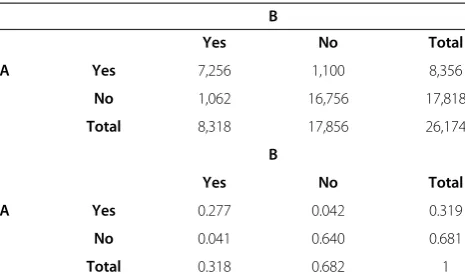
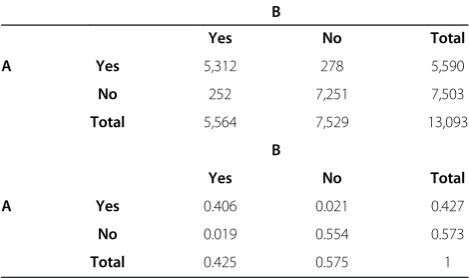
Based on the contingency tables produced for each data set (see Tables 4, 5, 6, 7, 8), we calculated the Kappa coeffi-cient values given in Table 9, which ranged from 0.809 to 0.918, thus indicating very high agreement. Gold standard for each data set was then created as the intersection of positive annotations. In other words, gold standard repre-sents a set of all tokens that were annotated as being part of a domain-specific term by both annotators.
Table 3 Contingency tables for inter–annotator agreement
B
Yes No Total
A Yes n11 n12 n1.
No n21 n22 n2.
Total n.1 n.2 N
B
Yes No Total
A Yes p11 p12 p1.
No p21 p22 p2.
Total p.1 p.2 p
General structure of a contingency table, wherenandpannotate the total
numbers and proportions respectively.
Table 4 Contingency tables for inter–annotator agreement on data set 1
B
Yes No Total
A Yes 11,948 346 12,294
No 1,664 10,138 11,802
Total 13,612 10,484 24,096
B
Yes No Total
A Yes 0.496 0.014 0.510
No 0.069 0.421 0.490
Total 0.565 0.435 1
Agreement at the token level.
Table 5 Contingency tables for inter–annotator agreement on data set 2
B
Yes No Total
A Yes 7,256 1,100 8,356
No 1,062 16,756 17,818
Total 8,318 17,856 26,174
B
Yes No Total
A Yes 0.277 0.042 0.319
No 0.041 0.640 0.681
Total 0.318 0.682 1
Agreement at the token level.
Table 6 Contingency tables for inter–annotator agreement on data set 3
B
Yes No Total
A Yes 2,325 204 2,529
No 436 37,496 37,932
Total 2,761 37,700 40,461
B
Yes No Total
A Yes 0.057 0.005 0.062
No 0.011 0.927 0.938
Total 0.068 0.932 1
The extent of terminological content across the five data sets illustrates great variation in biomedical language and justifies the need for multiple data sets in order to general-ise the results [37]. To illustrate this point we converted the information from Tables 4, 5, 6, 7, 8 to a histogram shown in Figure 3. Terms account for a massive 50% in PubMed abstracts in molecular biology (data set 1), whereas the same type of documents in medicine (data set 2) includes 28% of terminological content. Not surprisingly, terms account for only 6% in medical information reported by laymen (data set 3). Finally, the terminological content of medical notes also varies significantly with 26% in hospital discharge summaries (data set 4) compared to 41% in radiology reports (data set 5). These variations should be kept in mind later on when the evaluation results for the topkautomatically recognised terms are reported (k= 10, 20,…, 500).
Evaluation measures
ATR can be viewed as an information extraction (IE) task, where term occurrences constitute information to be extracted from text, and thus can be evaluated
using the contingency table model [47]. Information extracted by the system is classified either as a true positive if it is indeed a term or as a false positive if it is not. Conversely, each term occurrence is classified as a false negative if it is not extracted by the system. Given the total numbers of true positives (TP), false positives (FP) and false negatives (FN), precision (P) and recall (R) are calculated as the following ratios:
P¼ TP
TPþFPR¼ TP
TPþFN
In other words, precision represents the proportion of correctly extracted term occurrences, while recall represents the proportion of term occurrences that are extracted by the system. Given the precision and recall values, F-measure is calculated as their harmonic mean:
F¼2⋅P⋅R PþR
An important question that remains to be answered is what counts as a correctly recognised term. It is natural to assume that it would match an annotated term occurrence exactly. Such an approach is suitable for common IE task such as named entity recognition (e.g. protein name Table 7 Contingency tables for inter–annotator agreement
on data set 4
B
Yes No Total
A Yes 14,396 1,454 15,850
No 2,269 37,726 39,995
Total 16,665 39,180 55,845
B
Yes No Total
A Yes 0.258 0.026 0.284
No 0.040 0.676 0.716
Total 0.298 0.702 1
Agreement at the token level.
Table 8 Contingency tables for inter–annotator agreement on data set 5
B
Yes No Total
A Yes 5,312 278 5,590
No 252 7,251 7,503
Total 5,564 7,529 13,093
B
Yes No Total
A Yes 0.406 0.021 0.427
No 0.019 0.554 0.573
Total 0.425 0.575 1
Agreement at the token level.
Table 9 Inter–annotator agreement
Data set Observed agreement (Ao)
Expected agreement (Ae)
Kappa coefficient (κ)
1 0.917 0.501 0.834
2 0.917 0.566 0.809
3 0.984 0.878 0.869
4 0.934 0.587 0.840
5 0.960 0.511 0.918
The values of three agreement measures.
recognition), where it is easier to define the exact boundaries of the names occurring in text. However, it is less suitable for ATR, since terms are often formed by combining other terms. Consider for example a term such asprotein kinase C activation pathway, whereprotein,
protein kinase,protein kinase C,activation, pathway, pro-tein activation pathway and protein kinase C activation pathwayare all terms defined in the UMLS [22]. This fact makes the annotation task more complex and conse-quently more subjective. Even if we simplified the task by
focusing only on the most specific concepts, i.e. the ones described by the longest term encompassing all other nested terms, it would be difficult to justify the recogni-tion of subsumed terms as term recognirecogni-tion errors.
For these reasons, it may be more appropriate to apply token-level evaluation, which effectively evaluates the degree of overlap between automatically extracted terms and those manually annotated in the gold standard. Similar approach has been used for IE evaluation in i2b2 NLP challenges [48], as it may provide more detailed insight
into the IE performance. We adapted this approach for ATR evaluation to calculate token-level precision and recall. The same contingency table model is applied to individual tokens that are part of term occurrences ei-ther automatically extracted by the system or manually annotated in the gold standard. Each token extracted as part of a presumed term is classified as a true positive if it is annotated in the gold standard; otherwise it is classified as a false positive. Similarly, each token annotated in the gold standard is classified as a false negative if it is not extracted by the system as part of an automatically recognised term. Precision, recall and F-measure are then calculated as before.
Evaluation results and discussion
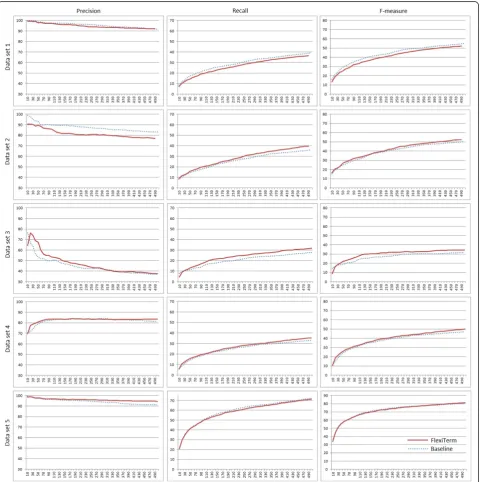
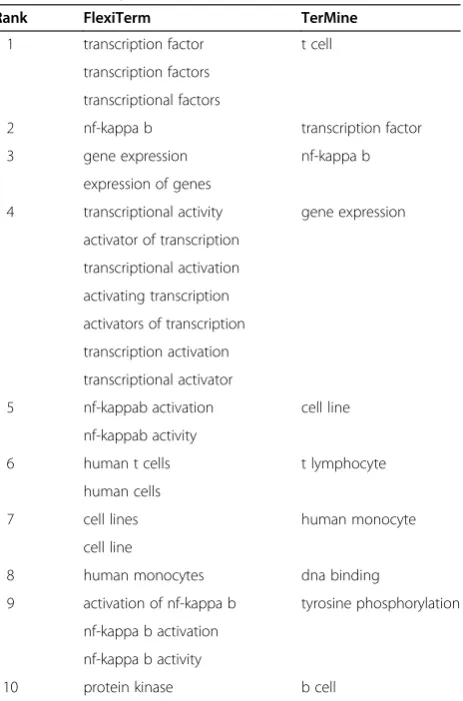
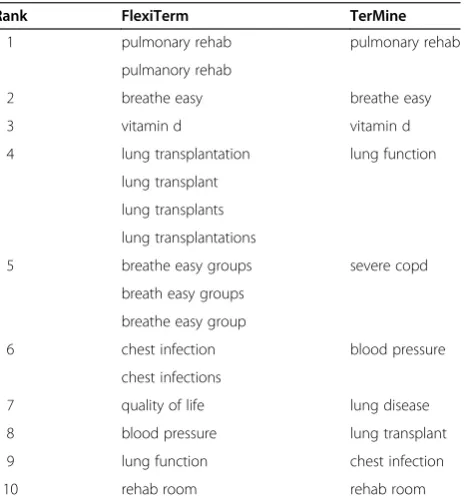
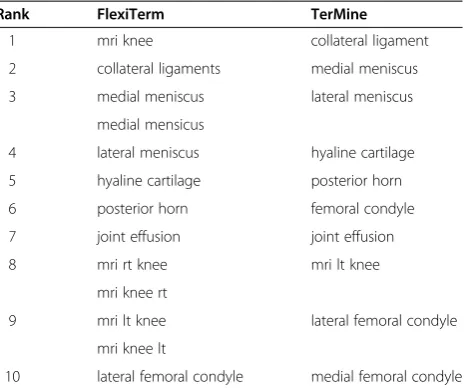
The evaluation was performed using the gold standard and the evaluation measures described previously. The evaluation results provided for our method were compared to those achieved by a baseline method. We used TerMine [49], a freely available service from the academic domain based on C-value [24], as the baseline method. The values of all evaluation measures achieved on topk(k= 10, 20,…, 500) proposed terms are plotted for both methods in Figure 4. Tables 10, 11, 12, 13, 14 illustrate the ATR results by providing top 10 terms as ranked by the two methods. Here we provide a more detailed analysis of the results achieved.
Our method underperformed on all three evaluation measures only on data set 1, a subset of the GENIA corpus [38]. The precision of our method was worse on the literature data in both domains, i.e. biology (data set 1) and medicine (data set 2). We hypothesise that the better performance of the baseline in terms of precision may stem from the highly regular nature of scientific language in terms of grammatical correctness, e.g. fewer syntactic and typographic errors compared to patient blogs (data set 3) and medical notes (data sets 4 and 5), where the flexibility of our approach in neutralising such errors and other sources of term variation may not be necessarily beneficial. The precision achieved on the remaining data sets does not contradict this hypothesis.
An alternative explanation for better precision of the baseline method is potentially better term candidate extraction prior to termhood calculation since TerMine uses GENIA tagger, which is specifically tuned for bio-medical text such as PubMed abstracts [50]. On the other hand, we used Stanford log-linear POS tagger [30,31] using a left-three-words tagging model of general English. This may pose limitation on the performance in the bio-medical domain, but also makes the FlexiTerm method more readily portable between domains.
The third reason contributing to poorer precision is the way in which prepositions were annotated in the gold standard and the fact that the baseline method does
not include prepositional phrases as part of term candi-dates. Our method does recognise prepositional phrases as term components, which in effect will tend to favour longer phrases such asexacerbation of chronic obstructive pulmonary diseaserecognised by our method, but not the baseline (see Table 11). Due to the problems with complex-ity and subjectivcomplex-ity associated with the annotation of com-pound terms (i.e. the ones which contain nested terms) as explained in the previous subsection, prepositions are likely not to be consistently annotated. In the given example this means that if one annotator failed to annotated the whole phrase and instead annotated exacerbation and chronic obstructive pulmonary diseaseas separate terms, the prep-osition ofwould be counted as a false positive in token-level evaluation. Therefore, prepositions that are syntactic constituents of terms partly account for the drop in precision. However, prepositions do need to be considered during term recognition and this in fact may boost the performance in terms of both precision and recall. We illustrate this point by the following examples. Data sets 2 and 3 are in the same domain (COPD), but written from different perspectives and by different types of authors. As
Table 10 A comparison to the baseline on data set 1
Rank FlexiTerm TerMine
1 transcription factor t cell transcription factors
transcriptional factors
2 nf-kappa b transcription factor
3 gene expression nf-kappa b
expression of genes
4 transcriptional activity gene expression activator of transcription
transcriptional activation activating transcription activators of transcription transcription activation transcriptional activator
5 nf-kappab activation cell line nf-kappab activity
6 human t cells t lymphocyte
human cells
7 cell lines human monocyte
cell line
8 human monocytes dna binding
9 activation of nf-kappa b tyrosine phosphorylation nf-kappa b activation
nf-kappa b activity
10 protein kinase b cell
they share the same domain, they naturally share some of the terminology used. Tables 11 and 12 show that the phrase quality of lifeis ranked highly by our method in both data sets. We checked the terminological status of the hypothesised term by looking it up in the UMLS
where it is indeed defined as "A generic concept reflecting concern with the modification and enhancement of life attributes, e.g., physical, political, moral and social envir-onment; the overall condition of a human life." Nonethe-less, the inspection of the complete results proved that the baseline method does not recognise it at all. The results on data set 4 (see Table 13) provide a similar example,
shortness of breath, listed as a synonym ofdyspneain the UMLS, which was ranked third by our method, but again Table 11 A comparison to the baseline on data set 2
Rank FlexiTerm TerMine
1 chronic obstructive pulmonary disease chronic obstructive pulmonary disease
2 patients with copd obstructive pulmonary disease
copd patients
3 pulmonary disease pulmonary disease
4 acute exacerbation copd patient
acute exacerbations
5 copd exacerbation acute exacerbation
copd exacerbations exacerbations of copd exacerbation of copd
6 patients with chronic obstructive pulmonary disease severe copd patients with chronic obstructive pulmonary diseases
7 lung function copd exacerbation
8 exacerbations of chronic obstructive pulmonary disease lung function chronic obstructive pulmonary disease exacerbations
exacerbation of chronic obstructive pulmonary disease
9 quality of life airway inflammation
10 airway inflammation exercise capacity
Top 10 ranked terms by the two methods.
Table 12 A comparison to the baseline on data set 3
Rank FlexiTerm TerMine
1 pulmonary rehab pulmonary rehab
pulmanory rehab
2 breathe easy breathe easy
3 vitamin d vitamin d
4 lung transplantation lung function lung transplant
lung transplants lung transplantations
5 breathe easy groups severe copd
breath easy groups breathe easy group
6 chest infection blood pressure
chest infections
7 quality of life lung disease
8 blood pressure lung transplant
9 lung function chest infection
10 rehab room rehab room
Top 10 ranked terms by the two methods.
Table 13 A comparison to the baseline on data set 4
Rank FlexiTerm TerMine
1 hospital course hospital course
course of hospitalization
2 chest pain present illness
3 shortness of breath chest pain
4 coronary artery coronary artery
coronary arteries
5 present illness blood pressure
6 blood pressure ejection fraction blood pressures
7 coronary artery disease coronary artery disease 8 congestive heart failure myocardial infarction 9 myocardial infarction congestive heart failure 10 ejection fraction cardiac catheterization
not recognised at all by the baseline. Failure to include prepositions therefore may completely overlook extremely important concepts in a domain. In less extreme cases, it may skew the term recognition results with less severe but still significant effects. For example, the difference in ranking ofcopd exacerbationin data set 2 may not seem significant. It was ranked seventh by the baseline method and slightly higher at five by our method due to the fact that the information obtained for two variants copd ex-acerbationand exacerbation of copdwas aggregated. The difference in ranking of the same term in data set 3, where it is used less often, becomes more prominent (16 in our method compared to 47 in the baseline method), thus signifying the importance of aggregation for sparse data. The importance of aggregation is nicely illustrated with the increase of precision in data set 5 (see Table 14), which exhibits high degree of derivational and orthographic vari-ation often as a result of typographical errors. For example, the third ranked term medial meniscus also includes its misspelled variant medial mensicus, which otherwise would not be recognised in isolation due to its low fre-quency. The 11th ranked term includes two orthographic variantspostero-lateral corner andposterolateral corner
in our results, while the baseline method ranks them separately at 18 and 55 respectively. Another interesting
example is the 14th ranked term, which includes three variantsinfrapatellar fat pad,infra-patella fat pad and
infra-patellar fat pad, the first one ranked 20th by the baseline method and the remaining two ranked as low as 281. The results on this data set demonstrate how flexible aggregation of term variants with the same or related meaning can significantly improve the precision of ATR (see Figure 4).
In general, with the exception of the literature data sets, the precision of our method is either comparable (an improvement rate of 0.71 percentage points on data set 3) or better (an improvement rate of 2.02 and 3.29 percentage points on data sets 4 and 5 respectively) than that of baseline. The natural drop in precision as the recall increases also seems to be less steep on all five data sets. Interestingly, the precision of both methods is rising on data set 4 and very soon stabilises to almost constant level. On another type of clinical text data (data set 5) where the recall values were nearly identical, the aggregation of term variants and their frequencies significantly boosts the precision as the recall increases.
A similar effect can be observed in boosting the recall, which is either comparable (a drop by 0.96 percentage points on data set 5) or better than the baseline (an im-provement rate of 3.77, 3.96 and 2.43 percentage points on data sets 2–4 respectively). The boost in recall is most obvious on terminologically sparse data set 3. When precision and recall are combined, the F-measure is better than that of the baseline with the exception of data set 1. It is significantly better on data sets 3 and 4 (an improve-ment rate of 2.73 and 2.77 percentage points respectively) where both precision and recall were improved.
In conclusion, both methods perform comparably well on literature and clinical notes. However, based on the results achieved on data set 3, it appears that the flexibility incorporated into the FlexiTerm method makes it more robust for less formal types of text data where the termin-ology is sparse and not necessarily used in the standard way. The underperformance on data set 1 in comparison to performance on other data sets does show that the results on this corpus cannot be generalised for other biomedical domains and language types as suggested in [37].
Computational efficiency
Computational efficiency of FlexiTerm is a function of three variables: the size of the dataset, the number of term candidates and the number of unique stemmed tokens that are part of term candidates. The size of the dataset will be reflected in the time required to linguistically pre-process all documents, including POS tagging and stemming. Additional time will be spent on term recogni-tion including the selecrecogni-tion of term candidates based on a set of regular expressions and their normalisation based on token similarity. Similarity calculation is the Table 14 A comparison to the baseline on data set 5
Rank FlexiTerm TerMine
1 mri knee collateral ligament
2 collateral ligaments medial meniscus 3 medial meniscus lateral meniscus
medial mensicus
4 lateral meniscus hyaline cartilage 5 hyaline cartilage posterior horn
6 posterior horn femoral condyle
7 joint effusion joint effusion
8 mri rt knee mri lt knee
mri knee rt
9 mri lt knee lateral femoral condyle
mri knee lt
10 lateral femoral condyle medial femoral condyle
Top 10 ranked terms by the two methods.
Table 15 Computational performance
Data set Linguistic pre-processing Term recognition
1 14 sec 101 sec
2 13 sec 96 sec
3 10 sec 59 sec
4 26 sec 290 sec
5 12 sec 32 sec
most computationally intensive operation and its complex-ity is quadratic to the number of unique stemmed tokens extracted from term candidates. According to Zipf's law, which states that a few words occur very often while others occur rarely, the number of unique tokens is not expected to rise proportionally with the corpus size. Therefore, the similarity calculation should not affect the scalability of the overall approach. Table 15 provides execution times recorded on five datasets used in evaluation.
Conclusions
In this paper, we described a new ATR approach and demonstrated that its performance is comparable to that of the baseline method. Substantial improvement over the baseline has been noticed on sparse and non-standardised text data due to the flexibility in the way in which termhood is calculated. While the syntactic structure of terms is an important factor in distinguishing between terms and non-terms, the results show that it need not be part of termhood calculation. Therefore, we suggest that the analysis of syntactic structure should be confined to linguistic filters used to select term candidates, after which they should be treated using a bag-of-word approach.
We also suggest grouping semantically related term candidates to further improve the termhood calculation for sparse terms. Such grouping can be achieved using phonetic and lexical similarity as a proxy for semantic similarity. Further improvement of semantic grouping can be achieved by using other methods to measure semantic relatedness between words. Latent semantic analysis, which statistically analyses contextual information over a large corpus in order to link related words [51], is an obvious choice and incorporating it into the FlexiTerm framework will be the subject of future work. To further improve the results of terminologically processing the data retrieved from the Web, we will conduct experiments with the Google distance [52], a semantic similarity measure calculated as a function of hits returned by the Google search engine for the given words, where words with similar meaning tend to appear close in this measure.
The improved performance of term recognition on data obtained from the Web and social media in particular may facilitate consumer health informatics research [53] by efficiently extracting consumer health vocabulary [54], thus effectively bridging the consumer-professional gap in com-munication. The extracted terminology can support trad-itional qualitative research techniques such as content analysis (e.g. [55,56]) by highlighting the most important concepts mentioned. More importantly, it can support large-scale processing with text mining. For example, ATR in combination with sentiment analysis can quickly reveal major concerns faced by specific patient populations, thus providing essential information for health policy makers be-yond that obtained with the traditional survey techniques.
Availability and requirements Project name:FlexiTerm
Project home page:http://www.cs.cf.ac.uk/flexiterm Operating system(s):Platform independent
Programming language:Java Other requirements:None License:FreeBSD
Any restrictions to use by non-academics:None
Competing interests
To the best knowledge of the authors, there are no competing interests.
Authors’contributions
IS conceived the overall study, designed and implemented the application and drafted the manuscript. MG contributed to the implementation, collected the data and coordinated the evaluation. AP was consulted throughout the project on all development issues. NF and GE lent their medical expertise to interpret the results. All authors read and approved the final manuscript.
Acknowledgements
MG gratefully acknowledges the support of the President’s Research Scholarships. We are thankful to Dr Kate Button for the provision of the MRI data set together with the ethical approval granted from the South East Wales Research Ethics Committee (ref: 10/WSE03/5) and School of Healthcare Studies Research Ethics Committee, Cardiff University. We would also like to thank David Rogers and Kieran Evans for their assistance in testing the software on data collected from Twitter.
Author details
1School of Computer Science & Informatics, Cardiff University, Queen's Buildings, 5 The Parade, Cardiff, UK.2The Cochrane Institute for Primary Care and Public Health, Cardiff University, Heath Park, Cardiff, UK.3Dartmouth Center for Health Care Delivery Science, Dartmouth College, Hanover, NH, USA.
Received: 26 June 2013 Accepted: 3 October 2013 Published: 10 October 2013
References
1. Jacquemin C:Spotting and Discovering Terms through Natural Language Processing.Cambridge, Massachusetts, USA: MIT Press; 2001:357. 2. Frantzi K, Ananiadou S:Automatic term recognition using contextual
cues.InProceedings of 3rd DELOS Workshop on Cross-Language Information Retrieval.Zurich, Switzerland; 1997.
3. Daille B:Study and implementation of combined techniques for automatic extraction of terminology.InThe Balancing Act - Combining Symbolic and Statistical Approaches to Language.Edited by Resnik P, Klavans J. Cambridge, Massachusetts, USA: MIT Press; 1996:49–66.
4. Kageura K, Umino B:Methods of automatic term recognition - A review.
Terminology1996,3:259–289.
5. Bernardi L, Ratsch E, Kania R, Saric J, Rojas I:Interdisciplinary work: the key to functional genomics.IEEE Intell Syst Trends Controversies2002,17:66–68. 6. Grefenstette G:Exploration in Automatic Thesaurus Discovery.Kluwer
Academic Publishers, Norwell, Massachusetts, USA: Springer; 1994:305. 7. Feldman R, Fresko M, Kinar Y, Lindell Y, Liphstat O, Rajman M, Schler Y,
Zamir O:Text mining at the term level.InPrinciples of Data Mining and Knowledge Discovery.Edited by Zytkow J, Quafafou M. Berlin, Germany: Springer; 1998:65–73.
8. Rinaldi F, Kaljurand K, Sætre R:Terminological resources for text mining over biomedical scientific literature.Artif Intell Med2011,52:107–114. 9. Krauthammer M, NenadićG:Term identification in the biomedical
literature.J Biomed Inform2004,37:512–526.
10. Turney P:Learning algorithms for keyphrase extraction.Inf Retr2000, 2:303–336.
12. Ananiadou S:Towards a Methodology for Automatic Term Recognition.
Manchester, UK: PhD Thesis, University of Manchester Institute of Science and Technology; 1988.
13. Justeson JS, Katz SM:Technical terminology: some linguistic properties and an algorithm for identification in text.Nat Lang Eng1995,1:9–27. 14. Wermter J, Hahn U:Effective grading of termhood in biomedical
literature.InAnnual AMIA Symposium Proceedings.Washington, District of Columbia, USA; 2005:809–813.
15. Majoros WH, Subramanian GM, Yandell MD:Identification of key concepts in biomedical literature using a modified Markov heuristic.Bioinformatics
2003,19:402–407.
16. Church KW, Hanks P:Word association norms, mutual information, and lexicography.Comput Ling1989,16:22–29.
17. Grefenstette G:Use of syntactic context to produce term association lists for text retrieval.InProceedings of the 15th annual international ACM SIGIR conference on research and development in information retrieval; 1992:89–97. 18. Smadja F:Retrieving collocations from text: Xtract.Comput Ling1993,
19:143–177.
19. Frantzi K, Ananiadou S:The C-value/NC-value domain independent method for multiword term extraction.J Nat Lang Process1999, 6:145–180.
20. Kita K, Kato Y, Omoto T, Yano Y:A comparative study of automatic extraction of collocations from corpora: mutual information vs. Cost criteria.J Nat Lang Process1994,1:21–33.
21. NenadićG, SpasićI, Ananiadou S:Mining term similarities from Corpora.
Terminology2004,10:55–80.
22. UMLS Knowledge Sources: http://www.nlm.nih.gov/research/umls/. 23. McCray A, Srinivasan S, Browne A:Lexical methods for managing variation
in biomedical terminologies.In18th Annual Symposium on Computer Applications in Medical Care.Edited by Ozbolt J. Washington, USA; 1994:235–239.
24. Frantzi K, Ananiadou S, Mima H:Automatic recognition of multi-word terms: the C-value/NC-value method.Int J Digit Libr2000,3:115–130. 25. NenadićG, SpasićI, Ananiadou S:Automatic acronym acquisition and
management within domain-specific texts.InProceedings of the Third International Conference on Language, Resources and Evaluation.Las Palmas, Spain; 2002:2155–2162.
26. Hersh WR, Campbell EM, Malveau SE:Assessing the feasibility of large-scale natural language processing in a corpus of ordinary medical records: a lexical analysis.InProceedings of the AMIA Annual Fall Symposium; 1997:580–584.
27. Ringlstetter C, Schulz KU, Mihov S:Orthographic errors in web pages: toward cleaner web corpora.Comput Ling2006,32:295–340. 28. Damerau F:A technique for computer detection and correction of
spelling errors.Commun ACM1964,7:171–176.
29. Wagner R, Fischer M:The string-to-string correction problem.
J ACM1974,21:168–173.
30. Stanford log-linear POS tagger: http://nlp.stanford.edu/software/tagger. shtml.
31. Toutanova K, Klein D, Manning C, Singer Y:Feature-rich part-of-speech tagging with a cyclic dependency network.InProceedings of Conference of the North American Chapter of the Association for Computational Linguistics on Human Language Technology; 2003:173–180.
32. Marcus MP, Marcinkiewicz MA, Santorini B:Building a large annotated corpus of English: the Penn Treebank.Comput Ling1993,19:313–330. 33. Jazzy: http://www.ibm.com/developerworks/java/library/j-jazzy/. 34. Philips L:Hanging on the Metaphone.Comput Lang1990,7:39–43. 35. MinorThird: http://minorthird.sourceforge.net/.
36. Gerner M, NenadićG, Bergman CM:LINNAEUS: a species name identification system for biomedical literature.BMC Bioinforma2010, 11:85.
37. Lippincott T, Séaghdha DÓ, Korhonen A:Exploring subdomain variation in biomedical language.BMC Bioinforma2011,12:212.
38. Kim JD, Ohta T, Tateisi Y, Tsujii J:GENIA corpus - a semantically annotated corpus for bio-textmining.Bioinformatics2003,19:i180–i182.
39. Zhang Z, Iria J, Brewster C, Ciravegna F:A comparative evaluation of term recognition algorithms.InProceedings of the Sixth International Conference on Language Resources and Evaluation.Marrakech, Morocco; 2008:28–31. 40. Harris Z:Discourse and sublanguage.InSublanguage - Studies of Language
in Restricted Semantic Domains.Edited by Kittredge R, Lehrberger J. Berlin, New York: Walter de Gruyter; 1982:231–236.
41. Friedman C, Kra P, Rzhetsky A:Two biomedical sublanguages: a description based on the theories of Zellig Harris.J Biomed Inform2002, 35:222–235.
42. Uzuner Ö:Recognizing obesity and comorbidities in sparse data.
J Am Med Inform Assoc2009,16:561–570.
43. SpasićI, Sarafraz F, Keane JA, NenadićG:Medication information extraction with linguistic pattern matching and semantic rules.
J Am Med Inform Assoc2010,17:532–535.
44. Cohen J:A coefficient of agreement for nominal scales.Educ Psychol Meas
1960,20:37–46.
45. Landis JR, Koch GG:The measurement of observer agreement for categorical data.Biometrics1977,33:159–174.
46. Krippendorff K:Content analysis: an introduction to its methodology.Beverly Hills: CA: Sage; 1980:440.
47. Lewis DD:Evaluating text categorization.InProceedings of the workshop on Speech and Natural Language; 1991:312–318.
48. Uzuner Ö, Solti I, Xia F, Cadag E:Community annotation experiment for ground truth generation for the i2b2 medication challenge.J Am Med Inform Assoc2010,17:519–523.
49. TerMine: http://www.nactem.ac.uk/software/termine/.
50. Tsuruoka Y, Tsujii J:Bidirectional inference with the easiest-first strategy for tagging sequence data.InJoint Conference on Human Language Technology and Empirical Methods in Natural Language Processing.
Vancouver, Canada; 2005:467–474.
51. Deerwester S, Dumais S, Landauer T, Furnas G, Harshman R:Indexing by latent semantic analysis.J Soc Inform Sci1990,41:391–407.
52. Cilibrasi RL, Vitanyi PMB:The google similarity distance.IEEE Trans Knowl Data Eng2004,19:370–383.
53. Street J, Braunack-Mayer A, Facey K, Ashcroft R, Hiller J:Virtual community consultation? Using the literature and weblogs to link community perspectives and health technology assessment.Health Expect2008, 11:189–200.
54. Smith CA, Wicks P:PatientsLikeMe: Consumer health vocabulary as a folksonomy.InAnnual AMIA Symposium Proceedings.Washington, District of Columbia, USA: Washington, District of Columbia, USA; 2008:682–686. 55. Hewitt-Taylor J, Bond CS:What e-patients want from the doctor-patient
relationship: content analysis of posts on discussion boards.
J Med Internet Res2012,14:e155.
56. Kim S:Content analysis of cancer blog posts.J Med Libr Assoc2009, 97:260–266.
doi:10.1186/2041-1480-4-27
Cite this article as:Spasićet al.:FlexiTerm: a flexible term recognition method.Journal of Biomedical Semantics20134:27.
Submit your next manuscript to BioMed Central and take full advantage of:
• Convenient online submission • Thorough peer review
• No space constraints or color figure charges • Immediate publication on acceptance
• Inclusion in PubMed, CAS, Scopus and Google Scholar • Research which is freely available for redistribution