Analytical Method Development and Validation for The
Simultaneous Estimation of Azithromycin and Cefixime by
Rp-Hplc Method in Bulk and Pharmaceutical Formulations
K.Nagaraju1*, Y.A. Chowdary 2
1Research scholar, Krishna university, Machilipatnam , Krishna, Andhra Pradesh, India 1Sir C. R Reddy college of Pharmaceutical Sciences, Eluru, W.G
2NRI College of Pharmacy, Pothavarappadu (V), Via Nunna,Agiripalli (M), Vijayawada Rural, Krishna, Andhra Pradesh, India
ABSTRACT
To develop and validate a simple, rapid, accurate and precise RP-HPLC method for the simultaneous determination of azithromycin and cefixime in bulk and pharmaceutical formulation. Chromatographic separation was performed on a supleco C18 (25cm×4.6 mm, 5 µm) column from thermo isocratic mode with mobile phase 80:20 Na2HPO4: Methanol with pH adjusted to 8 with methanol at flow rate 1 ml/min. Peak intensity of both the drugs was monitored at 273 nm with PDA detection.The retention time (RT) of Azithomycin and Cefixime was found to be 2.77 and 4.93 min, respectively. The linearity of Azithromycin and Cefixime were found in the range of 50-150 µg/ml . The limit of detection and limit of quantitation was3mg/ml and 10 mg/ml for Azithromycin and 3 mg/ml and 10 mg/ml for CHL.The proposed method was validated in terms of accuracy, precision, linearity, limit of detection and limit of quantification. Furthermore, no interference was observed with extra pharmacopoeial excipients in tablet suggesting its utility for routine quality control analysis of Azithromycin and Cefixime in pharmaceutical formulations. Keywords: Azithomycin and Cefixime,RP-HPLC,
I.
INTRODUCTION
Cefixime (CFI) (6R, 7R)-7-[[(Z)-2-(2-aminothiazol-4-yl)-2-[(carboxymethoxy) imino] acetyl] amino]-3- ethenyl-8-oxo-5-thia-1-azabicyclo [4.2.0] oct-2-ene-2-carboxylic acid trihydrate. The Molecular formula is C16H15N5O7S2.3H2O and molecular weight: 507.50. Cefixime is an orally active antibiotic with similar antibacterial spectrum and resistance to β-lactamase as third generation cephalosporins. It inhibits an enzyme transpeptidase which is responsible for bacterial
cell walls synthesis 1. It is used in Lower
Respiratory Tract Infections 2 Acute Urinary Tract
Infections 3, acute sinusitis4, Acute Otitis Media 5,
Helicobacter pylori infection6.
Azithromycin (AZT) is macrolide antibiotics, it is [9-de-oxy-9a-aza-9a-methyl-9a-homoerythromycin A dihydrate] is an Azalide. It inhibits protein synthesis by binding 50S ribosomal subunit of the
bacteria 7,8. It is used for Otitis
media9 ,Respiratory tract infection 10 ,Cystic
fibrosis 11, Anti-inflammatory in COPD Patient 12, in P. Falciparum Malaria with other
Antimalarial drugs 13, Typhoid fever 14 and
Both the drugs are official in Indian pharmacopoeia
2010 16. Literature survey reveals that HPLC 17,18 ,
LC-MS/MS 19, Micellar chromatography 20,
UV-Visible Spectrophotometry 21 and UPLC 22, methods were reported for the estimation of Azithromycin alone or in combination. The litrature survey reveals that UV- Visible
Spectrophotometry 23, HPLC 24, 25, 26, HPTLC 27,
Voltametry 28, High Performance Capillary
Electrophoresis 29 and LC-TMS 30 methods were reported for the estimation of Cefixime alone or in combination with other drugs. As per literature survey, no analytical method has been reported for simultaneous estimation of Cefixime and Azithromycin in pharmaceutical dosage forms.
II.
EXPERIMENTAL
Apparatus
The liquid chromatographic system consists of WATERS 2695 with Photo diode array detector(PDA), with an automated sample injector. The output signal was monitored and integrated using Empower 2 software. SUPLECO C18,25cm x 4.6mm,5µm was used for seperation
REAGENTS AND MATERIALS
All chemicals and reagents were used of AR grade. Authentic of CFI and AZT were obtained as gift samples Ato Z Pharmaceutical Chennai., India.
Selection of detector wavelength
Solutions of drug were scanned over the range of 200-400 nm. It was observed that the isobestic point of drugs showed considerable absorbance at 273 nm was selected as the wavelength for detection
Chromatographic Conditions
The SUPLECO C18 column (25 x 4.6mm, 5µm) equilibrated with mobile phase 0.01M Disodium
hydrogen phosphate (Na2HPO4): Methanol in the ratio of 80:20 (v/v) at pH 8 was used. The flow rate was maintained at 1 ml/min. Detection wavelength with PDA detector at 273 nm, and the injection volume was 10 μl and run time was kept 10min.
Preparation of Standard and Stock solutions
CFI and AZT were weighed (100 mg each) and transferred to two separate 100ml volumetric flasks and dissolved in 50 ml of methanol and make up the volume up to the mark with distilled water and the final concentration of solution containing 1000 µg/ml of CFI and AZT.
Preparation of Working Solution
Aliquot from the stock solutions of CFI and AZT were appropriately diluted with distilled water to obtain working standard of CFI and AZT.
Method Development
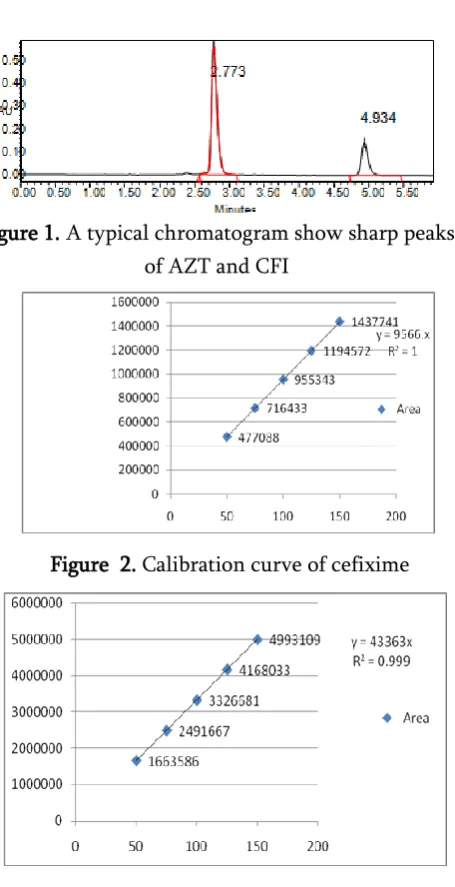
Lots of mobile phase and there different proportions were tried and finally was selected as 0.01M Disodium hydrogen phosphate (Na2HPO4): Methanol in the ratio of 80:20 (v/v) at pH 8 appropriate mobile phase which gave good resolution and acceptable system suitability parameters. The chromatogram of working standard solution is shown in fig 1.
Calibration Curve
Precision
The repeatability studies were carried out by estimating response of CFI (100 µg/mL) and AZT (100µg/mL) five times and results are reported in terms of % CV .
Figure 1. A typical chromatogram show sharp peaks of AZT and CFI
Figure 2. Calibration curve of cefixime
Figure 3. Calibration curve of Azithromycin
Accuracy
Recovery assessment was obtained by using standard addition technique which was by adding known quantities of pure standards at three different levels in 50%, 100% and 150% to the pre analysed sample formulation. From the amount of drug found, amount of drug recovered and percentage recovery were
calculated which sense to conformation that the proposed method was accurate.
Analysis of marketed formulation
Ten tablets were weighed accurately and finely powdered. Tablet powder equivalent to 25mg AZT and 20mg of CFI was taken in 100 ml volumetric flask. Methanol (50 ml) was added to the above flask and the flask was sonicated for 30 minutes. The solution was filtered using whatman filter paper No.1 and volume was made up to the mark with distilled water.
Detection limit
The Detection Limit of an individual analytical procedure is the lowest amount of analyte in a sample which can be detected but not necessarily quantitated as an exact value
Quantification limit
The Quantification limit of an analytical procedure is the lowest amount of analyte in a sample, which can be quantitatively determined with suitable precision and accuracy. .
Specificity
The method was determined as specific by comparing test results obtained from analyses of sample solution containing placebo ingredients with that of test results those obtained from analyses of standard solution.
III.
RESULTS AND DISCUSSION
and range for CFI and AZT were determined from mixed standards and were found to be of the order 50-150 µg /ml of CFI and 50-150 µg /ml of AZT. The formulation was diluted in the linearity range and peak areas were determined, the concentrations of both like CFI and AZT were then determined by comparing the peak areas of sample with that of standard peak areas of CFI and AZT in mixture can be identified by their retention times being 2.77 Minutes for AZT and 4.93 minutes for CFI. The results obtained from HPLC method were reproducible and encouraging. The values percentage deviation was within limit
IV.
CONCLUSION
Proposed study describes method for the estimation of AZT and CFI combination in mixture. The method was validated and found to be simple, sensitive, accurate and precise as per ICH guidelines .The method was successfully used for determination of drugs in their pharmaceutical formulation.
V.
REFERENCES
[1]. Richard F,Michelle C,Luigi X. Lippincott's Illustrated Reviews: Pharmacology. 4th Edition,360-364.
[2]. Ani R. Comparative Multicenter Studies of Cefixime Trihydrate and Amoxicillin in the Treatment of Respiratory Tract Infections. The American Journal of Medicine,1988; 85(3A):6-13.
[3]. Iravani A,Richard G. A Double-Blind,Multicenter,Comparative Study of the Safety and Efficacy of Cefixime Trihydrate versus Amoxicillin in the Treatment of Acute Urinary Tract Infections in Adult Patients. The American Journal of Medicine,1988; 85(3A):17-23.
[4]. Avner S,Buckley J,Pearlman D,Vitanza J. Comparison of Cefixime Trihydrate qd &
Amoxicillin tid for acute sinusitis. Journal acute Sinusitis. Journal of Allergy and Clinical Immunology,1991; 87:1:14
[5]. Johnson C,Susan A,Dennis M,Cefixime Trihydrate compared with amoxicillin for treatment of acute otitis media. Pediatric Pharmacology and Therapeutics,1991:117-122. [6]. Fera M,Carbone M,Foch A. Activity of Cefixime
Trihydrate against Helicobacter pylori. International Journal of Antimicrobial Agents. 1993; 3:105-108.
[7]. Sharma HL,Sharma KK :Principles of pharmacolog. 2008; 761-762.
[8]. Goldman RC,Fesik SW,Doran CC. Role of protonated and neutral forms of macrolides in binding to ribosomes from Grampositive and Gram-negarive bacteria. Antimicrobial Agents Chemotherapy. 1990;34:426-431.
[9]. Rothermel CSingle-Dose Azithromycin Dihydrate for Acute Otitis Media: A Pharmacokinetic/Pharmacodynamic Rationale. Current Therapeutic Research,2003; 64(A): 6. [10]. Treadway G,Pontani D,Reisman A. The safety of
Azithromycin Dihydrate in the treatment of adults with community-acquired respiratory tract infections. International Journal of Antimicrobial Agents,2002; 19:189-194.
[11]. Kabra S,Pawaiya R,Lodha R .Long-term daily high and low doses of Azithromycin Dihydrate in children with cystic fibrosis: A randomized controlled trial. Journal of Cystic Fibrosis. 2010; 9:17-23.
[12]. Parnham M. Modulation of neutrophil and inflammation markers in chronic obstructive pulmonary disease by short-term Azithromycin Dihydrate treatment. European Journal of Pharmacology. 2005;517:132-143.
[14]. Butler T,Sridhar C,Dagac M,Pathak K. Treatment of typhoid fever with Azithromycin Dihydrate versus chloramphenicol in a randomized multicentre trial in India. Journal of Antimicrobial Chemotherapy. 1999; 44:2:243-250.
[15]. Furuya R,Nakayama H,Kanayama A.In vitro synergistic effects of double combinations of β-lactams and Azithromycin Dihydrate against clinical isolates of Neisseria gonorrhoeae. Journal of Infection and Chemotherapy. 2006; 12:4:172-176.
[16]. Indian Pharmacopoeia Govrnment of India,Ministry of Health & Welfare,6th edition 2010; 2:857-858,1012-1013.
[17]. Zubata P,Ceresole R,Rosasco R,Pizzorno M. A new HPLC method for Azithromycin Dihydrate quantitation. Journal of Pharmaceutical and Biomedical Analysis .2002; 27:833-836.
[18]. Shaikh K,Patil S,Devkhile A. Development and validation of a reversed-phase HPLC method for simultaneous estimation of ambroxol hydrochloride and Azithromycin Dihydrate in tablet dosage form. Journal of Pharmaceutical and Biomedical Analysis,.2008; 48:1481-1484. [19]. Shena Y,Yina C,Sub M,Tua J. Rapid,sensitive
and selective liquid chromatography–tandem mass spectrometry (LC–MS/MS) method for the quantification of topically applied Azithromycin Dihydrate in rabbit conjunctiva tissues. Journal of Pharmaceutical and Biomedical Analysis. 2010; 52:99-104.
[20]. Kulikov A,Verushkin A. development and validation of a micellar liquid chromatographic method with uv detection for determination of azithromycin dihydrate in tablets and capsules. Chromatographia,2004; 60:1-2:33-38.
[21]. Suhagia B, Shah S, Rathod I, Patel H, Doshi K.Determination of Azithromycin Dihydrate
in pharmaceutical dosage forms by Spectrophotometric method. Indian Journal of Pharmaceutical sciences.2006; 68:2:242-245. [22]. Yanamandra R, Chaudhary A, Rao S, Patro B.
UPLC Method for Simultaneous Separation and Estimation of Secnidazole,Fluconazole and Azithromycin Dihydrate in Pharmaceutical Dosage Forms. E-Journal of Chemistry. 2010; 7:S1:S363-S371.
[23]. Rajendran S,Santhi N,Kumar P,Solomon S,Narayanan V. Simultaneous Estimation of Cefixime Trihydrate and Ofloxacin in Bulk and Tablet Dosage Form. Asian Journal Pharmaceutical Analysis. 2011; 1:2:36-38.
[24]. Deshpande M, Kasture V, Gosavi S. Application of HPLC and HPTLC for the Simultaneous Determination of Cefixime Trihydrate Trihydrate and Ambroxol Hydrochloride in Pharmaceutical Dosage Form. Eurasian Journal Analytical Chemistry.2010; 5:3:227-238.
[25]. Nemutlu E,Kır S,Katlan D,Beksac M. Simultaneous multiresponse optimization of an HPLC method to separate seven cephalosporins in plasma and amniotic fluid: Application to validation and quantification of cefepime,Cefixime Trihydrate and cefoperazone. Talanta. 2009; 80:117-126.
[26]. Falkowski A,Look Z,Noguchi H,Silber M. Determination of cefixime trihydrate in biological samples by reversed-phase high-performance liquid chromatography. journal of chromatography. 1987; 422:145-152.
[27]. Eric S,Agbaba D,Zivanov D,Vladimirov S.
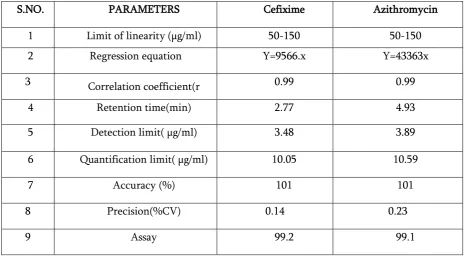
Table 1. Analytical parameters
S.NO. PARAMETERS Cefixime Azithromycin
1 Limit of linearity (µg/ml)
222
50-150 50-150
2 Regression equation Y=9566.x Y=43363x
3 Correlation coefficient(r 0.99 0.99
4 Retention time(min) 2.77 4.93
5 Detection limit( µg/ml) 3.48 3.89
6 Quantification limit( µg/ml) 10.05 10.59
7 Accuracy (%) 101 101
8 Precision(%CV) 0.14 0.23