University of Pennsylvania
ScholarlyCommons
Publicly Accessible Penn Dissertations
1-1-2015
Features and Functions: Decomposing the Neural
and Cognitive Bases of Semantic Composition
Christine BoylanUniversity of Pennsylvania, [email protected]
Follow this and additional works at:http://repository.upenn.edu/edissertations
Part of theCognitive Psychology Commons,Linguistics Commons, and theNeuroscience and
Neurobiology Commons
This paper is posted at ScholarlyCommons.http://repository.upenn.edu/edissertations/1619 For more information, please [email protected].
Recommended Citation
Boylan, Christine, "Features and Functions: Decomposing the Neural and Cognitive Bases of Semantic Composition" (2015).Publicly Accessible Penn Dissertations. 1619.
Features and Functions: Decomposing the Neural and Cognitive Bases of
Semantic Composition
Abstract
In this dissertation, I present a suite of studies investigating the neural and cognitive bases of semantic composition. First, I motivate why a theory of semantic combinatorics is a fundamental desideratum of the cognitive neuroscience of language. I then introduce a possible typology of semantic composition: one which involves contrasting feature-based composition with function-based composition. Having outlined several different ways we might operationalize such a distinction, I proceed to detail two studies using univariate and multivariate fMRI measures, each examining different dichotomies along which the feature-vs.-function distinction might cleave. I demonstrate evidence that activity in the angular gyrus indexes certain kinds of function-/relation-based semantic operations and may be involved in processing event semantics. These results provide the first targeted comparison of feature- and function-based semantic composition, particularly in the brain, and delineate what proves to be a productive typology of semantic combinatorial operations. The final study investigates a different question regarding semantic composition: namely, how automatic is the interpretation of plural events, and what information does the processor use when committing to either a distributive plural event (comprising separate events) or a collective plural event (consisting of a single joint event).
Degree Type Dissertation
Degree Name
Doctor of Philosophy (PhD)
Graduate Group Psychology
First Advisor
Sharon L. Thompson-Schill
Second Advisor John C. Trueswell
Keywords
angular gyrus, anterior temporal lobe, cognitive neuroscience, eyetracking, functional magnetic resonance imaging, semantics
Subject Categories
Cognitive Psychology | Linguistics | Neuroscience and Neurobiology
FEATURES AND FUNCTIONS: DECOMPOSING THE NEURAL AND COGNITIVE BASES
OF SEMANTIC COMPOSITION
Christine Boylan
A DISSERTATION
in
Psychology
Presented to the Faculties of the University of Pennsylvania
in
Partial Fulfillment of the Requirements for the
Degree of Doctor of Philosophy
2015
Supervisor of Dissertation Co-supervisor of Dissertation
______________________________ __________________________
Sharon L. Thompson-Schill John C. Trueswell
Christopher H. Browne Distinguished Professor of Psychology Professor of Psychology
Graduate Group Chairperson
_______________________ Sara Jaffee
Professor of Psychology
Dissertation Committee:
Russell A. Epstein, Professor of Psychology Florian Schwarz, Assistant Professor of Linguistics
FEATURES AND FUNCTIONS: DECOMPOSING THE NEURAL AND COGNITIVE BASES OF SEMANTIC COMPOSITION COPYRIGHT
2015
Christine Emily Boylan
This work is licensed under the Creative Commons Attribution- NonCommercial-ShareAlike 3.0 License
To view a copy of this license, visit
iii
ABSTRACT
FEATURES AND FUNCTIONS: DECOMPOSING THE NEURAL AND COGNITIVE
BASES OF SEMANTIC COMPOSITION
Christine Boylan
Sharon L. Thompson-Schill
John C. Trueswell
In this dissertation, I present a suite of studies investigating the neural and cognitive
bases of semantic composition. First, I motivate why a theory of semantic combinatorics
is a fundamental desideratum of the cognitive neuroscience of language. I then introduce
a possible typology of semantic composition: one which involves contrasting
feature-based composition with function-feature-based composition. Having outlined several different
ways we might operationalize such a distinction, I proceed to detail two studies using
univariate and multivariate fMRI measures, each examining different dichotomies along
which the feature-vs.-function distinction might cleave. I demonstrate evidence that
activity in the angular gyrus indexes certain kinds of function-/relation-based semantic
operations and may be involved in processing event semantics. These results provide the
first targeted comparison of feature- and function-based semantic composition,
particularly in the brain, and delineate what proves to be a productive typology of
semantic combinatorial operations. The final study investigates a different question
regarding semantic composition: namely, how automatic is the interpretation of plural
iv
distributive plural event (comprising separate events) or a collective plural event
v
TABLE OF CONTENTS
ABSTRACT ... III
LIST OF TABLES ... IX
LIST OF ILLUSTRATIONS ... X
I. INTRODUCTION ... 1
WHY CONCERN OURSELVES WITH COMPOSITIONALITY? ... 1
ATTRIBUTIVE VS. RELATIONAL COMBINATION ... 2
ADJUNCTS VS. ARGUMENTS, AND WHETHER VERB SEMANTICS IS PRIVILEGED IN THE ANGULAR GYRUS ... 3
COLLECTIVE VS. DISTRIBUTIVE INTERPRETATIONS OF PLURAL SETS ... 5
AIMS OF THE DISSERTATION ... 8
II. RELATIONAL VS. ATTRIBUTIVE INTERPRETATION OF NOMINAL COMPOUNDS DIFFERENTIALLY ENGAGES ANGULAR GYRUS AND ANTERIOR TEMPORAL LOBE ... 10
INTRODUCTION ... 10
A tale of two hubs: the angular gyrus and anterior temporal lobe ... 13
Relational vs. attributive interpretation of nominal compounds ... 16
MATERIAL AND METHODS ... 22
Experimental Task and Design ... 25
Image acquisition ... 25
vi
RESULTS ... 28
Task-‐responsive voxels in anatomical ROIs ... 28
Combinatorial bias predicts activity in left and right AG ... 29
BOLD timecourse of attributive interpretation differs by ROI ... 31
DISCUSSION ... 34
Angular gyrus and thematic relations ... 35
Anterior temporal lobe and semantic composition ... 43
Limitations, future directions, and conclusions ... 45
III. COMPOSITIONALITY AND THE ANGULAR GYRUS: A MULTI-‐VOXEL SIMILARITY ANALYSIS OF THE SEMANTIC COMPOSITION OF NOUNS AND VERBS ... 47
INTRODUCTION ... 47
Roles of left anterior temporal lobe and left angular gyrus in semantic composition ... 47
A feature vs. function dichotomy? ... 52
Multi-voxel pattern similarity as a window to various dimensions of compositionality ... 57
MATERIAL AND METHODS ... 59
Experimental Task and Design ... 67
Image acquisition and pre-processing ... 68
Analysis ... 69
RESULTS ... 73
Continuous similarity analyses between subjects’ pairwise similarity rankings and neural similarity scores for pairs of two-word phrases ... 75
DISCUSSION ... 77
vii
Semantic representations or semantic control? ... 81
Limitations, future directions, and conclusions ... 83
IV. A MATTER OF AMBIGUITY? USING EYE MOVEMENTS TO EXAMINE COLLECTIVE VS. DISTRIBUTIVE INTERPRETATIONS OF PLURAL SETS ... 90
INTRODUCTION ... 90
EXPERIMENT 1 ... 96
Method ... 96
Results ... 103
Summary of Experiment 1 ... 109
EXPERIMENT 2 ... 110
Method ... 110
Results ... 113
Summary of Experiment 2 ... 118
DISCUSSION ... 119
A matter of ambiguity ... 119
Conjoined NPs and plural determiners differ in selecting between collectivity and distributivity ... 121
V. GENERAL DISCUSSION ... 128
REVIEWING THE AIMS OF THE DISSERTATION ... 128
THE NEURAL BASES OF THE FEATURE-‐FUNCTION DIVISION ... 129
THE LATERALIZATION PUZZLE ... 131
THE AG AND VERB/EVENT SEMANTICS ... 131
viii
APPENDIX ... 134
ix
LIST OF TABLES
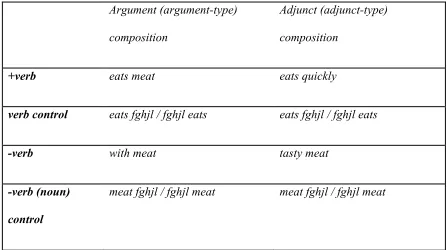
Table 1. An example set of two-word compositional and non-compositional phrases
sharing a given noun or verb………..….72
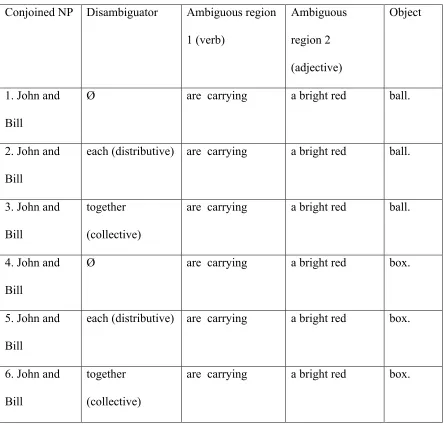
Table 2. Conjoined NP sentences……….109
Table 3. Plural NP sentences………122
x
LIST OF ILLUSTRATIONS
Figure 1. Plot of relational-attributive combinatorial bias ………24
Figure 2. Task-responsive voxel activity in left ATL and left AG ………...29
Figure 3. Beta coefficients from subject-wise parametric analysis of voxel activity in each
ROI………31
Figure 4. Peristimulus FIR curves of attributive vs. relational activation in each ROI…33
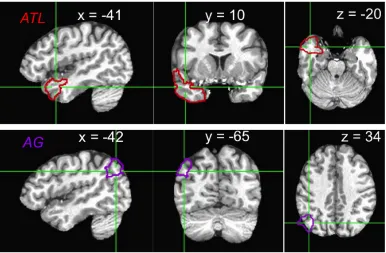
Figure 5. ROI boundaries of left ATL and left AG………...71
Figure 6. Diagram of similarity analysis………...72
Figure 7. Pairwise correlations between relevant pairs of word phrases in left AG…….74
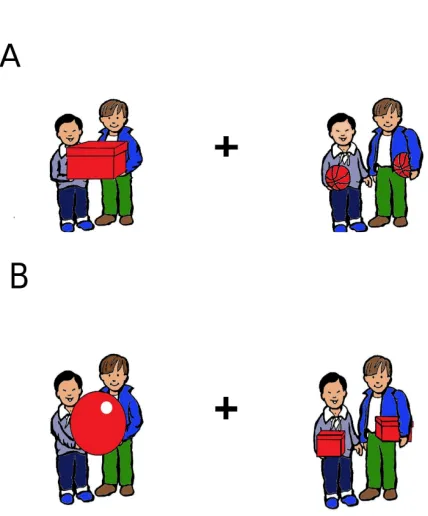
Figure 8. Two typical scene pairs for collective and distributive events……….100
Figure 9. Plots of collective advantage for conjoined NP subjects………..105
Figure 10. Plots of collective advantage for conjoined NP sentences in four time
windows………...……106
Figure 11. Timecourse of sentences with distributive-biased verbs………109
Figure 12. Plots of collective advantage for plural NP subjects………..114
Figure 13. Plots of collective advantage for plural NP sentences in four time
1
I. INTRODUCTION
Why concern ourselves with compositionality?
Language owes its infinite expressive capacity to our ability to take simple
building blocks, such as words or concepts, and combine them into complex
representations. How such conceptual combination might be realized in the brain, and
whether formal accounts of syntactic and semantic composition are useful in
characterizing the neural system underpinning conceptual combination, are still highly
debated questions, and the emergence of compositional meaning from units such as
morphemes, words, or concepts, is largely a mystery. However, understanding the
engine of compositionality in the brain is a fundamental desideratum of any cognitive
neuroscientific model of “concepts.”
This dissertation examines how the compositional system accomplishes
conceptual and grammatical semantic combinatorics along a number of possible
dimensions. We investigate several ways in which a natural dichotomy may exist
between feature-/property-based composition, which concerns attributive modification
operations on concepts, and relation-based composition, which concerns grammatical and
thematic relations between concepts. Chapters 2 and 3 examine two different ways of
characterizing this dichotomy that engage two regions of the brain we describe as
combinatorial hubs: the angular gyrus (AG) and the anterior temporal lobe (ATL).
Chapter 3 details the possibility that event semantics are particularly privileged in the
putative “relation-based” semantic space supported by (left) AG. Chapter 4 investigates a
2
interpretation of plural events, and what information does the processor use when
committing to either a distributive plural event (comprising separate events) or a
collective plural event (consisting of a single joint event).
Attributive vs. relational combination
For one intuitive explanation of the distinction between what we call
feature-based and function-feature-based compositional operations, we first look to the literature on
conceptual combination. Here, the distinction is often cast in terms of “properties”
instead of “features,” and “(thematic) relations” instead of “functions,” as in Wisniewski
and Love’s (1998) discussion of two different interpretations of a noun-noun combination
like robin hawk:
One kind of interpretation involved a thematic relation between the referents of
the modifier and head concepts. For example, a robin hawk could mean ‘‘a hawk
that preys on robins.’’ In property interpretations, people asserted that one or
more properties of the modifier concept apply in some way to the head concept,
as in ‘‘hawk with a red breast,’’ for robin hawk. Sometimes these interpretations
refer to an entity which shares many properties of both constituents (e.g., a robin
hawk could refer to a bird that is a cross between a robin and a hawk).
(Wisniewski & Love, 1998, p.178)
A thematic interpretation of robin hawk entails that each entity play a different functional
role (or thematic role): the modifier refers to a robin as the object, or “patient,” of the
action “to prey on,” while the head noun hawk refers the agent of “to prey on.” When
robin hawk is interpreted as a property combination, however, the modifier robin refers
property-3
combining interpretation involves no specification of functional roles or argument
structure as does the relational interpretation.
This fundamental distinction between property- or feature-based combination on
the one hand and functional, thematic relation-based composition on the other is
ubiquitous across linguistic and psychological theory, albeit under various different
guises. While chapter 2 uses functional magnetic resonance imaging (fMRI) to test how
property-based, or “attributive,” and relational nominal compounds like robin hawk
differentially engage ATL and AG, chapter 3 tests two more ways of operationalizing the
“feature-function” distinction, while still examining ATL and AG as neural substrates.
Adjuncts vs. arguments, and whether verb semantics is privileged in the angular
gyrus
Chapter 3 uses fMRI multi-voxel pattern analysis to test two different hypotheses
about the role of AG in compositional semantics. Our verb-centric hypothesis states that
if AG is preferentially sensitive to event-denoting verbs and their thematic relations, then
phrases that share a given verb (like eats meat and eats quickly) will evoke similar
patterns of activation in AG. Phrase pairs that do not share verb semantics will not
engage similar patterns of activation in AG. We find evidence that the verb is indeed
privileged in AG semantic space.
Another hypothesis asks whether AG may be sensitive to relational information
independent of the verb. The dichotomy between “feature” and “function” has a good
deal of traction in more formal theories of semantics, particularly in the distinction
4
between arguments and adjuncts, however, is more subtle than that between verbs and
non-verbs, and so we unpack the terms a bit below.
Intuitively speaking, the verb is the central predicate of a sentence, and predicates,
such as eat, must be able to take arguments (like meat) in order to participate in
well-formed sentences ( Heim & Kratzer, 1998; Pylkkänen, Brennan, & Bemis, 2011). While
the case of verbs and their direct objects is perhaps the most canonical example of
so-called “argument saturation”, there are other types of function-argument relations: for
instance, the composition of prepositional phrases (e.g. with meat, where the preposition
with takes the argument meat).
Many well-formed linguistic expressions can be derived merely by iterative
application of arg-type composition; however, there are other sorts of linguistic
expressions it cannot derive. Take, for instance, the following sentence:
(2) John ate a sandwich quickly in the kitchen.
The semantics of the verb “ate” can be represented as the function ate(x,y), where
x will be the object argument (here “a sandwich”) and y the subject (here, “John”).
Leaving aside the subject argument, we can see that applying argument-type composition
will get us “ate a sandwich,” since it is relatively intuitive that “a sandwich” is an
argument of “ate.” However, it is not so clear that we can derive the meaning of “ate a
sandwich quickly in the kitchen” in terms of argument-type composition alone. In order
for argument-type composition to accomplish this, all three underlined constituents in (2)
above must be arguments of “ate.” However, the case in (3) below shows us that “a
sandwich” does not behave like the other constituents do.
5 (a) Bill did (so), too.
(b) *Bill did (so) a salad.
(c) Bill did (so) slowly.
(d) Bill did (so) in the backyard.
It would seem that there is something about the status of the constituent “a sandwich”
that cannot be left out or replaced (see 3b), while the other constituents “quickly” and “in
the kitchen” can (3c, 3d). This is because the only argument of “ate” in 2-3 is “a
sandwich,” whereas the other underlined constituents are modifier, or “adjunct,” phrases
that modify the predicate “ate.” How do we derive the compositional meaning of these
modifying phrases?
Adjunct-type composition allows us to combine such modifiers with their “heads,”
where “ate” is the head in 2-3, and “in the kitchen” and “at midnight” are the modifiers.
These optional elements serve to further specify features or properties of the head they
modify (while “ate” is an event-denoting element, “quickly” and “in the kitchen” are
when- and where-type properties of that event).
In Chapter 3, we discuss evidence that specifically event-denoting verb argument
structure may selectively engage the AG, while it remains to be seen whether AG and/or
ATL differentiate arguments and adjuncts more generally.
Collective vs. distributive interpretations of plural sets
In Chapter 4, we turn to a different set of questions regarding events and semantic
composition, this time examining the degree to which the decision to interpret plural
6
be automatic and immediate, and also whether this decision is biased to be collective or
distributive at certain points along the timecourse of interpretation. Examining sentences
like “John and Bill carried a box,” where this sentence could entail John and Bill each
carrying a separate box (a distributive plural) or John and Bill together carrying the same
box (a collective plural), we ask whether the collective or distributive quality of the
predicate is something the processor can leave underdetermined, or whether the grammar
requires a commitment to one interpretation or the other early on in the sentence.
Using eye-tracking and the visual world paradigm, we tested a hypothesis (Frazier
et al.'s (1999) Minimal Semantic Commitment hypothesis) that distinguishes between
two types of mental representations the processor might entertain upon encountering a
underdetermined semantic constituent (like a plural event that could be collective or
distributive): if the representation is ambiguous, the processor will commit to one of its
interpretations and later revise it if necessary, but if the representation is vague, the
processor refrains from committing to an interpretation, leaving some features
underdetermined until further information is made available. The crucial difference
between these two proposed representation types is that an ambiguous representation
necessitates a decision about an interpretation, while a vague representation tolerates
unspecified features. This is somewhat similar to the notion that adjuncts have an
“optional” status in the grammar, while arguments are elements of the grammar that are
necessary in order for a parse to be successful, as described in the section above.
The following two sentences illustrate a case when a linguistic item can be said to
tolerate “underspecification,” or vagueness:
7 b. John ate quickly.
The difference in meaning between (4a,b) resides in the adverb “quickly.” In sentence
(4a), the manner in which John ate is left unspecified, and yet a reader will find sentence
(4a) perfectly interpretable without knowing the manner in which John ate. On the other
hand, if the sentence lacked information specifying other propositional content,
including, for instance, the number (singular) or tense (past) of the verb, this sentence
would be grammatically uninterpretable (forcing a case of ambiguity when the processor
would have to commit to a number or tense even if uncertain). Thus, while some
information about the verb must be determined in order to parse the sentence, other
features ostensibly need not be, as in the case of the adverbial adjunct “quickly” (1b).
Adjunct information, such as the manner in which John ate, is therefore characterized as
vague, rather than ambiguous.
Given the prediction that an ambiguous item will prompt the processor to
converge on one particular interpretation even in the absence of disambiguating
information, chapter 4 seeks to test whether, and when, sentences underdetermined for
collective/distributive plurality will nonetheless immediately converge on one
interpretation. We recorded participants’ eye movements as they interrogated two scenes,
one collective and one distributive, while listening to corresponding sentences either with
or without the early disambiguating adverbs “together” (explicitly indexing a collective
event) and “each” (indexing a distributive event). Experiment 1 queries the timecourse of
interpreting sentences beginning with conjoined noun phrases (conjoined NPs), such as
“John and Bill (each/together) are carrying a box,” while Experiment 2 uses the same
8
carrying a box”). We find evidence that the collectivity/distributivity of NPs like “John
and Bill” and “The boys” is a matter of ambiguity (a grammatically forced, necessary
choice). However, whereas early fixations are biased towards collective scenes in
conjoined NP John and Bill sentences, they are biased towards distributive scenes in The
boys sentences. We discuss possible reasons for this difference in the final section of
chapter 4.
Aims of the dissertation
In this dissertation, I seek to demonstrate the following:
i. Semantic compositionality can be characterized along a “feature-vs.-function”
dichotomy in several possible dimensions (chapters 2 and 3)
ii. The AG supports various aspects of function-/relation-based composition, among
them verb-specific argument structure around events (chapter 3) and more general
thematic relation-based composition (chapter 2).
iii. Semantic decisions on the collective or distributive representation of plural events
occur early on in sentence processing – at the verb phrase – even in the absence of
disambiguating evidence. However, the bias of this decision is largely determined
by the affordances of the subject noun phrase, and not just the verb phrase
(chapter 4).
While we find some evidence for the distinction between feature-based composition and
functional relation-based composition within left ATL itself (see Chapter 2), we find
stronger evidence for at least a single dissociation of relation-based composition in AG.
9
composition, and we consolidate evidence that AG subserves certain of these
relation-based operations. We close by reviewing evidence that AG may also be involved in the
representation of plural sets, and we speculate that further study of AG may not only shed
light on relation-based composition, but also on the distinction between distributive and
10
II. RELATIONAL VS. ATTRIBUTIVE INTERPRETATION OF NOMINAL
COMPOUNDS DIFFERENTIALLY ENGAGES ANGULAR GYRUS AND
ANTERIOR TEMPORAL LOBE
Introduction
Language’s infinite generative capacity allows us to produce utterances ranging from
the prosaic, as in “Close the door,” to the ridiculous, as in “Hold the newsreader's nose
squarely, waiter, or friendly milk will countermand my trousers” (Stephen Fry, A Bit of
Fry and Laurie). Less ridiculous, but no less novel, sentences are uttered every day, and
the ability of a reader or listener to understand such novel sentences, the propositional
meanings of which cannot be retrieved from memory, requires a compositional algorithm
that takes word meanings and combines them in such a way as to produce a more
complex meaning. The neural substrate of this compositional algorithm remains elusive.
Earlier work sometimes considered this engine of composition a more or less
undifferentiated mechanism working to combine elements at all levels of language,
whether that be syntax, semantics, or phonology (Hagoort, 2005; inter alia). While it is
entirely plausible that the brain co-opted a basic, domain-general combinatory
mechanism for language, and implements it across multiple brain regions, such a
monolithic theory of linguistic composition has its limitations.
For instance, many approaches to the study of composition benefit from a clear
distinction between syntactic and semantic composition. Numerous psycho- and
neurolinguistic studies investigating the syntax-semantics interface have included
11
function words remain in place, as semantically vacuous (or at least impoverished)
syntactic controls for linguistic phrases (e.g. “the mouse that eats our cheese” vs. “the
couse that rits our treeve” (example from Pallier, Devauchelle, & Dehaene, 2011).
These studies demonstrate that subjects parse Jabberwocky phrases into hierarchical
constituents similar to their natural language counterparts, even without knowing what
the phrase means. Studies of complement coercion also suggest that syntactic and
semantic argument structures are not isomorphic: evidence from behavioral, eye-tracking,
and electrophysiological measures demonstrate a processing cost where semantic
material unexpressed in the syntax must be inserted in order to coerce a coherent
argument structure; e.g. “The man began the book” is interpreted as “The man began
[reading/writing] the book” via implicit insertion of some event information (Baggio,
Choma, van Lambalgen, & Hagoort, 2010; Kuperberg, Choi, Cohn, Paczynski, &
Jackendoff, 2009; Kuperberg, Sitnikova, & Lakshmanan, 2008; McElree, Pylkkänen,
Pickering, & Traxler, 2006; Pylkkänen & McElree, 2006, 2007; Traxler, McElree,
Williams, & Pickering, 2005).
In this study, we proceed one step further, and suggest that within the domain of
semantic composition, there is evidence for a distinction between two basic combinatorial
operations, even when syntax is held constant. Specifically, we investigate the case of
noun-noun compounds, in which the syntax is always a modifier noun followed by a head
noun (e.g. mountain lake, where the syntax dictates this is a lake (in the mountains), not a
mountain (in a lake)). Noun-noun compounds are a particularly tractable case of minimal
12
than investigating compositionality in the context of multi-word phrases or sentence
stimuli, where multiple types of combinatorial operations occur simultaneously or in
quick succession. Noun-noun compounds are particularly interesting because the first
noun – the modifier noun – can be either predicating/“attributive” (as in zebra clam,
where zebra denotes the attribute “striped”) or non-predicating/“relational” (as in
mountain lake, where “mountain” is not an attribute but an object bearing a spatial
relation with “lake”). Predicating combinations can be paraphrased as “a [noun] that is
[adjective],” such as red ball (“a ball that is red”). Non-predicating combinations cannot
be paraphrased this way: e.g. tennis ball is not “a ball that is tennis,” but rather is “a ball
for playing tennis” (Downing, 1977; Gagné & Shoben, 1997; Levi, 1978). Attributive
noun-noun compounds are predicating in that they can be paraphrased as “a [head noun]
that is [modifier noun]-like”, as in zebra clam – “a clam that is zebra-like” (“a clam that
is striped”). Relational noun-noun compounds are more complex in that they are
non-predicating, and derive their meaning from some extrinsic predicating relation (e.g. “a
ball for playing tennis”) (Levi, 1978; Murphy, 1990).
We find evidence that relational and attributive interpretations of noun compounds
differentially engage two regions of the brain otherwise broadly implicated in semantic
composition: the angular gyrus (AG) and the anterior temporal lobe (ATL). Below, we
discuss how the distinction between attributive and relational combination may shed light
on the functional differences between these two putative neural “hubs” of semantic
13
A tale of two hubs: the angular gyrus and anterior temporal lobe
Mounting evidence suggests ATL and AG are involved in semantic processing,
generally, and in semantic composition, specifically; however, only recently has there
been effort to characterize their division of labor. Both have been characterized as
"semantic hubs,” owing to functional and anatomical patterns that are consistent with
multimodal convergence (Binder & Desai, 2011; Lambon Ralph, 2014; Patterson et al.,
2007; Seghier, 2012). The ATL is uniquely situated at the end of a caudal-to-rostral
stream of information processing feeding from primary sensory and motor areas and
association cortex (Binder et al., 2009; Binder & Desai, 2011; Binney, Parker, & Lambon
Ralph, 2012; Felleman & Van Essen, 1991). Moving anteriorly along the temporal lobe,
one finds a caudal-to-rostral hierarchy emerge as neuronal responses are more tuned to
complex stimuli and more invariant to low-level sensory variation; such a hierarchy has
been established along both visual (Felleman & Van Essen, 1991) and auditory
(Rauschecker & Scott, 2009) streams. This “graded convergence” may provide a
mechanism both for attributive feature combination and, in the limit, for maximally
invariant amodal, abstract conceptual representations. The culmination of this graded
convergence up the temporal lobe (Rauschecker & Scott, 2009; Stringer & Rolls, 2002) is
a basal rostral region of ATL shown to have very limited extra-temporal connectivity and
high intra-temporal connectivity (Binney et al., 2012). Such neuroanatomical
sequestration is a necessary condition for a region to be able to represent abstract,
modality-invariant semantics. Thus, ATL is a prime candidate for attributive semantic
14
In one of the first studies investigating the neural correlates of minimal two-word
composition, Baron and colleagues (2010) found evidence from fMRI pattern analyses
that the left ATL subserved the combination of concepts such that the superimposition of
individual patterns of the simplex concepts YOUNG and MAN (as represented by
various face stimuli) reliably predicted the activation pattern for the complex concept
YOUNG MAN. Consistent with this finding, a magnetoencephalography (MEG) study
of visually presented two-word phrases comparing nouns in minimal compositional
contexts (red boat) with nouns in non-compositional contexts (in which a non-word letter
string was concatenated with a real word, e.g. xkq boat) found increased
composition-related activity in left ATL (Bemis & Pylkkänen, 2011). There is a growing body of
functional and tractographic studies to suggest that the representational unit of
property-based composition in left ATL may be multimodal sensorimotor features, particularly
visual concrete properties of object-concepts in more ventromedial regions of ATL, and
possibly more abstract auditory-visual properties in more dorsolateral regions of ATL
(Coutanche & Thompson-Schill, 2014; Hoffman, Binney, & Lambon Ralph, 2015),
corroborating the notion of the left ATL as hub of the so-called ventral “what” pathway.
In addition to the ATL, researchers have also ascribed the label “semantic hub” to
the AG, as it lies at the junction between temporal, parietal, and occipital lobes and thus
receives a confluence of auditory, somatosensory, spatial, and visual inputs. Conceptual
combination studies of the sort described above (Bemis & Pylkkänen, 2012) have
demonstrated involvement of both left AG and left ATL, and several studies implicate
bilateral AG in the contrast between well-formed sentences on the one hand and word
15
al., 1994; Humphries, Binder, Medler, & Liebenthal, 2007; Humphries, Binder, Medler,
Liebenthal, & others, 2006). Left AG also shows greater activity for semantic violations
vs. congruent well-formed sentences (Friederici, Rüschemeyer, Hahne, & Fiebach, 2003;
Kang, Constable, Gore, & Avrutin, 1999; Kuperberg et al., 2000; Luke, Liu, Wai, Wan,
& Tan, 2002; Ni et al., 2000) and for connected discourse vs. unrelated sentences
(Fletcher et al., 1995; Homae, Yahata, & Sakai, 2003; Xu, Kemeny, Park, Frattali, &
Braun, 2005). This broad profile of effects has led some to suggest that the AG may play
a potentially domain-general role in semantic information integration structured around
events.
Not all studies investigating conceptual combination find activation in both left ATL and
bilateral AG. Of those stimuli that elicit differential activity in AG but not in left ATL,
one finds that the type of composition may more often be based on thematic relations
rather than attributive combination. Graves et al. (2010) compared familiar meaningful
noun-noun compounds, such as lake house, with reversed phrases, such as house lake, the
meanings of which were not obvious; they found that right AG, along with other
right-lateralized temporoparietal areas, showed greater activation for processing the more
obviously combinatorial phrases. Interestingly, the authors noted that most of their
noun-noun stimuli were interpreted as denoting thematic relations between head and modifier
nouns (see below for further explanation); that is, most compounds consisted of nouns
participating in some spatial relation (as in “a house on a lake”) or event-based relation
rather than picking out an attribute of the modifier noun. It is likely that these stimuli
were probing semantic thematic relations in particular rather than combinatorial
16
Relational vs. attributive interpretation of nominal compounds
In order to further distinguish between property-based associations and relation-based
associations between concepts, consider the following nominal compound: robin hawk.
Wisniewski (1996) found that people’s interpretations of a novel compound of this sort
could be characterized in one of two ways. Some individuals applied a property of the
concept “robin,” such as a red breast, to the head noun “hawk,” to arrive at an
interpretation like “a red-breasted hawk.” Others found a thematic relation between the
two birds, noting that a hawk might hunt a robin, and interpreted “robin hawk” as “a
hawk that preys on robins.” In the first type of interpretation, “robin” indicated some
attribute or feature commensurate with the head noun “hawk,” while in the second type
of interpretation, the modifier noun “robin” was not broken down into features, but rather
participated in a thematic relation with the head noun “hawk.”
It is worth noting here that the terminology “predicating and non-predicating” is
perhaps more precise than the terms “relational” and “attributive,” which bear the
misfortune of being both very common and denoting very different qualities depending
on the theoretical framework. (For instance, there are certain non-deverbal “relational”
nouns, like sister, boss, edge, height, etc., that seem to take implicit semantic arguments
(Partee & Borschev, 2003), but we do not consider such relational nouns here.)
However, “predicating and non-predicating” are terms that perhaps imply an overly
syntactic typology for a phenomenon we argue arises from conceptual-semantic
affordances; that is, robin hawk is interpretable as “a hawk that hunts robins” only
17
invite such a predator-prey relation). Therefore, we will refer to these nominal compound
types as “relational” and “attributive.”
Earlier literature assumed that the thematic relation was the primary means of
interpreting nominal compounds: the consensus was that only after failing to find a
plausible thematic relation binding the modifier and head nouns did people derive a
property-based interpretation (Downing, 1977; Gagné & Shoben, 1997; Shoben &
Gagné, 1997; Wisniewski & Gentner, 1991). Later proposals recognized attributive
interpretations as somewhat distinct, but still considered property-based combinations too
infrequent to be considered a different process; while Wisniewski & Love (1998)
reported that attributive interpretations accounted for 29% of their nominal compounds,
other samples reported attributives occurring as little as 1% of the time in corpora
(Downing, 1977; Gagné, 2000; Warren, 1978). Parsimony dictated that attributive
interpretations were simply another kind of relation, namely a resemblance relation
(where zebra clam is merely a clam that resembles a zebra), and a single-process model
prevailed (Costello & Keane, 2000; Gagné, 2000). One prominent formulation of
single-process conceptual combination is the Competition Among Relations in Nominals
(CARIN) theory (Gagné & Shoben, 1997). Under this account, the modifier noun (zebra
in zebra clam, or mountain in mountain lake) is not incorporated into the head noun’s
representation, but rather a relation (e.g. noun RESEMBLE modifier, or noun LOCATED
modifier, respectively) is inserted that links the two concepts. Moreover, under CARIN,
some relations will be considered prior to others, depending on the lexical items being
18
compound mountain lake). This model stipulates that the RESEMBLE relation (that is,
the attributive interpretation) is largely dispreferred.
However, further study found evidence for a categorical distinction between a
relation-linking process like that described under CARIN, and another process, by which
a property or attribute of the modifier is “transferred” to the head noun (attributive
combination). Several studies found that the interpretation of ambiguous nominal
compounds (such as robin hawk) could be manipulated based on priming the ambiguous
item with relational or attributive compounds. Wisniewski & Love (1998) found that
ambiguous targets were more likely to be interpreted attributively when following an
attributive-biased compound, but more likely to be interpreted as relational when
preceded by a relational prime. While this suggested that attributive and relational
processes were actually distinct, dual processes, Gagné (2000) failed to replicate this
effect using the same stimuli and procedure. Estes (2003) followed this work with
another priming study, testing whether relational interpretations occurred serially prior to
attributive interpretations, or whether these processes occurred in parallel. He found that
both comprehension and reaction times were facilitated when target combinations
matched prime combinations in attribution or relation. Moreover, Estes (2003) tested the
CARIN model’s serial relation prediction that there should be an interaction between
prime type and target type: if relation precedes attribution, then an attributive prime
should interfere with interpretation of a relational target while a relational target should
not hinder comprehension of an attributive target. That is, under the serial CARIN
19
otherwise induced during a relational prime, and this extra processing would interfere
with comprehension of a relational target. Estes (2003) did not find such an interaction,
and interpreted these findings as inconsistent with a serial model like CARIN. However,
this null result is hardly damning to a serial, single-process account, and evidence
arbitrating between single and dual process models of relational and attributive
compound interpretation remains equivocal.
Relational and attributive semantics in the brain
The distinction between property- and relation-based semantic processes is not
unique to work on conceptual combination, but also appears in the neuropsychological
semantic memory literature. Here, one abiding question has been: Do relational and
attributive conceptual combinations arise from neuroanatomically separable components
of the semantics, or are they subsumed by the same combinatorial operation? If the
latter, are these operations hierarchically disposed in some way: that is, do attempts at
relational interpretation precede attributive interpretation, or vice-versa?
In the semantic memory literature, the distinction between so-called taxonomic
and thematic associations serve as a parallel to what we have described as attributive and
relational associations, respectively. Contrary to the conceptual combination literature,
where models like CARIN suggest relational associations may precede attributive
associations, some connectionist accounts appear to suggest that taxonomic (attributive)
semantic knowledge may be logically prior to thematic (relation) knowledge. By some
accounts, taxonomically defined concepts are the constituents of thematic relations: for
20
these concepts’ properties (Lewis, Poeppel, & Murphy, 2015). Also, under many
connectionist frameworks, thematic relations are reified into features, such that the
concept dog might be linked not only to nodes for “furry,” “warm-blooded,” and “loyal,”
but also nodes for explicitly relation-based facts, such as “bears live young,” “is led on a
leash,” and “chews/buries bones” (Rogers & McClelland, 2004). This approach contrasts
with a model whereby thematic relations constitute a qualitatively different level of
representation from taxonomic features or properties, where the unit of representation is
the event rather than the feature.
Consistent with an account whereby property-based associations take precedence
over relation-based associations (contrary to CARIN), a recent MEG priming study found
that activity in left ATL was only sensitive to property-based taxonomic associations,
while both taxonomic and thematic associations predicted activity in the left
temporoparietal junction (TPJ), inclusive of AG (Lewis et al., 2015). Note that this study
supports a theory of logical precedence for taxonomic associations over thematic
associations; it does not, however, provide evidence for a temporal precedence of one
type of association over the other (as CARIN does for relational/thematic operations over
attributive/taxonomic operations).
Another study, however, found evidence of a double dissociation between
taxonomic and thematic semantic errors in left ATL and left AG, respectively (Schwartz
et al., 2011). Speakers’ semantic errors can be divided into either taxonomic category
errors (that is, uttering an incorrect word, but one which has commensurate features, such
21
when “bone” was intended, reflecting the thematic relation between “dog” and “bone”).
Schwartz et al. (2011) examined the taxonomic and thematic errors produced by 86
post-stroke aphasics in a picture-naming task and conducted voxel-based lesion-symptom
mapping (VLSM) on each error type separately (with shared variance between error types
regressed out). Taxonomic errors were mapped to left ATL lesions, while thematic errors
were localized to left AG. This double dissociation between ATL and AG supports the
view that the ATL and AG support distinct semantic computations, corresponding to
property-based and relation-based operations, respectively.
The current study examines the neural dissociation between property- and
relation-based conceptual combination in order to discern (1) whether these processes are
indeed functionally distinct and (2) whether they might allow us to better characterize the
roles of AG and ATL in semantic combination. While the double dissociation of the sort
reported in Schwartz et al. (2011), would be indicative of entirely dissociable systems, it
is also possible that a common underlying semantic process derives both sorts of
combination such that the distinction is moot. Midway between these two hypotheses is
the possibility that these two types of combination are both functionally and neurally
distinct, but recruit overlapping brain networks.
We find evidence for (1) a single dissociation in bilateral AG showing more
task-responsive activity for relational compounds than attributive compounds, and (2) a timing
difference in ATL, specifically an earlier ATL response to attributive compounds than
22
the CARIN model, but compatible with a different serial model: one whereby
attributive/taxonomic operations are logically prior to thematic operations.
Material and methods
Participants
Eighteen subjects (eleven female) participated in this study. Subjects ranged in
age from 18 to 42 years, and all were right-handed native speakers of English with
normal or corrected-to-normal vision and no reported history of neurologic problems.
Subjects gave written informed consent and were provided monetary compensation
($20/hour) for their time. The human subjects review board at the University of
Pennsylvania approved all experimental procedures.
Stimuli
Stimuli Design
We drew our nominal compound stimuli from two studies investigating the
effects of attributive- and relational-biased compounds (Estes, 2003; E. J. Wisniewski &
Love, 1998). Of the stimuli used in these studies, we chose the 64 most attributive-biased
and 64 most relational biased items according to a norming study we conducted via
Amazon Mechanical Turk (Buhrmester, Kwang, & Gosling, 2011). Subjects (n=17) were
asked to write their interpretations of each noun compound and indicate their familiarity
with the noun compound on a 1-7 Likert scale, and three independent coders designated
these interpretations as either attributive or relational. Coder agreement was over 95%,
and where coders’ designations diverged, the primary author’s designation was used
23
Estes, 2003, and Wisniewski & Love, 1998. Relational and attributive items were
matched on unigram frequency (t(254) = 1.09, p = 0.28), compound length (t(126) =
0.85, p = 0.40), and compound familiarity (t(126) = 1.67, p = 0.10) (Brysbaert & New,
2009) .
Norming for relational-attributive bias
In order to measure the variability in the interpretations of our noun-noun
compound stimuli, and thus the degree of bias toward attributive and relational
combination, we combined responses from the Mechanical Turk stimulus norming survey
with responses taken from a survey of our fMRI subjects after they left the scanner. Both
surveys asked subjects to describe what they thought each noun compound meant, with
the added instruction to the fMRI participants that they write down the interpretations
they had entertained while viewing the stimuli inside the scanner. Responses from a total
of 35 subjects per item (17 from Mechanical Turk norming, 18 from fMRI subjects) were
coded as either attributive or relational.
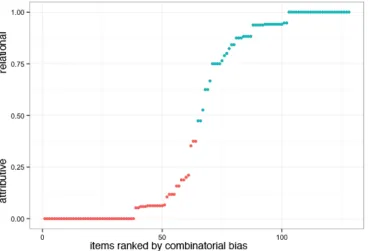
Figure 1 shows the distribution of attributive and relational bias by item,
order-ranked from unanimously attributive interpretations to unanimously relational
interpretations. The average “relational bias” for an item categorically labeled as
relational in the Estes and Wisniewski & Love studies was 89.6% (SD = 0.14); likewise,
the average “attributive bias” for an attributive item was 94.5%, (SD = 0.10). Despite
having identified 128 items from the Mechanical Turk survey as relatively biased towards
either relational or attributive meanings, additional responses from fMRI subjects
24
while the item “cow parsnip” was originally designated as relational-biased (example
interpretation: “a parsnip fed to a cow”), as was “pine mushroom” (e.g. “mushroom that
grows on pine trees”), additional responses indicated these items were equally likely to
have attributive readings, where interpretations such as “a parsnip shaped like a cow,”
and “mushroom that looks like a pine cone” were offered for “cow parsnip” and “pine
mushroom,” respectively.
Figure 1. Plot of relational-attributive combinatorial bias (normed on 35 participants,
inclusive of 18 fMRI subjects). Figure 1 shows the distribution of attributive and
relational combinatorial bias by item, order-ranked from unanimously attributive
(relational bias = 0) interpretations to unanimously relational (relational bias = 1)
25
Wisniewski & Love (1998) studies and red indicates those marked as attributive in those
studies.
Experimental Task and Design
The subject’s task on each trial was to read two simultaneously centrally presented words
constituting a nominal compound and indicate by button press (1) when they had decided
on a coherent meaning for the compound and (2) whether a subsequent “probe” matched
the meaning they had in mind. The nominal compound was presented for 2 seconds, and
was immediately followed by a fixation cross, on screen for 6 or 8 seconds, during which
time the subject need only passively view the screen. This fixation period was followed
by a probe phrase, which either matched the modal interpretation for a given item (as
determined in the Mechanical Turk survey; e.g. “a prickly carpet” for “cactus carpet”) or
was a dispreferred interpretation (e.g. “a carpet on which a cactus stands” for “cactus
carpet”), where one out of eight trials had a dispreferred probe. This was followed by a
6-8-second fixation-cross ITI. The entire experiment consisted of 8 runs of 16 trials each.
After leaving the scanner, subjects were given a questionnaire which asked them to write
down what they had thought each nominal compound meant when they had viewed them
in the scanner.
Image acquisition
FMRI data were collected at the Hospital of the University of Pennsylvania on a
3T Siemens Trio System using a 32-channel multiple-array head coil. Four types of
26
anatomic localizer; (2) a high-resolution, T1-weighted sequence for localization of fMRI
activity in standard stereotactic space; (3) T2*-weighted images from 9 experimental
runs; (4) a B0 field map sequence for subsequent geometric unwarping of T2*-weighted
images.
After acquiring T1-weighted anatomical images (TR=1630 ms, TE=3.11 ms, TI =
1100 ms, voxel size = 0.9 mm x 0.9 mm x 1.0 mm, flip angle 15°), we collected
T2*-weighted images using a gradient-echo echoplanar pulse sequence (TR=2000 ms, TE=30
ms, voxel size=2 mm x 2 mm x 2 mm, flip angle = 60°, BW = 1578 Hx/Px, 60 slices,
with a multi-band acceleration factor of 3).
Analysis
Image analysis and ROIs
FMRI data were pre-processed offline using the AFNI (Cox & Jesmanowicz,
1999) software package. The first four volumes of each functional run were removed so
as to allow the signal to reach steady-state magnetization. Functional images were
slice-time corrected, and a motion correction algorithm employed in AFNI registered all
volumes to a mean functional volume. Images were then unwarped via B0 field maps
(using FSL software; http://www.fmrib.ox.ac.uk/fsl) to reduce non-linear magnetic field
distortions. We applied a high-pass filter of 0.01 Hz on each run to remove low
frequency trends. Functional data were registered to the individual subject’s anatomical
27
Our a priori ROIs were left and right anterior temporal lobes and left and right
angular gyri, which we delimited using AFNI’s CA_ML_18_MNIA atlas. Our anterior
temporal ROIs spanned labels “left/right temporal pole” and “left/right medial temporal
pole”, while our angular gyrus ROIs circumscribed only the atlas’s “left/right angular
gyrus” ROI (see Figure 2).
Using AFNI’s TENT function, we modeled the hemodynamic response function
(HRF) as a finite impulse response (FIR) basis set fit to each condition, with bin-width
equal to the 2-second TR, and 9 knots (TRs) modeled for a given trial. We used the full
individually fitted 9-knot FIR HRFs to assess differences in the shapes and timecourses
of the BOLD responses to attributive and relational compounds (see below); however, for
our initial voxel selection and our analysis of relational-attributive combinatorial bias, we
collapsed the FIR output: While the FIR model outputs 9 TENT functions and thus 9 beta
estimates per condition per voxel, we selected the beta estimate of the largest magnitude
(positive or negative) within a given TENT series such that our design matrix had one
beta estimate per condition per voxel.
To identify task-activated voxels for inclusion in further analysis, we first
conducted a GLM with FIR regressors for task and fixation ITI. The task TENT series
was time-locked to the onset of the nominal compound, and the ITI TENT began at the
onset of the fixation ITI (10-12 seconds after the onset of the nominal compound). To
investigate effects of relational-attributive combinatorial bias in each ROI, we used a
model with covariates for task and jittered probe event, where task TENTs were again
28
of the probe question (8-10 seconds post compound onset), along with a continuous
covariate for the relational-attributive bias (see Figure 1) of the noun compound in each
trial. Head movement and global signal were included as covariates of no interest in both
models.
In addition to investigating effects of relational-attributive bias, we also utilized
subjects’ post-scanning surveys to label each item/trial as relational or attributive based
on individual subjects’ responses. We then extracted the peristimulus BOLD signal
timecourse starting at the onset of each trial, where TR0 was the onset of presentation of
the noun compound, to TR8 post-stimulus onset (total of 9 TRs). TR0 was subtracted
from each condition so that the starting point of the BOLD time series was aligned across
conditions (Staresina, Fell, Do Lam, Axmacher, & Henson, 2012). This is analogous to
the procedure of “baseline-correcting” in EEG analysis. Thus, only TRs 1–8 (2–16
seconds post stimulus onset) entered statistical timecourse analysis. We averaged FIR
parameter estimates across voxels in each ROI in the participant’s native space, and the
resulting values entered into subsequent BOLD timecourse analyses.
Results
Task-responsive voxels in anatomical ROIs
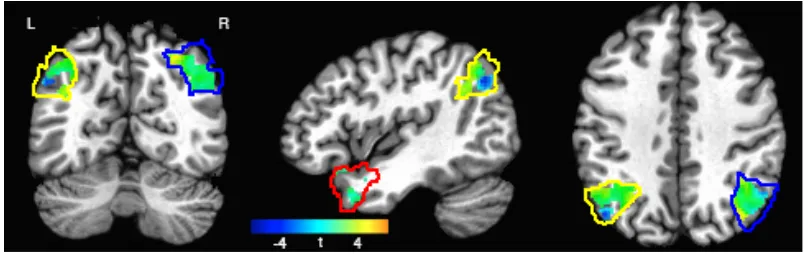
In a group-level contrast targeting bilateral AG and bilateral ATL, we found several
clusters of voxels with a reliable (p<0.01, uncorrected) activation difference between task
and ITI fixation baseline, where the task condition collapsed attributive and relational
29
cluster was positively activated for task relative to baseline (cluster centroid: [-45 -54 38]
Talairach coordinates) and another more posterior, inferior cluster that was more active
during baseline relative to task (cluster centroid: [-39 -67 35] Talairach coordinates). This
motivated us to treat positively and negatively activated task-responsive voxels as distinct
functional subregions within the anatomical left AG ROI. Other clusters in right AG and
left ATL were largely positively task-responsive, and so did not prompt any functional
division between above- and below-fixation task activation (see Figure 2). No significant
task-responsive clusters survived even a liberal threshold in right ATL, and so this
anatomical region was not analyzed further.
Figure 2: Task-responsive voxel activity (task vs. ITI fixation baseline) in left ATL (red),
left AG (yellow), and right AG (blue) at Talairach coordinates [-45 -57 38].
Combinatorial bias predicts activity in left and right AG
For each subject, we identified the 50 most positive task-responsive voxels in each of our
three ROIs: right AG, left AG, and left ATL. We also identified the 50 most negative
task-responsive voxels in left AG, for a total of four functional ROIs. The location and
30
ROI, precluding clear anatomical delineation of positive vs. negative task-responsive
regions within left AG for a given subject, even though group-level clusters suggest an
anatomical divide along PGa/PGp (Noonan, Jefferies, Visser, & Lambon Ralph, 2013;
see Discussion). Within each of four 50-voxel ROIs in each subject, we examined the
subject-wise effect of relational-attributive bias (referred to henceforth as simply
“combinatorial bias,” see Fig. 1) on BOLD signal amplitude.
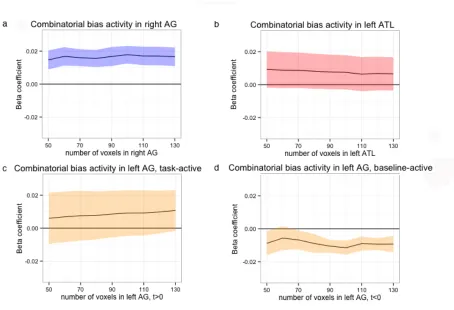
Within the 50 most task-responsive voxels in right AG, we found a significant
main effect of combinatorial bias (t(17) = 2.44, p=0.01), and this effect obtained for a
wide range of ROI sizes within right AG (see Fig. 3a). No such effect was observed in
responsive voxels in left ATL (t(17) = 0.84, p=0.20; see Fig. 3b) or in positive
task-responsive voxels in left AG (t(17) = 0.38, p=0.35; see Fig 3c). Activity in those 50
voxels that responded most negatively to task (relative to baseline) in left AG was
marginally predicted by combinatorial bias (t(17) = 1.23, p=0.11). A significant main
effect of combinatorial bias emerges when the size of the negatively task-responsive left
AG ROI is increased to 90 voxels (t(17) = 2.73, p=0.005), and this effect is also reliable
for ROI sizes larger than 90 voxels (p<0.01, see Fig. 3d).
In order to compare combinatorial bias effects across ROIs, we conducted an
ANOVA between ROI (right AG, left AG positive, left AG negative, and left ATL) and
the degree to which combinatorial bias predicted BOLD signal amplitude. Combinatorial
bias coefficients differed significantly across ROIs (F(3, 34) = 3.79, p=0.02). Post hoc
t-tests between pairs of ROIs revealed that combinatorial bias coefficients in right AG
31
(t(34) = 2.54, p=0.02), while coefficient differences between other ROI pairs were not
significant. When disregarding the direction of task-responsiveness, there are no
significant differences in the magnitude of these effects.
Figure 3. Beta coefficients from subject-wise parametric analysis of voxel activity by
combinatorial bias (see Fig. 1) across a range of voxels within (a) right AG, (b) left ATL,
(c) left AG, positively responsive voxels only, and (d) left AG, negatively
task-responsive voxels only. Voxels chosen by most positive (or, in (d), negative) t statistics
for the task-vs.-baseline contrast (see Fig. 2) in each anatomical ROI. Error ribbon
indicates +/-1 SEM.
32
In light of the evidence that combinatorial bias predicts the magnitude of the
response in both left and right AG, we further investigated whether relational and
attributive combination effects might also show distinct temporal BOLD profiles across
ROIs. Using the same task-responisve voxel selection criteria as above, we compared the
timecourse of BOLD activity for relational and attributive combinations in the 50 most
task-responsive voxels in right AG, left AG (negatively task-responsive voxels only), and
left ATL. In this analysis, we treated relational and attributive combination categorically,
coding each trial condition based on individual subjects’ responses in a post-scan survey.
Activity for relational combination significantly differed from attributive
combination between 6 and 12 seconds post stimuls onset in both right AG and left AG
(p<0.05; see Figure 4). Interestingly, activity associated with attributive combination was
greater than relational activity in left ATL at a markedly early 4 seconds post-stimulus
onset (p<0.05).
Examining the latencies of each subject’s effect peak (using a nonparametric
Wilcoxon signed rank test), we found that the response to attributive trials peaked
significantly earlier than the relational effect in left ATL (p = 0.01). This is not due to
differences in subjects’ attributive and relational response times, as we observed no
significant difference in RT between conditions (t(17) = 0.51, p = 0.61; Mattributive = 2.65 s
(SD = 0.28); Mrelational = 2.70 s (SD = 0.26)). Time-to-peak analysis also revealed that
both conditions peak earlier in left ATL than in right AG (p<0.01). While inferring
33
provides intriguing evidence that left ATL may also encode a distinction between
attributive and relational combination in addition to bilateral AG.
Figure 4. Peristimulus FIR curves of attributive (red) vs. relational (blue) activation in
each ROI. FIR curves shown are from the 50 most positively task-responsive voxels for
the task-vs.-fixation contrast in each anatomical ROI, except for left AG, where only the
50 most negatively task-responsive voxels are shown. Attributive and relational
34
surveys. Error bars indicate +/-1 SEM. Asterisks indicate significant effect of condition
at given time point (p<0.05).
Upper panel: Right AG; Middle panel: Left AG; Lower panel: Left ATL.
Discussion
This study sought to determine whether, and how, relational and attributive
interpretations of nominal compounds differentially engaged putative “semantic hubs,”
the left ATL and bilateral AG. We found evidence that both relational and attributive
processes engaged ATL and AG, but that each brain region responded very differently to
the relational-attributive dichotomy. Both right and left AG showed differential
responses to relational and attributive compounds, with relational compounds diverging
more from the baseline period than attributive compounds. However, while right AG
responded more to both compound types than to baseline, the direction of this activation
was reversed in left AG, such that left AG responded more at baseline than to compound
interpretation. This profile of activation in left AG was consistent with its role in the
so-called default network. Left ATL did not show a combinatorial bias effect per se, but the
time course of individual subjects’ BOLD response curves indicated that attributive
interpretations induced an earlier peak response than relational interpretations. Thus,
while the magnitude of response in left and right AG was greater to relational
combination than attributive combination, the timing, but not the magnitude, of left ATL
response varied across the two combination types .
These combined findings support an account whereby relational and attributive
35
differently in different regions. The multiple, potentially redundant, instantiations of a
combinatorial relational-attributive code across the brain provide compelling evidence
that the relational-attributive distinction is a productive one. While these data suggest that
bilateral AG is more engaged in computing relational combination, comparison with the
left ATL profile does not constitute a true double dissociation between relational and
attributive processes. While we do not find evidence to support a full dual-route, parallel
process model of relational and attributive processing, we find that these combinatorial
operations may be instantiated in overlapping networks across ATL and AG. The time
course of attributive and relational BOLD response in the left ATL is also consistent with
a serial, potentially single-process model. Interestingly, the serial process implicated here
is the opposite of the CARIN model (see Introduction): while the latter predicts that
attributive “relations” are the interpretations of last resort – i.e. attributive associations
are only analyzed after other relations are considered – we instead find evidence that
attributive processing precedes relational processing. This finding is more consistent with
accounts holding that attributive feature extraction is necessarily prior to computing
functional relations between concepts.
Angular gyrus and thematic relations
AG sensitivity to thematic relations as verbs
Bilateral AG, and more prominently left AG, have been implicated in a wide
range of linguistic and non-linguistic semantic processes (see Seghier, 2012, for review),
but our study pursues an emerging hypothesis that AG specifically subserves the
36
activated by thematic role information carried on verbs in particular. For instance, in one
group of studies, experimenters looking at 1-, 2-, and 3-argument verbs (that is,
intransitive, transitive, and ditransitive verbs, respectively) found that activation in
bilateral angular and supramarginal gyrus (BA 39 and 40) correlated parametrically with
the number of thematic roles that can attach to a given verb, even when the verb was
presented in isolation (Meltzer-Asscher, Schuchard, den Ouden, & Thompson, 2013;
Thompson et al., 2007; Thompson, Bonakdarpour, & Fix, 2010). Boylan, Trueswell, &
Thompson-Schill (2015) also found that multi-voxel patterns in left AG tracked
information relating to the presence of a shared verb in pairs of two-word phrases,
demonstrating that AG represents information specific to verbs, perhaps event structure
or thematic relations mediated by verbs.
While left AG has been implicated in the detection of syntactic errors (Embick,
Marantz, Miyashita, O’Neil, & Sakai, 2000), it is also involved in the detection of
semantic incongruities (Friederici et al., 2003; Newman, Pancheva, Ozawa, Neville, &
Ullman, 2001; Ni et al., 2000) as well as the processing of connected discourse as
opposed to unrelated sentences (Fletcher et al., 1995; Homae et al., 2003; Xu et al.,
2005). This suggests that the sensitivity of AG to thematic roles and verb structure is not
limited to the syntactic composition alone, but also to the semantic content (Pallier et al.,
2011). It may be that left AG acts as an interface between semantic memory and
syntactic structure, mapping semantic-thematic relations onto structural constraints
surrounding verbs and their arguments. Indeed, electrophysiological and neuroimaging