Cooperative Learning With a Focus on the Social:
A Pedagogical Proposal for the EFL Classroom
Aprendizaje cooperativo con un enfoque social: una
propuesta pedagógica para la clase de inglés
*
Janeth Juliana Contreras León
[email protected] Colegio Bravo Páez IED, Bogotá, Colombia
Claudia Marcela Chapetón Castro
[email protected] Universidad Pedagógica Nacional, Bogotá, Colombia
This article is a report of a pedagogical intervention which was developed with a group of seventh graders during their English as a foreign language class in a public school in Bogotá. It is part of an investigation in which the main purpose was to foster students’ classroom interaction through the use of cooperative learning principles from a dialogical perspective that focused on social aspects of students’ school lives. Thus, the instructional design incorporated a methodology that focused on the students’ realities and provided opportunities for dialogue, cooperation, and reflection. From a pedagogical perspective, this experience promoted changes in the classroom practices allowing a new vision of group work, encouraging personal growth and social awareness among participants.
Key words:Classroom as social reality, cooperative learning, English as a foreign language, critical pedagogy.
* Received: November 11, 2015. Accepted: June 24, 2016.
How to cite this article (APA 6th ed.):
Este artículo es un reporte de una intervención pedagógica que se desarrolló con un grupo de estu-diantes de séptimo grado durante sus clases de inglés como lengua extranjera, en una escuela pública de Bogotá. Esta experiencia es parte de una investigación en la que el objetivo principal era fomentar la in-teracción en el aula a través del uso de aprendizaje cooperativo desde una perspectiva dialógica, que se centró en los aspectos sociales de la vida escolar de los participantes. Por lo tanto, el diseño instruccional incorporó una metodología enfocada en la realidad escolar y brindó oportunidades para el diálogo, la cooperación y la reflexión. Desde una perspectiva pedagógica, esta experiencia promovió cambios en las prácticas de aula que permitieron una nueva visión del trabajo en grupo, fomentando el crecimiento personal y la conciencia social entre los participantes.
Palabras clave:aprendizaje cooperativo, aula como realidad social, inglés como lengua extranjera, pedagogía crítica.
Introduction
According to Vygotsky (1978), Malamah-Thomas (1991), and Tarone (2007), language learning is a social process that is achieved through interaction. The development of interaction creates opportunities to develop communicative skills and to acquire the ability to establish and maintain personal relationships. Unfortunately, at most Colombian public schools, students face a socially deprived setting characterized by different social and economic adversities such as urban violence, low-income and one-parent families, poor housing conditions, and few opportunities for social promotion (Guzmán, 2006; Palacios & Chapetón, 2014; Parga, 2011; Rojas, 2015). Students’ interaction in many English as a foreign language (EFL) classrooms reflect the social context and the realities that students are facing and living, thus engaging in disrespectful behaviors or disturbing attitudes and activities such as disruptive talking, clowning, verbal insults, rudeness, and bullying that hinder the teaching and learning processes. Students, in this type of setting, are found to be displaying a lack of social skills which are evidenced when a person does not have the necessary abilities to get along with others and to create and maintain relationships (Areritola, Breen, & Paz, 2009).
Consequently, it is necessary to examine alternatives that can help teachers to deal with these problems given that classroom interaction is an essential part of anEFLteaching and learning process and that, at public schools, the students’ exposure to the language occurs mainly in the classroom.
In this article we focus on the construction, implementation, and achievements of the pedagogical intervention as an experience that can be useful for teachers who are interested in fostering social interaction and cooperative learning in their teaching practice.
Fundamental Concepts
Critical Pedagogy: An Opportunity for Social Change
Freire and Shor (1987) define critical pedagogy as an active pedagogy which enables students to become truly participatory members of a community who not only belong to the society but who can create and re-create knowledge and society in and outside the classroom. Freire (2002) proposes a dialogical education, or liberating education, that transcends to an education of questioning. It is based upon dialogue that seeks not only to increase active student participation in the classroom, but also to develop a critical social consciousness among students.
This approach, as Freire (2002) claims, enables the humanization of teachers and students and the transformation of classrooms that encourage students to understand and transform their reality. He conceives education a liberatory process where learners come to consciousness, and a liberating teacher is one who uses questions to develop a dialogue with his/her students. This dialogue allows the development of a critical consciousness. In a dialogic process, students become active agents in their learning process. In that sense, education becomes the means to transform social reality.
It is our belief that the first step to adopt this perspective is to become aware of the world in which students live in order to develop meaningful learning by means of reflection and dialogue. This critical perspective constitutes the central part of this pedagogical intervention that aims to value students’ voices, beliefs, attitudes, knowledge, and experiences, and seeks the development of students’ critical consciousness as well as their social skills through the implementation of cooperative learning.
Cooperative Learning: A Social Learning Approach
According to Smith and MacGregor (1992), cooperative learning is a form of collaborative learning that involves groups of students working together to develop a specific activity. By working together, students are involved in supportive environments that promote interaction and scaffolding, they get the basis for interacting, practicing different teamwork skills, taking active part in the learning process, and taking responsibility for their learning.
Cooperative learning provides an excellent opportunity to acquire social skills while participants work in groups, improve their oral communication skills, and go beyond the linguistic aspect promoting better relationships and having a better classroom atmosphere, and this process is developed simultaneously. Through interaction and group work students discover ways of being on task, supporting each other, and learning in a meaningful way.
Classroom Interaction at the Heart of Communication
Language learning as a social process implies interaction as a key element, which requires the presence of two or more learners to achieve communication (Malamah-Thomas, 1991). Brown (1994) stresses that interaction is the heart of communication and the communicative purpose of language should be to create opportunities for genuine interaction in the classroom.
Various researchers (e.g., Castellanos, 2002; González, 2001; Parga, 2011) have investigated the importance of classroom interaction in building knowledge about the language and developing skills that will help learners improve their communicative competence and establish and maintain personal relationships.
Following Freire’s (2002) ideas of critical pedagogy and keeping in mind that a real classroom interaction is not a recitation exercise, interaction in this pedagogical intervention is seen as an opportunity for participants, both students and teacher, to express their own ideas or comment on those of others in a dialogical co-construction of knowledge. It is a cyclical process of interaction which means that the initiator of the interaction can be the teacher or the student and that there are no predicted or mechanical responses but a dialogical cycle of action and reflection where students can have an active role that allows for active participation and their voices can be heard.
The Pedagogical Intervention
describing the purpose, the construction and development of the different cycles, the topics, pedagogical objectives andEFLcomponents that got built into the implementation.
Context and Participants
This pedagogical experience took place at a public school located in the south-east of Bogotá, Colombia. The participants were a group of 30 students from seventh grade, 19 male and 11 female, aged 12 to 15. The school has an English program that places students into three different levels: basic, intermediate, and advanced; according to this classification, the participants were in basic level. These students were chosen because the disrespectful behaviors were more evident in the lower secondary grades, and particularly in this basicEFL
class of seventh graders.
Visions Behind the Implementation
Taking into account that this pedagogical experience aimed to foster students’ classroom interaction through cooperative learning principles from a dialogical perspective, one sees it was designed and implemented having in mind a specific curricular platform that included particular visions of curriculum, language, learning, and classroom.
Vision of Curriculum
As this pedagogical intervention is framed within a critical pedagogy approach, it takes a curriculum perspective that promotes a social construction of knowledge and the development of students’ critical consciousness. Grundy (1987) suggests a curriculum as praxis, where teachers promote reflection and action and encourage dialogue with students. This perspective proposes a transformation in education, going against a banking education where, as Freire (2002) states, the teacher attempts to transfer knowledge and the learner is considered a passive empty receiver of that knowledge and, although students face different kinds of social situations in their lives, these situations are not taken into account.
Vision of Language
As teaching a language is a complex process, there is no unique vision of it and, as Tudor (2001) mentions; a full mastery of language involves the mastery of all the elements that language implies. According to Tudor, language is a system, a means of “achieving functional goals, a means of self- expression, and the bearer of a set of cultural values and ideologies” (p. 65). This pedagogical intervention focused on language as self-expression.
This vision of language is embodied in the humanistic perspective. Tudor (2001) points out that language is “a medium by which we build up personal relationships, express our emotions, and explore our interests” (p. 65). The author discusses five main components which have underpinned most humanistic approaches to language teaching: (1)feelingswhich includes personal emotions and esthetic appreciation; (2) social relations that encourage friendship and cooperation; (3) responsibility that includes and accepts the need of public scrutiny, criticism, and correction; (4) intellect that includes knowledge, reason, and understanding; and (5)self- actualizationthat looks for full realization of one’s qualities.
Through this vision, it is possible to empower students, enabling them to be themselves and at the same time establish interpersonal relations in order to foster cooperative classroom interaction, which is the main goal of this pedagogical experience. The teachers’ purpose would be to create the possibility to foster and construct a safe and supportive environment in the classroom where the students could feel confident to express their ideas and respect others without fear or rejection.
Vision of Learning
The vision of learning embraced in this study is experiential which, according to Tudor (2001), implies that the learning process should foster the use of language as a means of communication. This vision is based on five principles: (1) focus on communication rather than learning about the language; (2) a holistic practice which reflects the multi-dimensional nature of normal communication; (3) the use of authentic material; (4) the use of communication strategies; and (5) the use of collaborative learning where interaction raises the learning processes.
ways of fitting the learning process in students’ needs, interests, and social contexts, so they can freely express their thoughts and opinions.
Vision of Classroom
The vision of classroom in this curricular platform includes two perspectives: the vision of classroom as a place for communication and the classroom as socialization. These two visions focus on two important aspects, namely interaction and social reality. Taking into account these visions, one sees that the classroom is a place of communication and also a social setting where language is a goal, but at the same time, it is a means of learning. According to Tudor (2001), “communication in the classroom was the preparation for communicative language outside the classroom” (p. 113), which means there should be a link between the communicative activities being developed in classes and participants’ real worlds.
Here the classroom is seen as a social and pedagogical entity. Thus, the language classroom reflects a vision of society, its beliefs and values that influence its dynamics. The classroom is a social reality which is influenced by a variety of participants. Through a process ofemergent socialization(Tudor, 2001), participants develop their own rules or norms that are not imposed but that have to be negotiated.1In this vision, the students become active agents
who question their reality in order to understand it and transform it.
From a critical perspective, a change from banking to a transformative education implies a self and social change, a student-centered classroom that encourages and respects the voices of students and promotes individual growth as an active, cooperative, and social being. Shor (1992) claims that “the learning process is negotiated, requiring leadership by the teacher and mutual teacher-student authority” (p. 16). In this sense, the classrooms must be places to question, examine, and relate reality to academic knowledge, letting students be part of the learning process.
Description of the Cycles: A Critical Dialogical Construction
This pedagogical intervention was systematized following the principles of action research, an approach which helps teachers to transform their practices by developing phases of planning, action, observation, and reflection. These stages were developed in four different cycles allowing for analysis and reflection on the information gathered and the activities developed in each cycle and, in that way, planning further action for the subsequent cycles.With a critical pedagogy perspective in mind, and as shown in Table 1, the cycles of this implementation were organized around topics and purposes that fostered cooperative learning, group work, and classroom interaction. These topics and purposes were articulated to theEFLcontents included in the course syllabus for seventh graders and were connected to the most immediate personal and social surroundings of the students (i.e., me, my class, my school, and my family).
Following Freire’s (2002) and Shor’s (1992) views of education, this pedagogical intervention focuses on the students’ reality and the ways in which pedagogy transforms that reality; and based upon dialogue, transcends to an education of questioning, reflection, and action. In relation to cooperative learning, we found it relevant to this experience since its principles help to fulfill the objectives established by critical pedagogy because as Gillies, (2007); Johnson, Johnson, and Holubec (1994); and Kagan (1992) highlight, it promotes dialogue, increases active student participation in the classroom, and facilitates the development of social skills.
The purpose thus, was to provide opportunities for students to know, understand, and transform their reality and develop social skills while using the foreign language to express themselves. Table 2 shows a summary of the pedagogical intervention, including the cycles, the number of sessions and dates, the topics students developed through group work, the pedagogical objectives, and theEFLcomponent developed in each session which is expressed in terms of communicative functions of language.
Table 1.Pedagogical Intervention: Cycles, Topics, Pedagogical Objectives, and EFL Component
Cycle Session
date Topic
Pedagogical objectives Related EFL component
Exploratory
C
ycle
1 Feb. 25
Getting to know each other
•To get to know one another and enhance empathy among students. •To introduce classmates to
the rest of the class.
•Asking and giving personal information about others. •Introducing other people. 2
March 4
3
Cycle Session
date Topic
Pedagogical objectives Related EFL component
Cycl
e
1
4 April 15
Me, my team, and my class
•To build teams. •To get to know team
members. •To identify team
commonalities based on preferences among the members of the team.
•Asking and giving personal information about myself and others.
•Expressing preferences related to food, sports, TV programs, leisure activities, clothes, color, place to be, song, school subject, movie, and person to visit.
•Identifying team commonalities.
5 April 25
•To choose a team name and select students’ roles. •To identify team qualities
required to work together.
•To design name tags and a group emblem.
•Talking about possible names for their group and the roles in a group (manager, time keeper, speaker, go for, praiser, etc.). •Identifying the team qualities. •Identifying and describing
simple objects (emblem and name tags).
6 May 6
•To establish agreements to work and to interact in small groups.
•Talking about group and class agreements.
•Making decisions about agreements that foster group work and class interaction.
7 May 20
•To establish agreements to work and to interact in the classroom.
Outcome: Poster design.
Cycl
e
2
8 Aug. 8
Me and my school community
•To understand and define the word “community”. •To get to know the school
community.
•To interview the school community.
•Understanding and expressing ideas about community. •Identifying the school
community.
Cycle Session
date Topic
Pedagogical objectives Related EFL component
Cycl
e
2
9 Aug. 15
Me and my school community
•To reflect upon the school community: roles and responsibilities •To reflect upon the
students’ roles, rights, and responsibilities at school.
•Identifying the school community: work places, roles, and responsibilities.
•Talking about the students’ role, rights and responsibilities at school.
10 Sept. 2
Rights and responsibiliti-es at School
•To understand and define rights and responsibilities in general.
•To reflect on the importance of rights and responsibilities in general.
•Understanding and identifying rights and responsibilities. •Talking about the importance
of rights and responsibilities.
11 Sept. 19
•To reflect upon students’ rights and responsibilities at school.
•To analyze the rights and responsibilities included in the School Handbook. •To propose actions to
contribute to the care of the school.
•Identifying the students’ rights and responsibilities at school. •Expressing their opinions about
their rights and responsibilities at school.
•Talking about actions to contribute to the care of the school. Outcome:Friso Cycl e 3 12 Oct. 17
Me and my family
•To reflect on the family as a community and its importance in our lives. •To describe the members of
the family and write a short paragraph about them.
•Understanding and talking about family and its importance in our lives.
•Identifying and giving information about the members of the family (name, age, place of birth, occupation,
personality, favorite activity and dreams).
13 Oct. 21
•To identify and reflect on the qualities that a family should have.
•To propose actions to promote those qualities in the family.
•Identifying and expressing their opinions about the qualities that the family should have. •Talking about actions to
Cycle Session
date Topic
Pedagogical objectives Related EFL component
Cycl e 3 14 Oct. 28 Rights and responsibiliti-es in my family
•To reflect upon the rights and responsibilities of the members of the family. •To reflect on students’ own
rights and responsibilities in relation to the family. •To propose actions to
contribute to the family as a community and improve the family relationships.
•Identifying and describing the rights and responsibilities of the members of the family. •Identifying and describing
students’ rights and responsibilities in the family. •Talking about actions to
contribute to the family as a community and improve the family relationships.
15 Nov. 14
Our
Handbook Outcome:Handbook Creation
16 Nov. 25
Socialization of the project
•To organize an oral presentation to share the outcomes of the intervention.
•To explain and describe to the school community the group work developed during the pedagogical intervention.
•Talking about what the students did during the pedagogical intervention.
•Expressing their opinions and feelings about this experience.
The instructional design was thus composed of four cycles with sixteen sessions developed in sixteen weeks. There was an initial exploratory cycle called “Getting to know each other” developed in three sessions. Here, the students introduced themselves, met their classmates, and shared personal information. During this process, their interactions were systematically observed and, through a questionnaire applied at the end of this initial cycle, we gathered their personal information, information about their family and school contexts, and about their relationships at school and family levels. Based on this preliminary observation and the information gathered through the questionnaire, we could choose the main topics that were to be developed in each subsequent cycle.
objectives that aimed at fostering group work, cooperative learning and social skills while encouraging students to use the foreign language to share and construct meaning.
The key moments of each cycle.Additionally, each cycle was developed in three main moments that helped us involve students’ reality in the learning process and plan activities that engaged students in a permanent dialogical process of reflection that let them know, understand, and propose actions to transform their reality. These moments in which the complete pedagogical experience was framed were:reading the world,learning about the world, and
changing the world. In the first moment,reading the world, the students focused on their particular reality and explored and learned more about it. They had the opportunity to activate their previous knowledge about the reality analyzed and link it to the new ideas introduced in each cycle. Then, in the second moment,learning about the world, the students could learn about specific aspects related to each context that let them understand their reality. Finally, in the third moment, changing our world, students reflected on what they had learned in order to propose actions to transform it. Table 2 shows how these moments were developed in each cycle.
Table 2.The Cycles and the Central Moments
Cycles Moments Description
1
Me, my team, and my class
1. Reading the world Exploring group work andrecognizing myself and others.
2. Learning about the world
Learning about the roles and responsibilities in a group and choosing them according to my own and others’ qualities and abilities.
3. Changing our world
Reflecting on the qualities that the group should have.
Making decisions and proposing agreements to work, interact, and have better relationships with the team members, based on the group characteristics.
2
Me and my school community Rights and responsibilities at school
1. Reading the world Exploring the concept of community
Cycles Moments Description
2
Me and my school community Rights and responsibilities at school
2. Learning about the world
Learning about the school community, its members, their work places, and roles.
3. Changing our world
Reflecting upon students’ own and others’ rights and responsibilities at school.
Proposing actions to contribute to the care of the school.
3
Me and my family
Rights and responsibilities in my family
1. Reading the world
Talking about the family as a community and discussing its importance in our lives.
2. Learning about the world
Learning more about students’ family members (their responsibilities, their dreams, and their favorite activities).
3. Changing our world
Reflecting on the qualities that a family should have, their roles, rights, and responsibilities within their household.
Proposing actions to have a better relationship with their relatives.
Cycle 1 was divided into four sessions, the students started the process of working in groups following the principles proposed by different experts in cooperative learning such as Gillies (2007), Johnson et al. (1994), and Kagan (1992).These authors have identified three main types of groups: formal, informal, and base groups. Because of the purpose of this pedagogical intervention, the students were organized in base groups, where students worked for a long period of time and followed a continuous process of work because their members were permanent. In the first moment of this cycle,reading the world, the students reflected on group work, they talked about how they usually work in groups and, the teacher and the students discussed the real meaning of working in groups. Then, the students decided and proposed how to choose the members of their groups and got to know each other as a group. They shared their personal information, talked about their preferences, and identified their common aspects. Then, each group selected a name that represented them as a group.
At the second moment, students learned about the roles and responsibilities that they were going to have within the group. They learned about them through a puzzle where they identified ten roles and their definitions. The roles were: manager, reader, checker, speaker,
identify each group and its members, each student designed a name tag with the name of the group, an emblem, and his/her roles (see Figure 1). Finally, at the third moment, the students were encouraged to reflect on the qualities that their groups should have, make decisions, and propose agreements to work, interact, and have better relationships in their groups and in the classroom (see Figure 2). By means of the activities proposed in this cycle, the students used the foreign language to express their ideas and opinions. Through the foreign language, they asked and gave information to know each other and used the vocabulary related to roles and qualities. As a final product for this cycle theartistsof each group got together in order to design a poster with the group and class agreements.
Cycle 2 was divided into four sessions. Whenreading the world, students shared their ideas and gave examples of communities, and compared their ideas with a definition given by the teacher to propose a new definition. In the second moment, learning about the world, the students had the opportunity to learn about the school community through an interview. Each group selected the person that they were going to interview, and the students designed the questions and the guidelines for the interview. Each group shared the information collected with the rest of the class through a jigsaw activity.2Then, students came back to
their original groups and used the information gathered to talk about the school community members and their work places. In the third moment,changing our world, they reflected upon their own and others’ rights and responsibilities at school and how they could contribute to the school. They listed some students’ rights and responsibilities and then compared them with the ones written in the School Handbook. As a final product of this cycle the students made a frisothat included the summary of the reflective work developed in the different
2 The jigsaw is a cooperative learning activity in which the members of different groups get together as pieces in a
sessions about their roles, rights, responsibilities in the school, and their actions to contribute to the school community. Each group was encouraged to explain its friso to the whole class using the foreign language (see Figure 3).
Cycle 3 was developed in five sessions. In the first moment, the students and the teacher talked about the family as a community; we then discussed its importance in our lives. In the second moment, the students interviewed their families, made a family tree, and wrote short paragraphs with the information collected. Then, in the third stage, they reflected on the qualities that a family should have, their roles, rights, and responsibilities within their household, and the students proposed actions to have a better relationship with their relatives. The students had the opportunity to use the foreign language to describe and share the information collected about their families, express their ideas about their rights, responsibilities, and planned actions.
The last two sessions closed the pedagogical intervention and let the students gather and share all the work developed during these cycles in two activities. The first activity was the creation ofOur Handbookthat was the final product of this cycle. Here, the students recorded the agreements and actions they decided to implement in their groups, in the classroom, at school, and in their homes to transform and improve their social relations as well as their contexts. Each group presented the handbook to the whole class and was motivated to use English to do that.
The second activity was the socialization of the pedagogical intervention with the school community. The students showed their work, shared it, and talked about their experience during the pedagogical intervention. A leaflet was designed in order to invite the whole school community to the event, which was held on November 25 in the English classroom.
Lesson Plans as Key Articulating Elements
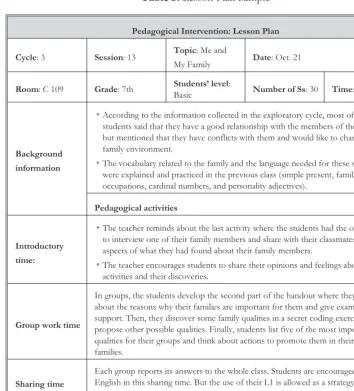
In order to further articulate the critical pedagogy perspective with the pedagogical purposes and the construction of the cycles, lesson plans were drawn up as key elements in this intervention. Thus, handouts were designed and developed in class sessions (see sample in Appendix) along with lesson plans for each cycle and for the last two sessions, which closed the pedagogical intervention. Lesson plans included a background information section plus four other sections that were developed in each session. There was anintroductory timewhere the teacher gave guidelines to develop the activities and both the teacher and students could make decisions and adjustments. In the second section called group work time, the activities were developed to be worked in groups, so the students got together to develop the activity which included the EFL component. There was also asharing time, where each group presented its work to the rest of the class. Finally, a group and individualreflection time, where the students were encouraged to reflect upon their individual and group work performance and on the activities developed. These sections were helpful to organize the contents of the cycles and sessions taking into account the three main moments of each cycle, cooperative learning, and classroom interaction from a critical pedagogy perspective.
Table 3 presents a sample of the lesson plans developed in one of the sessions from Cycle 3. This sample of a lesson plan includes the pedagogical activities and the sections explained before.
Table 3.Lesson Plan Sample
Pedagogical Intervention: Lesson Plan
Cycle: 3 Session: 13 Topic: Me and
My Family Date: Oct. 21
Room: C 109 Grade: 7th Students’ level:
Basic Number of Ss: 30 Time: 100 min.
Background information
•According to the information collected in the exploratory cycle, most of the students said that they have a good relationship with the members of their family, but mentioned that they have conflicts with them and would like to change their family environment.
•The vocabulary related to the family and the language needed for these sessions were explained and practiced in the previous class (simple present, family members, occupations, cardinal numbers, and personality adjectives).
Pedagogical activities
Introductory time:
•The teacher reminds about the last activity where the students had the opportunity to interview one of their family members and share with their classmates some aspects of what they had found about their family members.
•The teacher encourages students to share their opinions and feelings about these activities and their discoveries.
Group work time
In groups, the students develop the second part of the handout where they write about the reasons why their families are important for them and give examples to support. Then, they discover some family qualities in a secret coding exercise, and propose other possible qualities. Finally, students list five of the most important qualities for their groups and think about actions to promote them in their own families.
Sharing time
Each group reports its answers to the whole class. Students are encouraged to use English in this sharing time. But the use of their L1 is allowed as a strategy to share and construct meaning.
Reflection time •Each group fills in the group reflection form.
•Students write in their journals their reflections about their work and the activity.
Discussion of the Pedagogical Experience
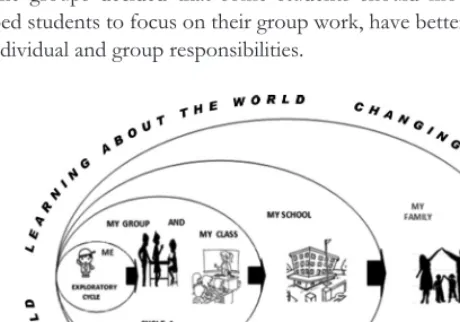
experience, there was a gradual process that moved students to a broader sphere of their realities in each cycle. This let them explore and reflect on their worlds and, at the same time, use the foreign language to do so. Figure 4 has been designed to show a visual representation of the intervention. Since each cycle was developed in three moments, these encapsulated the whole process that started with the exploratory cycle. This cycle is represented in the smallest oval, here, and individual recognition of the student as a person and as part of the group of students was encouraged. Then, in Cycle 1, the students fostered group and class work and established a better relationship with their teams and classmates. Cycle 2 moved students to a wider context which was the school. They could go beyond the classroom; they knew the school community and recognized themselves as part of it. Finally, in Cycle 3 students had the opportunity to know their family members better, reflect upon their family relationships, and propose actions to improve those relations, thus going beyond the school context.
This pedagogical intervention aimed at valuing students’ voices seeking the development of students’ critical consciousness, as well as their communicative skills, in a dialogical interaction among students, and between students and the teacher that could help them transform their attitudes and contexts. A change in attitudes was observed in different moments, especially when students were given opportunities to think about their actions and engage in dialogic interactions. For instance, before the second and third cycles, the teacher and the students talked and reflected upon their work and attitudes and, based on those reflections, the groups decided that some students should move to other groups. This decision helped students to focus on their group work, have better relationships, and reflect upon their individual and group responsibilities.
The pedagogical experience also showed that developing activities that take students beyond the classroom bounds can be very encouraging. As an example, students were motivated with the design and development of the interviews because it was the first time that they could go out of the classroom to get to know all the school community. Going around the school to interact with the community, wearing their name tags, gave them a sense of belonging and a feeling of responsibility as members of a group who have an active role. For this reason, students and the teacher decided to include interviews as an activity in the next cycle so that they could talk with and listen to family members to gather the information.
This dialogical perspective not only changed the teaching and learning practices allowing a balanced relationship among participants, and a new vision and practice of group work, but also encouraged personal growth, social awareness among students, and helped them communicate in the foreign language. In the different moments and stages of the intervention, students found themselves using language as a social practice and as a means to communicate and name the world.
Conclusions and Implications
This pedagogical intervention shows that it is possible to foster students’ interaction through cooperative learning from a dialogical perspective and go beyond traditional teaching practices common in public schools. Taking into account an approach in which language is viewed as a social practice where teachers encourage social awareness and promote spaces for interaction and critical reflection, it was possible to incorporate and articulate EFL syllabus contents with the students’ realities in order to help them understand and reflect upon those realities and become, little by little, active agents who can contribute to the transformation of their social contexts.
The English class could become a learning space that goes beyond grammatical and linguistic features of the language to promote critical and conscious agents that are able to use knowledge to transform their reality. As Chapetón (2007) asserts, the role of an English teacher goes beyond the instructional tasks and, although it is important to take into account the linguistic components, “the critical, living connections with the sociocultural and political arena of the realities we live in our country cannot be overlooked in education” (p. 101).
also need affection and care. Thus, by being conscious of the student’s reality, we can find ways to help our students to be better students, better citizens, and better human beings.
This pedagogical intervention has had an impact on our teaching practice. It has made us more critical of our practices helping us to gain understanding of the social issues present at the public school context and how these issues may influence the teaching learning process. It also provided important insights to foster student’s interaction and social awareness that deserve further exploration.
References
Areritola, K., Breen, J., & Paz, E. (2009).Increasing on-task behavior through the development of classroom social skills. Retrieved from ERIC database. (ED505020)
Brown, H. D. (1994).Teaching by principles:An interactive approach to language pedagogy.New York, NY: Longman.
Castellanos, A. (2002). Management of children’s aggressiveness when playing competitive games in the English class.PROFILE Issues in Teachers’ Professional Development, 3(1),72-77. Chapetón, C. M. (2007). Literacy as a resource to build resiliency. Bogotá, CO: Fondo Editorial
Universidad Pedagógica Nacional.
Freire, P. (2002).Pedagogy of the oppressed(30th anniversary edition). New York, NY: Continuum. Freire, P., & Shor, I. (1987).A pedagogy for liberation: Dialogues on transforming education.Westport, CT:
Bergin & Garvey.
Gillies, R. (2007). Cooperative learning: Integrating theory and practice. Thousand Oaks, CA: Sage. http://dx.doi.org/10.4135/9781483329598.
González, S. H. (2001). Encouraging interaction by applying cooperative learning.PROFILE Issues in Teacher’s Professional Development, 2(1), 28-30.
Grundy, S. (1987).Curriculum: Product or praxis?London, UK: Falmer Press.
Guzmán, E. (2006, March 18). Indiferencia hacia la Bogotá joven: la situación en Usme, Ciudad Bolívar y San Cristóbal [The indifference towards Bogotá’s youth: The situation at Usme, Ciudad Bolivar and San Cristobal].Desde Abajo, 110.
Johnson, D. W., Johnson, R. T., & Holubec, E. (1994).The new circles of learning: Cooperation in the classroom and school. Alexandria, VA: The Association for Supervision and Curriculum Development.
Kagan, S. (1992).Cooperative learning. San Clemente, CA: Kagan Publishing.
Malamah-Thomas, A. (1991).Classroom interaction.Oxford, UK: Oxford University Press. Palacios, N., & Chapetón. C. M. (2014). Students’ responses to the use of songs in the EFL
classroom at a public school in Bogotá: A critical approach.GIST Education and Learning Research Journal,9(July-December), 9-30.
Parga, F. (2011). Cooperative structures of interaction in a public school EFL classroom in Bogotá.
Rojas, L. F. (2015). Factors affecting academic resilience in middle school students: A case study.
GIST Education and Learning Research Journal,11(July-December), 63-78.
Sánchez, Y. (2011). Applying cooperative learning in large groups (Unpublished undergraduate monograph). Institución Universitaria Colombo Americana (UNICA), Bogotá, Colombia. Shor, I. (1992).Empowering education: Critical teaching for social change. Chicago, IL: University of
Chicago Press.
Smith, B. L., & MacGregor, J. T. (1992). What is collaborative learning? Retrieved from https://umdrive.memphis.edu/ggholson/public/collab.pdf.
Tarone, E. (2007). Sociolinguistic approaches to second language acquisition research.The Modern Language Journal, 91, 837-848. http://dx.doi.org/10.1111/j.1540-4781.2007.00672.x. Tudor, I. (2001).Visions of learning in the dynamics of the language classroom.Cambridge, UK: Cambridge
University Press.
Vygotsky, L. S. (1978).Mind in society: The development of higher psychological processes.Cambridge, MA: Harvard University Press.
The Authors
Janeth Juliana Contreras Leónholds a BA in Modern Languages (Spanish and English) from Universidad Distrital Francisco José de Caldas, Colombia, and an MA in Foreign Language Teaching from Universidad Pedagógica Nacional de Colombia. She is an EFL teacher for the Secretary of Education in Bogotá at Colegio Bravo Páez IED.
Appendix: Handout Sample
Public School Name:
Learning About the World – Cycle 2 Rights and Responsibilities
Name: Grade: 70 Date:
1. Draw lines to match the pictures with the expressions.
2. Match the rights in the first column with the responsibilities in the second column. Write the letter from each RESPONSIBILITY next to the number of the correspondingRIGHT.
RIGHT TO…
1. Live in a clean environment
D 2. Speak freely
3. Practice your religion
4. Have education
5. Have a home
6. Give your opinion
3. Discuss with your group:
–
Do you have rights at school? Yes¡ No ¡RESPONSIBILITY
A. To respect other’s religions
B. To be kind to all members of the family
C. To respect others’ opinions
D. Not to harm others with your words
E. To look after the natural resources
–
Why?–
Do you have responsibilities at school? Yes¡ No¡–
Why?–
Fill the chart. List 5 rights that students have at school and the responsibilities that go with them.Right Responsibility