Pre-Service Teachers
Construcción de la realidad social mediante el uso
del idioma inglés: un estudio con profesores argentinos
de pregrado
Pedro Luis Luchini [email protected] Instituto SuperiorIDRA& Universidad Nacional de Mar del Plata, Argentina
This case study aims at replicating a study conducted in 2007 with a group of ten trainees at the English Teacher Training Program at Universidad Nacional de Mar del Plata. In 2007, the participants recorded a dyadic interactive task. Speech data were analyzed to see how, through the use of language, learners construed their social reality. In the present work, seventeen pre-service English language teachers enrolled in a four-year program at Instituto Superior IDRA, in Mar del Plata, Argentina, completed a task similar to the one carried out by the 2007 group. Findings from both groups were cross-checked. Results revealed that most learners in both groups preferred to satisfy personal needs such as traveling, buying a house and a car to getting involved in doing academic research.
Key words: Discourse analysis, dyadic interactive tasks, social reality
Este estudio de caso describe los resultados provenientes de una réplica de un estudio realizado en 2007 con un grupo de diez estudiantes del Profesorado de Inglés de la Universidad Nacional de Mar del Plata, Argentina. En 2007, los participantes grabaron una tarea interactiva. El material de habla fue posteriormente analizado para determinar de qué forma los interlocutores construyen, por medio del uso de la lengua, su realidad social. En el presente trabajo, diecisiete alumnos del Profesorado de Inglés del Instituto SuperiorIDRA, Mar del Plata, Argentina, completaron una tarea similar a la realizada por los alumnos de laUNMDPen 2007. Los resultados dejaron ver que la mayoría todos los alumnos, en ambos grupos, prefieren satisfacer necesidades tales como: viajar, comprar una vivienda o un automóvil antes de involucrarse en actividades de investigación académica.
Introduction
Individuals and groups interacting together in a social system shape, in due course, concepts or mental representations of each other’s actions, and these concepts eventually become habituated into reciprocal roles played by the actors in relation to each other. When these roles are made available to other members of society to enter into and play out, the reciprocal interactions are said to be institutionalized. In this process of institutionalization, meaning is rooted in society. Knowledge and people’s conception and belief of what reality is become embedded in the institutional structure of society. Consequently, social reality is then said to be socially constructed (Berger & Luckmann, 1967).
Indeed, as part of his research, Searle (1995) explores the relationship between physical and social reality. In his study, he explains how physical reality provides the basis for the construction of social reality, and investigates the nature of the rules which constitutes and regulates the social world. He upholds that there is a real world existing independently of our ideas and representations, and he also sustains that statements are true if they correspond to facts in the real world. In this sense, language plays an important role in the analysis of the integration of everyday reality. Language links up commonsense knowledge with finite shades of meaning, thus enabling people, for example, to interpret dreams, theoretical constructs, religious or mystic beliefs, artistic and imaginary worlds (Willard, 1992).
The linguistic branch that explores language in use is Discourse Analysis (DA). DA studies how, through the use of language, people can accomplish certain communicative goals, perform certain communicative acts, take part in certain communicative situations and present themselves to others. Through the use of language, people not only display who they are but also how they want others to see them.DAis also concerned with how people manage interactions within particular groups and societies. It also explores how people carry things out beyond the use of language, and the ideas and beliefs that they communicate as they use language (Paltridge, 2006).
conform to a given affiliation (norm practices and norms). At the same time, these results will be compared with those coming from another group of trainees analyzed, under similar conditions, back in 2007.
The first part of this case study presents the theoretical background against which the findings obtained were critically analyzed and interpreted. In the next part, the participants and instrument of data collection are described. Finally, the results obtained are discussed and some conclusions are drawn.
Literature Review
Our understanding of the world is determined by the language we use (Whorf, 1956). When people speak about language, they mean talk, communication and discourse. However, in formal language study, the termlanguageis used to refer to structures or rules that are taught to underlie talk. The field that studies language as such is Discourse Analysis (DA). To be able to understand how language is used and how it functions, an explanation of what makesDAa different approach to language study is necessary (Johnstone, 2002).
Some discourse analysts focus their attention on traditionally linguistic-oriented aspects of language such as the linguistic structure of texts, language change, variation, meaning, and language acquisition, among others. Other researchers deal not only with these traditionally linguistic-oriented aspects of language but also with topics which are more interdisciplinary in their nature. They explore aspects related to social roles, needs and relations, communication and identity, gender, and affiliation, to name a few. What makes a difference betweenDAand other sorts of language studies that have a bearing on human communication lies in that DA focuses on the analysis and interpretation of the structure and function oflanguage in use(Johnstone, 2002).
hear, and how to interpret the implicit cognitive abilities that underpin the use of non-linguistic symbols in human interactions.
DAhas also helped to describe how people use utterances to perform actions and to understand what people mean by what they say, rather than what words, in their most literal sense, might mean in isolation. Meaning-making chiefly depends not only on what is explicitly said in a text but also on what is implicit; that is, what is assumed. Worded differently, what is said in a text always rests upon unsaid assumptions, so part of the analysis of texts implies the identification of what is assumed (Johnstone, 2002).
Fairclough (2003) and Fairclough and Wodak (1997) consider discourses as ways of seeing the world, often in regard to relations of power and domination. Fairclough (2003) explains that discourses have always pre-existed individual speakers. Speakers, through their language and social actions, constantly revise and reproduce discourses. Even though discourses -taken as a way of seeing the world- are invisible, a given discourse can be traced through the materialization of its own linguistic characteristics in spoken or written discourse.
People actively use spoken and written language to create or build a world of activities and institutions around them. People build and rebuild the world not just through language, but through language used jointly with actions, interactions, non-linguistic symbol systems, objects, tools, technologies and distinctive ways of thinking, valuing, feeling, and believing. When people speak or write they construct or build identities and activities and recognize the identities and activities that are being built around them. That is, when someone speaks or writes, he or she uses the resources of a given language in tandem with a set of other complementary assets to project her or himself as a certain kind of person under certain circumstances, engaged in a certain activity (Souderland, 2004).
An oral or written utterance has meaning, then, when it informs about the kind of person who is enacting it, and the type of activity he/she is engaged in. Thewhoand thewhatare really complementary and, therefore, cannot be separated. People arewho they are partially throughwhatthey do, andwhatpeople do is in part recognized bywho is doing it. So, it could be said that utterances are good informants ofsociallysituated identities and activities (Gee, 2002).
being recognized entails more than just language. It involves acting, interacting, thinking, valuing, talking, writing, and reading, among other activities, performed in the appropriate manner, place and time. When someoneuses languageand puts actions, values, emotions, symbols, objects, tools and places together in such a way that others recognize him/her as a particular type (identity) performing particular deeds (activity) here and now, then this person will have pulled off a discourse and, therefore, he/she will be recognized as a member of such (Gee, 2002).
The view to discourse as the social construction of reality considers texts as communicative units which are embedded in social and cultural practices. The different texts that people craft both shape and are shaped by their practices (Berger & Luckmann, 1967). Consequently, discourse shapes the world and the world shapes discourse (Paltridge, 2006).DAis a reflexive and recursive process through which questions about language are asked at a given place and time to construe the aspects of a situation network as realized at that time and place and how the aspects of this situation network concurrently give meaning to that language (Gee, 1999).
Although much has been said and theorized about the role that language plays in the construction of social reality, not very many empirical studies in this field have been documented in the literature so far. One of these studies was indeed conducted by Eliason (2005). In his work, this researcher made his students cognizant of how words within language are used to structure social reality. His work aimed to familiarize beginning sociology students with euphemisms and how they are used in everyday life, and, to stimulate thinking and discussion on the power of language and its relationship to social reality.
The Case Study
In order to help increase the internal validity of this study, the triangulation technique may be used whereby data sources are collected over a period of time, from more than one location, and from more than one person (Cohen & Marion, 1994). In this case study, two groups of pre-service English teachers from Argentina in similar contexts, and in a particular incident, were explored with the intention of providing a description, explanation and, above all, some judgment about existing assumptions which were held before the start of data collection in regard to how they build up their social reality through the use of language.
Method
Participants
The participants were seventeen pre-service English teachers taking English Phonology III (EPIII) at Instituto Superior IDRA -Argentina- in 2008. English Phonology III is a pronunciation course taught in students’ third year in the Teacher Training Program at this institute. Along with EPIII, these learners were simultaneously taking several other courses belonging to different areas such as linguistics, pedagogy, English history and culture and English grammar, among others. At the time data were gathered, the average age of these learners was 32. In this group, there were two males and fifteen females. The language level necessary to enter this program is equivalent to that required by the First Certificate in English test (Cambridge Local Examinations). I designed and administered the instrument for data collection as well as analyzed and interpreted the findings.
Instrument for Data Collection: The Task Sheet
items they would choose to spend their money on and explain why. They were told to rank the selected items in order of importance to them and justify their choices. The procedure for collecting data was done after class. All the students enrolled in this class volunteered to participate in this project. Completing the task sheet took them about 25 minutes.
Data Analysis Procedure
When we use discourse analysis and textual data to compare two linguistic groups, as in this case, we necessarily introduce our own viewpoint, which is invariably closer to that of one of the categories being compared than to the others. Discourse data is not just sensitive to the context of the immediate task and situation; it is also sensitive to the wider context of cultural norms and assumptions, knowledge, beliefs and values. The analysis of discourse data, its interpretation, is itself just more discourse, and discourse now from the point-of-view of the researcher’s community (Lemke, 1998).
Even studies which try hard for objectivity and neutrality of description in terms of gender, age, social class, or ethnic culture (see Bernstein 1971, 1975; Hasan 1986; Heath 1983) are unavoidably read by other researchers who will project their own values regarding what is better and what is worse onto their descriptions of difference. Even the questions which are raised of the data are asked from a very constricted range of human viewpoints. Discourse analysis is interpretation and viewpoint-oriented in any instance of discourse (Lemke, 1998).
The canonical procedures of discourse analysis which I have followed here provide a means for different analysts to analytically compare the many co-dependent grounds of their respective interpretations. These procedures are themselves the product of a limited array of human viewpoints.
In this study, a rhetorical interaction approach was used to guide the analysis of the data gathered (Gee, 1990). On analyzing these data, a set of comprehensible questions was followed systematically: i) What are these people trying to accomplish here? ii) What are they doing to or for one another? iii) How is the talk ratifying or changing their relationships? iv) How is it moving the activity along? v) How is it telling me (the researcher) what the writer’s viewpoint is? vi) What is it assuming about my viewpoint? vii) How does it situate itself in relation to other viewpoints? viii) What is its stance toward its own thematic content regarding its truth or probability, its desirability, its frequency of occurrence, its importance, its naturalness or necessity?
As was mentioned above, the data were analyzed using a rhetorical interactive approach at each organizational level of the text e.g. at the level of the function of the choice of genre as a whole, at the level of each stage in the unfolding of the genre, at the level of the local rhetorical formation and of each move within it, at the level of the sequencing of formations and topics, and at the grammatical and lexical levels.
For reasons of practicality, that is, to limit and in this way facilitate the analysis of the amount of information, the data coming from the seventeen task sheets were transferred to tables. The first step consisted of identifying the number of students that chose the five items selected:traveling, charity, car, housingandresearch laboratory.The learners’ choice was made disregarding the order of importance given to each item (see Table 1 below).
Table 1.Number of students and their choices
Items Travel Charity Car House Research lab.
Number of
students 15 12 5 14 4
Table 2.Order of importance given by the students to the five items
Freq. of occurrence in order of importance
Travel Charity Car House Research lab.
1st ranked 11 2 1 1 2
2nd ranked 3 3 2 9 0
3rd ranked 1 8 2 4 2
As can be observed in Tables 1 and 2, 26 students in all, that is 64%, chose travelling,and ranked this item first.Most of them recognized in their task sheets that through travelling they would have the possibility of visiting English-speaking countries mainly. This would allow them to practice and thus improve their English speaking skills and learn about different cultures. Regarding this item, two students pointed out the following:
Student 1:If I won a lottery, I would have the possibility of travelling and visiting many countries. By doing this, I would enrich my language, meet people from different cultures and learn about their ways of living.
Student 2: I would travel around the world; firstly, because I want to learn about other cultures and languages. I could go to England or the USA and practice my English; secondly, because that would help me to be more open-minded; and finally, because travelling would help me to rest from the university.
Fourteen learners chosehousing,and 52% of them ranked it second in order of importance. Eleven students backed up their choices saying the following: (1) people have the right to own their own houses, and (2) having their own houses would enable them to gain some freedom. These data correlate significantly with the information coming from the other group of learners (2007) when they discussed this same topic.
With respect to this, three respondents said the following:
Student 4: A house on the beach or anywhere, because I’d like to have my own house to live alone.
Student 5: I would choose a house because it is a basic need and in order to have a place to rest alone.
Forty seven per cent of the students chosecharity as the third most important item.Seven learners out of the nine who chose this item claimed that they would use their money to provide the poor with basic needs such as shelter, clothing, food and opportunities to have a decent job (basic needs). Unlike some of the students belonging to the other group, who seemed more concerned with satisfying their own personal needs, these learners focused their attention on helping others. The testimonies below illustrate this point:
Student 6:If I won a lot of money, I would help some people providing them with basic needs such as clothes, food and places to live in. Furthermore, I would prepare learning programmes to help them acquire language.
Student 7: I think that giving the money to the poor would be a good chance of being in contact with them. But rather than give them the money, I would like to offer them opportunities to have a decent job and be well-paid.
Student 8: If I won a lot of money, I would give it to the poor people so that they could buy what they consider necessary.
Social perception is that part of perception that allows us to understand the individuals and groups of our social world. It allows us to determine how people will affect our personal lives. While social perceptions can be flawed, they help people form impressions of others by making the necessary information available to assess what people are like (Smith & Mackie, 2000).
In the case of past experiences, consumers compare their current state to some situation in the past when they consider they were better, or a situation they would consider to be bettet in the future. Therefore, their desire to move backwards or forwards to that better state is aroused. On the other hand, reference groups are particular groups of people who influence the behaviour of potential consumers, because the consumers compare themselves with them in search for a social identity. Affiliation or membership groups are groups to which people belong, such as families, groups of co-workers, and student communities, as might be the case with this group of students. Membership groups are important sources of information and also sources of pressure for one to conform to group practices and norms.
Another kind of reference group is the aspirational group. This is a group to which consumers wish they could belong. People often buy, dress, and behave like this aspirational group with whom they would like to identify socially (Goodwin, Nelson, Ackerman, & Weisskopf, 2006). In view of this practice, these learners might have chosen certain items at the expense of others to satisfy their own needs or desires, or as Gee (2002) puts it, to conform to certain social norms and practices which will allow them to be recognized as members of a more socially accepted group.
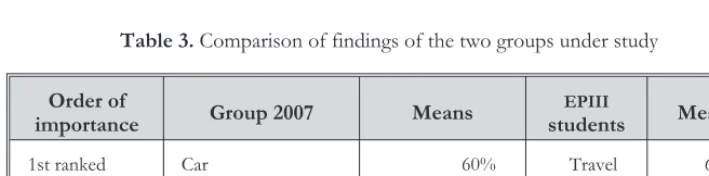
The last step in the data analysis procedure consisted in triangulating the information coming from the two groups of learners under study (Group 2007 and EPIII students). To do so, the results emerging from both groups were compared taking into account the order of importance given by the students to the items analysed. Table 3 below shows the items ranked from 1 to 3 according to the order of importance given by the learners and the results displayed as per means for each group:
Table 3.Comparison of findings of the two groups under study
Order of
importance Group 2007 Means
EPIII
students Means
1st ranked Car 60% Travel 64%
2nd ranked Travel / House 40%/40% House 52%
On looking at Table 3, it can be observed that the itemcar,which was ranked first byDiscurso Oral IIstudents in the 2007 study, was totally disregarded by the learners enrolled inEPIII. A number of assumptions can be made regarding this change. First, as opposed to the other students, whose average age was 25,EPIII students’ average age was 32. It can be inferred that those over 30, throughout their lifetime, have had more time and opportunities to save money and thus buy their own cars. Second, 92% of these learners were women and, probably, at this age, many of them are married and thus share a car with their spouses. However intuitive these assumptions might be, they provide some interesting information that may partly help to explain these learners’ social behavior. Yet, in order to corroborate and validate these claims, more research on this area should be conducted.
Travelingwas ranked second in order of importance by the other group and first by EPIIIlearners. Interestingly,housingwas chosen second by both groups. Disregarding their age difference, almost all the students in both groups assigned considerable importance to these two items in their contexts. According to Maslow’s hierarchy (1954), once physiological needs are satisfied, one’s attention turns to safety and security to be free from the threat of physical and emotional harm. This could explain why these learners selected living in a safe area as their second item.
Although these participants centered the outcome of their charitable works on different actors (themselves and the poor), both groups ranked this item third in order of importance, thus, allotting it similar percentages: 50% and 47%, respectively. Once someone has met the lower level physiological and safety needs, higher level needs become important, the first of which are social needs (Maslow, 1954). Ascharitycomprises giving and receiving, it is considered a social requisite.
Comparison of Findings across Groups
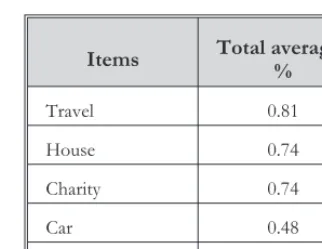
Table 4.Total average of all the population under study
Items Total averages %
Travel 0.81
House 0.74
Charity 0.74
Car 0.48
Res. Lab. 0.20
Close examination of these data reveals that most of the participants in both groups chosetraveling.In particular, they highlighted their interest in being immersed in an English-speaking country. As was explained above, this may respond to their individual motivation to improve command of their L2 (second language). This ostensible yearning for professional development may be related to their need to boost their self-esteem, increase their self-confidence and achieve their goals. Nonetheless, it is striking to see thatdoing research, an area that could also be taken as part of professional development, was ranked the lowest item on the list. Perhaps, at this early stage in their careers, these learners might not be fully aware of the benefits of doing research for the development of their professional lives.
Interestingly, both house and charity reached 74%. By having a house, these learners would satisfy one basic need and, at the same time, gain some independence. Although they might have been driven by mixed motivations to choosecharity, most of these learners claimed they would be willing to create a sense of community via team-based projects and social events.
Carwas allotted only 48%. This low percentage could have been the result of the relative disparity in age between these two groups, as was said earlier, and their consequent individual motivational differences.
logical to assume that these two groups of trainees had chosenresearch laboratoryas their first item. However, results showed otherwise. They chose to satisfy first other personal interests such as traveling, buying a house or a car or doing some charity before they actually involved themselves in doing research.
Although these learners share a common academic background and thus interests and preferences, they oftentimes are driven by different needs. At any time, different people may be motivated by entirely different factors. It is important then to understand the needs being pursued by each learner. To motivate students, teachers must be able to recognize the needs level at which their learners operate, and use those needs as levers of motivation.
Conclusion
This comparative case study consisted of the exploration of how two groups of pre-service teachers in Argentina construed their social reality by using language. On the one hand, upon analyzing these students’ testimonies, one sees that some claims could be made regarding their perceived needs, motivations, current state in relation to their past, their identity and social affiliation. If motivation is driven by the existence of satisfied needs, then it is sensible for teachers to understand which needs are the more important for individual students, and act accordingly. Incidentally, basic requirements must be satisfied before higher-level needs such as self-fulfillment or up-dating are pursued.
On the other hand, by critically examining the use of language in a given context, as is this case in this work, an increased awareness of the role it plays in shaping our perceptions of the world is facilitated. The information gathered here may also help to comprehend how by using language people can accomplish certain communicative goals and, thus, show who they are and how they want others to perceive them. It also shows how people’s perceptions of some phenomenon as either positive or negative are to some degree a result of the particular word that is used to describe it. These findings may also be used to trigger discussion about how language may be associated with several important issues such as meeting some personal needs and the identification with membership groups, to name only two.
research was conducted with two groups of Argentinean pre-service teachers which, although different in some respects, shared some common interests, likes and desires characteristic of their professional careers. The question remains then whether the results of this work would be analogous to the ones coming from a similar study carried out with another group of learners but with different characteristics. To further investigate in this field, then, additional research in this area should be conducted in similar contexts and with other populations.
References
Berger, P. L. & Luckmann, T. (1967).The social construction of reality: A treatise in the sociology of knowledge. Garden City, NY: Anchor Books.
Bernstein, B. (1971).Class, codes, and control: Theoretical studies towards a sociology of language. Volume 1. London: Routledge.
Bernstein, B. (1975).Class, codes, and control: Applied studies towards a sociology of language. Volume 2. London: Routledge.
Cohen, L. & Manion, L. (1994).Research methods in education. London: Routledge.
Eliason, F. (2005). Language and the social construction of Reality: Spinning social reality with euphemisms.The Great Plains Sociologist,17(2), 61-80.
Fairclough, N. (2003).Analysing discourse: Textual analysis for social research. London: Routledege. Fairclough, N. & Wodak, R. (1997). Critical discourse analysis. In T. Van Dijk (Ed.),Discourse
studies: A multidisciplinary introduction, Vol. 2 (pp. 258-284). London: Sage Publications. Gee, J. (1990).Social linguistics and literacies: Ideology in discourses.London: Falmer Press. Gee, J. (1999).An introduction to discourse analysis: Theory and method. New York: Routledge. Gee, J. (2002).An introduction to discourse analysis: Theory and method.2ndedition. London: Routledge. Goodwin, N., Nelson, J., Ackerman, F., & Weisskopf, T. (2006). Consumer society. Retrieved
from http://www.eoearth.org/article/Consumer_society
Hasan, R. (1986). The ontogenesis of ideology: An interpretation of mother child talk. In T. Threadgold, E.A. Grosz, G. Kress, & M.A.K. Halliday (Eds.),Semiotics, ideology, language(pp. 125-146). Sydney: Association for Studies in Society and Culture.
Heath, S. (1983).Ways with words: Language, life, and work in communities and classrooms.London: Cambridge University Press.
Hitchcock, G. & Hughes, D. (1995).Research and the teacher: A qualitative introduction to school-based research.London and New York: Routledge.
Johnstone, B. (2002).Discourse analysis. Oxford: Blackwell Publishing.
Maslow, A. (1954).Motivation and personality. New York: Harper and Row. Paltridge, B. (2006).Discourse analysis: An introduction. London: Continuum. Searle, J. (1995).The construction of social reality.New York: The Free Press.
Smith, E. & Mackie, M. (2000).Social psychology. 2ndedition. USA: Psychology Press. Southerland, J. (2004).Gendered discourses. Basingstoke: Palgrave MacMillan. Whorf, B. L. (1956).Language, thought and reality. New York: Wiley.
Willard, C. (1992).Liberalism and the social grounds of knowledge.Chicago: University of Chicago Press.
The Author
Pedro Luis Luchiniis anELTat Universidad Nacional de Mar del Plata (UNMDP), Argentina. He holds an MA in ELT and Applied Linguistics, King’s College, University of London, UK. Also, he is currently a doctoral student in Letters,
UNMDP. His main research areas of interest are Applied Phonology and Language Development.
Annex 1
Task Sheet
For this task, you will be asked to work individually. Imagine that you have won a lot of money. Look at the words below and choose three items on which you would spend your money. Rank these items in order of importance according to your preference. Explain briefly the reasons of your choices.
-a house on the beach -charity -a brand-new car
- travelling by plane - a research laboratory
1- Why?
2- Why?