Multiple Target Tracking in WSN
Ms. Deepthi Jayaprakash Mrs. Chithra K R
PG Student (M. Tech) Assistant Professor
Department of Applied Electronics & Communication Department of Electronics & Communication Thejus Engg. College, Kerala, India Thejus Engg. College, Kerala, India
Mrs. Aishwarya Vijayakumar PG Student (M. Tech)
Department of Applied Electronics & Communication Thejus Engg. College, Kerala, India
Abstract
A wireless sensor network is a spatially distributed independent sensor to monitor physical and environmental changes and has lot of applications in battlefield surveillance, disaster rescuing, etc. Target tracking in WSN has great importance in military surveillance. Enhanced energy consumption and node failure rates are the major challenges in target detection. And also, the entry of multiple targets makes the system more complex. In this paper an energy efficient strategy for multiple target detection has introduced, where each target is given a unique ID by the network and the tracking nodes changes its state adaptively. Compared to conventional methods energy consumption is considerably reduced and network lifetime has increased to an extent. Keywords: WSN, Multiple target detection, Energy efficiency
________________________________________________________________________________________________________
I.
I
NTRODUCTIONMost of the early research system performs retrieval based on low level image features, such as color and texture. A wireless sensor network (WSN) is a spatially dispersed self-sufficient sensor to observe physical or ecological conditions, such as sound, temperature, pressure, etc. and to cooperatively transfer their data through the network to a main location. The more modern networks are bi-directional, enabling the control of sensor activity. The growth of wireless sensor networks was inspired by military applications such as industrial, battlefield surveillance, and consumer applications, such as industrial process monitoring and control, machine health monitoring, and so on.
The WSN is built of nodes, from a few to several hundreds or even thousands, where each node is connected to one or sometimes several sensors. Each such sensor network node has normally several parts: a radio transceiver with an internal antenna or connected with an external antenna, a microcontroller acting as the processor of the sensor, an electronic circuit for interfacing with the sensors and energy sources, usually a battery or by gathering from an entrenched form of energy. A sensor node might vary in size from that of a chalk box down to the size of a particle of dust. Size and cost limitations on sensor nodes result in corresponding limitations on resources such as memory, energy, communications bandwidth and computational speed. The propagation technique between the hops of the network can be routing or flooding.
In sensor network applications two main challenges involved are event discovery and localization. When an event of interest occurs, it is detected by sensor nodes; reports are then aggregated and forwarded to a sink via multi-hop communication. According to the received reports, the sink may detect the event and perform suitable actions. In this paper the location data of the target is obtained through an energy efficient strategy. First the nodes are deployed in the prohibited area at their predetermined positions. Here each node can receive and transmit data from its neighboring nodes. In this system whenever an object enters into the prohibited area one node which is near to that target will detect the object and will assign an ID to it. This target tracking node will be in the active state (sensing state) and its 8 surrounding nodes will be in the idle state. Except those nodes all others will be in the sleep state. Because of providing Id to each target which is entering into the prohibited area, here we can detect multiple targets using its ID. The collected location data of each target will be transmitted to the sink node along with its ID. This method reduces the power consumption. The collected data from the nodes will be sent to the sink node through its neighbors (using shortest path method).
The rest of the work is organized as follows. Section II depicts the related works; III presents system overview, assumptions taken, state diagram and flow chart. Section IV shows the simulation studies and result obtained. Finally by section V paper is concluded.
II.
R
ELATED WORKS(IJSTE/ Volume 1 / Issue 10 / 063)
consumption, we need to reduce the number of nodes involved in target detection without affecting the efficiency. Here all the nodes will be sending the same location data to the monitoring center with respect to each nodes position.
Target detection using wireless sensor network mainly involves two events that is finding the target location and sending the collected data to the monitoring center. The two main difficulties in target detection are, in achieving accurate location and reducing the energy consumption. But both these circumstances cannot be fulfilled all together, either we have to compromise on accuracy or energy consumption. To increase the accuracy in unreliable node sequences Robust tracking method [1] was introduced, here first we need to plot a neighborhood graph by measuring the signal strength and interval time of the trial target used and then we will get a rough idea of the target’s expected moving path. By knowing the path, we can make the nodes of that path active to track the target. But this method is completely depended on probability and hence its efficiency is very low. Distributed RSSI processing [2] uses signal strength to detect the target, here the signal strength obtained from each node is sent to the sink node then the sink node will detect the target’s path, this system can provide accurateness but the energy consumption in this case is very high because all the nodes in the sensor network involve in tracking and hence every time all the nodes must be active and must continuously send the collected data to the sink node. To select the most appropriate node (node which is near to the target) for sensing the target location Global Node Selection method [4] was hosted. In this technique, all the nodes which are involved in tracking the target will make the nodes surrounding it to be active. Then as the target changes its position, the nodes which are away from the target will turn off. Almost similar thing is suggested in autonomous node selection method also. Here instead in GNS method, the nodes surrounding the target will routinely turn on, and will turn off when the target moves away. In face transversal method [5] the main intention was to reduce the energy consumption. By this method, we can reduce the energy consumption associated with the transmission of collected data to the monitoring center. Here instead of multi-hop, data packets are transmitted through any of the paths which are taking the packets to the sink node. Mobicast [6] is another method to reduce the energy consumption. In this all the nodes present in the network will collect the location data (and hence there is no reduction in energy consumption while sensing the data), but only those nodes which are in the forward zone will send the data to the sink node (here there is a drastic reduction in energy utilization). Hence in this method there is a huge reduction in energy consumption while transmitting the data to the sink but no reduction is occurring in sensing the data. Even though the transmission energy can be reduced, many nodes are in the active state during sensing, so the overall energy consumption is still high. Brink detection algorithm [7] is used in polygon based method to find the next expected moving path of the target and to track it, but this algorithm is also not much efficient. In real time dissemination JiTS approach [8] is used to reducing the delay problems, by giving a prolonged deadline time than which is required. This technique can reduce the inaccuracy glitches due to transmission delay and will not affect the energy consumption of a network but can improve the accuracy. Another effective tracking method makes use of monitor and backup nodes [9], by this method the inaccuracy occurring due to target’s directional change and variable speed can be reduced. Vigilnet method of tracking [10] is a method which is usually used where the occurrences of events are very high (such as in military surveillance area), so in order to make tracking energy efficient the nodes are divided into different states like sleep, active, wake up etc. this technique is used in the case of limited communication bandwidth and power supply the local data is compressed before transmitting it to the sink node [11]. This method is based on the principle that the intensity of the acoustic wave is inversely proportional to the square of the distance. So the sensed data will be in the form of intensity. Distributed election winner notification algorithm and intensity based localization algorithm [12] offer improved effectiveness in reducing energy consumption but less in accurateness.
III.
P
ROPOSED APPROACHThe proposed Tracking require an optimal number of sensors. In this system, first we need to deploy the nodes to their pre-determined positions of the required area. Number of nodes deployed in different areas will vary depending on the length and breadth of the area and the strength of coverage of the deployed nodes. Configure the node parameters such as whether the node is mobile or static, wired or wireless etc. Now select a sink in such a way that it must be easily reachable from all other nodes. Node deployment:
C number of columns R number of rows
Total CR number of nodes + 1 sink node Column – C1, C2, ……CR
Rows – R1, R2, …..RC
After the node deployment, the sink node collect the location data of its neighboring nodes CgRh, Cg+1Rh, CgRh+1, Cg+1Rh+1.
Then those nodes will in turn collect the location data of their neighboring nodes. This process continues until obtaining the location data of all the nodes. For collecting the location data RSSI method is used. In this method first of all a signal wi ll be sent from one node to its neighboring nodes. Then based on the time taken to reach the signal to the destination node and its strength are used for calculating the distance. After obtaining the distance, we can easily find the location data (x and y co-ordinates) of its neighboring node.
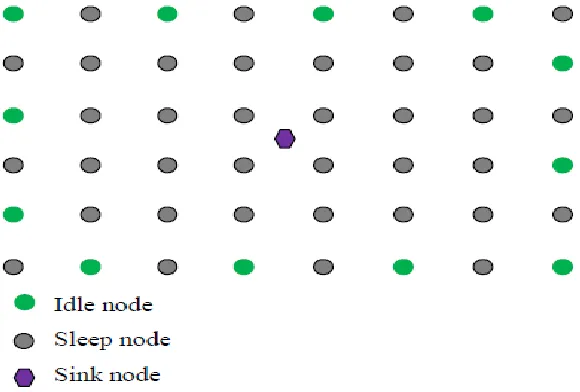
comparatively lower than that of the active state. The last state is sleep state, here all the antennas will be in the off state, there will not be any sensing process or transmission and reception of messages. Hence the energy consumption in this state is comparatively very small.
Fig. 1: Primary node deployment model
The transition from sleep to active state occurs usually for the nodes which are at the boundary of the restricted area when a target enters into that. Similarly the transition from active to idle state occur when the target moves away from its coverage area to its neighboring nodes coverage area and from idle to sleep state occurs when the target moves far away. Transition from idle to active state occurs when the target moves into its coverage area from its neighboring node and from sleep to idle occur when the target has moved near to its coverage area.
A. Assumptions
All the nodes are arranged into their predetermined positions.
All the nodes are assumed to be synchronous and hence can transmit the data through their neighboring nodes. All the sensors are homogeneous.
Here it is assumed that there is node failure in the whole system.
We can’t predict the direction through which the target enters into the prohibited area. Also we can’t predict the timing at which these targets enter. So the boundary nodes must be active. That means nodes in the even columns of first row and even rows of first column must be made idle. Similarly odd rows of the first column and odd columns of the first row should be made idle. The primary deployment of the nodes and its states are represented as shown above.
When any target has been detected, one of the nodes will become active to sense the target’s location data (let it be Ckj). To
make energy efficient tracking we need to choose the most useful node which can provide accurate location data (all other nodes in sleep state). Then need to make its neighboring nodes idle. Let the idle mode nodes be Ck-1,j, Ck+1,j, Ck,j, Ck,j-1, Ck,j+1, Ck-1,-1j,
Ck+1,j-1, Ck+1,j+1.
(IJSTE/ Volume 1 / Issue 10 / 063)
B. Multiple Target Detection:
For multiple target tracking, first of all we need assign an Id to the target when it enters into the prohibited area. This is done by the node which is first detecting the target’s presence. As soon as it crosses the boundary of the prohibited area, it will acquire an Id. Idle nodes at the boundary are capable of detecting the target and also for providing an Id to the target. Then as the target moves inside the restricted area, its nearby nodes will remain in active state to detect its location data along with the Id. The neighboring nodes of the active node will become idle, because on the very next moment there is every chance for the target to enter into its neighboring nodes coverage area. There are two benefits in making these nodes idle: we do not require a direction sensor to detect the direction change of the target and the energy consumption of idle nodes is less than that of active nodes, both in turn reduces the cost.
The collected location data of each active node along with its Id will be sent to the sink node. If there does not exist any direct path to the sink, then we need to choose any relay nodes to transmit the data to the sink node.
IV.
S
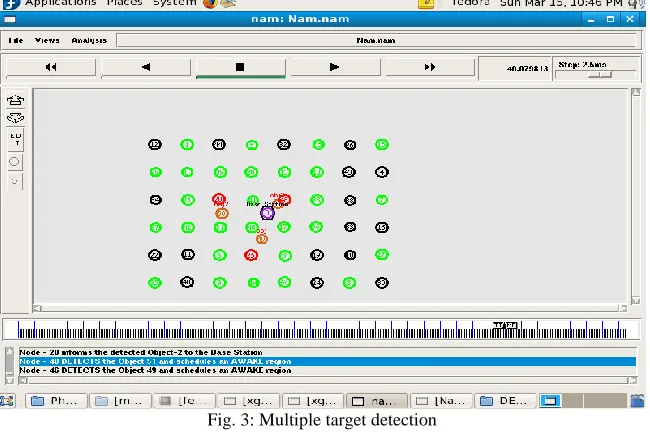
IMULATION RESULTSHere the simulation has been performed using NS2 simulation software. NS2 is the best software that can be used for simulating the operations in wireless nodes, because this software can provide animation using NAM window. This can provide a clear picture of what is happening in each node and its transmission and reception details.
Fig. 3: Multiple target detection
Here a total of 49 nodes (48 nodes +1 sink node) are deployed for detecting the target. Three nodes are considered as targets moving inside the prohibited area and have given a random motion. The simulation has been performed for 50 seconds. Here alternate nodes in the boundary are made to be in the idle state to detect the presence of any target’s entry. When any target enters one active node will sense the targets location data along with its Id and its neighboring nodes remain in idle state. Then the collected location data will be sent to the sink node along with its Id.
V.
C
ONCLUSIONUsually target detection in wireless sensor network requires a lot of energy. Here both single as well as multiple targets can be detected. For detecting the targets we need to deploy the nodes in such a way that alternate boundary nodes must be made idle, so that these nodes can detect the target and also can provide an Id to each target. When any target has been detected one of the neighboring nodes of each target will be in the active state and its neighboring nodes must be made idle. Then the active node will sense the location data of the target along with its Id and transmit it to the sink node. All other nodes will be in the sleep state, this reduces energy.
R
EFERENCES[1] Z. Zhong, T. Zhu, D. Wang, and T. He, “Tracking with Unreliable Node Sequence,” Proc. IEEE INFOCOM, pp. 1215-1223, 2009. [2] O. Kaltiokallio, M. Bocca, and L.M. Eriksson, “Distributed RSSI Processing for Intrusion Detection in Indoor Environments,” Proc. Ninth
ACM/IEEE Int’l Conf. Information Processing in Sensor Networks (IPSN), pp. 404-405, 2010.
[4] Global Node Selection for Localization in a Distributed Sensor Network Lance M. Kaplan U.S. Army Research Laboratory IEEE Transactions On Aerospace And Electronic Systems Vol. 42, No. 1 January 2006
[5] Y.J. Kim, R. Govindan, B. Karp, and S. Shenker, “Geographic Routing Made Practical,” Proc. USENIX Networked. Systems Design and Implementation (NSDI), pp. 217-230, 2005
[6] Q. Huang, C. Lu, and G.-C. Roman, “Mobicast: Just-in-Time Multicast for Sensor Networks under Spatiotemporal Constraints,” Proc. ACM/IEEE Int’l Conf. Information Processing in Sensor Networks (IPSN), pp. 442-457, 2003.
[7] M.Z.A. Bhuiyan, G. Wang, and J. Wu, “Polygon-Based Tracking Framework in Surveillance Wireless Sensor Networks,” Proc. IEEE Int’l Conf. Parallel and Distributed Systems (ICPADS), pp. 174- 181, 2009
[8] K. Liu, N. Abu-Ghazaleh, and K.D. Kang, “JiTS: Just-in-time Scheduling for Real-Time Sensor Data Dissemination,” Proc. IEEE Pervasive Computing and Comm. (PerCom), pp. 42-46, 2006
[9] M.Z.A. Bhuiyan, G. Wang, and J. Wu, “Target Tracking with Monitor and Backup Sensors in Wireless Sensor Networks,” Proc. IEEE Int. Conf. Computer Comm. and Networks (ICCCN), pp. 1-6, 2009.
[10] T. He, P. Vicaire, T. Yan, L. Luo, L. Gu, G. Zhou, R. Stoleru, Q. Cao, J. Stankovic, and T. Abdelzaher, “Achieving Real-Time Target Tracking Using Wireless Sensor Networks,” Proc. 12th IEEE Real-Time and Embedded Technology and Applications Symp. (RTAS), pp. 37-48, 2006
[11] Y. Zhou, J. Li, and D. Wang, “Posterior Cramer-Rao Lower Bounds for Target Tracking in Sensor Networks with Quantized Range-Only Measurements,” IEEE Signal Processing Letters, vol. 17, no. 2, pp. 377-388, Feb. 2010
[12] M. Waelchli, M. Scheidegger, and T. Braun, “Intensity-Based Event Localization in Wireless Sensor Networks,” Proc. Conf. Int’l Federation for Information Processing Wireless On-Demand Network Systems and Services (IFIP WONS), pp. 41-49, 2006