The effect of ownership concentration on selected
variables in companies accepted in Tehran stock
exchange
Amir Jafarzadeh Pirmousaei
1, Daryoush Javid
21. M.A. Student of Accounting, Islamic Azad University of Shahr Kord, Chaharmahal and Bakhtiari, Iran 1. Faculty Member at the Islamic Azad University of Broojerd, Lorestan, Iran
Abstract: In this research the effect of ownership concentration on selected variables at companies accepted in Tehran stock exchange has been considered. Dispersed (or decentralized) ownership causes occurrence of the problem of delegacies in companies that the ability and motivation of stockholders for controlling management will be weakened because their share is little. Ownership concentration in hands of institutional investors controls delegacies’ problems and improves supporting benefits of investors. In fact one of the most important factors that is seemed in choosing any investments among different choices of investment is liquidity, market value and efficiency. Generally liquidity means the degree of easiness at buying and selling an exchange without considerable change in its price. Considering sample includes 98 companies during 2007-2012. The result of testing research hypothesis by combined data method denotes that there is meaningful and diverse relationship between ownership concentration and liquidity in companies accepted in Tehran stock exchange. Also there is meaningful and direct relationship between ownership concentration and market value in companies accepted in Tehran stock exchange. However there isn’t meaningful relationship between ownership concentrations on efficiency in companies accepted in Tehran stock exchange.
Key words: ownership concentration, liquidity, market value, efficiency, combined data
INTRODUCTION
Some important changes of accounting havebeen done under the shadow of great companies and separation of ownership from great company’s management. In the past owners were the same managers of business companies and any conflict wasn’t identified between benefits of management and owner as owner controlled all operation of the company by themselves and caused increase of company’s value. Improvement of technology and fallowing that conformation of great companies and increasing capital caused creating great markets of capital and fallowing that ownership separate from management.
For many years it was supposed that all groups related to a company activate for a common goal. However by identification of theory of representative of Jensen and Mackling (1976) this hypothesis was introduced that owners and managers are going to maximize their benefits (Namazi and Kermani, 2008).
Hypothesis of representatives is related to the case that one person is responsible for decision making about distribution of financial and economic resources or delegates doing distinct services to another person during distinct contract. The first person are called owner (employer) and the second person is called representative ( broker).(Namazi, 2005).
In representative rel`ation the goal of owners is maximizing wealth. Therefore for achieving this goal they supervise representative work and evaluate his performance.
Financial markets have been conformed for optimized devotion of resources and therefore increasing welfare of society. Main characteristics of financial markets for implementing this goal includes 1) presence of institutes that has the power of preventing cheating and misuse 2) existence of various financial tools that complete risk distribution and 3) marketing which can transact assets at the least time and with the least cost can transact
One of the main functions of financial markets is supplying liquidity (Agarval, 2008).
40
buyer’s mind that can dissuasion of investor. Therefore one risk of investors during buying is lack of liquidity risk that means not be able to change financial assets to cash at proper time of investor without losses.Therefore investors are going to invest in assets that have the highest output, the least risk and the highest power of liquidity. Such factors that can affect above cases is ownership structure of companies.
Stating problem
In financial literature it seems that besides plan of benefit conflict between managers and owners, other mechanism exist for explaining difference of performance of economic institutes with different patterns.
Difference in managerial and supervising motivations and political goals and social commitments mainly causes to expect companies with different ownership structure have different performance. On important factor of decision making and one important criterion that investors pay attention during choosing a share is the subject of liquidity, market value and share efficiency. Dispersed (decentralized) ownership cause the appearance of representative problem in companies because the ability and motivation of shareholders for controlling management will weaken because its share is little. Ownership concentration at institutionalized invertors controls representative’s problems and improves supporting investor’s benefits. In fact one of the most important factors that is considered at choosing each investment among different choices of investment is liquidity, market value and efficiency. Generally liquidity means the degree of easiness at buying and selling an exchange without considerable change of its price.
According to the research different factors affect liquidity of share such factors are policy of profit division, capital structure, company ruling, period of preserving share.
Based on most research such as GhanRahi and Wang (2008) it has been distinguished that ownership structure as part of company ruling can affect criteria of liquidity, market value and efficiency. One method of increasing liquidity, market value and efficiency is decreasing informational symmetry that by identifying relation of ownership and informational asymmetry we can take the benefit of ownership structure function at reducing informational asymmetry and therefore increase liquidity, market value and efficiency.
Generally few researches have been done about effects of ownership structure on liquidity, market value and efficiency of share in Iran. Some of recent researches have considered the relationship of concentration and dispersion of ownership with difference of suggestive price of buying and selling share and also the effect of institutional owners on liquidity, market value and share efficiency.
Ging linger and Hamoon( 2010) showed that in secondary markets of French, liquidity, market value and efficiency decreases for companies with centralized ownership significantly and this subject was increasedduet lack of information symmetry and increase cost of incorrect choice.
Most Researches supported Gasper and Masa’sviewpoint (2007) that stated for improving liquidity, market value and market efficiency, ownership dispersion is necessary. Of course few people such as Kini and Mian (1995) didn’t find any relation between dispersion of ownership and liquidity, market value and share efficiency.
However all researches commonly pointed the thing that if increase of dispersion of ownership leads to the informational symmetry increase, the difference between suggestive price of buying and selling decreases and so liquidity, market value and share efficiency increase. In a research that has been done recently by Iadinia and Rasaeyan (2010) for considering relationship of ownership dispersion and liquidity, market value and share efficiency, the percent of blocking share for shareholders has been used as criteria dispersion and difference of suggestive price of buying and selling has been used as dependent variable, they didn’t find meaningful relation between these two variables. Regarding the identified problems above the main question of research is as bellow: Is there meaningful relation between ownership concentration and selected variables in companies accepted in Tehran stock exchange? In case of positive response how is this relationship?
Corporate Governance
Corporate ruling system is the reaction of representative that is resulted from separation of control from ownership. Before 1970s that Jensen presented theory of representative and conflict of benefits less attention was paid to the subject ofcompany’s ruling structure. After presenting representative theory, relations of representatives has extensively affected different subjects of financial literature and gradually and especially by appearance of financial scandal and bankruptcy of companies and misuse and financial corruption that happened at the end of 20th century the discussion of company’s ruling system has paid more attention to itself (Eyozlou and Sadeghi, 2008).
41
Company strategic system supervises auditory, combining managers, independence of auditors, ownership structure, controlling main and retail shareholders and is going to make balance between economic goals and being certain of having the same personal goals with public goals. Researches indicate that company ruling system can cause improvement of standards in trade, encouraging foreign investment and leads to improvement of administrative affairs of companies (Frank and Bekavs, 2003).Company ruling has different mechanism that is as below: 1-structure of board of directors
2-plan of paying reward to board of director 3-auditing committee
4-external controlling factors of market 5-ownership structure
One of significant points in literature related to company steering, is the discussion about fundamental role of ownership structure as strategic mechanism. Regarding the subject of current research, we mention explanations in this field:
Structure of company’s ownership
The most fundamental basis of company ruling is being certain of implementing correct ruling of shareholders on company’s management. However the existence of especial moods causes this ruling faces barriers especially for retail shareholders Therefore one important subject at company ruling is awareness of the structure of ownership and grading it at standard scale so that by using it we can write necessary strategies for establishment of company ruling. Therefore situation of ownership of shareholders can be divided into 3 groups (Saghir, 1993).
Partial: ownership between 5-20 percent of company share Efficient: ownership between 20-50 percent of company share Controller: ownership above 50 percent of company’s share
Structure of ownership at company ruling has central and distinct location. Determining type of ownership structure and combining company shareholders is a control tool and implementing ruling in companies. This dimension of ruling in different dimensions determines type of company’s ownership such as distribution of ownership, ownership concentration, existence of retail shareholders, minority and majority in combining company ownership and percent of their ownership is considerable. Also combining company’s shareholding fallows different patterns such as institutionalized shareholders, managerial ownership, private and public shareholders.
Concentration criteria
Ownership concentration means the way of distributing shares among shareholders of different companies or ownership concentration implies on what extent of total share of a distinct company is given to limited number of owners. For measuring concentration we should pay attention to the number of shareholders and the degree of their capital, as the number of shareholders is few ownership is more concentrated and as the number of owners is a lot, concentration will be less.
Researchers in studies have used different criteria for calculating ratio of ownership concentration.
METHODOLOGY
Current research is applied regarding goal. All companies accepted in Tehran stock exchange during 2007-2012 conforms statistical society of research. In this research for choosing statistical sample systematic elimination method( screening technique) has been used as below: 1-through necessity of calculating research variables and testing hypothesis, there were full information of each company in relation to the studying variables 2- regarding that the nature of financial statement is affected by nature and type of company’s activity. Therefore for having uniform feature and increasing comparative capability of information, companies should not be financial meddler. Then financial institutes, investments and banks are not mentioned in sample. 3- for homology of date of reporting, deleting season effect and increasing comparative capability of information, financial period of companies should be end of February each every year and during research they don’t change financial year. Therefore in this research 126 companies and 759 years- of company has been considered.
First hypothesis: ownership concentration affects liquidity of companies accepted in Tehran stock exchange.
Second hypothesis: ownership concentration affects market value of companies accepted in Tehran stock exchange.
42
Third hypothesis: ownership concentration affects efficiency of companies accepted in Tehran stock exchange.
Result of tests and estimations
In this research for testing hypothesis static consolidated data method has been used. In this method for choosing among two models of combined (pool) and model of fixed effects Chow test that is called structural changes is used. In fixed effect model each parameter has a its fixed amount and due to working with each of these fixed amount, a dummy variable is seemed, estimator of fixed effect is called least square dummy variable (LSDV). Chow test is an equality test between a set of coefficient in a linear regression.
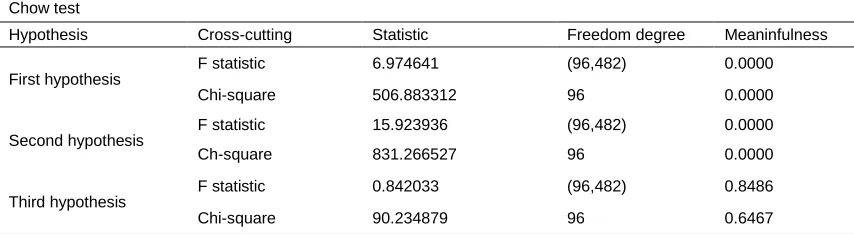
Chow test or structural changes test related to hypothesis
For testing hypothesis of the research firstly model of time fixed effects was estimated and then for considering meaningful difference structural change test will be used. This test for considering existence of fixed effect is hypothesized as below:
{
Hausman test related to hypothesis
As it is regarded, the result of chow test denotes choosing model of fixed effect for hypothesis.
Now we should test fixed effect model against random effect model of test. For doing this action Hausman test is used. For doing Hausman test firstly we should estimate random effect-time model. Hausman test for considering random effect existence is set as below:
{
Hausman test
Meaningfulness Freedom degree Statistics Test effect Hypothesis
0.0090 3 6.787471 Fixed First hypothesis
0.0992 3 35.274394 Random Second hypothesis
Chow test
Hypothesis Cross-cutting Statistic Freedom degree Meaninfulness
First hypothesis
F statistic 6.974641 (96,482) 0.0000
Chi-square 506.883312 96 0.0000
Second hypothesis
F statistic 15.923936 (96,482) 0.0000
Ch-square 831.266527 96 0.0000
Third hypothesis
F statistic 0.842033 (96,482) 0.8486
Chi-square 90.234879 96 0.6467
As it is regarded by paying attention to the obtained meaningful level in this step fixed effect model is used as preferred mode for the first hypothesis. Research hypothesis is tested through result of econometric and
Table 1-result of Hausman test related to hypothesis
43
multivariable regression. For determining significance of regression model Fisher t- statistic has been used. For considering meaningfulness of independent variables in each model t-student statistic at 95% has been used. Dourbin-Watson test has been used for considering lack of self-correlation problem between waste sentences. In case of violation of classic hypothesis of linear regression model, such as dissimilarity of variance or self-correlation between disruption component of model, pattern of “ first rank self –regression will be used for modifying and final fitting of the model (1) AR.First hypothesis: ownership concentration affects liquidity in companies accepted at Tehran stock exchange.
Table 3- result of obtained estimation from first hypothesis test through EGL method
Variables Coefficient Standard deviation T statistic Meaningfulness
Fixed number 1.274560 0.247512 5.149486 0.0000
Ownership concentration -0.714025 0.322932 -2.211066 0.0275
Risk 0.010731 0.004792 2.239406 0.0256
Company size 0.005865 0.042326 0.138574 0.8898
Determination coefficient 0.897817 Dependent variable mean 3.428139 Modified determination coefficient 0.876830 Standard deviation of dependent variable 2.637120 Regression criteria error 0.449802 Remaining square amount 97.51898
F statistic 42.77818 Dourbin Watson statistic 1.535654
Probability of F statistic 0.000000
Second hypothesis: ownership concentration affect market value in companies accepted in Tehran stock exchange.
Table 4-result of estimation obtained from first hypothesis test through EGLS method
Variables Coefficient Standard deviation T statistics Meaningfulness
Fixed number -0.104938 0.303207 -0.346095 0.0294
Ownership concentration 0.311197 0.276268 1.126434 0.0004
Risk -0.008053 0.007385 -1.090416 0.0060
Company size 0.984307 0.050227 19.59703 0.0000
Determination coefficient 0.398169 Dependent variable mean 1.441791 Modified determination
coefficient 0.395046 Dependent variable standard deviation 0.277833 Regression criteria error 0.216095 Remaining square amount 26.99089
F statistic 127.4677 Dourbin Watson statistics 1.426612
Probability of F statistics 0.000000
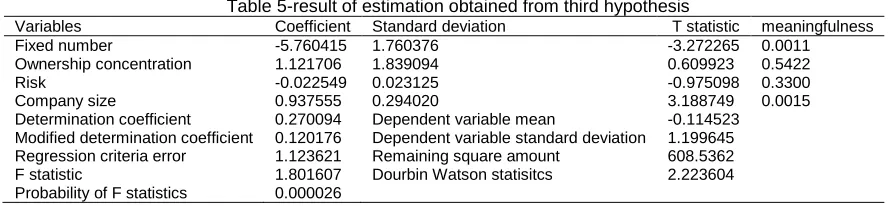
Third hypothesis: ownership concentration affects efficiency in companies accepted in Tehran stock exchange.
Table 5-result of estimation obtained from third hypothesis
Variables Coefficient Standard deviation T statistic meaningfulness
Fixed number -5.760415 1.760376 -3.272265 0.0011
Ownership concentration 1.121706 1.839094 0.609923 0.5422
Risk -0.022549 0.023125 -0.975098 0.3300
Company size 0.937555 0.294020 3.188749 0.0015
Determination coefficient 0.270094 Dependent variable mean -0.114523 Modified determination coefficient 0.120176 Dependent variable standard deviation 1.199645 Regression criteria error 1.123621 Remaining square amount 608.5362
F statistic 1.801607 Dourbin Watson statisitcs 2.223604
Probability of F statistics 0.000026
Suggestions based on research result
44
explanation of degree of liquidity, market value and efficiency of Tehran stock exchange, choose proper criteria or if necessary design a new criteria proper to the condition of Iran’s capital market.2- About public supply, consider the number of supplied share as an effective factor at liquidity, market value and efficiency of Tehran stock exchange.
Suggestions in relation with future research
This research is as a pattern for future studies. Summary of suggestive titles for future research are suggested as below:1- considering the effect of factors such as ownership on degree of concentration of ownership dispersion 2-studying the effect of type of industry on relation sepaprately3- dividing role and effect of ownership of financial institutes (banks and insurance companies), investment companies and non –financial companies in value and performance of companies 4- considering relation of ownership concentration and companies’ value for short-term period less than one year 5- using piece linear regression for identifying threshold or probable targeted level 6-considering effects of other control variables such as type of industry and so on
REFERENCES
1- Acharya, V. V. & Pedersen, L. H. (2005), "Asset Pricing with Liquidity Risk”, Journal of Financial Economics 77.
2- Ahmadi, Shahin and Bozorgasl, Mousa (2003). Reaction of investors to different social reporting of companies. Experimental research of accounting, second year, No 3.
3- Aitken, M. &Comerton–Forde, C. (2003). "How Should Liquidity is measured?” Pacific -Basin Finance Journal 11.
4- Badavari Nahandi, Jounes and Darkhor, Saeid (2003). Considering the relationship between financial limitations, cash and net value of investment, accounting experimental research, second year, No 8.
5- Butler, A. W. et al. (2005)."Stock Market Liquidity and The Cost of Issuing Equity",Journal of Financial and Quantitative Analysis", 40(2). 6- Datar, S., Iskandar-Datta, M., Raman, K., (2005). Managerial stock ownership and maturity structure of corporate debt. The Journal of
Finance 60, 2333–2350.
7- Dianatideylami, Zahra and Moradzadehfard, Mehdi and Mazaheri, Ali (2003). Effect of management tenure on company’s value, deligacy cost and informational risks, experimental research of accounting, third year, No 1.
8- Ellul, A. & Pagano, M. (2007)."IPO Underpricing and After-market Liquidity",Review of Financial Studies.
9- Kashefi, Hadi and Baghbani, Fatemeh (2012). Evaluation of performance and ranking center of civil engininers of Mazandaran province by using DEA, AHP technique, the first national accounting and management conference, Islamic azad university, Noor branch.
10- Lhabitant, F. Serge &Gregoriou, G. N. (2008). "Stock Market Liquidity", JohnWiley& Sons.
11- Shams, Shahaboldin and Babalyan, Shahram and Jola, Jafar 2010 “ considering efficiency of supplied companies of principle 44 in Tehran stock exchange “ stock exchange qualrterly, Third year, No 10, p 77-90.
12- Soumaya, Hechmi(2012). The effect of debt, firm size and liquidity on investment-cash flow sensitivity. International Journal of Accounting and Financial Reporting. Vol. 2, No 2.