Experimental study of convective heat transfer
in a horizontal tube with insert using Nano fluids
Nilesh C. Kanojiya 1* 1* Assistant professor, G. H. Raisoni Academy of
Engineering & Technology, Nagpur, Maharashtra 440016 (India)
[email protected], [email protected]
Dr. V. M. Kriplani 2
2 Professor, G. H. Raisoni College of Engineering, Hingna Road, Digdoh Hills,
Nagpur, Maharashtra 440016 (India) [email protected], [email protected]
Abstract—Experimental investigation was carried out for tube side heat transfer coefficient, heat transfer enhancement, friction factor of CuO/water, Al2O3/water Nano fluids for turbulent flow in a copper circular tube fitted with perforated twisted tape insert. The copper tube of 15.6 mm outer diameter and 12.5 mm inner diameter and test length of 800 mm was used. Reynolds number varied in the range of 10000 – 35000. Size of squire hole in the twisted tape insert was 5.00 mm. Volume concentration of Nano fluid was varied from 0.05% to 0.3%. Heat transfer coefficient and Nusselt number from Gnielinski correlation [3] were compared with results of pure water, Nano fluids with and without insert. Heat transfer coefficient enhancement with respect to base fluid water at Reynolds number 3100, volume concentration of 0.3% found to be 37.2% without insert, 90.5% with insert and 127.2% with perforated insert in case of Al2O3/water Nano fluid and in case of CuO/water Nano fluid, 79.9% without insert, 113.5% with insert and 150.3% with perforated insert as compared to the base fluid, water.
Keywords— Heat exchanger, heat transfer
enhancement, perforated twisted inserts,
nanofluids
Nomenclature
Cp specific heat of fluid (J/kg K)
dhyd hydraulic diameter of experimental tube (m)
h heat transfer coefficient (W/m2K) k thermal conductivity (W/m K) m mass flow rate of the fluid (kg/s) Nu average Nusselt number = (hexpdhyd)/ k P tube periphery (m)
Pr Prandtle number = µ Cp/k Q heat transfer rate (W)
Re Reynolds number = ρ u dhyd/ µ
S cross sectional area of the experimental tube T temperature (K)
U fluid velocity (m/s)
Greek letters ρ density (kg/m3) µ Viscosity (kg/m s)
∅ Volume fraction Subscripts
b bulk
exp. Experimental in inlet
nf nanofluid
out outlet p particle w wall
I. INTRODUCTION
Design requirements for modern heat transfer equipment are high thermal performance and reduced size. In the past considerable research efforts were made to the development of advanced methods for heat transfer equipment. Conventional cooling fluids such as water, ethylene glycol, mineral oils widely used possess poor thermal conductivity. Considerable efforts have been made to improve the rate of heat transfer by using extended surfaces, micro channel etc. but further enhancement of cooling or heating is always in demand. A possible way of improving the heat transfer performance of conventional fluids is to suspend various types of small solid particles (size < 100 nm), metallic (eg. Cu, Ag, Al etc.) and non-metallic (e.g. Al2O3, CuO, Fe3O4 etc.) particles in conventional fluids to form colloidal suspensions. Fluids suspended in them are called Nano fluids, and it was coined by Choi S. U. S. [1]. Nano fluid due to molecular chain behaviour, nanoparticles properly dispersed in the base fluid, achieved major benefits such as higher thermal conductivity, micro channel cooling without clogging, reduced chances of erosion and pumping power with enhancement in thermal conductivity and stability of mixture. In general, the above features in Nano fluids provide us new area of research in Nano fluid technology, plays an important role to improve heat transfer and energy efficiency in several areas including vehicular cooling in transportation, Power generation, defence, nuclear, microelectronics, biomedical devices. P. Promvonge [2] experimentally investigated the convective heat transfer with conical rings inserts in a circular tube. The mean heat transfer rates obtained using diverging rings, converging-diverging rings and converging rings with diameter ratio d/D = 0.7 – 0.5 (where d is small end diameter of conical ring and D is the diameter of test tube) were found to be 197- 333%, 138 – 234% and 91 – 175% more than those with plain tube respectively, Reynolds number range was 6000 < Re < 26000. For fixed Reynolds number, both Nu no. and friction increase with decrease in diameter.
Khwanchit Wongcharee, Smith Eiamsa-ard [3]
Vol. 3 Issue 8, August - 2017
fluid in a circular tube with twisted tape with alternate axis (TA). The concentration of Nano fluid was varied from 0.3 to 0.7 vol. %. The twist ratio of twisted tape was kept constant at 3. Experiment was carried out in
laminar region Reynolds no. Range was 830 – 1990.
With twisted tape Nusselt no. was improved up to 13.8 times of plain tube. Empirical correlations for heat transfer coefficient, friction factor and thermal performance are also developed. P. Bharadwaj A.D. et al. [4] experimentally determined heat transfer characteristics and pressure drop of flow of water in a spirally grooved tube with twisted tape insert. They considered laminar to fully turbulent range of Reynolds number. The groves are clockwise with respect to the direction of flow. Heat transfer enhancement due to spiral groves is further enhanced by twisted tape inserts. Bodius Salam, Suman Biswas [5] experimental investigation measuring heat transfer coefficient, friction factor, heat transfer enhancement of water for turbulent flow in a circular tube fitted with rectangular cut twisted tape insert was carried out under uniform heat flux. Reynolds number range was 10,000 – 19,000. Nusselt number obtained from smooth tube was compared with Gnielinski co-relation. With comparable Reynolds number, Nusselt no. was enhanced by 2.3 to 2.9 times at the cost of friction factor by 1.4 to 1.8 times compared to smooth tube. Alberto Garcia et al. [6] they carried out experimental study on three wire coils of different pitch inserts in a smooth tube in laminar and transition region. Friction factor lie between 5% to 40% in the fully laminar region. Reynolds number range 10- 25oo, Pr. No range 200 – 700. Re no Below 200, wire coils do not enhance heat transfer with respect to smooth tube. For Re no Between 200 and 1000 with wire coils increase in heat transfer is observed. At Re no around 1000, wire inserts increase heat transfer coefficient up to 8 times with respect to smooth tube. A performance comparison between wire inserts and twisted tape inserts they stated that wire inserts perform better than twisted tapes in Re no range 700-2500. P. Sivashanmugam, S. Suresh [7] Experimental investigation of heat transfer and friction factor characteristics of laminar flow through a circular tube fitted with full length screw-tape of different twist ratios was carried out with uniform heat flux. They compared the heat transfer coefficient with increasing twist ratio with those obtained with plain tube data. Heat transfer coefficient increases with the twist ratio. Friction factor also increases with twist ratio. K. B. Anoop et. al. [8] carried out experimental investigation on convective heat transfer characteristics in the developing region of tube flow with constant heat flux with Al2O3/water Nano fluid. Main objective was to study the effect of particle size on convective heat transfer. They selected two nanoparticles of average
size 45 nm and 150 nm. They observed that Nano fluid with Nano fluid with 45 nm particle size showed higher heat transfer coefficient than that with 150 nm size.
They also observed that in the developing region, heat transfer coefficient enhancement is higher than in the developing region. Nano fluid concentration results increase in effective thermal conductivity. Besides, heat transfer enhancement is associated with particle motion in the form of Brownian motion[9] by which the particle move though the liquid and possible collide, enabling solid to solid transportation of heat from particle to particle, and expecting increase in thermal conductivity. Other concept is of Nano-convection of fluid around particles due to their motion, particle transport some of the amount of heat transferred through agitation in the liquid. Mangrulkar C. K. et al. [10] experimentally investigated heat transfer enhancement in the laminar and transition fluid flow through copper tube with constant heat flux. Al2O3/water and CuO/water Nano fluids with volume concentration range 0.1% to 0.5%. In each case they found that optimum enhancement in heat transfer is observed at relatively lower volume concentration ranging between 0.2 to 0.3%.
OBJECTIVE OF THE WORK
The main objective of work was experimental investigation of heat transfer enhancement in horizontal tube using Nano fluids. The nanoparticles, Al2O3 and CuO, were selected, as metallic oxides are cheaper than metallic one, though metals have much higher thermal conductivity than metallic oxides and therefore, higher heat transfer enhancement. Base fluid chosen was distilled water.
II. EXPERIMENTAL SET UP
Experiment was conducted first with distilled water, the base fluid of a Al2O3 and CuO nanoparticles, with varying mass flow rates 4, 6, 8, 10, and 12 litters/min., then with CuO/water Nano fluid and same mass flow rates as with water and volume concentrations 0.05%, 0.08%, 0.1% and 0.3%. Next, the experiment was repeated with twisted tape insert with no perforations and same volume concentrations. The twisted tape was four in numbers. The experiment was repeated with squire perforated tape insert and same volume concentrations.
Fig.1Experimental set up [11]
III. NANOFLUID PREPARATION
The first step in experimental studies is the preparation of Nano fluids. Preparation of a stabilized Nano fluid is of great importance in heat transfer applications of Nano fluids. Poorly prepared Nano fluids will render biphasic heat transfer (i.e. solid-liquid). Dispersant or surfactant was not added as they may change the properties of the
Nano fluid. Nano fluids were prepared with
nanoparticles Al2O3 and CuO (average size 45 nm) with
deionized water as base fluid. The nanoparticles were purchased from Sigma Aldrich, Germany. Specific quantities of nanoparticles were mixed with distilled water as the base fluid for both and stirred with magnetic stirrer for about eight hours. The stirred Nano fluid was kept for about 24 hrs. and no sedimentation was observed. Immediately the experiment was started. The
Nano fluids with four different Al2O3 and CuO
nanoparticle concentration (0.05%, 0.08%, 0.1% and 0.3% volume fraction) were prepared to study the convective heat transfer in a tube.
IV. NANOFLUID PROPERTIES
Thermo physical properties of the Nano fluid must be known before using for experimental test. The nanoparticles are assumed to be well dispersed in the base fluid and concentration of nanoparticles is assumed to be uniform throughout the tube. This assumption is not true in real systems because the particles migrate in the tube. However, the assumption is useful tool to evaluate the physical properties of a
Nano fluid. The thermo-physical properties of prepared Nano fluids are calculated from water and nanoparticles characteristics at mean inlet and outlet bulk temperatures. The following correlations for thermal conductivity, density, specific heat, viscosity [2] are used.
The density of Nano fluids can be predicted by mixing theory as:
ρnf = (1- ∅) ρbf + ∅ρnp (1)
knf /kbf = [knp+ 2kbf +2(knp –kbf)(1+ β)3∅]/ [knp + 2kbf - (knp – kbf)(1+ β)3∅] (2)
Some researchers have used the following equation which is same approach as to the mixing theory for an ideal
(Cpnf .ρnf)= ∅ (Cpnp.ρnp) + (1-∅) (Cpbf . ρbf ) (3)
µnf = µbf(1 + 2.5∅) (4)
In the above equations, the subscripts “nf”, “np” and “bf” refer to the Nano fluid, nanoparticle and base fluid respectively.∅ is the volume fraction of the nanoparticles added to base fluid. β is the Nano layer thickness to the original particle radius. This can be taken as 0.1 to calculate the Nano fluid effective thermal conductivity.
Fig 3. Twisted tape inserts (without perforations)
Fig 4. Twisted tape inserts (with square shape perforations )
Fig. 2Arrangement of Inserts inside Copper Tube
V. DATA ANALYSIS
Observations were taken at steady state conditions. Initially experiment was performed with distilled water at various mass flow rates and then for Al2O3/water and CuO/water Nano fluids with volume concentrations 0.1- 0.7%. Flow rates were same for all three fluids. Constant heat flux was maintained in all the cases. According to the Newton’s law of cooling,
Q=hexpA(Tw–Tb) (5) Where mean bulk temperature is given by
Tb = (Tin + Tout)/2
Vol. 3 Issue 8, August - 2017
Heat transfer rate,
Q=m Cpnf(Tout–Tin) (6) Equating (5) & (6)
hexp A (Tw – Tb) = m Cpnf (Tout–Tin)
hexp =[m Cpnf(Tout–Tin)]/[A(Tw-Tb)] (7) Nu = (hexp Dhyd) / k
Dhyd = 4S/P
All the physical properties are evaluated at bulk mean temperature Tb, of the fluid.
VI. RESULT AND DISCUSSION
Experimental results are compared with Dittus-Boelter (eq.8) and Gnielinsky (eq. 9) correlations,
Nu=0.023Re0.8Pr0.4 (8)
Nu= [(f/8) (Re – 1000) Pr]/ [1+12.7 (f/8)0.5 (Pr2/3 – 1)] (6)
3000 ≤ Re ≤ 5 x 10⁶ and 0.5 ≤ Pr ≤ 2000
Where, from Petukhov, 1970, friction factor f, was calculated using equation (6)
f = (0.79 ln Re – 1.69)-2 (6)
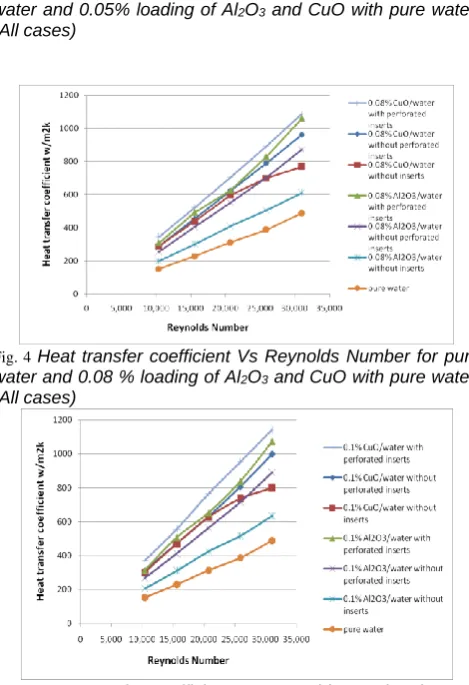
From fig. 3 (volume concentration 0.05%), it is observed heat transfer coefficient increases with increase in Reynolds number. Heat transfer coefficients are higher than pure water in case of both of the Nano fluids. They are higher for twisted tape inserts. This is because twisted tape inserts create turbulence in the flowing fluid causing enhancement of heat transfer. Perforated twisted tape inserts enhance heat transfer coefficients further than without perforations. Perforations cause increase in turbulence further causing increase in heat transfer, but at the cost of pressure drop. Further, heat transfer coefficients are higher in case of CuO/water Nano fluid than Al2O3/water. Similar trend is observed for higher volume concentrations (figs. 4, 5 and 6). For 0.3vol % (fig.6) and Reynolds number 31000, with Al2O3/water Nano fluid, the heat transfer coefficient enhancement w.r.t. water is 37.2%, 90.5% with twisted tape inserts, 127.2% with perforated twisted tape inserts. In case of CuO/water Nano fluid, the enhancements are 79.9%, 113.5% and 150.3% respectively.
At Reynolds number 1000 (fig.6), with Al2O3/water Nano fluid, the heat transfer coefficient enhancement w.r.t. water is 42.4%, 82.1% with twisted tape inserts and 117.2% with perforated twisted tape inserts. In case of CuO/water Nano fluid, the enhancements are 127.1%, 135.1% and 163.5% respectively.
Fig. 3Heat transfer coefficient Vs Reynolds Number for pure water and 0.05% loading of Al2O3 and CuO with pure water. (All cases)
Fig. 4Heat transfer coefficient Vs Reynolds Number for pure water and 0.08 % loading of Al2O3 and CuO with pure water. (All cases)
Fig. 5Heat transfer coefficient Vs Reynolds Number for pure water and 0.1% loading of Al2O3 and CuO with water. (All cases)
Fig. 6Heat transfer coefficient Vs Reynolds Number for pure water and 0.3% loading of Al2O3 and CuO with water. (All cases)
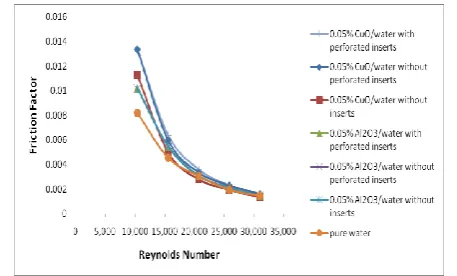
Fig. 7Friction Factor Vs Reynolds Number for pure water and 0.05 % loading of Al2O3 and CuO with water. (All cases)
Fig. 8Friction Factor Vs Reynolds Number for pure water and 0.08 % loading of Al2O3 and CuO with water. (All cases)
Fig. 9Friction Factor Vs Reynolds Number for pure water and 0.1 % loading of Al2O3 and CuO with water. (All cases)
Fig. 10Friction Factor Vs Reynolds Number for pure water and 0.3 % loading of Al2O3 and CuO with water. (All cases)
For lower Re no., for CuO/water Nano fluid friction factor is higher than Al2O3/water Nano fluid. At higher Re no. friction factor is almost same for both the Nano fluids. This trend is same for all volume concentrations. At lower Re no. friction factor is higher for Nano fluid than for pure water. However at higher Re no. difference is not significant.
Fig.(11,12,13 and 14) show the graphs, Nu no. Vs Re no with increasing volume concentration. Nu no. increase with Re no. This trend is same for all volume concentrations. At comparable Re no Nu nos. is higher for higher volume concentration
Fig.11Nusselt Number Vs Reynolds Number for pure water
and 0.05% loading of Al2O3 and CuO with water. (All cases)
Vol. 3 Issue 8, August - 2017 Fig. 13Nusselt Number Vs Reynolds Number for pure water
and 0.1% loading of Al2O3 and CuO with water. (All cases)
Fig. 14Nusselt Number Vs Reynolds Number for pure water and 0.3% loading of Al2O3 and CuO with water. (All cases)
For the validation of experimentation, theoretical heat transfer coefficient is compare with the experimental values. In this experimentation, the value of Reynolds number is ranging from 10000 to 35000 hence, From Gnielinski, 1976 equation [3] is used to find theoretical Nusselt number. From fig.18 it is observed that, theoretical Nusselt number is greater as compare to the experimental values for 0.3 vol. % Al2O3/water Nano fluids and 0.3 vol. % of CuO/water Nano fluids. In the experimentation, with and without perforated twisted tape inserts is use which causes the more Nusselt number difference between theoretical and practical values. Nusselt number of perforated twisted tape inserts is more as compare to other conditions. It is just because of provision of inserts wit perforations in the flow stream which increase turbulence results increase Nusselt number. It is observed that, Nusselt number increases rapidly when mass flow rate increases. From fig.15 it is observed that, theoretical h is greater as compare to the experimental values for 0.3 vol. % Al2O3/water Nano fluids and 0.3 vol % of CuO/water Nano fluids. In the experimentation, with and without perforated twisted tape inserts is use which causes the more heat transfer coefficient difference between theoretical and practical values. Heat transfer coefficient of perforated twisted tape inserts is more as compare to other conditions. It is just because of provision of inserts with perforations in the flow stream which increase turbulence results increase in heat transfer coefficient if rapidly increasing in mass flow rate.
Fig.15Heat transfer coefficient Vs Reynolds Number for 0.3% Al2O3/water Nano fluid
Fig.16Heat transfer coefficient Vs Reynolds Number for 0.3% CuO/water Nano fluid
Fig.17 Nusselt Number Vs Reynolds Number for 0.3%
Al2O3/water Nano fluid
Fig.18 Nusselt Number Vs Reynolds Number for 0.3%
CuO/water Nano fluid
VII. CONCLUDING REMAKS
Experimental investigation was carried out for tube side heat transfer coefficient, heat transfer enhancement, friction factor of CuO/water and Al2O3/water Nano fluids in a copper circular tube with perforated (square hole) twisted tape insert. Reynolds number range was 10,000 – 35,000. Volume concentration varied from 0.05% to 0.3%. Conclusions can be drawn as below:
(1) Heat transfer coefficient increases with increase in Reynolds number.
(3) Heat transfer coefficients are higher for twisted tape inserts for both Nano fluids compared to Nano fluid alone. This is because twisted tape inserts create turbulence in the flowing fluid.
(4) Perforated twisted tape inserts further enhance heat transfer coefficients but at the cost of pressure drop. (5)Heat transfer coefficients are higher for CuO/water Nano fluid than Al2O3/water Nano fluid.
(6) At lower Re nos. the friction factors are higher for CuO/water Nano fluid than Al2O3/water Nano fluid. However, at higher Re no. there is no noticeable difference.
(7) At lower Re no. the friction factor is higher for Nano fluids than pure water. However this difference is insignificant at higher Re nos. Nano fluid with enhanced thermal conductivity brings about enhanced heat transfer. In additions, other suitable conditions as nanoparticle material, appropriate particle concentrate in range, particle size affect the enhancement of the heat transfer coefficient. Suspended nanoparticles increase the surface area and thermal conductivity of suspensions increase with the ratio of surface area to volume of the nanoparticle and hence increase in heat transfer rate.
REFERENCES
[1] Stephen U.S.Choi, and J.A. Eastman, Enhancing Thermal Conductivity of Fluids with Nanoparticles, Energy Technology Division and Material Science Division, Argonne National Laboratory, Argonne, Illinois, Oct. 1995.
[2] P. Promvonge, “Heat transfer behaviours in round tube
with conical ring inserts”. Energy Conversion and Management 49 (2008) 8–15.
[3] Khwanchit Wongcharee, Smith Eiama-ard “Enhancement of heat transfer using CuO/water Nano fluid and twisted tape with alternate axis” International Communications in Heat and Mass Transfer, 22 March, 2011, Science Direct , available on line.
[4] P. Bharadwaj, A. D. Khondge, A. W. Date “ Heat transfer and pressure drop in a spirally grooved tube with twisted insert” International Journal of Heat and Mass Transfer, 52 (2009) 1938- 1944. ScinceDirect.
[5] Bodius Salam, Samana Biswas, Shuvra Saha,
Muhammad Mostafa, K. Bhaiya “Heat transfer
enhancement in a tube using tectangular-cut twisted tape
insert” 5th BSME International Conference on Thermal
Engineering, Procedia Engineering 56(20) 96-103, SciVerse Science Direct.
[6] Alberto Garcia, Juan P. Solano, Pedro G. Vicente, Antonio Viedma “Enhancement of laminar and transitional flow heat transfer in tubes by means of wirw coil inserts” International Journal of Heat and Mass Transfer 50 (2007) 3176-3189 Science Direct.
[7] P. Sivashanmagam, S. Sursh “Experimental studies on
heat tranfer and friction factor characteristics of laminar flow through a circular tube fitted with helical screw-tape inserts” Applied Thermal Engineering 26(2006) 1990-1997 Science Direct.
[8] K.B. Anoop, T. Sundrarajan, Sarit K. Das “Effect of particle size on the convective heat transfer in Nano fluid in the developing region” International Journal of Heat and Mass Transfer 52 (2009) 2189-2195. Science Direct.
[9] P. Keblinski, S. R. Phillpot, S.U.S. Choi, J.A. Eastman “Mechanism of heat flow in suspensions of nano-sized particles (Nano fluids) “International Journal of Heat and Mass Transfer 45 (2002) 855-863.
[10] Chidanand K Mangrulkar., Vilayatrai M. Kriplani, Aswinkumar S. Dhoble “Experimental investigation of
convective heat transfer enhancement using
alumina/water and copper oxide/water Nano fluids” THERMAL SCIENCE: Year 2016, Vol. 20, No. 5, pp. 1681-1692
[11] Anurag Hatwar, V.M.Kriplani “Experimental study of
![Fig.1 Experimental set up [11]](https://thumb-us.123doks.com/thumbv2/123dok_us/8356499.1669118/3.595.67.262.200.376/fig-experimental-set-up.webp)