https://doi.org/10.26637/MJM0S01/08
Performance analysis of a juice packaging plant
using BFT
Nitin Kumar Sharma
1*, Sachin Kumar
2and Neelam Sharma
3Abstract
In this paper we are analyzing the performance of a juice packaging plant by finding various reliability parameters. The juice plant under consideration consists of a total of 11 components/ subsystems operating. According to working of them, a mathematical model has been developed and using Boolean function technique (BFT) expressions for various reliability parameters are obtained. At last a numerical example is included to study effect of various failures over the performance of the system.
Keywords
SVT, RPT, BFT, Series and Parallel configuration, Reliability and MTTF.
1,2,3KIET Group of Institutions, Ghaziabad, Uttar Pradesh, India.
*Corresponding author:1[email protected];
Article History: Received24December2017; Accepted21January2018 c2018 MJM.
Contents
1 Introduction. . . 41
2 Assumptions or Notations. . . 42
3 Mathematical Notations. . . 42
4 Formulation of Mathematical Model. . . .42
5 Solution of Model. . . 42
6 Numerical Calculations. . . 44
7 Conclusion. . . 44
References. . . 44
1. Introduction
With the development of technology and modernization of our society juice manufacturing and packaging business has at-tracted various industries and now a days so many companies are in this business of juice packaging. At present customers are having options of selecting best of available brands which is due to the reliability created by their product quality as well as availability and cost of the product. So each company wants to improve the performance of their plant.
There are so many techniques available to solve mathemat-ical model such as supplementary variable technique (SVT), Regenerative point technique (RPT) and Boolean function technique (BFT) etc. [8] use supplementary variable to find out various reliability parameters of a three state repairable system, [9,11,12] used Boolean function technique in their papers to obtain expressions for various reliability parameters.
[5] in his work discus the working of a juice plant and explain various stages involved in the juice packaging process. Keep-ing all these in view the authors has taken the problem of juice packaging plant and developed a mathematical model of same which consists of a total of 11 components/ subsystems oper-ating. According to working of them, a mathematical model has been developed Boolean function technique (BFT) has been used to solve the model. Expression for Reliability and MTTF are obtained. At last a numerical example is included to study effect of components working over the performance of the system.
There are 11 components/ subsystems denoted byai, where
ready to drink juice (RTD) packed in bottle and concentrate packed in cans and made ready to supply in market.
State configuration of juice plant under consideration is given below:
Figure 1
2. Assumptions or Notations
The determination of reliability of model described in this paper, using Boolean Function Technique, the following as-sumptions are (taken into account) made:
(1) All the components/subsystems are in good and opera-ble condition, initially.
(2) The Failure times are arbitrary for all the components.
(3) The state of all components is statistically independent.
(4) In the system, each of the components is either in good or in failed state.
(5) Reliability of every component or stage is known in advance.
(6) The repair facility for any failed component is not avail-able.
(7) The whole system will fail if there is failure in any one of its units.
3. Mathematical Notations
a1,a2: States of extraction unit
a3,a5: States of storage tanks
a4,a8: States of Perfect switching devices
a6: State of Processing unit
a7,a9: States of Production section
a10: State of Pasteurizing unit
a11: State of Packaging unit
ai: State of components which is equal to 1/0 in good/failed state∀i=1,2,3, . . . ,11.
a0i: Negation ofai
∧: Conjunction
||: Logical Matrix
Ri: Reliability of ithcomponent of the system.
Qi: 1−Ri,∀i=1,2,3, . . . ,11
Rs: Reliability of the whole system.
RSE/RSW: Reliability of ithcomponent of the system.
4. Formulation of Mathematical Model
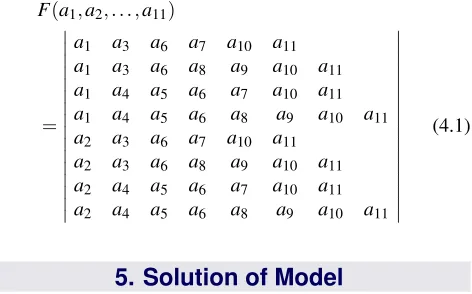
Incorporating Boolean Function Technique, The possible suc-cessful operating conditions of juice plant in terms of logical matrix are:F(a1,a2, . . . ,a11)
=
a1 a3 a6 a7 a10 a11
a1 a3 a6 a8 a9 a10 a11
a1 a4 a5 a6 a7 a10 a11
a1 a4 a5 a6 a8 a9 a10 a11
a2 a3 a6 a7 a10 a11
a2 a3 a6 a8 a9 a10 a11
a2 a4 a5 a6 a7 a10 a11
a2 a4 a5 a6 a8 a9 a10 a11
(4.1)
5. Solution of Model
By means of algebra of logics, Equation (4.1) can be ex-pressed as:
F(a1,a2, . . . ,a11) = [a11∧a10∧f(a1,a2,a3, . . . ,a11)] (5.1)
where f(a1,a2,a3, . . . ,a11)
=
a1 a3 a6 a7
a1 a3 a6 a8 a9
a1 a4 a5 a6 a7
a1 a4 a5 a6 a8 a9
a2 a3 a6 a7
a2 a3 a6 a8 a9
a2 a4 a5 a6 a7
a2 a4 a5 a6 a8 a9
= L1 L2 L3 L4 L5 L6 L7 L8 (5.2)
whereL1=
a1 a3 a6 a7
L2=
a1 a3 a6 a8 a9
L3=
a1 a4 a5 a6 a7
L4=
a1 a4 a5 a6 a8 a9
L5=
a2 a3 a6 a7
L6=
a2 a3 a6 a8 a9
L7=
a2 a4 a5 a6 a7
L8=
a2 a4 a5 a6 a8 a9
By orthogonalization algorithm, we may write (5.2) as
f(a1,a2,a3, . . . ,a11)
= L1
L01 L2
L01 L02 L3
L01 L02 L30 L4
L01 L02 L30 L04 L5
L01 L02 L30 L04 L05 L6
L01 L02 L30 L04 L05 L06 L7
L01 L02 L30 L40 L05 L06 L07 L8
(5.3)
NowL1=
a1 a3 a6 a7
L01L2=
a01 a1 a03
a1 a3 a06
a1 a3 a6 a7
∧
a1 a3 a6 a8 a9
L01L2=
a1 a3 a6 a07 a8 a9
L01L02L3=
a1 a03 a4 a5 a6 a7
L01L02L03L4=
a1 a03 a4 a5 a6 a07 a8 a9
L01L02L03L04L5=
a1 a2 a3 a6 a7
L01L02L03L04L05L6=
a01 a2 a3 a6 a07 a8 a9
L01L02L03L04L05L06L7=
a01 a2 a30 a4 a5 a6 a7
L01L02L03L04L05L06L07L8=
a01 a02 a3 a4 a5 a6 a8 a9
Putting all in (5.3), we get
f(a1,a2,a3, . . . ,a11)
=
a1 a3 a6 a7
a1 a3 a6 a07 a8 a9
a1 a03 a4 a5 a6 a7
a1 a03 a4 a5 a6 a07 a8 a9
a1 a2 a3 a6 a7
a01 a2 a3 a6 a07 a8 a9
a01 a2 a03 a4 a5 a6 a7
a01 a02 a3 a4 a5 a6 a8 a9
(5.4)
Therefore (5.1) becomes
f(a1,a2,a3, . . . ,a11) (5.5)
=
a1 a3 a6 a7 a10 a11
a1 a3 a6 a70 a8 a9 a10 a11
a1 a03 a4 a5 a6 a7 a10 a11
a1 a03 a4 a5 a6 a07 a8 a9 a10 a11
a1 a2 a3 a6 a7 a10 a11
a01 a2 a3 a6 a07 a8 a9 a10 a11
a01 a2 a03 a4 a5 a6 a7 a10 a11
a01 a02 a3 a4 a5 a6 a8 a9 a10 a11
(5.6)
This equation is the disjoint of disjoint conjunctions; therefore we can calculate the reliability of whole system which is given
by
RS=Pr{f(a1,a2,a3, . . . ,a11)}=1 (5.7)
or,
RS=R10R11{R1R3R6R7+R1R3R6Q7R8R9
+R1Q3R4R5R6R7+R1Q3R4R5R6Q7R8R9
+R1R2R3R6R7+Q1R2R3R6Q7R8R9
+Q1R2Q3R4R5R6R7+Q1Q2R3R4R5R6R8R9 (5.8)
whereRiis the reliability ofith state of the system andQi= 1−Ri,∀i=1,2,3, . . . ,11.
RS=R1R3R6R7R10R11+R1R3R6R8R9R10R11
−R1R3R6R7R8R9R10R11+R1R4R5R6R7R10R11
−R1R3R4R5R6R7R10R11+R1R4R5R6R8R9R10R11
−R1R3R4R5R6R8R9R10R11−R1R4R5R6R7R8R9R10R11
+R1R3R4R5R6R7R8R9R10R11+R1R2R3R6R7R10R11
+R2R3R6R8R9R10R11−R1R2R3R6R8R9R10R11
−R2R3R6R7R8R9R10R11+R1R2R3R6R7R8R9R10R11 +R2R4R5R6R7R10R11−R1R2R4R5R6R7R10R11
−R2R3R4R5R6R7R10R11+R1R2R3R4R5R6R7R10R11 +R3R4R5R6R8R9R10R11−R1R3R4R5R6R8R9R10R11
−R2R3R4R5R6R8R9R10R11+R1R2R3R4R5R6R8R9R10R11
RS=x1+x2−y1+x3−y2+x4−y3−y4+x5
+x6+x7−y5−y6+x8+x9−y7−y8+x10
+x11−y9−y10+x12 (5.9)
Case – (1) when reliability of each component is R, Then
(5.9)gives:
RS=2R6+3R7−4R8−2R9+2R10 (5.10)
Case –(5.1)when failure rates follow Weibull time distri-bution:
Let mi is the rate of failure for ith state of system where
i,j=1,2,3, . . . ,11, then reliability of system at any time “t”, is calculated by
RSW(t) = 12
∑
i=1exp{−xitp} − 10
∑
j=1exp{−yjtp} (5.11)
wherepis a parameter(p>0)andxi,yj, are given above
Case – (3) when failure rates follow Exponential time dis-tribution:
Takingp=1 in case (5.1), it will become Exponential time distribution, then we have
RSE(t) = 12
∑
i=1exp{−xit} − 10
∑
j=1Wherexi,yjtaken as in case (5.1).
In this case, the expression for another reliability parame-ter i.e. M.T.T.F. given by
M.T.T.F= Z ∞
0
RSE(t)dt= 12
∑
i=1
1
xi
−
10
∑
j=1
1
yj
(5.12)
6. Numerical Calculations
For Numerical computation, let us setting the values as:
(1) mi =0.001, t=0,1,2, . . ., p=2 in equation (5.11) wherei=1,2,3, . . . ,11.
(2) mi=0.001,t=0,1,2, . . .in equation (5.11) wherei= 1,2,3, . . . ,11.
(3) mi=0.0,0.1,0.2, . . . ,1.0 in equation (5.12) wherei= 1,2,3, . . . ,11.
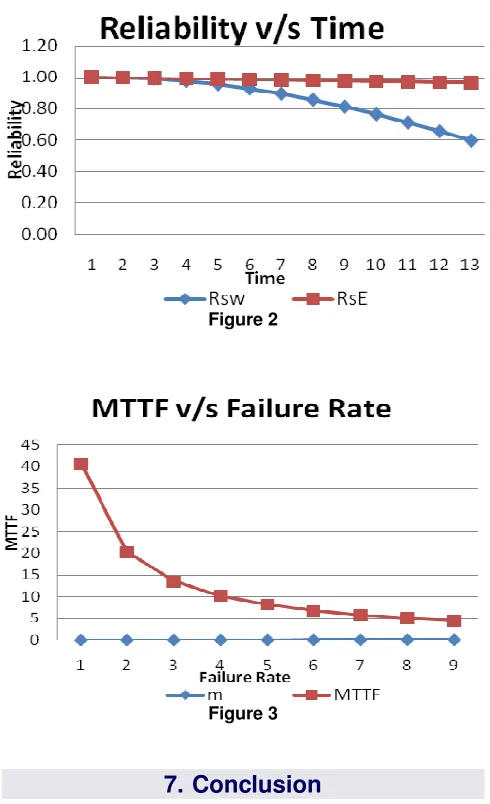
The computed results are given in Table 1 and Table 2 and graphically shown in Figure 2 and Figure 3 respectively.
Table 1
Sr. No. t RSW RSE
1 0 1.0000000000 1.0000000000 2 1 0.9970005075 0.9970005075 3 2 0.9880084829 0.9940020602 4 3 0.9730460385 0.9910047034 5 4 0.9521593699 0.9880084829 6 5 0.9254331315 0.9850134446 7 6 0.8930106164 0.9820196345 8 7 0.8551185369 0.9790270991 9 8 0.8120937128 0.9760358849 10 9 0.7644075017 0.9730460385 11 10 0.7126828900 0.9700576069 12 11 0.6576992298 0.9670706371 13 12 0.6003808648 0.9640851762
Table 2
m MTTF
0.01 40.6349206349 0.02 20.3174603175 0.03 13.5449735450 0.04 10.1587301587 0.05 8.1269841270 0.06 6.7724867725 0.07 5.8049886621 0.08 5.0793650794 0.09 4.5149911817 0.1 4.0634920635
Figure 2
Figure 3
7. Conclusion
The author has analyzed aJuice Packaging Plantfor deter-mining various reliability parameters by applying the Boolean Function Technique & algebra of logics.
In Table 1, Reliability of system is computed with respect to time when failure rates follow Weibull time distribution and exponential time distribution. The graph of “Reliability v/s Time” in the figure-2 depicts that the reliability of the complex system decreases approximately at a uniform rate in case of Exponential Time Distributions, but it decreases very rapidly, in case when failure rates follow Weibull Time Distributions. In Table 2, MTTF is calculated and the graph “MTTF v/s Failure Rate” in figure-3 depicts that MTTF of the system decreases catastrophically in beginning but later it decreases approximately at a uniform rate.
References
[1] E Balagurusamy,Reliability Engineering, Tata McGraw –
Hill Education, 1984.
[2] Marvin Rausanda, System Reliability Theory; Models,
[3] M. Van Der Spiegel and P.A. Luning, W.J. De Boer,
G.W. Ziggers and W.M.F. Jongen,How to Improve Food Quality Management in the Bakery Sector, NJAS 53-2, pp. 131-150, 2005.
[4] D. Sharma and N. Sharma,Evaluation Of Some
Reli-ability Parameters For Tele-Communication System By Boolean Function Technique, International Journal of Re-search and Reviews in Applied Sciences, 1 (3) (December 2009).
[5] J.J.H. Fey,Design of a Fruit Blending and Packaging
Plant, Ph.D. Thesis, University of Technology, Eind-hoven, 2000.
[6] S. Fang-Ming and H. Pin-Han,Reliability optimization of
distributed access networks with constrained total cost, IEEE Trans. on Reliability, 54 (3), 221-230, 2005. [7] S.H. Sim, and J. Endrehyi,A failure repair model with
minimal and major maintenance. IEEE Trans. On Relia-bility, 55 (1), 134-140, 2006.
[8] S. Kumar and A. Sachin,Evaluation of some reliability
parameters of a three state repairable system with envi-ronmental failure, International Journal of Research and Reviews in Applied Sciences, 1 (2) (November 2009). [9] S. Bansal, S.C. Agarwal and K. Sharma,Evaluation of
Reliability Factors Using Boolean Function Technique in Milk Powder Manufacturing Plant, IJRRAS, 4 (4) (September 2010), 416–424.
[10] S. Gulati, P.K. Yadav and K. Bhatia,A Reliability Model
for the Task Schedule in Distributed System based on Fuzzy Theory, CIIT Int. Journel of Networking and Com-muication Engineering, 4 (11), 684-688 (August 2012). [11] M. Kumar and R. Avtar,Reliability Analysis of Rice Mill
by Boolean Function Technique, IJETT, 4 (5) (May 2013, 1947-1953.
[12] J. Singh and R.A. Jaswal,Evaluation Of Reliability
Pa-rameter Of Thermal Power Plant By BFT,Int. Journal of Adv. Engg. Tech/IV/III, 79-81, July-Sept 2013.
[13] N. Yadav and R.B. Yadav,Reliability Estimation In Milk
Powder Manufacturing Plant Mathematics Subject Clas-sification, IJERIA, 7 (II) (May 2014), 15-31.
[14] A.K. Aggarwal, V. Singh and S. Kumar,Availability
Anal-ysis and Performance Optimization of a Butter Oil Pro-duction System: A Case Study, Int. Journal of Sys. Assur, Engg. and Management, Springer, Nov. 2014.
[15] M. Ahmad,A Case Study of Maintenance Management
System for Bread Baking Plant, Pak. Journal of Engg. Tech. & Science, 5 (1), 1-12, 2015.
? ? ? ? ? ? ? ? ?
ISSN(P):2319-3786
Malaya Journal of Matematik
ISSN(O):2321-5666