Multilateral consensus decision making:
How Pacific island states build and reach consensus in climate
change negotiations.
A thesis submitted for the degree of Doctor of Philosophy of
The Australian National University
The work presented in this thesis is, to the best of my knowledge, my own original work, except where acknowledged in the text.
ii
Dedication
In loving memory of my dear father, a man of great humility and compassion. Alōfa’aga e lē uma.
Faumui Harry Amos Carter
Acknowledgements
For a thesis that explores how consensus is built and reached, beyond the strategies and politics of negotiations, in the end-- it is about people and their special relationships. This explanation aptly describes the journey of this PhD candidature. I am grateful and indebted to the kindness of many people and the relationships forged throughout the years.
This research focuses on Pacific leaders and negotiators in various multilateral climate change negotiations around the globe. I was privileged to be among them as a
researcher-negotiator in 2015, and thankful to all those who participated in the project through talanoa. Furthermore, I would like to thank and acknowledge the governments of Samoa and Tuvalu for allowing me in their delegations; this opportunity opened many doors, to see the negotiations from their own eyes. More importantly I am grateful to the generosity and friendship of Ali’ioaiga Feturi Elisaia and Anne Rasmussen Fata, who did not hesitate to take me under their wing during the negotiations. The stories of advocacy, frustrations, successes and aspirations of many Pacific leaders and
negotiators are inked throughout the pages of this thesis. Thank you for your trust – your fa’asoa – talanoa/toktok in telling our Pacific story.
I would like to express my sincere gratitude to Associate Professor Dr Nicole Haley and the staff of the Department of Pacific Affairs, for their encouragement and investment tell the stories of the Pacific climate change champions. The opportunities afforded to record Pacific voices around the globe, and the space to convey them through academic teaching and means of this research, have enriched my capacity and commitment to the scholastic endeavour. I cannot forget the collegiality and encouragement of my fellow PhD cohort: David, Almah, Theresa, Eliorah, Maebh, Susan, Anita, Mona, Lincy, Ellen, Denghua, Scott and many more dear friends of DPA and the Coral Bell School of Asia and Pacific Affairs.
iv various Pacific church groups, community groups, and families in ACT who have blessed me in so many ways, fa’afētai mo tou talosaga ma fa’amānuiaga. My heartfelt thanks to my Canberra Aiga - Lilomaiava Florence Sa’aga, Hinauri Petana, Rona Meleisea, Fata Brian and Stephanie Kaio, Henry Tunupopo, Dr Nicholas and Makayla Halter, Rev Dr Latu and Lotu Latai, Tausala Uilelea, Rodney Ng Shiu, Tavalea Nilon and not forgetting Cheryl, Joe, Hanna Ketesemane and all my Pasifika friends in ANU- for keeping me grounded and focussed (and well nourished).
For many who know me well, this work would not have been possible without the immeasurable support from the people that reside in the finest house on the river, Toad Hall. I could not have found a more welcoming community with the perfect space to focus on my writing, and a multicultural community that can serve as a reference point to understanding behaviour in multilateral negotiations, than my global Toad Hall family. Under the leadership of Dr Ian Walker and Lucinda Watt, it has been a pleasure to work, live and learn alongside all my fellow Community Coordinators, Senior Resident teams, and residents of the Hall from 2012-2018.
I am fortunate to be surrounded by many remarkable friends, in Canberra, Sydney, Auckland and Samoa, who have given their time and resources to make sure that I cross the finishing line. They have shared in my frustrations, joys and lows throughout the years. Whether it be constant social media messages, or long discussions at the flat, I would like to thank my support network of Siosina, Myjolynne, Lilu, Sizs Jerry, Binota and Dipta, Faraz, Vince, Fakasoa, Puakena, Makareta, Moana, Aneta, Hendry, Morina, Siniva, Katenia, Dulcie, Robert, Bure, Audoa, Leisha, Marva, Virginia, Sharon and many more friends around the Pacific and the world.
In building and reaching consensus, a key finding of this research is the presence of a core group of people that have vested interested and concern on an issue. I am
privileged to have two core groups who have invested so much of their time and
grateful and indebted to your kindness and vision in my potential. You never hesitate to lend a helping hand to me, or the countless other Pacific students and scholars in the region. Through your silent and caring leadership, you have been an inspiration in paving the way for a new generation of Pacific scholars. Faafetai tele lava. I could not have completed this work without the diligence and patience of my committee chair, Dr Stewart Firth. I am fortunate to have studied under one of the greatest pioneers of contemporary Pacific scholarship. Thank you for your encouragement throughout my masters and doctoral thesis candidatures. Despite the typhoons and my over-committed routine, you have been continuously generous with your time in the last few months. Words can never be enough to thank all your kindness.
I pay special tribute to all my teachers, lecturers and educators - from Sunday schools and Aoga Faifeau in Alamagoto and Auala, to formal education from RLSS, Samoa College, National University of Samoa, Victoria University of Wellington and the ANU. O le aiga o le faleaoga muamua – and I am heavily influenced by the philosophies, values, and love for family, God and community by my late
grandmothers- o mea uma o le faleaoga- Taofia Amosa Carter and Lailoa Tuiasau Wong Sin.
My second and inner core group, are my aiga. My extended families in Samoa, New Zealand, Australia and U.S. and mātua fa’alēagāga Rev. Faatafa and Sinuanua –
fa’afetai mo tou talosaga ma faamanuiaga. E le galo le tapuaiga a aiga ma fanau- Molioo Tuiletufuga ma Falenaoti Julie, Leiataua ma Anne, Vaimaila, Tuiasau ma Lina, Gilbert ma Shona. My father, Faumui Harry Amos Carter, whom I dedicate this
research would not be able read it in its completion. However, I have comfort that his grandchildren Lailara, Lemuel Ata, Leopold and Lomenya would be able to read these stories when they are little older. E lē gālo le tou alofa ma outou talosaga i aso uma, of my siblings Muliagatele David, Lailoa, ma lo’u tina peleina, Barbara. Thank you for in being patient, loving and allowing me to pursue studies away from home for such a long time. You all are the inspiration to this work, fa’afetai mo mea uma. Alofa na o le alofa nei.
vi
Abstract
For over two decades, Pacific island states have been active participants in multilateral climate change negotiations. Yet little is known about how these small states perform inside multi party negotiations, far less their contribution in building and reaching a consensus. This thesis investigates the behaviour of fourteen Pacific island states, by examining their negotiators and their activities in international, regional and global negotiation processes. It uses global talanoa to trace their work in the making of the UN climate change Paris Agreement in 2015, by detailing the complexity of the structures, issues, actors, politics and decision making processes inside various multilateral forums: the Ad Hoc Durban Platform (ADP), Pacific Islands Development Forum (PIDF), Pacific Islands Forum (PIF), and the twenty first Conference of the Parties (COP21). Beyond the structural conditions (rules, formula, procedures, the Chair) and incremental stages of negotiations, this thesis finds there is a small core group of individuals in each forum that condition and precipitate the building and reaching multilateral climate
change consensus. Underpinning the work of the core group of Pacific leaders and
technical negotiators is their resilience and their successes in conducting cordial
exchange of ideas, interests and building trust and respectful relationships in the
Table of Contents
Acknowledgements ... iii
Abstract ... vi
List of Tables ... x
List of Figures ... xi
Acronyms ... xii
Chapter One: Introduction ... 1
The Puzzle ... 2
Research Design ... 5
Contributions and Context ... 8
Multilateral Consensus Decision Making ... 10
Climate Change Negotiations ... 11
Small states and Multilateral Negotiations ... 13
Pacific Islands in Climate Change Negotiations ... 16
Methodology ... 20
Talanoa Method ... 20
Global Talanoa: process tracing through global political ethnography ... 23
Conclusion and Outline ... 25
Chapter Two: Multilateral Consensus Decision Making ... 28
Introduction: ... 28
Consensus Decision Making: Outcome and Process ... 29
Defining Consensus Decision Making ... 31
Psychology: Interactional Consensus ... 33
Unanimity ‘Vote’ and Consensus ‘Agreement not to Disagree’ ... 35
International Relations: Actors and Institutions ... 37
Actor-Specific: Decision/Foreign Policy Making ... 38
Process Specific: Institution-oriented/Multilateralism studies ... 42
Multilateralism ... 44
Diplomatic Studies: Negotiations ... 53
Analysing Multilateral Negotiations ... 54
Integrative Analysis of Multilateral Negotiations ... 56
Stages of Multilateral Negotiations ... 56
Actors in Multilateral Negotiations ... 59
Activities in Multilateral Negotiations ... 60
Building Consensus in Multilateral Negotiations ... 63
Reaching Consensus in Multilateral Negotiations ... 65
Multilateral Consensus Decision Making: An Analytical Framework ... 66
Conclusion ... 69
Chapter Three: UNFCCC and the Pacific island states ... 71
Introduction: ... 71
The Climate Regime: A short but complex history of UNFCCC ... 71
Global Warming Consciousness ... 71
viii
Complexity Within a Complex Process ... 83
UNFCCC Procedures and Consensus ... 90
History of Pacific island states’ involvement in climate negotiations ... 93
Small island states unity under the Alliance of Small Island States ... 93
Pacific countries and UNFCCC coalitions ... 102
Climate Change as Regional Priority ... 106
Setting the Scene in 2015 ... 109
The international UNFCCC ADP and global UNFCCC COP21 ... 110
The regional negotiations: climate politics of regional, sub-regional partner-regional forums ... 113
Conclusion ... 121
Chapter Four: International Negotiations - UNFCCC Ad Hoc Durban Platform Ninth Session (ADP2-9) ... 123
Introduction ... 123
ADP2-9 Context... 124
ADP2-9 Pre-Negotiation Phase ... 129
ADP Process ... 129
Inside: AOSIS and small states’ politics ... 130
Inside: G-77 and China ‘balancing multiple coalitions’ ... 137
Inside: Coalition of Rainforests Nations and maintaining REDD Plus ... 140
Inside: Cartagena Dialogue bridging a divide ... 141
Coalition Consensus ... 142
ADP2-9 Negotiation Phase ... 143
Timeline of ADP2-9 Process ... 143
Inside: Informal Facilitated Negotiation Groups ‘a day in the life of Pacific negotiators’... 146
Inside: Pacific SPREP-SIDS Collective ... 151
Inside: Aspirations of the Collective and Challenges of Delegates from the Pacific 155 ADP2-9 Agreement Phase ... 160
ADP Process: The Consensus Point ... 160
Conclusion ... 161
Chapter Five: Regional Negotiations- Pacific Island Development Forum and Pacific Island Forum ... 165
Introduction ... 165
The Pacific Way: Consensus Decision Making in the Pacific ... 167
The Pacific Islands Development Forum ... 169
PIDF Context ... 169
PIDF Pre-Negotiation Phase ... 172
PIDF Negotiation Phase ... 174
Inside: Consultative Open Process (Talanoa Diplomacy) - Strategy for COP21 ... 175
Inside: PIDF Senior Officials Committee - Drafting Group ... 178
PIDF Agreement Phase ... 179
The Pacific Islands Forum ... 180
PIF Context ... 180
PIF Pre-Negotiation Phase ... 185
Inside: Smaller Island States meeting - The making of Smaller Island States Declaration on Climate Change ... 186
Inside: Forum Officials Meetings: Drafting Group on PIF Climate Change Declaration
... 194
PIF Agreement Phase ... 197
Conclusion ... 199
Consensus Decision Making in Pacific Regionalism ... 200
Chapter Six: Global Negotiations - UNFCCC Paris Climate Change Conference ... 203
Introduction: ... 203
COP21 Context... 204
Global multilateral conference, global participation ... 204
French leadership and proactiveness ... 205
Pacific island states and COP21 Preparations ... 207
COP21 Pre-Negotiation Phase ... 212
One Conference, Five Meetings: COP21, CMP11, SBI43, SBSTA43, ADP2-12 .... 212
Inside: AOSIS Preparatory ... 214
Inside: Pacific SIDS Preparatory ... 215
COP21 Negotiations Phase ... 220
Leaders High-Level Segment ... 220
ADP2-12: Technical Negotiators Refining the Final Text ... 223
Established Coalitions and the ad hoc Pacific SIDS coalition in the Negotiations .. 226
Inside: Pacific SIDS and Negotiations ... 227
COP21 Agreement Phase: Global Consensus Point ... 230
Inside: Comité de Paris ... 230
Inside: Tuvalu vs. United States of America - Loss and Damage ... 234
Inside: High Ambition Coalition ... 238
Inside: Moments of the Final Day ... 241
Conclusion: ... 247
Consensus Decision Making in Global Multilateral Forums ... 249
Small states with a disagreement matter ... 252
Chapter Seven: Conclusion ... 253
Conditions of Multilateral Consensus Decision Making ... 256
Conditions for Building Consensus ... 257
Conditions for Reaching Consensus... 260
Overall Conditions for Multilateral Consensus Decision Making ... 262
The Core Group: Pacific Island Negotiators ... 265
Strategies in shaping negotiations ... 266
Strategies in building capacity ... 267
Overcoming challenges for the Core Group ... 268
Limitations and Future Directions ... 269
Pacific Negotiators and Multilateral Consensus Decision Making Continues ... 270
Appendix ... 273
x
List of Tables
Table 1. Small states strategies to build capacity in multilateral negotiations ... 14
Table 2. Small state strategies in shaping multilateral negotiations ... 14
Table 3. Pacific island states: UNFCCC, population and physical geography .. 18
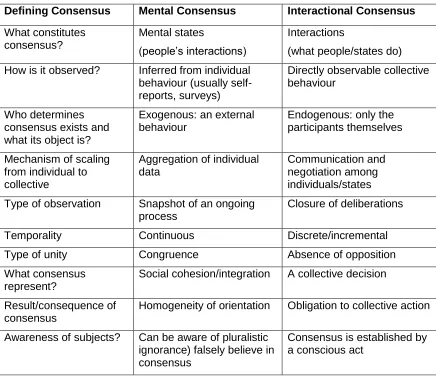
Table 4. Mental Consensus and Interactional Consensus ... 35
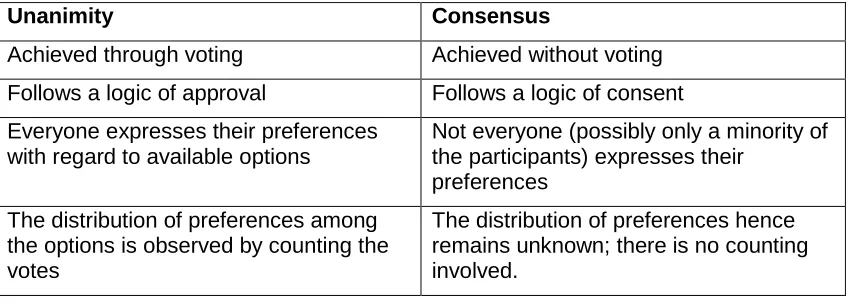
Table 5. Distinction between Unanimity and Consesnus ... 36
Table 6: Activties in multilateral negotiations ... 61
Table 7: Propostions of building and reaching consesnsus in multilateral negotiations ... 67
Table 8: Analytical Framework to observe how consensus is built and reached in multilateral negotiations ... 67
Table 9. Main types of negotiating arenas in UNFCCC ... 84
Table 10. Coalition Blocs in UNFCCC Negotiations ... 89
Table 11. UNFCCC Vice President Representatives of SIDS Seat in the Bureau ... 98
Table 12. Regional and Sub Regional polictical declarations on climate change ... 120
Table 13. Pacific island states official delegation composition at ADP2-9 ... 129
Table 14. PIDF 2015 official program and schedule of meetings ... 173
Table 15. PIF 2015 official program and schedule of meetings ... 186
Table 16. Paris Climate Change Conference 2015 official program and schedule of meetings ... 212
Table 17. Pacific officials delegation composition at COP21 ... 219
Table 18. Pacific Delegations Breakdown of Ministers and Non-State Representation ... 220
Table 19. Conditions for Building Consensus ... 257
Table 20. Conditions for Reaching Consensus ... 260
List of Figures
Figure 1: Map of the Pacific Islands. ... 17
Figure 2: Country groups in the climate change negotiations ... 88
Figure 3 and Figure 4.Images of negotiators from the Pacific at the Pacific SIDS preparatory meeting on November 26, 2015. Photographs by author. ... 216
Figure 5. Image of WhatsApp AOSIS Finance Coordination Group during
COP21 negotiations. Image provided by author. ... 225
Figure 6. Image inside Pacific SIDS coordination meeting on December 3, 2015. Photograph by author. ... 228
Figure 7. Image of Pacific SIDS huddle during ADP 2-12 spin-off negotiations on adaptation December 4, 2015. Photograph by author. ... 229
Figure 8. Image of U.S.-Tuvalu bilateral on loss and damage, on December 8, 2015. Tuvalu is led by prime minister Enele Sopoaga, and U.S. by Secretary of
State John Kerry (Tuvalu is joined by Timor Leste of the LDC group). ... 237
Figure 9 and Figure 10: Images inside the final Pacific SIDS coalition meeting as negotiators peruse and inspect the final text of the Paris Agreement on
December 12, 2015. Photographs by author. ... 243
Figure 11 and Figure 12. Image inside the final AOSIS coalition meeting on reaction to the Paris Agreement text on December 12, 2015. Photographs by
author. ... 244
Figure 13 and Figure 14. Image inside final G-77 coaliation as the southern coalition consent to the text of the Paris Agreement text on December 12, 2015.
xii
Acronyms
ADP Ad Hoc Working Group on Durban Platform
AILAC Association of Independent Latin American Countries) AOSIS Alliance of Small Island States
ASEAN Association of Southeast Asian Nations BAP Bali Action Plan
BASIC Brazil, South Africa, India and China CARICOM Caribbean Community
CDM Clean Development Mechanism CfRN Coalition for Rainforest Nations
CHOGM Commonwealth Heads of Government Meeting
CMP Conference of Parties serving as Meeting of the Parties to the Kyoto Protocol
COP Conference of Parties of the UNFCCC
CROP Council of Regional Organisations in the Pacific CVF Climate Vulnerable Forum
ECOSOC United Nations Economic and Social Council EIG Environmental Integrity Group
ENB Earth Negotiations Bulletin EU European Union
FIELD Foundation for International Environmental Law and Development FIPIC Forum for India-Pacific Islands
FOC Pacific Islands Forum Officials Committee G77 Group of 77 and China
GATT General Agreements on Tariffs and Trade (now, World Trade Organisation)
GHG Greenhouse gas emissions HLSM High-Level Support Mechanism IMF International Monetary Fund
INC Intergovernmental Negotiating Committee on Climate Change INDC Intended Nationally Determined Contributions
IPCC Intergovernmental Panel on Climate Change LDC Least Developed Countries
OECD Organisation for Economic Cooperation and Development OPEC Organisation of the Petroleum-Exporting Countries
PALM Japan-Pacific Islands Leaders Meeting
Pacific SIDS Pacific Small Islands Developing States (at COP21)
PSIDS Pacific Small Islands Developing States (New York) PCCR Pacific Climate Change Roundtable
PIDF Pacific Islands Development Forum
PIF Pacific Islands Forum (formerly South Pacific Commission) PIF SIS Pacific Islands Forum Smaller Islands States
PIFACC Pacific Islands Framework for Action on Climate Change PLG Polynesian Leaders Group
PNG Papua New Guinea
REDD Reducing Emissions from Deforestation and Degradation SBI Subsidiary Body for Implementation (of the UNFCCC)
SBSTA Subsidiary Body for Scientific and Technological Advice (of the UNFCCC)
SIDS Small island developing states
SPC Secretariat of the Pacific Community (formerly Secretariat of the Pacific Commission)
SPREP Secretariat of the Pacific Regional Environment Program UN United Nations
UNCTAD United Nations Conference on Trade and Development
UNESCO United Nations Educational Scientific and Cultural Organization
UNFCCC United Nations Framework Convention on Climate Change UNGA United Nations General Assembly
UNSC United Nations Security Council
USP University of the South Pacific
WB World Bank
WMO World Meteorological Organisation WTO World Trade Organisation
WCC World Climate Conference
Chapter One: Introduction
Today, we stand here facing one of the greatest challenges of humankind, climate change. We are at a critical point of history...For a country like Tuvalu, our survival depends on the decisions we take at this Conference. Let me emphasize this point. Our survival as a nation depends on the decisions we take at this Conference. This is not simply a stepping-stone to a better future. We stand on a cliff edge. Either we stand united and agree to combat climate change or we all stumble and fall and condemn humanity to a tragic future.
Enele Sopoaga, Prime Minister of Tuvalu1
For more than two decades, the United Nations Framework Convention on Climate Change (UNFCCC or the Convention) has been addressing one of the greatest
challenges of humankind, climate change. The Convention is a multilateral process to find global solutions for the global problem of climate change. This diplomatic endeavour of multiple states interacting simultaneously created a complex climate change regime of prolonged negotiations that exists to the present day. An intrinsic feature of modern-day multilateral diplomacy embedded in these negotiations is the ability of states to conform and innovate in a regime that promotes consensus decision making. The ability of the 196 signatory parties, each with unique national interests and ideological backgrounds, to reach consensus on an annual basis is a feat of international politics and diplomatic finesse.
Since the establishment of the UNFCCC in 1992, fourteen Pacific island countries have joined the multilateral negotiations2. These island states are some of the most vulnerable
frontline states to climate change impacts. Despite their vulnerabilities, they have actively participated in these climate change multilateral consensus decision making
1Enele Sopoaga, "Statement by Prime Minister of Tuvalu Hon Enele Sopoaga at Leaders Event Opening
of COP21," UNFCCC https://unfccc.int/process/conferences/past-conferences/paris-climate-change-conference-november-2015/statements-and-resources/statements-made-during-the-leaders-event.
2 Cook Islands, Federated States of Micronesia, Fiji, Kiribati, Marshall Islands, Nauru, Niue, Palau, Papua
negotiations, their efforts have received little attention and it is this subject that this thesis is concerned with.
The Puzzle
This thesis examines how states behave inside multilateral negotiations, in particular, negotiations that utilise decision making by consensus. How do states build and reach consensus in multilateral diplomacy? Multilateral diplomacy is the management of international relations by negotiations among three or more states through diplomatic or governmental representatives. Multilateral consensus decision making is not unique to climate change negotiations. In fact, consensus decision making by many states has been well studied in economic and trade forums like the European Union (EU), World Trade Organisation (WTO), International Monetary Fund (IMF) and the World Bank (WB)3. The small and limited studies on consensus decision making in climate change
negotiations have pointed to alternative decision making processes4. A common thread
amongst all these bodies of work, despite prolonged and continuous negotiations with many impasses throughout the years, is that multilateral consensus decision making forums do work. The very existence of the UNFCCC is a sign that consensus in multilateralism does work. For international relations, the ability of states to advance their interests through dialogue to find common solutions by consensus is a cornerstone of international politics. For diplomatic studies, the fascination with consensus decision making follows the practices and activities that state practitioners employ in conducting negotiations. In providing insight into how states have sought to define and advance their interests in these international negotiations, this thesis ultimately puts a
microscope on who the state practitioners are, and their activities that build and reach consensus.
3 Dorothee Heisenberg, "The institution of ‘consensus’ in the European Union: Formal versus informal
decision‐making in the Council," European Journal of Political Research 44, no. 1 (2005). I William Zartman, International multilateral negotiation: Approaches to the management of complexity (Jossey-Bass, 1994). Miles Kahler, "Multilateralism with small and large numbers," International Organization 46, no. 3 (1992). Heisenberg.
4 Robyn Eckersley argues in favour of minilateralism through regional climate councils, and Luke Kemp
3 This research is concerned with the behaviour of a particular group of states in climate change negotiations. The discursive nature of multilateralism, or “the practice of coordinating national policies in groups of three or more states, through ad hoc arrangements or by means of institutions “5 offers a paradoxical dilemma. For great
powers the benefits of multilateralism come from controlling the behaviour of another great power or rising power; while for small states, international institutions offer a platform to influence international policy decisions6. Much of the scholarship on
multilateral negotiations is geared towards understanding the role of a few big states, with only a handful exploring what scholars call the ‘Lilliputians’7or ‘dwarfs’8. In main
multilateral institutions like the United Nations (UN) where small states outnumber great states, little is known about the activities of small states and how they influence outcomes9. How do small states influence negotiations, and what are their contributions
to the negotiations?
In the climate change regime, some of the smallest and most vulnerable countries that participate in the negotiations are from the Pacific region. These small island states are not only vulnerable as frontline states to the impacts of climate change; they are also vulnerable in their limited capacity in terms of diplomatic representation and technical expertise in negotiations10. Despite these challenges, Pacific states, along with other
small island states around the world, have had a long and successful history since the early days and continue to remain the moral conscience of the Convention11. While
5 Robert O Keohane, "Multilateralism: an agenda for research," International journal 45, no. 4 (1990):
731.
6 Robert O Keohane, "Lilliputians' Dilemmas: Small States in Internatinal Politics," International
organization 23, no. 2 (1969).
7 Ibid.
8 Diana Panke, "Dwarfs in international negotiations: how small states make their voices heard,"
Cambridge Review of International Affairs 25, no. 3 (2012).
9Christine Ingebritsen, Iver Neumann, and Sieglinde Gsthl, Small states in international relations
(University of Washington Press, 2012).
10 George Carter, "Establishing a Pacific voice in the climate change negotiations," in The new Pacific
diplomacy, ed. Gregory Fry and Sandra Tartte (Canberra: ANU e-Press, 2016). Carola Betzold, "‘Borrowing’power to influence international negotiations: AOSIS in the climate change regime, 1990– 1997," Politics 30, no. 3 (2010).
11 Inés de Agueda Corneloup and Arthur PJ Mol, "Small island developing states and international
studies of small island states exist especially on the negotiating bloc of the Alliance of the Small Islands States (AOSIS) in the UNFCCC that include Pacific states, there is no substantial research that focuses on their particular contributions or detailed analysis of how they influence consensus decision making.
The remarks by Tuvaluan Prime Minister Enele Sopoaga cited at the beginning of this chapter, reflect the significance of climate change multilateralism for the people of the Pacific, let alone the survival of a nation. These words were shared by other Pacific leaders at the opening of the UNFCCC twenty first conference of the parties (COP21) in Paris 2015. For Pacific island states, climate change is more than an energy or economic issue, it is an existential threat. The UNFCCC is the main multilateral forum that allows their voice to be heard and influence a global solution.
These collocations in the gap in the literature on multilateral consensus decision making, the unexplored contributions of small Pacific island states in international negotiations, and the significance of climate change to the states and people of the Pacific provide the empirical and theoretical underpinning of this thesis. This research asks:
In multilateral climate change negotiations, how do small Pacific Island states build and reach consensus?
The main research question is framed around understanding how Pacific island states behave and engage inside multilateral climate change negotiations. As Chapter Two will explain, consensus is both a process and an outcome. During negotiations there is a process of debates, discussions, and compromise amongst multiple parties that attempt to achieve an outcome(s). Furthermore, the process assumes that Pacific island states are active members in the negotiations, where they assist in building and reaching that consensus. By tracing consensus both as a process and outcome, the research will illuminate two key elements of diplomatic studies’ investigation: the actors and their activities in conducting negotiations. This informs the two sub-questions of this
5
Research Design
In 2015, the UNFCCC successfully negotiated the Paris Agreement or the Accord de Paris12. The agreement set forth new targets for global action and responses to climate
change after 2020, at the conclusion of the Kyoto Protocol. This global consensus came after more than three years of negotiations amongst the 196 parties. Following the failures of the climate change negotiations in Copenhagen 2009, an Ad Hoc Working Group on Durban Platform (ADP) was established in 2012 with the mandate to “develop a protocol, another legal instrument or an agreed outcome with legal force under the Convention applicable to all Parties, which is to be completed no later than 2015 in order for it to be adopted at the twenty-first session of the Conference of the Parties (COP) and for it to come into effect and be implemented from 2020”.13 The
mandate would establish a multilateral negotiation process premised on consensus decision making, whereby states were called upon to build and achieve an outcome within a certain timeframe. Although the first two years of the ADP talks concentrated on guidelines, the actual negotiations would intensify from January until December 2015. These diplomatic negotiations are the focus of this research. Climate change negotiations are seen here, as in the case of 2015, as operating within a particular timeline, but more importantly occupying and operating at multiple levels. While it is important to acknowledge that climate change discussions do occur in local community and national levels that determine national interest, the emphasis of this research is to explore multilateral negotiations of three or more party states. This leads the study to explore particular multilateral negotiating processes at the regional, international and global levels.
This thesis will explore and trace the involvement of Pacific island states not only in the global Paris Climate Change Conference (December 2015), but also in the international negotiations of the ADP (June 2015) and regional forums of the Pacific Islands
Development Forum (PIDF) and Pacific Islands Forum (PIF) (September 2015) leading up to the conclusion of the Paris Agreement. By explaining the behaviour of Pacific
12 UNFCCC, "Paris Agreement," ed. United Nations Framework Convention on Climate Change (Paris:
United Nations Framework Convention on Climate Change, 2015).
13 "Report of the Conference of the Parties on its seventeenth session, held in Durban from 28 November
island states in multi-level multilateral forums, it will reveal the actors and their activities involved in consensus negotiations. These explanations in turn provide building blocks in what can be termed and explored in detail in the concluding chapter: international consensus, regional consensus and global consensus.
International Negotiation Process
The ADP process was conducted over 12 sessions of negotiations ranging from procedures to compiling a text to actually touching and negotiating text. In 2015, the ADP negotiations started with the eighth session (ADP2-8) in Geneva where a draft text was formulated which would serve as the basis in the following sessions in Bonn
(ADP2-9, ADP2-10, ADP2-11) and in Paris (ADP2-12). The ADP mandate and expectations of states was that the negotiations of the text would be completed by ADP2-12; but this would not be the case. The ADP sessions were preparatory
negotiations, an international process that was state-centric driven by party delegations to streamline and synthesise the various national positions. These international
preparatory meetings were deemed essential in garnering the various positions and their limitations, or red lines, of states essential in finding a compromise. This research will take an in-depth description and analysis of the Bonn ADP2-9 in June. This
international conference was the first meeting in which the draft of the then Geneva negotiating text would be open to parties to be streamlined. With a timeline ending in December later that year, there was no expectation amongst the parties that negotiations would end here. Therefore, for negotiators and the purpose of this research, what mattered was relationships, consent on process and more importantly consensus.
Regional Negotiation Process
The formal international negotiations process of the ADP throughout the year, would not be obvious from the attention of states and their governments in the Pacific region. In parallel to the international process, many regional and sub-regional organisations in the Pacific held with their annual meetings their own preparations for both the
international ADP process and the global forum of the Paris Climate Change
7 (MLS), and regional organisations like the Secretariat of the Pacific Regional
Environment Program (SPREP), PIDF and PIF. Even regional partner-regional meetings with donor countries like Japan’s Pacific Islands Leaders Meeting (PALM), Forum for India-Pacific Islands Cooperation (FIPIC), Commonwealth Heads of Government meeting, U.S.-Small Islands meeting, and France-Oceania Summit
included in their dialogues common understanding on issues discussed at the UNFCCC. In the communiques and political declarations that would come out of the multilateral forums, there was a common call both implicitly and explicitly for Pacific state solidarity. From these regional meetings, the project will explore decision making in two multilateral regional forums: PIDF and PIF. Both these diplomatic forums took place within a span of 12 days; and the practice of consensus took on varied forms. The PIDF viewed consensus as inclusive in the participation of non-sovereign states, private and civil society, premised on principles of talanoa, while the pre-eminent political organisation PIF’s Pacific Way consensus tended to revolve around the decisions of leaders. This research traces the making of two key climate change declarations that emanated from these forums: the PIDF Suva Declaration on Climate Change, and the PIF Port Moresby Declaration on Climate Action.
Global Negotiation Process
The Paris Climate Change meeting or COP21 is determined here as the global process of negotiations. A global consensus was mandated to be reached at this final meeting. At this level not only would the international and regional negotiation processes
converge, but so would the plethora of interested actors from state governments, NGOs, private industries and individual citizens. The COP21 was a megaconference of ideas, interests and political will that was expected to rectify the diplomatic failures of the 2009 UNFCCC Copenhagen COP15, where consensus was not achieved. Not only was it to be a testing ground to regain the faith of the global community on multilateralism to provide a global solution, it would test the faith of states on the practice and vitality of consensus decision making.
structures and political dynamics of global negotiations. It accentuates how Pacific solidarity and relationships were built through international and regional processes in delivering a Pacific voice in the negotiations. Most importantly, in the most pivotal moments of negotiations or the consensus point, it explores whether Pacific states and their actors could influence a final agreement.
Having identified the puzzle, the main research question and the design of the research project, the next section will focus on the contributions and context of the research. It will provide an overview of the literatures on multilateral consensus decision making, climate change negotiations, and small states. It will identify a lacuna in the discipline’s understanding of how small states influence climate change negotiations, and especially the subjects of this investigation, Pacific island states. The final section will detail the methodology used in the research, Global Talanoa, that is, a hybrid of methods from process tracing, global political ethnography and talanoa. The chapter will then
conclude by providing a summary of the structure of this research and the chapters that follow.
Contributions and Context
This thesis offers three key contributions to the disciplines of international relations and diplomatic studies. Firstly, the purpose of this research is not to test theory, but rather to substantiate conditions for theory making. These conditions provide building blocks to create new theories and broadening the scholarship on consensus decision making. It suggests a new analytical framework to explore the internal dynamics of multilateral negotiations through phases as they occurred in real time, to formulate theoretical conditions for multilateral consensus decision making. This research is concerned with micro-processes of negotiations, that is the internal or inside dynamics of processes and actors within negotiations. While the main unit of analysis remains the state, the
9 of state behaviour in consensus decision making are examined against a framework which goes inside negotiations and traces them through the following phases: from pre-negotiation, pre-negotiation, and agreement phase.
A major methodological challenge in understanding international negotiations is typically that they are secretive and much of the complex process is informal, and not recorded14. This is compounded by a further empirical challenge that any experimental findings need corroboration with observational studies15. To meet these challenges, the second contribution of this research is through its methodological approach of global talanoa. To understand the nature of consensus decision making, and the practice of negotiations more generally, this research will take an in-depth approach by unpacking negotiations as they occur in real time. For global talanoa to take place, the researcher needs to act as a participant negotiator-observer with negotiations to build thick ethnographic descriptions or insider accounts of people, structures and events as they unfolded. The thick descriptions will then be corroborated with the propositions or hypotheses of consensus decision making part of the analytical framework. The
concluding section of this introductory chapter will further explore the methodology of global talanoa.
Thirdly, the empirical contribution of this thesis is to shed light on the remarkable story of Pacific island states and their diplomatic endeavours in multilateral climate change negotiations. The recent scholarship on new Pacific diplomacy16 with Pacific scholars17 and negotiators18 have undertaken the first steps to address these lacunae. The work by
14 John Odell, "Negotiation and Bargaining," in Handbook of international relations, ed. Walter
Carlsnaes, et al. (London: Sage, 2002), 394.
15 Ibid., 395.
16 Greg Fry and Sandra Tarte, The new Pacific diplomacy, ed. Greg Fry and Sandra Tarte (Canberra:
ANU Press, 2016).
17 Nicollette Goulding, "Marshalling a Pacific response to climate change," in The new Pacific diplomacy,
ed. Gregory Fry and Sandra Tartte (Canberra: ANU Press, 2016)., Fulori Manoa, "The New Pacific diplomacy at the United Nations: the rise of the PSIDS," in The New Pacific Diplomacy, ed. Sandra Tarte and Greg Fry (Canberra: ANU e-press, 2015).
18 Ian Fry, "The Paris Agreement: An Insider's Perspective-The Role of Small Island Developing States,"
Ashlie Denton explores the power, knowledge and the contestation of global and local narratives, in effectively building a climate empire in the Pacific19. Moreover, it fills a
crucial deficit in the disciplines that tends to study Pacific island states as mere objects or passive players in regional and international politics20. The empirical contributions of this research emphasise the agency and collective active participation of states, that situates them as subjects of international relations theory making.
Multilateral Consensus Decision Making
The main concept this thesis is concerned with is multilateral consensus decision making. It is defined here as the outcome agreement that is achieved from a non-voting decision making process that involves negotiating disagreements of interests, values and ideas among three or more party states collaboratively. There are two reasons why consensus decision making needs to be clarified. Firstly, it is frequently observed in international organisations. Secondly, it is viewed as more democratic than decisions made by majority rule. Decisions that are agreed to by all parties will gain higher levels of legitimacy. For climate change negotiations this is vital; as legitimacy will pave the way for collective action on implementing the decisions.
As both a norm and procedure in multilateral conferences, consensus is achieved when multiple parties agree to common decisions without casting a vote. It is important to acknowledge decisions by consensus is not the only form of multilateral decision making utilised. Learning from the failures of decisions by unanimity in the early half of the twentieth century, international organisations established after World War II experimented with various forms of voting. From unit veto as in the UN Security Council, or weighted voting in the Boards of the WB to majority rule within the UN General Assembly; voting was preferred for its quicker results. But this was at the expense of creating binaries and divisions amongst disapproving parties that would prove detrimental when it came to implement these agreements. In effect consensus
19 Ashlie Denton, "Voices for environmental action? Analyzing narrative in environmental governance
networks in the Pacific Islands," Global environmental change 43 (2017)., and Ashlie Denton, "Building Climate Empire: Power, Authority, and Knowledge Within Pacific Islands Climate Change Diplomacy and Governance Networks," (2018).
20 Elise Huffer, "Canoes v. carriers: International relations in the South Pacific," Journal of
11 decision making allowed each party to have a veto during the negotiation process, and although the talks were laborious there was a higher assurance that agreements would be implemented. Decisions by consensus continue to enjoy favour today: in forums that exercise voting there is a preference that negotiations be achieved by consensus to avoid voting as much as possible.
The existing literature on multilateral consensus decision, although small, has been focussed on the behaviour of great powers or regions of economic integration like the EU21. Studies have compared and quantified multi-issue negotiations across various conferences and times, in order to tease out common features of this form of decision making. These studies tend to explain consensus based on the outcome, and through historical and retrospective accounts attempt to provide convincing arguments on conditions of how states build and reach consensus. The purpose here is to examine both the outcome and process of negotiations. To explore the purported benefits of consensus decision making, it is best to examine the exact nature of the practice and how it takes place in negotiations. The research uses an ‘insider approach’ to detail how negotiations take place within the rules of consensus procedures, and more importantly within a particular time.
Climate Change Negotiations
Climate change negotiations like many multilateral negotiations are complex. The UNFCCC is both the source of the international regime complex for climate change22,
and the main site for multilateral forums on climate change. The level of complexity is far greater in a multilateral conference where negotiations are characterised by “multi-parties, multi-issues, multi-roles, and multi-values”23. It is an arena involving seemingly endless and prolonged negotiations with wide ranging issues, a plethora of actors (state, civil society and private businesses) and coalitions with the aim of reaching global consensus and solutions to address climate. For over two decades member states on an
21 Arzu Hatakoy, "The effectiveness of decision making in European Union treaty negotiations," (2009). 22 Robert O. Keohane and David G. Victor, "The Regime Complex for Climate Change," Perspectives on
Politics 9, no. 1 (2011).
23 James P Muldoon Jr et al., Multilateral diplomacy and the United Nations today (Westview Press,
annual basis have continually negotiated on various issues and measures on the
objective for the “stabilization of greenhouse gas concentrations in the atmosphere at a level that would prevent dangerous anthropogenic interference with the climate
system”24. In this highly political forum, negotiating climate change has three main
challenges. First, climate change is a global issue that prompts a need for a collective international response in lieu of national interest. Second, for most countries the impacts are either not noticeable, or inter-generational, and not severe enough to create
collective political will by state leaders for action. Thirdly, any international solution requires a habitual change, with policies to alter behaviour change for billions of people25.
Climate change is viewed by parties from various vantage points. For all states, and especially larger developed and emerging economies, climate change is an economic issue. Any measures around curbing mitigation26 constricts these states to control and
regulate their energy sectors. For many developing states, adaptation27 measures apply,
and it is vital that negotiations address finance, capacity and technical assistance to cope with existing climate change impacts. These impacts are more pronounced in the
smaller island developing states, like of those from the Pacific region. Pacific island states produce less than 1% of the world’s greenhouse gas emissions, yet their
economies and livelihoods are constantly under threat from natural disasters of extreme weather and sea level rise28. Compensation for the permanent loss of natural resources
due to human induced climate impacts and establishing a global ambition for reducing emission to levels no more than 1.5°C above preindustrial levels, remain the core issues for islands from the Pacific.
24 UNFCCC, "United Nations Convention on Climate Change," in FCCC/Informal/84 GE.05-62220, ed.
United Nations (Rio de Janeiro: United Nations, 1992).
25Keohane and Victor, 7.
26 Climate change mitigationconsists of actions to limit the magnitude or rate of long-termclimate
change, generally involves reductions in human (anthropogenic) emissions ofgreenhouse gases(GHGs).
27 Climate change adaptation are measures that seeks to reduce thevulnerabilityof social and biological
systems to relatively sudden change and thus offset theeffects of global warming.
28 FRDP, "Framework for Resilient Development in the Pacific: An Integrated Approach to Climate
13 Small states and Multilateral Negotiations
Despite the limited research on small states’ behaviour in multilateral negotiations, there have been notable studies that help frame the approach of this research. The growing literature of international political economy on small states participation in and dealings with the European Union is beginning to fill this gap. These studies explore the involvement of small European states and least developing countries which make up 75 per cent of membership in the global trade regime and their increasing impact despite their negotiation-resource deficit. More relevant to this research is a special edition of the Cambridge Review of International Affairs on small states in various multilateral negotiations. These focus on niche and coalition diplomacy in the International Criminal Court and UNFCCC29; compliance bargaining in the WTO30; and tariff
negotiations in the EU31.
Challenges in Multilateral Negotiations
These studies substantiate common challenges that small states encounter in multilateral negotiations, which all stem from limited financial resources. Small states tend to have limited diplomatic representation and research capacity. “Having an exceedingly high workload because the number of administrators, attachés or experts is limited can, in turn, lead to delays in the arrival of instructions in small states or to situations in which smaller states do not formulate national positions for all items on the negotiation agenda”32. Limited finance also leads to small number of delegates, who will find it hard to cover the breadth of negotiations meaning less time to develop compelling frames and conduct other argument-based strategies, or propose issue linkages
positions. Thirdly, small states have limited options in bargaining as they cannot offer side payments, sequencing of demands, concessions and threats which great states employ in negotiations33. To overcome these challenges, Diana Panke summarises
29 Nicole Deitelhoff and Linda Wallbott, "Beyond soft balancing: Small states and coalition-building in
the ICC and climate negotiations," Cambridge Review of International Affairs 25, no. 3 (2012).
30 Ibid.
31 Diana Panke, "Being small in a big union: punching above their weights? How small states prevailed in
the vodka and the pesticides cases," ibid.
research on small states in negotiations by suggesting two key strategies small states can employ. They are strategies in improving the capacity of state delegations, and strategies to shape the conditions of negotiations.
Table 1. Small states strategies to build capacity in multilateral negotiations
Strategy Type of Expertise
Institutional actors; contacting secretariats and chairs.
Increase expertise on subject matter and knowledge about positions of others NGOs: working with scientific, legal and
industry lobbyists
Increase expertise on subject matter
Institutional knowledge: learning from past experiences and creating an institutional memory
Increase expertise on how negotiations work in a particular setting; strengthen network
Source: Diana Panke, "Dwarfs in international negotiations: how small states make their voices heard," Cambridge Review of International Affairs 25, no. 3 (2012).
Small states can increase their cognitive capacity by obtaining information from institutional organisations’ secretariats and chairs on background information and processes of how negotiations would operate. This background information will inform small states of the political dynamics and positions of other states. A second strategy that small states can employ is working with non-state actors. Ranging from NGOs, epistemic communities or industry lobbyists, these actors can “provide inexpensive scientific insights, information about the situation on the ground and additional information about risks and opportunities of different policy options”34. And thirdly,
learning from past experiences in negotiation setting, and the consistency of
negotiators’ participation and policies help counterbalance size-related disadvantages. The longer a state is a proactive member in negotiations, the more institutional
knowledge and memory they possess in building their capacity effectiveness.
Table 2. Small state strategies in shaping multilateral negotiations
Strategy Type of influence
15
(Re-)framing Influencing negotiation processes; changing the range and type of persuasive or bargaining based strategies that can be effective
Causal arguing/ technical arguing
Influencing negotiation outcomes via persuasion of other actors on the basis of scientific expertise
Moral arguing/shaming
Influencing negotiation outcomes via persuasion of other actors on the basis of moral arguments
Legal arguing Influencing negotiation outcomes via persuasion of a third party on the basis of legal expertise
Coalition-building Increasing the collective leverage (regarding bargaining power or regarding discursive power)
Bargaining Influencing negotiation outcomes via demands/ threats/concessions/offers
Value-claiming Influencing negotiation outcomes via first-mover advantages in distributive bargaining situations
Source: Diana Panke, "Dwarfs in international negotiations: how small states make their voices heard," Cambridge Review of International Affairs 25, no. 3 (2012).
States may indirectly manipulate negotiations by framing or re-framing debates. Frames influence how an issue is perceived in negotiations; the use of moral or normative arguments can turn the direction of debates that may be inclined for technical outcomes that favour bigger states. The second condition on causal or technical arguments refers to small states prioritising one or few policy issues of high importance to a state. Their investment on a particular issue can systematically build expertise for effective
technical and causal augmentation. “Moral and normative arguments refer to institutionalized logics of appropriateness, used to delegitimize positions contrary to incorporated norms and values (thus, to shame actors representing ‘inappropriate’ positions) while strengthening positions in line with shared beliefs of what is normatively right and proper”.35 Their smallness can be used as a card to argue that positions by bigger states are less impartial and do not take into account the needs of a minority. Small states also need to prioritise legal capacity. Multilateral negotiations are generally geared towards creating some form of international legal agreement; thus, the necessity of having legal skills in delegations are vital. In order to maximise their positions in negotiations states will have to join or form bargaining blocs with likeminded states. “States can influence outcomes if they form winning coalitions or blocking minorities”. 36Despite small states having limited options in bargaining, they
35 Ibid., 317.
can still voice their red lines by implicitly and explicitly hinting threats to leave the negotiations. Furthermore, small states can act as ‘neutral mediators’ or ‘honest brokers’, introducing their own interests through the back door by mediating towards their own position37.
Although these strategies were found in the behaviour of small states from Europe and the Caribbean region, as well as negotiating blocs of small island states and least developing countries that include Pacific islands in their membership, empirical studies specifically focussed on Pacific states are limited38. These strategies in building
capacity, and shaping negotiations are essential in this research as criteria to measure the effectiveness of Pacific island states in climate change negotiations. Moreover, this research will examine whether these criteria can also explain small states’ behaviour in negotiating forums that specifically employ consensus decision making procedures.
Pacific Islands in Climate Change Negotiations
Pacific island states were part of climate change negotiations even before the UNFCCC was established. Yet only a handful of studies highlight the work of Pacific states in the UNFCCC, and they are primarily focussed on their participation in the Alliance of Small Island States (AOSIS). The work of Robert Ashe et al39, Pamela Chasek40 Eric
Shibuya and Carola Betzold41 have analysed the influence of AOSIS, especially in the
37 See Ivo Maes and Amy Verdun, "Small States and the Creation of EMU: Belgium and the Netherlands,
Pace‐setters and Gate‐keepers," JCMS: Journal of Common Market Studies 43, no. 2 (2005): 344.; Anders Wivel, "The security challenge of small EU member states: Interests, identity and the development of the EU as a security actor," ibid.: 408.
38 The work by Rebecca Gruby and Lisa Campbell on Pacific island delegations in biodiversity
negotiations provide insights for comparison in climate change negotiations. Rebecca L Gruby and Lisa M Campbell, "Scalar politics and the region: strategies for transcending Pacific Island smallness on a global environmental governance stage," Environment and Planning A 45, no. 9 (2013).
39 John W. Ashe, Robert Van Lierop, and Anilla Cherian, "The role of the Alliance of Small Island States
(AOSIS) in the negotiation of the United Nations Framework Convention on Climate Change (UNFCCC)," Natural Resources Forum 23, no. 3 (1999).
40 Pamela S. Chasek, "Margins of Power: Coalition Building and Coalition Maintenance of the South
Pacific Island States and the Alliance of Small Island States," Review of European Community & International Environmental Law 14, no. 2 (2005).
41 Carola Betzold, "'Borrowing' Power to Influence International Negotiations: AOSIS in the Climate
17 early days of the regime and recent sources of internal disagreements.42 While this body
[image:31.595.146.507.232.511.2]of work on AOSIS is useful in providing some insight in the work of Pacific Islands in negotiations, it does not fully uncover how the coalitions operate and the dynamics of their internal politics. In terms of negotiation analysis, this body of work would suggest small island states are effective in early phases of negotiations agenda setting, with little to no indication as to whether they can influence negotiations in the final moments. Can Pacific island states influence building and reaching consensus, and if so how?
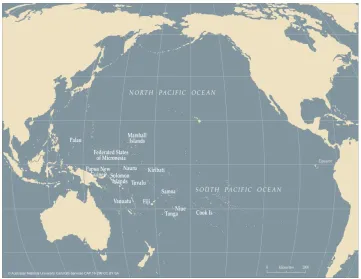
Figure 1: Map of the Pacific Islands.
Source: Map provided by CartoGIS Services, ANU College of Asia and the Pacific, The Australian National University.
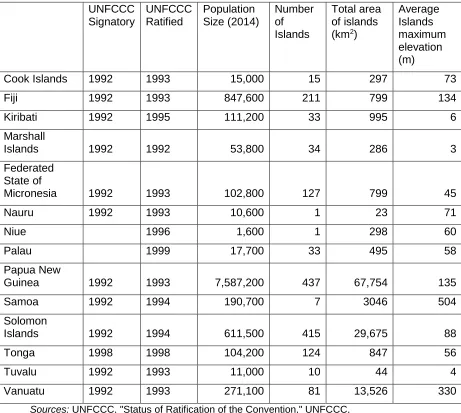
This thesis will focus on the fourteen Pacific island states that are signatory parties of the Convention: Cook Islands, Fiji, Kiribati, Federated States of Micronesia, the Marshall Islands, Nauru, Niue, Palau, Papua New Guinea, Samoa, Solomon Islands, Tonga, Tuvalu and Vanuatu43. Eleven Pacific island states joined the Convention when
42Carola Betzold, Paula Castro, and Florian Weiler, "AOSIS. in the UNFCCC. negotiations: from unity to
fragmentation?," Climate Policy 12, no. 5 (2012).
43 Although Cook Islands and Niue are self-governing states and observers to the United Nations,
it was first opened for signature at the Rio Earth Summit in 1992, as evident in Table 1. Meanwhile, Niue and Tonga joined the cause in the late 1990’s, with Palau as the most recent member in 2000 after it gained full independence. Pacific island countries like Vanuatu, Samoa and Tuvalu were instrumental in the leadership of drafting of both the UNFCCC and the Kyoto Protocol in 1997, which established the agenda and procedures of the regime. The notable accomplishments by these states were ushered in through the influence of and strategic alliances with other small island states in the formation of the negotiation coalition, the AOSIS. An in-depth history of Pacific island states
[image:32.595.84.545.305.718.2]participation in the regime is further explored in Chapter Three.
Table 3. Pacific island states: UNFCCC, population and physical geography
Sources: UNFCCC, "Status of Ratification of the Convention," UNFCCC,
https://unfccc.int/process/the-convention/what-is-the-convention/status-of-ratification-of-the-convention; Patrick D Nunn et al., "Classifying Pacific islands," Geoscience Letters 3, no. 1 (2016). UNFCCC Signatory UNFCCC Ratified Population Size (2014) Number of Islands Total area of islands (km2)
Average Islands maximum elevation (m)
Cook Islands 1992 1993 15,000 15 297 73
Fiji 1992 1993 847,600 211 799 134
Kiribati 1992 1995 111,200 33 995 6
Marshall
Islands 1992 1992 53,800 34 286 3
Federated State of
Micronesia 1992 1993 102,800 127 799 45
Nauru 1992 1993 10,600 1 23 71
Niue 1996 1,600 1 298 60
Palau 1999 17,700 33 495 58
Papua New
Guinea 1992 1993 7,587,200 437 67,754 135
Samoa 1992 1994 190,700 7 3046 504
Solomon
Islands 1992 1994 611,500 415 29,675 88
Tonga 1998 1998 104,200 124 847 56
Tuvalu 1992 1993 11,000 10 44 4
19 Although geographically bound within the Pacific Ocean these states vary physically in land area and population size, not to mention their cultural diversity. Among the island states are larger continental or volcanic island states in the west that account for more than 90% of land area and population size of the Pacific: Papua New Guinea, Solomon Islands, Vanuatu and Fiji. The Pacific is also home to some of the smallest states in the world with populations less than 10,000 and total land areas no more than a couple hundred square kilometres. States such as Tuvalu, Marshall Islands and Kiribati are conglomerations of societies living on low atoll islands with elevation less than five metres. The impact of climate change on individual islands also vary.
The effects of climate change on islands and the communities that live on them are likely to be highly differentiated: not all places will experience the same changes; where changes are similar the magnitude and timing of them will likely differ; the sensitivity of ecological and social processes to changes differs from place to place; the capacity of social systems to adapt to these changes is not homogenous; and the significance of changes to the social systems will also differ44.
Despite the diversity in physical, cultural and the magnitude of climate change impacts on individual states, there is shared understanding that not one state is better off, or immune from sea-level rise, and frequent and extreme weather patterns45. All Pacific
states are similar in the challenges they face, in terms of their small economies,
geographical isolation and social development. Climate change impacts intensify these challenges and increase their vulnerability. This shared vulnerability of Pacific island states has meant that they have used moral and normative arguments in their constructed identity in the negotiations as frontline states46. As Chapter Three will explain, this
identity as the frontline states or moral conscience of the climate change negotiations, has been used for strategic positioning to amplify their concerns in climate negotiations.
44 John Campbell and Jon Barnett, Climate change and small island states: power, knowledge and the
South Pacific (Routledge, 2010), 22.
45 The Pacific region has endured an increasing number and intensity, in natural disaster ranging from
droughts, tropical cyclones, storm surges, heavy rainfall etc.
46 M. Williams and D. McDuie-Ra, Combatting Climate Change in the Pacific: The Role of Regional
While they are most effective in the early phases of negotiations, this research will explore how valid this strategy is in the consensus point of concluding an agreement.
Methodology
The design of this qualitative research traces actors and their activities in various multilateral settings through an inductive approach of describing the different processes of negotiations and the perspectives of Pacific island parties. The methodology draws on talanoa a Pacific research method and global talanoa, a term that this research has coined to describe the use of process tracing47 and global political ethnography48 for this
research.
Talanoa Method
The unique method used in this qualitative research is the application of talanoa
method49. Talanoa is an existing cultural practice found in mainly Polynesian cultures50
to depict formal and informal conversations, storytelling and experiences which has become a popular and prominent methodology to study Pacific communities51 by
47 James Mahoney, Erin Kimball, and Kendra L Koivu, "The logic of historical explanation in the social
sciences," Comparative Political Studies 42, no. 1 (2009)., Rosemary C. Reilly and David Walner, "Process tracing and causal mechnism," in Case Studies and Theory Development in the Social Sciences ed. Alexander L and Andrew Bennett George (Cambridge, Mass: MIT Press, 2005)., Rosemary C. Reilly, "Encyclopedia of Case Study Research," ed. Gabrielle Durepos & Elden Wiebe Albert J. Mills, Encyclopedia of Case Study Research (Thousand Oaks, California: SAGE Publications, Inc., 2010), under "Process Tracing."
48 Finn Stepputat and Jessica Larsen, Global political ethnography: A methodological approach to
studying global policy regimes (DIIS Working Paper, 2015).
49 Some of the work around talanoa as a method of inquiry and methodology in social research include
Mo'ale Otunuku, "How can talanoa be used effectively an an indigenous research methodology with Tongan people?," Pacific-Asian Education 23, no. 2 (2011)., Tamasailau Suaalii‐Sauni and Saunimaa Ma Fulu‐Aiolupotea, "Decolonising P acific research, building P acific research communities and developing P acific research tools: The case of the talanoa and the faafaletui in S amoa," Asia Pacific Viewpoint 55, no. 3 (2014)., Peggy Fairbairn-Dunlop and Eve Coxon, Talanoa, Building a Pasifika Research Culture (Dunmore Publishing, 2014)., Nāsili Vaka'Uta, "Talanoa: Building a Pasifika Research Culture ed. by Peggy Fairbairn-Dunlop," the contemporary pacific 29, no. 1 (2017).
50 The concept and practice of talanoa are found across many Polynesia cultures in Samoa, Tonga, Cook
Islands Fiji, Niue, Hawaii and Solomon Islands. See more Semisi M Prescott, "Using talanoa in Pacific business research in New Zealand: Experiences with Tongan entrepreneurs," AlterNative: An
International Journal of Indigenous Peoples 4, no. 1 (2008).
51 Trisia Farrelly and Uanasi Nabobo-Baba, "Talanoa as empathic research" (paper presented at the