Janaina Ribeiro do Nascimento Instituto Federal Fluminense (IFF), Campos dos Goytacazes,
RJ, Brasil. [email protected]
João Jose de Assis Rangel Universidade Candido Mendes (UCAM-Campos), Campos dos Goytacazes, RJ, Brasil.
Milton Baptista Filho Instituto Federal Fluminense (IFF), Campos dos Goytacazes,
RJ, Brasil. [email protected]
Discrete Event Simulation of Physics Lessons
in High School Classrooms: an Application in
Refraction and Reflection of Light
Abstract
This paper describes the application of a model of discrete-event simulation (DES) to be used as a teaching resource in class. Some basic concepts of phys-ics related to refraction and reflection of light, typically taught in high school classes, were simulated. A comparison was made between certain relevant aspects of the simulation models developed for this paper and those of other models having a similar purpose. As a result, we concluded that the models built, in addition to not requiring extensive laboratory resources, offered, as significant advantages, dynamic visualization of the concepts to be taught, the possibility of adapting them to new parameters, and a relative short time for their construction.
Keywords: Discrete event simulation, Simulation education, Teaching
1 Introduction
In recent works, such as Nascimento and Rangel (2012), Silva and Rangel (2011), Rangel et al. (2011), and Zee and Slomp (2009), an alterna-tive use for discrete-event simulation (DES) as a didactic resource for student learning and train-ing has been demonstrated. Thus, the possibility was raised of extending the boundaries of DES beyond traditional applications of analysis of dy-namic and stochastic systems. The fact emerged from the currently-existing facility in construct-ing simulation models quickly, with a high degree of detail and at a low cost, using a DES package. That is, one may think of constructing small simu-lation models as a tool in order to enrich teach-ing a lesson through dynamic examples. Thus, a teacher with limited programming-language skills can create a simulator using the development envi-ronments of DES models to demonstrate concepts to be applied in examples of physics situations for classroom environments.
In this way, this paper describes the use of a DES model to be used as a didactic resource. The models were able to demonstrate basic concepts of physics related to refraction and reflection of light, typically taught in high school classes. In this sense, it is expected that a student can visual-ize the concepts addressed by the simulations as well as better understand the subject being taught in a physics class. A comparison of some relevant aspects was performed, relating the simulation models developed for this paper to other existing ones of similar purpose.
1.1 Description of the Physical
Phenomenon
This section describes a simulation model to demonstrate the basic concepts of the phenome-non of refraction and reflection of light. It is note-worthy that this simulation model is built only
with the purpose of being able to visualize the animation of the system and, therefore, represent the physical phenomenon of interest. It is worth emphasizing that the purpose here is quite differ-ent from typical situations, where a DES model is built to be used as an object of analysis and evalu-ation of variables related to the dynamic behavior of a given system.
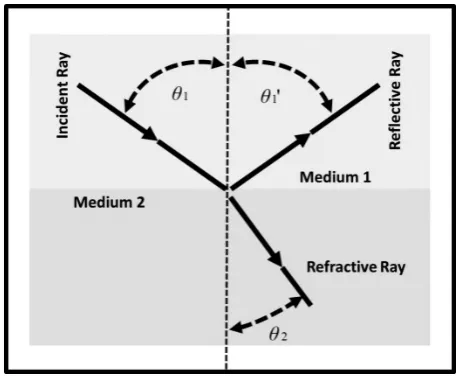
One of the principles of geometrical optics, the law of reflection, states that the reflection an-gle (θ1’) of a light ray incident on a smooth surface is equal to the angle of incidence (θ1). When the incidence occurs on another transparent or semi-transparent physical medium, part of the ray is transmitted (θ2) as can be seen in Figure 1. This transmitted ray passes through the other medium with a propagation velocity different from the speed of light in a vacuum, and it characterizes a trajectory different from the one that would be traversed in the previous medium.
The law of refraction or Snell’s law, shown in Equation 1, expresses the difference of trajectory in terms of the projection angle of the light rays,
θ1 and θ2, and its relation to the index of refrac-tion of each medium, n1 and n2, respectively.
(1)
The refractive index of a medium is defined as a relation between the propagation speed in the vacuum and the propagation speed in that medi-um, as shown in Equation 2.
(2)
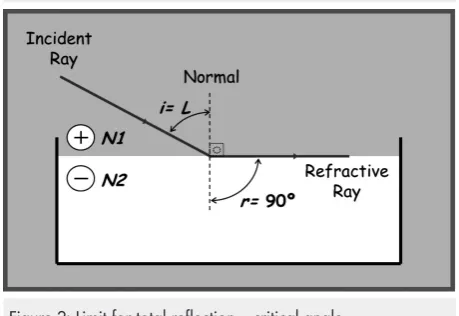
In a special case, a light ray that propagates in a medium and enters another one with a lower refractive index may not even be refracted. At a certain angle of incidence defined by Equation 2, the whole incident ray is reflected, in an example of what is described as total reflection. Thus, as shown in Figure 2, there will be a value for the angle of incidence, called the critical angle, and sin1 θ2> 1.0 in Equation 1.
1.2 Simulation Model
Although light is a continuous phenomenon, the simulation models that illustrated the physi-cal concepts of reflection and refraction of light propagation could be represented in a DES en-vironment, where the entity represented was the light ray.
The methodology used by Banks (2010) was followed to prepare this simulation model according to the following steps: formulation and analysis of the hypothetical problem; construction of the con-ceptual model; construction of the simulation mod-el; verification and validation; and experimentation. From the IDEF-SIM technique (Montevechi et al., 2010), it was possible to construct the conceptual model of the process with an easily understandable visual representation and logic similar to that used in programming the computational model. The con-ceptual model was translated into Arena software in order to carry out the computer simulation.
Thus, two simulation models were construct-ed to illustrate the light ray changing dynamically across the mediums. In the first, the light propa-gated from air to water, and, in the second, the ray went from water to air. As the two models were similar, only the model in which the light propa-gated from air to water was presented.
1.3 Air-Water Model
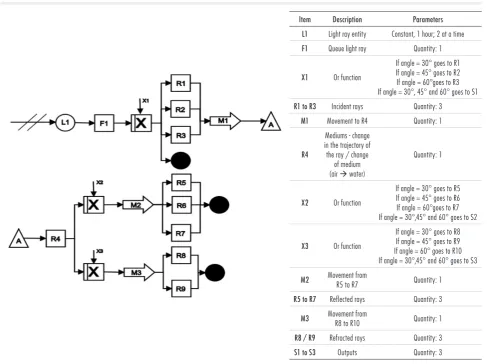
To represent this model, we considered the most commonly used angles of incidence: 30º, 45º e 60º. Figure 3 shows that the light ray was the generated entity and would follow a particu-lar trajectory depending on the attribute, in this case, the angle of incidence chosen by the student through a spreadsheet interface. This trajectory was chosen through three “or” functions, that drove the rays according to their angles.
1.4 Experiments
The purpose of the experiments performed was to evaluate whether the constructed models can represent the concepts of the physical phe-nomena of interest in a clear and easy way.
1.5 Air-Water Simulation
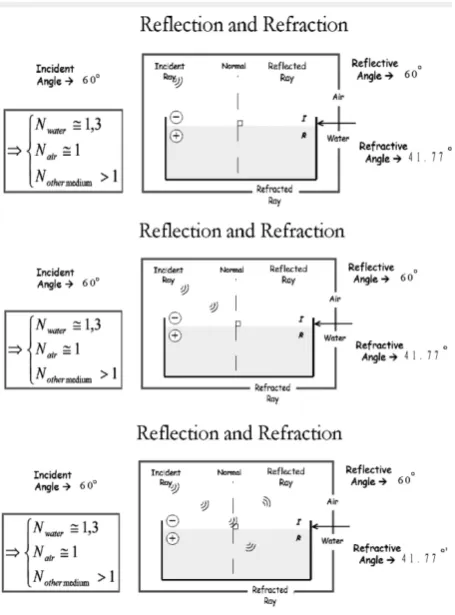
Figure 4 shows three instants during the sim-ulation of physical phenomena. In this model, the
trajectory followed when the selected attribute of the light entity was 60° could be visualized. In ad-dition to designing the trajectory of the light ray, the animation showed the angles of reflection and refraction according to the angle of incidence cho-sen. Thus, if the chosen angle of incidence were 60°, the angle of reflection would be equal to 60° and the angle of refraction 41.77º.
1.6 Water-Air Simulation
Figure 5, similarly to the one above, also shows three instants of the simulation of the physi-cal phenomena. However, in this case, the trajecto-ry followed when the chosen attribute for the entity was 30° (angle smaller than the limit angle) could be visualized. In addition to designing the
trajec-tory and indicating the predefined limit angle, the animation showed the angle of reflection and re-fraction according to the angle of incidence chosen. If the chosen angle were 30°, the angle of reflection would be of 30° and that of refraction 41°.
If the angle of incidence chosen were greater than the limit angle, the total reflection of light would occur, since the light would only be reflect-ed and no longer refractreflect-ed. Figure 6 shows the simulation model that represents that phenom-enon. In the example illustrated by the model, the limit angle is 50.28°.
1.7 Comparison with other Simulators
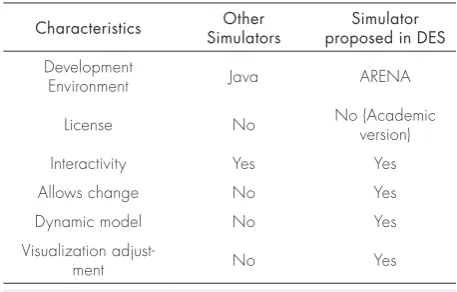
Table 1 presents a concise comparison of the simulation models described in this paper with
Item Description Parameters L1 Light ray entity Constant, 1 hour; 2 at a time F1 Queue light ray Quantity: 1
X1 Or function
If angle = 30° goes to R1 If angle = 45° goes to R2 If angle = 60°goes to R3 If angle = 30°, 45° and 60° goes to S1 R1 to R3 Incident rays Quantity: 3
M1 Movement to R4 Quantity: 1
R4
Mediums - change in the trajectory of the ray / change
of medium (air à water)
Quantity: 1
X2 Or function
If angle = 30° goes to R5 If angle = 45° goes to R6 If angle = 60°goes to R7 If angle = 30°,45° and 60° goes to S2
X3 Or function
If angle = 30° goes to R8 If angle = 45° goes to R9 If angle = 60° goes to R10 If angle = 30°,45° and 60° goes to S3
M2 Movement from R5 to R7 Quantity: 1
R5 to R7 Reflected rays Quantity: 3
M3 Movement from R8 to R10 Quantity: 1
R8 / R9 Refracted rays Quantity: 3 S1 to S3 Outputs Quantity: 3
other models developed using general-purpose programming languages. These are as follows: Refraction of Light Simulation (Refraction of Light Simulation, 2012), Reflection / Refraction (Reflection / Refraction, 2012), Refraction Simulator (Refraction Simulator, 2012) and Reflection and Refraction (Reflection and Refraction, 2012).
Analyzing Table 1, it can be seen that oth-er simulators that woth-ere found are built using the Java programming language. It is clear that this is a language with many programming resources; however, it requires expert programmers for the development of applications. In contrast, the pro-posed simulator could be created by a teacher of the discipline in about five hours of development time and learned to use with only twenty hours of training in any development environment of the DES, in this case, Arena.
Furthermore, the simulator in DES made it possible for the student to visualize the propaga-tion of the light ray, through movements displayed by the model in real time. The other simulators that were found are more static; despite allow-ing the changallow-ing of characteristics such as angles and the refractive index, as the model in DES also does, they cannot reproduce this animation.
Figure 4: Different moments of the simulation model execution (Trajectory Air-Water).
Figure 6: Instant when the angle of incidence was greater than the limit angle (WATER-AIR Trajectory). Total light reflection.
2 Concluding Remarks
The experimental simulation models de-veloped for this paper suggest that the propos-al presented can be applied in the classroom. Dynamically, the simulators that were devel-oped could show the physics concepts being taught, without the need for extensive labora-tory resources.
Concerning the comparison made with the existing simulators, the construction of the didac-tic models without the need for extensive labo-ratory resources, using instead a DES package, demonstrated the main advantages to be real-time animation, the possibility of adaptation to new parameters, and the simplicity of the interface .
It is noteworthy that the model described in this paper was developed by a teacher of the discipline who is not a programming expert. Thus, once the teacher is the modeler, he or she can change the model, adapting it to facilitate the demonstration of the concepts being taught.
As future studies, one proposal would be to compare the time required for the construc-tion of the models developed in a DES simula-tion environment with the time for those built in Java. Furthermore, the extent of specialization
required for the developers of both approaches can be evaluated.
After developing the models, we noticed that there were numerous possibilities for the use of simulated environments to build models that can be used for training of high school and technical students, facilitating learning in the class.
It can also be suggested, for a coming study, to evaluate students’ learning using the simulation environment for the representation of the concepts addressed in class and compare it with the perfor-mance of students without its help.
Acknowledgments
The authors thank the National Council for Scientific and Technological Development (CNPq) and the Research Support Foundation of the State of Rio de Janeiro (FAPERJ) for financial support for this research. They also thank Maria Marta Garcia for suggestions on the text.
References
Banks, J.; Carson, J.S.; Nelson, B. L. and Nicol, D.M. (2010) Discrete-Event System Simulation. 5nd ed. New Jersey: Prentice Hall, Inc.
Montevechi, J.; Leal, F.; Pinho, A.F. de; Costa, R.F. da S.; Oliveira, M.L.M. de; Silva, L. F. da. (2010) Conceptual Modeling in Simulation Projects by Mean Adapted IDEF: An Application in a Brazilian Tech Company. In Proceedings of the 2010 Winter Simulation Conference, Edited by B. Johansson, S. Jain, J. Montoya-Torres, J. Hugan, and E. Yücesan, 1624-1635. Piscataway, New Jersey: Institute of Electrical and Electronic Engineers, Inc.
Nascimento, J.R and Rangel, J.J.A. (2012) Modelo de Simulação a Eventos Discretos como Recurso Didático no Ensino Médio. Simpósio Brasileiro de Pesquisa Operacional, 2012, Rio de Janeiro. XVI CLAIO - XLIV SBPO, 2012. p. 3895- 3904.
Rangel, J.J.A.; Teixeira, A.C.T.; Shimoda E. and Lisbôa R.T. (2011) Simulation Model of Discrete Event as a Teaching Resource in the Subject of Physics at High School. S & G. Sistemas & Gestão, Vol. 6, pp. 56-71. Table 1: Comparison among simulators in general and the
simulator described in this paper.
Characteristics SimulatorsOther proposed in DESSimulator
Development
Environment Java ARENA
License No No (Academic version)
Interactivity Yes Yes
Allows change No Yes
Dynamic model No Yes
Visualization
Refraction of Light Simulation. (2012) Science Joy Wagon. Available: http://www.sciencejoywagon.com/ physicszone/otherpub/wfendt/refraction.htm. Access: February, 2012.
Reflection/Refraction. Department of Physics National Taiwan Normal College. (2012) Available: http://www. phy.ntnu.edu.tw/ntnujava/ index.php?topic=4. Access: February, 2012.
Refraction Simulator. (2012) Interactagram.com. Available: http://interactagram.com/physics/optics/ refraction/. Access: February, 2012.
Reflection and Refraction. (2012) Department of Physics University of Toronto. Available: http://www.upscale. utoronto.ca/PVB/Harrison/Flash/Optics/Refraction/ Refraction.html. Access: February, 2012.
Silva, T.M.P.; Rangel, J.J.D.S. (2011) Discrete Event Simulation as Didactic Support to the Teaching of Telecommunications Systems: Applications in digital telephony. In Proceedings of the 2011 Winter Simulation Conference, Edited by S. Jain, R.R. Creasey, J.
Himmelspach, K.P. White, and M. Fu, eds. 3893-3903 -Piscataway, New Jersey: Institute of Electrical and Electronic Engineers, Inc.