Maity. World Journal of Engineering Research and Technology
APPLICATION OF SPANNING TREE TO OPTIMIZE THE GARBAGE
COLLECTION UNITS
*Dr. Swapan Kumar Maity
MaulanaAbulKalam Azad University of Technology, West Bengal, India.
Article Received on 04/09/2019 Article Revised on 25/09/2019 Article Accepted on 15/10/2019
ABSTRACT
Municipal Solid Waste Management (MSWM) is a burning issue in our society. It is a burning problem to resolve the issue pertaining to the Municipal Solid Waste Management (MSWM) namely wastes generated in medium and large urban centres, have become a relatively difficult problem to solve. To promote sustainable development, waste management has evolved into material flow management in many developed countries, and included careful handling of raw materials and reduction of emissions as well as climate/environment protection. But it is different in other parts of the world especially in a large number of developing countries. In developed countries material flow management has been emphasized in the waste management. Major portion of solid waste generated are disposed of on earth in a casual manner. In cities and towns this crisis is acute as the waste disposal facility is not sufficient enough in comparison to the waste generated in that particular area. Dumping of waste/ garbage are found in scattered manner in every nook and corner of the city. Thus transportation of those wastes in effective way is one of the major problems in Municipal Solid Waste Management. The incapability to fully optimize code in a garbage-collected system is a hidden cost of garbage collection. The inability of collection of garbage in a scientific way by Municipal Authority leads to increase the overall garbage collection cost to great extent. So, it is the need of the hour that the effective method should be incorporated by the Municipal Authority for collection of the garbage efficiently. In most of the cases it is found that there is a lack of planning for establishment of garbage collection unit or bin as well as selection of garbage transportation pathways. There are several works
World Journal of Engineering Research and Technology
WJERT
www.wjert.org
SJIF Impact Factor: 5.924
*Corresponding Author
Dr. Swapan Kumar Maity
MaulanaAbulKalam Azad
University of Technology,
on garbage transportation pathway but no significant works have been carried out so far for finding the optimized solution for garbage collection units. In this chapter a novel method is described for finding such optimized and cost effective method for such garbage collection unit in a Municipality.
KEYWORDS: Municipal Solid Waste Management (MSWM), Garbage Collection Unit (GCU), Graph, Spanning Tree.
1. INTRODUCTION
Solid waste management (SWM) is one among the fundamental and essential services provided by Municipal Authorities in the country to keep the urban centers clean. Solid waste management has always been a serious problem for cities throughout the world. The developing country like India is not an exception to this. In a few geographical area of India, the disposal facilities in a casual manner have reached to the extreme limit and the local bodies are confronted with difficult decisions. A lot of amenities, comfort and conveniences in the day to day live of the people has been brought forward in this modern age of the civilization. Those amenities in this modern age of civilization in the life of the people have contributed a significant quantum of waste generation. The SWM can resolve this burning problem of the modern society and there by SWM is regarded as the integral element of this modern society. In the SWM the waste generated disposed of by adapting various practices and technological advancement. In order to address the waste disposal at a desired level it is the need of the hour to adapt such practices. In this chapter concentration has been given to the solid waste management procedure of Salt Lake (Bidhannagar) Municipality which is located adjacent to Kolkata (Formerly Calcutta), the oldest city of India.
2. Bidhannagar (Salt Lake) Municipality and Solid Waste Management (SWM)
SWM has an crucial role particularly in the disposal of waste management and environmental management and protection.[2,3] Salt lake city was developed in order to cater the dwelling need of 4,50,000 population. Greater emphases has been given in SWM in India like other essential infrastructural services. Previously SWM issue was not viewed seriously by the public as well as Authorities concern. The significant activity of waste generated is alarming to the public health, environment and wellness.
Bidhannagar (Salt Lake) Municipality is responsible for efficient and effective management of solid waste that are being produced everyday and the present study has been carried out in the urban environment of Salt Lake in the year 2011 with a view to identify the problems associated with solid waste management in the city and feasible solutions to the problems to be identified.
3. Specification of problem
Five sectors of Bidhannagar (Salt Lake) Municipality are producing garbages (solid waste) day by day and Salt Lake Municipality is accountable for the collection and subsequent disposal of the said solid waste. All the five sectors are comprised of blocks numbering seventy-eight in total. The solid waste production sources of the Salt Lake Municipality are appended below:
(a) Market places
(b) Play Ground/Parks/Athletic Areas (c) Domestic Buildings/dwelling house (d) Dwelling House containing shops (e) Educational Institutions/Colleges
(f) Office Buildings and Office Complex/ Bhavans (g) Shopping Complex/Malls
(h) Super Speciality Hospitals/Nursing Homes and Hospitals
Following are the statistical information of producing solid waste (in kg) per day from different sectors, this data was collected from the Municipal Authority of Salt Lake (Bidhannagar) Municipal Corporation.
Table 1: Statistical Information of garbage production in SaltLake (Bidhannagar) Municipality.
Sector House Market Play
ground Park
Instit
ution Office Mall
Bhawan/
Complex Hospital Factory Total I 47941 16200 6 20 421 859 2005 12562 750 0 80772
II 35936 10000 4 15 90 183 0 1655 405 0 48288
III 24272 6250 53 7 5047 612 502 13302 1000 0 51045
IV 0 0 0 1400 0 0 0 0 0 0 1400
V 1936 2000 12 10 1785 6170 200 5360 0 1600 19073 It transpires from the above table 1:
(a) In Sector – I the garbage generation is high in comparison to all other sectors.
(b) There are many markets in Sector – I. As a result of that the waste generation is higher in comparison to the remaining areas of other sectors.
(d) Many factories are found in Sector – 5 and thereby that sector is producing a considerable quantum of waste.
Salt Lake Municipality is responsible and accountable for the collection and disposal of the waste generated in five sectors. The Salt Lake Municipal Authority is discharging its responsibility at a desired level in terms of collection of garbage. The Salt Lake City being a planned and satellite city the maximum garbage producer sources like dwelling houses, big and small shops, big market complexes and block-wise markets, super speciality hospitals, hospitals & nursing homes and factories are located in the specified areas as per master plan of the city. Big dustbins have been placed in several areas of the city and those big dustbins are being shared by several blocks. The solid waste is being dumped in those bins from the vicinity areas. Four (04) scavengers/sweepers wearing blue dress with yellow colour helmet are engaged in every block. Apart from this two persons are engaged for collection of solid waste from door to door. Additional two scavengers are entrusted with the job of collection in the market complex area. The drainage system of Salt Lake Municipal area is underground. The scavengers are sweeping the roads, streets and lanes and collecting the solid waste generated and those are being transferred to the vats. Those dustbins are being cleared frequently where adequate numbers of sweepers are engaged. The solid waste collected is being transferred by small cart, tractors or trucks allocated for the purpose of collection.
The solid waste collected is transferred to the disposal sites by adopting certain procedures. This begins from small type of damper and completes in the big waste vats. In the waste collected the presence of two types of wastes namely; degradable and non-degradable wastes are found. Various types of plastic products are also heaped into the big vats and this is an alarming issues. Different types of vehicles like Tri cycle cart, Tractor and Tipper Truck are being used for transportation of the solid waste with a view to dispose of the same in the garbage disposal area.
engaged. It is alarming to observe that the vehicles loaded with the solid waste are not covered during the time of transportation to the disposal site as a result the garbage spill over on the roads creating pollution and health hazards. The mechanical system and manual system are being adopted for loading and unloading of garbage. Normally the collected garbage is disposed in specific site and garbage is recycled where it is possible. Though Salt Lake is a satellite township but there are no proper planning for dumping the solid waste.
There is a disposal site named Moller Verrie where all the solid wastes are disposed of without adopting any process like treatment and recycling of waste. The recycling procedure as laid down in the Municipal Solid Waste (Management & Handling) Rules 2000 has not been adopted. Solid waste management is one among the fundamental and essential services provided by Municipal Authorities in the country to keep urban centres clean. In accordance to Ogra, A, it is not possible on the part of Municipal Bodies to provide a hundred percent efficient system. Even those are unable to achieve sixty percent efficiency. The root cause of this is the old back dated conventional working methods. Without upgradation of the same by adopting the modern system like GIS it is not at all possible on the part of Municipal bodies to achieve the desired efficiency an effective solid waste management system has to be designed by the Municipal Authorities. The causes for this mismanagement of the solid waste maintenance as noticed by the Municipal Authorities are appended below:
(a) The residents throw the solid waste in a scatter manner around the dustbins which is causing the area dirty and polluted.
(b) The lifting and disposal capacity of waste is far below the amount of garbage generated in the Municipal area.
(c) Infrastructural shortage like manpower, equipment and machinery is also the predicament. (d) The environment of the garbage area is having the bad smell.
(e) The waste collectors are having a serious life threat.
(f) Many animals viz. Dogs, Goats, Cats and Crows are searching foods in the garbage area and thereby spreading the garbage around the vats.
(g) The market price of the properties becomes less due to the environmental pollution caused by the garbage. The aesthetics of that area also becomes ugly.
It is proposed to create the MIS and GIS information database which can handle different data forms like spatial as well attribute data simultaneously. The data set useful for this purpose are (i) the information of the area concerned where major garbage are generated (ii) the employees deployed in the garbage management activity. A systematic waste management having adequate information pertaining to the garbage generated in various locations including the roads/streets and junctions will be created by the image processing based technique. The modern application of GIS can analyse the state of affairs and a future prediction on trend can be made that will be helpful for long term planning. The adopted procedure will depict the collection of data of various sources and sketching of the map components viz. ward & city map, garbage generation map of various locations, existing garbage vats location, the procedure of collection from the vats and deployment of manpower in different wards. Critical analysis in depth can be carried out taking into consideration the aforesaid components in order to find out the logistics and spatial planning. The issues appended below are required to be considered at the time of application of GIS. (a) Explore and identify the correct location of waste vats through GPS. (b) Maintenance of records of the vats. (c) A schematic diagram (map) depicting the quantum of garbage generation in various locations. (d) A schematic diagram (map) depicting the distance between the vats. (e) The record of the deployment of staff viz. sanitary inspectors, sweepers, scavengers etc. It will helpful to work out the ratio of employees assigned to a particular work and machinery and equipment provided to that particular work. (f) Finding out the existing garbage lifting procedure (g) Identification of the location of garbage disposal site/landfill site. (h) Maintenance of data pertaining to the deployment of vehicles and equipment for the purpose of Municipal solid waste management. (i) Marking of all waste vats with unique number in order to identify quickly as and when the complaint is raised. (j) Duties and responsibility has to be entrusted to the crew members by grouping and assigning them the specific work area. Most specifically it is helpful for befitting allocation and distribution of work. The implementation phase of GIS & MIS approach will consist of three stages stated below: 1 st Stage: Training/Seminar/Workshop/Symposia of employees of Municipal departments and other users concerned for their acquaintance with the modern technologies of GIS.
2 nd Stage: The Database Management Training and accumulation of various information for the attribute data.
implemented system. It is obvious that the post implementation issues may cause to derive a new system in consultation with different stakeholders.
Moreover, the successful implementation of GIS & MIS helps to design the
transportation pathway of garbage collection. Routing algorithms use a standard of measurement called a metric (i.e. path length) to determine the optimal route or path to a specified destination. Optimal routes are determined by comparing metrics, and these metrics can differ depending on the design of the routing algorithm used. The complexity of the problem is high due to many alternatives that have to be considered. Fortunately, many algorithms have been developed and discussed in order to find an optimized solution, leading to various different results. The reason for this diversity is that the majority of routing algorithms include the use of heuristic algorithms. Heuristic algorithms are adhoc, trial-and-error methods which do not guarantee to find the optimal solution but are designed to find near-optimal solutions in a fraction of the time required by optimal methods. This optimized path will reduce the overall cost of transportation of garbage significantly.[11,12,13]
It is found that the Municipal solid waste management of Salt Lake Municipal area is not sufficient which is required to be upgraded. Scientific way of waste disposal is required. The quantum of Municipal solid waste can be reduced by segregating the recyclable material. The Municipal Authority can optimize the entire operation of solid waste management giving emphasis on the issues like segregation at waste source, proper collection in time, routes of transportation, different types of vehicles used and efficient operation of sanitary landfill site. The efficient solid waste management system has to be developed in the Salt Lake.
Municipality keeping in view the unprecedented growth of population, fast increase of the establishments.
adjacent wards/blocks. (ii) Distance between waste bins varies to a great extent: it is found that generally in each block/ward only one dustbin is present. The area of each block/ward varies greatly. Thus in several cases it is found that the distance between waste bins located in adjacent blocks/wards considerably large. (iii) There is no proper justification regarding waste generation and number of waste bin in a particular area: it is because huge garbage production areas contain few numbers of waste bins. In this study the critical path of garbage collection and transportation has been designed and subsequently it is noticed that 13% overall cost will be decreased and achieve 95% collection efficiency if Municipal Authority follows this path.[1,3]
Discussion had been made in the concluding para regarding the reformation of the concept of the data management and the analysis made after application of GIS. As and when the Municipal waste management department will acquire knowledge about the overall operation of GIS system, they will also be well acquainted with the systems effectiveness. All records pertaining to the solid waste management and adequate logistic management and spatial planning has to be maintained in order to achieve the desired effectiveness of the system. It can be made by the application of GIS on various layers for the practical implementation. The required information can be derived by successful application of different functions like overlaying, application of buffer for proximity analysis or by application of queries through a structured query language (SQL). In order to ascertain the huge garbage generating areas the demographic map is useful. The categorisation/classification of waste viz. domestic, industrial, commercial etc. can be identified hassle free by using the land use map. The present location of vats and the road/street maps will give the closeness of the vats to the garbage collection routes. The bins/vats may be relocated if situation demands. A map depicting the present quantum of waste generated and the garbage generated in various wards, sectors and along the roads, streets and junctions will be immensely helpful in this exercise. The aforesaid issues are regarded as an important exercise to start with. Several waste management issues are covered in those point but those are much generalised. Huge date and its analysis thereof by application of GIS software will be immense help in this direction. A requirement to develop various models in order to apply the aforesaid points on the real time data will also be felt.[3]
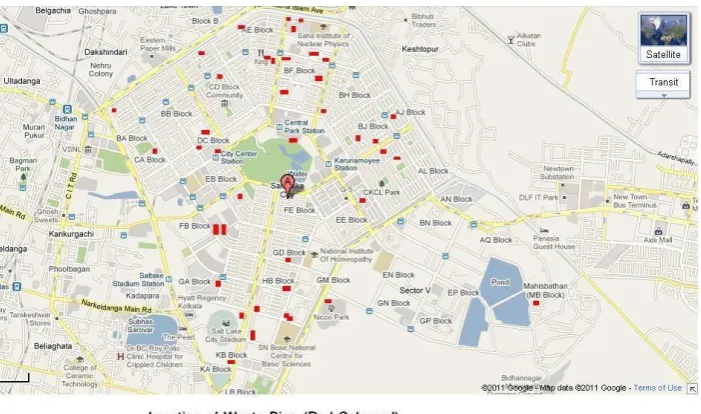
hospitals mentioning the longitudes and latitudes information of the vats. The longitudes and latitudes of those locations were calculated through GIS logger. The source of obtaining the Salt Lake Municipal map is the Google map which was saved in.tiff format. One C – Language program has been developed and the MATLAB was used which took the longitudes and latitudes information of the waste bins as input and ultimately those are plotted the corresponding region as red coloured spot on the map. The map developed with this application is depicted hereunder:
Fig 2: Location of Garbage Collection Units (bins) in Salt Lake Municipality.
Another program was written in C Language and MATLAB which was able to construct waste generation map which is given below and the colour code of the map signifies the following:
Table 2: Significance of the colour in waste generation map.
Serial No Code of Color Connotation of colours
1 Green
0-1500 Kg garbage generated per day in this Block
2 Yellow
1501- 3000 Kg garbage generated per day in this Block
3 Blue
3001- 4500 Kg garbage generated per day in this Block
4 Red
Fig 3: Waste generation map of Salt Lake (Bidhannagar) Municipality.
4. Graph Theory & spanning tree
Graph theoretical ideas are highly utilized by computer science applications. Especially in research areas of computer science such data mining, image segmentation, clustering, image capturing, networking etc. For example a data structure can be designed in the form of tree which in turn utilized vertices and edges. Similarly modeling of network topologies can be done using graph concepts. In the same way the most important concept of graph coloring is utilized in resource allocation, scheduling. Also, paths, walks and circuits in graph theory are used in tremendous applications, say, traveling salesman problem, database design concepts, resource networking. This leads to the development of new algorithms and new theorems that can be used in tremendous applications. This paper has been divided into two sections. First section gives the historical background of graph theory and some applications in scheduling. Second section emphasizes how graph theory is utilized in various computer applications.
In 1852, Thomas Gutherie found the famous four color problem. Then in 1856, Thomas. P. Kirkman and William R.Hamilton studied cycles on polyhydra and invented the concept called Hamiltonian graph by studying trips that visited certain sites exactly once. In 1913, H.Dudeney mentioned a puzzle problem. Eventhough the four color problem was invented.Itwas solved only after a century by Kenneth Appel and Wolfgang Haken. This time period is considered as the origin of Graph Theory.
Caley studied particular analytical forms from differential calculus to study the trees. This had many implications in theoretical chemistry. This lead to the invention of enumerative graph theory. Any how the term “Graph” was introduced by Sylvester in 1878 where he drew an analogy between “Quantic invariants” and covariants of algebra and molecular diagrams. In 1941, Ramsey worked on colorations which lead to the identification of another branch of graph theory called extremel graph theory. In 1969, the four color problem was solved using computers by Heinrich. The study of asymptotic graph connectivity gave rise to random graph theory.[14]
Graph theoretical concepts are widely used to study and model various applications, in different areas. They include, study of molecules, construction of bonds in chemistry and the study of atoms. Similarly, graph theory is used in sociology for example to measure actors prestige or to explore diffusion mechanisms. Graph theory is used in biology and conservation efforts where a vertex represents regions where certain species exist and the edges represent migration path or movement between the regions. This information is important when looking at breeding patterns or tracking the spread of disease, parasites and to study the impact of migration that affect other species. Graph theoretical concepts are widely used in Operations Research. For example, the traveling salesman problem, the shortest spanning tree in a weighted graph, obtaining an optimal match of jobs and men and locating the shortest path between two vertices in a graph. It is also used in modeling transport networks, activity networks and theory of games. The network activity is used to solve large number of combinatorial problems. The most popular and successful applications of networks in OR is the planning and scheduling of large complicated projects. The best well known problems are PERT(Project Evaluation Review Technique) and CPM (Critical Path Method).
(a number) associated to it, the graph is called a weighted graph. In order to mention the vertex set and edge set of a graph it is denoted as G=(V, E). If the edge set of a graph is a collection of “ordered pairs” of vertices, then it is called a “directed graph”.
If {i, j} is an edge of a graph G, we say that i and j are adjacent to each other. Also i and j are called the end-points of that edge. If (i, j) is an edge of a directed graph G, we say that i is adjacent to j. If a vertex is not adjacent to any other vertex, it is called an isolated vertex.
A Subgraph S of a graph G is a graph whose vertex set V(S) is a subset of the vertex set V(G), that is V(S)⊆V(G), and whose edge set E(S) is a subset of the edge set E(G), that is E(S)⊆E(G).
A path 𝑃= 𝑣0,𝑒1,𝑣1,𝑒2,…𝑒𝑛,𝑣𝑛 in a graph G is a traversal through the graph G, where
𝑣0,𝑣1,…,𝑣𝑛are vertices and 𝑒1,𝑒2,…𝑒𝑛 are the edges such that𝑒1= 𝑣0,𝑣1 ,𝑒2= 𝑣1,𝑣2 ,,…𝑒𝑛=
𝑣𝑛−1,𝑣𝑛 . We also say that the path P connects the two vertices 𝑣0 and𝑣𝑛.If𝑣0=𝑣𝑛, then it is called a cycle.
A graph G is said to be connected if every pair of vertices of G are connected by a path in G. If a graph G is not connected, it is called a disconnected graph, which may look like several connected graphs put together. Each of these parts is called a component of the disconnected graph, G. Formally, a component of a graph G can be defined as the maximal connected subgraph of G. A graph G is connected if and only if g has exactly one component.
A connected graph without any cycles is called a tree. It is well known in Graph theory that the number of edges of a tree is one less than the number of vertices of it. A spanning tree of a connected graph is defined as a sub-graph which itself is a tree i.e. in this spanning tree there is no cycle. A connected graph G with p vertices and q edges is a tree if and only if p=q+1.
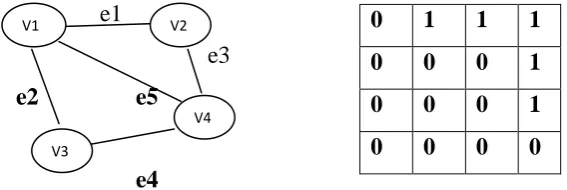
The graph structure may be represented by a matrix consisting of all vertices in the said graph both rows and columns. If the path exists between two vertices of row and column, then the corresponding index value will be 1 or if there is no path between two vertices, then the corresponding index value will be 0. This matrix is known as Adjacency Matrix.
For example, consider the following graph (G) of four vertices (v1,v2,v3 and v4) and five edges (e1,e2.e3, e4 and e5) and the corresponding Adjacency Matrix:
e1
e3
e2 e5
e4
Fig 4: Representation of graph (G) and corresponding Adjacency Matrix.
e2
e1
e3
Fig 5: Representation of Spanning tree and Corresponding Adjacency Matrix.
5. Application of spanning tree for optimizing the garbage collection units (GCU)
There are several applications of spanning tree in modern science. Most of the applications are oriented to path finding and path optimization problems. Besides that power networks, automatic speech recognition system spanning tree algorithm is used. In solid waste management system spanning tree is mainly applied in finding the optimized path of garbage collection but application of spanning tree to optimize garbage collection unit is an unique problem.
From the discussion of previous section it is found that a large number of garbage collection units (GCU) are not properly distributed in that Municipal area. In certain cases it is noted that a few numbers of GCU are present in such areas where garbage production is maximum whereas in some areas where garbage production is comparatively less, higher number of
0 1 1 1
0 0 0 1
0 0 0 1
0 0 0 0
0 1 1 0
0 0 0 0
0 0 0 1
0 0 0 0
GCU are present. So if GCU are properly distributed among this Municipal area, then overall garbage collection efficiency will be increased. To facilitate this concept, spanning tree algorithm may be applied.
For applying such spanning tree an algorithm has been developed which is as follows:
Step 1: Give the weightage (w) to each GCU. The weightage may be directly proportional to the deposited amount of garbage in than bin/per day. So if there are n number of bins (may be referred as demand points) then w1 is the minimum weightage and wn is the maximum
weightage of the bin. Sometimes some bins have same weightage.
Step.2: For such n number of demand points calculate the cost C(i, j) = d(D, i) + d(D, j) − d(i, j) for every pair (i, j) of demand points. There will be at most n(n-1)/2 such pairs.
Step.3: Rank the list of cost, C(i, j), in descending order of the magnitude. This derived list will be processed where the largest C(i, j) is present as a first entry point.
Step.4: For each of the cost, C(i, j), include the link (i, j) in a route between two GCUs provided that no route constraints will be violated as inclusion of the (i, j) in a route, and i) If neither i nor j have already been assigned to a route, initiate a new route including the points i,j and the link, (i,j). ii) If exactly one of the two points (i or j) has already been included in an existing route and that point is not interior to that route, add the link (i, j) to that same route. iii) If both i and j have already been included in two different existing routes and neither point is interior to its route, merge the two routes into a single one. Continue this process with the next entry in the list till the savings list C(i, j) is exhausted. This results in a weighted graph with N vertices.
The derived result is as follows:
Step.1: Calculate the cost C{i, j} = d{D, i} + d{D, j}–d{i, j} for each edge {i, j} of G.[There will be at most N(N-1)/2 such pairs]
Step.2: Rank the list of cost, C(i, j), and arrange them in descending order of magnitude. Step.3: Process this list beginning with the first entry in the list (the largest C(i, j)). For each of the cost, C(i, j), include the respective edge (i, j) in a route if no route constraints will be violated through the inclusion of (i, j) in a route, and
i) If neither i nor j have already been assigned to a route, initiate a new route including i, j and the edge
adjacent to the depot D in the order of traversal of vertices), add the edge{i, j} to that same route.
iii) If both i and j have already been included in different existing routes and neither vertices interior to its route, then merge the two routes into a single one by including the edge {i, j}. Continue with the next entry in the list till the savings list S{i, j} is exhausted.
Step.4: Stop. The solution consists of the routes created during Step 3. (Any vertex that is not assigned to a route during Step 3 must be served by a vehicle route that begins at the depot D visits the unassigned point and returns to D. Such vertices are isolated vertices of the graph, G).
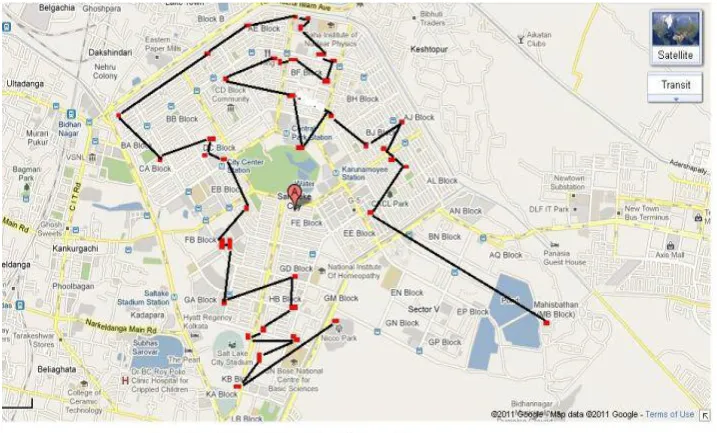
Algorithmic Complexity of Clarke-Wright Algorithm Let G has N vertices (demand points). The complexity of the Clarke-Wright Algorithm is calculated and the total number of operations (worst case) of the algorithm is 3N(N-1). Although this algorithm is an efficient one, in the sense that it requires only a polynomial time, 3N2 -3N3𝑁 2 − 3𝑁 = (𝑁2 ), for its completion, this can be significant and sometimes unaffordable in the case of cities with large number of waste collection points. For sake of curiosity this heuristic algorithm for calculating routing length have been applied and the experimental results confirm an improvement of the optimum route by about 25.6%. We have developed our program in Matlab in Windows 7 operating system where minimum 2 GB RAM and Pentium quadcore processor is required. The Fig 6 shows the derived spanning tree of the existing GCUs in Bidhannagar (Salt Lake)Municipality.[15,16,17]
6. CONCLUSION(S)
Existing techniques for garbage collection and machine code optimizations can interfere with each other. The inability to fully optimize code in a garbage-collected system is a hidden cost of garbage collection. In most of the cases of effective solid waste management researchers are mainly concentrated on optimization of garbage collection pathway. In these cases spanning tree, Ant Colony Optimization (ACO) technique has been applied but propose an effective solution on both optimizing the garbage collection unit and garbage collection route is really a challenging task. One solution to this problem is proposed; an inexpensive protocol which permits optimizations the route and garbage collection to coexist. In this study the activity of the Bidhannagar (Salt Lake)Municipality has been studied. It is noted that in this area several blocks are there where garbage production per day and number of bins in that area are inversely proportional. Thus, the spanning tree among the garbage collection units has been proposed which reveals that the proposed route is optimized and ultimately it improves the garbage collection efficiency up to 25.6% and significantly it is reducing overall solid waste management cost at the tune of 13%
ACKNOWLEDGMENTS
The officials of Bidhannagar (Salt Lake) Municipality provided the necessary data in carrying out this study. The same is being acknowledged.
REFERENCES
1. Maity S.K, Bhattacharyay B K and Bhattacharyya, “ A Case Study on Municipal Solid Waste Management in Salt Lake City”, International Journal of Engineering Science and Technology, ISSN 0975-5462, August 2011; 3(8): 6208- 6211.
2. Maity S.K, Bhattacharyay B K and Bhattacharyya, “ A Case Study on Municipal Solid Waste Management in Chandannagar City”, International Journal of Application or Innovation in Engineering & Management, ISSN 2319-4847, November 2012; 1(3): 1-4. 3. Maity S.K, Bhattacharyay B K and Bhattacharyya, “ Solid Waste Management and Salt
Lake Municipality- A GIS and MIS Approach”, International Journal of Research and Reviews in Applied Sciences (IJRRAS), ISSN 2076-734X, November 2012; 13(2): 461-468.
Journal of Engineering Innovation & Research, ISSN 2277-5668, November 2012; 1(6): 510-515.
5. Maity S.K, Bhattacharyay B K and Bhattacharyya, “ Application of GIS & MIS in the Context of SWM of Chandannagar Municipality”, International Journal of Innovative Research in Engineering & Science, ISSN 2319-5665, December 2012; 1(): 45-52.
6. S.G. Shrinivaset. al. “Application of Graph Theory in Computer Science Overview”, International Journal of Engineering Science and Technology 2010; 2(9): 4610-4621.
7. Salt Lake City, Kolkata, India, Wikipedia.
8. “Baseline methodology for biomethanation of municipal solid waste in India, using compliance with MSW rules”, UNFCCC/CCNUCC, AM0012 / Version 01, Sectoral Scope: 13, 11 August 2004.
9. National Solid Waste Association of India, Urban Municipal Waste Management Newsletter, ENVIS NSWAI, June 2008.
10. Municipal Solid Waste Management in Asia- A Comparative Analysis, C. Visvanathan and J. Tränkler, Workshop on Sustainable Landfill Management 3–5 December, 2003; Chennai, India, pp. 3-15.
11.] Integrated Approach to Municipal Solid Waste Management, IL&FS Infrastructure Development Corporation Limited, September 2008.
12.Chouhan B.M and B.K Reddy, Bio-energy scenario in India. IREDA News. 1996; 7(1): 20-27.
13.Mazumdar,N.B (1994) Municipal solid waste management the Indian perspectives. 14.S.G.Shirinivas et al, Application of Graph Theory in Computer Science An Overview,
International Journal of Engineering Science and Technology 2010; 2(9): 4610-4621. 15. Suresh Kumar, Satheesh E.N, An application of Spanning Tree Algorithm to Municipal
Solid Waste Management, International Journal of Mathematics Trends and Technology (IJMTT) – November 2017; 51(4).