OF EDUCATION IN THE 21st CENTURY Volume 70, 2016 59
Advised by Agneta Simeonsdotter Svensson, University of Gothenburg, Sweden
Received: March 05, 2016 Accepted: April 22, 2016
Radka Borůvková PhD Student, Department of Algebra and Geometry, Faculty of Science, Palacky University, Olomouc, Czech Republic.
E-mail: : [email protected] Website: http://www.upol.cz
Petr Emanovský PhD., Associate Professor, Department of Algebra and Geometry, Faculty of Science, Palacky University, Olomouc, Czech Republic.
E-mail: [email protected] Website: http://www.upol.cz
AUTHENTIC SCIENCE EXPERIENCES:
PRE-COLLEGIATE SCIENCE EDUCATORS’
SUCCESSES AND CHALLENGES DURING
PROFESSIONAL DEVELOPMENT
Andrea C. Burrows University of Wyoming, Laramie, WY USA E-mail: [email protected]
Michael A. DiPompeo Dartmouth College, Hanover, NH USA E-mail: [email protected]
Adam D. Myers University of Wyoming, Laramie, WY USA E-mail: [email protected]
Ryan C. Hickox Dartmouth College, Hanover, NH USA E-mail: [email protected]
Mike Borowczak Erebus Labs, Laramie, WY USA E-mail: [email protected]
Debbie A. French, Andria C. Schwortz University of Wyoming, Laramie, WY USA
E-mail: [email protected],
Abstract
Twenty-three pre-collegiate educators of elementary students (ages 5-10 years) and secondary students (ages 11-18 years) attended a two-week science, technology, engineering, and mathematics (STEM) astronomy focused professional development in the summer of 2015 with activities focused on authentic
science experiences, inquiry, and partnership building. ‘Authentic’ in this research refers to scientific skills and are defined. The study explores the authentic science education experience of the pre-collegiate
educators, detailing the components of authentic science as seen through a social constructionism lens. Using qualitative and quantitative methods, the researchers analyzed the successes and challenges of pre-collegiate science and mathematics educators when immersed in STEM and astronomy authentic science practices, the educators’ perceptions before and after the authentic science practices, and the educators’ performance on pre to post content tests during the authentic science practices. Findings
show that the educators were initially engaged, then disengaged, and then finally re-engaged with the authentic experience. Qualitative responses are shared, as are the significant results of the quantitative
Volume 70, 2016
60 science experience and partnership building processes. Furthermore, expert structure and support is vital for participant research question generation, data collection, and data analysis (successes, failures, and reattempts). Overall, in order to include authentic science in pre-collegiate classrooms, elementary and secondary educators need experience, instruction, scaffolding, and continued support with the STEM processes.
Key words: authentic science, astronomy outreach, inquiry activities, partnership building, professional development, STEM education.
Introduction
It often requires a leap of faith for educators at all levels to try new strategies in their classrooms. For educators, it can be unsettling as well as uncomfortable to motivate and encourage students using means and methods that are unfamiliar. Globally, “science curriculum reform has seen a renewed interest in a number of countries in a greater use of real world contexts in the teaching of science” (Fensham, 2009, p. 884). Similarly, in a time when U.S. pre-collegiate science, technology, engineering, and mathematics (STEM) educators embrace - and post-secondary educators investigate and explore - inquiry and active learning movements (Beichner, 2008), authentic science experiences are paramount for educators and their students. One such authentic science experience occurred during the summer of 2015 when 23 pre-collegiate educators met for two weeks to engage in astronomy activities that directly related to the STEM content that they would teach in the 2015-2016 academic year. This pre-collegiate STEM professional development (PD) was entitled Launching Astronomy: Standards and STEM Integration (LASSI). An extension of prior PD experiences (Burrows, 2015), LASSI’s team and participants targeted authentic science practices and partnerships, which for most pre-collegiate educators is an atypical classroom construct or endeavor in practice.
Problem of Research
Educators in countries across the world are looking to incorporate real-world scenarios as they teach (Fensham, 2009). “Students need preparation to explore, analyze, and attempt to solve the big societal challenges of today and tomorrow, challenges that are global in nature – including climate change, food and water security, global health, human rights, migration, sustainability, and technological innovation” (Whitehead, 2016, p. 1) In the U.S., pre-collegiate educators (teachers of elementary students aged 5-10 years, and secondary students aged 11-18 years) often ignore the importance of the use of real-world scenarios and authentic science practices in classrooms (Rule, 2006; Sadler, Burgin, McKinney, & Ponjuan, 2010; Yore & Treagust, 2006), although they are called for in the U.S. Next Generation Science Standards – NGSS (NGSS Lead States, 2013). Real-world and authentic science practices include: A) Working toward a solution of a real-world problem, B) Exploring and summarizing current information, C) Using scientific instruments and technology, D) Using appropriate mathematics in the analysis of data, E) Analyzing evidence and using the findings as a basis for conclusions, F) Developing and/or refining questions during the activity and presenting new questions as a result of the work, G) Developing and/or refining procedures and methods, H) Communicating the methods used and results of work to peers/colleagues for review and critique and engaging in that process, I) Collaborating with others in meaningful ways throughout the process, and J) Recording the results of their work where it is accessible to the broader scientific community (Spuck, 2014). Crawford (2014) emphasizes the need for authentic science use in classrooms as she states,
PROBLEMS OF EDUCATION IN THE 21st CENTURY Volume 70, 2016 61
sophistication and use of elaborate equipment, scope, and duration. On the other hand, classroom inquiry can resemble many aspects of a scientist’s inquiry. A reasonable goal of classroom science teachers includes helping students learn how to think in similar ways to that of scientists, do the kinds of work [that] scientists do, and develop insight into tenets of nature of science [emphasis added] (see NGSS Lead States, 2013). (p. 526)
Thus, the first step to enable educators to use authentic science with their students is to have them immersed in the experience themselves. The LASSI PD incorporated all of these real-world, authentic science components, and emphasized the value of using authentic science practices in elementary though secondary classrooms by engaging educators in an authentic science experience and exposing them to others. This problem motivates the researchers’ three questions (next section).
Research Focus: Theoretical Framework and Literature Review
An interpretivist, social constructionism theoretical perspective was embraced during this study (Koro-Ljungberg, Yendol-Hoppey, Smith, & Hayes, 2009). The researchers grappled with describing the group’s socially constructed view of the authentic science practice phenomenon, while concentrating on locating and transformation during the process. The aspects of authentic science as defined by Spuck (2014) were integrated into the LASSI experience, while the team and educators addressed the Common Core mathematics and NGSS standards (NGA, 2010; NGSS Lead States, 2013). In order to more fully understand the context of the LASSI PD, the researchers offer a brief literature review on international practices, the U.S. STEM movement and teacher certification, the use of authentic science and inquiry, and a quality professional development system.
By utilizing international assessments such as the Programme for International Student Assessment (PISA) and Trends in International Mathematics and Science Study (TIMSS), the U.S. Common Core (mathematics) standards and NGSS (science) standards share the following international-benchmarking characteristics (NGA, 2010; NGSS Lead States, 2013):
• Integrated science standards (rather than grade-level, subject-specific middle grade courses)
• Physical science standards receive the most emphasis (chemistry and physics content)
• Life science standards focus on human biology and relationships among living things
• Crosscutting content, such as the nature of science, receives considerable attention The above hallmarks of strong science programs across countries that score well on PISA and TIMSS, resonate in authentic science practices and experiences. In the U.S. the movement for STEM integration includes authentic science practices (Crawford, 2014).
As of 2011-2012, with ~145,000 secondary mathematics educators (where ~66% have a major/minor in the content) and ~127,000 secondary science educators (where ~77% have a major/minor in the content), the large majority of U.S. secondary STEM educators have a degree (major or minor) in the disciplinary field in which they are teaching (Hill & Stearns, 2015). However, these percentages drop with middle school and elementary teachers (Baldi, Warner-Griffin & Tadler, 2015). Thus, secondary educators are more likely to have real-world authentic experiences through their major/minor content. Consequently, many elementary through secondary educators have not experienced research in its pure, evolving form – in the field or laboratory. Indeed, researchers contend, “that laboratory‐based school science teaching needs to be complemented by … learning that draws on the actual world” (Braund & Reiss, 2006, p. 1373), and this is authentic science practice. Since authentic science practice is needed in order for the educators to then create lessons and implement those lessons with their own students, PD opportunities are often the only place where educators can obtain this critical practice.
Volume 70, 2016
62 Quality PD stresses the need for several components including: A) Improvement of content knowledge, pedagogy, and dispositions (Crippen, 2012; Loucks-Horsley, Love, Stiles, Mudry & Hewson, 2003; Penuel et al., 2007; Zozakiewicz & Rodriguez, 2007); B) Creation of instructional materials (Burrows, Briener, Keiner, & Behm, 2014; Jackson & Ash, 2012; Stolk, DeJong, Bulte & Pilot, 2011); C) Use of authentic science and inquiry practices (Marshall & Alsont, 2014; Spuck, 2014); D) Consideration of socioscientific issues (Zeidler, 2014); E) Iterative cycles of use and reflection (Penuel et al., 2007); and F) Partnership development (Burrows, 2015). Astronomy and physics PDs, which lend themselves to physical manipulation and modeling, can utilize the aforementioned components and enhance authentic science experiences to spark the imagination of educators (Roth, 2012). Finally, student achievement is influenced by educator expectations (Steele, 2010), and educator expectations are rooted in understanding – like immersion in STEM practices (Burrows, Borowczak, Slater, & Haynes, 2012).
To explore the authentic science components of LASSI, the research questions included:
• How will pre-collegiate STEM educators describe successes and challenges when immersed in astronomy authentic science practices?
• What are the pre-collegiate STEM educators’ perceptions before and after astronomy authentic science practices?
• How will pre-collegiate STEM educators show learning gains on pre to post content tests during the astronomy authentic science practices?
Methodology of Research
Professional Development Experiences during LASSI
In order to engage the educators fully in an authentic STEM and astronomy research process, the pre-collegiate educators participated in self-designed research projects (described later in this section) using the techniques, equipment, and expertise of professional astronomers. Throughout the two-week PD, the pre-collegiate educators (elementary and secondary teachers) were engaged with a broad range of astronomy and physics concepts to use in the classroom (all LASSI activities are freely available and can be found on UWpd.org/LASSI) to provide the groundwork and background knowledge necessary to transform them into researchers (Slater, Burrows, French, Sanchez, & Tatge, 2014).
The researchers sent an email to approximately 500 STEM teachers within a 645 km (~400-mile) radius. The researchers accepted twenty-three pre-collegiate educators that then participated in LASSI during the summer of 2015 for two weeks. Thus, the 18 female and five male participants were self-selected. Although all of the educators taught science (n=21) or mathematics (n=2), they taught a variety of grade levels from elementary (n=17) through secondary school (n=6). The LASSI team assigned participants into eight groups of mixed grade-level pre-collegiate educators, who then self-created authentic astronomy questions (during the morning PD) as well as investigated content activities (during the afternoon PD) during the ten summer days.
PROBLEMS OF EDUCATION IN THE 21st CENTURY Volume 70, 2016 63
can you determine the mass of Jupiter? The beginning research questions of interest for the WIRO Projects included: A) Who were the Harvard Computers, and what science did they do?, B) How do stellar spectra compare to galaxy spectra?, C) How can we tell how far away a galaxy is?, D) What affects the shape of an emission or absorption line?, and E) If you wanted to request time to use WIRO with your students, what would you want to observe and why?
For context, STAR is a Schmidt-Cassegrain telescope with a 16-inch primary mirror, located on the roof of the University of Wyoming Physical Sciences building. It is primarily used for teaching purposes in introductory-level astronomy classes, as well as for public outreach. It has a variety of eyepieces available to provide various levels of magnification for direct viewing. LASSI participants had access to the telescope every evening during the first week of the PD to make observations in pursuit of solving their chosen research question. PD instructors were on hand to provide guidance and technical support during the telescope use. WIRO (Findlay et al., in press) is a research-grade observatory located on Jelm Mountain, about 25 miles west of Laramie, Wyoming at an elevation of 2943.1 m (or 9656 ft.). WIRO has a 2.4 m (~7.9 ft.) primary mirror, and is the largest telescope, owned by a single university, in the United States. Students and faculty alike heavily use it, providing data for the basis of over 100 peer-reviewed publications in astronomical journals to date, on topics from massive stars to distant galaxies. It is equipped with an imaging camera for precise photometric observations, as well as a long-slit spectrograph. The latter instrument was installed for use during the PD. The first halves of three nights (from sunset until approximately midnight) were dedicated to the PD. Each night, a small subset (3-4 participants) of the WIRO pre-collegiate educator group was taken to the telescope, given a tour, and guided through the observing process. Given the sensitive nature of the telescope, and the high degree of technical proficiency needed to operate it properly, expert observers were on hand to perform most tasks. However, educators were able to participate in preparing instruments (such as filling the camera cooling system with liquid nitrogen), and giving commands to the telescope to point at different objects or take exposures of various lengths. As opposed to STAR however, observing targets were selected strategically before the PD, to provide data from a variety of celestial sources. These included bright, low mass stars, galaxies, and quasars. These classes of objects were chosen to provide a range of spectral features for educators to exploit in their research projects.
When doing astronomical research from the ground, the pre-collegiate educators were always at the mercy of the weather. With limited days available to use the telescope, unfortunately several of the dedicated observing nights were cloudy. However, this allowed the team to expose the participants to other techniques also used by professional astronomers – in particular, sharing data with colleagues who were more fortunate with collecting data, and utilizing archival data, particularly from dedicated astronomical surveys.
In the case of the STAR group, given that they were primarily observing planets within the Solar System, they utilized electronic observing tools such as Stellarium. This software can provide, for example, images of Jupiter and the four Galilean moons, at any given date or time. For the WIRO group, the LASSI team specifically selected observing targets that had data available from the Sloan Digital Sky Survey (SDSS) (York et al., 2000). SDSS is one of the largest and most successful astronomy surveys to date, providing images of over one quarter of the entire sky, and spectra of many millions of objects, all of which is available to the public. The PD participants were provided with SDSS spectra of objects when we were not able to obtain high-quality data with WIRO. This also provided the pre-collegiate educators with an introduction to the wealth of data SDSS has available that they may use with their students, as well as the many outreach and education products SDSS provides.
Volume 70, 2016
64 here, but all eight posters for the pre-collegiate educators can be found at UWpd.org/LASSI/ lessons.html.
The Mass of Jupiter (STAR)
Jupiter is the largest planet in the Solar System, and has four moons (known as the Galilean Moons) that are easily viewable with even small telescopes from Earth. Drawing from lessons on gravitation and Kepler’s laws, which describe the motion of orbiting bodies, a group planned to deduce the mass of Jupiter by observing the orbits of these moons. Using images from direct observations with STAR along with electronic versions to fill in cloudy nights, the group watched the movement of the moons to deduce their orbital periods (P). Assuming the size of Jupiter is known, its apparent diameter through the telescope can be used to set the observational scale and determine the maximum distance of the moon from Jupiter (assumed to be the orbital radius, or more specifically the semi-major axis a) of the moon. Using Kepler’s third law, which relates the semi-major axis to the period via: P2 = a3 the mass of Jupiter (in units of the Earth’s mass) can be determined. Repeating the measurement for each of the four moons provides independent follow up and an estimate of the measurement uncertainty. This group also explored the idea of orbital resonance, which is established by gravitational interactions between individual objects in many-bodied systems and set fixed ratios between the periods of those objects.
Angular Size and Distance (STAR)
Another set of participants decided to simulate telescopic observations and methods using a camera and various objects. In their experiment, they attempted to determine the true linear size of objects in a photograph, by using known distances and measuring apparent sizes. This was inspired by a question derived from the Mass of Jupiter group, as they used the known size of Jupiter to set the physical scale in telescope images. This experiment set-up is readily accessible and provides a simplified version of the technique, but it can be extended to the telescopes later. The process involves one equation, the relationship between angular size (a, in radians), physical size L and distance D: a = L/D. First, a camera is placed on a tripod. Then, objects are placed in front of the camera at known distances (measured with a tape measure), and images are captured of each. Then, the same is done for a quarter, which is the “reference image” and the only object for which a direct, linear size L is measured (the diameter of the quarter). By calculating the angular size of the quarter, and using the above equation, the angular scale of the photographs is set. This can then be applied to the other objects in the image, rearranging the equation to solve for L. This group was successful, and an extra result from this experiment was the finding that deducing L for smaller objects was much more difficult than for large objects. This is true in astronomy as well.
Classifying Spectra (WIRO)
PROBLEMS OF EDUCATION IN THE 21st CENTURY Volume 70, 2016 65
their continuum emission lying at very red wavelengths. They also contain strong absorption features, characteristic of the atmosphere of cool stars. The galaxies were identified from their very strong narrow emission lines, characteristic of hot diffuse gas in between stars, heated by the intense radiation of young, newly formed massive stars. Finally, as mentioned above, their broad emission features identified the quasars.
Hubble’s Law (WIRO)
In the early 1900’s, Edwin Hubble discovered that all galaxies appear to be moving away from us. This ultimately led to the realization that the Universe itself is expanding. One of the WIRO groups attempted to measure the recessional velocities (v) of the three galaxies and quasars in the WIRO dataset, by using known emission lines (identified using SDSS information) and their expected wavelength l0 compared to their measured wavelength l:v/c=(l-l0)/ l0, where c is the speed of light. Because the recessional velocity is caused by the expansion of the Universe, things that are farther away will be moving faster (there is more space to expand between us and the object). Thus, using the current best-measured value for Hubble’s constant H0, the group also could determine a simplified estimate of the distance d to each galaxy or quasar: d=v/H0.
During the end of the second week of the PD, each participant group created a poster to showcase the research question, data collected, suggestions/conclusions based on the evidence, and other important information. These posters were disseminated to the LASSI team and other community members at a final poster presentation session. The posters are freely available on the UWpd.org/LASSI website under the ‘lesson plan’ tab.
Instrument, Procedures, and Data Analysis
In this mixed methods analysis, involving qualitative open responses and quantitative scores, the researchers utilized several data collection methods. A university institutional review board (IRB) assessed and approved this research. Qualitative data sources included: A) Informal interviews, B) Informal journaling in a community notebook, and C) Observational field notes. The informal interviews were held before, during, and after the daily sessions when participants would gather and discuss a topic, and this information was compiled in a LASSI team notebook. The informal journaling community notebook was available all day during each PD session, and there was a page for free open responses and a starter question on the opposite page that was different each day. Participants could add to the community journal at any time during the sessions. The LASSI team observed (e.g. team members walked amongst the PD groups and wrote participants’ comments and concerns in notebooks) the setting, participants, and activities before, during, and after sessions both at the university and in the field. Whereas quantitative data sources included: A) Formal survey question responses regarding authentic science, and B) Formal pre/post content assessment scores from individual participants. The formal survey (adapted to say “authentic science” from an agricultural education perception survey using a 9-point scale) was given electronically through an email link, and the formal pre/ post content tests (researcher created) were given daily before and after each content session. Additionally, the LASSI team consisted of three physics/astronomy experts, one computer science and engineering expert (all with terminal degrees), two graduate students (with high levels of physics/astronomy content knowledge), and one science education expert to guide the process. Thus, five experts (astronomy Ph. D.s and graduate students) active in astronomy research were an integral part of the LASSI team and participated in participant support as well as the aspects of data collection and analysis.
Volume 70, 2016
66 finally interrelating and interpreting the meaning of the themes and descriptions. By conducting these steps the researchers validated the accuracy of the qualitative information (2014). The researchers ensured the trustworthiness of the data through reliability checks during triangulation measures (Golafshani, 2003). The quantitative data was subjected to descriptive analysis (2014) including the following statistical measures: A) Mean, B) Standard deviation, C) Pearson’s Correlation, D) Paired t-test, E) Significance, and F) Effect size - Cohen’s d (Sullivan & Feinn, 2012).
Results of Research
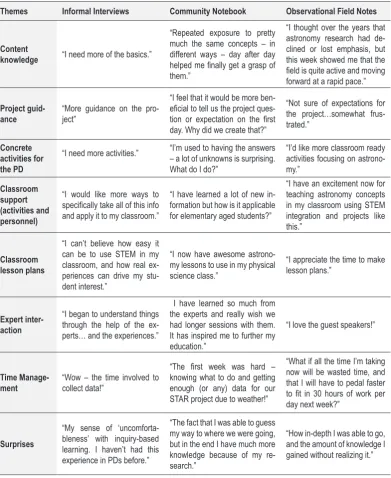
Overall, the qualitative data analysis shows that educators want certainty, and are frustrated with ambiguity even when it is a part of the process. The educators called for clear, up-front content knowledge and end-of-project deliverables before the authentic research experience began (Table 1). Additionally, the educators requested less inquiry and open-ended questions/ activities/projects and more concrete activities and classroom ready activities, although more inquiry-type activities are called for in the standards. Benefits to the educators included content to take back to classrooms, created lesson plans, and interaction with the experts. While concerns for the educators related to specific project guidance, time management, teaching the content, and using the project information in their classrooms (Table 1). Generally, there was a swing from dissatisfaction with the open-ended research and project, to acceptance of the task with disengagement, but finally engagement and excitement about the authentic science experience along with some participant surprises.
Viewing a typical quote from each major part (beginning, middle, and end) of the PD emphasizes the participants’ uneven journey with the process. The following participant quote examples were written in the accessible community notebook. Beginning quotes echoed one participant who on day-3 exclaimed, “I learned (and understand) so much more than I knew before!.” The term “like” appears often, as does the use of the exclamation point (!). Middle quotes boomed with uncertainty, such as a participant on day-6 who explained, “I understand the ‘inquiry based’ approach and the ‘authentic research’ opportunities, but quite honestly this approach felt disconnect and highly unorganized.” Ending quotes were once again optimistic, for example one participant on day-10 boasted, “[I have] an excitement for teaching astronomy concepts in my classroom using STEM integration.” More examples of the educators’ comments collected during the two PD weeks are included in Table 1, and selected quotes are shown in a progression timeline in Figure 1.
Overall, the quantitative data from the LASSI participants indicates that educators perceive authentic science as a means to more effectively prepare students which matches the ending comments of the participants. Educators believe that teacher preparation programs should include authentic science integration and modeling. Moreover, educators visualize supports (e.g. parental and administrative support), not barriers (e.g. doubts about student capacity), to implementing authentic science (see Table 2) in their classrooms.
PROBLEMS OF EDUCATION IN THE 21st CENTURY Volume 70, 2016 67
Table 1. Qualitative samples from 2-week PD showcasing selected quotes from informal interviews, community notebook, and observational field notes for pre-collegiate educators.
Themes Informal Interviews Community Notebook Observational Field Notes
Content
knowledge “I need more of the basics.”
“Repeated exposure to pretty much the same concepts – in different ways – day after day
helped me finally get a grasp of
them.”
“I thought over the years that astronomy research had de-clined or lost emphasis, but this week showed me that the
field is quite active and moving
forward at a rapid pace.”
Project
guid-ance “More guidance on the pro-ject”
“I feel that it would be more
ben-eficial to tell us the project ques
-tion or expecta-tion on the first
day. Why did we create that?”
“Not sure of expectations for the project…somewhat frus-trated.”
Concrete activities for the PD
“I need more activities.” “I’m used to having the answers – a lot of unknowns is surprising. What do I do?”
“I’d like more classroom ready activities focusing on astrono-my.”
Classroom support (activities and personnel)
“I would like more ways to
specifically take all of this info
and apply it to my classroom.”
“I have learned a lot of new in-formation but how is it applicable for elementary aged students?”
“I have an excitement now for teaching astronomy concepts in my classroom using STEM integration and projects like this.”
Classroom lesson plans
“I can’t believe how easy it can be to use STEM in my classroom, and how real ex-periences can drive my stu-dent interest.”
“I now have awesome astrono-my lessons to use in astrono-my physical science class.”
“I appreciate the time to make lesson plans.”
Expert inter-action
“I began to understand things through the help of the ex-perts… and the experiences.”
I have learned so much from the experts and really wish we had longer sessions with them. It has inspired me to further my education.”
“I love the guest speakers!”
Time
Manage-ment “Wow – the time involved to collect data!”
“The first week was hard –
knowing what to do and getting enough (or any) data for our STAR project due to weather!”
“What if all the time I’m taking now will be wasted time, and that I will have to pedal faster
to fit in 30 hours of work per
day next week?”
Surprises
“My sense of
‘uncomforta-bleness’ with inquiry-based
learning. I haven’t had this experience in PDs before.”
“The fact that I was able to guess my way to where we were going, but in the end I have much more knowledge because of my re-search.”
Volume 70, 2016
70 Limitations
The participant sample for this study was limited with 23 self-selected participants, not purposefully or randomly selected, and thus evaluating a group with similar perspectives and/or motivations might skew the results. The majority of the participant pool consisted of elementary educators (74%) not usually accustomed to research based STEM classes and/or activities/ projects. The project duration of two-weeks, although desirable for a PD, was short for a large research based STEM project. The STEM content focused almost exclusively on astronomy and further studies may be required to generalize these results to other disciplinary PDs. The PD experts were accustomed to educational outreach, and consequently the partnership support was extremely effective and usurped the research project in many areas.
Discussion
Based on the current literature, across the world pre-collegiate STEM educators are striving to incorporate real-world scenarios and authentic scientific practices into their teaching. This research adds clarification to the steps needed in order to engage STEM pre-collegiate educators in authentic science practices. Since the results show that the LASSI educators were initially engaged and excited at the start of the project, then disengaged during the middle, and finally re-engaged in the last few days with the authentic experience, it is vital to guide participants with clear scaffolding in objectives, process, outcomes, and support (written and verbal forms). For some educators, disengagement during the middle (when confusion tends to set in) might seem undesirable, however, the LASSI team found that persistence genuinely produced a more worthwhile experience for the participants. It is apparent that those involved with PDs look for and react to the tension between educators wanting certainty and the fact that authentic science activities are inherently ambiguous. Importantly, the experience of an authentic science PD alone is not sufficient for educators to translate the content and practices learned into realized pedagogy. At the intersection of inquiry activity confusion and useful classroom practice, a PD team can purposefully guide participants through the stages of authentic science acceptance in order to engage the participants with the STEM practices and show meaningful connections to the classroom. The LASSI team undoubtedly embraced this philosophy and challenge other coordinators to do the same.
The participant challenges during LASSI’s authentic science experience were polarizing and explicit, and a PD team can learn from these fluctuations. The community journal showcased these extremes of confusion and clarity during the participants’ journey through the entire process – from question creation to community dissemination. The participants used the community journal as an anonymous feedback mechanism for the LASSI team as well as a safe forum for expressing doubts and concerns. The LASSI team was pleasantly surprised by the utility of the journal and the richness of the honest reactions in the participant explanations. The PD team met daily to discuss the entries and would begin the next day’s session based on the emergent themes identified. The researchers argue that such a journal, anonymous in nature, is needed for continuous and honest participant input.
PROBLEMS OF EDUCATION IN THE 21st CENTURY Volume 70, 2016 71
for community poster dissemination). When creating a PD team, the group needs to not only be well versed in their content but also vested in communication and process reiteration on a regular basis with the participants.
Conclusions
This research is significant as it addresses the vital components required in order to engage STEM pre-collegiate educators in authentic science practices and STEM skills. The PD team must plan for and include participants in clear communication plans, anticipating the stages of inquiry and authentic science engagement, and guide the participants through the excitement of the beginning, “dip” in creating and investigating in the middle, and understanding of the entire process and product at the end. Thus, when creating a PD, a content knowledgeable team needs to explicitly communicate the process – both participant successes and challenges along the way - on a regular basis with the participants and engage them in discussion for the full authentic science and partnership effect to occur. If pre-collegiate educators perceive authentic science as a means to more effectively prepare students (which matches the ending quotes of the participants), then PD teams should provide these experiences as often as possible. Providing authentic science experiences and STEM skill practice extends to teacher preparation programs as well as in-service teacher PDs.
Future studies could include larger participant samples with authentic science educator PDs, especially those that diversify the research topics. Science educators at the collegiate level should consider authentic science experiences for pre-service educators to either start or continue their engagement with scientific practices in their future classrooms. Explorations of participant disengagement during the middle of the process could benefit the STEM PD community as a whole. Methods and means of creating well-defined, shorter (such as this two-week experience) authentic science experiences – with a variety of experts - that can be shared with other educators at all levels could be foundational in building meaningful experiences for future educational authentic science and STEM skill PDs.
Acknowledgements
The researchers would like to acknowledge partial to full funding, as well as activity trials during grant endeavors, for this authentic science study from the following grants: A) LASSI (DOE WDE MSP #WY140202), B) Black Holes (NSF AST #1211112 & 1211096), C) New Probe of Black Holes (NSF AST # 1515404 & 1515364), D) SWARMS (NSF DUE #1339853), and E) Faculty PD of Solid Body Guitar Design (NSF ATE DUE #0903336).
References
Baldi, S., Warner-Griffin, C., & Tadler, C. (2015). Education and certification qualifications of public middle grades teachers of selected subjects: Evidence from the 2011–12 schools and staffing
survey (NCES 2015-815). U.S. Department of Education, National Center for Education Statistics.
Washington, DC: U.S. Government Printing Office.
Beichner, R. (2008). The SCALE-UP project: A student-centered active learning environment for undergraduate programs. Invited paper for the National Academy of Sciences. Retrieved from
http://publish.illinois.edu/disruptivespaces/files/2014/07/SCALE-UP-Paper1.pdf.
Braund, M., & Reiss, M. (2006). Towards a more authentic science curriculum: The contribution of out-of-school-learning. International Journal of Science Education, 28 (12), 1373-1388.
Burrows, A. C. (2015). Partnerships: A systemic study of two professional developments with university faculty and K-12 teachers of science, technology, engineering, and mathematics. Problems of Education in the 21st Century, 65, 28-38.
Volume 70, 2016
72 Burrows, A. C., Breiner, J., Keiner, J., & Behm, C. (2014). Biodiesel and integrated STEM: Vertical alignment of high school biology/biochemistry and chemistry. Journal of Chemical Education, 91 (9), 1379-1389.
Crawford, B. (2014). From inquiry to scientific practices in the science classroom. In. N. Lederman &
S. Abell (Eds.), Handbook of Research on Science Education (Vol. II) (pp. 515-541). New York, NY: Routledge.
Creswell, J. W. (2014). Research design. Thousand Oaks, CA: Sage Publications.
Crippen, K. (2012). Argument as professional development: Impacting teacher knowledge and beliefs about science. Journal of Science Teacher Education, 23 (8), 847-866.
Fensham, P. J. (2009). Real world contexts in PISA science: Implications for context-based science education. Journal of Research in Science Teaching, 46 (8), 884-896.
Findlay, J. R., Kobulnicky, H. A., Weger, J. S., Bucher, G. A., Perry, M. C., Myers, A. D., … & Vogel, C. (2016). A wide-field camera and fully remote operations at the Wyoming infrared observatory. arXiv:1604.02446. Retrieved from https://arxiv.org/abs/1604.02446.
Golafshani, N. (2003). Understanding reliability and validity in qualitative research. The Qualitative Report, 8 (4), 597-606.
Hill, J., & Stearns, C. (2015). Education and certification qualifications of departmentalized public-level teachers of selected subjects: Evidence from the 2011–12 schools and staffing survey (NCES 2015-814). U.S. Department of Education, National Center for Education Statistics. Washington,
DC: U.S. Government Printing Office.
Jackson, J. K., & Ash, G. (2012). Science achievement for all: Improving science performance and closing achievement gaps. Journal of Science Teacher Education, 23 (7), 723-744.
Koro-Ljungberg, M., Yendol-Hoppey, D., Smith, J. J., Hayes, S. B. (2009). (E)pistemological awareness, instantiation of methods, and uninformed methodological ambiguity in qualitative research projects. Educational Researcher, 38 (9), 687-699.
Loucks-Horsley, S., Love, N., Stiles, Kl, Mundry, S., & Hewson, P. (2003). Designing professional development for teachers of science and mathematics. Thousand Oaks, CA: Corwin Press. Marshall, J. C., & & Alston, D. M. (2014). Effective, sustained inquiry-based instruction promotes higher
science proficiency among all groups: A 5-year analysis. Journal of Science Teacher Education, 25 (7), 807-821.
NGA – National Governors Association Center for Best Practices, Council of Chief State School Officers.
(2010). Common Core state standards for mathematics. Washington, DC: National Governors
Association Center for Best Practices, Council of Chief State School Officers.
NGSS Lead States. (2013). The Next Generation Science Standards: For states, by states. Washington DC: The National Academies Press.
Penuel, W., Fishman, B., Yamaguchi, R., & Gallagher, L. (2007). What makes professional development effective: Strategies that foster curriculum implementation. American Educational Research Journal, 44 (4), 921-958.
Roth, W. M. (2012). Authentic school science: Knowing and learning in open-inquiry science laboratories (Vol. 1). Springer Science & Business Media.
Rule, A. C. (2006). Editorial: The components of authentic learning. Journal of Authentic Learning, 3 (1), 1-10.
Sadler, T. D., Burgin, S., McKinney, L., & Ponjuan, L. (2010). Learning science though research apprenticeships: A critical review of the literature. Journal of Research in Science Teaching, 47 (3), 235-256.
Slater, T., Burrows, A., French, D., Sanchez, R., & Tatge, C. (2014). A proposed astronomy learning progression for remote telescope observation. Journal of College Teaching and Learning, 11 (4), 197-206.
Spuck, T. (2014). Putting the “authenticity” in science learning. In T. Spuck, L. Jenkins, & R. Dou (Eds.), Einstein fellows: Best practices in STEM education (pp. 118-156). New York, NY: Peter Lang. Steele, C. (2010). Whistling Vivaldi: And other clues how stereotypes affect us. New York, NY: Norton. Stolk, M., DeJong O., Bulte, A., & Pilot, A. (2011). Exploring a framework for professional development
in curriculum innovation: Empowering teachers for designing context-based chemistry education. Research in Science Education, 41 (3), 369-388.
Sullivan, G. M., & Feinn, R. (2012). Using effect size – or why the p value is not enough. Journal of Graduate Medical Education, 4 (3), 279-282.
PROBLEMS OF EDUCATION IN THE 21st CENTURY Volume 70, 2016 73
Yore, L. D., & Treagust, D. F. (2006). Current realities and future possibilities: Language and science literacy – empowering research and informing instruction. International Journal of Science Education, 28 (2-3), 291-314.
York, D. G., Adelman, J., Anderson Jr, J. E., Anderson, S. F., Annis, J., Bahcall, N. A., … & Boroski, W. N. (2000). The Sloan digital sky survey: Technical summary (September). The Astronomical Journal, 120 (3), 1579-1587.
Zeidler, D. (2014). Socioscientific issues as a curriculum emphasis. In. N. Lederman & S. Abell (Eds.),
Handbook of Research on Science Education (Vol. II) (pp. 697-726). New York, NY: Routledge. Zozakiewicz, C., & Rodriguez, A. J. (2007). Using sociotransformative constructivism to create
multicultural and gender-inclusive classrooms an intervention project for teacher professional development. Educational Policy, 21 (2), 397-425.
Advised by Danny Dale, University of Wyoming, Laramie, USA
Received: March 10, 2016 Accepted: April 18, 2016
Andrea C. Burrows Curriculum and Instruction Science Ed.D, Assistant Professor, University of
Wyo-ming, 1000 E. University Ave., # 3374, Laramie, WY 82071 USA.
E-mail: [email protected]
Website: http://www.uwyo.edu/seced/faculty-staff/andrea-burrows.html
Michael A. DiPompeo Physics Ph.D., Postdoctoral Research Associate, Dartmouth College, 6127 Wilder
Laboratory, Hanover, NH 03755 USA.
E-mail: [email protected]
Website: http://www.dartmouth.edu/~mdipompeo/
Adam D. Myers Astrophysics Ph.D, Associate Professor, University of Wyoming, 1000 E. University Ave., Dept. 3905, Laramie, WY 82071 USA.
E-mail: [email protected]
Website: http://www.uwyo.edu/physics/faculty-directory/adam-bio.html
Ryan C. Hickox Astronomy Ph.D., Assistant Professor, Dartmouth College, 6127 Wilder Laboratory,
Hanover, NH 03755 USA.
E-mail: [email protected] Website: http://www.dartmouth.edu/~hickox/
Mike Borowczak Electrical and Computer Engineering and Computer Science, Ph.D., Chief Scientist,
Erebus Labs, P.O. Box 1554, Laramie, WY 82073 USA.
E-mail: [email protected] Website: http://www.erebuslabs.com/
Debbie A. French Science Education, Doctoral Candidate, University of Wyoming, 1000 E. University
Ave., Dept. 3374, Laramie, WY 82071 USA.
E-mail: [email protected]
Website: http://www.uwyo.edu/seced/faculty-staff/debbie%20french.html
Andria C. Schwortz Physics/Astronomy, Doctoral Candidate, University of Wyoming, 1000 E. University
Ave., Dept. 3374, Laramie, WY 82071 USA.
E-mail: [email protected]