Volume-5 Issue-1
International Journal of Intellectual Advancements
and Research in Engineering Computations
Optimized selection decision maker using
Fuzzy-ahp
P.Prema1 , Dr. L.M.Palanivelu2
PG Scholar1, Professor2
Velalar College of Engineering and Technology1,2 [email protected]
Abstract - Aim is to come up with a computer driven selection decision, especially to address the marriage selection process. Matrimonial match making is growing rapidly in India. Many researchers set the stable matching as their most important optimal objective. Purpose of this study is to enable users to explore their partners effectively and efficiently and restrict to the desired matches so that the probability of match making are maximized. Gale-Shapley stable matching algorithm is used to help customers to get the desired shortlist of profiles with an optional stable match. An integrated approach is proposed for matrimonial matchmaking using Fuzzy Analytic Hierarchy Process (FAHP), where multiple criteria are considered in the process.
A compatibility index (matched metric), is developed that enhances the probability of matchmaking. In this model, the scale of data in the decision background is very huge or the useful information given is very less, they take little effect to determine the weight value. MATLAB already supports various implementations and different stages of the data processing as matrices, with various toolboxes created by experts in the field. It utilizes the advantage of AHP on forming pair wise comparison matrix and computing index weight. Final decision depends on the ranks derived for each alternative. The advantage of fuzzy comprehensive evaluation method is establishing quantitative indexes membership, qualitative indexes membership and classifying the level.
Keywords— Fuzzy Analytic Hierarchy Process (FAHP), Multi-Criteria Decision-Making (MCDM), Pair wise comparison.
I. INTRODUCTION
Marriage or life mate selection is viewed as strategic decision in the life of humankind. It has long-term effect on the life of an individual and the following generations because of its non-repetitive nature in normal conditions. It is not an easy decision to make, and to lay the proper foundation for any marriage, careful and studied steps that require wisdom and thorough planning are needed.
Therefore, matchmaking is certainly a multi-criterion decision-making process.
User would like to depict his or her own requirements (attributes) like features or personal criteria and salary in terms of more fair (around 50 000 etc). Such linguistic expressions need to be converted into fuzzy sets as described in the following study. The classical AHP also performs pair wise comparison of candidates attribute wise. The Analytic Hierarchy Process (AHP) is one of the Fuzzy Multiple Criteria Decision Making (MCDM) methods.
Thoughts or expectations concerning life partners are given. With these expectations, finding a perfect partner is not an easy job. Marriage means a lifetime commitment, and it is expected that the person is wholly committed and dedicated to his or her life partner. In the past, marriages are traditionally be arranged typically by the parents, with the help of relatives and other persons. This would finalize the match for their partner. In today’s world, and family people being located at different places because of jobs etc., more and more people take the decision themselves about their life partners taking their families in confidence with changes in society. In this process, they get good support from the newspaper advertisements and online matrimonial websites. According to some research, the popularity of online matrimony services has grown mainly because of convenience and cost-savings.
In this paper, life partner is selected without online, by using fuzzy- AHP algorithm which is multi criteria decision making process (MCDM). Problem is formulated as hierarchy and priority weight manipulation is done to short list the alternatives.
This paper is divided into five sections. In section one, the problem is introduced. In section two, related works are discussed. In section three, the FAHP is constructed and computations are carried out. In section three how the proposed model is used in an example in the real world is explained. Finally, in section five, conclusions and future study areas are discussed.
II. RELATED WORK
A polynomial-time algorithm is applied for a problem as graph, and to make a decision whether such a decision exists in the presence of restricted edges. If it is not
possible, one might look for a solution close to optimal. This paper subject for the case of NP-hard problems, arising from restrictions on the lengths of the preference lists, or upper bounds on the numbers of restricted pairs, we confer polynomial solvable special cases [1]. The objective of this paper is to select the best product of notebook computers by applying the fuzzy analytic hierarchy process (fuzzy AHP) under Multi Criterion Decision Making (MCDM). This algorithm is to determine the virtual importance of the decision criterion. Both the theoretical and practical background of this paper have shown that fuzzy AHP can efficiently handle the fuzziness of the data involved in the multi-criteria decision making problem[2].
This proposed paper basically focuses on ID3 (classical decision tree approach) a classification technique of data mining to identify the class of an attribute. This approach adds fuzzification to improve the optimization of the result. Id3 results are based on information gain theory and Entropy values of each attribute. It also contains design and implementation of this combined approach with chosen datasets. Classification results are obtainable as decision tree which incorporate the result of Id3 & FID3. Fuzzy ID3 results are based on information gain of fuzzy dataset and fuzzy entropy. Iteractive Dichotomizer 3 algorithm is one of the most used algorithms in machine learning and data mining due to its easiness to use and effectiveness [3]. Marriage problem was introduced by Gale and Shapley. GS algorithm was used to find solution for it. Only one factor has been used assuming that the preference list is based on a single factor in the existing algorithm. In this proposed study, the researcher has introduced N-factors with weights (i.e. Dowry, Height, Weight, Colour and so on) in Marriage problem and Satisfactory Matching Algorithm has been applied to find solution with optimal pair for the marriage problem [4].
Proposed algorithm for match making is done by using decision trees based on Hunt’s algorithm. A research worker named J. Ross Quinlan developed a choice tree rule called ID3 (Iterative dichotomies). Later, he conferred C4.5, which was the successor of ID3 that enhances the search area with optimal decision suggestions. ID3 and C4.5 adopt a greedy approach. In this rule, there is no back tracking; the trees square measure made in a top-down algorithmic divide-and-conquer manner. Match making using Hunt’s Algorithm follows considering preferences, generate Decision Tree, apply Hunt’s algorithm for selecting best match. Advantages are less time consuming, covers large area, suitable match suggestions [5].
The model constructed extends preference sequence from a complete and strong to an incomplete and weak one. Problem can be solved with Branch and Bound algorithm. The algorithm adds the constraint on threshold to pledge matching effect of each matching pair. Besides, the model we construct is succinct and explicit. The problem model is classified into 0-1 integer programming problem in the field of linear optimization. We think it is a better method to solve two sided problems with uncertain preference sequences in actual decision situation [6]. An integrated approach to matchmaking in
e-matrimony environment using fuzzy-AHP considering multiple criteria and alternatives involved in the process. As the match making through online portal, chances of matching are maximized. Marriage partner profiles are shortlisted by pair wise comparison. The objective of the study is to enable users to search their partners effectively and efficiently and narrow down to the desired matches [7].
Analytic Hierarchy Process (AHP) is a mathematical technique for multi-criteria decision-making. AHP technique is used to prioritize the opinions and finally in the assortment of the measuring tool. Complex problems or issues for decision making involving value or subjective judgments are suitable applications of the AHP approach. Using AHP, this paper involves a number of qualitative judgments based on criteria at multi-levels and can be addressed [8]. The goal is to match n men with m women in a one-to-one fashion. The set of strategies S, of player I, is given by the preferences that an individual can specify, depending on the model either as a preference list or as a set of utility functions. In the case of preference lists, these utilities are given by the consequent entries. In the case of utility functions, the utilities are given by the corresponding utility functions.
Any polynomial time algorithm can be used to solve this marriage problem. NP hard problem may arise for certain hardly solvable preference list. The preferences are given as (not necessarily complete) preference lists [9]. We addressed the strategic issues in the Gale-Shapley model i.e., a one-to-one matching model in which each participant submits complete preference lists. Only one factor considered with single weight values. Hence very little was known about the strategic issues for this model prior to our work. Assuming that the men-optimal mechanism is used, we derived an optimal cheating strategy for the women [10].
III. PROPOSED ARCHITECTURE
A. The Analytic Hierarchy Process (AHP)
AHP was introduced by Thomas Saaty (1980). AHP is an effective tool for dealing with complex decision making, and may help the decision maker to set priorities and make the best decision. It helps in reducing complex decisions to a series of pair wise comparisons, and then synthesizing the results. The AHP also helps to capture both subjective and objective aspects of a decision. It incorporates a useful technique for checking the consistency of the decision maker’s evaluations, thus reducing the prejudice in the decision making process.
B. Features of the AHP
qualitative) made by the decision maker into a multi-criteria ranking. Users of the AHP first decompose their decision problem into a hierarchy (fig.1) of more easily comprehended sub-problems, each of which can be analyzed independently.
Fig. 1 Goal selection hierarchy
The elements of the hierarchy can relate to any aspect of the decision problem that is tangible or intangible, carefully measured or roughly estimated, well or poorly understood, anything at all that applies to the decision. Once the hierarchy is constructed, the decision makers systematically evaluate its various elements by comparing them to each other two at a time, with respect to their impact on an element above them in the hierarchy. In making the pair wise comparisons, the decision makers can use concrete data about the elements. they typically use their judgments about the elements relative meaning and importance.
C. The AHP working
The Analytic Hierarchy Process considers a set of evaluation criteria, and a set of alternative options amid which the best decisions are to be made. The best option is the one which optimizes each single criterion and it is important to note that, since some of the criteria could be contrasting, rather the one which achieves the most suitable transact among the different criteria. Initially the AHP generates a weight for each evaluation criterion according to the decision maker’s pair wise comparisons of the criteria. If the weight is higher, then the corresponding criterion is considered to be more important. For a fixed criterion, the AHP assigns a score to each option. According to the decision maker’s pair wise comparisons of the options based on that criterion considered, the score is considered. If the score is higher, the performance of the option is considered better with respect to the considered criterion. Finally, the Fuzzy-AHP combines the criteria weights and the options scores. It thus determines a global score for each option, and a consequent ranking. The global score for a given option obtained is a weighted sum of the scores with respect to all the criteria.
D. Fuzzy- Analytic Hierarchy Process (F-AHP)
Fuzzy Analytic Hierarchy Process (F-AHP) embeds the fuzzy theory (FT) to basic Analytic Hierarchy Process (AHP). AHP is a widely used decision making tool in various multi-criteria decision making (MCDM) problems. Analytic Hierarchy Process is one of the best ways for decision making among the complex criteria structure at different levels. Fuzzy AHP is a synthetic extension of classical AHP method, where the fuzziness of the decision makers is considered. In a general AHP model as in Fig.1, the objective is in the first level, the criteria and sub criteria are in the second and third levels respectively. Finally the alternatives are found in the fourth level. Since basic AHP does not include ambiguity for personal judgments, it has been enhanced by benefiting from fuzzy logic technique. In F-AHP, the pair wise comparisons of both criteria or sub criteria and the alternatives are performed through the linguistic variables. These comparisons are represented by triangular numbers. Then they defined as the triangular membership functions for the pair wise comparisons.
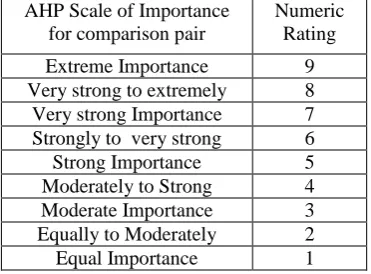
The AHP method provides a structured framework for setting priorities on each level of the hierarchy using pair-wise comparisons that are quantified using a 1 - 9 scale as demonstrated in Table. 1.
TABLE I PREFERENCES MADE ON SATTY’S SCALE
AHP Scale of Importance for comparison pair
Numeric Rating
Extreme Importance 9
Very strong to extremely 8
Very strong Importance 7
Strongly to very strong 6
Strong Importance 5
Moderately to Strong 4
Moderate Importance 3
Equally to Moderately 2
Equal Importance 1
AHP takes the judgments of decision makers to form a disintegration of problems into criteria and alternative hierarchies. The number of levels in the hierarchy represents the problem complexity which combines with the decision-makers problem model that to be solved. The hierarchy is used to derive ratio-scaled measures for decision alternatives and determines the relative value alternatives that represent organizational goals and project risks. FAHP uses matrix algebra (MATLAB) to sort out factors to derive a mathematically optimal solution. FAHP is a time-tested method that has been used in making multi-billion dollar decisions. Buckley’s method is implemented to determine the relative importance weights for both the criteria and the alternatives although there are some more techniques embedded in F-AHP.
E. Architecture of F-AHP selection decision match making
which they are met by each alternative. To solve a decision problem with AHP, there are some steps which are defined.
Fig. 2 Architecture design of multi-criteria match making
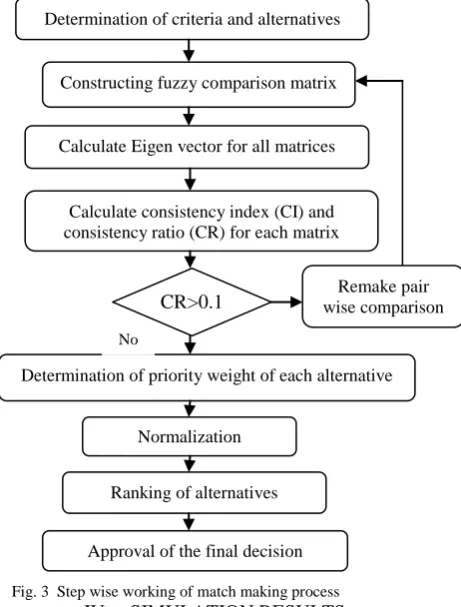
We propose a new integrated method as depicted in Fig 1. This integrated approach based on FAHP, CI and stable matching algorithm based process is elaborated stepwise.
Fig. 3 Step wise working of match making process
IV SIMULATION RESULTS
A. Step wise process of F-AHP
Figure 3 illustrate the step wise procedure to identify the perfect match and the degree of matching.
(1)Decision – making problem is defined that is determination of criteria and alternatives.
Fig. 3 Hierarchy with Goal, criteria, sub-criteria and alternatives
(2)Fuzzy comparison Matrix between factors is formed.
Next, we give the fuzzy comparison matrixes of the criteria level and sub-criteria level. Following tables show the original fuzzy pair-wise comparison matrixes for partner selection evaluation.
TABLE II. FUZZY COMPARISON MATRIX AT SUB-CRITERIA LEVEL
Education Occupation
Education 1 3
Occupation 1/3 1
TABLE III. FUZZY COMPARISON MATRIX AT SUB- CRITERIA LEVEL.
TABLE IV FUZZY COMPARISION MATRIX AT SUB-CRITERIA LEVEL
Age Height Body type Diet
Age 1 1/5 3 4
Height 5 1 9 7
Body type 1/3 1/9 1 2
Diet ¼ 1/7 1/2 1
TABLE V FUZZY COMPARISION MATRIX AT CRITERIA LEVEL
Education Wealth Personality
Education/Occupation 1 1/4 1/7
Wealth 4 1 ½
Personality 7 2 1
(3) Percentage importance distributions of the criteria are determined.
Family status Location Earning
Family status 1 1/3 2
Location 1/3 1 1/5
Earning ½ 5 1
Data regist ration
Male/ Female
profile
F-AHP
Fuzzif ier
Defuzz ifier Rules
Selection decision(MCDM)
Pair wise comparision and weight manipulation
Report generation of matched male/
female profile
Determination of criteria and alternatives
Constructing fuzzy comparison matrix
Calculate Eigen vector for all matrices
Calculate consistency index (CI) and consistency ratio (CR) for each matrix
CR>0.1
Determination of priority weight of each alternative
Normalization
Ranking of alternatives
Approval of the final decision
No
Selection of best spouse
Education/
occupation Wealth Personality
Family status Location Earning
Age Height Body type Diet
Female1 Female2 Female3 Female4
Goal
Alternatives
Percentage importance distributions of the criteria are the normalization of each entry divide by the column sum and take the overall row average. Consider for Table 4 the normalized matrix can be given as follows.
TABLE VI NORMALISED MATRIX VALUE FOR TABLE4 SUB-CRITERIA
0.1519 0.1376 0.2222 0.2857
0.7595 0.6878 0.6667 0.5000
0.0506 0.0764 0.0741 0.1429
0.0380 0.0983 0.0370 0.0714
(4)Consistency Ratio (CR) in factor comparisons is calculated.
CR= CI/RI
(1)
Where CI= Consistency Index RI= Random Index And CI= (Maximum of Eigen value – Size)/ (Size-1) (2)
TABLE VII VALUES OF RI
Size of
matrix 1 2 3 4 5 6 7 8
RI 0 0 0.58 0.90 1.12 1.24 1.32 1.41
If CR>0.1 then it concludes that judgment is consistent enough else the judgment is untrustworthy and the reconstruction of matrix is needed.
(5) Ratings of each alternative are multiplied by the weights of sub-criteria or criteria.
That is the normalized vector is matrix multiplied with the row average of each criterion.
TABLE VIII THE WEIGHTS OF CRITERIA BASED ON EACH ALTERNATIVE WITH RESPECT TO THE OVERALL WEIGHTS OF THE CRITERIA
Education/Occupation Wealth Personality
Female1 0.010 0.013 0.012
Female2 0.015 0.014 0.013
Female3 0.019 0.029 0.037
Female4 0.013 0.007 0.010
(6)Finding the result distribution at decided decision points.
From the Table 8, Female3 has the highest value compared with other alternatives based on the criteria wealth and the second highest is Female2.
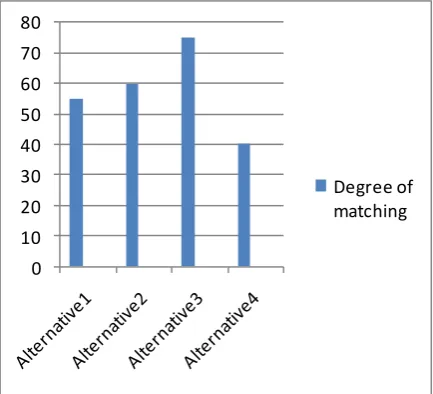
The graph in Fig.4 and Fig.5 illustrates the sub-criteria level variation among the four alternatives. These graphs are to present the criteria among the alternatives. The graph in Fig. 6 illustrates the percentage of weight sums of each alternative and the highest degree is the best optimal solution pair.
0 0.1 0.2 0.3 0.4 0.5 0.6 0.7 0.8
Female1 Female3
Family status
Location
Earning
Fig. 4 Variation of sub-criteria wealth among alternatives
0 0.1 0.2 0.3 0.4 0.5 0.6 0.7 0.8 0.9
Female1 Female3
Age
Height
Bodytype
Diet
Fig. 5 Variation of sub-criteria personality among alternatives
0 10 20 30 40 50 60 70 80
Degree of matching
Fig. 6 Degree of matching of each alternative
V CONCLUSION
other hand, AHP cannot capture the fuzziness of human judgments as the verbal assessments are converted into crisp values. F-AHP is a merger of the two methods, Fuzzy logic and the Analytic Hierarchy Process (AHP), which inherits the advantages of both fuzzy and AHP, and therefore, addresses the above mentioned problems. The FAHP method is useful in identifying a suitable partner and to evaluate its performance as demonstrated in the described case study. It can also be applied in any other selection or ranking problem. The dependency of the weights to the depth of the hierarchy and the consistency measure issue can be solved. AHP cannot accept fuzzy numbers as inputs having the form of mean and variance and fuzzy logic does not accept pair wise comparisons.
The aim of the study was to provide an adequate MCDM algorithm based on the consistency is designed in the selection of matrimonial profile selection. In order to achieve consensus among the decision-makers, all pair-wise comparisons were converted into pair wise priorities to alter the fuzzy rating and the fuzzy attribute weight. The fuzzy set theory in the decision-making process implies that this practice is not absolute. Profile selection is a process that also contains uncertainties. This problem can be conquering by using fuzzy numbers and linguistic variables to achieve accuracy and consistency. In short, our analysis suggests that selection within an attribute environment is a complex issue and, thus, human resources and/or other authorities need to take appropriate measures when selection decision.
As for future work, it is suggested that other multicriteria approaches may such as, ANP (Analytic Network Hierarchy) and fuzzy outranking methods can be applied and compared in the process of matrimonial selection decision. The comparison of various methods in the selection of partner may help in finding out the accuracy, appropriateness, suitability, fairness and practicality efficiently.
REFERENCES
[1] D. Gale, L.S. Shapley, College admissions and the stability of marriage, Amer. Math. Monthly 69 (1962) 9–15. [2] Applying Fuzzy Analytic Hierarchy Process to Evaluate and
Select Product of Notebook Computers, Phanarut Srichetta and Wannasiri Thurachon,International Journal of Modeling and Optimization, 2013
[3] Decision tree classification implementation with fuzzy logic, Renuka D. Suryawanshi , D. M. Thakore, 2012
[4] Varients of weighted N-factor marriage problem using SMA,
Dr. T. Ramachandran, D. Udayakumar, K. Velusamy, 2015
[5] Life mate- reliable matching using Hunts algorithm, Arjuna Rao, K. Sujatha, P. Poornima, P. Divya, B. Harika, K. Chaitanya, 2016
[6] A two-sided matching decision model based on uncertain preference sequences, Xiao Liu and Huimin Ma , 2015
[7] Matchmaking using Fuzzy Analytical Hierarchy Process, Compatibility Measure and Stable Matching for Online
Matrimony in India, Kedar joshi and Sushil kumar, Journal of multi-criteria decision analysis, 2012
[8] A Fuzzy AHP Approach for Selection of Measuring Instrument for Engineering College Selection, P. Mahendran, M. B. K. Moorthy, S. Saravanan, Applied Mathematical Sciences, 2014 [9] R.W. Irving, An efficient algorithm for the stable roommates
problem, J. Algorithms 6 (1985) 577–595.
[10] D. Gusfield, R.W. Irving, The Stable Marriage Problem: Structure and Algorithms, MIT Press, 1989.
[11] Gale-Shapley stable marriage problem revisited: strategic issues and applications, Jay Sethuraman , Wee-Peng Tan ,2010 [12] Applying fuzzy analytic hierarchy process to evaluate success factors of E-Commerce , Feng kong and Hongyan liu, International Journal of Information and system sciences,2011 [13] A Fuzzy AHP approach for supplier selection problem: a case
study in a gearmotor company, Mustafa Batuhan AYHAN, International Journal of Managing Value and Supply Chains (IJMVSC) Vol.4, No. 3, September 2013
[14] Decision making with the analytic hierarchy process, Thomas L. Saaty, Int. J. Services Sciences, Vol. 1, No. 1, 2008 [15] K. Hamada, K. Iwama, S. Miyazaki, An improved
approximation lower bound for finding almost stable maximum. .