Available online on 15.11.2017 athttp://ujpr.org
Universal Journal of Pharmaceutical Research
An International Peer Reviewed Journal
Open access to Pharmaceutical research
This is an open access article distributed under the terms of the Creative Commons Attribution-Non Commercial Share Alike 4.0 License which permits unrestricted non
commercial use, provided the original work is properly cited Volume 2, Issue 5, 2017
RESEARCH ARTICLE
ORAL
C. ALBICANS
COLONIZATION AND NON-
CANDIDA ALBICANS
CANDIDA
COLONIZATION AMONG UNIVERSITY STUDENTS, YEMEN
Abbas M Al-Kebsi1, Arwa M Othman2 , Al-Kasem M A Abbas3, Ebtihal M Madar2 , Hassan A. Al-Shamahy2 , Khaled M Al-Gaffari1 , Samera M. Naser Daname4 , Fuad L. Motareb5
1Department of Prosthodontics, Faculty of Dentistry, Sana’a University, Republic of Yemen 2Medical Microbiology and Clinical Immunology, Faculty of Medicine and Health Sciences, Sana’a University, Yemen
3
Department of Maxillo-Facial, Faculty of Dentistry, Sana’a University, Republic of Yemen
4Department of Physiology, Faculty of Dentistry, Sana’a University, Republic of Yemen 5
Department of Orthodontics, Faculty of Dentistry, Sana’a University, Republic of Yemen
ABSTRACT
Objectives: Candida albicans is diploid yeast that in some circumstances may cause oral or oropharyngeal infections. This investigation aimed to study the oral C. albicans colonization (OCC) and Non-Candida albicans Candida colonization (ONCACC) and risk factors of OCC in healthy University students.
Methods: This cross sectional laboratory study was carried between January 2014 and July 2014. A total of 265 healthy students were included in this study, 131 males and 134 females. Demographic and clinical and risk factor variables were registered in predesigned questionnaire. Standard methods were used for collection oral specimens, culturing and identifying Candida species. Results: The crude rate of OCC was 17.7% and the crude rate of ONCACC was 29.1%. C. tropicalis and C. glabrata were the most common species isolated after C. albicans. Statistically significant association of OCC (< 0.05), was identified between the gender (male) (OR=3.7), smoking (OR=14.6), denture wearing (OR=6.2), dental bridge (OR=5.4), orthodontics (OR=2.5), the reduced saliva flow rate (OR=11.3), previous antibiotics users (OR=2.99), and Qat chewers (OR=5.2).
Conclusion: Current study results are important for the development of strategies to eliminate these indicators of risk and significantly reduce Candida species colonization and oral Candida infections in young healthy adults and in general in Yemen community. The data also suggests that the prevalence rate of OCC was relatively high and it was affected by presence of prostheses, orthodontics, behaviors, xerostomia certain sociodemographic characteristics, which indicate the need for comprehensive, scheduled programs of healthcare educations.
Keywords: Non-Candida albicans Candida colonization (ONCACC), Oral C. albicans colonization (OCC), risk factors, Yemen.
Article Info: Received 5 November 2017; Revised 9 November; Accepted 12 November, Available online 15 November 2017 Cite this
article-Al-Kebsi AM, Othman AM, Al-Kasem MAA, Madar EM, Al-Shamahy HA, Al-Gaffari KM, Daname SMN, Motareb FL.Oral C. albicans colonization and non-candida albicans candida colonization among University students, Yemen. Universal Journal of Pharmaceutical Research 2017; 2(5): 5-9.
DOI:http://doi.org/10.22270/ujpr.v2i5.R2 Address for Correspondence:
Dr. Hassan A. Al-Shamahy, Medical Microbiology and Clinical Immunology, Faculty of Medicine and Health Sciences, Sana’a University, Yemen, Tel: +967-1-239551, E-mail: [email protected]
INTRODUCTION
Candida albicans is an opportunistic fungal pathogen usually found in the human gastrointestinal and female lower genital tracts. It is an only one of its kind parasite capable of colonizing, infecting, and persisting on mucosal surfaces, and motivating mucosal immune responses1. Attack of tissues by Candida is aided by hyphal development. The transformation of budding yeasts to hyphal growth is endorsed by physical contact with surfaces and is under genetic control. When fungi colonize an epithelial or epidermal surface, they adhere to host cells and generate depressions in the surface of host cells. As yeast-form cells alter to the hyphal form,
Conditions that favour this transformation include extremes in age, broad-spectrum antibiotic therapy, corticosteroids, xerostomia, immune dysfunction (especially of cell-mediated immunity), diabetes mellitus, nutritional deficiencies, or the presence of removable prostheses4,5. There are some clinical manifestations of oral candidiasis, the most common being the pseudo membranous, erythematous, angular cheilitis, hyperplastic and mucocutaneous forms6,7. Non-Candida albicans Candida (NCAC) strains, however, are isolated in ever-increasing numbers in medically compromised patients. These strains might cause systemic infections and are frequently resistant to commonly used antifungal agents such as fluconazole8,9. Candida species may be able of metabolizing ethanol to carcinogenic acetaldehyde and can thus development oral and upper gastrointestinal tract cancer, cconsequently, more focus should be placed on diagnosis and treatment of oral Candida
infections, as well on other Candida species than C. albicans10,11. This investigation aimed to study the prevalence of Candida species and risk factors of oral
Candida albicans colonization in healthy students of Sana'a University in Sana'a city, Yemen.
MATERIALS AND METHODS
Sample collection and processing:
The samples were collected aseptically by oral rinse method. The students were asked to rinse the mouth with 10 ml of sterile Phosphate Buffered Saline (PBS, pH 7.2) for 60 seconds and thereafter oral rinse was collected in sterile container. The oral rinse specimen was without delay centrifuged at 3000xg for 10 minute. The supernatant was discarded and sediment was re-suspended in 1 ml of sterile PBS and vortexed for 1 minute. This solution was used for direct microscopic examinations, performed with lactophenol cotton blue and 100 μl of this preparation was inoculated onto Sabouraud’s Dextrose Agar (SDA) plate with and without chloroamphenicol (Oxod, UK). The plates were incubated at 37°C for 48 h. The colonies of
Candida were counted to assess CFU/ml of rinse sample12.
Sterile cover-slip, incubated at room temperature for 3 to 5 days in dark to endorse the production of chlamydospores, hyphae, pseudohyphae, and arthroconidia. Biochemical tests were carried out; using API Candida Syste API system ll tests were completed according to the manufacturer’s instructions13. The API Candida system consists of a single-use disposable plastic strip with 10 wells to perform 12 colorimetric biochemical tests: five sugar assimilation tests (for glucose, galactose, sucrose, trehalose, and raffinose) and seven enzymatic tests (for β-maltosidase, α-amylase, β-xylosidase, β-glucuronidase, urea hydrolysis, N -acetyl-β-glucosaminidase, and β-galactosidase). Inoculation of the wells was done by adding a yeast suspension to the dehydrated substrates. The results were read after incubation for 18 to 24 h at 35°C. A four-digit numerical profile was made for each isolate depending upon the reactions it produced. Identifications were made by referring to the list of numerical profiles and a
computer program offered by the manufacturer.Mouth hygiene determined by the frequency of using oral hygiene measures (as mouth washes, using antiplaque and anti-gingivitis tooth paste per day14.
Salivary Flow Rate: The students asked to chewing paraffin for 5 minutes, and then saliva collected into a measuring container. Then saliva sample was measured and flow rate was calculated on an ml/minute basis15. It is recommended that the tests are performed at least one hour after the person has eaten something (drinking water is allowed), smoked or taken snuff. It is important that the person is relaxed and calm. If the person has any disease, it should be considered if the disease affects the secretion rate, and if it is a temporary condition or a lasting disease. If long-lasting, the reduced secretion rate may be regarded as representative for that person and for that period of time.
All relevant data of the students included in this study were obtained though a pre-designed questionnaire. Also laboratory results, measuring of mouth hygiene and salivary flow rate results were collected in the pre-designed questionnaire.
Table1: The distribution of tested students according to their sex and age groups
Total n=265 Female
n=134 Male
n=131 Age groups
% No % No. % No
43 114 48.5 65 37.4 49 20-22 years
32 87 35.1 47 30.5 40 23 -25 years
24.2 64 6.4 22 32.1 42 ≥ 26 years
100 265 50.6 134 49.4 131 Total
22.1 years 23.4 years
Mean age
2.1 years 2.3 years
S. D
21 years 22 years
Mode
21 years 21 years
Median
26 years 27 years
Max
20 years 20 years
Min
RESULTS
This analytical laboratory study was conducted on 265 students of Sana'a University during the period of two months from January 2014 to February 2014. Their age was ranged from 20–27 years, with mean age±SD equal to 22.1±2.1 years for female students, and for male students the mean age±SD was 23.4±2.3 years. Females represent 49.4% of total and males represent 50.6% of the total.
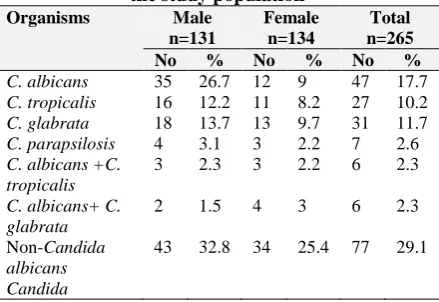
Table 2: The yeast distribution in different sexes of the study population
Organisms Male
n=131
Female n=134
Total n=265
No % No % No %
C. albicans 35 26.7 12 9 47 17.7 C. tropicalis 16 12.2 11 8.2 27 10.2 C. glabrata 18 13.7 13 9.7 31 11.7 C. parapsilosis 4 3.1 3 2.2 7 2.6 C. albicans +C.
tropicalis
3 2.3 3 2.2 6 2.3
C. albicans+ C. glabrata
2 1.5 4 3 6 2.3
Non-Candida albicans Candida
Most of the students were in age group 20-22 years (43%) and in age groups 22-25 years were 32.8%, and students in age group≥ 26 years count only 24.2% of the total (Table1). The total OCC rate in our students was 17.7%. OCC was 26.7% among male students, higher than that for female students in which it was 9% (Table 2). In addition, there was a highly significant association of OCC with male students (OR=3.7, pv=0.0001) (Table 3). When we study the relation of student age and risk of OCC, a higher rate and risk of colonization found in age group 23-25 years with prevalence rate equal to 23.8%, and risk (OR) equal to 1.65 times comparing to other age groups (Table 2). When we considered predisposing factors of OCC, there was a highly significant association (pv=0.0004) of denture wearing with OCC in which this risk equal to 6.2, and ranged from 1.8-22.2. Also proportional prevalence of 41% oral C. albicans was higher in students who had previously received antibiotics, and there was a highly significant association (pv<0.0001) of history of recent using antibiotics with colonization of C. albicans in which this risk equal to 2.99, and ranged from 1.8 to 4.9. An inverse correlation between salivary flow rate and OCC is reflected in present
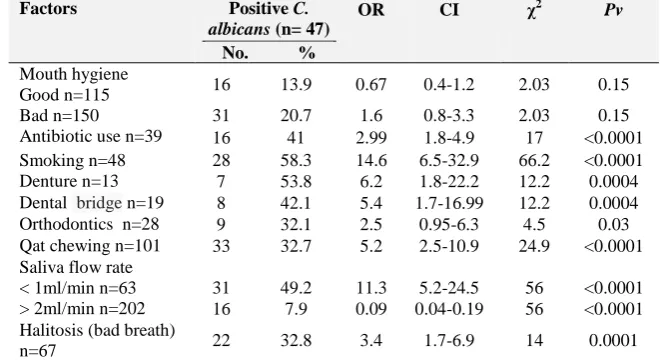
study, in which significant relation was found between reduced saliva flow rate and OCC. Proportionally, 58.3% OCC was found with reduced saliva rate (< 1 ml/min) with highly significant OR equal to 14.6 times (pv<0.0001). There was a highly significant association (pv<0.0001) of smoking with OCC in which this risk equal to 14.6, and ranged from 6.5 to 32.9 (Table 4). However, there was no effect for mouth hygiene in occurring of colonization of C. albicans among our students (Table 4). In this study 29.1% of tested healthy students had oral colonization with
Non-Candida albicans Non-Candida colonization (ONCACC). In current study Candida tropicalis accounted for 10.2%, Candida glabrata for 11.7%, and Candida parapsilosis for 2.6% (Table 2).
Statistical Analysis
The statistical analysis was done using Graph Pad Prism 5. Univariate analyses were performed on all variables of this study using the Fisher’s and Chi squared tests (2-sided tests). The results of this analysis were expressed as an odds ratio (OR) with a 95% confidence interval (CI). A p value of < 0.05 was considered statistically significant.
Table 3: The prevalence and associated odds ratio of Candida albicans mouth colonization among different sexes and age groups
Age groups Positive C. albicans
(n= 47) No. %
OR CI χ2 Pv
Male n=131 35 26.7 3.7 1.74-8 14.3 0.0001
Female n=134 12 9 0.27 0.12-0.57 14.3 0.0001
Age groups
20 -22 years n=114 15 13.2 0.56 0.3-1.15 2.9 0.09
23-25 years n=87 20 23 1.67 0.83-33.4 2.5 0.11
≥ 26 years n=65 12 18.5 1.1 0.48-2.3 0.03 0.86
Total n=265 47 17.7
OR- odds ratio> 1 (risk), CI- Confidence intervals 1 to more than 1, X2- Chi-square> 3.9 (significant), PV- Probability value <0.05 (significant)
DISCUSSION
The total OCC rate in our students was 17.7%. This candidal carriage state is not considered a disease, but when Candida species become pathogenic and invade host tissues, oral candidiasis can occur. This change usually constitutes an opportunistic infection of because of local (i.e., mucosal, introducing oral devices as denture, dental bridge etc.), or systemic factors altering host immunity16. Our rate is slightly higher than these findings by Scully in UK in adults (11.5%), and by Tarcin in USA (13%)17,18. Also colonized of C. albicans was about 26.7% among male students, higher than that for female students in which it was 9% (Table 2). In addition, there was a highly significant association of C. albicans colonization with male students (OR= 3.7, pv=0.0001) (Table 3). Results of current study is different from that reported by Greenberg et al.,3 with high rate (40.9%) in adult females and low rate (12.2%) in adult males. When we study the relation of student age and risk of mouth colonization of C. albicans, a higher rate and risk of colonization was found in age group 23-25 years with prevalence rate is equal to 23.8%, and risk (OR) equal 1.65 times comparing with other age groups. This result suggested that students in older age are an
Sometimes dentures become much worn, or they have been constructed to allow insufficient lower facial height (occlusal vertical dimension), directed to over-closure of the mouth (an appearance sometimes described as "collapse of the jaws"). This causes pronouncement of the skin folds at the corners of the mouth, in consequence creating an intertriginous areas where another form of candidiasis, angular cheilitis, can develop. Candida species are capable of adhering to the surface of dentures, most of which are made from polymethylacrylate. They exploit micro-fissures and cracks in the surface of dentures to aid their maintenance. Intra-oral prostheses may therefore become covered in a biofilm22, and act as reservoirs of infection23, continually re-infecting the mucosa. For this reason, disinfecting the denture is a vital part of treatment of oral candidiasis in persons who wear dentures, as well as correcting other factors like not enough lower facial height and fit of the dentures17. In fact broad-spectrum antibiotics used in the treatment of a wide range of disease conditions have also been recognized as a predisposing factor of OCC, possibly because of changes in oral environment and/or in the immune response reducing neutrophils candidacidal activity24. In this study, proportional prevalence of 41% oral C. albicans was higher in students who had previously received antibiotics. Also there was a highly significant association (pv<0.0001) of history of recent using antibiotics with colonization of C. albicans in which this risk equal to 2.99, and ranged from 1.8 to 4.9 (Table 4). This result can be explained by the fact that broad spectrum antibiotics lead to imbalance of the oral micro-organisms3,25. An inverse correlation between salivary flow rate and OCC has been reported
as is reflected in present study26. In this study, significant relation was found between reduced saliva flow rate and OCC. Proportionally, 58.3% OCC was found with reduced saliva rate (< 1 ml/min) with highly significant OR equal to 14.6 times (pv<0.0001) (Table 4). This association can be explained by that both the quantity and quality of saliva are important oral defenses against Candida27. Decreased salivary flow rate or a change in the composition of saliva28 collectively termed salivary hypo function or hypo salivation is an important predisposing factor. Also xerostomia is frequently listed as a cause of candidias is16 but xerostomia can be subjective or objective, i.e., a symptom present with or without actual changes in the saliva consistency or flow rate16,28.
There was a highly significant association (pv<0.0001) of smoking with OCC in which this risk equal to 14.6, and ranged from 6.5 to 32.9 (Table 4). Obtained result is similar to that reported by Tarcin in which a high significant risk of colonization was associated with smoking habit17. This result can be explained by the fact that smoking, especially heavy smoking, is an important predisposing factor but the reasons for this relationship are unknown. One hypothesis is that cigarette smoke contains nutritional factors for C. albicans, or that local epithelial alterations occur that help colonization of Candida species and smoking lead to kill immune cells and damage mucus membrane of the mouth17,24. There was no effect for mouth hygiene in occurring of colonization of C. albicans among our students. This result is different from that reported by Rautema et al.,26 in which a high significant risk of mouth colonization was associated with bad mouth hygiene.
Table 4: The risk factors of contracting Candida albicans mouth colonization among different student groups
Factors Positive C.
albicans (n= 47) No. %
OR CI χ2 Pv
Mouth hygiene
Good n=115 16 13.9 0.67 0.4-1.2 2.03 0.15
Bad n=150 31 20.7 1.6 0.8-3.3 2.03 0.15
Antibiotic use n=39 16 41 2.99 1.8-4.9 17 <0.0001 Smoking n=48 28 58.3 14.6 6.5-32.9 66.2 <0.0001
Denture n=13 7 53.8 6.2 1.8-22.2 12.2 0.0004
Dental bridge n=19 8 42.1 5.4 1.7-16.99 12.2 0.0004 Orthodontics n=28 9 32.1 2.5 0.95-6.3 4.5 0.03 Qat chewing n=101 33 32.7 5.2 2.5-10.9 24.9 <0.0001 Saliva flow rate
< 1ml/min n=63 31 49.2 11.3 5.2-24.5 56 <0.0001 > 2ml/min n=202 16 7.9 0.09 0.04-0.19 56 <0.0001 Halitosis (bad breath)
n=67 22 32.8 3.4 1.7-6.9 14 0.0001
OR- odds ratio> 1 (risk), CI- Confidence intervals 1 to more than 1, X2- Chi-square> 3.9 (significant), PV- Probability value <0.05 (significant)
In this study 29.1% of tested healthy students had oral colonization with other Candida species than C. albicans (ONCACC) (Table 2). In current study
Candida tropicalis accounted for 10.2%, Candida glabrata for 11.7%, and Candida parapsilosis for 2.6% (Table 2). Obtained result is similar to that reported elsewhere in which Candida tropicalis was the most common non-albicans species, followed by Candida glabrata while others ad Candida parapsilosis were rare isolated in healthy oral colonization or as cause of
illnesses in patients9. As it is known Candida species may be capable of metabolizing ethanol to carcinogenic acetaldehyde and can thus progress oral and upper gastrointestinal tract cancer so 29.1% of studied individuals under risk of oral and upper gastrointestinal tract cancer. Consequently, more focus should be placed on diagnosis and treatment of oral
Candida infections, also on other Candida species than
CONCLUSION
In the present study, the higher oral Candida carriage rate in healthy young adults buttresses the importance of oral Candida carriage for identification of individuals with the propensity for progression to clinical cases. Data from current study suggested that OCC was significantly associated with gender (male), smoking, denture wearing, dental bridge, orthodontics, the reduced saliva flow rate, previous antibiotics users, and Qat chewers. Obtained results are important for the development of strategies to eliminate these indicators of risk and significantly reduce OCC and oral Candida infections in young healthy adults and in general in Yemen community. The data also suggests that the prevalence rate of OCC was relatively high and it was affected by hygiene behaviors and certain socio demographic characteristics, which indicate the need for comprehensive, scheduled programs of healthcare educations.
AUTHOR’S CONTRIBUTION
The manuscript was carried out, written, and approved in collaboration with all authors.
CONFLICT OF INTERESTS
There are no conflicts of interest.
REFERENCES
1.Ghom A, Shubhangi M. Textbook of oral pathology. New Delhi: Jaypee Brothers Medical Publishers 2010; 498, 508– 514.
2.Scully, C; el-Kabir, M; Samaranayake, LP. Candida and oral candidiasis: a review. Critical reviews in oral biology and medicine: an official publication of the American Association of Oral Biologists 1994; 5 (2): 125–57. https://doi.org/10.1177/154411130301400403
3. Greenberg MS, Glick M, Ship JA. Burket's oral medicine (11th ed. ed.). Hamilton, Ont.: BC Decker. 2008; 79–84. 4. James, William D, Berger, Timothy G, Elston Dirk.
Andrews' Diseases of the Skin: Clinical Dermatology. Philadelphia: Saunders Elsevier 2006; 308.
5.Coulthard P, Horner K, Sloan P, Theaker E. Master dentistry volume 1, oral and maxillofacial surgery, radiology, pathology and oral medicine (2nd ed. ed.). Edinburgh: Churchill Livingstone/Elsevier. 2008; 180, 181194–195. 6.Sitheeque MA, Samaranayake LP. Chronic hyperplastic
candidiasis/candidiasis (candidal leukoplakia). Crit Rev Oral Biol Med 2003; 14 (4): 253–67.
https://doi.org/10.1177/154411130301400403
7.Li, X; Lei, L; Tan, D; Jiang, L; Zeng, X; Dan, H; Liao, G; Chen, Q. Oropharyngeal Candida colonization in human immunodeficiency virus infected patients. APMIS: Acta Pathologica Microbiologica, Immunologica Scandina vica. 2013; 121 (5): 375–402.
https://doi.org/10.22270/ujpr.v2i5.R2
8. Lalla, RV; Patton, LL; Dongari- Bagtzoglou, A. Oral candidiasis: pathogenesis, clinical presentation, diagnosis and treatment strategies. J California Dental Assoc 2013; 41 (4): 263–8. PMID: 23705242
9. Kourkoumpetis, Themistoklis. Candida infection and colonization among non-trauma emergency surgery patients. Virulence 2010; 2010: 359-366.
https://doi.org/10.4161/viru.1.5.12795
10.Wingard JR. Importance of Candida species other than C. albicans as pathogens in oncology patients. Clin Infect Dis 1995; 20(1):115-25.https://doi.org/10.1093/clinids/20.1.115 11.Mullen CA, Abd El-Baki H, Samir H, Tarrand JJ, Rolston
KV. Non-albicans Candida is the most common cause of candidemia in pediatric cancer patients. Support Care Cancer 2003; 11(5):321-5.
https://doi.org/10.4103/1947-2714.118919
12.Gautam RK, Garg AP. Microbiological and clinical assessment of Candida carriage in different clinical samples from HIV-infected and non infected patients. Sch J App Med Sci 2013; 1(2): 69-75.
https://doi.org/10.4103/0973-029X.164534
13.Campbell CK, Davey KG, Holmes AD, Szekely A, Warnock DW. Comparison of the API Candida system with the AUXACOLOR system for identification of common yeast pathogens. J Clin Microbiol 1999; 37(3): 821–823.
PMID: 9986865
14.Choo Audrey, Delac David M, Messer Louise Brearley. Oral
hygiene measures and promotion: Review and
considerations. Australian Dent J 2001; 46:(3):166-173 https://doi.org/10.1111/j.1834-7819.2001.tb00277.x 15.Zunt SL. Cancer therapies may decrease saliva and increase
oral health problems: reasons, symptoms and solutions. http://www.ohccp.org. 2015.
16.Kerawala C, Newlands C. Oral and maxillofacial surgery. Oxford: Oxford University Press. 2010; 446-447.
17. Tarçın, BG. Oral candidiasis: etiology, clinical manifest-tations, diagnosis and management. MÜSBED. 2011; 1(2):140-148.
18. Scully C. Oral and maxillofacial medicine: the basis of diagnosis and treatment (3rd ed.). Edinburgh: Churchill Livingstone. 2013; 254–267.
19.Bouquot, Brad W. Neville, Douglas D. Damm, Carl M. Allen, Jerry E. Oral and maxillofacial pathology (2nd. ed.). Philadelphia: W.B. Saunders. 2002; 189–197.
20.Samaranayake, LP. Essential microbiology for dentistry (3rd ed.). Elseveier 2009; 178–180, 247, 293–297.
21.Gendreau, L; Loewy, ZG. Epidemiology and etiology of denture stomatitis. J Prosthodont : J American College of Prosthodontists 2011; 20 (4): 251–60.
https://doi.org/10.1111/j.1532-849X.2011.00698.x
22.Williams, D; Lewis, M. Pathogenesis and treatment of oral candidiasis. J oral microbiology. 2011; 3: PMC 3087208. PMID 21547018.https://doi.org/10.3402/jom.v3i0.5771 23.Treister NS, Bruch JM. Clinical oral medicine and
pathology. New York: Humana Press 2010; 19, 21, 92, 93. https://doi.org/10.1007/978-1-60327-520-0
24.Kumaraswamy KL, Vidhya M Rao PK, Mukunda A. Oral biopsy: oral pathologist's perspective. J cancer Res Therap. 2012; 8(2): 192–8. https://doi.org/10.4103/0973-1482.98969 25.Gow, Neil. Candida albicans - a fungal Dr Jekyll and Mr
Hyde. Mycologist. 2002; 16 (01).
https://doi.org/10.1017/S0269-915X(02)00618-3
26.Rautemaa R, Ramage G. Oral candidosis--clinical challenges of a biofilm disease. Critical Reviews Microbiol 2011; 37 (4): 328–36.https://doi.org/10.3109/1040841X.2011.585606 27.Newman MG, Takei HH, Klokkevold PR, Carranza FA.
Carranza's clinical periodontology (11th ed.). St. Louis, Mo.: Elsevier/Saunders. 2012; 180.
28.Rhodus NL. Treatment of oral candidiasis. Northwest dentistry 2012; 91 (2): 32–3.PMID 22662470.
29.dEnfert C, Hube B. Candida: comparative and functional genomics. Caister Academic Press. 2007