One thousand years of
ENGLISH CHURCH MONUMENTS
One thousand years of
One thousand years of
ENGLISH CHURCH MONUMENTS
Edited by Sally Badham
© Copyright the authors 2010. All rights reserved.
ISSN: 1460-4213
ISBN: 978-0-946823-14-7
Published 2010 by the Ecclesiological Society c/o The Society of Antiquaries of London Burlington House
Piccadilly London WIV 0HS
The Ecclesiological Society is a registered charity. Charity No. 210501.
www.ecclsoc.org
The views expressed in this publication are those of the authors, and do not necessarily represent those of the Ecclesiological Society or its officers.
Front cover: Detail of the tomb monument to Lady Dorothea Dodderidge (1614) at Exeter Cathedral,
discussed in the article by Paul Cockerham.
Back cover: Detail of the monument to Louisa Blanche Foljambe and Frederick (1871) by William Calder
Marshall, at St Mary’s,Tickhill,Yorkshire, discussed in the article by Jane Kelsall.
Ecclesiology
Today
Issue 43
published December 2010
Journal of the
Ecclesiological Society
Chairman’s letter 2
Church monuments: about this issue
by Sally Badham 3
Lineage, Liturgy and Locus: the changing role of English funeral monuments
by Paul Cockerham 7
Abused, neglected and forgotten: the story of the medieval cross slab
by Brian and Moira Gittos 29
Deceptive appearances: the presentation of children on medieval tombs
by Sophie Oosterwijk 45
What an epitaph can tell us: recovering the world of John Lovekyn
by Nigel Saul 61
Commemoration in brass and glass of the Blackburn family of York
by Sally Badham 68
‘Flouds are due unto this stone’: English verse epitaphs at Alderton,Wiltshire
by Jon Bayliss 83
He loved his mother: memorials to mothers in the Early Modern period
by Jean Wilson 92
Private act or public commemoration? The Yorke family and the eighteenth-century church monument
by Kerry Bristol 108
Mourning the dead in the nineteenth century:
Neoclassical, Romantic and Gothic Revival monuments
Jane Kelsall 125
Pastiche or fake? A sub-Gill monument at Brandwood End Cemetery, Birmingham
Julian W. S. Litten 142
Book Reviews 151
Dear Fellow Member
Ecclesiology Today
This edition of Ecclesiology Today is devoted to English church monuments. As Sally Badham, our guest editor, explains in her introduction, its genesis was an email conversation from nearly two years ago. I am delighted how that germ of an idea has grown into this substantial volume, and the Society is grateful both for Sally’s vision and energy in seeing it through, and for the efforts of the group of expert contributors she persuaded to write for us. Between them I believe they have produced a volume which should be of interest to all who love churches, whether or not their particular interest lies in church monuments.
As members know, it is the intention that we produce two issues of Ecclesiology Today per year. This is the second edition for 2010. Our next issue (no. 44) is due out half way through 2011, and will be the first to be produced by our new Hon. Editor, Dr Lynne Broughton. Lynne is keen to receive offers of articles, so please contact her if you would like to submit a piece: she is happy to talk matters through at a very early stage.
Presidency
As already known to those who attended our Annual General Meeting in October, after many years service Dr Donald Buttress has resigned as President of the Society. At the Annual Conference immediately preceding the AGM I was able to say a few words of thanks, emphasising the active interest he has shown in the Society and the personal support he has given, and to present him with a small token of our gratitude. I am glad to say that he is retaining his links with the Society by becoming a Vice-President.
For those not at the AGM, I am pleased to be able to announce that our new President is the Right Reverend David Stancliffe, recently-retired Bishop of Salisbury. He will be known to many members already. To appreciate some of his ecclesiological interests, a look at his recent The Lion Companion to Church Architecture (Oxford, 2008) is recommended, a tour de force which describes churches from a range of geographies, periods and confessions, and is notable for discussing the architecture of churches in the context of their use and purpose. We are delighted that he has accepted our invitation to be President.
OFF-HAND REMARKS can have unexpected consequences. This I found early in 2009 when I submitted an article to
Ecclesiology Today about the commemoration in brass and glass of
the Blackburn family of York and their kin. I commented to Trevor Cooper (this was before the Society had appointed its new Editor) that I hoped it would be of interest, although I had rarely seen articles about church monuments in the journal. Trevor replied:
Your comment that we don’t often carry material on monuments has got me thinking, whether we ought to have a themed issue on the subject . . . it might be that our style of journal could do something useful in a themed issue in a way which the house style of [the] Church Monuments Society journal would find more difficult.
After more discussion and with the enthusiastic support of the councils of the Ecclesiological Society and the Church Monuments Society, I accepted an invitation to act as guest editor for an issue of Ecclesiology Today devoted to the topic of church monuments.
Perhaps the most difficult part of the challenge was to decide which approach to adopt when commissioning articles for this special edition. As I understand it, perhaps about a tenth of Ecclesiological Society members have a specific interest in church monuments. Most of you will have noticed monuments while you explore churches but perhaps not have paid them as much attention as, say, the architecture, glass, woodwork or other fittings. It was therefore clear that what was required was not a miscellany of individual essays aimed at those already deeply interested in the subject, but a structured series of tasters accessible to the intelligent non-specialist, which those whose curiosity is piqued can follow up through the sources quoted in the references.
My first aim, therefore, in commissioning contributions for this edition was to show you what monuments have to offer to those with interests in other aspects of churches by providing a cohesive themed volume that would cover monuments from the pre-Conquest period to the twentieth century. A comprehensive history of church monuments is not intended; instead contributors have chosen particular issues and approaches which they hope will have general appeal.Their essays cover only a tiny part of the subject, which has a huge scope. Most concern intra-mural monuments, but the final article demonstrates that
Church Monuments: about this issue
churchyard monuments also can be extremely interesting. All contributors have focused primarily on English monuments, but there are also many fascinating memorials in Scotland, Wales, Ireland, continental Europe and beyond.
My second aim was to provide a variety of perspectives and show how monuments can inform a wide variety of studies. Contributors include art historians, church archaeologists, historians, literary scholars and, to modify the Ecclesiological Society’s slogan, those who just love church monuments. Some who have contributed to this volume have spent their working lives in academia or museums, while others (like me) have had to regard the study of monuments as a leisure interest, albeit a somewhat consuming one. (This is not to say that those in the first group should be regarded as professionals and the second amateurs, as all those who have contributed to this volume are recognised authorities in their field.)
The Ecclesiological Society Council approved my list of authors and subjects, but, just when I was feeling that all was nicely under control, threw me a curved ball. I heard that:
It would be very interesting (if possible) to have an introductory chapter which talked about the role and place of monuments in church buildings over the centuries, their location, their purpose, and perhaps ask questions about how (if at all) they were explicitly incorporated into the liturgy.
My first reaction was that to do even moderate justice to such a broad brief would take at least one whole issue of Ecclesiology
Today, and could hardly be contained in just a few thousand
words. It would also need to be written by someone with an exceptionally wide interest in monuments. If I were to deliver, all would all depend on finding someone who would rise to any challenge, even a seeming ‘Mission Impossible’ like this. Well, I persuaded someone to take it on and I am glad to say that the resulting essay delivers all that was asked for and provides the perfect backdrop to the rest of the volume.
I am deeply grateful to all those who have contributed to this special issue of Ecclesiology Today. I hope their work will generate a greater interest in and understanding of church monuments. Needless to say, the views expressed are those of the various authors and should not be taken necessarily to represent the views of the Ecclesiological Society (or even the guest editor).
The Church Monuments Society
Although, as explained above, the contributors to this volume come from a wide variety of backgrounds and adopt a range of approaches to the study of church monuments, they have in common an active involvement in the Church Monuments Society. The CMS promotes the study, care, appreciation and conservation of church monuments through a lively and varied programme of meetings, study visits and publications. Members’ interests vary from simple cross slabs to large and elaborate effigial monuments, both in the UK and abroad. The society offers a unique opportunity for people to meet and exchange views on a subject which spans many disciplines including art history, genealogy, political and social history, as well as costume, armour and heraldry.
Current membership rates are £20 individual, £30 corporate and £15 (full-time) student, with the subscription year running from 1 June to 31 May. Joining the CMS will offer the following benefits:
– the journal Church Monuments. Published once a year, typically at least 144 pages in length and richly illustrated (including colour plates), this peer reviewed journal attracts articles from both professional scholars and informed enthusiasts. It also has an extensive reviews section.
– CMS Newsletter. This informal publication is produced twice a year and contains short articles on monuments, information about forthcoming activities, work in progress, lists of new publications on monuments, and related topics.
– the opportunity to attend biennial weekend symposia, annual study days at churches rich in monuments, coach excursions, ad-hoc lecture meetings and other events.
To find out more, visit the website www.churchmonuments society.org or contact the Hon. Membership Secretary, Dr Clive Easter, 55 Bowden Park Road, Crownhill, Plymouth, PL6 5NG.
IN A REMARKABLY diverse and seminal collection of epitaphs published in 1631, John Weever aimed ‘to publish to the view of the world, as well the moderne, as the ancient memorialls of the dead’. Additionally, he would have ‘gained as much as I looke for, if I shall draw others, when I am dead, into this argument; whose inquisitive diligence and learning may finde out more, and amend mine’.1
Picking up Weever’s gauntlet of finding out more, we need to look beyond his epitaphs to determine the very function of a monument at the time it was erected. How, for instance, did a monument relate to its contemporary context, both in its selected location and its inclusion in rituals and liturgy? And how did this involvement develop over time? This paper aims to respond to these questions not by skimming through a broad chronological history2 but adopting instead a comparative methodology,
contextualising individual monuments at periods on a timeline extending from late medieval to the Enlightenment.
Medieval monuments
Tomb monuments originated as plain stone slabs laid flat in a churchyard to act as grave markers, and incised with simple cross designs developed from the decorated lids of sarcophagi and stone coffins. From these early medieval stones developed internal floor monuments of increasing design complexity and size, such that by the late medieval period they incorporated effigies of the deceased, perhaps in gilded brass, within lavish architectural enclosures and with other accessories. Three-dimensional monuments evolved concurrently, by the late medieval period comprising large tomb chests with sculpted effigies of the deceased on top and imagery on the sides, occasionally set inside enormous architectural structures.
Common to all late medieval monuments, however, were three things.Their primary purpose was to be noticed. As a direct sequela they were commissioned to elicit prayers for the commemorated to accelerate the process by which their soul(s) were refined in Purgatory before they entered Heaven. Additionally, the monument was a statement of how the deceased wished to be remembered, manifesting their status and lordly authority. These purposes were exemplified through visual imagery and texts.
To take a case study, the tomb of Bishop Edmund Stafford (1419) in Exeter Cathedral, Devon, comprises his alabaster figure
Paul Cockerham is a Fellow of the Society of Antiquaries of London and a Vice-President of the Monumental Brass Society.
Lineage, Liturgy and Locus: the changing role
of English funeral monuments
beautifully sculpted in complete episcopal dress, with his hands reverentially at prayer (Fig. 1). There is a small alabaster ‘gablette’ placed over his head, with this and the effigy resting on an elaborate heraldic tomb chest with an ornate stone canopy above and a short verse inscription on the side.3 So much for the
monument itself, but its function can only properly be assessed within the context of the other commemorative strategies planned by the bishop. He ordered the tomb himself, specifying its location on the south side of St John’s chapel at the east end of the north choir aisle, so imposing his own commemorative artefact on an important sacred space.4 Additionally, Stafford
endowed the chapel with two chantry priests, celebrating for the souls of himself, his father, mother and uncle, kinsmen, Sir Humphrey Stafford, King Henry IV and his sons.5As the tomb
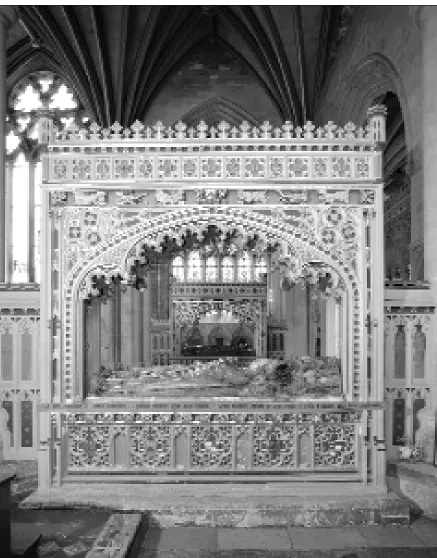
was open on the south side to the body of the Lady Chapel, structurally it mirrored the earlier tomb of bishop Bronescombe (1280) on the south side, which was much embellished in the fifteenth century to make the resemblance closer still (Fig. 2).The Lady Chapel was at the heart of the Cathedral, dedicated to the Virgin Mary, and was where at least three daily masses were said, to which lay worshippers were admitted.6 The sentiment of
prayers for the dead recited in the Lady Chapel cannot fail to have been influenced by the large tombs to these two bishops, flanking the entrance, as well as the gravestone of Bishop Quivil (1291) in the centre of the chapel itself.7 Hence, the figure of Bishop
Stafford would have acted as a visible aide-mémoire for personal inclusion in these cycles of intercessory prayer, and the heraldic relationships symbolised on the tomb chest’s sides would have ensured the perpetual commemoration of an even wider family.8
Furthermore, it is hardly coincidental that Stafford’s monument is in line with the arcade of the north wall of the Lady Chapel and the tombs of earlier bishops which had been transposed there,9ensuring that Stafford was visibly encompassed
within the corporate body of his predecessors – the establishment bishopric. Sponsored exclusivity of high status private prayer for himself and his family took place within his own chantry chapel. Yet simultaneously this audience was widened, not only because these private masses were probably observed by lay persons circulating around the chancel aisles,10 but also because the
strategic position of Stafford’s tomb relative to the others in the Lady Chapel made sure that he was remembered as part of the greater ecclesia.
evocative tombstone (Fig. 3) bears a small brass showing him in profile, kneeling, and with his head tilted upwards following the line of a precatory scroll which bears a responsary from the Office of the Dead.12Below the figure is a formulaic inscription seeking
prayers for the soul and supplemented to highlight Langeton’s kinship with the bishop. Consequently, both this, the Stafford arms at the corners of the slab and the family knot incorporated into the orphreys of his cope, all combine to maximise the spectator’s awareness of Langeton’s obligation to Stafford. Langeton willed that he should be buried ‘either on the right or to the left of the tomb of Bishop Stafford’13and so he was, his graveslab lying to the
north of Stafford’s tomb on the floor of St John’s chapel. He kneels towards the recumbent figure of his bishop and relative, the responsary on his brass scroll resonating to the sixth lesson of Matins as if it had been read by the bishop himself. Not only would the brass have ensured that Langeton’s soul was remembered by those able to understand and respond to the
message of the inscription, as well as at his month’s mind and anniversary,14 but there was a much closer link, with Langeton’s
words continually recited by bishop Stafford’s chantry priests in the ritual performance of their duties. All these devices – Langeton humbly depicted at prayer for his own salvation as well as for his bishop, the heraldic and textual reminders of kinship, and the phrase from a mass for the dead used as a verbal mnemonic – closely interlocked to maximise the intercessory value of his brass as a function of imagery and location.The mutuality of these two monuments is quite clear; their particular intimacy was obviously sanctioned by Stafford himself.
Medieval funeral monuments were also incorporated into more lavish and personal iconographic programmes, such as the Speke chantry (Fig. 4) in the north choir aisle of the cathedral,15
equally symbolic of wider schemes of memorialisation. For instance, in 1438 John Stourton the elder, of Preston, Somerset, willed his body to be buried in Stavordale Priory, and also:
that the church of Staverdale and the cloister there shall be completed in all things, as well in glazing the windows as in other buildings there to be done … I will that two images carried thither by me shall be ordained and placed in the middle of the choir of the said church, between the stalls there, and that underneath shall be made a certain tomb, ordained and walled for the bodies of me and my wife … with one closet of iron bars around the said tomb; and that the reading desk shall be at the head of the said tomb. Item, I will that the aforesaid church shall be throughout honestly paved with ‘Tyle’ of my arms and the arms of my mother.16
The rebuilding of the priory was completed in 1443 and one can only now imagine the heraldically-saturated and prestigious setting of the tomb and its accessories within the choir. On a lesser scale, in 1469 Walter Sydenham Esq. wanted to be buried at Brympton, Somerset, and in addition he willed ‘to the High aulter … one paire of Aulter Clothes of Crimesyne Damask with a Frontille of blak velvet embrawded. Item I bequethe xxs. of peise grotes to make a boxe to put in oure lordes body and to honge over the said aulter. Item I bequethe to the maytenaunce of a lampe to brenne a fore our lordes body at the said aulter’.17
These more transitory elements of intercessory schemes were abandoned or consolidated through insufficient endowment to maintain them, or they were sold on and/or destroyed as a result of the final Chantries act of 1547. So although nowadays monuments have been stripped of many of their contemporary intercessory accessories, their original locations are instructive as to how they might have functioned liturgically. Commemoration of the dead had come to focus on the funeral mass, and those subsequent masses, which enacted the doctrine of transubstantiation.The consecrated bread and wine, elevated over the altar at the very crux of the ritual, were transformed into the body and blood of Christ, so that intercessory prayers were made in His very presence and in consequence carried more weight.18
Hence, Richard Bruton, canon of Wells (1417) willed that ‘One small tabula at the time of mass to be placed before the priest’s eyes, whereon shall be written, Orate pro anima Ricardi Bruton
parentumque eius et omnium animarum pro quibus tenetur’.19
A tomb could equally intrude itself into sacred space and ritual, enabling the commemorated to benefit from a perception of sanctity. The north side of the chancel was a particularly desirable position: firstly, it was near to where the Gospel was read; secondly, it was also close to one of the principal images of the church; and lastly, it was the position usually occupied by the Easter sepulchre, this last enhancing the relationship of the commemorated with the suffering of Christ.20 Similar holy
be buried ‘in the myddys of the high aulter, so that my body may ligh part underneath the same aulter, so that the Mynesters of Crist that shall say masses ther may stond upon my body while they shall mynester the blyssed sacrament of our Lordes body’.21
Some wished to be memorialised before the image of a particular favourite saint, or in front of the Rood;22 others desired to be
buried in the porch by the stoup, or by the church door,23which
may appear to have been humble locations relative to the holiest parts of the church. Paradoxically however, these were the areas where people congregated, and monuments located there would have been highly visible. In particular, those entering and leaving the church would have paused by the stoup and blessed themselves with holy water, reciting a personal prayer as they did so, making this location an astute choice for siting a monument there, inviting an extension to that personal invocation.With time burial location both inside and outside the church became increasingly specified, so it was this link between spiritual remembrance and liturgy which concerned many testators more than their social memory conveyed by any monumental imagery, which may anyway have been commissioned by the deceased’s executors. Hence, social aspirations may well have been secondary to the spiritual benefits mediated by a tomb.24
In a small number of cases imagery was selected which amplified the relationship between the deceased, their monument, and liturgy.25A few brasses clearly refer to the Judgement and the
resurrection of the body, with a poignant example at Lavenham, Suffolk to Thomas Spryng and family (1486) (Fig. 5).The figures of Thomas, his wife and their children are all depicted in shrouds and emerging from two coffins with their lids pushed aside, with precatory scrolls rising towards a (lost) plate presumably of Christ sitting in Judgement upon them. While remarkable in itself the location of the brass is equally telling. Spryng was a rich but non-armigerous clothier and burial close to the main altar may have been socially unattainable. What better solution than to build a ‘vestibularium’, where he was buried, attached to the east end of the chancel? This unpretentious location matched the humility with which he was represented on his tomb, yet it was close to the high altar and continually mindful to the priest whom he paid to say masses for him.26
sort of people, as burial and tomb commemoration became cheaper and more commonly permitted. Monuments were more affordable – by now a small brass inscription in its slab could be had for a mere ten shillings27– and there were also large numbers
of them in many churches. Generations of the major manorial families might have colonised specific areas of a church with successive tombs, but intra-mural burial and monument erection elsewhere in the church gradually incorporated a much broader cross-section of parish society. This would have enlarged further still as the wider families of those commemorated by monuments were actively involved in intercessions for their dead relatives. However, the fundamental doctrinal changes which were imposed in the mid-sixteenth century, particularly the termination of all intercessory activity, dramatically shifted the rationale behind the erection of a tomb monument to one which was politically and religiously acceptable to the establishment.28
Post-Reformation funeral monuments
In a directive to halt the monument destruction resulting from this official change in religious orthodoxy, Elizabeth I’s proclamation of 1560 identified the effects of such iconoclasm,
which had extinguished ‘the honourable and good memory of sundry virtuous and noble persons deceased … also the true understanding of divers families in this realm (who have descended of the blood of the same persons deceased) is thereby so darkened as the true course of their inheritance may be hereafter interrupted’.29
So what, now, was the function of a monument? Protestant theology insisted that the soul of the deceased was despatched immediately after death, inducing an abrupt separation between the living and the dead. Hence, a monument was now primarily a permanent marker of a dead individual, symbolising the continued presence of that person and linking him with a lineage of both ancestors and descendants, which emphasised and maintained that family’s status, representing a social continuum at a time when a landed descent was fractured. While this was also one of the purposes of a pre-Reformation monument, of which the imagery and text exemplified status and family lineage alongside the more important salvitic elements of the design, monuments were now being erected at a time of unprecedented activity in the land market and when family tensions were high as their traditional religious privileges and rituals were acutely challenged. By the 1560s the need was for a funeral monument which was religiously anodyne. Instead of inviting prayer like their medieval counterparts, albeit many of which remained undisturbed close by, these Elizabethan structures encompassed the new orthodoxy by encouraging an understanding of salvation achieved through living virtuously, their inscriptions providing exemplars based on the lives of those commemorated.30
Continuing the Exeter examples, the tomb of Sir Gawen Carew (1589) dominates St John’s chapel (Fig. 6). It is an enormous structure, comprising a table bearing the sculpted relief figures of Sir Gawen and his second wife; over them is a large canopy supported by Corinthian columns and pilasters, with panels bearing shields enclosing the back and sides and more sculptural and heraldic exuberance above. Under the table is a third full-size figure, of Sir Peter Carew, Sir Gawen’s nephew, peculiarly depicted in a cross-legged pose, inclined slightly towards the spectator and with his hand grasping his sword.31The
‘longevity and continuity and perhaps referred to the statues of kings and prophets displayed on facades such as those on Exeter cathedral itself or the figures set out at the base of representations of the Tree of Jesse, the father of all ancestral imagery’.32 The
profusion of heraldry – forty-three shields in all – is set vertically to maximise its visual impact.
But what does this tomb mean? Sir Gawen left detailed instructions in his will, requesting ‘a Toombe to be made and sett over my bodye’, going on to spell out in detail the heraldry, genealogy and social status of his wives and their former husbands that he wanted represented on it.33 The consequent
superabundance of heraldry specifically and permanently articulated Carew’s connections during his lifetime at Court, perpetuating after his death his status in local and wider society. It inferred a venerable and élite lineage, Sir Peter’s subsidiary figure resonating in this antiquity; yet his tortured posture was equally a metaphor for the conflict of a military Protestant ethic, in the sustained fight against Catholicism which dogmatised Elizabethan court society. In contrast, serene and contemplative above, the effigies of Sir Gawen and his wife exemplified the dead in life, crystallising their achievements in living a godly life as well as providing the spectator with symbols of continuity which negated the horror of death and the potential change in social harmony. Their presence bridged the presumed crisis of succession from one (dead) generation to the next (living) one by the stereotypical quietude of the effigies: their very permanence communicated a reassuring aura of the perpetuity of the social order.34
LINEAGE, LITURGY AND LOCUS: THE CHANGING ROLE OF ENGLISH FUNERAL MONUMENTS
opened out space and controlling the view that the parishioners enjoyed into it.35Thus, location reinforced the functions of these
monuments, smoothing over potential inheritance crises in a dominating manorial descent and reassuring parishioners by maintaining a social regularity. They combined with grand manorial pews to buttress that family’s perceived status in an increasingly educated, articulate and opportunist society, acting together as part of a defence strategy against potential manorial and governmental hubris.
Burial alongside earlier generations of the same family was a commonplace request in Elizabethan wills therefore. Commemoration of ancestors continued without interruption, hence chantry chapels were converted into private family chapels or appropriated by succeeding families.36In Exeter cathedral Lady
Dorothea Dodderidge (1614) negotiated successfully to erect her tomb at the east end of the Lady Chapel, at the theological crux of the cathedral and its traditional Marian veneration, as well as at the core of the greater ecclesia, among the bishops’ tombs.37It was
balanced by the monument to her husband Sir John Dodderidge (1628) on the opposite side of the high altar, so they visually appropriated the east end of the chapel.38 This ‘pairing’ of
monuments was established early on in Exeter with the bishops’ tombs, so in choosing the sites of their own tombs the Dodderidges, perhaps unconsciously, perpetuated a pre-Reformation custom. In addition they commissioned monuments whose qualities resonated with those of the bishops as they all comprised finely dressed figures raised up on tomb chests, elaborated with heraldry and inscriptions inside an architectural superstructure.39Yet while the bishops are peacefully recumbent,
Lady Dodderidge is propped up on one elbow and casts her melancholic gaze across the body of the chapel at the tomb of her husband (Fig. 7).This affinity reflected the mutuality between the tombs of Bishops Stafford and Bronescombe in particular, which flanked the entrance to the Chapel.
A continuity in customs affecting monument erection was also manifest in other ways.40The persistent use of a funeral pall
sermon’.41 Similarly, John Felgate, yeoman, of Stonham Aspal,
Suffolk, willed in 1623 that his executrix ‘procure 8 sermons [in separate parishes] namely 1 sermon at burial, 1 sermon on that day a 12 month & so successively for 6 more years’.42Yet all these
rituals related chiefly to the funeral. Once the body had been buried a monument erected over it was frequently the only token of the life and death of that individual. That said, the sermon preached in 1619 at the funeral of Mrs Elizabeth Juxon in St Laurence Pountney, London, was subsequently published as
The Monument or Tombe-Stone. By 1631 it had gone into five
editions, implying an acknowledged bond between the temporary nature of the funeral and the perpetuity of a monument. Affirmation of the life and death of an individual modulated from verbal ceremony to silent rhetoric therefore; as the 1566 will of Thomas Myldmay esquire of Moulsham insisted, ‘My executors shall bestow [£40] upon a comely tomb or monument of hard stone … as a remembrance of our being here together upon this earth and for a remembrance to our children and friends left behind us, without any pomp or glory or other respect’.43
These changes signalled a significant reduction, to the point of separation, in the relationship between a tomb and liturgy; it was almost as if there were a secular detachment of the monument from religion. However, Finch has traced epitaphs which mimicked the funeral sermon and were frequently in tune with Protestant theology,44and monuments may also have promulgated
a Protestant identity: kneeling effigies were common, but they now faced a prayer desk with the Bible open upon it, and with the family rather than the individual providing the model (Fig. 8). Other means of recall also evolved. In Cornwall for example, numerous slate monuments were erected on the walls of the church, the homogenous, grey-black stone contrasting starkly with the newly whitened, evangelical church interiors, stripped of religious clutter and decoration. White and black are absolute, simple colours.White ‘Consisteth of very much Light’; Black, the colour of slate, represented ‘the Horror of Death and Corruption’.45 Mural slate monuments would have increasingly
The role of a monument had evolved rapidly, with its impact attested to at several levels. Every spectator would appreciate the large scale, grandeur and overwhelming dominance of a tomb and what it said about the commemorated. Most would understand the heraldry, and if not recognising all of it then they would at least recall by its very complexity how well connected with other armigerous families the commemorated individual was. The sculpted figures of the deceased acted as a permanent visible reminder of their original presence and social role; and the inscriptions, sometimes very sophisticated and appreciated only by a few, moved these structures into an altogether higher plane of élite recognition and appreciation.Yet these discourses were also being encompassed by other social milieu. Family portraiture was well established, with successive generations of heads of families ‘hung’ in their solars, although only as a private contrivance of continuity of succession.46
Civic portraits were commissioned for town and livery company halls, creating separate lineages of leadership as a cause for celebration and self-satisfaction in their success – but all ultimately removing schemes of memorialisation from a liturgical setting.47
The Romantic period
The following centuries maintained the momentum of this secularisation. Funeral monuments continued to proliferate in churches as manorial families crammed them into any remaining space in their family chapels. Where traditional architectural structures were now spatially impossible, hanging wall monuments superseded, with busts of the deceased and allegorical symbols of the Virtues and of mortality. Complicated texts and heraldic metaphors were introduced, the effects of which were to reduce the panoply of a monument, but only, paradoxically, as a means of contrasting this self-effacement with the exalted achievements of the deceased that they extolled.48Where space did permit, imagery
replaced architecturally based structures with vibrant dramas of family life and allegory, but crucially they all still retained the message of lineage and status. The arrival in England of sculptors of the calibre of Rysbrack, Scheemakers and Roubiliac moved funerary sculpture into a different art form as an increasingly aesthetic appreciation of these sculptures evolved. The surface finish of monuments, for example, became an important aspect of quality in an age when a steadily increasing range of luxury goods was available to the consumer.49This realisation helped to distance
monuments from their earlier liturgical function; indeed, the enormous and complicated dramatic composition planned by Roubiliac for the monument to Richard Boyle, Viscount Shannon (1757) at Walton-on-Thames, Surrey, was so obviously inappropriate for the church that he recommended it to be erected in a specially built extension, so that it might be viewed for its own sake – a splendid public military heroism blended with family emotionalism, grief and an atmosphere of melancholy.50
A last case study is provided by the monument to Admiral Edward Boscawen (1763) which was erected in the estate church of St Michael Penkivel, Cornwall (Fig. 9). An early nineteenth-century historian reverently described the ‘stately altar tomb, formed of beautifully polished marble, on the top of which is a remarkably fine bust of the deceased, surrounded by a variety of implements connected with naval warfare’.51 The epitaph was
composed by Boscawen’s ‘intellectual’ wife in forty-five lines of English prose which exemplify the flawless personal qualities of the admiral:‘His concern for the interest, and unwearied attention to the health of all under his command, softened the necessary exactions of duty, and the rigors [sic] of discipline, by the care of a guardian, and the tenderness of a father’.52
monument for the admiral in a more ostentatious location such as Westminster Abbey.53 Despite his father, the first Viscount
Falmouth being buried at St Michael’s in 1733, this was the first Boscawen monument erected there since 1626, when an enigmatic effigial tomb was put up by Hugh Boscawen Esq. to commemorate several earlier generations of the family back to 1559.54
This earlier monument was a modulation of an individual memorial into a symbol of dynastic commemoration, which perhaps came to signify its contemporary function forwards in time as much as it celebrated the Boscawens retrospectively. It took a man of great political reputation, the naval hero of the battle of Louisburg, to break with this symbolism when he was buried at St Michael’s ‘amidst the groans and tears of his beloved Cornishmen’.55The monument was a signed collaborative effort
between Robert Adam, the classical architect involved at the admiral’s house at Hatchlands, Surrey, and the by then ageing sculptor Michael Rysbrack.56
Despite the artist’s infirmity the detail on the monument is crisp, and the realism of the bust portrait, set against the pyramid background, utterly convincing. Equally, the austere classicalism of design was symbolic of the physical and moral advances by which the élite sought to differentiate themselves from the lower orders. This monument, moreover, quickly stimulated more monuments to family members, all relatively standardised tablets by Joseph Nollekens (Fig. 10), which reinforced the Boscawen colonisation of the church, and by employing the same dark pyramidal background echoed the Admiral’s monument. Indeed, as prior to its restoration in 1862 the church was noted as being decorated like a domestic
family house, it is hard to avoid the sense of complete secular control of this church building and its contents, symbolised by the combination of domestic architect and monumental sculptor for the admiral’s tomb. Services in the church would have been seen perhaps as secondary to the overwhelming presence of the family’s funeral monuments; these promoted a civic, national pride, imbued with qualities reflecting heroism, a national supremacy, defeat of the enemy and a pride in history, which superseded any religious dogma. There was no need here for a private family mausoleum of the type being constructed elsewhere,57 as the
church adequately provided that function. The family controlled both estate and church, and provided an enduring commonality between the two.
Conclusion
Notes
1 J.Weever, Ancient Funerall Monuments (1631), unpaginated ‘Epistle to the reader’. 2 B. Kemp, English Church Monuments (1980).
3 B. Cherry, ‘Some cathedral tombs’, in M. Swanton (ed.), Exeter Cathedral: A
Celebration (Exeter, 1991), 156–67.
4 E. F. Jacob (ed.), The Register of Henry Chichele,Archbishop of Canterbury 1414–1443, II (Oxford, 1938), 154.
5 N. Orme, ‘The medieval chantries of Exeter cathedral – III’, Devon and Cornwall
Notes and Queries [DCNQ] 35 (1982), 67–71, (p. 68).
6 N. Orme, Exeter Cathedral:The First Thousand Years, 400–1550 (Exeter, 2009), 67. I am most grateful to Professor Orme for discussing the Exeter bishops’ tombs with me.
7 Orme, ‘Medieval chantries’, DCNQ 34 (1981), 319–26, (pp. 320–22).
8 A. M. Morganstern, Gothic tombs of kinship (Pennsylvania, 2000), passim, provides similar models for this rationale of intercessory recall.
9 D. Lepine and N. Orme (eds.), Death and Memory in Medieval Exeter (Exeter, 2003), 30–31.
10 Orme, Exeter Cathedral, 67.
11 W. Lack, H. M. Stuchfield and P.Whittemore, The Monumental Brasses of Devonshire (2000), 112, 116.
12.N. Rogers,‘“Et expectis resurrectionem mortuorum”: Images and texts relating to the Resurrection of the dead and the Last Judgement on English brasses and incised slabs’, in N. Morgan (ed.), Prophecy, Apocalypse and the Day of Doom (Donington, 2004), 342–55, (p. 350).
13 F. C. Hingeston-Randolph, The Register of Edmund Stafford (1886), 404–05. 14 Langeton bequeathed 20s to John Wylle, chaplain, to pray for his soul, which sum,
while not sufficient to maintain a chantry, would have ensured ceremonies of remembrance were enacted; see Hingeston-Randolph, Stafford, 405.
15 N. Orme, ‘Sir John Speke and his chapel in Exeter Cathedral’, Transactions of the
Devonshire Association 118 (1986), 25–41.
16 F.W.Weaver (ed.), Somerset Medieval Wills 1383–1500 (1901), 145, translation from the Latin original now The National Archives [TNA], PROB11/3/195, will proved 27 January 1439.
17 TNA, PROB11/5/223v, will proved 22 January 1469. 18 Lepine and Orme (eds.), Death and Memory, 239–40. 19 Weaver (ed.), Somerset Medieval Wills, 92.
20 N. Rogers, ‘Hic Iacet…: the location of monuments in late medieval parish churches’, in C. Burgess and E. Duffy (eds.), The Parish in Late Medieval England (Donington 2006), 261–81, (p. 264).
21 Weaver (ed.), Somerset Medieval Wills, 290.
22 R. Marks, Image and Devotion in Late Medieval England (Stroud, 2004), 173–81. 23 L. L. Duncan, Testamenta Cantiana:West Kent (1906), 26, 28, 31.
24 S. Badham,‘Status and Salvation: the design of medieval English brasses and incised slabs’, The Monumental Brass Society, XV (1997), 412–65.
25 Rogers, ‘Images and Texts’, 346–7.
26 J. J. Howard (ed.), The Visitation of Suffolke 2 vols (1866), I, 166–70.
27 J. R. Greenwood,‘Wills and brasses: some conclusions from a Norfolk study’, in J. Bertram (ed.), Monumental Brasses as Art and History (Stroud, 1996), 82–102. 28 R. Houlbrooke, Death, Religion and the Family in England 1480–1750 (Oxford,
1998), 330–71.
29. Weever, Ancient Funerall Monuments, 52.
30 N. Llewellyn, ‘Honour in life, death and in the memory: funeral monuments in early modern England’, Transactions of the Royal Historical Society, 6th series, 6 (1996), 179–200.
31 C. J. M. Faunch, ‘Church monuments and commemoration in Devon
c.1530–c.1660’, (doctoral thesis, University of Exeter, 1998), 398–403.
32 N. Llewellyn, Funeral Monuments in post-Reformation England (Cambridge, 2000), 373.
35 K. Fincham and N. Tyacke, Altars Restored: The Changing Face of English Religious
Worship, 1547–c.1700 (Oxford, 2007), 59.
36 S. Roffey, Chantry Chapels and Medieval Strategies for the Afterlife (Stroud, 2008), 167–76.
37 S. E. Lehmberg, Cathedrals under Siege: Cathedrals in English Society, 1600–1700 (Exeter, 1996), 228.
38 Faunch, ‘Church monuments’, 413–18, 427–31.
39 C. Brooks, ‘Exeter Cathedral’, Archaeological Journal Supplement 147 (1990), 24–34. 40 V. Harding, ‘Choices and changes: death, burial and the English Reformation’ in D. Gaimster and R. Gilchrist (eds.), The Archaeology of Reformation1480–1580 (Leeds, 2003), 386–98.
41 F. G. Emmison, Elizabethan Life: Essex Gentry’s Wills (Chelmsford, 1978), 242. 42 M. E. Allen (ed.), Wills of the Archdeaconry of Suffolk 1620–1624 (Woodbridge,
1989), 306.
43 Emmison, Elizabethan Life, 114.
44 J. Finch, ‘A reformation of meaning: commemoration and remembering the dead in the parish church, 1450–1640’, in Gaimster and Gilchrist (eds.), Archaeology of
Reformation, 437–49, (pp. 442–7).
45 J. Guillim, A Display of Heraldry:The Sixth Edition (1724), 8–9.
46 N. Cuddy, ‘Dynasty and display: politics and painting in England’, in K. Hearn (ed.), Dynasties: Painting in Tudor and Jacobean England 1530–1630 (1995), 11–20. 47 R. Tittler, The Face of the City: Civic Portraiture and Civic Identity in Early Modern
England (Manchester, 2007).
48 J. Scodel, The English Poetic Epitaph: Commemoration and Conflict from Jonson to
Wordsworth (Ithaca and London, 1991), 277–311.
49 M. Baker, Figured in Marble:The Making and Viewing of Eighteenth-Century Sculpture (2000), 50–60.
50 D. Bindman and M. Baker, Roubiliac and the Eighteenth-Century Monument: Sculpture
as Theatre (New Haven and London, 1995), 134–41.
51 C.S. Gilbert, Historical and Topographical Survey of the County of Cornwall 2 vols (Plymouth Dock, 1817–20), II, 832.
52 J.Whetter, Cornish People in the 18th Century (Gorran, 2000), 102–03.
53 M. Craske, The Silent Rhetoric of the Body: A History of Monumental Sculpture and
Commemorative Art in England, 1720–1770 (New Haven and London, 2007), 27.
54 P. Cockerham, Continuity and Change: Memorialisation and the Cornish Funeral
Monument Industry 1497–1660 (Oxford, 2006), 95.
55 Gilbert, Cornwall, II, 833.
56 M. I.Webb, Michael Rysbrack, Sculptor (1954), 183.
Introduction
THE LITERATURE on medieval church monuments is skewed towards those with the highest visual impact and the most significant genealogical associations. Considerations of high status tombs, sculptured effigies and monumental brasses predominate, with other classes such as cross slab grave stones often ignored. They are, for instance, only rarely mentioned in Pevsner’s The
Buildings of England series, even when they are the oldest objects
in the church. Our purpose is to demonstrate their importance and raise awareness of the contribution they make to our understanding of the past. Cross slabs were once the first choice of the higher echelons of society and since their use subsequently permeated down the social strata, they achieved a degree of longevity and continuity unparalleled by any other form of commemoration except headstones.1 They reflect centuries of
changing tastes and a wide spectrum of personal wealth, ranging from great artistic achievement utilising costly materials and sumptuous decoration down to locally-made products. But all tell of the world and society that created them.
So what do we mean by ‘cross slab’? The term is surprisingly hard to define and it is difficult to justify excluding clearly related monuments simply because they transgress an arbitrary boundary. However, here ‘cross slab’ is taken to embrace commemorative monuments produced from a single stone and which usually have some form of cross as the principal decoration. Primarily a class intended to be recumbent, most of the medieval examples would have been a coffin lid or covered a grave.They can be tapered or rectangular with squared or shaped ends. Most show a cross head atop a shaft firmly planted on a base (Fig. 1) but each element is subject to many interpretations. Few head designs are identical with games being played, for instance, on the setting; the shape and number of the arms; the form of the terminals and any decoration at the centre. Bases may be stepped, arched, foliate or absent. The decoration may take many forms, such as incising, relief carving, inlay, painting or any combination. A slab at Wycliffe, Yorkshire employs relief carving, incising and separate letter inlays of lead (Fig. 2). Inevitably there is overlap with sculptured effigies, ledger slabs, incised slabs and monumental brasses, particularly when different decorative techniques are used together.
Brian and Moira Gittos, founder members of the Church Monuments Society, have been studying medieval church monuments since the 1970s and have published widely on the subject.
Fig. 1: Cross slab of Stephen Langton, Archbishop of Canterbury 1206–28, at Canterbury Cathedral.The slab shows the archetypal arrangement of a cross on a tall shaft, standing on a stepped calvary.This design may be derived from processional crosses. From Styan,
Sepulchral Cross-Slabs, Plate L.
Abused, neglected and forgotten:
the story of the medieval cross slab
Fig. 2: Fourteenth-century cross slab built into the south wall of the nave at Wycliffe,Yorkshire with incised cross, low relief head and inscription inlaid in lead.The shears are partly incised and partly bas-relief as though unfinished. Photo: B. & M. Gittos
ECCLESIOLOGY TODAY 43 · DECEMBER 2010
Origins
The origins of the cross slab can be traced, ultimately, to the gabled lids of classical sarcophagi. Common across the Romanised world, they continued into the Christian era with appropriate symbols added. Over time, their shape gradually flattened and crosses were marked out on the top, the ridge becoming the shaft. Several sarcophagi in York show a significant stage in this process. Used to denote Christian burials from early times, the cross could be viewed as protection for the deceased and an evocation of the burial rites for the living.
Cross slabs occur throughout Europe and are known from north Africa (e.g. Libya, Fig. 3) but are less frequent in the eastern Mediterranean with only isolated examples known from Greece.2
The exception to this declining eastward trend is the kingdom of Armenia. Amongst many thousands of upright cross inscribed stones (khatchkars), carved body stones and recumbent figural incised slabs, some bear pastoral staffs (Fig. 4). Nearer to home, cross slabs were especially popular in Merovingian Gaul. The region around Poitiers abounds with examples, clearly derived from the lids of Roman sarcophagi. The Civaux cemetery is estimated to have contained 15,000 stone coffins and sufficient lids remain for a selection, placed upright, to form a bizarre churchyard wall (Fig. 5).3The Société Des Antiquaires de l’Ouest,
based in Poitiers, collected some of the most elaborate examples (Fig. 6), which are now displayed in the Baptistère Saint-Jean.
Anglo-Saxon England produced a large number of cross slabs, with the symmetrical double-ended cross patterns being a common feature (Fig. 7), seemingly reflecting those of western France but more likely due to a common source in Roman tombs. Pre-conquest slabs survive in greatest numbers from the end of the period but examples can be found throughout the volumes of the Corpus of Anglo-Saxon Stone Sculpture. The Scandinavian-inspired monuments of the north and east, although typified by hogbacks, also included cross slabs using Viking decoration. Such individuality is also found in Scotland,Wales and Ireland. The large collection of cross inscribed memorials at Clonmacnois, Republic of Ireland,4 for example, has a close
affinity with other Irish art forms such as the high crosses, illuminated manuscripts and fine metalwork (Fig. 8). The monuments reflect the environment in which they were created.
The golden age of cross slabs
The introduction of Norman culture is visible in the form and decoration of twelfth-century English cross slabs. Some have
Fig. 4: Medieval inscribed body stones and khatchkars in the vast cemetery of Noraduz, Armenia. Photo: B. & M. Gittos
ABUSED, NEGLECTED AND FORGOTTEN: THE STORY OF THE MEDIEVAL CROSS SLAB
Fig. 6 (left): Medieval cross slab from Antigny, now housed with other slabs in the Baptistery of St-Jean, Poitiers, France. From E. Ginot, Le Baptistière Saint-Jean de Poitiers (Poitiers, undated), catalogue no. 46.
geometric patterns (Fig. 9) akin to those used architecturally, and the coffin-shaped slab becomes the norm. Throughout the following century, large numbers of cross slabs were produced in this country and they attained the apogee of their popularity. Demand continued through the Middle Ages and beyond but by the advent of the fourteenth century their pre-eminence had been usurped by other products, notably sculptured effigies and monumental brasses.
Slabs from this ‘golden age’ vary greatly in design, particularly the representation of the cross, selection of other decorative features and their arrangement. Most surviving examples are anonymous with only a small proportion identifiable through inscriptions or heraldry. However, the use of architectural and contemporary artistic features may give dating clues. In this regard, the popularity of leaves in cross head designs and branching from the shaft are especially useful. Stiff leaf appeared as early as the late twelfth century at Wells Cathedral and became a hallmark of the Early English style through the next century until discarded in favour of naturalistic representations prior to 1300. Early in the fourteenth century, naturalistic leaves gave way to more exuberant bulbous forms with the advent of the Decorated style.
Fig. 8: Cross-inscribed grave slab to ‘Suibine mac Mailae Humai’, scribe of Clonmacnois, now lost. From a drawing by Petrie, in Macalister, Memorial
This progression is reflected in the design of cross slabs and consequently some of the most striking and artistically successful examples date from the first half of the fourteenth century. Amongst a notable collection of slabs in the monk’s dormitory at Valle Crucis Abbey (Clwyd) is one to Madog ap Gruffydd (d.1306).5He was the great-grandson of the abbey’s founder and
his fine monument (Fig. 10) was appropriately laid before the high altar.Vine stems with naturalistic leaves flank the centrally placed spear; the deceased is identified by the heraldry and the shield’s border inscription. As well as demonstrating the use of contemporary leaf forms, the slab also highlights the difficulty of defining the term ‘cross slab’, as no actual cross is shown (except, perhaps, the shapes formed by the weapons). However, it fulfils the same function as a cross slab and is a closely related form. The remainder of this paper will consider in more detail the cross slabs to be found for the most part in English churches.
Cross slab studies
The impression, given in the Introduction, of cross slabs being largely ignored is true in comparison to other forms of monument but they have attracted the attention of several antiquaries stretching back to Richard Gough in the late eighteenth century, who included four pages of slab drawings in his seminal work.6 In 1849 the Revd Edward Cutts produced a
manual on the subject, commenting in the preface ‘This branch of archaeology has been hitherto much neglected, although it is a very interesting one and the examples are much more numerous than is generally imagined ...’.7 More than a century and a half
later this remains the standard work. Another useful contribution was made by Charles Boutell in 1854, illustrating and describing a large number of slabs.8Brindley and Weatherley (1887) ranged
widely across the monument spectrum but included many
well-Fig. 9: Romanesque cross slab showing zig-zag patterning related to
illustrated cross slabs (Fig. 11).9 K. E. Styan’s 64 examples were
drawn largely from the south and east of England and Wales.10
Since then writers have tended to treat cross slabs on an individual or regional basis. Canon Bower published a series of articles on the slabs in the Diocese of Carlisle, just prior to the second world war and Lawrence Butler’s ground-breaking 1964 study dealt specifically with the East Midlands.11 In the last 25
years a number of extremely thorough surveys of northern counties have been produced by Peter Ryder.12 His most recent
book, published in 2005, deals with Cumbria and is, like all his earlier works, fully illustrated with his own meticulously accurate drawings, which help to make them invaluable reference sources.13
There are some less comprehensive county surveys such as the present authors’ work on the East Riding of Yorkshire, Miller Christy on Essex and Ruth Butler and Leslie Jones’ paper on Gloucestershire.14However, most English counties have yet to be
surveyed and there is no country-wide bibliography.
The recent survey of Purbeck marble coffin-shaped slabs is described below and the pre-conquest survivals from England are
Fig. 10 (left): Cross slab of Madog ap Gruffydd (d.1306),Vale Crucis Abbey, Clwyd. Photo: B. & M. Gittos Fig. 11 (right): Late thirteenth-century slab in Brecon Cathedral. From Brindley & Weatherley, Ancient
included in the emerging volumes of the Corpus of Anglo-Saxon Stone Sculpture, with a companion project underway in Wales. The growth of systematic church archaeology has begun providing more securely dateable evidence, although even when published, the material is scattered through the literature, buried in site reports.
How many slabs?
The total number of English medieval cross slabs originally commissioned will never be known and it is only possible to make crude estimates.Very few slabs are in situ and those that remain are frequently incomplete, broken and damaged. Ironically, very many survive only because they were recycled as building material. Sometimes the pieces are still visible, for example on the stair turret of St Cuthbert’s in Wells, Somerset; built into the tower and chancel walls at Kirby Grindalythe; or incorporated into the buttresses and exterior wall of the north aisle at Riccall (Fig. 12) (both Yorkshire). More often they are invisible, buried within the structure and found only during repairs or demolition.
When the nineteenth-century restorers at Bakewell, Derbyshire dismantled the tower, both transepts and the Vernon Chapel, they discovered numerous medieval grave slabs and crosses, in the foundations and walls.15Most were re-used (again!)
in the new work but about 70 stones were retained and displayed. The total found was not recorded but contemporary sources suggest it could have been as high as 350. More recently, when the church of St Brandon, Brancepeth, County Durham was severely damaged by fire in 1998, the subsequent rebuilding programme revealed more than 70 medieval cross slabs. They had been incorporated into the walls, with many laid complete rather than broken up for rubble. During the large scale church restorations of the nineteenth century, many other similar but often unrecorded discoveries were made, which can be inferred
from the collections of medieval slabs left behind. During the major 1864 restoration at Gainford, County Durham, some pre-conquest stones were uncovered which eventually joined the collection in Durham Cathedral library.16 However, 27 cross slabs
are still to be seen built into the walls and benches of the nineteenth-century porch with another standing inside. They were presumably revealed at the same time but there are no details of their discovery.
When the source is an historical description rather than archaeology, the monument type is rarely specified. For example, we know from surviving records of the large numbers of wealthy patrons who were buried in the lost monastic churches of London (such as the Black Friars) but can only surmise from considerations such as dates of death that many of these monuments were probably cross slabs.17 Weever said of
Christchurch (Aldgate) Priory in 1631: ‘and seven score grave-stones of marble in divers places; all which were pulled downe, taken away, and sold for fiftie pounds or thereabouts, by Sir Martin
Bowes Maior of London, An.1545’.18This is an extreme but not
untypical story.
There is abundant evidence, therefore, of the wholesale destruction of medieval monuments country-wide particularly as a result of the Reformation. The cross slab was especially vulnerable because, once broken into pieces, it was ideal building material. Peter Ryder has suggested that the survival rate ‘is probably less than 10% (and perhaps as little as 2-3%)’.19We fully
support this suggestion but it could only be used to estimate the original total if the number of survivors were known. As an indication, Ryder lists 570 slabs in County Durham; 350 in South Yorkshire and about 450 in Cumbria.These figures are somewhat inflated by the inclusion of head stone, grave markers and a few known only from antiquarian drawings. However, our own researches have produced similar county totals elsewhere such as
c.200 for the East Riding of Yorkshire and 141 for Dorset, to
which should be added the results of the Purbeck marble coffin-shaped slab survey described below. Country-wide the total must, therefore, run to several thousands, almost certainly exceeding the more than five thousand surviving monumental brasses.
Purbeck marble cross slabs
From 1994 to 2003, a survey of Purbeck marble coffin-shaped slabs was serialised in the Church Monuments Society Newsletter.20
monument which lasted from the later twelfth century into the fourteenth. They were initially highly prestigious but were subsequently supplied to less wealthy clients with production spanning the ‘golden age’ of cross slabs.We considered that a better understanding of high quality slabs would inform the study of these monuments as a whole. Many unexpected facts emerged, with the total count surprisingly as high as 820 and more still being recorded. There was strong evidence for primary transportation by water along the coast from Dorset and inland using navigable rivers.The contrast between Dorset with 100 slabs and the neighbouring county of Somerset with only eight makes the point well and also demonstrates that the sea journey around Lands End acted as a significant barrier. Travelling east, much further away in Yorkshire, there were more than twice as many slabs as Somerset. It was most surprising that many more survive in Norfolk than any other county.
Standard workshop products predominated, with the most common combination being double-hollow chamfered edges, cross botonnée head and three-step calvary (shown with the addition of trumpets and an inscription in Figure 13). However, there were also many highly individual commissions, which demonstrated how the marblers were also prepared to satisfy individual customers. Good examples are at Hampstead Norris, Berkshire (Fig. 14), where a mounted knight holds a war-like pose above a shield and Brent Pelham, Hertfordshire.The latter depicts an angel carrying the praying soul of the deceased, surrounded by evangelistic symbols, above a foliated cross, with its stem gripped by the teeth of a wyvern. Here is drama indeed and a unique composition. These are some preliminary observations but a full analysis of this survey is still to come.
Regional styles
As with Purbeck marble slabs, stylistic groups using other stones can be distinguished throughout the country which show characteristic features of the workshops which produced them. Some are limited to a couple of similar slabs in the same church, such as a pair built into the nave wall benches at Patrington in Holderness, Yorkshire. Others can be found largely within a county, like the slabs with elaborate foliated cross heads in Herefordshire (Fig. 15). Products of the workshops at Barnack, Northamptonshire, which typically have double-omega shaped ribbons on the stem (Fig. 16), are distributed throughout the eastern counties from Lincolnshire to North Kent. Many, more local, groupings can be recognised. Examples include those with very distinctive cross heads of the twelfth and thirteenth centuries
Fig. 13: Purbeck marble slab now in the Museum of London but found on the site of the Guildhall chapel.The most common form of Purbeck cross design is here flanked by trumpets, and the inscription commemorates Godfrey le Troumpour. From Boutell, Christian
around Cirencester; a collection of fifteenth/sixteenth century Ham Hill stone slabs in south Somerset and a series in and around Brecon, South Wales which continue into the post medieval period.
The use of symbols to indicate the deceased’s profession or status shows a trend which cuts across many regional groupings. Such slabs bearing swords, shears (Fig. 17), chalices, books etc are most commonly found in the north and become progressively rarer further south.Amongst Purbeck marble slabs that at Morden, Dorset with six shields beside the cross stem is an exception, whereas Peter Ryder has shown how common symbols are in northern counties.
The Gothic Revival and after
As well as having a dramatic effect on nineteenth-century church building and rebuilding, the Gothic Revival also created a
corresponding interest in medieval monuments, and cross slabs enjoyed a period of considerable popularity as many British churchyards testify.This continued into the twentieth century and the need for suitable designs was largely satisfied by the pattern books of monumental masons. However, genuine medieval monuments were also copied as can be seen with some memorials in the Camery cemetery of Wells Cathedral. Two medieval slabs which were then in the Chapter House crypt were copied to a high standard. One was used as a model for the monument of Walter Farrer, Archdeacon of Wells (d.1934) and the original is now mounted against the south wall of the cloister (Fig. 18).The second was copied for three memorials, to Eleanor Freeman (d.1902), widow of the historian Edward Freeman; Florence Cronshaw (d.1925) and another with a partly illegible inscription but also dated 1902.21Unfortunately, the second medieval slab has
disappeared and, although it is also known from three nineteenth-century drawings, its loss means that the copies have become important records. At Piddlehinton, Dorset the memorial to Colonel John Dalrymple Belgrave (d.1955) imitates a Purbeck marble cross slab, with double hollow chamfered edges, four circle head, bar knop and three-step calvary. Inside the church porch rests a genuine Purbeck marble slab, which is worn and broken but probably provided the inspiration. An even more modern cross slab memorial is at Sutton Bingham, Somerset. George Aitken was headmaster of East Coker village school and an amateur archaeologist. He died in 1985 and his grave stone is a slightly coped slab bearing a relief cross with trefoil terminals and similar base.
Vulnerability
The destruction of cross slabs has occurred throughout their history and unfortunately the process continues. What was done historically, for reasons of religious zeal and a lack of respect for memorials of the dead, is still happening, due to ignorance, plausible excuses and even considerations of heath and safety. A disturbing example of the latter occurred in Bristol in 1985. An interesting group of broken slabs lay in the churchyard of St Mary Redcliffe. We had previously noted them and arrived in the June to make an up-to-date detailed record. However, only a few of the larger pieces were still evident and enquiries eventually elicited a sorry story. Concerned that loose stones might be used by vandals to smash floodlights, the churchwardens offered the slabs to Bristol Museum, which declined as it was said they were of no particular importance.The church proceeded, therefore, to dispose of the monuments by smashing them with hammers and depositing the debris in a skip, which was taken to a landfill site near Bristol Airport where they were buried under thousands of tons of the City’s rubbish. This case of modern vandalism is believed to have accounted for (amongst others) the greater part of a cross slab with incised Lombardic inscription, which Paul identified as commemorating a fourteenth-century carpenter, John Rowberwe (Fig. 19).22
Repairs to the tower at Rillington, Yorkshire in 1978 necessitated the replacement of the masonry of one of the buttresses. Amongst the displaced stones we noted eleven fragments of cross slabs and informed the vicar. Some of the pieces were still to be seen (in 2003) scattered in the grass beside the tower. Part of a Purbeck marble coffin-shaped slab served as a drain cover in the churchyard at Lytchett Matravers, Dorset in the 1990s but by 2000 it had disintegrated. The top half of another Purbeck marble cross slab used to lean against the exterior of the chancel east wall of All Saints, Dewlish, Dorset. In the mid 1990s a commemorative seat took its place and it was discarded. It was rediscovered underneath some bushes on the edge of the churchyard in 1999. English parish churches and churchyards are currently experiencing a period of considerable change and unidentified loose stones are clearly at high risk.
Conclusions
Fig. 16 (top left): Barnack-style slab at Watlington, Norfolk showing the characteristic double cross head layout with the double omega ribbons down the centre of the slab. Drawing from Boutell, Christian Monuments, 19. Fig. 17 (top right): Early fourteenth-century slab from Langtoft, East Yorkshire showing a representative bracelet head and with a Lombardic inscription commemorating Alina de Vale. Photo: B. & M. Gittos Fig. 18 (bottom left): Thirteenth-century slab at Wells Cathedral (now in the cloister), copied in the early-twentieth-century.The design clearly derives its inspiration from contemporary metalwork. Photo: B. & M. Gittos
Fig. 19 (bottom right): Fourteenth-century slab of John Rowberwe formerly at St Mary Redcliffe, Bristol. Most of this slab was disposed of in 1985. Drawing from Paul, Incised and