INTRODUCTION
The construction industry is among these branches of economy that have the heaviest impact on the environment. According to the European Commission, it consumes about 42% of the energy and emits 35% of greenhouse gases in the whole European Union. The consumption of building materials corresponds to over 50% of the total production in Europe, and concrete pro-duction globally uses up 20 billion tons of aggre-gates, 1.5 billion tons of cement and 800 billion
tons of water. Beside the consumption of natural resources at the stage of their construction, build-ings generate numerous loads to the environment during their useful life. Another important ques-tion is what happens to a building which is with-drawn from use. Thus, a building should be ana-lyzed in the perspective of its complete life cycle: from the production of materials, construction work and useful life, to its demolition and recy-cling of the demolition waste. Experts distinguish two basic guidelines that enable us to relieve the environmental load: passing through the phases
Accepted: 2019.09.16 Available online: 2019.09.30
Volume 20, Issue 9, October 2019, pages 87–94 https://doi.org/10.12911/22998993/112504
Selected Problems of the Environmental Impact Analysis of
Investment Projects Based on Life Cycle Assessment Procedure
Elżbieta Szafranko
11 University of Warmia and Mazury in Olsztyn, Faculty of Geodesy, Geospatial and Civil Engineering,
ul. Heweliusza4, 10-724 Olsztyn, Poland e-mail: [email protected]
ABSTRACT
The building objects show a wide variety. Among them, we can distinguish buildings and various building constructions. In addition to the fact that they are of various sizes, they perform different functions, while their purpose and use generates various problems, they can be made using various materials, different technologies and construction solutions. Therefore, the decision on which solutions to apply may be difficult to make. In this situation, it is good to develop several alternative solutions for their comprehensive comparison. In addition, the existing regulations that originate in the EU directives, in many cases impose the obligation to develop several variants of future investments and analyze them taking into account many factors. In the EU recommendations, the analysis related to the impact of construction investments on the environment is of highest importance. The ISO 14040–1404X regulations created and introduced by the European Union are the most important tool for a global assessment of the environmental impact of a product, facility and service. They relate to the environmental impact assessment of the entire Life Cycle Assessment (LCA), and their assumption is to identify and minimize any environmental impacts that may arise from the production, use and disposal of the product. Research should include specific stages according to the LCA evaluation system: determination of the purpose and scope of the assessment, inventory of input and output data and the impact assessment. The following research methods were used: source materials analysis, library query, advanced data collection methods through online surveys, LCA assessment, multicriterial methods. The research conducted by the author showed that the analysis involving se-lected problems related to the object-environment interaction is dominant. However, in practice it is difficult to find the analyses covering the entire lifecycle of an object in accordance with the LCA procedure and examples of comparison of specific design solutions within the variant assessment procedure taking into account the LCA procedure. The aim of the article is to show how such procedure can look while comparing the exemplary vari-ants of a construction project. The article presents an example and diagrams of conduct covering the whole life cycle of an object, and the analysis is based on specific examples.
Journal of Ecological Engineering Vol. 20(9), 2019
in a life cycle so as to minimize the absorbed re-sources, and minimizing consumption of resourc-es and emission of pollutants at every stage of the building’s life [1, 2].
As the environmental conservation is a prior-ity goal, new concepts of proecological behavior are being developed. These include green nologies. In the construction industry, green
tech-nologies mostly indicate effective management of
energy and natural resources, from the manufac-turing of materials and implementing energy-sav-ing technologies, to the design solutions and tech-nologies used during the construction work and, subsequently, during the useful life of a construc-tion. Another important issue is how the demoli-tion waste will be recovered and recycled. These actions should be viewed from the perspective of the entire life cycle of a building [5, 7].
Concept of a life cycle of a building, (concept of LCA)
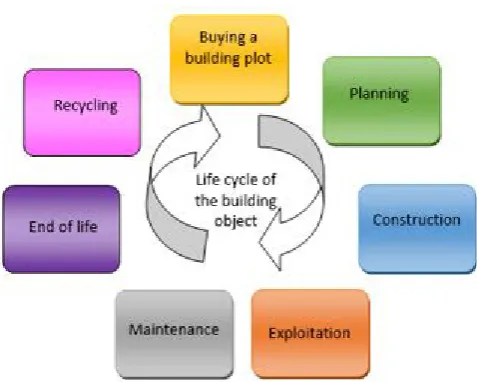
In line with the EU directives, the life cycle of a building encompasses all phases of the ex-istence of a delivered building commodity, ser-vice or job, especially: research, design, testing, production, transport, use, repairs, modernisation, refurbishment, and maintenance during the whole period of useful life, depreciation, demolition, and removal. The idea of a life cycle is funda-mental to broader analyses that include the ac-tions ‘from concept to demolition’, and serves as a base for a complex assessment of any building enterprise [7, 8]. The structure of a life cycle is illustrated in Figure 1.
The complex approach to the life cycle of a building has given rise to various concepts of how to assess buildings. These include the Ecological (Environmental) Assessment of the Life Cycle – LCA (Life Cycle Assessment). This approach is
defined as ‘the aggregation and evaluation of in
-put and out-put data, and environmental influences
of the system of a given product during its life cycle.’ Inputs are quantitative and the qualitative data concerning resources as well as the energy consumed to carry out the analysed process. The outcomes of this process, i.e., both desired prod-ucts and services, and emissions and waste, are the outputs of a process [3, 8]. The product sys-tem is perceived as a set of unit processes, i.e. its smallest components, interconnected by shar-ing materials and energy supply. Every system has boundaries, which are set up by the system’s
designer, and an assessment can include differ -ent production processes or particular stages in a technological line. Hence, evaluation is
com-posed of the following stages: identification of
an assessment’s goal and scope, analysis of a set
of input data, assessment of the influences on the environment, and final interpretation. Figure 2
shows a schematic presentation of this process.
Factors in an assessment of proecological solutions (green technology)
An analysis which captures the whole life cy-cle of a building generates a series of factors, which can undergo subsequent evaluation [4, 5]. They
can be described and classified according to the
division into the basic life cycle stages, enabling
to distinguish certain processes, e.g. preparation of building materials, construction of a
build-ing, using the finished buildbuild-ing, demolition. The
observations made during this study enabled the author to identify a number of factors which af-fect the ultimate outcome of an assessment. A list of the most important indicators which occur in LCA assessments is presented below [5].
Ecological assessment of building materials and the process of their preparation
As the construction industry is the branch of economy that probably consumes the most
re-sources and raw material worldwide, it is signifi -cant to pay attention to the proper management of materials, optimisation of the manufacture of building materials and consumption of energy due to production and transport of the building materials [3, 7]. An ecological assessment of this stage includes the following criteria:
• resourceful use of natural raw materials – pro-tection of fossil resources, use of renewable resources, use of recycled materials;
• elimination of hazardous chemical and bio-logical contaminants – minimising the toxic emission to the environment, avoiding danger-ous contamination in the event of a failure that could threaten human health or life; elimina-tion of biological hazards during the produc-tion and use of building materials;
• optimising the energy consumption during the production process, transport and processing of building materials;
• saving the energy needed to heat a building by using materials which lower the energy de-mand of a building;
• assessment of the durability of material with-out it losing desired properties – long du-rability of materials, minimising the need for repairs;
• recovery of materials and recyclability – easy to disassemble or demolish, recyclable;
• minimising the amounts of waste under stan-dard conditions – no need to set up special dumping sites, safe storage of waste.
As can be seen, several of the factors defined
with respect to the manufacture of building ma-terials are associated with the subsequent usage of these materials for constructing a building, and with their utilisation or possible recycling [3, 8].
Assessment of a building process
The process of constructing a building is the shortest phase in its life cycle. Its assessment can be summarized in a few points:
• resourceful use of space and protection of the natural surroundings of a building site;
• resourceful use of building materials;
• execution of the construction works inclusive of eco-friendly processes;
• implementation of energy-saving technologies;
• minimizing the transport of materials to a con-struction site.
Assessment of the useful life of a building
Journal of Ecological Engineering Vol. 20(9), 2019
adequate technical condition. The following factors can be listed:
• reducing the emission of wastewater, sew-age and other waste, and reducing energy consumption;
• using durable materials, limiting maintenance and repairs;
• using pro-ecological technologies during ma-jor repairs;
• using the existing buildings as long as pos-sible, taking care of the existing buildings.
Assessment of the process of demolition, recyclability and utilisation of demolition waste
An assessment of the recyclability of demolition waste and possible problems of their recovery are often the most important contributor to an LCA evaluation. This problem has been given considerable attention in the EU regulations and directives. The most important guidelines originate from the following assessment factors:
• safe demolition of a building;
• selective collection of demolition waste, which enables their re-use;
• recovery of material and its recyclability – easy disassembly or demolition;
• safe storage of waste, minimising amounts of waste, no need to set up special dumping sites. The above-mentioned factors, related to the stages in the life cycle of a building, illustrate the diversity of problems considered during an LCA (Life Cycle Assessment) procedure. They can serve as the criteria for evaluating the variant de-signs of planned buildings.
Due to their large number, only some of these criteria are actually selected for an evaluation of a single case [3, 7, 8].
Selection of criteria, research methodology An assessment of variants of building in-vestments typically relies on many factors. If an analysis is to comprise the whole life cycle of a building, the number of factors is greater [10, 11]. Therefore, it is helpful to arrange the criteria into groups, i.e. the main criteria and subcrite-ria. A natural consequence of including all life cycle phases is to divide them [11, 12] into the following groups:
1. Factors connected with the preparation of building materials
2. Evaluation of the construction process
3. Evaluation of the useful life of a ready building 4. Evaluation of the process of demolition and
re-cyclability of demolition waste.
The diagram presented in Figure 3 shows the hierarchy of main and subordinate criteria for an assessment of a building investment case. The factors presented in such a way enable one to ap-ply a hierarchy analytical method and take the en-tire life cycle of a building into account.
The criteria identified previously can be ap -plied in a complex assessment of any building. However, their application in further evaluations
calls for the identification of their importance. On
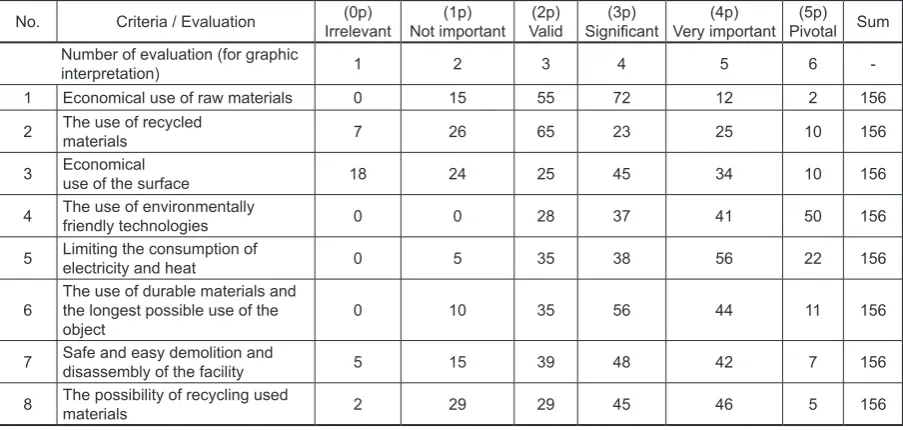
the basis of the opinions expressed by experts in a questionnaire, the most important criteria in an evaluation were determined. The importance of criteria was evaluated via a survey, where answers to a series of questions were given, e.g. ‘Which element (criterion) is most important in your opinion in relation to the above problem?’ The an-swers consisted of points assigned according to a given scale. For instance, a scale from 0 to 5 is in-terpreted as follows: 5 points mean the maximum satisfaction of the goal by the analysed factor, 0 – complete lack thereof. The relevant literature and other research carried out with the same meth-od provide us with some examples [5, 8, 11, 12]. On the basis of these examples, the author developed templates of questionnaires used in re-search. The examples are given in Figure 4.
Case study of an assessment of criteria covering the whole life cycle of an object – the author’s own research
In order to illustrate the research problem and an approach to the assessment of the impor-tance of criteria, fragments of the calculations
which correspond to the specification of weights
obtained from surveys before and after their pro-cessing for further calculations are shown below.
The specification comprises criteria which cover
the whole life cycle of a building object. Table 1
presents the specification of opinions expressed
Figure 4. Examples of surveys prepared by the author of this research Figure 3. The hierarchical structure of chosen criteria for the AHP method
Table 1. Summary of expert evaluations
No. Criteria / Evaluation Irrelevant(0p) Not important(1p) Valid(2p) Significant(3p) Very important(4p) Pivotal Sum(5p) Number of evaluation (for graphic
interpretation) 1 2 3 4 5 6
-1 Economical use of raw materials 0 15 55 72 12 2 156
2 The use of recycled materials 7 26 65 23 25 10 156
3 Economical use of the surface 18 24 25 45 34 10 156
4 The use of environmentally friendly technologies 0 0 28 37 41 50 156
5 Limiting the consumption of electricity and heat 0 5 35 38 56 22 156
6 The use of durable materials and the longest possible use of the
object 0 10 35 56 44 11 156
7 Safe and easy demolition and disassembly of the facility 5 15 39 48 42 7 156
Journal of Ecological Engineering Vol. 20(9), 2019
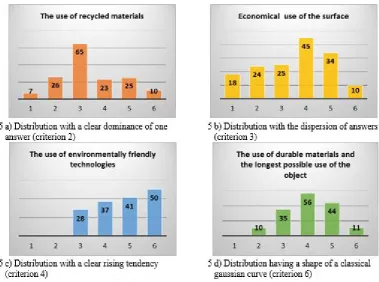
The replies obtained from the surveys show
different characteristics. It is possible to observe
the criteria for which there is one dominant an-swer (Fig. 5a), or else a distinct rising tendency (Fig. 5c). More details are presented in diagrams in Figure 5.
a) Distribution with a clear dominance of one an-swer (criterion 2)
b) Distribution with the dispersion of answers (criterion 3)
c) Distribution with a clear rising tendency (cri-terion 4)
d) Distribution having a shape of a classical gaussian curve (criterion 6)
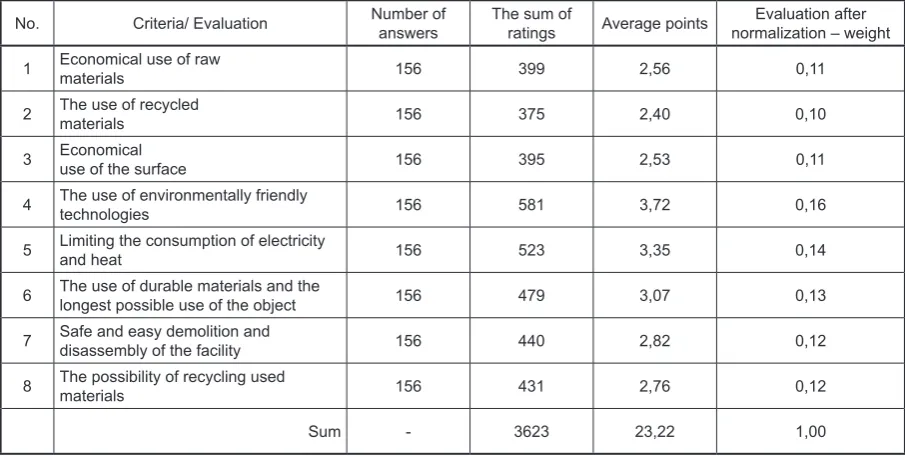
The evaluations achieved in this way were subjected to a further procedure in order to cal-culate an average assessment. The last column in Table 2 shows the values of evaluations after normalisation – this is a vector of preferences showing weights of particular criteria. Their sum equals 1.
Following the criteria above, it is now pos-sible to identify the criteria which, according to experts’ opinions, are more important. The fact that the experts assigned the least importance to the criteria connected with the preparatory
ac-tions, i.e. with the first stage of the life cycle of a
building, is noteworthy.
RESULTS
The example presented above adheres to the provisions of the Polish and EU law, and con-tains a set of criteria to evaluate variant solu-tions of a planned building development which encompass the whole life cycle, from the prepa-ration of materials to the demolition of the build-ing. The analysis of data shows that the ques-tions concerning the materials from recycled waste (criterion 2) and reduced consumption of energy (criterion 5) were met with the domi-nance of a single answer. This proves the high level of concordance between experts on these matters. A high degree of agreement was also reached with respect to the criterion of using eco-friendly technologies (criterion 4). Greater discrepancy was observed with respect to the an-swers which followed a Gaussian curve. These are the replies to the question about using du-rable materials (criterion 6), safe demolition (criterion 7) and economical use of raw materi-als (criterion 1). Much higher discrepancy and a certain information chaos arise from the an-swers acquired to the question about economi-cal space management (criterion 3) and possible recycling of the demolition materials (criterion 8). This study showed that the responses varied
depending on the type, functions and intended use of the analysed designs of planned
build-ings. Different answers were given depending
whether residential buildings (housing estates) or industrial facilities were considered, and the replies given by experts enquired about planned road developments were completely unlike the previous ones.
This distribution of the replies is caused by experts somehow distancing themselves from the new group of questions connected with the dura-bility of buildings, economical use of materials or space. The new approach is included in the regu-lations and EU directives, which mandate the in-clusion of such criteria. They are gradually being added to the assessments of variant solutions of
building development, and – with time – experts are becoming more inclined to adopt the complex approach to the pro-environmental design of vari-ants of building investments.
The list of criteria which govern the final as -sessment output, presented in this article, proves their great diversity. A large number of criteria
sug-gests that they would be difficult to compare di -rectly. In order to apply a mathematical instrument such as e.g. a multicriterial analysis, it is necessary to order the parameters considered, and to create matrices of main criteria and subcriteria (Fig. 3).
The proposed procedure for analysing the en-vironmental impact of construction investments, taking into account the life cycle of the object, is presented in Figure 6.
Table 2. Calculation of the sum of assessments and vector of priorities through normalisation of results
No. Criteria/ Evaluation Number of answers The sum of ratings Average points normalization – weightEvaluation after
1 Economical use of raw materials 156 399 2,56 0,11
2 The use of recycled materials 156 375 2,40 0,10
3 Economical use of the surface 156 395 2,53 0,11
4 The use of environmentally friendly technologies 156 581 3,72 0,16
5 Limiting the consumption of electricity and heat 156 523 3,35 0,14
6 The use of durable materials and the longest possible use of the object 156 479 3,07 0,13
7 Safe and easy demolition and disassembly of the facility 156 440 2,82 0,12
8 The possibility of recycling used materials 156 431 2,76 0,12
Sum - 3623 23,22 1,00
Journal of Ecological Engineering Vol. 20(9), 2019
CONCLUSIONS
For centuries, the economic activities carried out by the man have posed numerous threats to
nature. Some of the losses suffered thus far can -not be replaced. The implementation of new tech-nologies and the development of systems which will enable us to evaluate the impact of new
buildings on nature reflect the care we take about
our surroundings. This article shows how many factors decide whether the man’s activity in the
field of civil engineering can be friendly to the en -vironment or not. A complex approach to the as-sessment of an impact on the natural environment caused by various building objects allows us to take into account all stages in the building’s life cycle. The research based on experts’ opinions has provided evidence that there is not a single, universal set of criteria, and an appropriate set of
criteria needs to be defined in each case.
The results presented in this paper are just a fragment of a larger study, and they are limited
to the specific problems arising while making an
assessment of the impact on the natural environ-ment by building objects throughout their entire life cycle.
REFERENCES
1. Bribián, I. Z., Capilla, A. V., & Usón, A. A. (2011). Life cycle assessment of building materials: Com-parative analysis of energy and environmental im-pacts and evaluation of the eco-efficiency improve -ment potential. Building and environ-ment, 46(5), 1133–1140.
2. Brown M. A. 2012. Construction management: the management of the development, conservation and improvement of the built environment. Organiza-tion, Technology & Management in Construction: An International Journal, 4(2), 457–460.
3. Cabeza, L. F., Rincón, L., Vilariño, V., Pérez, G., & Castell, A. (2014). Life cycle assessment (LCA) and life cycle energy analysis (LCEA) of buildings and the building sector: A review. Renewable and sustainable energy reviews, 29, 394–416.
4. Isaac S., Navon R. 2008. Feasibility study of an auto-mated tool for identifying the implications of chang-es in construction projects. Journal of Construction Engineering and Management, 134(2), 139–145. 5. Marques G., Gourc D., Lauras M. 2011.
Multi-criteria performance analysis for decision making in Project Management. International Journal of Project Management, 929(8), 1057–106.
6. Mora, E. P. 2007. Life cycle, sustainability and the transcendent quality of building materials. Build-ing and Environment, 3(42), 1329–1334.
7. Negahban S., Baecher G.B., Skibniewski M.J. 2012. A decision- making model for adoption of enterprise resource planning tools by small –to – medium size construction organizations. Journal of Civil Engineering and Management, 8(2), 253–264. 8. Ortiz O., Francesc C., Sonnemann G. 2009.
Sus-tainability in the construction industry: A review of recent developments based on LCA. Construction and Building Materials 23.1, 28–39.
9. Rodriguez-Pose A., Fratesi U. 2009. Between de-velopment and social policies: the impact of Eu-ropean Structural Funds in Objective 1 regions. Regional Studies, 38(1), 97–113.
10. Shen L. Y., Tam V. W., Tam L., Ji Y. B. 2010. Project feasibility study: the key to successful implemen-tation of sustainable and socially responsible con-struction management practice. Journal of Cleaner Production, 18(3), 254–259.
11. Szafranko E., (2017). Application of multi-criterial analytical methods for ranking environmental cri-teria in an assessment of a development project. Journal of Ecological Engineering, 18(5), 151–159. 12. Szafranko, E. (2016). Evaluation of data obtained
![Figure 2. Evaluation system for LCA, source: the author, based on [3, 6]](https://thumb-us.123doks.com/thumbv2/123dok_us/8361444.1671447/3.595.167.431.73.259/figure-evaluation-lca-source-author-based.webp)