INTORDUCTION
The development of industrial societies and the urbanization of the third world countries, in-cluding an increase in the population by 2 billion, that is 45%, have increased the demand for our civilization on effecting power by 6 TW, that is by 63% over the past 20–30 years. Despite a con -siderable development in the field of renewable energy sources, fossil fuels such as hard coal, oil and natural gas are still used extensively. At present, 85% of the energy demand in the world is covered by the use of fossil fuels, including around 65% of the energy demand in Poland that is covered by coal, 22% – oil and 12% – natu -ral gas. The amount of the most commonly used fuels with different calorific values and the esti -mated time they will be sufficient at the present consumption level are shown in Table 1.
The side effect of burning traditional fossil fuels is the release of oxides of carbon, sulfur and nitrogen, and also dust that is a carrier of toxic compounds, such as polycyclic aromatic hydro-carbons (PAHs), cadmium and lead [Flagan and Seinfeld 1988, Figueroaa et al. 2008] into the at -mosphere. These compounds can cause respirato -ry diseases and skin and eye irritation (NOx, SOx,
dust), neurological disorders (Hg, Pb) as well as mutagenic effects (PAHs, cadmium). In addition to the direct threat to living organisms, carbon di-oxide included to the emitted substances, together with water vapor, methane, freon and nitrous ox-ide, forms a group of the so-called greenhouse gases [Caldeira et al. 2003, Hoffert et al. 1998, Kessel 2000] that are recognized as one of the causes of global warming. In general, the anthro -pogenic emission of pollutants, though in total it is lower than natural one caused by volcanic erup-tions, storms and fires, has serious consequences for human health and life because it occurs pri-marily in inhabited areas.
The improvement of the air condition is influ -enced by the use of various waste gas treatment technologies, and in the case of coal, which is Poland’s most popular fuel used in power plants and combined heat and power plants, the devel-opment and implementation of clean coal tech-nologies is of particular importance. These types of technologies can be used in the extraction and enrichment stages of the raw material as well as in the combustion and exhaust purification pro -cess. Such solutions include, for example, coal gasification, the use of fluidized boilers, oxygen-enriched combustion, as well as exhaust purifica
-REDUCTION OF POLLUTION EMISSION BY USING SOLAR ENERGY
IN EASTERN POLAND
Piotr Dragan1, Agata Zdyb1
1 Faculty of Environmental Engineering, Lublin University of Technology, Nadbystrzycka 40B, 20-618 Lublin,
Poland, e-mail: [email protected]
Volume 18, Issue 4, July 2017, pages 231–235
DOI: 10.12911/22998993/74290 Research Article
ABSTRACT
The present work is devoted to the analysis of electric energy production in
photo-voltaic power plant located in eastern part of Poland and to the estimation of pollu
-tion avoided due to the use of solar radia-tion energy. Photovoltaic power plant con
-sists mainly of silicon polycrystalline modules but in its experimental part thin film modules of three different technologies are also installed giving the total power of 1.4 MWp. In 2015 the PV plant produced above 1.5 MWh of electric energy. Benefits of renewable energy use result in a significant reduction of emissions that are harmful to people and other living species too.
Keywords: photovoltaic plant, coal combustion, pollution emission
tion processes aiming at desulfurization, dedust-ing and reduction of nitrogen oxides. Sequestra -tion techniques may be used to reduce CO2 levels in the atmosphere.
Increasing energy demand, limited fossil fuel resources, and harmful emissions from their com-bustion have led to the need to develop new, envi-ronmentally friendly energy sources. This issue is reflected in the legislation adopted for many years at European Union and national and regional lev-els. In 2009, Directive 2009/28/EC on the promo -tion of the use of energy from renewable sources was announced, which resulted in the adoption of the National Action Plan on Renewable Energy Sources in Poland in 2010, supplemented in 2011. Two years later, the European Parliament resolu -tion of 21 May 2013 on current challenges and opportunities for renewable energy in the Euro-pean internal energy market was announced. In our country, in March 2015, Act on Renewable Energy Sources was adopted which provided sta-ble legislative conditions and tariffs guaranteed for prosumer installations.
Among the various renewable energy sourc -es, solar power is particularly promising be-cause of its widespread availability and unlim-ited resources. The most common ways of using this energy are the use of solar collectors and photovoltaic modules.
In this paper, we present a case study of pho -tovoltaic technology in a group of municipalities located in the eastern part of Poland. The produc -tion of electricity was combined with the set values of pollutants that would be emitted if traditional fuels were combusted. The analysis allowed for the assessment of the ecological benefits achieved in a given area through the use of solar energy.
METHODS AND RESEARCH FACILITY
Photovoltaic power plant discussed in this work is located in eastern part of Poland (lati -tude 51o51, longitude 23o10), and it was created
as a result of cooperation of local governments from five boroughs. The geographical location of municipalities’ partnership, characterized by outstanding solar conditions (1700 h of intense solar energy per year), causes that it has a great potential in this regard. Solar energy resources throughout the area of Poland, because of its lo -cation in the temperate climate zone, are charac-terized by uneven distribution in the annual cycle.
In the photovoltaic power plant with a capac -ity of 1.4 MWp that came into existence, solar energy is used to produce electricity in a grid-connected system, assuming the sale of energy to the electricity grid. In the farm a direct conver -sion of solar energy occurs – of the optical solar radiation – into electricity through photovoltaic conversion. For this purpose, photovoltaic cells connected together in series have been installed in order to obtain a desired voltage, and then in parallel to obtain the necessary power.
The investment involved the installation of 5560 of silicon polycrystalline modules (poly-Si) with a total capacity of 1.39 MWp. The efficien -cy of these modules is at least 15.3% at standard conditions including insolation of 1000 W/m2
and a module temperature equal to 25°C. Silicon polycrystalline modules represent the majority of all mounted modules. In the experimental part of the farm 104 thin film modules composed of amorphous silicon (a-Si), gallium-indium dis -elenide-copper (CIGS), and cadmium telluride (CdTe) have been also installed. The total power of the thin-film panels is equal to 10,44 kWp. Table 2 shows the number of modules and the power of each technology. The total area of the land on which the plant is located is 3.5 hectares.
One of the crucial elements of PV installa -tions except the photovoltaic modules are in-verters, that is devices supporting control and regulation system. They connect the solar panels to the electricity network. Their main task is to convert the direct current produced by the photo-voltaic module, into the alternating current with the parameters of the grid. Thanks to these de -Table 1. The world fossil fuels reserves [World Energy Outlook, 2014]
Raw material [million tons]Resources Resource structure [%] Resource availability [years] Calorific value
Carbon 469 298 59.6 158 17–31 [MJ/kg]
Petroleum 159 644 20.3 41 41–49 [MJ/kg]
Natural gas 158 815 20.1 63 35.5 [MJ/m3]
vices, all energy produced can be transferred into the network. On average, at each 80 photovoltaic modules one inverter was installed with the AC active power equal to 20 kW each, which results in 70 installed inverters on 5560 polycrystalline modules. These inverters have a maximum effi -ciency of not less than 98% and the effi-ciency of the Euro-eta not less than 97.5%. For each type of thin-film modules, one inverter of active power 3.5 kW AC has been installed. On this farm is thus 70 inverters of the AC power 20 kW and 3 inverters of the AC power 3.5 kW.
Methodology of experimental research con -ducted in the present photovoltaic power plant is based on data recording, such as the amount of generated electricity, the temperature of the modules and insolation in the module plane. Re -cording of the operating parameters of the various photovoltaic modules types, i.e. silicon polycrys -talline and thin-film a-Si, CdTe and CIGS tech -nologies is performed by using procedures imple-mented in inverters for recording daily, monthly, and annual production of power and energy for each part of the installation separately. Measure -ment of the intensity of radiation is performed by means of pyranometer placed in the same lo-cation as the photovoltaic power station, in its central part. Ambient temperature measurement and the temperature of the modules is carried out using appropriately calibrated thermocouples. Readings of all the measured values: the amount of generated energy, solar radiation and the tem-peratures were recorded every 5 minutes.
RESULTS
Demand for electricity in public utilities and lighting in the discussed partner communities is 1434.5 MWh per year [Dragan and Lubańska 2016]. On the basis of the demand it is possible to estimate the required area of the modules, accord -ing to formula [Luque and Hegedus 2003]:
𝑆𝑆 = 𝑄𝑄
𝐹𝐹𝐹𝐹𝐹𝐹, (1) where: Q – annual demand [kWh/year],
F – loses factor between module and receiver,
η – module efficiency,
H – annual irradiation [kWh/m2year].
In the photovoltaic power plant located in the described above location in eastern Poland, the area of installed modules is equal to 8753 m2
for the entire installation. Knowing the surface of the modules, the value of electricity produced by a given photovoltaic installation can be estimated from the dependence:
𝐸𝐸 = 0.85𝐻𝐻𝐻𝐻𝐻𝐻 (2)
The theoretical energy output determined in accordance with the above formula is equal to 1,450 MWh, assuming average modules ef -ficiency of 15% and irradiation in the module plane of 1300 kWh/m2 per year. Experimental
data from 2015 show that the total electricity production in this photovoltaic power plant is equal to 1530.42 MWh. The amount of real en -ergy produced is therefore higher than predicted, which can be caused by the favorable sunshine in a given calendar year and ambient temperatures or slight pollution of the modules. The main contri -bution to the power generation in the analyzed PV plant (99.26%) are poly-Si modules that produced 1518.94 MWh. Thin-layer modules constituting an experimental part of a power plant produced 11.32 MWh, only 0.74% of the total energy sold to the grid. Table 3 shows energy produc -tion related to installed capacity of each kind of installation. In total, the energy produced by the photovoltaic power plant covers the needs of the partner municipalities for electricity in public utilities and for lighting.
In order to obtain 1530 MWh of electricity by conventional means, 688 tons of coal would have to be used in the traditional coal-burning process, Table 2. The number of modules and the nominal power of each technology modules
Modules technology Number of modules Nominal power of the module [Wp] Installed power [kWp]
a-Si 36 98 3.42
CIGS 24 155 3.72
CdTe 44 75 3.3
assuming that on average 0.45 kg of coal is need -ed to produce 1 kWh of energy. Burning of 688 tons of coal would involve the emission of many pollutants into the atmosphere.
The amount of harmful substances emitted to the atmosphere depends primarily on the type of fuel that is its calorific value, ash and sulfur content, and the methods used to purify the gases [www.iea.org]. The emission of a given substance can be determined using the formula:
𝐸𝐸 = 𝐵𝐵 ∙ 𝑊𝑊 (3)
where: E – volume of emissions, B – fuel consumption,
W – emission factor per unit of fuel consumed.
Calculated according to the Eq. (3) ammount of substances emitted during combustion of 688 t of carbon are presented in Table 4. The content of sulfur in coal that ranges from 0.7% to 1.3% (eg. in Bogdanka coal mine) influences emmision of sulfur oxides. The emmision of dust depends on the coal quality, too. In our considerations we assumed the contenet of dust in coal in the range of 4–31%. Depending on combustion technology
the amounts of emited nitrogen and carbon oxides and pirene also differ.
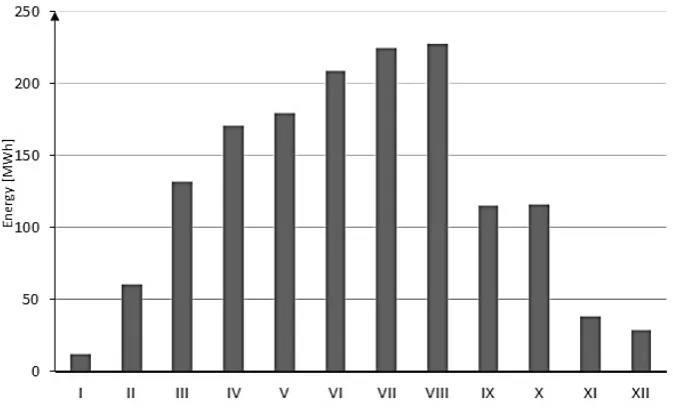
The performance of the analzyed photovol-taic power plant differ significantly in summer and winter half of the year which is shown in Figure 1. The PV plant provides 1135.5 MWh in April to September period, and 394.92 MWh from October to March. Warm half of the year, in which 74% of the entire energy is produced, is significantly more profitable but energy demand for lightening is higher in colder part of the year. However, the excess of energy generated in sunny months are sold to the grid so they finally cover the electric energy demand.
Table 4. Emissions of pollution arising in combustion of 688 t of coal
Pollutant Emission amount [kg]
SOx/SO2 7705.6 – 14310.4
NOx/NO2 688 – 2201.6
CO 6880 – 48160
CO2 1272800 – 1465440
Dust TSP 2752 – 42656
Benzopyrene 2.201 – 9.632
Table 3. Energy production related to installed capacity of each kind of installation
Technology Installed capacity [kWp] Energy production in 2015 [KWh/kWp]
a-Si 3.42 1031.89
CIGS 3.72 1115.59
CdTe 3.3 1058.58
poly-Si 1390 1080.06
CONCLUSIONS
The photovoltaic power plant located in east-ern Poland produces 1530.42 MWh of electricity annually. This amount of energy covers the needs of partner municipalities for public utilities and lighting. In a conventional power station, the pro -duction of this amount of energy would involve burning of 688 tons of carbon and consequently emitting significant amounts of sulfur, nitrogen and carbon oxides, as well as benzopyrene and dust. Using solar energy in photovoltaic conver -sion and thus replacing carbon with a clean source of energy will reduce the emission of harmful substances into the atmosphere. It should also be taken into account that apart from the emissions generated by the coal combustion process, addi-tional contamination arises during the exploita-tion of the raw material and during transport.
The reduction of pollutant emissions that has been achieved in municipalities using a photo-voltaic power plant contributes to the improve-ment of the quality of the environimprove-ment both in the areas inhabited by humans and in nature re-serves. Therefore, not only people but also other living organisms experience beneficial effects. It is therefore advisable to develop a low-carbon economy, which should include the diversifica -tion of energy sources, the improvement of en-ergy production efficiency, and education aimed at raising the ecological awareness.
REFERENCES
1. Caldeira K., Jain A.K., Hoffert M.I. 2003. Climate
sensitivity uncertainty and the need for energy
without CO2 emission. Science, 299, 2052–2054. 2. Dragan P., Lubańska Z. 2016. The Energy Efficien
-cy of Polycrystalline and Thin Film Photovoltaic Farm in the Dolina Zielawy. Ecological Engineer
-ing, 50, 42–48.
3. Figueroaa J.D., Fouta T., Plasynskia S., McIlvriedb H., Srivastavab R.D 2008. Advances in CO2 cap
-ture technology–The U.S. Department of Energy’s Carbon Sequestration Program. International Jour
-nal of Greenhouse Gas Control, 2, 9–20.
4. Flagan R.C., Seinfeld J.H. 1988. Fundamentals of Air Pollution Engineering, Prentice Hall, New Yersay. 5. Hoffert M.I., Caldeira K., Jain A.K., Haites E.F.,
Harvey L.D.D., Potter S.D., Schlesinger M.E., Schneider S.H., Watts R.G., Wigley T.M.L., Wueb
-bles J. 1998. Energy implications of future stabili
-zation of atmospheric CO2 content. Nature, 395, 881–884.
6. Kessel D.G. 2000. Global warming – facts, assess
-ment, countermeasures. Journal of Petroleum Sci
-ence and Engineering, 26, 157–168.
7. Luque A., Hegedus S. 2003. Handbook of Photovol
-taic Science and Engineering. Wiley, Chichester. 8. World Energy Outlook, 2014. International Energy
Agency, Paris.
![Table 1. The world fossil fuels reserves [World Energy Outlook, 2014]](https://thumb-us.123doks.com/thumbv2/123dok_us/8360878.1671180/2.595.69.527.86.165/table-world-fossil-fuels-reserves-world-energy-outlook.webp)