(UDC: 57+61]:004.9"2006/2016")
A review of models in bioengineering developed by the group led by Miloš
Kojić in the period 2006
-2016
M. Kojić1,2
1 Bioengineering R&D Center BioIRC, Kragujevac, Serbia 2 Methodist Hospital Research Institute, Houston
e-mail: [email protected]
Abstract
A brief summary of results in the period 2006-2016 of the group led by Milos Kojic is given in this report. Three fields are included: general bioengineering problems, models for transport in capillary systems and tissue, and modeling of underground water flow. This research has been published in books, journal papers and conference proceedings. The research has been supported by various grants, national (Ministry of Education, Science and Technological Development of Serbia) and international, and industry. The computational models have been implemented into our software PAK.
Keywords: FE models in bioengineering, tissue, muscles, transport in capillaries and tissue multiscale, underground water flow, FE package PAK
1. Introduction
Our group started with the development of computational FE models and our software package PAK back in 1975 (founder and main author M. Kojic). Over decades, significant progress was continuously made, so that the original structural linear and further nonlinear FE modeling problems have been enriched by other fields such as heat transfer, fluid flow, solid-fluid interaction, damage mechanics, multiphysics, multiscale, and biomechanics and transport within capillary systems and tumors. This work has been initiated at the Computer Center of the Serbian car factory “Zastava” in the City of Kragujevac, followed by work at the Faculty of Mechanical Engineering of the University of Kragujevac, Center for Scientific Research of the Serbian Academy of Science and Arts and the University of Kragujevac, Bioengineering R&D Center for Bioengineering in Kragujevac, and the Faculty of Science of the University of Kragujevac.
2.1 The model of biological membrane covered with surfactant
Alveolated structure deep in the lung is composed of membranes in the form of alveolae and connective tissue as fibers and rings (Wilson 1982; Bachofen and Schurch 2001; Bachofen et al. 1979). Exchange of oxygen occurs due to contact of air and membranes and that exchange depends on the airflow within alveolae. The flow is conditioned by motion of alveola membranes. During breathing, the overall lung structure is subjected to cyclic motion and deformation. The supporting structure of the lung is the connective tissue which contains muscle and other connective tissue cells, and displays hysteretic characteristics when the force-deformation relationship is considered. The alveolar membranes deform during breathing and their surface change has a cyclic character. Membranes are covered by surfactant which generates surface stresses, with hysteretic character. Hysteresis of the fibers and membranes have the opposite character and their superposition results in the hysteretic motion of the lung walls - which produces air mixing deep in the lung. This mixing is crucial for normal lung functioning. In our study (Kojic et al. 2011) we investigated the mechanical behavior of an alveolar duct and used our model of biological membrane covered by surfactant (Kojic et al. 2006).
Fig. 1. The model of biological membrane according Kojic et al. (2006) and of alveolar duct according to Kojic et al. (2011). a) Geometry and FE model of the spherical membrane. b)
Geometry of the duct. c) Uniaxial and biaxial constitutive curves for membrane tissue. d) Hysteretic characteristic of surfactant. e) Stress integration which includes membrane tissue,
alveolar ring and surfactant. f) Radial displacement-pressure relationship for the spherical membrane. g) Geometric hysteresis expressed as the ratio of the duct surface to duct volume for
the alveolar duct
2.2 Cancerous cell passing through capillary narrowing
Fig. 2. Schematics of the remeshing procedure. After the solution for the current time-step is obtained, the solid is displaced, a new fluid mesh is generated (with common solid and fluid nodes at the solid surface), and solutions from the old mesh are mapped to the new mesh [80]
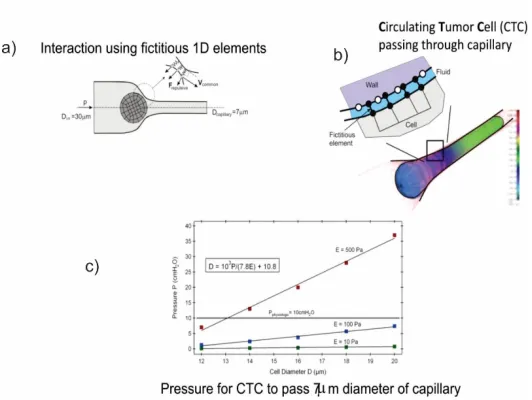
Among other applications, we present here the results given in Kojic N. et al. (2015) where conditions must be fulfilled for circulating tumor cell (CTC) to pass a capillary narrowing. In Fig. 3a,b the concept of solving interaction between deformable bodies using 1D fictitious elements is schematically shown. This is one of the simple methods in computational mechanics summarized in Kojic (2013). Regarding deformation of the solid, a mixed formulation introduced in Kojic (2015) is implemented.
Fig. 3. Model of circulating tumor cell (CTC) passing capillary narrowing according to Kojic (2015). a) and b) Use of fictitious 1D elements to model interaction between cell and wall. c) Relation between blood pressure and cell diameter to pass 7 micrometer capillary diameter, for
several cell stiffnesses (elastic modulus E)
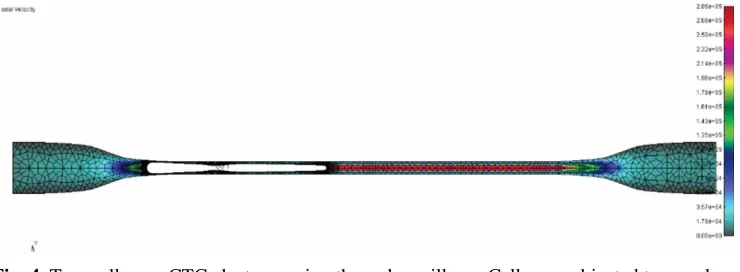
we show two cells within capillary together with velocity field, to demonstrate the applicability of our models to very challenging computational problems.
Fig. 4. Two cells as a CTC cluster passing through capillary. Cells are subjected to very large deformation (direct coupling, interaction algorithm and mixed formulation are implemented to demonstrate robustness of our methodology and applicability to very challenging problems of
computational mechanics)
3. Models for mass transport within capillaries and tissue
From 2009, our group was engaged to develop models for convective and diffusive mass transport within small blood vessels and tissue, with the emphasis on tumor problems. In the previous section, we have briefly presented convection due to blood flow. Here, we summarize the main results for the transport which is mainly governed by diffusion.
3.1 Hierarchical multiscale model for diffusion
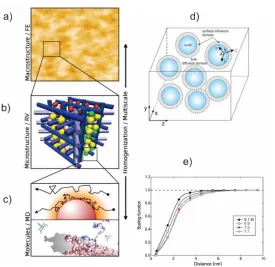
Fig. 5. Hierarchical multiscale model. a) A reference volume (RV) of the porous continuum is selected. b) General microstructural geometry. c) Molecular dynamics (MD) is used to determine
dependence of diffusion coefficient on the distance from solid microstructural surface. d) Domain of restrained diffusion due to interaction of solute particles and surfaces, and domain of
free (bulk) diffusion. e) Scaling functions as the ratios of the effective and bulk diffusion coefficient
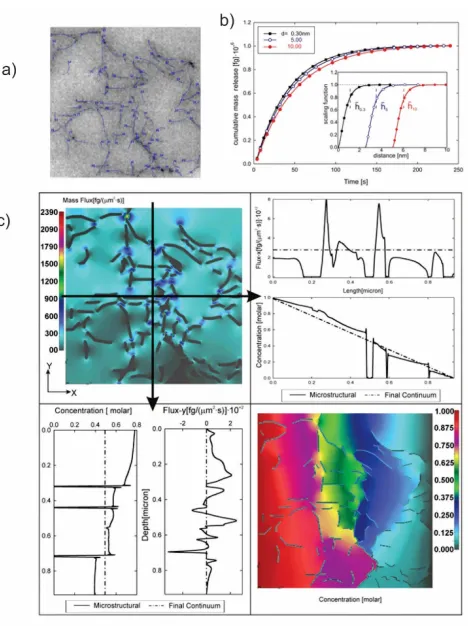
Fig. 6. Diffusion within an agarose polymeric solution according to Ziemys et al. (2011). a) Internal microstructure obtained by imaging. b) Mass release curves for three particle diameters
0.3, 5 and 10 nm, corresponding to rhodamine 6G and two general nanoparticles. c) Field of mass flux distribution in x-direction (left upper panel), concentration and flux distributions along
x and y directions, and concentration field (right lower panel)
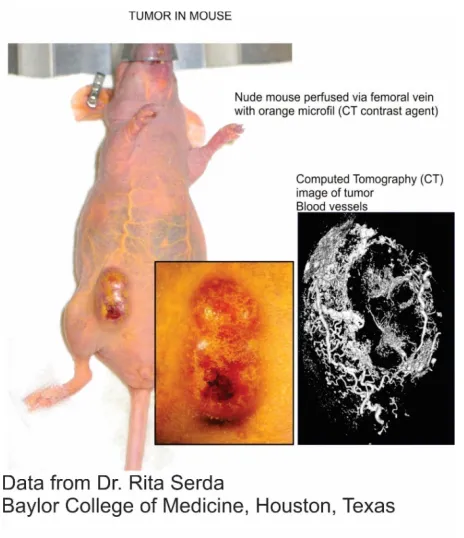
Fig. 7. Experimental investigations with use of imaging for recording blood vessel network in a tumor. Data from Dr. Rita Serda, Baylor College of Medicine, Houston, Texas, USA (private
communication)
Application of our methodology and software PAK (Kojic et al. 2010) to modelling transport in tumor is shown in Fig. 8 where concentration distribution within the tumor is displayed.
Fig. 8. Concentration distribution within tumor according to Kojic et al. (2015). Concentration within capillaries in plane and in front of plane, in plane and capillaries looking through the
4. Model of underground water flow
Our group has been involved over several years in the development of methodology and software for modeling underground water flow. This research has been performed together with the
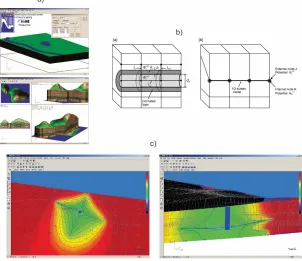
Institute “Jaroslav Čеrni”, Belgrade. A very sophisticated user-friendly interface software Lizza (Fig. 9a) was developed. Also, a number of publications appeared from this work.
Fig. 9. Modeling underground water flow. a) Illustration of the menu of the interface software Lizza. b) One-dimensional FE of wall screen connected to the continuum (Dimkic et al. 2013). c)
Field of potential in models of Belgrade Water Supply System obtained by application of the Lizza and PAK software
Here we show in Fig. 9b the concept of modeling well screens by 1D elements, which are connected to the 3D space (discretized by isoparametric FEs) by fictitious-dimensionless finite elements (Dimkic et al. 2013); these fictitious elements take into account permeability of colmatted soil layers close to the screens. This concept is very important in practical applications since it does not require a fine mesh near the screens – the screens are represented by 1D elements imbedded to the 3D mesh and directly connected to the 3D element nodes. The applications of this methodology and packages Lizza and PAK (Kojic et al. 2010) to the Belgrade Water Supply System is shown in Fig. 9c.
Acknowlegements A number of institutions have been supporting this research, and large number of researchers contributed to the development of methods and software outlined in this report.
Baylor College of Medicine: Rita Serda
Texas Children’s Hospital: Annand Anapragada
Извод
Преглед модела у области биоинжењеринга развијених од стране
истраживачке групе професора Милоша Којића у периоду 2006
-2016
М. Којић1,2
1Истраживачко-развојни центар за биоинжењеринг БиоИРЦ, Крагујевац, Србија
2Methodist Hospital Research Institute, Хјустон, САД
имејл: [email protected]
Резиме
У овом раду се представља преглед резултата групе предвођене од стране Милоша Којића
у периоду 2006-2016. Наведене су три области: општи проблеми биоинжењеринга, модели
транспорта у капиларним системима и ткиву, и моделирање струјања подземних вода. Овај истраживачки рад је публикован у књигама, радовима у часописима и у зборницима са конференција. Истраживања су подржана кроз пројекте, националне (Министарство просвете, науке и технолошког развоја Србије) и интернационалне, и од индустрије. Компјутерски модели су уграђени у наш софтвер ПАК.
Кључне речи: ФЕ модели у биоинжењерингу, ткива, мишићи, транспорт у капиларним системима и ткиву, струјање подземних вода, ФЕ пакет ПАК
References
Bachofen HP, Gehr P, Weibel ER (1979). Alterations of Mechanical Properties and Morphology in Excised Rabbit Lungs Rinsed with Detergent, J.Appl. Physiol. Respir. Environ. Exercise. Physiol., 47, 1002–1010.
Cirkovic B, Isailovic V, Milosevic Z, Radulovic J, Sofla A, Radisic M, Kojic M and Filipovic N (2012) Analytical and numerical analysis of magnetic separation of cardiomyocytes, JSSCM, Vol. 6(2), pp.145-159.
Dimkic M, Rankovic V, Filipovic N, Stojanovic B, Isailovic V, Pusic M, Kojic M (2013). Modeling of radial well lateral screens using 1D finite elements, J. of Hydroinformatics, 15 (2), 405-415.
Filipovic M, Kojic M, Ferrari M (2011). Dissipative particle dynamics simulation of circular and elliptical particles motion in 2D laminar shear flow, Journal of Microfluidics and Nanofluidics, 1127-1134.
Filipovic N, Cvetkovic A, Isailovic V, Matovic Z, Rosic M, Kojic M (2009). Computer simulation of flow and mixing at the duodenal stump after gastric resection, World Journal of Gastroenterology, ISSN1007-9327.
Filipovic N, Gibney B, Kojic M, Nikolic D, Isailovic V, Ysasi A, Konerding M, Mentzer S, Tsuda A (2013). Mapping cyclic stretch in the postpneumonectomy murine lung, J. Applied Physiology, vol. 115, 9, 1370-1378.
Filipovic N, Haber S, Kojic M and Tsuda A (2008). Dissipative Particle Dynamics Simulation of Flow Generated by Two Rotating Concentric Cylinders. Part II: Lateral Dissipative and Random Forces. J. Phys. D: Appl. Phys. 41:035504.
Filipovic N, Isailovic V, Djukic T, Ferrari M and Kojic M (2012). Multi-scale modeling of circular and elliptical particles in laminar shear flow, IEEE Trans Biomed Eng., 59 (1):50 53.
Filipovic N, Ivanovic M, Kojic M (2008). A comparative numerical study between dissipative particle dynamics (DPD) and smooth particle dynamics (SPH) when applied to simple unsteady flows, Microfluidics and Nanofluidics, 1613-4982.
Filipovic N, Ivanovic M, Krstajic D and Kojic M (2011). Hemodynamic Flow Modeling through an Abdominal Aorta Aneurysm Using Data Mining Tools, IEEE - Transactions on Information Technology in Biomedicine, B 15, 189-194.
Filipovic N, Ivanovic M, Krstajic D and Kojic M (2011). Hemodynamic Flow Modeling through an Abdominal Aorta Aneurysm Using Data Mining Tools, IEEE - Transactions on Information Technology in Biomedicine, B 15, 189-194.
Filipovic N, Jovanovic A, Petrovic D, Obradovic M, Jovanovic S, Balos D, Kojic M (2012). Modelling of self-healing materials using discrete and continuum methods, Surface Coatings International, Vol. 95, No. 2, pp. 74-79, ISSN 1754-0925.
Filipovic N, Kojic M, Ferrari M (2011). Dissipative particle dynamics simulation of circular and elliptical particles motion in 2D laminar shear flow, Journal of Microfluidics and Nanofluidics, 1127-1134.
Filipovic N, Kojic M, Tsuda A (2008). Modeling of thrombosis using dissipative particle method, Phylosoph. Trans. Roy. Soc. London, A 366(1879).
Filipovic N, Meunier N, Fotiadis D, Parodi O, and Kojic M (2014). Three-dimensional numerical simulation of plaque formation in arteries, in M. Garbey, B. Lee Bass, S. Berceli, C. Collet, and P. Cerveri, Eds: Computational Surgery and Dual Training, Springer, 257-264.
Filipović N, Petrović D, Isailović V, Jovanović A, Kojić M (2010). Modeling of self-healing process in new nanocoating of surfaces by material with containers filled with healing agents, Contemporary materials, Vol. 1, No. 2, pp. 129-132, UDK 519.876.5:621.89, 2-3 July 2010.
Filipović N, Petrović D, Jovanović A, Jovanović S, Balos D, Kojić M (2008). DPD simulation of
Themis E, Sakellarios A, Siogkas P, Marraccini P, Vozzi F, Meunier N, Teng Z, Fotiadis D, Parodi O, Kojic M (2011). ARTREAT project: computer, experimental and clinical analysis of three-dimensional plaque formation and progression in arteries; Journal of the Serbian Society for Computational Mechanics, Vol. 5 No. 2, 129-146.
Fine D, Grattoni A, Hosali S, Ziemys A, De Rosa E, Gill J, Medema R, Hudson L, Kojic M, Milosevic M, Brousseau III L, Goodall R, Ferrari M, Liu X (2010). A robust nanofluidic membrane with tunable zero-order release for implantable dose specific drug delivery, Lab on a Chip, DOI: 10.1039/c0lc00013b.
Gilbert RJ, Stojanovic B, Kojic M, Liang A, Wang TT, Gaige TA, Benner T, Wang R, Wedeen VJ, Mijailovich SM (2010). Finite element model of human lingual tissue deformation during swallowing based on the mechanics of mesoscale myofiber tracts obtained by diffusion tensor MR imaging with tractography, Journal of Applied Physiology, 109, 1500– 1514.
Isailovic V (2012). Numerical modeling of motion of cells, micro- and nano- particles in blood vessels, Ph. D. Thesis, Belgrade: Metropolitan University.
Isailovic V, Kojic M, Milosevic M, Filipovic N, Kojic N, Ziemys A, Ferrari M (2014). A computational study of trajectories of micro- and nano-particles with different shapes in flow through small channels, J. Serb. Soc. Comp. Mech., Vol. 8 (2), 14-28.
Kojic M (2007). Serbian Society for Computational Mechanics – a brief overview, IACM Expressions, 21, 18-21.
Kojic M (2010). On the stress integration for nonlinear material models within the finite element method, Bulletin CXLII de l'Académie serbe des sciences et des arts Classe des sciences techniques 32, 47-82.
Kojic M (2013). Simple concepts in computational mechanics – do they really work?, J. Serbian Soc. Comp. Mech., Vol. 7, No. 1, pp. 1-15.
Kojić M (2015). Mixed formulation for incompressible solid in the finite element method, with
application to motion of solid within fluid, Reports of the Department of Technical Sciences of the Serbian Academy of Sciences and Arts.
Kojic M, Butler JP, Vlastelica I, Stojanovic B, Rankovic V, Tsuda A (2011). Geometric hysteresis of alveolated ductal architecture, ASME J. Biomechanics, Vol. 133 / 111005-1-11.
Kojic M, Filipovic N (2012). Computational mechanics in science, applications and teaching, Theoretical and Appl. Mechanics, Vol. 40(S1), pp. 147-162.
Kojic M, Filipovic N, Stojanovic B, Kojic N (2008). Computer Modelling in Bioengineering – Theory, Examples and Software, J. Wiley and Sons.
Kojić M, Filipović N, Stojanović B, Ranković V, Krstić M , Otašević L, Ivanović M, Nedeljković
M, Dimkić M, Tričković M, Pušić M , Boreli-Zdravković Đ, Đurić D (2007). Finite element
Kojic M, Filipovic N, Tsuda A (2008). A mesoscopic bridging scale method for fluids and coupling dissipative particle dynamics with continuum finite element method, Comp. Meth. Appl. Mech. Eng., 197, 821-833.
KojićM, Isailović V, Stojanović B, Filipović N (2007). Modeling of cell mechanical response by
biphasic models with activation, J. Serb. Soc. Comp. Mech., Vol. 1, 135-143.
Kojic M, Milosevic M, Kojic N, Ferrari M, Ziemys A (2011). On diffusion in nanospace, J. Serbian Soc. Comp. Mechanics, Vol. 5, No. 1, 84-109.
Kojić M, Milošević M, Kojić N, Ferrari M, Ziemys A (2013). Numerical modeling of diffusion
in complex media with surface interaction effects, Contemporary Materials, 2, 153-166. Kojic M, Milosevic M, Kojic N, Kim K, Ferrari M, Ziemys A (2014). A multiscale MD–FE
model of diffusion in composite media with internal surface interaction based on numerical homogenization procedure, Comput. Methods Appl. Mech. Engrg. 269, 123–138.
Kojic M, Milosevic M, Kojic N, Koay EJ, Fleming JB, Ferrari M, Ziemys A (2016). Mass release curves as the constitutive curves for modeling diffusive transport within biological tissue, Computers in Biology and Medicine, DOI: 10.1016/j.compbiomed.2016.06.026. Kojic M, Milosevic M, Kojic N, lsailovic V, Petrovic D, Filipovic N, Ferrari M, Ziemys A
(2015). Transport phenomena: Computational models for convective and diffusive transport in capillaries and tissue, in: Suvranu De, Wonmuk Hwang, Ellen Kuhl, Eds., Multiscale Modeling in Biomechanics and Mechanobiology, Springer, Chapter 7, 131-156.
Kojic M, Milosevic M, Kojic N, Starosolski Z, Ghaghada K, Serda R, Annapragada A, Ferrari M, Ziemys A (2015). A multi-scale FE model for convective-diffusive drug transport within tumor and large vascular networks, Comput. Methods Appl. Mech. Engrg., 294,100–122. Kojic M, Milosevic M, Simic V, Ferrari M (2014). A 1D pipe finite element with rigid and
deformable walls, J. Serb. Soc. Comp. Mech., Vol. 8 (2), 38-53.
Kojic M, Milosevic M, Wu S, Blanco E, Ferrari M, Ziemys A (2015). Mass partitioning effects in diffusion transport, Physical Chemistry Chemical Physics, DOI: 10.1039/c5cp02720a. Kojic M, Slavkovic R, Zivkovic M, Grujovic N, Filipovic N (1998,2010). PAK – FE Software
for structural analysis, field problems, multiphysics and biomechanics, Faculty of Mechanical Engineering, Bioengineering R&D Center for Bioengineering, Kragujevac. Kojic M, Vlastelica I, Decuzzi P, Gentile F, Ferrari M (2011). A Microstructural Doublet
Mechanics Finite Element Formulation, Monograph of South Slavic Academy for Nonlinear Sciences, Vol 3.
Kojic M, Vlastelica I, Decuzzi P, Granik VT, Ferrari M (2011). A finite element formulation for the doublet mechanics modeling of microstructural materials, Comp. Meth. Appl. Mech. Engrg., 200, 1446–1454.
Kojic M, Vlastelica I, Stojanovic B, Rankovic V, Tsuda A (2006). Stress integration procedures for a biaxial isotropic material model of biological membranes and for hysteretic models of muscle fibers and surfactant, Int. J. Num. Meth. Engng., Vol 68, 893-909.
Kojic M, Ziemys A, Milosevic M, Isailovic V, Kojic N, Rosic M, Filipovic N, Ferrari M (2011). Transport in biological systems, J. Serbian Soc. Comp. Mechanics, Vol. 5, No. 2, 101-128.
Kojić N, Huang A, Chung E, Ivanović M, Filipović N, Kojić M,. Tschumperlin DJ (2010). A 3 D
model of ligand transport in a deforming extracellular space, Biophysical Journal, 99, 3517– 3525.
Kojić N, Milošević M, Petrović D, Isailović V, Fatih Sarioglu A, Haber DA, Kojić M, Toner M
(2015). A computational study of circulating large tumor cells traversing microvessels, Computers in Biology and Medicine (among 10 the best in 2015), 63, 187–195.
Kojic N, Panzer MJ, Leisk GG, Raja WK, Kojic M, Kaplan DL (2012). Ion electrodiffusion governs silk electrogelation, Soft Matter (cover article), Vol. 8, 6897-6905.
Rakić D, Živković M, Slavković R, Kojić M (2008). Stress integration for the Drucker-Prager material model without hardening using the incremental plasticity theory, J. Serb. Soc. Comp. Mech., Vol. 2, No.1, 80-89.
Ranković V, Ristić B, Kojić M (2007). Internal fixation of femoral bone comminuted fracture -
FE Analysis, J. Serb. Soc. Comp. Mech., Vol. 1, 120-128.
Rosic M, Pantovic S, Rankovic V, Obradovic Z, Filipovic N, Kojic M (2008). Evaluation of dynamic response and biomechanical properties of isolated blood vessels, J. Biochem. Biophys. Methods, 70, 966-972.
Ruiz-Esparza GU, Wu S, Segura-Ibarra V, Cara FE, Evans KW, Milosevic M, Ziemys A, Kojic M, Meric-Bernstam F, Ferrari M, and Blanco E (2014). Polymer Nanoparticles Encased in a Cyclodextrin Complex Shell for Potential Site- and Sequence-Specifi c Drug Release, Adv. Funct. Mater., DOI: 10.1002/adfm.201400011; 24, 4753–4761.
Stamenović D, Kojić M, Stojanović B, Hunter D (2008). A finite element analysis of an osteoarthritis knee brace, J. Serb. Soc. Comp. Mech., Vol. 2, No.2, 29-41.
Stamenović D, Kojić M, Stojanović B, Hunter D (2009). Pneumatic osteoarthritis knee brace, J.
Biomech. Engng, Transactions ASME, Vol. 131, 045001-1,6.
Stojanović B, Kojić M (2007). Modeling of musculoskeletal systems using finite element
method, J. Serb. Soc. Comp. Mech., Vol. 1, 110-119.
Stojanovic B, Kojic M, Rosic M, Tsui CP, Tang CY (2007). An extension of Hill’s three-component model to include different fiber types in finite element modelling of muscle, Int. J. Num. Meth. Eng., 71, 801-817.
Tang CY, Tsui CP, Stojanovic B, Kojic M (2007). Finite element modelling of skeletal muscles coupled with fatigue, Int. J. Mech. Sciences, 49, 1179-1191.
Veljković D and Kojić M (2010). Prediction of planar uniaxial and constrained biaxial state of
deformation by commonly used anisotropic constitutive models in arterial mechanics, J. Serbian Society for Computational Mechanics, Vol. 4, No. 2, 54-74.
Veljkovic D, Filipovic N, Kojic M (2012). The effect of asymmetry and axial prestraining on the amplitude of mechanical stresses in abdominal aortic aneurism, J. of mechanics in Medicine and Biology, Vol. 12, No. 5, 1250089, OI: 10.1142/S0219519412500893.
Veljkovic D, Rankovic V, Pantovic S, Rosic M, Kojic M (2014). Hyperelastic behavior of porcine aorta segment under extension-inflation tests fitted with various phenomenological models, Acta of Bioengineering and Biomechanics, Vol. 16, No. 3, pp. 37-45.
Vlastelica I, Isailović V, Djukić T, Filipović N, Kojić M (2008). On accuracy of the element-free Galerkin (EFG), method in modeling incompressible fluid flow, J. Serb. Soc. Comp. Mech., Vol. 2, No.1, 90-99.
Wilson TA (1982). Surface Tension-Surface Area Curves Calculated from Pressure-Volume Loops, J. Appl. Physiol.: Respir. Environ. Exercise. Physiol., 53(6), pp. 1512–1520.
Yazdi K, Ziemys A, Evangelopoulos M, Martinez JO, Kojic M, Tasciotti E (2015). Physicochemical properties affect the synthesis, controlled delivery, degradation and pharmacokinetics of inorganic nanoporous materials, Nanomedicine, ISSN 1743-5889. Yokoi K, ChanD, Kojic M, Milosevic M, Engler D, Matsunami R, Tanei T, Saito Y, Ferrari M,
Ziemys A (2015). Liposomal doxorubicin extravasation controlled by phenotype-specific transport properties of tumor microenvironment and vascular barrier, Journal of Controlled Release, 217, 293–299.
Yokoi K, Kojic M (equal contribution), Milosevic M, Tanei T, Ferrari M, Ziemys A (2014). Capillary-wall collagen as a biophysical marker of nanotherapeutic permeability into the tumor microenvironment, Cancer Research, 74(16), 4239-4246.
Ziemys A, Filipovic N, Ferrari M, and Kojic M (2014). Transport in nanoconfinement and within blood vessel wall, in M. Garbey, B. Lee Bass, S. Berceli, C. Collet, and P. Cerveri, Eds: Computational Surgery and Dual Training, Springer, 273-288.
Ziemys A, Klemm S, Milosevic M, Yokoi K, Ferrari M, Kojic M (2015). Computational analysis of drug transport in tumor microenvironment as a critical compartment for nanotherapeutic pharmacokinetics, Drug Delivery, DOI: 0.3109/10717544.2015.1022837. Ziemys A, Kojic M, Ferrari M (2015). Physics-based multiscale mass transport model in drug
delivery and tumor microenvironment, Handbook of Mathematical Methods in Cancer Biology, NCI.
Ziemys A, Kojic M, Milosevic M, Ferrari M (2012). Interfacial effects on nanoconfined diffusive mass transport regimes, Physical Review Letters, Vol. 108(23), 236102, ISSN: 0031-007.DOI: .1103/PhysRevLett.108.236102.