Volume-7 Issue-2
International Journal of Intellectual Advancements
and Research in Engineering Computations
Design and analysis of leaf spring by using composite materials for light
weight vehicles
Mohamed Ajmal Mahasin. M
1, Kesava Moorthy. R
2, Logesh. M
2,
Mathankumar. R
2,
Poornachandran. T
2,
1
Assistant Professor, Department of Mechanical Engineering, Nandha Engineering College, Erode.
2
UG Students, Department of Mechanical Engineering, Nandha Engineering College, Erode 52.
ABSTRACT
In present years, natural fiber composite material locate a major role in industries like aerospace and automobile. The natural fiber is amplified by hook up with plastics. The ample availability of natural fibers are coir, Aloevera, Palm fiber ramie, sisal, jute, banana, bagasse etc. Common matrix materials are epoxy, phenolic, polyester, polyurethane vinyl ester etc. The composites formed by fibers gained attention due to their low cost, light weight, renewability, low density, high specific strength, non abrassivity, non toxicity and biodegradability etc. In this project, we discuss the Composite material leaf spring by using aloevera with Epoxy resin. Fabrication is carried out by hand lay-up technique and to evaluate the Mechanical properties of leaf spring (Tensile strength, Hardness, Impact Examination). Aim of this project is to reduce the production cost of conventional leaf springs and also improve the efficiency of the springs and of the cars .
Keywords: aloevera, epoxy resin palm fiber tensile strength, hardness, impact.
INTRODUCTION
A composite material can be defined as a combination of two or more materials that results in better properties than those of the individual components used alone. In contrast to metallic alloys, each material retains its separate chemical, physical, and mechanical properties. The two constituents are reinforcement and a matrix. The main advantages of composite materials are their high strength and stiffness, combined with low density, when compared with bulk materials, allowing for a weight reduction in the finished part.
The reinforcing phase provides the strength and stiffness. In most cases, the reinforcement is harder, stronger, and stiffer than the matrix. The reinforcement is usually a fiber or a particulate.
approximately equal in all directions. They may be spherical, platelets, or any other regular or irregular geometry. Particulate composites tend to be much weaker and less stiff than continuous fiber composites, but they are usually much less expensive. Particulate reinforced composites usually contain less reinforcement (up to 40 to 50 volume percent) due to processing difficulties and brittleness. A fiber has a length that is much greater than its diameter. The length-to-diameter (l/d) ratio is known as the aspect ratio and can vary greatly.
Continuous fibers have long aspect ratios, while discontinuous fibers have short aspect ratios. Continuous-fiber composites normally have a preferred orientation, while discontinuous fibers generally have a random orientation. Examples of
discontinuous reinforcements are chopped fibers and random mat. Continuous-fiber composites are often made into laminates by stacking single Sheets of continuous fibers in different orientations to obtain the desired strength and stiffness properties with fiber
volumes as high as 60 to 70 percent. Fibers produce high-strength composites because of their small diameter, they contain far fewer defects (normally surface defects) compared to the material produced in bulk.
Fig.1 Traditional leaf spring arrangement
The replacement of steel with optimally designed composite leaf spring can provide 92% weight reduction. Moreover the composite leaf spring has lower stresses compared to steel spring. All these will result in fuel saving which will make countries energy independent because fuel saved is fuel produced.
FRP springs also have excellent fatigue resistance and durability. But the weight reduction of the leaf spring is achieved not only by material replacement but also by design optimization. Weight reduction has been the main focus of automobile manufacturers in the present scenario.
SELECTION OF MATERIALS
PALM FIBER- Palmyra (Borassus flabellifer) fibers are naturally occurring fibers usually extracted from Date palm, Oil palm or any other kind of palm treeThe fibers are then dried in sunlight.
ALOE VERA FIBER- Aloevera fibers are very strong natural fibers obtained from Aloe-Vera, an evergreen plant which is available everywhere from domestic households to tropical rainforests. To extract the fibers from Aloe-Vera, the leaves are peeled and washed to remove the gel. The fibers are then extracted and dried
PROPERTIES OF COMPOSITE MATERIAL
Table.1 Properties of Fibers
Properties Value of aloevera
Value of palm fiber
Density 0.85-1.1 g/cm³ 1.2-1.3 g/cm³ Tensile strength 175-203 MPa 220-240 MPa Young’s
modulus 1.85-3.70 GPa 2.5-5.40 GPa
METHODOLOGY
MATERIAL SEPERATION
The aloe Vera and palm fiber which is taken as reinforcement in this study is collected from local sources. The epoxy resin and the hardener are supplied. The composite sample of different composition are prepared in the ratio of Aloevera 11 %, palm fiber 34% with mixing of epoxy resin 55%.
MIXING PROCESS
The epoxy resin and hardener are mixed in the ratio of 2:1 and stirred thoroughly. The fibers are washed with fresh water thoroughly. The fibers are
then soaked in NaOH solution for 8 hours. The fibres were then washed several times with fresh water to remove the residual NaOH sticking to the fibre surface and neutralized by Acetic acid finally washed again with water. The fibers were then dried at room temperature for 10 hours.
FABRICATION
MECHANICAL PROPERTY TESTS
Tensile Test
Hardness Test
Impact Test
RESULT AND DISCUSSION
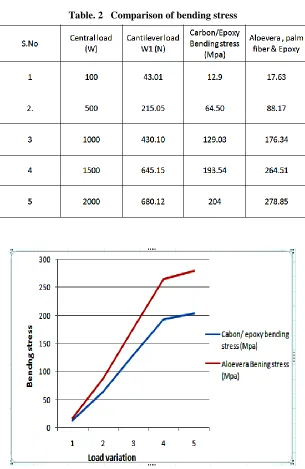
Comparison of Bending stress with Carbon/Epoxy Bending stress and Aloevera, palm fiber &
Epoxy
Table. 2 Comparison of bending stress
Comparison of Deformation stress with Carbon/Epoxy Bending stress and Aloevera, palm fiber &
Epoxy
Table.3 Comparison of Deformation stress
Fig.4 Comparison of bending stress
CONCLUSION
As a lot of work has been done in designing of leaf springs which is discussed briefly in this report, on the basis of this study, problems in overall weight reduction by using composite materials are identified. Many of the authors suggested various methods of designing, manufacturing and analyses of composite leaf springs. After studying all the available literature it is found that weight reduction can be easily
achieved by using composite materials instead of conventional steel, but there occurs a problem during the operation while using the composite leaf spring i.e. chip formation when the vehicle goes off road. Therefore there is an immense scope for the future work regarding use of (Aloe Vera, palm fiber) composite materials in leaf springs to reduce the overall weight of the vehicle as well as the cost of the vehicle.
REFERENCES
[2]. Pankaj saini, Ashish goel. Design and analysis of Composite Leaf Spring for Light Vehicles - International Journal of Innovative Research in Science, Engineering and Technology ISSN: 2319-8753, 2(5), 2013.
[3]. Senthil kumar, Ijayarangan . Analytical and Experimental Studies on Fatigue Life Prediction of Steel and Composite Multi-Leaf Spring for Light Passenger Vehicles using Life Data Analysis - ISSN 1392–1320 materials science (medžiagotyra). 13(2), 2007
[4]. Vinod sheshkar, Yogesh yadav . Finite Element Analysis of Mono Leaf Spring by using Hybrid Composite Material - International Research Journal of Engineering and Technology (IRJET)