ABEPRO
DOI: 10.14488/BJOPM.2017.v14.n4.a5
INTEGRATION OF CONCEPTS ABOUT LEAN CONSTRUCTION, SUSTAINABILITY AND LIFE
CYCLE OF BUILDINGS: A LITERATURE REVIEW
Alberto Eduardo Besser Freitag1, Rosley Anholon2, Valmir Martins de Oliveira3, Tomás Vivanco Larrain4
ABSTRACT
The purpose of this study was the development of a theoretical framework integrating concepts of lean con
-struction, sustainability and the life cycle of buildings. It was prepared using a systematic review of the literature through the Prisma method. Findings show that there is scarce scientific literature about lean construction contributions to ac
-tivities related to the consumption phase of the life cycle of a building. Project and construction ac-tivities presented the highest number of lean construction contributions in the production phase. Research limitations are terms used in the search sentences and the choice of surveyed databases. The study contributes with knowledge that can be used by com
-panies to adopt lean construction. It is also useful for researchers who can explore several research lines. The originality of this research is to view in a same table the interrelationship of concepts about lean construction, sustainability and the life cycle of buildings.
Keywords: Lean management, Construction industry, Sustainability, Life cycle, Brazil. 1 Fluminense Federal University - UFF
1. INTRODUCTION
The construction industry is one of the economic indi
-cators of success in the prosperity of a nation, since this sector has a substantial impact on Gross Domestic Product (GDP) and employment (Ibrahim et al., 2010). The authors reported that a 10% increase in the productivity of this sec
-tor would result in a GDP improvement estimated in 2.5 %, since the performance of the construction industry affects productivity in all sectors of the economy.
Brazil’s development and production capacity are directly related to the growth of the construction industry. This im
-plies new challenges for innovation, technology, profession
-al training and the establishment of business environments that promote productivity, business competitiveness and country development (FIRJAN, 2014).
An explanation for the persistent differences in produc
-tivity between companies, and between the respective countries where they are located, lies largely on variations of management practices (Bloom et Rennen, 2010). To measure management practices, the authors developed a research methodology and conducted almost 6,000 inter
-views, using a random sample of the population of all pub
-lic and private manufacturing companies with 100 to 5,000 employees.
The United States has, on average, the highest scores for management practices, followed by Germany, Japan, Swe
-den and Canada and then followed by a block of Central Eu
-ropean countries - France, Italy, Ireland, the UK and Poland - and Australia. The last places belong to southern European countries, such as Greece and Portugal, along with develop
-ing countries such as Brazil, China and India. Bloom et Re
-enen (2010) found that energy efficiency is strongly associ
-ated with a higher level of company management, probably because good management practices, such as lean manufac
-turing, tend to save on energy consumption.
Many studies have been published on the application of lean manufacturing practices and continuous improvement concepts in different sectors, such as healthcare (Senna et al., 2016; Ferreira et al., 2016; Paim et al., 2016; Maruyama
et al., 2016), paper packaging industry (Hidalgo Martins et
Cleto, 2016), construction (Nascimento et al., 2016; Martins
et al., 2016), automobile industry (Vanalle et al., 2009), sug
-ar and ethanol industry (Satolo et al., 2012), food (Endo et al., 2017) and beverage plants (Araujo et Castro, 2012).
EY and the engineering department of the Polytechnic School of the University of São Paulo (USP) developed a study (EY, 2014) about productivity in the construction in
-dustry. Personal interviews were conducted in eight compa
-nies and an online questionnaire was answered by 74 ex
-ecutives working in the sector in Brazil. Seven productivity levers were defined for the study, of which project planning and management methods such as lean construction - con
-struction based on waste reduction paradigms that became known as the Toyota production method - will be prioritized in 2015-2016, according to the interviewed professionals.
Productivity and innovation have a direct relation with sustainability. The search for competitiveness and sustain
-ability should influence the actions and positions of Brazilian industrial companies and other representative bodies, both industrial and governmental, as well as other organizations directly or indirectly related to the industrial issue (CNI, 2013).
According to the ISO 26000:2010 standards (ABNT, 2010), the goal of sustainable development is to achieve a state of sustainability for society as a whole and for the planet. The sustainability of an organization may or may not be compat
-ible with the sustainability of society as a whole, which is obtained when dealing with social, economic and environ
-mental aspects in an integrated manner, as mentioned in the classic work of Elkington (1998) on the Triple Bottom Line. Sustainable consumption, sustainable resource use and sus
-tainable livelihoods are relevant to all organizations and are related to society’s sustainability as a whole.
Martínez-Jurado et Moyano-Fuentes (2014) analyzed 58 articles, representing the state-of-the-art research on the links between Lean Management, Supply Chain Manage
-ment and Sustainability. About half of all studies have been conducted in the automotive sector and 17% of published papers dealt, simultaneously, with different sectors such as chemical, electronic, construction with wood, agro-food and financial, among others. Most studies in specific sectors were not significant enough to be analyzed individually, such as the construction industry.
This context demonstrates the importance of the con
-struction industry value chain for the world economy, and the need for Brazilian companies to adopt management methods to increase productivity, such as lean construction, respecting sustainability criteria. Analyzing the existing lit
-erature, an opportunity is observed to develop research to identify the interrelationships between lean construction, sustainability and the life cycle of a building. Thus, the study proposed herein complements the findings of the aforemen
-tioned documents, aiming to answer the following research question: “How to integrate concepts of lean construction, sustainability and the life cycle of a building?”
This question is expected to be answered by developing a theoretical framework integrating concepts of lean construc
detailing of activities related to the production and consump
-tion phases of the life cycle of a building, based on existing lit
-erature and identifying the contributions of lean construction for sustainability in its economic, social and environmental dimensions, based on state-of-the art literature.
This first section contains the context that led to the de
-velopment of this paper; the second section presents the material collected using a systematic review of the litera
-ture as the research method, involving phases, steps and activities of the life cycle of a building and lean construc
-tion contribu-tions towards sustainability; the third sec-tion presents the expected results for the objectives of this study and their discussion; while the fourth section presents the conclusions.
2. MATERIAL AND METHODS
The material for this paper was collected through a sys
-tematic literature review, conducted in four steps. First, a set of records resulting from the search sentences used at SciELO and Scopus scientific databases was identified. Then, a second set was selected, consisting of items that remained after the removal of duplicated and non-adherent records, as well as those with incomplete author information. At the final steps, a content analysis of the remaining documents was conducted in order to select those to be included in the literature review.
Initially the material used in preparing this study will be presented, encompassing existing scientific literature about phases, steps and activities of a building life cycle as well as contributions of lean construction for sustainability. Subse
-quently, the research method adopted in the present study will be detailed.
2.1. Material
2.1.1. Phases, steps and activities in the life cycle of a building from the construction industry
Life analysis is a methodology that attempts to identify, quantify and characterize the different potential environ
-mental impacts associated with each step of the useful life of a product (Calcedo et al., 2012). The authors compared a masonry structure with a reinforced concrete structure, us
-ing the Life Cycle Analysis by apply-ing the ISO 14040 and ISO 14044 standards, dividing the life of each of the materials that compose the structures into five steps:
1. The manufacturing, which includes the extraction of raw materials and the manufacturing process;
2. The delivery of the material to the consumption point;
3. The effort of putting the resources used in the con
-struction process;
4. The useful life of the used resources; and
5. Demolition and recycling.
Passuello et al. (2014), discuss the BRE 15804 standard, which evaluates the environmental performance of prod
-ucts related to the construction industry, through environ
-mental EPD labeling (Environ-mental Product Declaration), according to which five phases of the life cycle of buildings can be identified:
1. Product selection;
2. Construction;
3. Use;
4. End of life; and
5. Benefits and environmental loads.
In the same study, the authors listed the four steps of the Life Cycle Assessment, according to the NBR/ISO 14040 stan
-dard:
1. Definition of goal and scope;
2. Inventory analysis;
3. Impact assessment; and
4. Interpretation.
The concept of a construction system life cycle was con
-sidered in the research of Ortiz-Rodriguez et al. (2012), with the two phases described below, displaying materials, water and energy as inputs and solid waste, together with air, land and water emissions as outputs:
1. Construction, including the extraction and produc
-tion of construc-tion materials and transporta-tion to the construction site;
2. Use, including operation and maintenance.
Muñoz et al. (2012) considered a set of five unitary pro
-cesses for the Life Cycle Assessment of a house:
2. Transport and distribution;
3. Construction involving CO2 emissions and consump
-tion of energy and fuel;
4. Use or operation; and
5. Demolition.
The development of the integrated approach of Sus
-tainable Construction and Lean Construction philosophies should be analyzed within the life cycle of a project, accord
-ing to Martínez et al. (2009). Their research includes the steps of Design - Planning - Construction, and exclude Oper
-ation and Deconstruction steps, thus the entire Productive Cycle or Materialization of a construction project is taken into account. Other research phases will address the explo
-ration or use (ope-ration) steps and end of its useful life, with this being the final step, where reuse or recycling of each of the construction parts or components (deconstruction) should be considered. For the purpose of the analysis of the developed study, the considered steps were defined by the authors as:
1. Project: steps in which the engineering, construction and/or architecture drawings (in building projects) are developed, as well as the technical specifica
-tions and reference terms of the project are estab
-lished for budget and planning. The types of relevant equipment and machinery are also defined.
2. Planning: steps in which project activities are pro
-grammed and the final work methods, layout, sup
-pliers, inventory policies, acquisition programs for relevant equipment and machinery, quality and quantity of personnel and budget (among the most important elements of these steps), are defined.
3. Construction: steps in which the physical materi
-alization of the project with all necessary material (labor, equipment, materials, etc.) and immaterial (drawings, inventory policy, working protocols, etc.) resources is accomplished.
Diaz et al. (2010) consider the Life Cycle Analysis as one of the most accurate methods of environmental assessment, focusing on the sustainability of products, processes and services. The evaluation of the environmental impacts of concrete manufacturing technologies is a complex process, since many elements are involved, combined in different op
-erations and steps throughout their useful life. The develop
-ment of each of the possible life cycle steps of the material was divided into eight steps, to facilitate the analysis of the study:
1. Extraction of raw materials;
2. Transportation of raw materials;
3. Production of concrete components;
4. Component distribution to plants and construction sites;
5. Drawings and/or projects;
6. Construction and start-up;
7. Use;
8. Demolition. Reuse. Rehabilitation.
The life cycle steps of hydro-sanitary equipment are ad
-dressed by Kalbusch et Ghisi (2012) as follows:
1. Production: extraction, processing and transporta
-tion of raw material, purchase, processing and trans
-portation of recycled materials, equipment manu
-facturing (hydro-sanitary equipment industry), and equipment transportation;
2. Use: use and maintenance of the equipment;
3. Final provision: transportation, recycling and disposal.
Salgado et al. (2012) considered the life cycle of a building as divided into six steps:
1. Elaboration of the building program, which can be divided between environmental needs and project requirements (users);
2. Project development;
3. Definition of execution methods;
4. Implementation of the construction;
5. Use, operation and maintenance of the building; and
6. Demolition.
Sustainable construction, according to the authors, must meet the tripod that defines sustainability, including envi
-ronmental, social and economic aspects, as follows:
• Social: respecting the staff, relationship with local communities and establishment of partnerships;
• Economic: increasing productivity and profit, project improvement (product offered) and performance monitoring and reporting versus goals.
2.1.2. Contributions of lean construction for sustainability
The construction industry is continually evolving and moving forward with the use of new technologies, materi
-als and practices. According to Harper et Hazleton (2014), for new, inexperienced, construction engineers to succeed in the construction industry, they need to be well educat
-ed in the main knowl-edge of construction and engineering, as well as understand how to use new technologies and practices, such as BIM (Building Information Modeling), sus
-tainability and lean construction, effectively and efficiently. Sustainable construction requires almost the same basic knowledge than a traditional design, with differences in the details. These include changes in the materials and their procurement, innovations in lighting and energy, mechani
-cal and air quality innovations, as well as sanitary and water use efficiency. Some of the advantages in using the princi
-ples of lean construction include lower project costs, fewer delays, less uncertainty, less waste, more efficient buildings and facilities and higher customer satisfaction. In addition, studies have shown that sustainability and lean construction complement each other in construction projects (Harper et Hazleton, 2014).
Lean construction is now faced with the challenges of sustainable development, continuous improvement, waste elimination, a stronger focus on the user, the need to in
-crease the value for money coupled with high quality proj
-ect management and improved supply chains and commu
-nications. Ogunbiyi et al. (2014) presented an exploratory study on existing literature and the results of the use of a questionnaire, among construction participants, to explore the contribution of lean construction techniques application in sustainable construction. A survey was conducted with UK based professionals, and the global perspective of build
-ing industry professionals, accord-ing to the questionnaire, shows that benefits due to the integration of lean construc
-tion principles and sustainable construc-tion, within the con
-struction industry, are perceived. The improvement of the corporate image was deemed the most important benefit to synchronize lean construction and sustainability, while in
-creasing the morale and commitment of employees was the least important. Regarding the level of use of lean principles/ techniques to enable sustainability in respondents’ organi
-zations, just-in-time, visualization tools, value analysis, daily meetings and value stream mapping are the more common
lean tools/techniques, while Six Sigma is the least used. The study of Ogunbiyi et al. (2014) also identified several con
-necting areas between lean construction and sustainability, the most important being waste reduction, environmental management, value maximization and health and safety im
-provement, among others, while cost reduction was indicat
-ed as being the least important.
Sustainability and lean concepts can be applied to the construction industry to help minimize waste. Although both concepts work to alleviate similar problems, organiza
-tions find it difficult to integrate the concepts. Koranda et al. (2012) examined projects of different sizes and in different environments in the Midwest of the United States to deter
-mine what aspects hinder the integration of sustainability and lean concepts in the region. Professionals related to the industry were surveyed to identify sources of waste in sus
-tainable and lean projects. Based on case studies, various as
-pects of waste that exist in construction projects have been recognized, and a comparison of the interaction of lean con
-cepts and sustainability has been documented. A model for the planning of the entire construction process was deter
-mined so that waste can be reduced and the integration of lean concepts and sustainability gets more feasible. In the model of Koranda et al. (2012), performance indicators are the essential condition for designers and contractors to be able to integrate lean and sustainability concepts. Observing the indicators, stakeholders can allow for a better under
-standing in terms of where they are in the process of inte
-gration of lean and sustainability concepts.
Construction activities and the built environment have a huge effect on the environment, human health and the economy in general. Sustainable home building in the three dimensions of economic, environmental and social effects is achievable through technology and practical innovation (Nahmens et Ikuma, 2012). However, the biggest barrier to the widespread application of sustainable home building is the higher initial cost, largely attributable to the employees’ learning curve, building with them practical innovations and technologies, and the resulting additional cost of bad de
-fined construction processes. To meet these challenges and achieve the ideal of sustainable construction, the authors propose the use of lean construction as a viable and effec
-tive strategy, especially, the lean tool “kaizen”. Nahmens et Ikuma (2012) use several case studies to demonstrate the lean effect on the triple bottom line of sustainability in the construction of modular homes. Each case study highlights a dimension of sustainability. Lean construction resulted in a significant environmental impact, reducing material waste by 64%, a significant social effect, reducing or eliminating the main security risks due to excessive force, poor posture and worker accidents, and a significant economic effect, re
The lean manufacturing of autoclaved aerated concrete (AAC) is considered a highlight in the modern building mate
-rials industry (Boggelen, 2011). Crises, lower volume of con
-struction, excess capacity and sustainability requirements have forced the construction industry to create higher prod
-uct quality, greater efficiency and lower manufacturing costs with new application ideas. The reduction of waste and en
-ergy reuse is a serious potential for the AAC industry to con
-tribute to a sustainable future. Based on a good fit between raw materials, technology and systems, lean manufacturing offers promising challenges for producers to reduce costs. According to Boggelen (2011), modern production technolo
-gies will support the AAC product development to achieve a better, faster, and, therefore, sustainable construction.
Construction companies are facing obstacles and chal
-lenges in the adoption of BIM (Building Information Model
-ing), since there is no clear guidance or study of best practic
-es from which to learn and build their capacity to use BIM in order to increase productivity, efficiency, quality and achieve competitive advantages in the global market, thus reaching environmental sustainability goals. The study of Arayici et al. (2011) aims to conduct a comprehensive and system
-atic evaluation of technologies relevant to BIM, as part of the adoption and implementation of BIM, to demonstrate how efficiency gains have been achieved through a lean architectural practice. The overall BIM implementation ap
-proach used a socio-technical view that, not only considers the implementation of technology, but also considers the socio-cultural environment that provides the context for its implementation. As a result of BIM adoption, Arayici et al. (2011) reported efficiency gains achieved through pilot proj
-ects; and the design process of the project was improved through the elimination of waste and generation of value.
Many actors argue that the construction industry moves toward a lean output, based on a way of working through processes, for cost and quality reasons. In this context, en
-gineering approaches using molded wood are considered competitive and environmentally advantageous. Tykkä et al. (2010) identified innovative companies in six European countries using molded wood and rated their sources of in
-novation. The common factor that leads these companies to innovate is that business opportunities arise from demo
-graphic changes in the environment outside the company, such as environmental sustainability and affordable housing for low-income groups. To address these opportunities, the companies used in the case studies implicitly acknowledged that the traditional approaches to design and construction on the building site are an incongruity. The companies, therefore, established internal prefabrication, including the development of methods based on lean production to en
-sure quality and effectiveness (Tykkä et al., 2010).
Currently, most engineering management approaches are concentrated in the outer world, that is, all what is visi
-ble (structures-processes-results). This situation has created low sustainability for these approaches and tools, since it overlooks central aspects of people’s individual and collec
-tive behavior. Based on this, various efforts are being carried out to integrate the inside and outside world of an organi
-zation, in order to draw the inside world (personality, affec
-tion, values, culture) as a space that facilitates the incorpo
-ration of effective management practices centered on the outside world, such as lean construction. Pavez et al. (2010) describe and analyze the theory of integral vision proposed by Wilber (2001, 2005, 2007), as a reference framework that allows strengthening the project management discipline, under the approach of lean construction.
2.2. Method
The purpose of the following described research method is to obtain knowledge available in the scientific literature to allow the development of a theoretical framework, inte
-grating concepts of lean construction, sustainability and the life cycle of a building, according to the concept displayed in Figure 1.
Sustainability
Production and consumption life cycle of a building
Lean
construction
Concept integration
Figure 1. Purpose of the research method
Source: The authors’ own.
A general strategy for conducting research is to use avail
-able data. In contrast to research strategies based on data, gathered first hand (experiments, surveys, field studies), data mining researchers make use of available second hand information. The source of such information includes data files generated from surveys and ethnographies (Singleton Jr. et Straits, 2010).
Systematic reviews are a specific way of identifying and synthesizing research evidence, with emphasis on (Robson, 2011):
• Providing a comprehensive coverage of the available literature in the field of interest;
• Following a detailed and explicit approach to the synthesis of the data; and
• The use of transparent and rigorous processes throughout.
Based on this, a qualitative research approach was adopt
-ed, using available data whose content has been analyzed through the Prisma method (Preferred Reporting Items for Systematic Reviews and Meta-Analyses), a guide of rec
-ommendations for systematic reviews of the literature de
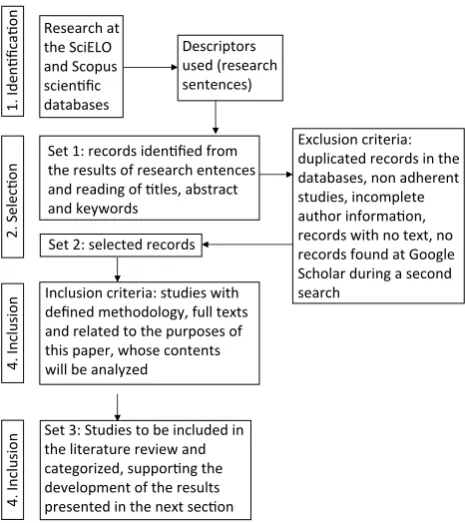
-scribed by Moher et al. (2009), using the flow of information through four steps (identification, selection, eligibility and inclusion) described in Figure 2, from data available at the SciELO and Scopus scientific databases.
1. Iden�fica�on
2. Selec�on
4. I
n
cl
usi
o
n
4. I
n
cl
usi
o
n
Research at the SciELO and Scopus scien�fic databases
Set 2: selected records
Set 3: Studies to be included in the literature review and categorized, suppor�ng the development of the results presented in the next sec�on Inclusion criteria: studies with defined methodology, full texts and related to the purposes of this paper, whose contents will be analyzed
Exclusion criteria: duplicated records in the databases, non adherent studies, incomplete author informa�on, records with no text, no records found at Google Scholar during a second search
Set 1: records iden�fied from the results of research entences and reading of �tles, abstract and keywords
Descriptors used (research sentences)
Figure 2. Flow of information through the four steps of a systematic review of the literature
Source: Compiled from Moher et al. (2009)
The research was conducted in two steps, the first dealing with the phases, steps and activities in the life cycle of con
-struction industry buildings (Table 1), and the second about contributions of lean construction for sustainability (Table 2).
The SciELO scientific database was chosen in Table 1, especially to obtain available data from countries in South America about the life cycle of buildings.
The Scopus scientific database is considered by Treinta et al. (2014) as being currently the largest database in view of the wide coverage of abstracts and literature citations it of
-fers; Thus, it was accessed to obtain state-of-the-art knowl
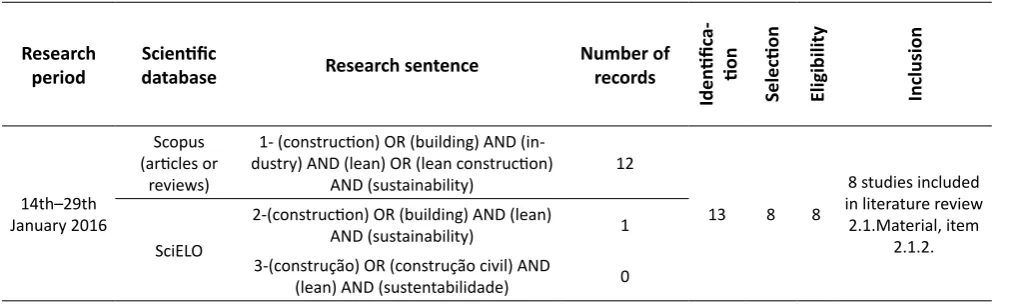
-edge about lean construction (Table 2). Considering that, after 2010, there is a leveling in the number of documents for the search sentence (construction) OR (building) AND (industry) AND (lean) OR (lean construction), that more than half of the records (163) are available from 2010 until January, 2016 and that this study was intended to be developed from recent lit
-erature, it was decided to limit the review from 2010 onwards.
3. RESULTS AND DISCUSSION
The main result of this study is the development of a
the-oretical framework integrating concepts of lean construc
-tion, and sustainability and the life cycle of a building. To do this, the interrelationships between activities linked to the production and consumption phases of the life cycle of a building must be studied first, followed by the interrelation
-ships of lean construction and economic, social and environ
-mental sustainability.
Analyzing the literature review of subsection 2.1.1., Phases, steps and activities in the life cycle of construction in -dustry buildings, it can be realized that the eight documents addressed phases, steps and activities, ranging from two to eight. Table 3 displays the results of the consolidation of all 14 activities identified in the literature review, dividing the life cycle in two phases, each one with two steps. The first is the production phase, comprising the steps of development and construction, with a total of 10 activities. The second
Table 1. Research about phases, steps and activities related to the life cycle of buildings
Research
period databaseScientific Research sentence Number of records
Iden
tific
a
-tion
Selection Eligibility Inclusion
5th–13th
January 2016 SciELO
1- (ciclo) AND (vida) AND (con
-strução) 30
65 8 8 8 studies included in literature review 2.1.Ma-
-terial, item 2.1.1. 2-(construction) OR (building) AND
(life cycle) 35
is the consumption phase, comprising the steps of use and deconstruction, with a total of four activities.
Activity 10 (construction) was the most frequently cited by the authors of the analyzed studies, followed by activi
-ty 11 (use, operation and maintenance) and activi-ty 4 (ex
-traction of aggregates and other raw materials). It is inter
-esting to note the few studies available about life cycles of hydro-sanitary equipment (sinks, toilets, faucets, etc.), which are part of the life cycle of any building. Likewise, the existence of a program for the whole construction of the building (activity 1) was also relatively unexplored, despite its importance, because it influences, directly or indirectly, the 13 remaining activities in order to ensure an adequate life cycle, which meets the environmental and design needs, aiming to satisfy customers, users and society.
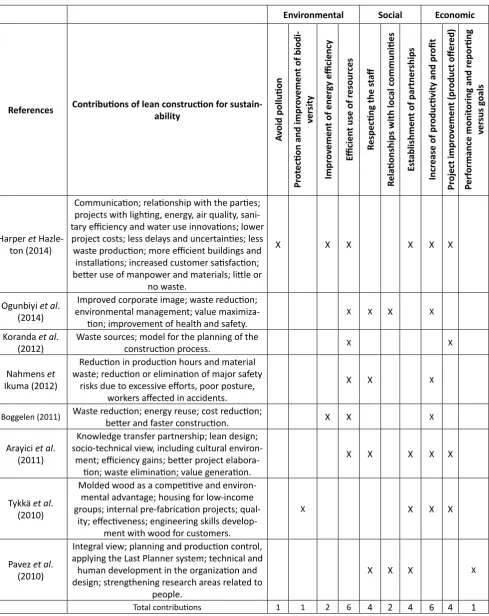
Analyzing the literature review of subsection 2.1.2., Con -tributions of lean construction for sustainability, it was pos
-sible to build Table 4, with the result of the consolidation of the main contributions of lean construction for sustain
-ability, identified from the literature review, in alignment with the tripod that defines sustainability itself, including environmental, social and economic aspects and their sub-themes (Salgado et al., 2012).
The results indicate that almost all authors address eco
-nomic, social and environmental aspects in their studies. Only for two authors it was not possible to establish a direct relationship with social aspects (Koranda et al., 2012; Bog
-gelen, 2011).
The environmental aspect had one of the most cited sub-themes, “efficient use of resources”; however, the other sub-themes merited little attention, which denotes research deepening opportunities in the sub-themes “avoid pollu
-tion,” “protection and improvement of biodiversity” and “improvement of energy efficiency.”
Table 2. Research about contributions of lean construction for sustainability
Research
period Scientific database Research sentence Number of records
Iden
tific
a
-tion
Selection Eligibility Inclusion
14th–29th January 2016
Scopus (articles or
reviews)
1- (construction) OR (building) AND (in
-dustry) AND (lean) OR (lean construction)
AND (sustainability) 12
13 8 8
8 studies included
in literature review
2.1.Material, item 2.1.2. SciELO
2-(construction) OR (building) AND (lean)
AND (sustainability) 1
3-(construção) OR (construção civil) AND
(lean) AND (sustentabilidade) 0
Source: The authors’ own.
The social aspect was well quoted in the sub-themes “re
-spect with staff” and “establishment of partnerships”, but the sub-theme “relationship with local communities” can be further explored.
The economic aspect also had one of the most cited sub-themes, “increase of productivity and profit,” obviously, very much in line with the precepts of the lean management philosophy. The sub-theme “project improvement (product offered)” was also mentioned several times. Strangely the subtheme “performance monitoring and reporting versus goals” received few contributions, indicating that its rela
-tionship for sustainability deserves attention in future re
-search.
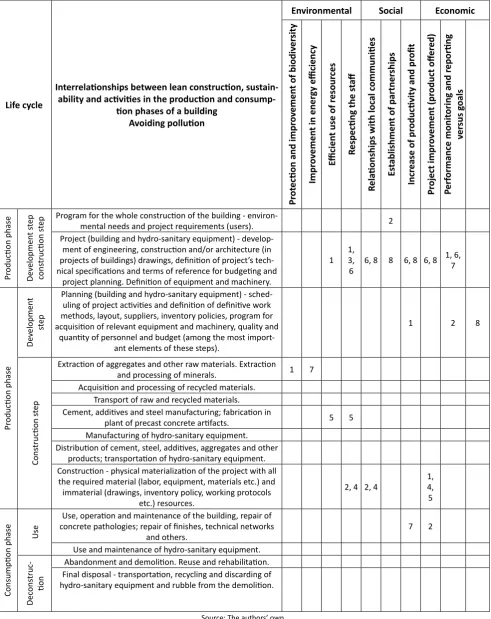
The theoretical framework, integrating concepts of lean construction, sustainability and the life cycle of a building in the construction industry (Table 5), was compiled from the 14 activities of the life cycle of a building, described in Table 3, and its relationship with the tripod, which defines sustainability, including environmental, social and economic aspects (Salgado et al., 2012), as well as the contributions of lean construction for sustainability, listed in Table 4.
The numbers presented in Table 5 are the references to the documents about lean construction with contributions for sustainability, and their more adherent alignment with the 14 activities of a building life cycle, as follows: (1) Harp -er et Hazleton, (2) Ogunbiyi et al., (3) Koranda et al., (4) Nahmens et Ikuma, (5) Boggelen, (6) Arayici et al., (7) Tykkä
et al. and (8) Pavez et al.
From the results, it was found that the vast majority of studies included in the literature review are about contri
Table 3. Life cycle activities of production and consumption phases in buildings
Life cycle
Activities in the production (development and construction steps) and consumption (use and
deconstruction steps) phases Calcedo et al. (2012)
References
Passuello e
t al. (2014)
Ortiz-R
odrigue
z e
t al. (2012)
Muño
z e
t al.(2012)
Martine
z e
t al. (2009)
Díaz e
t al. (2010)
Kalbusch e
t Ghisi (2012)
Salg
ado e
t al.(2012)
Pr
oduction phase
De
velopmen
t s
tep
Program for the whole construction of the building -
environmental needs and project requirements (users). X
Project (building and hydro-sanitary equipment) - devel
-opment of engineering, construction and/or architec
-ture drawings (in projects of buildings), definition of projects’ technical specifications and terms of reference for budgeting and project planning. Equipment, machin
-ery definition.
X X X X
Planning (building and hydro-sanitary equipment) - scheduling of project activities and definition of definitive work methods, layout, suppliers, inventory policies, program for acquisition of relevant equipment
and machinery, quality and quantity of personnel and budget (very important).
X X
Pr
oduction phase
Cons
truction s
tep
Extraction of aggregates and other raw materials. Ex
-traction and processing of minerals. X X X X X
Acquisition and processing of recycled materials. X
Transport of raw and recycled materials. X X X
Cement, additives and steel manufacturing; fabrication
in plant of precast concrete artifacts. X X X
Manufacturing of hydro-sanitary equipment. X
Distribution of cement, steel, additives, aggregates and other products, and transportation of hydro-sanitary
equipment. X X X X
Construction - physical materialization of the project with all the required material (labor, equipment, mate
-rials, etc.) and immaterial (drawings, inventory policy, working protocols, etc.) resources.
X X X X X X X
Consump
tion phase
Use
Use, operation and maintenance of the building, repair of concrete pathologies; repair of finishes, technical
networks and others. X X X X X X
Use and maintenance of hydro-sanitary equipment. X
Dec
ons
truction
Abandonment and demolition. Reuse and rehabilita
-tion. X X X X
Final disposal - transportation, recycling and discard
-ing of hydro-sanitary equipment and rubble from the
demolition. X X
Table 4. Contributions of lean construction for sustainability
Environmental Social Economic
References Contributions of lean construction for sustainability
-Av
oid pollution
Pr
ot
ection and impr
ov
emen
t of biodi
-ver
sity
Impr
ov
emen
t of ener
gy e
fficiency
Efficien
t use of r
esour
ces
Respecting the s
ta
ff
Rela
tionship
s with loc
al c
ommunities
Es
tablishmen
t of partner
ship
s
Incr
ease of pr
oductivity and pr
ofit
Pr
oject impr
ov
emen
t (pr
oduct off
er
ed)
Perf
ormance monit
oring and r
eporting
ver
sus g
oals
Harper et Hazle
-ton (2014)
Communication; relationship with the parties; projects with lighting, energy, air quality, sani
-tary efficiency and water use innovations; lower project costs; less delays and uncertainties; less waste production; more efficient buildings and
installations; increased customer satisfaction; better use of manpower and materials; little or
no waste.
X X X X X X
Ogunbiyi et al. (2014)
Improved corporate image; waste reduction; environmental management; value maximiza
-tion; improvement of health and safety. X X X X
Koranda et al.
(2012) Waste sources; model for the planning of the construction process. X X
Nahmens et Ikuma (2012)
Reduction in production hours and material waste; reduction or elimination of major safety
risks due to excessive efforts, poor posture, workers affected in accidents.
X X X
Boggelen (2011) Waste reduction; energy reuse; cost reduction; better and faster construction. X X X
Arayici et al. (2011)
Knowledge transfer partnership; lean design; socio-technical view, including cultural environ
-ment; efficiency gains; better project elabora
-tion; waste elimina-tion; value generation.
X X X X X
Tykkä et al. (2010)
Molded wood as a competitive and environ
-mental advantage; housing for low-income groups; internal pre-fabrication projects; qual
-ity; effectiveness; engineering skills develop
-ment with wood for customers.
X X X X
Pavez et al. (2010)
Integral view; planning and production control, applying the Last Planner system; technical and human development in the organization and design; strengthening research areas related to
people.
X X X X
Total contributions 1 1 2 6 4 2 4 6 4 1
Table 5. Theoretical framework integrating concepts of lean construction, sustainability and life cycle of a building.
Life cycle
Interrelationships between lean construction, sustain
-ability and activities in the production and consump
-tion phases of a building Avoiding pollution
Environmental Social Economic
Pr
ot
ection and impr
ov
emen
t of biodiv
er
sity
Impr
ov
emen
t in ener
gy e
fficiency
Efficien
t use of r
esour
ces
Respecting the s
ta
ff
Rela
tionship
s with loc
al c
ommunities
Es
tablishmen
t of partner
ship
s
Incr
ease of pr
oductivity and pr
ofit
Pr
oject impr
ov
emen
t (pr
oduct off
er
ed)
Perf
ormance monit
oring and r
eporting
ver
sus g
oals
Pr
oduction phase
De
velopmen
t s
tep
cons
truction s
tep Program for the whole construction of the building - environmental needs and project requirements (users). - 2 Project (building and hydro-sanitary equipment) - develop
-ment of engineering, construction and/or architecture (in projects of buildings) drawings, definition of project’s tech
-nical specifications and terms of reference for budgeting and project planning. Definition of equipment and machinery.
1 1, 3,
6 6, 8 8 6, 8 6, 8 1, 6, 7
Pr
oduction phase
De
velopmen
t
ste
p
Planning (building and hydro-sanitary equipment) - sched
-uling of project activities and definition of definitive work methods, layout, suppliers, inventory policies, program for acquisition of relevant equipment and machinery, quality and
quantity of personnel and budget (among the most import
-ant elements of these steps).
1 2 8
Cons
truction s
tep
Extraction of aggregates and other raw materials. Extraction
and processing of minerals. 1 7
Acquisition and processing of recycled materials. Transport of raw and recycled materials. Cement, additives and steel manufacturing; fabrication in
plant of precast concrete artifacts. 5 5
Manufacturing of hydro-sanitary equipment. Distribution of cement, steel, additives, aggregates and other
products; transportation of hydro-sanitary equipment. Construction - physical materialization of the project with all
the required material (labor, equipment, materials etc.) and immaterial (drawings, inventory policy, working protocols
etc.) resources.
2, 4 2, 4 1, 4, 5
Consump
tion phase
Use
Use, operation and maintenance of the building, repair of concrete pathologies; repair of finishes, technical networks
and others. 7 2
Use and maintenance of hydro-sanitary equipment.
Dec
ons
truc
-tion
Abandonment and demolition. Reuse and rehabilitation. Final disposal - transportation, recycling and discarding of hydro-sanitary equipment and rubble from the demolition.
Regarding the development step, the life cycle activity 2 (project) received most lean construction contributions from the literature, especially in the sub-themes “efficient use of resources” of the environmental aspect and “project improvement (product offered)” from the economic aspect. As previously identified, activity 1 (program for the whole construction of the building), despite its importance, has been little explored so far, only with the sub-theme “rela
-tionship with local communities,” from the social aspect. It is likely that there are research development opportunities also in connection with the contributions of environmental and economic aspects to this activity. Activity 3 (planning) also had few contributions, only the sub-theme “establish
-ment of partnerships” of the social aspect and sub-themes “project improvement” and “performance monitoring and reporting versus goals” of the economic aspect. The impor
-tance of this activity is supported by the EY (2014) study, that identified this activity as one of the productivity levers that will be prioritized in 2015-2016 by the interviewed ex
-ecutives.
In the construction steps, the life cycle activity with more contributions received from lean construction was the actu
-al construction activity (10), especi-ally in the sub-theme “in
-crease of productivity and profit” from the economic aspect. Activity 5 (acquisition and processing of recycled materials) and activity 8 (manufacturing of hydro-sanitary equipment) did not receive contributions from the surveyed studies, rep
-resenting a further research development opportunity, es
-pecially for manufacturers of metals and ceramics. Similarly, there were no lean construction contributions for activities 6 (transportation of raw and recycled materials) and 9 (dis
-tribution of cement, steel, additives, aggregates and other products, and transportation of hydro-sanitary equipment.). These two activities have as core a logistical component, so they are also a research opportunity with good contribution prospects in the sub-theme “establishment of partnerships” from the social aspect, and “increase of productivity and profit” from the economic aspect.
There were virtually no contributions to the consumption phase, only two in activity 11 (use, operation and maintenance), at the use step. A comment is relevant at this step about the contribution to the sub-theme “establishment of partnerships”, in the social aspect of sustainability, from the study of Tykkä et al. (2010), who identified, alongside the surveyed companies, that a key barrier to their business was the lack of engineering skills with molded wood in their customers’ organizations. This led these companies to develop skills in construction projects with molded wood on their client teams, which include internal prefabrication through processes based on lean production to ensure quality and effectiveness.
Skill acquisition necessarily involves education, that is, learning lean construction concepts and tools in technical
schools and universities, to ensure professional training aligned to market needs.
Still in the use step, no studies are available with inputs for activity 12 (use and maintenance of hydro-sanitary equipment), which comprises sinks, toilets, faucets, etc., thus, representing an in-depth research opportunity in this area. Finally, in the deconstruction phase, encompassing ac
-tivities 13 (abandonment and demolition, reuse and reha
-bilitation) and 14 (final disposal - transportation, recycling and discarding), no contributions from the literature were observed, representing a wide field for future research.
4. CONCLUSION
This study showed the importance of the construction in
-dustry for the world economy and the need for the Brazilian companies of this sector to adopt management methods to increase productivity, such as lean construction, respecting sustainability criteria.
Based on these findings, the present study attempted to address the research problem of how to integrate concepts of lean construction, sustainability and the life cycle of a building.
The research question was answered, achieving the main objective of the study, which was to develop a theoretical framework integrating concepts of lean construction, sus
-tainability and the life cycle of a building, through a system
-atic review of the scientific literature, using the Scopus and SciELO scientific databases. The specific objectives were also achieved, detailing activities related to the production and consumption phases of the life cycle of a building, as well as the contributions of lean construction for sustainability in its economic, social and environmental dimensions.
The discussion indicates that there is still relatively little scientific literature on lean construction contributions for activities related to the use and deconstruction steps of the consumption phase of the life cycle of a building, represent
-ing vast opportunities for future research. Project activities, at the development step, and construction activity, at the step with the same name, were those with the highest num
-ber of lean construction contributions in the production phase of the life cycle.
The life cycle of hydro-sanitary equipment (sinks, toilets, faucets, etc.), which is part of the life cycle of any building, has been little explored so far. Likewise, it is important to conduct further research, involving the contribution of lean construction in the programming and planning of a building, to ensure an adequate life cycle, which meets environmen
Finally, to encourage companies of the construction in
-dustry sector to adopt lean construction, it is essential that lean construction concepts and tools are taught in techni
-cal schools and universities, to ensure trained professionals aligned to market needs.
Despite the contributions brought by this study, there are limitations in the research, primarily related to the keywords used in the applied search sentences, as well as the choice of the surveyed scientific bases, which led to the findings.
Even with these limitations, it is understood that this study provides a new way of organizing knowledge from the scientific literature, allowing viewing, in a same table, the in
-tegration and interrelationships of concepts about lean con
-struction, sustainability and the life cycle of a building. The findings can contribute so that more companies adopt lean construction as a way to increase their productivity, as well as the productivity of the construction industry sector and of the country. This study is also useful for researchers who can explore several research lines from the results, developing new scientific papers.
REFERENCES
Araujo, F.O.; Castro, F.P. (2012), “Proposal for OEE (overall equipment effectiveness) indicator deployment in a bevera
-ge plant”, Brazilian Association for Industrial Engineering and Operations Management (ABEPRO), Vol 9, No 1.
Arayici, Y. et al. (2011), “Technology adoption in the BIM implementation for lean architectural practice”, Automation in Construction, Vol. 20, pp. 189–195.
Associação Brasileira de Normas Técnicas – ABNT (2010), NBR ISO 26000, Diretrizes sobre responsabilidade social, As
-sociação Brasileira de Normas Técnicas, Rio de Janeiro. Bloom, N.; Reenen, J. V. (2010), “Why do management practices differ across firms and countries?”, Journal of Eco
-nomic Perspectives, Vol. 24, No. 1, pp. 203-224, available at http://worldmanagementsurvey.org/wp-content/ima
-ges/2010/07/Why-Do-Management-Practices-Differ-Across
--Firms-and-Countries-Bloom-and-Van-Reenen.pdf. (Accessed on March, 2015).
Boggelen, W.M.V. (2011), “The contribution of AAC in se
-curing a sustainable future. AAC innovations from a life cycle perspective”, Cement, Wapno, Beton.
Calcedo, J.G.S. et al. (2012), “Análisis comparativo en base a la sostenibilidad ambiental entre bóvedas de albañileria y estructuras de hormigón”, Revista Ingeniería de Construcción, Vol. 27, No. 1.
Confederação Nacional da Indústria - CNI (2013), Mapa es
-tratégico da indústria 2013-2022, 2. Ed. Brasília: CNI, available at http://cni.org.br. (Accessed on March, 2015).
Díaz, V. A. O’R. et al. (2010), “Las tecnologías del concreto en su ciclo de vida”, Concreto y cemento, investigación y de
-sarrollo, Vol. 1, No. 2.
Elkington, J. (1998), “Accounting for the triple bottom line”, Measuring Business Excellence, Vol. 2, No. 3, pp. 18-22.
Endo, L. M. A. et al. (2017), “Descriptive and comparative study of the purchasing activity: a case study in a food com
-pany”, Brazilian Journal of Operations & Production Mana
-gement, Vol 14, No. 2, DOI: http://dx.doi.org/10.14488/BJO
-PM.2017.v14.n2.a14. (Accessed on July 31, 2017).
EY. (2014), Estudo sobre produtividade na construção ci
-vil: desafios e tendências no Brasil. São Paulo: EY, available at http://ey.com.br. (Accessed on March, 2015).
Federação das Indústrias do Estado do Rio de Janeiro - FIR
-JAN (2014), Construção Civil: Desafios 2020, Rio de Janeiro: FIRJAN, available at http://www.firjan.org.br. (Accessed on March, 2015).
Ferreira, W. et al. (2016), “Lean & Healthcare organizations – a systematic literature review with bibliometric analysis on application of lean healthcare in Brazil”, Brazilian Journal of Operations & Production Management, Vol 13, No. 4, DOI: http://dx.doi.org/10.14488/BJOPM.2016.v13.n4.a2. (Acces
-sed on July 31, 2017).
Harper, C.; Hazleton, R. (2014), “New Engineer’s Knowled
-ge for Success with Subcontractors and Trade Partners”, Prac
-tice Periodical on Structural Design and Construction, Vol. 19, No. 1, February 1.
Hidalgo Martins, G.; Cleto, M. G. (2016), “Value stream mapping and earned value analysis: a case study in the paper packaging industry in Brazil”, Brazilian Journal of Operations & Production Management, Vol 13, No. 3, DOI: http://dx.doi. org/10.14488/BJOPM.2016.v13.n3.a13. (Accessed on July 31, 2017).
Ibrahim, A. R. B. et al. (2010), “Analyzing the dynamics of the global construction industry: past, present and future”, Benchmarking: An International Journal, Vol. 17, No. 2, pp. 232-252.
Kalbusch, A.; Ghisi, E. (2012), “Método para quantificação do consumo energético no ciclo de vida de equipamentos hi
-drossanitários”, Ambiente Construído, Porto Alegre, Vol. 12, No. 3, pp. 57-73.
Koranda, C. et al. (2012), “An Investigation of the Applicabi
-lity of Sustainabi-lity and Lean Concepts to Small Construction Projects”, KSCE Journal of Civil Engineering. Vol. 16, No. 5, pp. 699-707.
Martínez, P. et al. (2009), “Integración conceptual Green
--Lean en el diseño, planificación y construcción de proyectos”, Revista Ingeniería de Construcción, Vol. 24, No. 1.
A Literature Review”, Journal of Cleaner Production, Vol. 85, pp. 134-150.
Martins, V. W. B. et al. (2016), “Problem-based learning method use in the civil construction organizational environ
-ment”, Brazilian Journal of Operations & Production Mana
-gement, Vol 13, No. 1, DOI: http://dx.doi.org/10.14488/BJO
-PM.2016.v13.n1.a9. (Accessed on July 31, 2017).
Maruyama, Ú. et al. (2016), “Lean e-health care: its per
-formance improvement based on Brazilian university case study”, Brazilian Journal of Operations & Production Mana
-gement, Vol. 13, No. 4, DOI: http://dx.doi.org/10.14488/BJO
-PM.2016.v13.n4.a4. (Accessed on July 31, 2017).
Moher D. et al. (2009), “Preferred Reporting Items for Systematic Reviews and Meta-Analyses: The PRISMA State
-ment”, PLoS Medicine, available at http://www.ncbi.nlm.nih. gov/pmc/articles/PMC2707599/. (Accessed on December 22, 2015).
Muñoz, C. et al. (2012), “Estudio del flujo energético en el ciclo de vida de una vivienda y su implicancia en las emisio
-nes de gases de efecto invernadero, durante la fase de cons
-trucción. Caso Estudio: Vivienda Tipología Social. Región del Biobío, Chile”, Revista de la Construcción, Vol. 11, No. 3, pp. 125-145.
Nahmens, I. et Ikuma, L.H. (2012), „Effects of Lean Cons
-truction on Sustainability of Modular Homebuilding”, Journal of Architectural Engineering, Vol. 18, No. 2.
Nascimento, D. L. M. et al. (2016), “Project automation application with lean philosophy at the construction of oil re
-fining unit”, Brazilian Journal of Operations & Production Ma
-nagement, Vol. 13, No. 1, DOI: http://dx.doi.org/10.14488/ BJOPM.2016.v13.n1.a15. (Accessed on July 31, 2017).
Ogunbiyi, O. et al. (2014), “An empirical study of the impact of lean construction techniques on sustainable construction in the UK”, Construction Innovation, Vol. 14, No. 1. pp. 88-107.
Ortiz-Rodríguez, O. et al. (2012), “Environmental Impact of the Construction and Use of a House: Assessment of Building Materials and Electricity End-Uses in a Residential Area of the Province of Norte de Santander, Colombia”, Ingeniería Univer
-sidad Bogotá (Colombia), Vol. 16, No. 1, pp. 147-161.
Paim, R. et al. (2016), “Lean healthcare application in a surgical procedures appointment scheduling center in a ma
-ternity”, Brazilian Journal of Operations & Production Mana
-gement, Vol. 13, No. 4, DOI: http://dx.doi.org/10.14488/BJO
-PM.2016.v13.n4.a5. (Accessed on July 31, 2017).
Passuello, A. C. B et al. (2014), “Aplicação da Avaliação do Ciclo de Vida na análise de impactos ambientais de materiais de construção inovadores: estudo de caso da pegada de car
-bono de clínqueres alternatives”, Ambiente Construído, Porto Alegre, Vol. 14, No. 4, pp. 7-20.
Pavez, I. et al. (2010), “Improving the Effectiveness of New Construction Management Philosophies using the Integral Theory”, Revista de la Construcción, Vol. 9, No. 1, pp. 26-38.
Robson, C. (2011), Real World Research: a resource for users of social research methods in applied settings. 3rd Ed. West Sussex: John Wiley & Sons, Ltd., chapter 5, pp. 81-129.
Salgado, M. S. et al. (2012), “Produção de edificações sus
-tentáveis: desafios e alternativas”, Ambiente Construído, Por
-to Alegre, Vol. 12, No. 4, pp. 81-99.
Satolo, E. G. et al. (2012), “A multiple case study of sustai
-nability issues in companies from sugar and ethanol industrial sector”, Brazilian Association for Industrial Engineering and Operations Management (ABEPRO), Vol. 9, No. 2.
Senna, P. et al. (2016), “Study on techniques and tools used in the lean healthcare implementation: a literature review”, Brazilian Journal of Operations & Production Management, Vol. 13, No. 4, DOI: http://dx.doi.org/10.14488/BJOPM.2016. v13.n4.a1. (Accessed on July 31, 2017).
Singleton JR., R. A.; Straits, B. C. (2010), Approaches Social Research. 5th Ed., Oxford University Press, Inc., chapter 12, pp. 393-430.
Treinta, F. T. et al. (2014), “Metodologia de pesquisa biblio
-gráfica com a utilização de método multicritério de apoio à decisão”, Production, Vol. 24, No. 3., available at http://dx.doi. org/10.1590/S0103-65132013005000078. Print version ISSN 0103-6513. (Accessed on March, 2015).
Tykkä, S. et al. (2010), “Development of timber framed firms in the construction sector — Is EU policy one source of their innovation?”, Forest Policy and Economics, Vol. 12, pp. 199–206.
Vanalle, R. M. et al. (2009), “Strategies of production in the automobile industry: a multi-case study in Spain and Brazil”, Brazilian Association for Industrial Engineering and Opera
-tions Management (ABEPRO), Vol. 6, No. 2. (Accessed on July 31, 2017).
Wilber, K. (2001), “A Theory of Everything: An Integral Vi
-sion for Business, Politics, Science and Spirituality”, Shambala Publications, Boston, USA, 189 pp.
Wilber, K. (2005), “The Integral Vision of Healing”, in Schlitz M, Amorok T, Micozzi MS, editors. Consciousness and healing: integral approaches to mind-body medicine. Elsevier/Chur
-chill Livingston, St Louis, USA.
Wilber, K. (2007), “The Integral Vision: A Very Short Intro
-duction to the Revolutionary Integral Approach to Life, God, the Universe, and Everything”, Shambala Publications, Bos