Volume-6 Issue-1
International Journal of Intellectual Advancements
and Research in Engineering Computations
Design and analysis of emission controlled silencer using zeolite
V.Vimala
1, S.Ravikumar
2, K.Santhosh
2, V.Venkadeshkumar
2, K.Vijayraj
21
Assistant Professor,
2UG Students
Department of Mechanical Engineering, Nandha College of Technology,
Erode-52, Tamil Nadu, India
1
[email protected]
Abstract : The abatement of nitrogen oxide (NOX) species, such as NO, NO2, and N2O from the exhaust gases of automotive as well as stationary sources is a very important aspect of emission control in terms of having a cleaner environment. The work presented in this paper aims at detecting and understanding some critical behaviour aspects of zeolite containing catalysts. An already available mathematical model for precious metal catalysts was used as a starting point. A specially designed set of experiments provided the information needed to improve some special modelling features. New sub-models were introduced to account for hydrocarbon and H2O adsorption, as well as diffusion limitations in the zeolite. The effect of flow maldistributions during real world operation is investigated experimentally and numerically. Although a number of issues (especially regarding the de-NOx mechanisms) are not fully resolved, significant progress was achieved as regards the understanding and prediction of zeolite catalyst operation.
Index words –Zeolites, Fly ash zeolites, Properties of zeolites.
I. INTRODUCTION
Catalytic converters have been widely used on vehicles and have already been proved for many years to be the most effective technical solution to reduce exhaust emissions from gasoline engines. The pollutants have negative effect on air quality, environment and human health that leads in stringent norms of pollutant emission. Numbers of alternative technologies like improvement in engine design, fuel pre-treatment, use of alternative fuels, fuel additives, exhaust treatment or better tuning of the combustion process etc. are being considered to reduce the emission levels of the engine. Out of various technologies available for automobile exhaust emission
control a catalytic converter is found to best option to control CO, HC and NOx emissions from petrol driven vehicles while diesel particulate filter andoxidation catalysts converter or diesel oxidation catalyst have so far been the most potential option to control particulates emissions from diesel driven vehicle. This review paper discusses automotive exhaust emissions control by catalytic converter using zeolite mineralsZeolites are crystalline minerals that are broadly present in nature and have been known to mankind for almost 250 years. Zeolites are crystalline micro porous minerals, built up of silicon, aluminum and oxygen atoms. Zeolite structures consist of silicon cations (Si4+) and aluminumcations (Al3+) that are surrounded by four oxygen anions (O2-). Each oxygen anion connects two cations and this yields a macromolecular three-dimensional frame work, with net neutral SiO2 and negatively charged AlO2 tetrahedral building blocks
.
Fig.1 Zeolite silencer
important class of reactions performed by zeolites is the acid-catalyzed reactions.
II. LITERATURE SURVEY
The main goal of this work was to derive the plausible reaction mechanisms for NO reduction by hydrocarbons with propene in particular being the reductant. The platinumloadedzeolites have been studied and the formation of intermediates on the catalystssurfaces has been detected. Pd/Al2O3
-based catalysts have been used as a referencematerial. Based on the infrared (IR) technique, the catalytic activity and performance ofthe catalysts have been investigated and the mechanism of NO reduction in leanconditions and at low temperatures has been derived. The reaction mechanisms can bedetermined via the combined analysis of gaseous products and the identification of theadsorbed surface species formed during thereactions, and likewise the kinetic equationscan be further derived for the C3H6-SCR of NOX. The kinetic analysis can
be utilised inthe reactor design. Studies were carried out by gas-IR and by in situ Diffuse ReflectanceInfrared Fourier Transform Spectroscopy, DRIFTS.The other main focus was to study the use of the infrared technique, in surface speciesidentification and activity experiments as well as in aciditymeasurements, and to studythe applicability of IR and DRIFT techniques as an engineering tool formechanisticstudies. Temperature Programmed Desorption (TPD) is used to investigate the adsorption
and desorption performances of the catalysts as a function of temperature.
III. MATERIALUSED IN FABRICATION Zeolite:
Zeolites represent a group of more than 50 soft, white aluminosilicate minerals of tectosilicate type, i.e., a three dimensional framework of interconnected tetrahedra, comprising (mostly) of aluminum, silicon and oxygen atoms . They consist of a crystalline structure built from AlO4 ½ _5_and SiO4 ½ _4_ ,bonded
together in such a way that all four oxygen atoms located at corners of each tetrahedron are shared with adjacent tetrahedral crystals as shown. As presented, if each tetrahedron in the framework contains silicon as its central atom, the overall structure becomes electrically neutral (as in Quartz, SiO2). In zeolite structures, some
of the quadri-charged silicon cations are replaced by
triply-charged aluminum, giving rise to a deficiency of positive charge. The sodeveloped charge is balanced by the presence of singly- and/or doubly-charged cations, such as sodium (Na+), potassium (K+), calcium
(Ca2+)and magnesium(Mg2+), elsewhere in the structure,
featuring spacious pores or rings. The general formula of a zeolite is Me2/n O _ Al2O3 _ xSiO2 _ yH2O, where,
Meis any alkali or alkaline earth atom, n is the charge on
that atom, x is the number of Si tetrahedron varying from 2 to 10, and y is the number of water molecules varying from 2 to 7.
Fig.2 Zeolite
The crystalline lattice structure of zeolites consists of exceptional lattice stability by virtue of which they facilitate considerable freedom of ion-exchange and reversible dehydration. Zeolites can accommodate new cations (mainly sodium,potassium, magnesium and calcium), water molecules and even small organicmolecules. Furthermore, ions and molecules in the cages are loosely bound so thatthey can be removed or exchanged without destroying the zeolitic framework.However, this depends on the chemical composition and the crystalline structures of
a specified zeolite. Zeolites in nature often, formed as crystals in small cavities of basaltic rocks over the years or as volcanic tuffs or glass altered by the interaction with saline water. These natural as alkaline deserts, lake sediments, ash ponds and marine sediments zeolites are formed in a number of geological environments such at relatively low temperature, under natural conditions. They also get crystallized in geologically young metamorphic rocks in mountainous regions.
IV. MODELING 1. Background:
The currently available model for PM based diesel catalysts will be employed as a starting point. Themodel describes the transient heat and mass transfer phenomena, as well as the heterogeneousreactions in the catalyst. A 2-dimensional grid is employed to simulate the cylindrical catalyst. Thegoverning mathematical equations have been described in detail elsewhere .
2. Flow maldistribution:
In order to predict the flow maldistribution at monolith inlet, a special technique is employed, whichcalculates the flow distribution by solving an equivalent hydraulic circuit, in which the diffuser isrepresented by suitable flow resistances. This technique is described in more detail in a previous paper.
3. Zeolite diffusion limitations:
An additional mass diffusion resistance is considered for the hydrocarbon species. According to therelated literature, this resistance follows an exponential temperature dependence. The pre-exponentialfactors and the activation energies are the independent parameters that should be fitted for each HC species
4. H2O, HC Adsorption – Desorption:
A further novel feature, which is introduced in the model in the frame of the present work is thesimulation of adsorption and desorption phenomena. The long-chain and the aromatics HC species aremuch keener to adsorption in the zeolite, compared to the short chain molecules. Based on thespeciation of total hydrocarbons emitted by a typical diesel engine, we can consider that the“adsorbable” HC species can be represented by decane and toluene.Since we deal with adsorption in microporouszeolite, we follow the principles of the Polanyiadsorption theory, extended by Dubinin and Radushkevich [5]. According to this model, the adsorbatein intimate contact with the solid is in liquid form. The equation of the DR isotherm gives theadsorbed mass at equilibrium xeq as function of temperature and partial pressure:Wateradsorption is also taken into account based on the same theory. An interesting feature of H2Oadsorption is the high amount of latent heat released during the process.The simulation of the adsorption of H2O and two different HC species (decane, toluene) leads to asystem of 3 differential equations for the adsorbed mass of each species vs time, which is solved by animplicit numerical procedure.
5. Reaction mechanisms and kinetics:
The NOx conversion levels observed with the specific catalyst at the tested conditions were too low to allow an identification of the prevailing DeNOx mechanism and the respective kinetics. Thus, we
willrestrict our attention to the catalyst performance as regards only CO and hydrocarbon conversion.This simplifies substantially our reaction scheme. H2 oxidation is typically taken into account, since itcontributes significantly in the overall reaction exothermy.The activation energies, the pre-exponential constants, as well as the inhibition constants are fitted in order to match the experimental with the model results for a variety of SGB tests.
V. EXPERIMENTAL
1. Catalyst type:
Two catalysts were tested in the frame of this work. The first catalyst (CATOX1) contained Pt (70g/ft3) and zeolite (Alumina/zeolite = 80/20 % mass). The second catalyst (CATOX2) contained thesame amount of Pt but the ratio Alumina/zeolite was 70/30 % mass.For the tests in the synthetic gas bench (see below), samples of 1” diameter and 3” length were used. Ageing? (PSA).In the driving cycle tests the catalyst (CATOX2) had a diameter of 5.6” and a length of 6’’. Thecatalyst was aged for 20h at full load engine operation.
2. Adsorption test:
A series of measurements in a Synthetic Gas Bench (SGB) was conducted with two catalystformulations to understand the adsorption – desorption phenomena in zeolite based catalysts anddetermine the parameters to be included in the model.The test protocol is the following: Starting from a clean catalyst at a stabilized temperature of 130°C,the flow mixture (2000 ppmC HC, 10% H2O, N2) passes through the catalyst sample (GHSV=70000h-1) for 500 s at constant inlet temperature (130°C). During this phase, the catalyst is saturated withHC. At time=500s, the HC injection in the gas mixture is cut-off. At the same time the temperature ofthe feed gas is steadily increased at a rate of 1K/s. The adsorbed hydrocarbon starts to desorb and theHC concentration at the exit is monitored until it becomes zero.
3. Light-off test:
4. MVEG driving cycle:
The CATOX2 catalyst was mounted on a vehicle (PSA – vehicle – engine displacement – catalyst
positioning).The exhaust gas analysis during the test included measurement of CO, HC, NOx, CO2, O2 before andafter the catalyst. A set of thermocouples was also installed at different positions before, after and inside the catalytic converter.
VI. FRAMEWORK STRUCTURE OF ZEOLITIC CRYSTAL
Each of the silicon and aluminiumtetrahedra, present in a zeolite, is popularly known as its primary building unit (PBU). Whereas, the simple geometrical shapes are created by inter linkage between two or more tetrahedra. Hence, the formed linkages are called secondary building units (SBU).
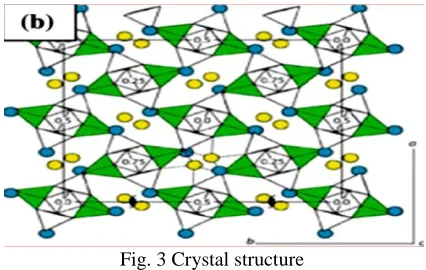
For example, the shape and dimension of channels and/or pores of some common zeolites are being depicted. It has been established that Si/Al ratios have considerable effect on other properties (viz., CEC, channel dimension, void volume and specific gravity). represents the zeolite, Analcime (ANA)-distorted 8-ring, viewed along [110], which has cubic shaped irregular channels of size (Å): 4.2 * 1.6.
Fig. 3 Crystal structure
Further, the frame work structure of zeolite can be correlated with its Si/Al ratio. It has been observed that, in general, with an increase in the Si/Al ratio, the zeolite structure gets transformed from 4-, 6- and 8-membered rings to 5-membered rings.
VII. WORKING PRINCIPLE
Zeolite plays roll as catalyst and absorbs toxic gases emitted from the engine. A zeolite converter is a device used to reduce the toxicity of emissions from an internal combustion engine. Catalytic converters are most commonly used in motor vehicle exhaust systems. Zeolite converters are also used on generator sets, forklifts, mining equipment, trucks, buses, trains, and other engine-equipped machines. A zeolite converter provides an environment for a chemical reaction wherein toxic combustion by-products are converted to less-toxic substances. Zeolites usually gain cations (viz., Na+, K+ and NH4 +)during the synthesis process or by
interaction with the surrounding medium by virtue of their ion exchange or adsorption characteristics. Based on these properties, the zeolites have been also found to adsorb gases and separate them for useful industrial applications. The most common gases being CO, CO2, SO2, H2S, NH3, HCHO, Ar, O2, N2, H2O, He, H2, Kr, Xe, CH2OH, Freon andFormaldehyde. The size and shape of crystals of minerals can be ascertained by interpreting theSEM micrographs of the raw materials (viz., fly ash) and the end products obtainedfrom the zeolitization process.
VIII. RESULT AND DISCUSSION
With the perspective to model as reliably as possible a zeolite containing diesel catalyst, the presentstudy led to a number of observations, useful for understanding and simulating the catalyst behavior.Specially designed adsorption tests carried out in the synthetic gas bench enabled us to understandand quantify the HC adsorption phenomena on the zeolite material, which are important especiallyduring the cold start. A series of light-off tests in the same bench provided valuable information onthe oxidation reaction kinetics of CO and four different HC species. At this stage, we did not haveenough information to model the de-NOx reaction mechanisms and estimate the respective kinetics.The predictions of CO, HC emissions as well as catalyst temperatures were impressively successful inthe simulation of the MVEG driving cycle, which is a quite demanding modeling case. The relativeimportance of different model assumptions was investigated. It was verified that a reliable modelingapproach for zeolite containing diesel catalysts should take into account: (a) adsorption phenomenafor hydrocarbons and water, (b) flow maldistributions, (c) accurate estimation of the oxidation kinetics, (d) accurate representation of the actual exhaust hydrocarbons by four HC species, (e)diffusion limitations in the zeolite.The presence of negatively charged microscopically small sized surface and/or internal pores of zeolites adds to their values as absorbent and/or adsorbent. They are also called as the
“molecular sieves” as cation exchange materials. Based on these attributes, zeolitesfind applications in separation and filtration processes.
REFERENCES
[1]. Chang, B.P., Akil, H.M., Nasir, R.B.M.,2013. Comparative study of micro- and nano-ZnO reinforced UHMWPE composites under dry sliding wear,Wear297,p. 1120.
[2]. Stamatelos A.M., Koltsakis G.C., Kandylas I.P., Pontikakis G.N., “Computer Aided Engineering in the
Design of Diesel Exhaust Aftertreatment Systems”,
[3]. M.A.Kalamet. al., “Development and test of a new
catalytic converter for natural gas fuelled engine”,
Sadhana, Vol.34, (2009), 467-481.
[4]. Stamatelos A.M., Koltsakis G.C., Kandylas I.P., Pontikakis G.N., “Computer Aided Engineering in
the Design of Diesel Exhaust Aftertreatment Systems”,
SAE paper 1999-01-0458 (1999).
[5]. Ansell G., Bennet P., Cox J., Frost J., Gray P., Jones A., Rajaram R., Walker A., Litorell M. and G. Smedler, "The development of a model capable of predicting diesel lean NOx catalyst performance under
transient conditions", Applied Catalysis B: