Volume 33, 2011
118
THE EFFECTIVENESS OF AGRO-DEALERS
IN ENHANCING DISSEMINATION AND
ADOPTION OF THE “PUSH PULL”
TECHNOLOGY AMONG SMALLHOLDER
FARMERS IN WESTERN KENYA
Stephen Wambugu Maina
Ministry of Agriculture, Narok South District, Nakuru, Kenya E-mail: [email protected]
John Gowland-Mwangi
Egerton University, Egerton, Kenya E-mail: [email protected]
Abstract
Despite “Push pull” technology’s (PPT) effectiveness in increasing maize yields by controlling Stem borer and striga weeds, its full benefits are yet to be realized. PPT involves planting Napier grass around maize intercropped with Desmodium. Agro-dealers are often used to spread PPT but knowledge of its effectiveness was inadequate. This study sought to provide the missing information using a cross-sectional research design to collect data from a proportional stratified random sample of 102 agro-dealers in Western Kenya. A valid, closed-ended questionnaire whose 0.85α reliability was above the 0.70 acceptable was used. Data were analysed using Chi-square at 0.05α set a priori. Results: Agro-dealers’ effectiveness in communicating PPT was independent of their knowledge of it, Desmodium plant or seriousness of the striga problem but depended on frequency at which farmers sought advice from them; gender, education and years in business did not affect agro-dealers’ effectiveness; and those visited most by farmers were more effective in disseminating PPT. Conclusions: Agro-dealers are appropriate for educating males and females and spreading PPT through them enhances adoption. Recommendations: Extension providers should train and involve agro-dealers in disseminating PPT and selling certified seeds.
Key words: agro-dealers, Desmodium seeds, effectiveness, farmers, maize, Napier grass, push-pull technology, Stem Borer, Striga weeds, Western Kenya.
Introduction
in the 21 century Volume 33, 2011 119 their yields by 30-100% on smallholder farms (Khan, midega, njuguna, amudavi, Wanyama & pickett 2008a). Striga hermonthica is a major biotic constraint to cereal production that can be controlled by trap crops (odhiambo, Vanlauwe, tabu,Kanampiu, & Khan, 2011). the international centre of insect physiology and ecology (icipe) with its collaborators has developed the “push pull” technology (ppt) in which farmers use napier grass planted in border rows and desmodium legume (silver leaf and Green leaf desmodium) intercropped with maize or sorghum to control these pests and improve soil fertility (Khan, midega, pittchar, pickett & bruce, 2011). the technology is appropriate and economical to the resource-poor the technology is appropriate and economical to the resource-poorthe technology is appropriate and economical to the resource-poor smallholder farmers in the region because it is based on locally available plants, no expensive external inputs, and fits well with traditional mixed cropping systems in africa (international centre of insect physiology and ecology, 2011).
a number of research projects have found the “push pull” technology to be effectivethe “push pull” technology to be effectiveto be effective (Woodward, 2011). but as with any such project, many useful agricultural research findings failany useful agricultural research findings fail to reach the intended users due to deficiencies in the delivery systems. it is important therefore to use appropriate extension methods to give farmers relevant agricultural technologies suchse appropriate extension methods to give farmers relevant agricultural technologies such as ppt as this may enhance their knowledge, skills and overall attitude towards agricultural attitude towards agriculturalattitude towards agricultural productivity (Government of Kenya, 2008). furthermore, knowledge of the adoption processadoption process may greatly improve the planning and implementation of successful research and extension programs (cramb, 2003). in Kenya, agro-dealers play a key role in the cereals’ production value chain as well as in agricultural extension. Kenya has a well established network of agro-dealers who link farmers with other stakeholders in the agro-inputs supply chain (aatf, 2008; the sower, 2008). agro-dealers provide farmers with farm inputs (seeds, tools, pesticides, and fertilizer), which are critical in raising crop and livestock productivity. many agro-dealers have a background in research, extension or entrepreneurship and by making quality agricultural information and advice as well as farm inputs readily available to farmers, they accelerate efficiency of the production process (blackie & albright, 2005; rockefeller foundation,(blackie & albright, 2005; rockefeller foundation,blackie & albright, 2005; rockefeller foundation, 2006).
the ‘push–pull’ technology (ppt) has been promoted and disseminated through different pathways each of which might have different uptake enhancement capabilities (murage, obare, chianu, amudavi, pickett, & Khan, 2011). this study sought to determine agro-dealers’ effectiveness in enhancing dissemination and adoption of the “push pull” technology, which is used to control Busiolla fusca and Striga hermonthica with the aim of increasing cereal production among smallholder farmers in Western Kenya. the study’s specific objectives were to determine the effectiveness of agro-dealers in disseminating information and adoption of “push pull” technology as well as the effectiveness of agro-dealers in stimulating demand for desmodium seeds among smallholder farmers in Western Kenya. the researchers hypothesized that possession of this missing information would enable extension providers in the ministry of agriculture, icipe and their development partners to more effectively disseminate information and their development partners to more effectively disseminate information on desmodium seeds, which would lead to greater adoption of the ppt among smallholder farmers in Western Kenya.
Problem of Research
scientists continue to develop improved technologies to increase farming efficiency and productivity but the rate of adoption of these technologies is still less than optimal. consequently, the full benefits of agricultural research are far from being realized. among the technologies whose full benefits are yet to be realized in Western Kenya is the effective, icipe-developed, low-cost and environmentally friendly ppt for controlling Busiolla fusca
Volume 33, 2011
120 how it was diffused to smallholder farmers using agro-dealers. insufficient empirical evidence on the effectiveness of agro-dealers in disseminating the ppt to smallholder farmers limited its full exploitation. this was a primary concern among researchers and extension providers who needed the information to enhance service delivery particularly with respect to input supply.
Research Focus
While selling farm inputs aimed at increasing crop and livestock productivity, agro-dealers advise farmers on how to use them. their well established network in Kenya links farmers with other stakeholders in the agro-inputs supply chain and the dealers are used by local and multi-national seed, fertilizer, and agro-chemical companies to exhibit and demonstrate new technologies to farmers (rockefeller foundation, 2007, the sower, 2008). at the time of the study, seed outlets in most districts of Western Kenya were few, unevenly distributed seed outlets in most districts of Western Kenya were few, unevenly distributedeed outlets in most districts of Western Kenya were few, unevenly distributedWestern Kenya were few, unevenly distributed were few, unevenly distributed and mostly found in big trading centres and because the dealers were concentrated in high production areas or where production of high value crops was practiced, farmers travelled long distances to buy seeds thereby incurring high transaction costs (Gordon, 2000). While local agro-dealers in the area supplied most of the seeds that farmers required, availability of certified desmodium seeds posed a big challenge because seed companies did not engage in commercial did not engage in commercialcommercial multiplication of desmodium seeds (Kibaara, 2006). unavailability of high quality certified(Kibaara, 2006). unavailability of high quality certified unavailability of high quality certified desmodium seeds made it harder for agro-dealers to stock them, which caused scarcity of the seeds and their inaccessibility by farmers. this situation left farmers using desmodium seeds of unknown quality.
according to dfid (2006), a seed dealer in Kenya required an operation permit of 70,000.00 Kenya shillings (Ksh 80 = us$ 1.00), which was unaffordable to many smallholder farmers. a favourable policy for seed production, certification, registration, packaging and supply prices would motivate the private sector to invest in the seed supply business. input suppliers’ costs, risks and uncertainty can be reduced by increased demand volumes and transaction sizes, which can be arranged between farm input suppliers and farmer organisations (blackie & albright, 2005; Gordon, 2000). the ‘push-pull’ technology developed by icipe offers an effective control of Busiolla fusca and Striga hermonthica and is simple, low-cost and environmentally friendly (Khan, 2007). in this technology, desmodium is planted between the rows of maize or sorghum to improve soil fertility and stability through nitrogen fixation. being a low-growing plant it does not interfere with the growth of maize. it also provides a highly nutritious animal feed.
despite the vegetative propagation of desmodium seeds being widespread, their shortage limits disseminating of the ppt (icipe, 2007). farmers have difficulties accessing the seeds because agro-dealers who are expected to sell them do not usually deal with some particular legume, tree or shrub seeds (dfid, 2006). marketers and business managers in general often(dfid, 2006). marketers and business managers in general often marketers and business managers in general oftenmarketers and business managers in general often want to estimate demand for the seeds in order to use the estimates for strategic and tactical planning (brennan, 2004). estimates of the potential number of buyers times the averageestimates of the potential number of buyers times the average quantity purchased by a buyer times the price gives helps in arriving at the total market potential (Kotler, 2002; solomon, marshall & stuart, 2006). insufficient demand for desmodium seeds limits their market size making it smaller than that of food crops and relatively unattractive to big seed companies, which leaves farmers selling uncertified seeds among themselves (odame,(odame,odame, musyoka & Kere, 2008). With this problem in mind, desmodium seed producers should inform potential buyers through radio, print and electronic media as well other communication channels where to get the seeds (Kotler, 2002; perreault & mccarthy, 2005).
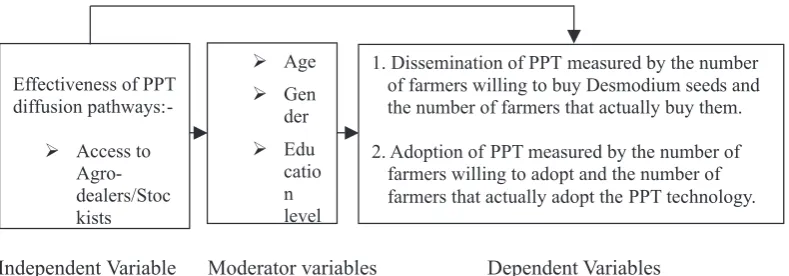
in the 21 century Volume 33, 2011 121 which an innovation is communicated to members of a social system (arumapperuma, 2008). the willingness and ability of intended users to adopt a new technology depend on their awareness, interest, evaluation and trial of the technology. according to rogers (1971), research on the effectiveness of communication pathways in the diffusion process was inadequate and although researchers continued to develop new technologies such the ppt to address farmers’ needs, improving farmers’ adoption rates was still a major challenge. the diffusion of innovation the diffusion of innovationthe diffusion of innovation theory provided an instrument for conducting and analyzing empirical data aimed at measuring agro-dealers’ effectiveness in disseminating ppt among farmers in Western Kenya.
independentVariable moderator variables dependent Variables
Figure 1: A conceptual framework for measuring the effectiveness of agro-dealers in enhancing dissemination and adoption of “Push-Pull” tech-nology.
Methodology of Research
General Background of Research
the study used a cross-sectional survey design, which is also called cross-sectional analysis, to collect and analyze data. the researchers chose this design for the study because it is faster and less expensive compared to cohort studies and it allows for hypotheses testing while providing self-reported facts on things that are not directly observable such as people’s beliefs, feelings, attitudes, opinions and habits (Kendall, 2007, Kombo & tromp, 2008, Kothari, 2008). cross-sectional surveys are used in all branches of science. they enable researchers to study and describe a population that is too large to observe directly (Kendall, 2007). since data is collected from a specific population at one point in time, chances for attrition are minimized. Western Kenya borders uganda to the west, tanzania to the south and lies between latitude 1° 8’ n and 1° 24’ s and between longitude 34° and 35° e (Jaetzold & schmidt, 1982, 1983).
Sample of Research
the study population comprised local agro-dealers located in districts of Western Kenya in which farmers practised ppt. a district-based proportionatestratified random sampling with consideration for agro-ecological, ethnical and market access diversity was used to select a sample of 102 agro-dealers from a list of 250 that was provided by the local staff of the ministry of agriculture prior to the beginning of the study. this sample size was considered adequate, precise and representative enough of the target population because according to the central limit theory, the sampling distribution of the mean tends to be closer to the normal distribution provided that the number of sample items is equal or more that 30 (frankfort-nachmais, 1997;
Effectiveness of PPT diffusion
pathways:- Access to Agro-dealers/Stoc kists
Age
Gen
der
Edu
catio n level
1. Dissemination of PPT measured by the number of farmers willing to buy Desmodium seeds and the number of farmers that actually buy them.
Volume 33, 2011
122 Kathuri & pals, 1993, Kothari, 2003). the districts from where the sample was drawn included districts from where the sample was drawn included bungoma south, teso, busia, Vihiga, siaya, bondo, butere, Kisii, Kuria, migori, rachuonyo and suba.
Instrument and Procedures
a closed-ended questionnaire, used to collect data from agro-dealers, enhanced consistency of responses across respondents. content validity was ascertained by a panel of 10 extension professionals drawn from egerton university and the international centre of insect physiology and ecology. the cronbach’s alpha coefficient was used to measure the instrument’s internal consistency while a pilot test involving 18 agro-dealers from homabay district showed that the questionnaire’s reliability was 0.85α, which was above the 0.70 minimum acceptable for educational research. prior to field data collection, the researchers sought and obtained a research permit from the national council of science and technology after which they make appointments with the selected respondents and explained to them the purpose of the study before asking them to complete the questionnaire. the responses recorded in the questionnaires were later transferred to an electronic database (spss version 11.5 software) for further analysis.
Data Analysis
the data were checked to ensure correct entry of the responses and summarized and classified according to the hypotheses and objectives of the study. all data obtained from the questionnaires were entered and analysed using the statistical package for social sciences (spss). descriptive and inferential statistics were used to describe and report information related to the variables of the study. cross-tabulation was utilised to compare situation of respondents along several variables and to determine the effects of various categorical variables. study findings were represented in form of discussions, charts and tables. the two null hypotheses of the study were tested using Chi-square at a confidence level of 0.05α.
Results of Research
in the 21 century Volume 33, 2011 123
Table 1. Agro-dealers’ personal characteristics and rating of the striga problem by length of years in business (N=120).
Agro-dealers characteristics Percent Seriousness of the striga problem Percent Female 25.5 Agro-dealers� ����� ��o�ledge o� s��r�ga ����� ��o�ledge o� s��r�ga 98.0
Male 74.5 Co�s��dered s��r�ga �ro�lem as� �er�� s�er�o�s� s��r�ga �ro�lem as� �er�� s�er�o�s� 50.0 O�era�ed ��s���es�s� for 01-05 ��rs� 61.8 Co�s��dered s��r�ga �ro�lem as� �er�o�s� s��r�ga �ro�lem as� �er�o�s� 37.3 O�era�ed ��s���es�s� for 06-10��rs� 28.4 Co�s��dered s��r�ga �ro�lem as� Modera�e s��r�ga �ro�lem as� Modera�e 11.8 O�era�ed ��s���es�s� for 11-15��rs� 3.9 Co�s��dered s��r�ga �ro�lem as� �es�s� s�er�o�s� s��r�ga �ro�lem as� �es�s� s�er�o�s� 1.0 O�era�ed ��s���es�s� for 16-20��rs� 2.9
O�era�ed ��s���es�s� for 21-30��rs� 1.0 O�era�ed ��s���es�s� for >30��rs� 2.0
Agro-dealers� from ���om farmers� s�o�g��� s�ol���o�s� for s��r�ga �ro�lem from ���om farmers� s�o�g��� s�ol���o�s� for s��r�ga �ro�lem 85.3 source: survey data (2011)
Table 2. Agro-dealers’ characteristics and rating of striga problem by educa-tion (N=120).
Agro-dealers’� rating of striga problem in their area rating of striga problem in their arearating of striga problem in their area
Agro-dealers characteristics Very serious Serious Moderate Less serious
Female(�= 26) 50.0 34.6 15.4 0.0
Male(�=76) 50.0 38.2 10.5 1.3
Pr�mar�� ed�ca��o� (�= 7) 85.7 0.0 0.0 14.3
�eco�dar�� (�=37) 59.5 27.0 13.5 0.0
College ed�ca��o� (�=44) 40.9 47.7 11.4 0.0
U���ers����� ed�ca��o� (�=14) 35.7 50.0 14.3 0.0
O�era�ed as� a� agro-dealer for 1-9 ��rs� (�=82) 54.9 32.9 12.2 0.0
O�era�ed as� a� agro-dealer for 10-19 ��rs� (�=15) 40.0 3.3 0.0 6.7
O�era�ed as� a� agro-dealer for 20-29 ��r (�=3) 0.0 66.7 33.3 0.0
O�era�ed as� a� agro-dealer for >30 ��rs� (�=2) 0.0 50.0 50.0 0.0
source: survey data (2011)
Volume 33, 2011
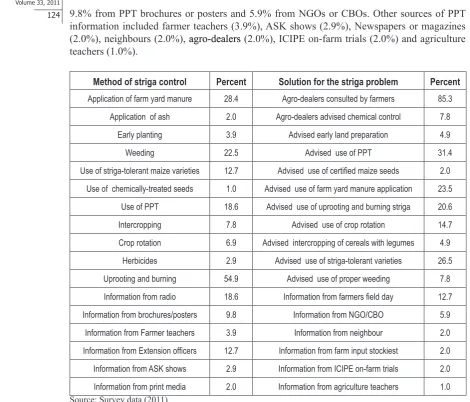
124 9.8% from ppt brochures or posters and 5.9% from nGos or cbos. other sources of ppt information included farmer teachers (3.9%), asK shows (2.9%), newspapers or magazines (2.0%), neighbours (2.0%), agro-dealersagro-dealers(2.0%), icipe on-farm trials (2.0%) and agriculture teachers (1.0%).
Method of striga control Percent Solution for the striga problem Percent
A��l�ca��o� of farm ��ard ma��re 28.4 Agro-dealers� co�s��l�ed ��� farmers� 85.3
A��l�ca��o� of as��� 2.0 Agro-dealers� ad��s�ed c��em�cal co��rol 7.8
Earl�� �la����g 3.9 Ad��s�ed earl�� la�d �re�ara��o� 4.9
Weed��g 22.5 Ad��s�ed �s�e of PPT 31.4
Us�e of s��r�ga-�olera�� ma�ze �ar�e��es� 12.7 Advised use of certified maize seeds 2.0
Us�e of c��em�call��-�rea�ed s�eeds� 1.0 Ad��s�ed �s�e of farm ��ard ma��re a��l�ca��o� 23.5
Us�e of PPT 18.6 Ad��s�ed �s�e of ��roo���g a�d ��r���g s��r�ga 20.6
I��ercro����g 7.8 Ad��s�ed �s�e of cro� ro�a��o� 14.7
Cro� ro�a��o� 6.9 Ad��s�ed ���ercro����g of cereals� ����� leg�mes� 4.9
Her��c�des� 2.9 Ad��s�ed �s�e of s��r�ga-�olera�� �ar�e��es� 26.5
U�roo���g a�d ��r���g 54.9 Ad��s�ed �s�e of �ro�er �eed��g 7.8
I�forma��o� from rad�o 18.6 Information from farmers field day 12.7
I�forma��o� from �roc���res�/�os��ers� 9.8 I�forma��o� from NGO/CBO 5.9
I�forma��o� from Farmer �eac��ers� 3.9 I�forma��o� from �e�g���o�r 2.0
Information from Extension officers 12.7 I�forma��o� from farm ����� s��oc��es�� 2.0
I�forma��o� from A�K s���o�s� 2.9 I�forma��o� from ICIPE o�-farm �r�als� 2.0
I�forma��o� from �r��� med�a 2.0 I�forma��o� from agr�c�l��re �eac��ers� 1.0
source: survey data (2011)
Table 3. Striga control methods and solutions as suggested by agro-dealers (N=120).
in the 21 century Volume 33, 2011 125
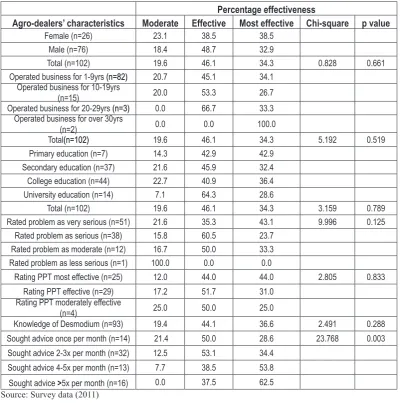
Table 4. Agro-dealers’ effectiveness (N=120).
Percentage effectiveness
Agro-dealers’� characteristics Moderate Effective Most effective Chi-square p value
Female (�=26) 23.1 38.5 38.5
Male (�=76) 18.4 48.7 32.9
To�al (�=102) 19.6 46.1 34.3 0.828 0.661
O�era�ed ��s���es�s� for 1-9��rs� (�=82)(�=82) 20.7 45.1 34.1
O�era�ed ��s���es�s� for 10-19��rs�
(�=15) 20.0 53.3 26.7
O�era�ed ��s���es�s� for 20-29��rs� (�=3)(�=3) 0.0 66.7 33.3
O�era�ed ��s���es�s� for o�er 30��rs�
(�=2) 0.0 0.0 100.0
To�al(�=102)(�=102) 19.6 46.1 34.3 5.192 0.519
Pr�mar�� ed�ca��o� (�=7) 14.3 42.9 42.9
�eco�dar�� ed�ca��o� (�=37) 21.6 45.9 32.4
College ed�ca��o� (�=44) 22.7 40.9 36.4
U���ers����� ed�ca��o� (�=14) 7.1 64.3 28.6
To�al (�=102) 19.6 46.1 34.3 3.159 0.789
Ra�ed �ro�lem as� �er�� s�er�o�s� (�=51) 21.6 35.3 43.1 9.996 0.125
Ra�ed �ro�lem as� s�er�o�s� (�=38) 15.8 60.5 23.7
Ra�ed �ro�lem as� modera�e (�=12) 16.7 50.0 33.3
Ra�ed �ro�lem as� les�s� s�er�o�s� (�=1) 100.0 0.0 0.0
Ra���g PPT mos�� effec���e (�=25) 12.0 44.0 44.0 2.805 0.833
Ra���g PPT effec���e (�=29) 17.2 51.7 31.0
Ra���g PPT modera�el�� effec���e
(�=4) 25.0 50.0 25.0
K�o�ledge of Des�mod��m (�=93) 19.4 44.1 36.6 2.491 0.288
�o�g��� ad��ce o�ce �er mo���� (�=14) 21.4 50.0 28.6 23.768 0.003
�o�g��� ad��ce 2-3x �er mo���� (�=32) 12.5 53.1 34.4
�o�g��� ad��ce 4-5x �er mo���� (�=13) 7.7 38.5 53.8
�o�g��� ad��ce >5x �er mo���� (�=16) 0.0 37.5 62.5
source: survey data (2011)
Volume 33, 2011
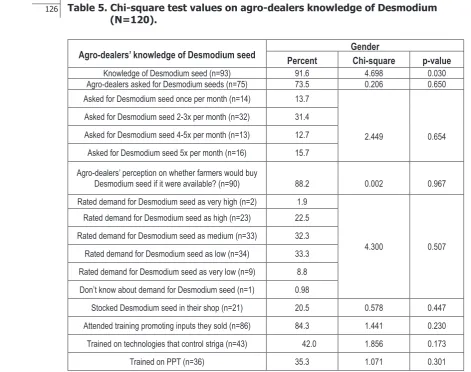
126 Table 5. Chi-square test values on agro-dealers knowledge of Desmodium
(N=120).
Agro-dealers’� knowledge of Desmodium seed Percent GenderChi-square p-value
K�o�ledge of Des�mod��m s�eed (�=93) 91.6 4.698 0.030
Agro-dealers� as��ed for Des�mod��m s�eeds� (�=75) 73.5 0.206 0.650
As��ed for Des�mod��m s�eed o�ce �er mo���� (�=14) 13.7
2.449 0.654
As��ed for Des�mod��m s�eed 2-3x �er mo���� (�=32) 31.4 As��ed for Des�mod��m s�eed 4-5x �er mo���� (�=13) 12.7
As��ed for Des�mod��m s�eed 5x �er mo���� (�=16) 15.7
Agro-dealers�’ �erce���o� o� ���e���er farmers� �o�ld ����
Des�mod��m s�eed �f �� �ere a�a�la�le? (�=90) 88.2 0.002 0.967
Ra�ed dema�d for Des�mod��m s�eed as� �er�� ���g�� (�=2) 1.9
4.300 0.507
Ra�ed dema�d for Des�mod��m s�eed as� ���g�� (�=23) 22.5
Ra�ed dema�d for Des�mod��m s�eed as� med��m (�=33) 32.3
Ra�ed dema�d for Des�mod��m s�eed as� lo� (�=34) 33.3
Ra�ed dema�d for Des�mod��m s�eed as� �er�� lo� (�=9) 8.8
Do�’� ��o� a�o�� dema�d for Des�mod��m s�eed (�=1) 0.98
��oc�ed Des�mod��m s�eed �� ���e�r s���o� (�=21) 20.5 0.578 0.447
A��e�ded �ra����g �romo���g �����s� ���e�� s�old (�=86) 84.3 1.441 0.230
Tra��ed o� �ec���olog�es� ���a� co��rol s��r�ga (�=43) 42.0 1.856 0.173
Tra��ed o� PPT (�=36) 35.3 1.071 0.301
source: survey data (2011)
in the 21 century Volume 33, 2011 127
Table 6. Agro-dealersperceptions on creating demand for Desmodium seeds
(N=120). D�s��r�c� of ���e ��s��-�es�s� Wo�ld farmers� ���� Des�mo-d��m s�eed �f a�a�la�le? (%)
Do ��o� s��oc� Des�mod��m s�eed �� ��o�r s���o�? (%)
If ��o� do�’� ��a�e
Des�mo-d��m s�eed, �o�ld ��o� l��e �o s��oc�
s�ome?(%)
Are ��o� Us��all�� �ra��ed o� ��o� �o �romo�e ��o�r
�����? (%)
Ha�e ��o� a�-�e�ded �ra��-��g o� ��o� �o co��rol s��r�ga? (%)
Ha�e ��o� e�er a��e�ded a���
�ra����g o� �romo��o� of
PPT? (%)
B��goma 100.0 12.5 87.5 100.0 87.5 37.5
Tes�o 63.6 9.1 81.8 27.3 9.1 0
B�s��a 100.0 8.3 100.0 91.7 50.0 41.7
V����ga 100.0 100.0 100.0 100.0 0 0
Em���a��a 100.0 66.7 66.7 100.0 88.9 88.9
��a��a 81.8 27.3 90.9 81.8 72.7 27.3
Bo�do 100.0 0 100.0 100.0 33.3 33.3
Rar�eda 100.0 50.0 100.0 100.0 100.0 100.0
B��ere 66.7 33.3 100.0 100.0 0 33.3
K�s��� 100.0 14.3 85.7 57.1 28.6 42.9
G�c��a 100.0 0 100.0 0 0 0
K�r�a 71.4 14.3 100.0 100.0 42.9 28.6
M�gor� 100.0 12.5 100.0 100.0 12.5 12.5
Ro�go 100.0 0 100.0 100.0 50.0 100.0
Rac���o���o 83.3 33.3 66.7 100.0 16.7 16.7
���a 80.0 0 80.0 80.0 20.0 40.0
To�al 88.2 20.6 89.2 84.3 42.2 35.3
source: survey data (2011)
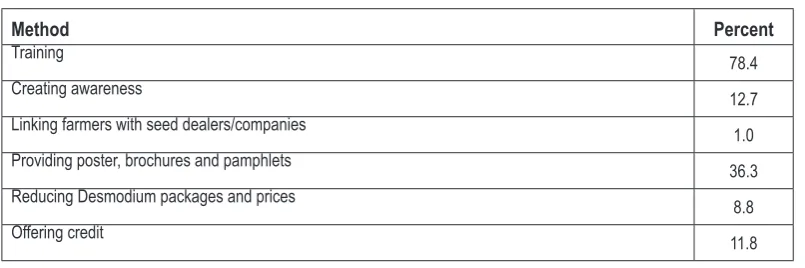
on how agro-dealers could be made more effective in dissemination ppt and creating demand for desmodium seed (table 7), 78.4% of the agro-dealers suggested empowerment through training; 12.7% suggested creating awareness on ppt and desmodium seeds; 1% suggested creating linkages with seed companies; 36.3% suggested providing posters, brochures and pamphlets; 8.8% suggested reducing desmodium packages and prices; 11.8% suggested offering credit; 9.8% advertising and promoting ppt through media; 14.7% accessing desmodium seeds; 7.8% supplying stockists with desmodium sample seeds; 5.9% publicizing availability of desmodium seeds; and 9.8% suggested establishing ppt demonstration plots near agro-dealers’ stores.
Table 7. Ways of supporting agro-dealers to disseminate PPT (N=120).
Method Percent
Tra����g 78.4
Crea���g a�are�es�s� 12.7
������g farmers� ����� s�eed dealers�/com�a��es� 1.0
Pro��d��g �os��er, �roc���res� a�d �am���le�s� 36.3
Red�c��g Des�mod��m �ac�ages� a�d �r�ces� 8.8
Volume 33, 2011
128 Promo���g PPT ���ro�g�� med�a 9.8
Acces�s���g Des�mod��m s�eeds� 14.7
����l����g Des�mod��m s�am�le s�eeds� 7.8
P��l�c�s���g a�a�la��l���� of Des�mod��m s�eeds� 5.9
Es��a�l�s�����g demo�s��ra��o� �lo�s� �ear agro-dealers� s��ores� 9.8
source: survey data (2011)
Discussion
over 80% of agro-dealers scored highly on nine aspects of effectiveness, which included (1) ability to deliver needed goods and services on time; (2) use of different distribution strategies to reach many farmers; (3) linking farmers to seed companies; (4) ability to explain to farmers how to use seed-based technologies; (5) keeping regular and up to date stock; (6) membership to agro-dealers’ networks, partnerships or outreach programs that work with farmers; (7) ability to give credit to farmers; (8) ability to keep records of farmers served; and (9) the ability to keep record of farmers who buy inputs. agro-dealers’ effectiveness in disseminating ppt wasagro-dealers’ effectiveness in disseminating ppt was not significantly related to their ability to estimate the seriousness of the striga problem in theto their ability to estimate the seriousness of the striga problem in the local farm (p�0.05). neither was their effectiveness significantly related to their understanding. neither was their effectiveness significantly related to their understandingir effectiveness significantly related to their understanding significantly related to their understanding to their understanding of how ppt works or to their knowledge of desmodium. however, there was a statistically significant relationship between agro-dealers’ effectiveness and the frequency in a month in which farmers sought information on desmodium seeds as indicated by the chi square test (p<0.05). agro-dealers’ effectiveness was not significantly related to their gender, number ofagro-dealers’ effectiveness was not significantly related to their gender, number ofwas not significantly related to their gender, number of years in which they had operated the business or their education level.
however, agro-dealers’ gender was significantly related toagro-dealers’ gender was significantly related togender was significantly related to their knowledge of desmodium but not significantly related to their perception on whether farmers would buy desmodium seed if it was made available , being asked for desmodium seed by farmers or the frequency in a month in which farmers sought information on desmodium seed. as suggested by Khan (2007), involving agro-dealers in promoting and stocking of desmodium seed could help meet farmers’ demand for the seed and also provide market information on available inputs. in summary, the effectiveness of agro-dealers in disseminating and enhancing adoption of ppt was not affected by gender, education or the number of years in business but agro- gender, education or the number of years in business but agro-or the number of years in business but agro-number of years in business but agro-dealers effectiveness in enhancing demand for desmodium seed was affected by one’s gender gender and knowledge of desmodium. however, it was not affected by the frequency in which farmers sought information on desmodium seed in a month. nor was it affected by their perception on whether farmers would buy desmodium seed if it was made available or whether they were asked for information on desmodium seed by farmers.
Conclusions
in the 21 century Volume 33, 2011 129 more effective in disseminating it. marketers should therefore, target agro-dealers who are visited most frequently by many farmers. this study has indicated the important role that agro-dealers play in disseminating ppt, enhancing its adoption and linking farmers to the private sector, seed dealers, extension providers, researchers and other stakeholders. these linkages help farmers to access crucial knowledge, skills, professional advisory services, financial support, credit and useful networks. if properly utilised as dissemination pathways, agro-dealers can enhance adoption by farmers of technologies such as ppt.
since agro-dealers have been found to be effective in disseminating and enhancing adoption of the push-pull technology by smallholder farmers, they should be taught the correct way to use desmodium seed and to identify and control the striga weed using the push-pull technology so that they can in turn educate the farmers effectively. since agro-dealers deal with adult farmers who vary greatly in terms of age, education, experience and socio-economic status, extension providers and their collaborators should train them adequately in adult education principles and in soft skills to improve their competences in public relations as well as oral and written communication. such training is particularly important for agro-dealers working in areas where stem borer and striga pose a major challenge to agricultural production. effective training may require a multifaceted approach involving many stakeholders such as universities, banks, Kephis, agmark, rockfeller foundation, icipe, Western seed company, Kari, acdi and Voca, among other players along agricultural products and marketing value chain. through the public-private partnerships, local and national leaders should facilitate timely and widespread availability of affordable and certified desmodium seed to farmers across the country and should encourage more farmers to use certified desmodium seed as well the ppt in order to increase productivity of cereals. for future research, the researchers recommend two studies in Western Kenya. the first study should be done to assess the number of smallholder farmers practising and adopting ppt as a result of information disseminated by agro-dealers while the second study should be done to assess the impact of ppt on farmers’ standard of living after buying and using desmodium seed for a period of five years.
Acknowledgements
the researchers are grateful to icipe for financially supporting this study, to fellow researchers for ascertaining the questionnaire’s content validity, and to all agro-dealers and field extension officers involved in the study for their support. they are also grateful to their families for their encouragement and support.
References
african agricultural technology foundation (aatf) (2008). strides in striga management. retrieved onretrieved on march, 7, 2009, from http://www.strides-issue-2-march 08.pdf
arumapperuma, s. (2008). The role of information technology in disseminating innovations in agribusiness: A comparative study of Australia and Sri Lanka. melbourne. centre for strategic economic studies. Victoria university.
blackie, m. & albright, K. (2005). A lesson learning study of the Farm Inputs Promotion Projects (FIPS) in Kenya, (Special emphasis on public-private partnerships for input provision and possibilities for regional upscaling). nairobi, fips.
brennan, m. (2004). The Juster Purchase Probability Scale: A Bibliography. Marketing Bulletin Bibliography. retrieved november 25, 2007, from http://marketing- bulletin.massey.ac.nz/V15/mb_ V15_b1_brennan.pdf.
Volume 33, 2011 130
central bureau of statistics. (2007). Basic report. Kenya integrated household budget survey-2005/2006. revised edition. ministry of planning and national development. Kenya.
cook, m. s.,Khan, Z. r. & pickett, a. J. (2007). the use of “push pull” strategies in integrated pest management. Annual Review of Entomology, 52, 375-400.
cramb, r. a. (2003). processes affecting the successful adoption of new technologies by smallholders. in: hacker, b. (ed). Working with Farmers: the Key to the Adoption of Forage Technologies, pp.11-22. aciar proceedings no. 95. canberra: australian centre for international agricultural research.
department for international development (dfid). (2006). Fodder shrub seed production and marketing in Kenya: matching demand to supply. retrieved on november 1, 2008 from www.worldagroforestry. org/downloads/publications/pdfs/pp06104.pdf
frankfort-nachmias, c., nachmias, d. (1997). Research method in social sciences. 5th ed. london. anorld.
Gordon, a. (2000). Policy Series 7. Improving smallholder access to purchased inputs in Sub-Saharan Africa. Natural Resources Institute. university of Greenwich. retrieved november 9, 2007, from http:// www.nri.org
Government of Kenya (GoK). (2008). Millennium development goals status report for Kenya-2007.
nairobi. ministry of state for planning, national development and vision 2030.
international centre of insect physiology and ecology (icipe). (2007). Icipe external R & D review 2002-2007. nairobi. icipe science press.
international centre of insect physiology and ecology (icipe). (2007). “Push Pull” technology for the control of stem borers and striga weeds. retrieved august 5, 2007 from http://www.”push pull”.net/ 1aboutus1.htm
international centre of insect physiology and ecology (1cipe). (2011). Push Pull. A novel farming system for ending hunger and poverty in sub-Saharan Africa. retrieved 20 may 2011 from http://push-pull.net/
Jaetzold, r., schmidt, h. (1982). Farm management hand book Vol. i. nairobi. Kenya. ministry ofnairobi. Kenya. ministry of ministry of agriculture.
Jaetzold, r., schmidt, h. (1983). Farm management hand book Vol. 2. nairobi. Kenya. ministry ofnairobi. Kenya. ministry of ministry of agriculture.
Kathuri, J. n., pals, a. d. (1993). Introduction to educational research. njoro. (Kenya). egerton university.
Kegley, c. W. Jr. (2008). World politics trends and transformation. eleven edition. usa. thomson Wadsworth.
Kendall, d. (2007). Sociology in our times. The essentials. usa. thomson Wadsworth.
in the 21 century Volume 33, 2011 131
Khan, Z. r, midega a. o., njuguna, e. m., amudavi, d. m., Wanyama, J.m. & pickett, J.a. (2008a). economic performance of the “push pull” technology for stem borer and striga control in smallholder farming systems in Western Kenya. Crop Protection, 27, 1084-1097.
Khan, Z. r., midega, c. a. o., amudavi, d. m. hassanali, a., pickett, J. a. (2008c). on-farm evaluation of the “push pull” technology for the control of maize stem borers and striga weed in western Kenya.
Field Crops Research, 106, 224-233.
Khan, Z. r. (2007). “Push Pull” technology for control of stem borer and striga. A platform technology for improving livelihoods of resource poor farmers. retrieved august 5, 2007, from http://www.push pull.net/updates.html
Kibaara, b. (2006). Working paper No 20/2006 rural financial services in Kenya: What is working and Why? Egerton University. Tegemeo Institute of Agricultural Policy and Development. retrieved november 12, 2007, from http://www.fao/ag/ruralfinconference/docs/
Kombo d. K., tromp, d. l. a. (2008, 4th reprint). Proposal and thesis writing: An introduction, p. 168. nairobi: pauline’s publications africa.
Kothari, c. r. (2008). Research methodology: Methods and techniques, (pp. 1-56). new delhi: new age international (p) limited, publishers.
Kothari, c. r. (2003). Research methodology: Methods and techniques. new delhi. india. Wishwa prakashan.
Kortler, p. (2002). Marketing management. The millennium edition. new delhi. prentice- hall.
murage a. W., obare, G., chianu, J., amudavi, d. m., pickett, J., & Khan, Z. r. (2011).duration analysis of technology adoption effects of dissemination pathways: a case of ‘push–pull’ technology for control of
Striga weeds and stemborers in Western Kenya. Crop Protection, Vol.30:5, pp 531-538.
odame, h., musyoka, p., Kere, J. (2008). How national public policies encourage or impede agribusiness innovation: cases of maize, tomato and dairy in Kenya. Draft report. retrieved on november 1, 2008 from http://www.info.worldbank.org/etools/docs/library/243548/Kyagribusinessreport.pdf
odhiambo, J. a., Vanlauwe, b., tabu, i. m., Kanampiu, f., Khan, Z. (2011). effect of intercropping maize and soybeans on Striga hermonthica parasitism and yield of maize. Phytopathology and Plant Protection,
Vol. 44: 2, p. 158 - 167.
perreault, Jr, W. d., mccarthy, e. J. (2005). Basic marketing. A global- managerial approach. usa. mcGraw-hill.
rockefeller foundation. (2007). Developing rural agricultural input supply systems for farmers in Africa. Infertilizer toolkit: promoting efficient and sustainable fertilizer use in Africa. retrieved on november 2, 2008 from
http://www.worldbank.org/html/extdr/fertilizeruse/bpractices/.htm
rockefeller foundation. (2006). Developing rural agricultural input supply systems for farmers in Africa. Fertilizer toolkit: Promoting efficient and sustainable fertilizer use in Africa. retrieved on november 2, 2008 from http://www.worldbank.org/html.../documentspdf/rockefelleragrodealersupport.pdf
Volume 33, 2011 132
solomon, m. r, marshall, G. W., stuart, e. W. (2006). Marketing. Real people, real choices, Fourth Ed.
new Jersey. pearson.
the sower. (2008). saving the cereals sub sector. Newsletter, Vol. 1, issue 9 (a publication of the cereals Growers association).
Woodward, a. (2011). Integrated Pest Management in Sub-Saharan Africa. Washtenaw county master Gardener newsletter, Vol. 19: 3, pp 2-3.michigan state university. usa. retrieved may 21, 2011, from http://www.ewashtenaw.org/government/departments/extension/mGnewsletters/
Advised by Naglis Švickus, SMC “Scientia Educologica”, Lithuania
received: April 20, 2011 accepted: June 01, 2011
Stephen Wambugu Maina MSc. in Agricultural Extension, Principal Agricultural Officer, Ministry of Agr�c�l��re, Naro� �o���� D�s��r�c�, P. O. Box 15428-20100 Na��r�, Ke���a. E-ma�l: ��e���e�67ma��a@��a��oo.com
John Gowland-Mwangi P��D. �� Agr�c�l��ral Ed�ca��o� a�d Ex�e�s��o�, Profes�s�or of Agr�c�l��ral Ed�ca��o� a�d Ex�e�s��o�, Eger�o� U���ers�����, P. O. Box 536-20115 Eger�o�, Ke���a.