Volume 5, Issue 1, 1 - 18.
ISSN: 2469-9632 http://www.ijem.com/A Research on the Characteristics of the Inspiring Teacher
Nihan Solpuk Turhan *
Fatih Sultan Mehmet Vakif University, TURKEY Fatih Sultan Mehmet Vakif University, TURKEY Belgin Parlakyildiz
Nihan Arslan
Fatih Sultan Mehmet Vakif University, TURKEY
Gokcen Gocen
Fatih Sultan Mehmet Vakif University, TURKEY
Tugba Yilmaz Bingol
Fatih Sultan Mehmet Vakif University, TURKEY
Received: October 19, 2018 ▪ Revised: November 4, 2018 ▪ Accepted: December 5, 2018
Abstract: In this study, it was aimed to find out the characteristics of inspiring teachers who inspired teacher candidates to do teaching profession properly. In the study, “An Exploratory Sequential Design” a mixed method where qualitative and quantitative approaches are used concomitantly, was employed to determine the inspiring teacher characteristics. In this design, the researcher respectively followed two steps. In the first step grounded theory research design as a qualitative research design was used and in the second step survey research model as a quantitative research design was used. Inspiring Teacher Scale (ITS) was developed by the researchers to collect the data. In the second phase, the study group was extended to continue the quantitative studies. Exploratory and confirmatory factor analyses were used first to analyze the data. The results of analysis have demonstrated that the items loaded on four factors, which reflect inspiring teacher characteristics as “teacher communication”, “personal characteristics”, “professional development” and “supporting students in different ways”. Findings suggest that ITS, which has four-factor structures with 36 items, can be suggested as a valid and reliable instrument to determine the characteristics of inspiring teacher. Therefore, in this study the characteristics inspiring teachers were specified according to opinions of teacher candidates and presented to be o model for teacher candidates.
Keywords: Education, teaching, inspiring teacher, teacher candidate, grounded theory.
To cite this article: Solpuk -Turhan, N., Parlakyildiz, B., Arslan, N., Gocen, G., & Yilmaz -Bingol, T. (2019). A research on the characteristics of the inspiring teacher. International Journal of Educational Methodology, 5(1), 1-18. https://doi.org/10.12973/ijem.5.1.1
Introduction
As a matter of fact, a successful education system depends on the quality of teacher training process and the quality of education in education faculties provide to train teacher candidates (Guven, 2016). In parallel with to the rapid change in the educational paradigms, within the development process of educational sciences, expectations about teachers and the skill areas and competencies of contemporary teachers have also changed.
Primarily, it is important to know the characteristics of qualified and effective teacher when it comes to train inspiring teacher. According to Dowling (1988) teacher “serves as a vital resource that encourages learning and development.” The roles of teacher such as observer, planner, instructor, converser, listener, questioner, educator, evaluator and model ease the learning process. Undoubtedly, it is not possible that a teacher possesses the listed characteristics and qualities (Dowling, 1988). However, a well-organized and performed education program may help teachers to acquire academic and personal characteristics and develop these characteristics through education (Ustunoglu, 1986). Some of these qualities are acquired through personal experiences and efforts during the teacher's professional life. Shortly, a contemporary teacher should be a determined advocate of scientific thinking and justice in performing the teaching profession (Bilen, 1996).
The term of "inspiring teacher" is a comprehensive term, which contains different definitions such as a good and effective teacher; a teacher who perform the teaching profession in sufficient, qualified and successful in different ways; a teacher who is supportive and inspirational to the students; a contemporary teacher. While previous studies have
*Corresponding author:
identified several characteristics of “teacher” knowledge about the characteristics of “inspiring teacher” is still scarce. In this regard, it is important to reveal the characteristics of the teachers who “inspire” his/her by touching their lives. Much of the reviewed literature on teacher characteristics have not focused and considered the viewpoint of the candidate teachers. In describing a teacher, however, the views of teacher candidates are extremely important because the teaching profession is one of the chosen professions through model or inspiration. Nowadays, it is obvious that teaching is a profession that requires continuous change and development. Within this framework, the aim of this research is to reveal the characteristics of inspiring teachers.
In this regard, the problem statement of the study is: "What are the characteristics of an inspiring teacher according to the candidate teachers?" Thus, in the present study it was aimed to reveal the characteristics of an inspiring teacher from different viewpoints and to lead the teachers and educators to train teacher candidates as an inspiring teacher in future.
Methodology
Research Model
In the study, an exploratory sequential design a mixed method was used in the current study. Mixed methods studies contain combining quantitative and qualitative data collection and analysis in a single study (Creswell, Fetters & Ivankova, 2004). In the first step grounded theory research design as a qualitative research design was used in this study. That aims to reveal characteristics of inspiring teacher according to the opinions of teacher candidates and independently of current ideas and theories. When a field of study is new or has little constructed ideas and theories, grounded theory, which seeks to construct theories, is suitable to study in that field (McMillan & Schumacher, 2006). In the currents study, grounded theory research design as a qualitative research design was used. In the second step survey research model as a quantitative research design was used. A descriptive analysis was used to analyze data obtained through scales (Yildirim & Simsek, 2001).
Study Group
Qualitative study: The population of this study comprises students who study in the faculty of Education and teacher candidates who attending pedagogical formation training certification program. The sample strategy used in this study was criterion sampling, in which each participant meets a predetermined criterion of importance (Buyukozturk, 2012). In this study criterion sample properties is proportional selection that is continue education program in the university. According to grounded theory, data collection and analysis is a simultaneous process. The categories and codes should emerge from data not based upon predetermined hypothesis, categories must be detailed, specified and relationships between categories should be defined (Glaser & Strauss, 1965). In this research, the sampling criterion is teacher candidates who are studying at university. In the current study, 10 students were interviewed. These twenty-five participants were selected conveniently among students enrolled in Fatih Sultan Mehmet Vakif University. Students were recruited from three different undergraduate programs: Pre-school education, Turkish teaching and psychological counseling and guidance. The interview questions were applied in written form to the 210 teacher candidates who attending pedagogical formation training certification program.
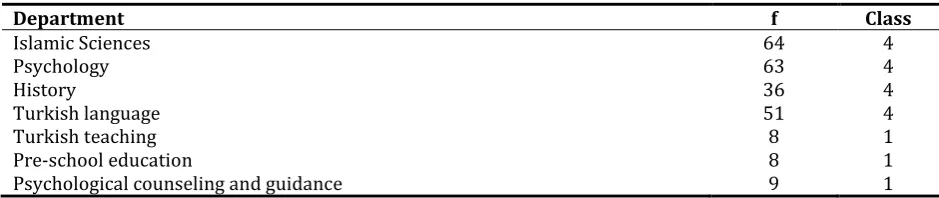
During the data analysis process, instead of using the names of participants researchers used their department and class to ensure the confidentiality of the research data. Table 1, illustrates demographic information of participants.
Table 1. Participant Demographic Information
Department f Class
Islamic Sciences 64 4
Psychology 63 4
History 36 4
Turkish language 51 4
Turkish teaching 8 1
Pre-school education 8 1
Psychological counseling and guidance 9 1
Table 2. Demographic Characteristics of Participants
Pedagogical formation
training
Psychological counseling and guidance
Pre-school
education teaching Turkish Others
Gender Female Male 60 19 81 47 1 3 2 2 22 10
Class
1. Year 7 81 0 3 9
2. Year 0 9 1 0 17
3. Year 12 97 3 1 5
4. Year 60 3 0 0 1
When the distribution of the study group is analyzed, it can be seen that 166 of the study group students are female and 81 of them are male. Of the participants, 100 were first-year students, 27 were second year students, 118 were third-year students, and 64 were fourth-third-year students.
Data Collection Tools
Qualitative study: In this research, researchers related measurement tools to develop open-ended questions. In accordance with the obtained information open- ended questions were prepared to guide the interviews and to facilitate revealing the views of teacher candidates on inspiring teaching. First of all, semi- structured 10 open ended questions were created to conduct a pilot study. Subsequently, in the pilot study, open-ended questions which are not appropriate for the scale was omitted by the research group, and remained 4 open-ended questions. The remainder of the questionnaire included 4 open-ended questions presented to 5 experts and these experts discussed the last version. Finally, these open-ended questions were administered the teacher candidates.
Questions:
• Could you tell us your story about your teacher who inspired you by giving detailed information about topic that you inspired during your education life?
• What are the characteristics of the teacher who inspired you in your education life? • How the inspired teacher affected your life and how he/she changed your life?
• Is your inspiring teacher also effective out of school? Which out-of-school activities were effective?
The semi-structured open-ended questions asked face-to-face by the interviewer to teacher candidates. Data collection and analysis carried out simultaneously. Within the frame of these questions new questions were developed to collect written data.
The open-ended questions asked teacher candidates to determine the characteristics of an inspiring teacher are given below:
• Tell your story about a teacher who inspired you that includes the theme that you are inspired. When did you meet the inspired teacher in this story?
• What are the characteristics which makes the inspiring teacher different in this story? • How did hi/she changed your life?
• What is the inspiration for you to choose teaching profession? • Please explain the teacher inspired you in one sentence.
In the current study, semi-structured and structured open-ended questions were used as data collection tools.
Quantitative study: The Inspiring Teacher Scale (ITS) was developed in this study. ITS aimed to determine the
characteristics of an inspiring teacher using a 5-point Likert-type scale ranging from 1 (strongly disagree) to 5 (strongly agree). An item pool was developed from a review of literature and pilot study was conducted. The 99-item scale was used in the pilot study and the number of items are reduces according to item analysis. There are no negatively worded items in the scale. The last version of the scale consists of 36 items.
Qualitative study: In this study, the face-to-face interviews were conducted on the university without time limit. The
interviews were semi-structured and the length of interviews ranged from twenty-five minutes to forty minutes. It was aimed to minimize data loss and all interviews were recorded in their entirety.
answer the questions written in their own words. The data of the study consist of individual thoughts, feelings and experiences of teacher candidates about inspiring teacher
Quantitative study: The Inspiring Teacher Scale (ITS) was administered to the teacher candidates who are enrolled in
Faculty of Education in groups in the classrooms. All participants were informed about the objectives of the study. All the teacher candidates completed the scale their regular class hours. It took 20 minutes to complete the scale.
Analysis of Data Qualitative study:
In this study, grounded theory is used to deeply examine the characteristics of inspiring teachers. Grounded theory was used in analysis of the data. Therefore open coding; axial coding and selective coding were performed in the analysis of data. During the open coding process, which is the first analytical step, the researcher analyzed the answers and coded prominent concepts and themes. Then, all the codes categorized according to their similarities and differences. Axial coding was attempted to describe the codes, which include the details of similarities in a category and explore the relationships between the categories. Lastly, selective coding was implemented to integrate the understanding of the emerged categories (Stauss & Corbin 1998).
According to the analysis of the obtained data about the characteristics of the inspiring teacher according to the opinions of the teacher candidates, five interrelated categories, which are teacher communication, teacher behavior skills, class management, professional development, and supporting students in different ways, were explored.
Quantitative study: In the quantitative section, the Turkish scale items were applied and the results of the analysis of the
Turkish scale data were presented in the finding section. Firstly, an exploratory factor analysis was done was done on all thirty six items of the ITS. The validity and reliability analysis were examined to ensure that the obtained responses are valid and reliable. The results are interpreted in findings section. Afterwards confirmatory factor analysis was carried out to assess to evaluate the adequacy of the factor structure that obtained from the scale items. In this research, analysis use SPSS and AMOS programs.
Reliability and Validity
Qualitative study:A researcher should observe the subject that he/she focuses on as objectively as possible in order to
ensure validity. In a qualitative research increasing the cogency is required for internal validity and transmissibility for external validity. In addition, to ensure reliability in qualitative research time independence (continuity), consistency between independent observers and internal consistency are required. In short, in order to provide internal reliability in qualitative research, consistency is required and conformability is required for external reliability. Also, in the research, expert opinion was taken for content and face validity
In this study, the participants were effective in providing detailed information. Congruence between the research questions and the methods employed were explained. The data collection tools used in the study and obtained data are specified clearly. The data collection and analysis were conducted as parallel process. Saturation of categories was ensured according to grounded theory.
Quantitative study: A pilot study, the 99-item scale in a 5-point Likert type response format was administered first to
develop Inspiring Teacher Scale (ITS) and findings based on the reviewed version of the scale were presented. As a result of the analysis, data is distributed normally. Total score can be taken from the scale.
Then an exploratory factor analysis (EFA) was carried out. Afterwards, A confirmatory factor analysis was performed to evaluate the factorial validity of ITS. Reliability of the scale was also demonstrated in analyses. All the applications and analyses were presented in finding section.
Results
Qualitative Study Findings
In the present study, which aimed to reveal the characteristics of inspiring teacher, data obtained by grounded theory analysis was presented by direct quotations from the participants. The quotations were coded according to the departments of the participants. A grounded theory analysis of this qualitative study yielded five categories: communication, teacher behavior skills, class management, professional development, and supporting students in different ways. In this section, the categories emerging from the research data and opinions of the participants about these categories were presented.
Teacher Communication
Developing Passion for Learning
Teacher candidates reported “developing passion for learning” as a characteristic of inspiring teacher. Teacher candidates expressed their opinions on developing passion for learning as,
“The characteristics that make my teacher a good teacher was his helpful encouragement, support, trust and be with me all time which led me to develop learning passion and help to improve.”(Pedagogical Formation Certificate Program).
According to the views of the participants, the support and motivation of the learner by the teacher has led to develop and increase passion for learning of the learner. It is stated that being in communication with an inspiring teacher effect s passion for learning in a positive way. Another view on passion for learning is explained by the following quote:
“He/she was saying that he had more than 350 books. In our family houses, traditionally, there is a room, which is called guest room. This room was library in his/her house. I was very impressed and asked him/her how he could do this? He/she taught me how to read a book" (Preschool education).
Establishing Empathy
Participants mentioned that establishing empathy with students is a teacher quality that has positive affect on students. According to the participants, establishing empathy also helps teacher to encourage students. Therefore students have more confidence and are more challengers.
Teacher candidates emphasized the importance of this point as,
“My teacher as a helpful, interested, cheerful and vivacious has affected me positively. For example, I was suffering from low self-confidence during high-school years, but, thanks to the encouragement and effort of my teacher to increase my self-confidence, I played a leading role in a theater play.”(Psychological counseling and guidance)
Teacher’s ability to empathize with students and understand them is key factors in this sub category. Participants emphasized that a teacher should have the ability to empathize with students. According to the participants a teacher may understand his/her student and aware of student’s feelings through empathy. A participant expressed his opinion on establishing empathy as,
"A teacher should be understanding and should understand the feelings of every pupil that is under her or him through empathy"(Pre-school education).
Having Good Relationship
According to the participants having good relationships with students is another characteristic of an inspiring teacher. Teachers who have good relationships whit their students also have a positive impact on them. Thus, students have more positive thoughts about teaching profession or their university life effected positively. For example, participants stated their ideas about a teacher’s ability to have good relationships with students as,
"My teacher affected me positively. Thanks to him, first I liked Turkish lesson, then I liked school and finally I liked teaching profession. We went to the panels together, we participated too many events..” (Psychological counseling and guidance).
According to the participants establishing good relationship with the student leads to a long-term communication. Having good relationships with a teacher is an important determinant for student's motivation. A participant stated,
"I am still in contact with my teacher and this teacher is a special person for me. It made me very happy that he interacted with me and he made me feel valued. "(Pre-school education).
Acting like a mother / father / friend
According to participants’ expressions one of the subcategories of the characteristics of an inspiring teacher is acting like a mother / father / friend. Participants stated that teacher’s acts like a mother or friend have a positive impact on students. Other participants also expressed similar ideas. As an example a participant stated that;
"My teacher treated me like his own child and I loved him/her more because of his/her attitude" (Pedagogical Formation Certificate Program).
When the teacher act like a mother, father or friend to his/her students, the relationship between the teacher and the student will be improved. If a student should access the teacher easily, it may help to solve the problems. A participant stated that;
Personal Characteristics
When the interview transcripts are analyzed, it is found that an inspiring teacher should have some personal values such as being fair and having indulgence. At the same time, an inspiring teacher should have different personal characteristics for effective class management. In order to achieve the desired goals, it is an important point for a teacher to spend enough time preparing for class, to make research, to produce something and to transfer all of these to the class effectively. Effective classroom management provides the opportunity for all students in the group to learn. This section includes the personal values that an inspiring teacher should have and characteristics related to classroom management.
Being Fair To Students
A fair teacher is not just a teacher who treats his/her students equally. At the same time, a fair teacher takes into account their individual situations and handles them as a whole. The findings of the research revealed that the teachers believed to be fair were described as inspiring teachers. The views of the teacher candidates for this finding are;
“I have never seen that my teacher made discrimination against students and he/she was never unconcerned with students’ problems even if it a personal problem. He/she was very interested in us.” "(Psychological counseling and guidance).
“He/she was interested in us carefully. He/she was fair.” (Pedagogical Formation Certificate Program). Being Reliable, Confidant and Friend
When students feel that his/her teacher is reliable, close to him/her that he could open himself/herself and care for him as an individual help him too feel safe in school as a second home. The findings of the current study indicated that being reliable is an important characteristic of an inspiring teacher. One of the teacher candidates stated that;
“My confidence on teacher makes me feel the school as a second home.” (Pedagogical Formation Certificate Program)
“My teacher took care of us, shared our problems and talked to us” (Turkish language teaching). Being Consistent
Teachers’ consistent behaviors can affect the student are important for them. According to the participants responses it was found that being a consistent teacher is one of the characteristics of inspiring teacher. The views of the teacher candidates relating to this finding are given below;
“When you meet him/her out of the class and say hello to him/her he/she doesn’t answer. If you say “May I ask you a question?” he/she replies that he has no time. There's often a bit of insincerity in these attitudes.” (Pedagogical Formation Certificate Program)
“His/her these characteristics should be approved by other people too. We asked that our teacher had such a quality or not, everyone was saying yes.” (Pre-school education)
Being Sensitive to Individual Differences
Results of the current study also indicated that being sensitive to students’ individual differences, taking into account of students’ personal characteristics in evaluating them and displaying positive behavior which help to students feel valued and develop a more positive sense of self are characteristics of an inspiring teacher. For example, a teacher candidate stated,
“It is a very welcome behavior that the teacher recognizes the special situations of the students and evaluates them according to their emotional state. When I was in high school, I was thinking that no one's paying attention to me but one of my teachers always told me my positive sides and praised me and made me very happy.” (Pedagogical Formation Certificate Program).
“My teacher also has noticed my abilities” (Turkish language teaching). Having Positive Attitudes towards Students
The positive attitudes of a teacher toward his / her student will have positive affect his / her personal relationship with the student. It is also very important for the student to develop a positive viewpoint towards the class and the school during his / her life. The findings of the research showed that teachers should have positive attitude towards their students as an inspiring teacher. The views of the teacher candidates relating to this finding are given below;
“She was very sincere and candid. She was like a mother, sister or friend. She is far away from me but I can easily go to her when I need. "(Pre-school education).
Being an Unforgettable Teacher
A teacher, who made an impression on students, is unforgettable by the students even if the students leave the school. The participants name a teacher who has characteristics that provide to be imprinted on students’ mind as inspiring teacher. The views of the teacher candidates relating to this finding are given below;
“I am still in contact with my teacher and this teacher is a special person for me.”(Pre-school education). “Even now, I mention her, Medine Teacher.” (Pre-school education).
Non-Discrimination between Students
The research findings indicated that teacher who does not make discrimination against students is characterized as an inspiring teacher. The views of the teacher candidates relating to this finding are given below;
“For instance, at those times it was very common that teachers were making discrimination between students from high socioeconomic families and students from low socioeconomic families. We could see that. It was very easy to understand which students were from high socioeconomic families. Their dressing style was different for instance. “ (Pedagogical Formation Certificate Program)
“I have never seen that my teacher made discrimination against students and he/she was never unconcerned with students’ problems even if it a personal problem. He/she was very interested in us.” (Psychological counseling and guidance).
Being Tolerant to Students
A teacher should be tolerant when a student made a mistake or failure, never display humiliating behaviors, helps student to take lesson from his failure by being tolerant and should encourage the student to attend the lesson. The participants of the study emphasized the importance of being tolerant to students to be an inspiring teacher. The views of the teacher candidates relating to this finding are given below;
“Once, a friend of mine lost something and claimed that I had stolen it. I could not express myself. My teacher could also judge me because it was a very serious issue, but his/her attitude was very positive and this made me very happy. Then, I felt very comfortable. His attitude positively impacted even my lesson.” (Pedagogical Formation Certificate Program)
Being fair, tolerant and consistent a teacher is emphasized by participants and these characteristics are revealed as characteristics of an inspiring teacher.
Different Teaching Methods
Using different teaching methods and instructional strategies is important to lead students to use students’ different thinking styles. As an aspect of classroom management, which strategies, approaches, methods, techniques, tools and materials will be used to provide effective learning experiences are determined. It is important for a teacher to be aware of the needs of each student and to use different teaching strategies to meet these needs. A successful and inspiring teacher helps the students to follow their own learning by asking questions that will help the student to see if he learnt the subject or not (Senemoglu, 1997: 281). The views of the teacher candidates relating to this finding are given below;
“His/her teaching method was very different. He/she was making us to listen to music in the class to like the lesson.” (Turkish language teaching)
Analysis of this qualitative study yielded that an inspiring teacher is seen as a teacher who finds out in which way, technique or method is more useful for better learning, and who shows different approaches according to students’ level and who visit to their heart.
Being Creative
Teachers need to make arrangements with various examples in order to support creativity in the educational environment as well as using their professional knowledge. It is an important finding that making connections between your curriculum and the real world, making subjects easier, interesting understandable to learn promotes students achievement. The views of the teacher candidates relating to this finding are given below;
“The teacher was teaching tough subjects and important parts of the subjects like telling a tale... I can say the teacher who teaches the subject by explaining it” (Pedagogical Formation Certificate Program)
Professional Development
According to the opinions of the participants; being innovative, participating in academic studies, being a model and master of profession are determined as the characteristics of an inspiring teacher and as subcategories of professional development.
Being Innovative
Teacher candidates stated that being open to new ideas and willingness to use new methods is characteristics, which a teacher should have. A teacher should follow the current developments in teaching to meet students ‘needs. Lecturing in a monotone voice or lecturing without using new and different examples may bother students. Hence, being an innovative teacher, using different and original methods in teaching are found as important factors to give inspiration as a teacher. The views of the teacher candidates relating to this finding are given below;
“Even though he was a retired teacher, he was innovative, he was he improving himself and he was adapting himself to new developments. That is what I impressed.” (Pedagogical Formation Certificate Program)
Participating in Academic Studies
Participating in-service training activities, seminars or panels related to his/her profession and being noticed by the students that their teacher is participating in academic studies is as a significant point to give inspiration as a teacher. The view of a teacher candidate relating to this finding is given below;
We went to the panels together, we participated too many events. His energy also made me more energetic.” (Psychological counseling and guidance).
Being a Model
It is very important for the teacher to improve himself/herself and to share his/her experiences with the students. It is noteworthy for the students that a teacher has experienced before what he/she recommended to do. Therefore, sharing positive experiences with students is an important finding in terms of inspiration.
It was also found that, having reading habit and encouraging students to read books is also significant points to inspire students. This finding is also important in terms of social learning. If students see their teachers while they are reading book, their reading behavior may also reinforce. In addition, knowledge cannot be transferred without gaining it. Therefore, teachers should give priority to reading books. Also reading educational psychology books may help teachers to understand his/her students better and to support their personality development. The views of the teacher candidates relating to this finding are given below;
“Medine teacher, used to say she had a library and she had nearly 350-400 books. In our family houses, traditionally, there is a room, which is called guest room. This room was library in her house. Her vocabulary was very rich. She was a model for me.” (Pre-school education).
Being Master of Profession
Being and experienced teacher in his field of study or being master of profession are remarkable characteristics for students. Students can easily notice this when they ask questions. In this context, the teacher's self-improvement in his field of study is an important finding in terms of inspiration.
“Most importantly, he/she must be knowledgeable. He/ she should improve himself/herself, he/she should follow developments in his/her field closely, he/she should recognize students well and consider individual differences” (Pedagogical Formation Certificate Program)
Supporting Students in Different Ways
Participants of the current study remarked the characteristics of the inspiring teacher by giving examples of the characteristics, behaviors, and communication with the student of the teacher who inspired them.
When the opinions of the participants in the research are examined, it is revealed that the inspirational teacher needs to support his / her student in various ways such as social, academic and psychological. In this section, the findings about which ways of an inspirational teacher should support his / her student are presented with the views of participants.
Supporting Student's Dreams
While defining the inspirational teacher, the teacher candidates mentioned the necessity of supporting the dreams of the students and the impact of the teacher to influence student dreams positively and negatively. For example, a participant explained as below how an inspiring teacher may have an impact on students’ dreams,
addition the education that the teachers take should reinforce positively their attitudes towards students and should have a positive impact on their personal characteristics (Pedagogical Formation Certificate Program)
Therefore, an inspiring teacher can be defined as a teacher who support and impact students’ dreams and improve students’ imagination skills.
Valuing the Student and Students’ Ideas
Feeling that a student is valued by the teacher is one of the factors that positively affect the student. For example, a participant emphasized the importance of “value” while defining inspiring teacher as,
“I met my teacher at the age of 13. My teacher treated us like an adult, like an individual, not a 13-year-old child. He/she treated us like a young girl, a young man. He was asking our ideas personally. I was impressed that he was announcing my decision like an adult make this decision not a child.” (Turkish language teaching)
Accordingly, the impact of teacher attitudes and practices on behavior of student is understood. Giving value to the students also has a positive effect on student-teacher relationship. A teacher candidate stated this positive effect as,
“Our teacher used to read all of the diaries one by one. She used to write notes for all of us and give them back to us. In that note, he used to write beautiful phrases for me that impressed me so much. These phrases made me proud and I felt valued as my teacher. I saw her like a sister or a mother. She was more than a teacher for me. I was very pleased that I was a person who valued the ideas and was given importance to emotions by a teacher.” (Pedagogical Formation Certificate Program)
A student must be influenced positively by a teacher in order think that his/her her teacher is an inspiring teacher. To make a student to feel valued and to give importance to their ideas may influence them.
Supporting the Courage of Students
According to the participants’ views one of the concepts that are related to the characteristics of an inspiring teacher is “courage”. One of the teacher candidates emphasized the importance of courage while he was describing the teacher, who inspired him as,
“When I was in high school, I was writing poems and stories on my own. I was writing these poems and stories to read myself, not to show my teacher. One day, my teacher told me to read my poems and stories in my class and even in other classes. I was not sure that I could do this. But he told me that I could to this and encouraged me. He also said that he believes I will be a Turkish teacher in future. Then something changed for me. I began to believe that I can do. I said that, I can be a Turkish teacher.” (Turkish language teaching).
In this context, it can be said that the teacher encouragement may increase the confidence of the student. Both courage and confidence may have a positive impact on students’ lives and helps students’ to shape their future.
Supporting Students to Gain a Different Viewpoint / Different Way of Thinking
An analysis of the views of teacher candidates indicated that helping students to gain a different viewpoint is accepted as a characteristic of an inspiring teacher. The different point of view means new experiences for students:
“My teacher provided me to gain new experiences. He/she has changed my point of view about life.”
(Pre-school education).
Helping students to gain a different viewpoint can contribute to the development of the students as well as give chance them to evaluate an event in a different way.
"He changed my point of view. He taught me to look at events from a different aspect, even in daily life. He helped me to develop more. When I watched my behaviors, my teacher helped me to change my point of view about the events.” (Pre-school education).
Helping students to gain a different viewpoint also concerns the entire life of the students and their out-of-school life. It is seen that, a teacher who helps students to gain a different viewpoint may impact students’ out-of-school life and their decisions. A teacher who did this is called as inspiring teacher by students.
Supporting Students' Abilities
Each student has different abilities. Participants in the study indicated that it was important for them to realize their abilities. A teacher who realize the abilities and potential of students are characterized as inspiring teacher by participants. A participant stated that,
Teachers, who direct their students in the direction of their abilities, also prepare their students for future. Thus, their positive impact on the student may continue in the future. The views of the teacher candidates relating to this finding are given below;
“He/she helped me to discover myself. I have learnt my strengths and the area that I am talented. I did my best to improve myself in this area. Playing sports or drawing pictures may be easy things for some teachers but this teacher discovered our talents and provided us to improve in this area. We have earned success and won prizes in this area.” (Pedagogical Formation Certificate Program)
It is seen that it is important for the students to reveal the talents that the students can not realize and to direct them according to their talents. In this way, the teacher who plays a role in the life of the students is defined as an inspiring teacher by the participants.
Supporting Students’ Personal Development
According to the opinions of the teacher candidates participating in the research, supporting students to gain different point of views and directing them according to their talents may have a permanent and positive impact on the lives of the students. These positive impacts may help students to improve themselves as well. A teacher candidate participating in the research emphasized the impact of the teacher on increased confidence as,
“My teacher revealed my talent and increased my self-confidence.”(Turkish language teaching).
In addition to increasing confidence, helping students to get social skills and helping them to decrease their feelings shyness are also specified as the characteristics of an inspiring teacher.
“I was very shy in my first year of high school. I didn’t talk to anyone. Someone had to interact with me to talk to me. My teacher did it.” (Turkish language teaching).
Supporting Students’ Academic Development
Findings of the currents study demonstrated that, it is important for the students to be supported academically by the teachers. A teacher candidate who participated in the research explained how the teacher increased his motivation to participate in the lesson as;
“He/she understood that I had in interest in is/her lesson and he gave me a book to read which was called “Intibah” and said, “I think you will like that book.” Thanks to him, my interest in literature increased even more.” (Turkish language teaching).
In a similar example, the positive effects of the teacher's behavior on the student can be seen;
“I loved Necip Fazil because of him/her. He/she presented me a book of Necip Fazil Kisakurek. I never forget. Therefore, he/she was a different teacher for me. That is the reason why I love and interested in literature.”(Turkish language teaching).
When the opinions of the students are examined, it can be seen that, improving students’ academic skills, supporting their academic development are characteristics of inspiring teacher. These characteristics also support the students’ personal development.
Supporting Students’ Career Development
According to the participant, supporting students’ career development is a key point for an inspiring teacher. A participant emphasized the importance of support of the teacher for career development as;
“Yes, I used to like this lesson but my teacher had an impact on my decision to study the department of Turkish language teaching. Actually, I used to want to study psychology or psychological counseling. But my scores were not high enough for these programs. Department of Turkish language teaching was also in my mind. Then, I made my decision and choose this department. I am very happy to make this decision. I like my department.” (Turkish language teaching).
When the opinions of participants are examined, it is seen that the teacher is also an inspiration in the career choices of students;
“While I was talking about something with my friends during the lessons, my teacher watched me and he/she said that I could be a good teacher. But I wanted to be a psychologist, I did not really think about being a teacher. I decided to be teacher during the university preference period. Now I am glad to be in this department.” (Turkish language teaching).
Supporting Students’ Psychological Well-Being
“I was a pessimistic person. I always saw the negative sides of events. I realized that it was so ridiculous that to be always pessimistic and desperate when I spent time with him/her. Then I began to say every cloud has a silver lining. I tend to think more positive.” (Pre-school education)
Sharing experiences with students as a teacher also is inspirational for students and may have a positive impact on students’ behavior;
“I was a very obsessed person. A teacher who I met told me that I should not be so obsessed and shared me one of his/her experience. He told me an event that he/she experienced when he/she was young. This event was impressed me very much. I'm less obsessed now. I can react better what something happened. I am not obsessed by something that makes me said. I keep on going.” (Pre-school education)
Supporting Students to Like Lessons and School
Helping students’ to like the lessons and the school as a teacher are also specified as characteristics of an inspiring teacher by participants. To cause to be liked the class sometimes may be related to teaching method that the teacher uses. A participant exemplified this as;
“He/she was making us to listen to music in the class to like the lesson. I started to interest in his/her lesson. I was making a preparation before the lesson. I tried to learn more than we had to earn in the class. I noticed that there was a progress. He/she had a big impact. He/she made me to like the lesson.” (Turkish language teaching).
Supporting students to like lessons also positively affects the success of the students. A student explained how his/her teacher’s support helped him to raise his/her achievement in mathematics;
“Thanks to my Elif teacher, we achieved something that seemed impossible to me. I have learned math. I liked this lesson and I was really successful in math.”(Psychological counseling and guidance).
It is important for students’ to be supported in different ways by teachers. According to research findings students defined their teacher as an inspiring teacher and are positively influenced and when their dreams are supported or encouraged; sometimes when their ideas, different point of views, their abilities are supported; sometimes when their academic and vocational skills are supported; sometimes when their academic psychological well-being and personal development are supported; sometimes when their lesson and school like supported.
Quantitative Study Findings
Descriptive factor analysis and confirmatory factor analysis methods were used in the analysis of data under structural equality modeling. Explanatory factor analysis is a statistical analysis method that aims to determine the factors that are not correlated with fewer than the variables by taking advantage of the relationships between the variables in a data set.
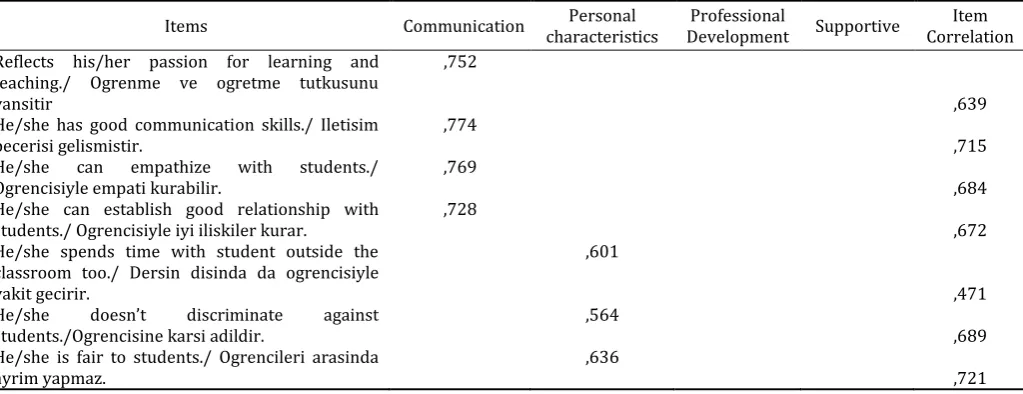
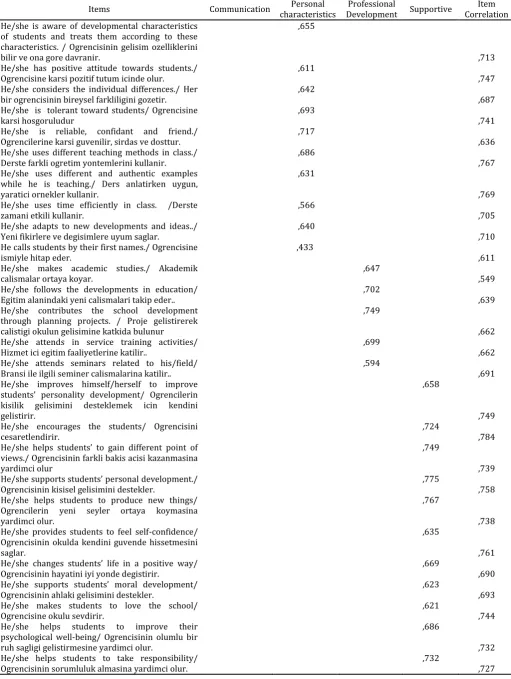
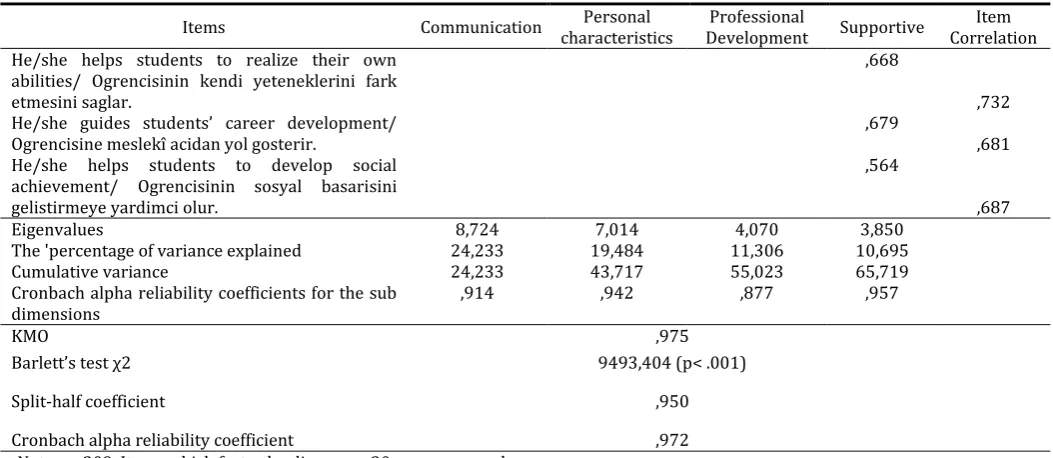
First of all, an exploratory factor analysis was used to find out the number of factors of ITS. In order determine item discrimination values of the ITS item-total correlations were examined. According to results of item analysis corrected item-total correlation changed between 0.43 and 0.78. In item analysis, corrected item total correlations values are usually suggested above .30. Thus, .30 and higher loadings of items have enough values to differentiate items (Buyukozturk, 2007). Results of exploratory factor analysis were shown in Table 3.
Table 3. Results of Item analysis of the Inspiring Teacher Scale (ITS), Eigenvalues and Explained Variance of ITS, KMO and Bartlett coefficient and reliability analysis
Items Communication characteristics Personal Development Professional Supportive Correlation Item Reflects his/her passion for learning and
teaching./ Ogrenme ve ogretme tutkusunu yansitir
,752
,639 He/she has good communication skills./ Iletisim
becerisi gelismistir. ,774 ,715
He/she can empathize with students./
Ogrencisiyle empati kurabilir. ,769 ,684
He/she can establish good relationship with
students./ Ogrencisiyle iyi iliskiler kurar. ,728 ,672 He/she spends time with student outside the
classroom too./ Dersin disinda da ogrencisiyle vakit gecirir.
,601
,471 He/she doesn’t discriminate against
students./Ogrencisine karsi adildir. ,564 ,689 He/she is fair to students./ Ogrencileri arasinda
Table 2. Continued
Items Communication characteristics Personal Development Professional Supportive Correlation Item He/she is aware of developmental characteristics
of students and treats them according to these characteristics. / Ogrencisinin gelisim ozelliklerini bilir ve ona gore davranir.
,655
,713 He/she has positive attitude towards students./
Ogrencisine karsi pozitif tutum icinde olur. ,611 ,747 He/she considers the individual differences./ Her
bir ogrencisinin bireysel farkliligini gozetir. ,642 ,687 He/she is tolerant toward students/ Ogrencisine
karsi hosgoruludur ,693 ,741
He/she is reliable, confidant and friend./
Ogrencilerine karsi guvenilir, sirdas ve dosttur. ,717 ,636 He/she uses different teaching methods in class./
Derste farkli ogretim yontemlerini kullanir. ,686 ,767 He/she uses different and authentic examples
while he is teaching./ Ders anlatirken uygun, yaratici ornekler kullanir.
,631
,769 He/she uses time efficiently in class. /Derste
zamani etkili kullanir. ,566 ,705
He/she adapts to new developments and ideas../
Yeni fikirlere ve degisimlere uyum saglar. ,640 ,710 He calls students by their first names./ Ogrencisine
ismiyle hitap eder. ,433 ,611
He/she makes academic studies./ Akademik
calismalar ortaya koyar. ,647 ,549
He/she follows the developments in education/
Egitim alanindaki yeni calismalari takip eder.. ,702 ,639 He/she contributes the school development
through planning projects. / Proje gelistirerek calistigi okulun gelisimine katkida bulunur
,749
,662 He/she attends in service training activities/
Hizmet ici egitim faaliyetlerine katilir.. ,699 ,662 He/she attends seminars related to his/field/
Bransi ile ilgili seminer calismalarina katilir.. ,594 ,691 He/she improves himself/herself to improve
students’ personality development/ Ogrencilerin kisilik gelisimini desteklemek icin kendini gelistirir.
,658
,749 He/she encourages the students/ Ogrencisini
cesaretlendirir. ,724 ,784
He/she helps students’ to gain different point of views./ Ogrencisinin farkli bakis acisi kazanmasina yardimci olur
,749
,739 He/she supports students’ personal development./
Ogrencisinin kisisel gelisimini destekler. ,775 ,758 He/she helps students to produce new things/
Ogrencilerin yeni seyler ortaya koymasina yardimci olur.
,767
,738 He/she provides students to feel self-confidence/
Ogrencisinin okulda kendini guvende hissetmesini saglar.
,635
,761 He/she changes students’ life in a positive way/
Ogrencisinin hayatini iyi yonde degistirir. ,669 ,690 He/she supports students’ moral development/
Ogrencisinin ahlaki gelisimini destekler. ,623 ,693 He/she makes students to love the school/
Ogrencisine okulu sevdirir. ,621 ,744
He/she helps students to improve their psychological well-being/ Ogrencisinin olumlu bir ruh sagligi gelistirmesine yardimci olur.
,686
,732 He/she helps students to take responsibility/
Table 2. Continued
Items Communication characteristics Personal Development Professional Supportive Correlation Item He/she helps students to realize their own
abilities/ Ogrencisinin kendi yeteneklerini fark etmesini saglar.
,668
,732 He/she guides students’ career development/
Ogrencisine meslekî acidan yol gosterir. ,679 ,681 He/she helps students to develop social
achievement/ Ogrencisinin sosyal basarisini gelistirmeye yardimci olur.
,564
,687
Eigenvalues 8,724 7,014 4,070 3,850
The 'percentage of variance explained 24,233 19,484 11,306 10,695 Cumulative variance 24,233 43,717 55,023 65,719 Cronbach alpha reliability coefficients for the sub
dimensions ,914 ,942 ,877 ,957
KMO ,975
Barlett’s test χ2 9493,404 (p< .001)
Split-half coefficient ,950
Cronbach alpha reliability coefficient ,972 Note: n=309, Items which factor loading are <.30 were removed.
In order to assess the reliability of the scale, the internal consistency was assessed by Cronbach alpha and Cronbach alpha reliability coefficient was found .97 for the entire scale. In addition, Cronbach alpha coefficient was calculated for each of the four subscales. Their internal consistency coefficients were found to be .91 for communication; .94 for personal characteristics; .88 for professional development; and .96 for supportive. It was determined that the dataset was suitable for factor analysis (KMO =, 975 p <.001). The result of the factor analysis to test the structural validity of the scale demonstrated that showed that the ITS has four factors with 28 items, namely, communication, personal characteristics, professional development and supportive.
Means and standard deviations for the subscales of ITS are presented in Table 4. As it can be seen in Table 4, the means and standard deviations for each subscale are 6.41 and 0.57 for communication, 6.39 and 0.59 for personal characteristics, 6.36 and 0.53 for professional development and 6.30 and 0.58 for supportive, respectively.
Table 4. Means and standard deviation for the subscales of ITS
Subscales N
S.S.
Communication 309 4,251 0,854
Personal Characteristics 309 4,201 0,749
Professional Development 309 4,076 0,814
Supportive 309 4,285 0,748
Figure 1. Structural equation model and factor loadings related to the Characteristics of Inspiring Teacher Scale
Fit indices obtained through CFA were reviewed of ITS with four-factor structure was calculated. According to the confirmatory factor analysis it was necessary to make modifications between the items. Chi-square value (χ2/df= 2.69, p<.001) was found significant. Fit indices for the ITS indicated acceptable fit of the four structure model (RMSEA = .074, NFI = .841, CFI = .894, IFI = .894, RFI = .829, AGFI = .757, and GFI = .787). Fit indices than 0.85 are also acceptable values. Furthermore, the model fit values decrease as the number of variables in the model increases (Raykov & Marcoulides, 2006; Vieira, 2011).
Discussion, Conclusion & Implementation
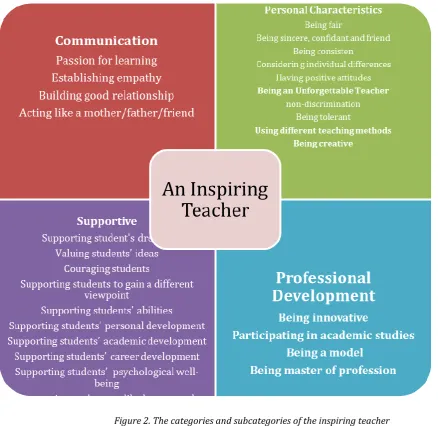
In the current study it was aimed to reveal the characteristics of the inspiring teacher and according to the opinions of the teacher candidates who composes of participants of the study, five categories were explored. In addition four subscales were emerged from 36-item ITS
Figure 2. The categories and subcategories of the inspiring teacher
The results of this study demonstrated the characteristics that an inspiring teacher should have according to the opinions of teacher candidates. These findings that are related to the characteristics of an inspiring teacher can be discussed in the light of the related literature. Thus, it is necessary to review the previous studies that focused on characteristics of teacher.
In a study conducted by Chen (2007) it was aimed to examine the characteristics of a perfect teacher and it was reported that leading multi-directional development, creating a connection between the academic knowledge and the everyday and planning courses according to the constructivist approach are main characteristics of perfect teacher. In addition, effective teacher makes an effort to create a positive classroom atmosphere, leads multi-directional development of students, supports students both academic and moral development. At the same time, effective teachers increase students’ self-esteem and motivation; develop their personality, help them to raise civic consciousness and encourage them to respect the cultural, racial and religious diversities (Chen, 2007; Pratt, Arseneau & Collins, 2001, Gao & Watkins, 2001). Thus, the results of the current study, which aimed to reveal characteristics of an inspiring teacher, are consistent with previous studies.
When the opinions of the teacher candidates are examined, it is found that having good communication with students, being a successful teacher or being an expert in his/her field, having positive personal values, managing the class effectively and supporting students are the characteristics of an inspiring teacher.
The most successful teachers pay attention to individual differences and evaluate their students fairly (Beane & Brodhagen, 2001). Fenstermacher and Soltis (1998) used metaphors to describe successful teaching. They emphasized metaphor of teacher as therapist/facilitator. These findings support our results that an inspiring teacher should be supportive and facilitator.
characteristics which are basic abilities to maintain a successful learning atmosphere, include; personal characteristics, supporting student achievement, establishing standards for student performance, ensuring students to reach a determined level, communicating effectively with students, the family and the community both within and outside the classroom, performing high level performance as a teacher, improving himself/herself, strengthening effort as a teacher, improving personal abilities as a teacher, motivating students even resistant, influencing not external and internal motivation of students, supporting and improving students from different ways. These dimensions are parallel with the dimensions, which were determined according to the opinions of teacher candidates in the current study. Sullo (1999) also emphasizes nine skills, which teachers need to improve to be an inspiring teacher. These skills are; characteristics of an inspiring teacher (passion for learning, lifelong learning, etc), choice theory (genetic factors that have an impact on behavior), brain-based learning (multiple intelligence etc.), developmental issues (human development theory, moral reasoning steps, gender and gender bias), inspiring students (building classroom community, planning the first day of school, being goal-driven, trying to reach an objective), inspiring colleagues (talking with colleagues, maintaining authenticity, interacting with people at school), allying with parents (conflict, threatening, insulting behaviors, and family expectations), conflict management (win and win method), time management (student evaluation, being a facilitator). It is emphasized that the teachers who have these skills are inspiring teachers.
The present study investigated characteristics of an inspiring teacher according to the opinions of teacher candidates. There are contributions from this study. The results of the present study may be useful for researchers, academicians and teachers. According to the results obtained from participants, teachers should support academic and moral development of students, should be good listeners and should support students to have a positive mental health. The characteristics of and inspiring teacher can be taught as a course in educational faculties. Professional can develop programs to improve positive characteristics of teacher candidates. In addition, providing teacher candidates with quality education may create more qualified teachers. This research is limited to teacher candidates studying in Turkey. Therefore, future studies may be conduct with different study groups and in different cultures to make a comparison.
References
Beane, J. A., & Brodhagen, B. L. (2001). Teaching in middle schools. In V. Richardson (Ed.), Handbook of Research on
Teaching (4th ed., pp. 1157-1174). Washington: American Educational Research Association.
Bentler, P. M. (1980). Multivariate analysis with latent variables: Causal modeling. Annual Review of Psychology, 31, 419-456.
Bentler, P. M., & Bonett, D. G. (1980). Significance tests and goodness of fit in the analysis of covariance structures.
Psychological Bulletin,88, 588-606.
Bilen, M. (1996). Plandan uygulamaya ogretim [Plan to practice
]
. Ankara: Aydan Publishing. Buyukozturk, S. (2007). Deneysel Desenler [Experimental patterns]. Ankara: Pegem Publishing.Buyukozturk, S. (2012). Sosyal bilimler icin veri analizi el kitabi [Data analysis handbook for social sciences]. Ankara: Pegem Publishing.
Browne, M.W., & Cudeck, R. (1993). Alternative ways of assessing model fit. In K. A. Bollen & J. S. Long (Eds.), Testing
structural equation models (pp. 136-162). Newbury Park, CA: Sage.
Chen, F. F. (2007). Sensitivity of goodness of fit indexes to lack of measurement invariance. Structural equation
modeling,14(3), 464-504.
Creswell, J. W., Fetters, M. D., & Ivankova, N. V. (2004). Designing a mix methods study in primary care. Annals of Family
Medicine, 2(1), 7-12.
Celikten, M., Sanal, M., & Yeni, Y. (2005). Ogretmenlik meslegi ve ozellikleri [Teaching profession and features]. Journal
of Social Sciences Institute, 19(2), 207-237.
Demirel, O. (1999). Planlamadan degerlendirmeye ogretme sanati [The art of teaching from planning to evaluation].
Ankara: Pegem Publishing.
Dowling, M. (1988). Education 3 to 5: A teachers’ handbook (pp.108-120). London: Paul Chapman Publishing Ltd.
Erturk, S. (1998). Egitimde program gelistirme [Curriculum development in education] (10th Edition). Ankara: Meteksan. Fenstermacher, G. D., & Soltis, J. F. (1998). Approaches to teaching (3rd Edition ). New York: Teachers College Press. Freeman, W., & Scheidecker, D. (2009). Becoming a legendary teacher to instruct and inspire. Thousand Oaks, CA:
Gao, L., & Watkins, D. A. (2001). Identifying and assessing the conceptions of teaching of secondary school physics teachers in China. British Journal of Educational Psychology, 71, 443-469.
Glaser, B. G., & Strauss, A. L. (1965). Awareness of dying. Chicago: Aldine.
Glaser, B. G., & Strauss, A. L. (1967). The discovery of grounded theory: Strategies for qualitative research. New York: Aldine.
Gurkan, T. (1986). Ogretmen tutumlarinin okuloncesi cocuklari uzerindeki etkileri [The effects of teacher attitudes on preschool children]. Ankara: Ya-pa 4. Seminar on School Education and Dissemination, 124-125.
Guven, S. (2016). Ogretmen adaylarinin bakis acisi ile egitim fakulteleri [Faculties of education with the perspective of prospective teachers]. Canakkale: VIII. International Educational Research Congress, 2020-2027.
Hergenhahn, B. R. ( 1988). An Introduction To Teories of Learning, (3th Ed.), New Jersey: Prentice Hall.
Karagozoglu, G. (2003). Egitim sistemimizde ogretmen yetistirme politikamiza genel bir bakis [An overview of our teacher
training policy in our education system]. Paper Presented at the Reflections in Education: VII Cagdas Education
Teacher Training Symposium, Cumhuriyet University, Sivas, Turkey.
McMillan, J., & Schumacher, S. (2006). Research in education: Evidence based inquiry (6th ed.). Boston: Pearson Education.
Ozden, Y. (1999). Egitimde donusum egitimde yeni degerler [New values in education in education transformation].
Ankara: Pegem Publishing.
Pratt, D. D., Arseneau, R., & Collins, J. B. (2001). Reconsidering "good teaching" across the continuum of medical education. The Journal of Continuing Education in the Health Professions,21, 70-81.
Raykov T, & Marcoulides GA.( 2006). Fundamentals of Structural Equation Modeling. A First Course in Structural
Equation Modeling (2nd Ed.) (pp.1-43). London: Lawrence Erlbaum Associates.
Senemoglu, N. (1997). Gelisim Ogrenme ve Ogretim Kuramdan Uygulamaya [Development learning and teaching from
theory to practice]. Ankara: Spot Publication.
Strauss, A., & Corbin, J. (1998). Basics of qualitative research: Grounded theory, procedures and techniques. Newbury Park, CA: Sage.
Sullo, R. A. (1999). The inspiring teacher: New beginnings for the 21st century. The Inspired Classroom Series. National Education Association, Washington, DC.
Unal, L. I., Gumus, A., Gurbuz, C., Karsli, M. D., Guven, S., Yildizlar, … Ural, A. (2011). Turkiye’de ogretmen yetistirme
[Teacher training in Turkey]. Ankara: Pegem Publishing.
Ustunoglu, U. (1986). Okul oncesi ogretmenlerin uzaktan ogretim yontemi ile yetistirilmelerine yonelik program modeli
[Program model for the training of preschool teachers by distance education method] (Unpublished Doctoral
Dissertation). Anadolu University, Eskisehir, Turkey.
Yildirim, A., & Simsek, H. (2001). Sosyal bilimlerde nitel arastirma yontemleri [Qualitative research methods in the social
sciences]. Ankara: Seckin Publishing.
Varis, F. (1988). Program gelistirme teori ve teknikleri. [Program development theory and techniques]. Ankara: Ankara University Publishing.
Appendix
Ilham Veren Ogretmen Olcegi/The Inspiring Teacher Scale
Reflects his/her passion for learning and teaching./ Ogrenme ve ogretme tutkusunu yansitir He/she has good communication skills./ Iletisim becerisi gelismistir.
He/she can empathize with students./ Ogrencisiyle empati kurabilir.
He/she can establish good relationship with students./ Ogrencisiyle iyi iliskiler kurar.
He/she spends time with student outside the classroom too./ Dersin disinda da ogrencisiyle vakit gecirir. He/she doesn’t discriminate against students./Ogrencisine karsi adildir.
He/she is fair to students./ Ogrencileri arasinda ayrim yapmaz.
He/she is aware of developmental characteristics of students and treats them according to these characteristics. / Ogrencisinin gelisim ozelliklerini bilir ve ona gore davranir.
He/she has positive attitude towards students./ Ogrencisine karsi pozitif tutum icinde olur. He/she considers the individual differences./ Her bir ogrencisinin bireysel farkliligini gozetir. He/she is tolerant toward students/ Ogrencisine karsi hosgoruludur
He/she is reliable, confidant and friend./ Ogrencilerine karsi guvenilir, sirdas ve dosttur. He/she uses different teaching methods in class./ Derste farkli ogretim yontemlerini kullanir.
He/she uses different and authentic examples while he is teaching./ Ders anlatirken uygun, yaratici ornekler kullanir. He/she uses time efficiently in class. /Derste zamani etkili kullanir.
He/she adapts to new developments and ideas../ Yeni fikirlere ve degisimlere uyum saglar. He calls students by their first names./ Ogrencisine ismiyle hitap eder.
He/she makes academic studies./ Akademik calismalar ortaya koyar.
He/she follows the developments in education/ Egitim alanindaki yeni calismalari takip eder..
He/she contributes the school development through planning projects. / Proje gelistirerek calistigi okulun gelisimine katkida bulunur
He/she attends in service training activities/ Hizmet ici egitim faaliyetlerine katilir.. He/she attends seminars related to his/field/ Bransi ile ilgili seminer calismalarina katilir..
He/she improves himself/herself to improve students’ personality development/ Ogrencilerin kisilik gelisimini desteklemek icin kendini gelistirir.
He/she encourages the students/ Ogrencisini cesaretlendirir.
He/she helps students’ to gain different point of views./ Ogrencisinin farkli bakis acisi kazanmasina yardimci olur He/she supports students’ personal development./ Ogrencisinin kisisel gelisimini destekler.
He/she helps students to produce new things/ Ogrencilerin yeni seyler ortaya koymasina yardimci olur. He/she provides students to feel self-confidence/ Ogrencisinin okulda kendini guvende hissetmesini saglar. He/she changes students’ life in a positive way/ Ogrencisinin hayatini iyi yonde degistirir.
He/she supports students’ moral development/ Ogrencisinin ahlaki gelisimini destekler. He/she makes students to love the school/ Ogrencisine okulu sevdirir.
He/she helps students to improve their psychological well-being/ Ogrencisinin olumlu bir ruh sagligi gelistirmesine yardimci olur.
He/she helps students to take responsibility/ Ogrencisinin sorumluluk almasina yardimci olur.
He/she helps students to realize their own abilities/ Ogrencisinin kendi yeteneklerini fark etmesini saglar. He/she guides students’ career development/ Ogrencisine meslekî acidan yol gosterir.