THE PROCESSING OF ELECTROCHEMICAL COATINGS THROUGH
SURFACE PLASTIC DEFORMATION (SPD)
Stefan Kostadinov
Department “Machinery and technology” – Ruse University „Angel Kanchev” - Ruse, Bulgaria,
[email protected]
Abstract: Because of the surface oxide film’s presence, a negative electric potential and formation of the disadvantageous residual strains
under the galvanic film’s putting on soft metals and alloys, there are the coming of considerable technological complications. This is obstructive to the good interaction between the films and main metal. In this case it isexpedient the technological combination the galvanic film of the surface with surface plastic deformation. In this case, the surface plastic deformation is realized by the tools with radial feed of the deforming elements.
Key words: surface plastic deformation,electrochemical covers, quality, roughness, precision.
1. INTRODUCTION
The operating characteristics of the details and their work’s time limit in considerable stage are defined by their roughness.
The applying of the surface plastic deformation (SPD) as a method for finished processing provides the improvement of the relief of the roughness and its parameters [5]. From its side it proofs the operating characteristics of the surface. It can be applied in combination with other technological methods for finished processing. The realized combination proofs physic and mechanicals characteristics of the surface layer metal [1].
The galvanic cover of the metal surfaces is one of the most applied methods for its finished processing. With this their corrosion stability and stability of the wear are rising [2].
With the making of the galvanic covers on soft metals and alloys, there are considerable technological complications which appear, because of the presence the surface oxidized layer, negative electrical potential and forming of the unfavorable remaining voltages. These complications disturb the good interactions between the surface and the main metal [2]. In this case its expedient the technological combination of the galvanic cover of the surface and SPD [1].
On a mass scale in the practice the instruments for SPD with axis feeding found their application. However they are non- applicable with the processing of thin galvanic covers. The reason is the presence of the edge defect and getting of wave in front of the deformation rollers [4].
In this case it’s expedient to be used instruments with radial feeding of the deformation elements which has respective priorities [3].
2. PURPOSE AND OBJECT OF THE RESEARCH
Purpose of the present work is to be examined the technological opportunities for combining of the finished processing with galvanic soft cover and surface plastic deformation in case of recovery of the aluminum pistons for internal-combustion engines.
The objects of the research are the surfaces of the apertures for the piston pins of the diesel engines ЯМЗ-238 НБ и СМД-62.
The pins of this kind of engines are made of aluminum alloy Аl25 with high contents of Si. Their hardness after heat-treating isНВ 90-130.
There are presented some requirements according to the apertures for the piston pin:
•The precision of the piston’s aperture ЯМЗ-238 НБ is Ø 50 0,006
015 , 0 −
− mm; the precision of the piston’s
aperture СМД-62 is Ø45−−00,,005010mm; •Aperture’s roughness is Rz = 0,4µm;
•The mutually beating of the apertures is maximum to 0,015mm.
3. EXPOSE
With work the piston is put under considerable mechanical and heat loadings from gases and inertia forces. The high maximum pressures of the gases and high frequency of the working cycles determine the accelerated character of the piston’s loading.
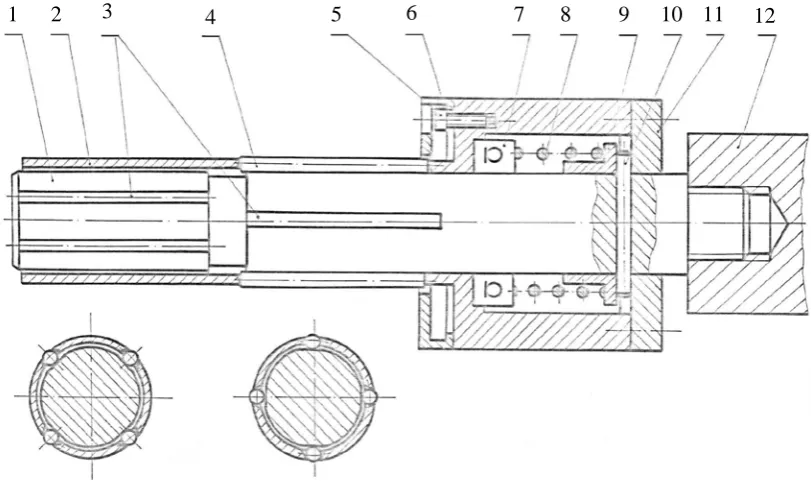
With rendering the technological characteristicsof the processingsurfaces (presence of grooves and apertures) and the contact interaction of the deform elements with the surfaces, a tool with radial feeding is chosen for the surface plastic deformation [3] – Fig.1.
Figure 1: A tool for surface plastic deformation has two line deformation rollers
The tool has tubular bearing shaft 1 with chords 3, which made over it; a separator 2 (it carries two line cylindrical rollers 4), which is bearing through the thrust bearing 7 on the bearing shaft 1; a screw 5, a guide insertion 9, a finger 10 (which serve as a fixer), a cap 11 and a tail-end 12.
When the tools is not work situation the fixer 10 ensure establishment of the rollers 4 over the chords 3 and it go into the grooves of the cap 11. In this case the separator 2 and the bearing shaft 1 are immovable together. The tool has diametric size smaller than the diameter of the machining aperture. This allows free tool’s movement – in and out of the aperture което позволява свободното му въвеждане и извеждане. The working of the tool is the following: through the tail-end 12, the tool is moved in axis direction till to contact the fulcrum 6 with the front of the detail. The continuing of the movement causes a flexion of the spring 8 from the guide insertion 9 and release the finger 10 from the grooves of the cap 11. In this way the separator 2 gives the possibility for a relatively turning with the rollers 4 round about the bearing shaft 1.
The machining scheme with such tools ensures the galvanic cover from outflow in the two apertures’ ends [4].
As deformation elements are used cylindrical rollers from a steel SchCh15 (BDS 12731).They turn over a bearing shaft with chords. The rollers are polished to Rа = 0,06 – 0,07µm.
The machining by the surface plastic deformation is going on the vertically - boring machine PK-32 with turning frequency 63min-1. The pistons are fixed in an appliance. This prevents their rotating toward to the machine. In this case the fixture is provided from the tool’s jam.
Before the process of the piston’s recovery it is made measuring, which is necessary for the conclusive valuation of the done. It is measured 16 pistons of the diesel
engines АМЗ 238 НБ and 18 pistons of the diesel engines
СМД-62. The measuring is made to the following
parameters:
•The precision of the apertures’ shapes for the piston pin, which is measured with an apparatus „TALYROND 200”;
•The apertures’ diameters for the piston pin, which is measured with an universal apparatus for a length with a precision 0,0002mm;
•The apertures’ roughness, which is measured with an apparatus „TALYSURF-6”.
•The dimension’s wear of the apertures’ diameters for the piston pin is dispersing in a field 0,0636 mm for Ø 45mm and 0,0534mm for Ø 50mm. This is over that the apertures’ limit.
The measured roughness is Rz = 4,27 – 14,58µm for Ø 45mm and Rz = 3,98 – 7,99µm for Ø 50mm. This is over repeatedly the requirements for roughness Rz = 0,4µm which is necessary in the documentation.
The recovery cover for the piston pin’s aperture is Fe-Zn alloy. The technological process is the following:
•become lighter in a nitrogen and fluorine-hydrogen acids;
•contact zinc-coating with a room temperature; •become lighter and contact zinc-coating for the
second time;
•stratification with temperature 42° and electricity force from 3 to 5А/gm2.
A planned experiment is carried out on a plan В4 (table 1) and statistic analysis. As an object of the examination before and after surface plastic deformation are the roughness and the precision of the dimensions and the shape of the machined surfaces.
Table 1: A plan of the experiment
Factors and levels of a variance
mm
N
F
l=
/
;m – number; n – min-1; Rz - μm
Naturals
Coding
x
1≡
F
lx
2≡
m
x
3≡
n
x
4≡
l
z-1 0 +1 100 150 200 1 3 5 11,2 31,5 63 6 29 52
Steerable factors, which are acceptable: the deform force in a unit of length Fl, the turning frequency of the bearing shaft n, the starting roughness Rz and the rate frequency of the deformation influence m (which is performed by number the separator’s turning).
The following parameters are measured:
Rа is the average absolute deviation of the roughness of the section, µm;
Rz is the height of the roughness of the section, µm;
tр is the relatively bearing length of the section, %
Δ is the maximum diversion of a circle, µm;
Е is the dislocation of the real aperture’s axis toward the geometric axis of the aperture, µm;
Δr is the radial beating toward the geometric axis of the aperture, µm.
The controlled parameter’s data for eachmodel are received from two mutually perpendicular plains.
The precision of the dimensions and the shape before and after surface plastic deformation is presented by their dispersing field and the respective theoretical and experimental distribution. The last is illustrated with the
following numeral characteristics:
R is the range;
x
is the chosen measure of central tendency of the data set;σ[х] is the standard deviation;
σ2[х] is the variance;
γ1 is the asymmetry;
γ2 is the excess.
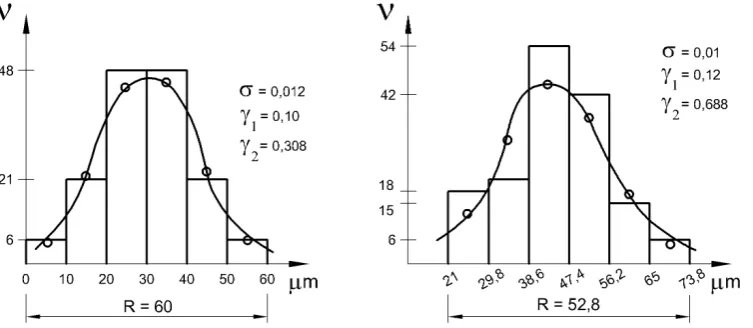
The theoretical frequency of the distribution is determinate thought characteristics of the appropriate law, which is confirmed by the Pirson criterion. In the case the hypotheses for normal, logarithmic-normal and exponential distribution are examined. The curves of the distribution are built (Fig.2).
The statistical characteristics of the distribution for the apertures’ diameters show preservation of its normal characterbefore and after surface plastic deformation. It is observed decrease of the average value of the diameter’s
dimension
x
, remarkable narrowing of the probable field ω (20 – 60%), sharpened of the theoretical curve of a distribution, which is conditioned by the excess value γ2 and displacement ofx
toward medium of the distribution’s field. It is evident from the asymmetry value γ1.Figure 2: Curves of the distribution
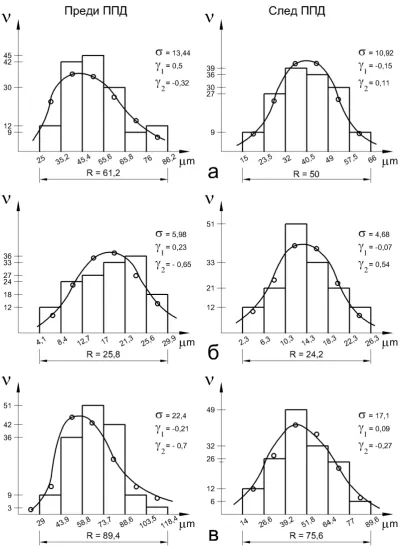
The values of the three parameters for the shape’s precision are determinate as a result of double measuring in exactly definitely section of the models. The graphs (Fig.3) are using for evaluation of the diversions of the right geometrical shape. The comparison of the statistical distribution characteristics of the parameters and the reading of the distribution laws, which are confirmed by the Pirson criterion (Fig.3), enable to establish the following changing in the shape’s precision:
•
• the mathematical expectance of the parameters, which characterized the shape’s precision after с surface plastic deformation is less than that before surface plastic deformation;
• the percentage notability of the decrease is graded accordingly the rising line: a radial beating toward the geometric axis and the diversion of a circle;
The received data of the planned experiment for the roughness parameters (Rа, Rz и tр) and the analyzing of the coefficients of the members in the equations of the regression show, that the greatest influence over the roughness have Fl and outgoing Rz.
Figure 4: A distribution of the shape’s diversions:
а – diversion from a circle(Δ); b – off-centered; (Е) ; c – radial beating (Δr)
It is received adequate equations of the regression. Their comparing shows that the plasticity of the processing metal determines their structural diversity. The equations’ analyse with the two levels of the outgoing roughness shows that the decrease outgoing roughness increase the influence
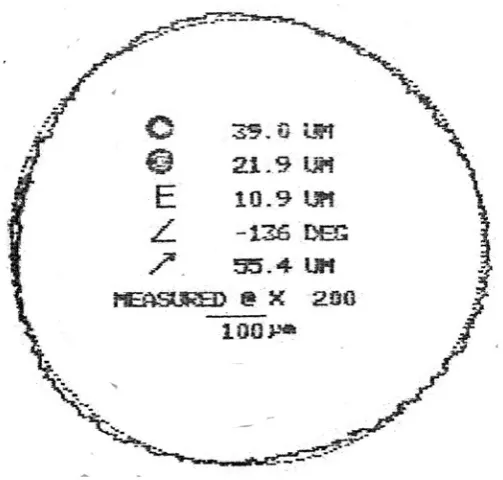
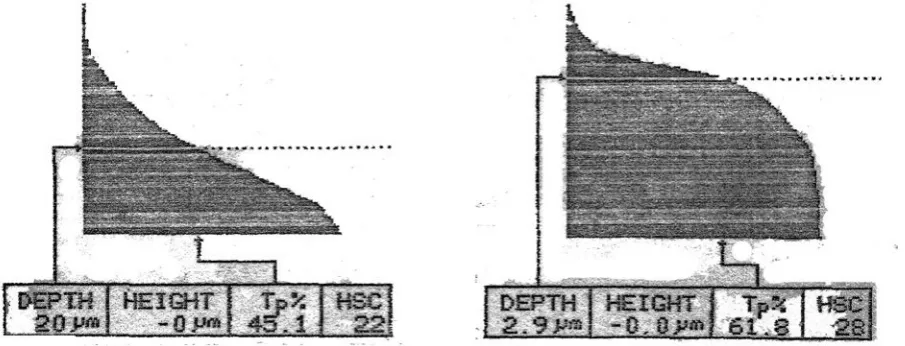
of other steerable factors. Fig.4 shows the out-rigger curve of the roughness profile. The favorable shapes of the curves after surface plastic deformation are obvious – the parameter
Figure 5: Out-rigger curve of the profile
4. CONCLUSION
As a result of the made research it can do the following conclusions:
•the finishing machining through surface plastic deformation of the apertures for the piston pin of the diesel engine’s pistons in combination with the discussing technology for the recovery through galvanic cover ensures the necessary precision parameters;
•it is satisfied the technical requirements to the processing surfaces according the constructive
documentation in reference to the received
qualitative indices of the surface (Rа, Rz, diversion from a circle, diversion from a cylinder); •the application of the surface plastic deformation over galvanic recovery surfaces allows to increase the resource for using of the internal-combustion engine’s pistons and to expand the technologic possibilities of the method.
BIBLIOGRAPHY
[1] Baranov Е.А. Engineering galvanic techniques in instrument-building. Мoskva, Machine building, 1977, in Russian.
[2] Kostadinov V.S. About the ending effect for surface plastic deformation tools with radial feed. Scientific works of High technical school, Rousse, volume ХХVІІІ, 1986, in Bulgarian.
[3] Suchkov А.G., V.S.Kostadinov, М.К.Кarchakov. BG Patent № 29758, 1979, in Bulgarian.