2017 | VOLUME 13 | 203 © ARCHIVES OF BUDO | PROPHYLACTIC AND THERAPEUTIC AGONOLOGY
This is an open-access article distributed under the terms of the Creative Commons Attribution-NonCommercial 4.0 International (http://creativecommons.org/licenses/by-nc/4.0), which permits use, distribution, and reproduction in any medium, provided the original work is properly cited, the use is non-commercial and is otherwise in compliance with the license.
Effectiveness of avoiding collision with an object
in motion – virtual reality technology in diagnostic
and training from perspective of prophylactic of
body injuries
Robert Michnik
1ABCDE, Piotr Wodarski
1BC, Andrzej Bieniek
1BC, Jacek Jurkojć
1ABC,
Dariusz Mosler
2ABD,
Roman Maciej Kalina
3ABCD1
Silesian University of Technology, Faculty of Biomedical Engineering, Department of Biomechatronics, Zabrze, Poland
2Institute Physical Education, Tourism and Physiotherapy, Jan Dlugosz University of Czestochowa, Czestochowa, Poland
3Gdansk University of Physical Education and Sport, Faculty of Physical Education, Department of Combat Sports,
Gdansk, Poland
Received:
27 April 2017;
Accepted:
15 June 2017;
Published online:
27 July 2017
AoBID:
11472
Abstract
Background and Aim: People older than 60 years, with dysfunctions of musculoskeletal or motor system, impaired vision or hear
-ing etc. are in a group of higher risk of collisions with objects in motion, which suddenly are head-ing towards their body (cyclists, runners, thrown an object, intentional punch or kick etc.). This study aims to verify com
-pensation possibilities of this category of threats by a person who is cumulating a few factors of higher risk of collision with an object in motion heading toward his head, but on the other hand, having a longstanding adaptation for this kind of threats.
Material and Methods: Two men have been subjected to the study: a man A 68-years-old and man B 27-years-old. Measurements have been performed with the use of MVN Biomech System (XSENS). Application projects a ball with a di
-ameter of 12 cm, which fly with constant velocity (three trials; 10-, 6- and 3 m/s) alongside axis perpendicu
-lar to a frontal plane on the height the head and legs of the participant in an initial moment.
Results: Man B avoided collision head with an object in motion three times. Man A avoided it only with a velocity of 3 m/s. Mean time of reaction of man A was 0.407 ±0.27s and was 35% longer than man B (0.263 ±0.05s). Man A performed body rotation faster (0.870 ±0.636s) than B (1.133 ±0.054s); moves his centre of mass more efficiently in the frontal plane (5.953 ±0.034deg) and sagittal plane (6.185 ±0.959deg) than man B (9.825 ±2.909deg) and (13.001 ±0.451deg). Man A managed to avoid collision with a ball with a diameter of 12 cm for the left knee at the highest velocity (10 m/s). Man B did not avoid collision nor for the left or right knee in the same circumstances. Kinematic trajectory for following velocities registered for 27 years old man differs significantly.
Conclusion: Positive adaptation effects for 68 years old man (most of the analysed time graphs of kinematics quantities were similar) is an empiric proof, that some category of “life sports” guarantee an optimal level of motor safe -ty to a late elderly. Furthermore, adequately adapted virtual reali-ty technology could be an effective and at -tractive tool for enhancing training of avoiding collisions on small space (in the apartment, garage etc.) de -spite weather or other circumstances.
Key words: health-related training • life sports • motor safety • prophylactic and therapeutic agonology • martial arts •
safe fall
Copyright: © 2017 the Authors. Published by Archives of Budo Conflict of interest: Authors have declared that no competing interest exists Authors’ Contribution:
A Study Design
B Data Collection
C Statistical Analysis
D Manuscript Preparation
204 | VOLUME 13 | 2017 www.archbudo.com Original Article
INTRODUCTION
Alongside with falls and collisions with a ground or vertical objects, collisions with objects in motion belongs to one of the most common causes of body injuries or death. Group of these issues belongs to the most neglected areas of public health in both exploratory and application areas, especially in body injuries prevention. Differences are seen on a level of epidemiology monitoring of such phenomena. Most of the reports are about risk factors, directs causes and results of falls [1-4].
A few studies provide information about num
-bers and results of collisions of men with vertical objects and objects in motion [5, 6].
Similar to falls, both categories of collisions, have direct relation with motor safety (is consciousness of the person undertaking to solve a motor task or consciousness the subject who has the right to encourage and even enforce from this person that would perform the motor activity, who is able to do it without the risk of the loss of life, injuries or other adverse health effects [7]). It is hard to question an assumption that optimal adaptation for protection of one’s body during a fall and col -lisions should be expected from people who are combat sports, martial arts and games. This divi -sion is too general to acknowledge those athletes as a homogenous group in a meaning of effective prevention. Following athletes should be better adapted to fall: judokas, wrestlers, sumotori etc., and handball, hockey, rugby, soccer players etc. To avoid collisions better: boxers, fencing, karate, tae -kwondo athletes etc.
Although falls cannot be eliminated (everybody has felt at least once before becoming an adult and may fall at least once during rest of his life), collisions can be limited in the human population. For example, people older than 60 years, with dysfunctions of musculoskeletal or motor system, impaired vision or hearing etc. are in a group of higher risk of collisions with objects in motion, which suddenly are heading towards their body (cyclists, runners, thrown object, intentional punch or kick etc.) [8, 9]. Compensatory factors
of such threat are solid adaptation effects, mostly acquired by longstanding health-related training basic on (independently from “life sports”) com -bat sports, martial arts, self-defence, games etc.
This study aims to verify compensation possibil -ities of this category of threats by a person who is cumulating a few factors of higher risk of colli -sion with an object in motion heading toward his head, but on the other hand, having a longstand -ing adaptation for this kind of threats.
MATERIALS AND METHODS
Two men have been subjected to the study: a 68-years-old scientist (A), who has been training judo and other combat sports for over than fifty years and is professionally involved in teaching people how to fall down safely and avoided colli -sion (with diagnosed type 2 diabetes, sight defect and burdensome degeneration of left ankle joint); a 27-years-old physiotherapist (B), who trains judo as an amateur, has completed specialist course on safe falling and avoided collision used those exercises in his kinesiotherapy practice (including patients with mental disorders).
Measurements have been performed with the use of MVN Biomech System (XSENS), which is com -posed of 17 sensors placed on different body parts (based on internal sensors equipped with acceler -ometer, gyroscope and magnetic field sensor) and mobile 3D projection system Oculus Rift. In virtual reality environment, an application which simu -lates object in motion was designed. Application projects a ball with a diameter of 12 cm, which fly with constant velocity (three trials; 10-, 6- and 3 m/s, starting from the fastest) alongside axis perpendicular to a frontal plane on the height the head of the participant in an initial moment. In this pilot study experiment during the first trial, (pro -jectile fly with 10 m/s) man A was not aware of the necessity of a focus on a task (effect of surprise). Before other trials, head of the project (Robert Michnik) gave such information to tested men.
Budo (Budō) – originally a
term denoting the “Way of the warrior”, it is now used as a collective appellation for modern martial arts of kendō, jūdō, kyūdo and so on. The primary objective of these “martial ways” is self-perfection (ningen-kesei) [19].
Sabaku – to move to an advantageous position. Also called tai-sabaki (body movement) and ashi-sabaki
(footwork) [19].
Tai-sabaki – body movement [19].
Ethical approval: The research was approved by the Local Ethics Committee Provenance & peer review: Not commissioned; externally peer reviewed
Source of support: Departmental sources
© ARCHIVES OF BUDO | PROPHYLACTIC AND THERAPEUTIC AGONOLOGY 2017 | VOLUME 13 | 205
RESULTS
Collision in head
Man A avoided it only with a velocity of 3 m/s
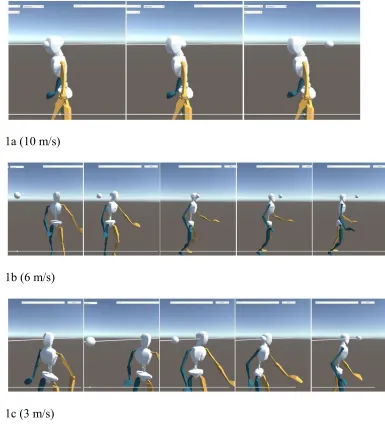
(Table 1, Figure 1a). Man A performed body rota -tion faster (0.870 ±0.636s), so he even has taken into account a situation with an element of sur -prise. He diverged a trunk in a frontal and sag -ittal plane at the lesser angle (Figure 1a,b,c). Except for purposely arranged situation with an element of surprise, he reacts to approaching an object in similar reaction time to a man 41 years
younger. Mean time of reaction of man A was
0.407 ±0.27s and was 35% longer than man B
(0.263 ±0.05s).
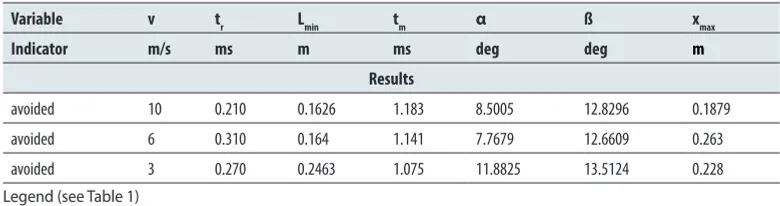
Man B avoided collision with an object in motion three times (Table 2). Performed body rotation slower (1.133 ±0.054s); moves his centre of mass less efficiently in frontal (9.825 ±2.909deg) and sagittal plane (13.001 ±0.451deg) than
men A (respectively 5.953 ±0.034deg; 6.185
±0.959deg).
The average minimal distance of flying project
from a centre of mass of a head Lmin in a case
of man A was two times smaller than in a case
of man B. Man A also in a smaller range shifted his centre of mass in frontal plane xmin. From one
side, these assessment data indicates flawless technique of body control in a danger of collision
with an object in the motion of a man A (Figures 1a, 1b, 1c).On the other hand,it justifiesmore hits to a head (with a velocity of 3 m/s it was just a scratch).
For man B kinematic trajectory for following velocities differs significantly (Table 2) and this inconsistency is identified on a level of direct observation (Figures 2a, 2b, 2c).
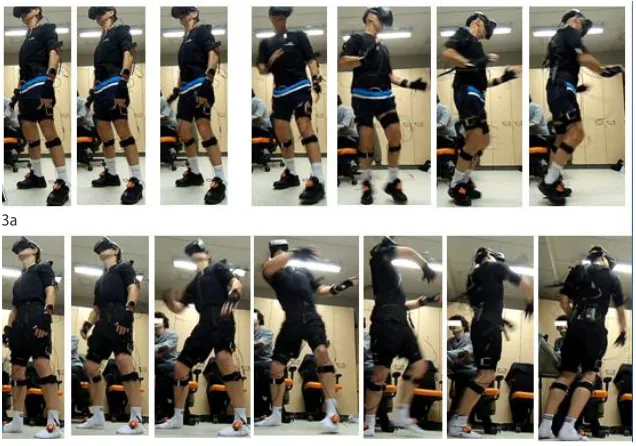
Biomechanical description of avoiding collision with the object for the highest velocity (10 m/s) for both men (Table 1 and 2) and visualisation of avatars (Figure 1a and Figure 2a), as well as verbal characteristics (Table 3), fulfils time-lapse photos in the same time function.The frame of reference (head to ceiling lights; legs to operator’s desk etc.) reveals differences in quality of body movement in favour of the man A (Figure 3).
Collision with legs
Man A managed to avoid collision with a ball
with a diameter of 12 cm for the highest veloc
-ity (10 m/s) with the left knee. Man B did not
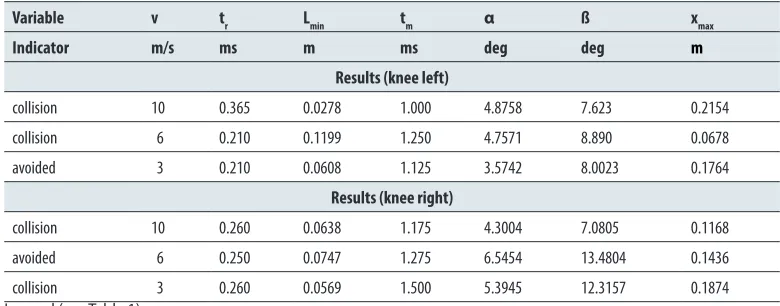
avoid collision nor with the left or right knee in the same circumstances (Table 5). Both men (in accordance with methodology) perform dodge by simultaneous retraction of left leg and rotation of 180o on the right leg.
Table 1. Biomechanics characteristic of avoiding head collision with object in motion in laboratory conditions by man A
Variable v tr Lmin tm α ß xmax
Indicator m/s ms m ms deg deg m
Results
collision 10 0.720 0.065 0.900 5.2488 5.103 0.0748
collision 6 0.230 0.0482 0.833 6.1215 6.5185 0.1555
avoided 3 0.270 0.1586 0.875 6.4872 6.932 0.251
Legend: v velocity of an object; tr reaction time; Lmin minimal distance between an object and a target; tm time of body rotation; α maximal angel of trunk divergence in frontal plane; ß maximal angel of trunk divergence in sagittal plane; xmax maximal shift lengthwise transversal axis.
Table 2. Biomechanics characteristic of avoiding collision with object in motion in laboratory conditions by man B.
Variable v tr Lmin tm α ß xmax
Indicator m/s ms m ms deg deg m
Results
avoided 10 0.210 0.1626 1.183 8.5005 12.8296 0.1879
avoided 6 0.310 0.164 1.141 7.7679 12.6609 0.263
avoided 3 0.270 0.2463 1.075 11.8825 13.5124 0.228
206 | VOLUME 13 | 2017 www.archbudo.com Original Article
1a (10 m/s)
1b (6 m/s)
1c (3 m/s)
Figure 1
. The way of avoiding collision with object in motion in laboratory conditions by
man
A
(
a
10 m/s;
b
6 m/3;
c
3 m/s)
For man
B
kinematic trajectory for following velocities differs significantly (Table 2) and this
inconsistency is identified on a level of direct observation (Figure 2a,b,c).
2a (10 m/s)
Figure 1. The way of avoiding collision with object in motion in laboratory conditions by man A (a 10 m/s; b 6 m/3; c 3 m/s).
Table 3. Motor characteristic (in a timeline) of avoiding collision with an object in motion in laboratory conditions.
V [m/s] Man A Man B
10 result: a direct hit(Figure 1c) knee flexion; rising of a right upper limb; bending trunk forward; Tilting of a trunk to a right side; putting away right lower limb to a side; result: avoided (crossing of an object at 90-110°) (Figure 2c)
6
knee flexion; head rotation; rising of a left upper limb; turn on a right lower limb; result: scratch of an object at a right side of a head at 120-130°) (Figure 1b)
knee flexion; tilting of a trunk to a right side and backward; rising of a right upper limb;
turn on a right lower limb result: avoided (crossing of an object at 80-90°) (Figure 2b)
3 knee flexion; head rotation; rising of a left upper limb; turn on a right lower limb; result: avoided ( 90°) (Figure 1a)
Michnik R et al. – Effectiveness of avoiding collision with an object in motion...
© ARCHIVES OF BUDO | PROPHYLACTIC AND THERAPEUTIC AGONOLOGY 2017 | VOLUME 13 | 207
1b (6 m/s)
1c (3 m/s)
Figure 1
. The way of avoiding collision with object in motion in laboratory conditions by
man
A
(
a
10 m/s;
b
6 m/3;
c
3 m/s)
For man
B
kinematic trajectory for following velocities differs significantly (Table 2) and this
inconsistency is identified on a level of direct observation (Figure 2a,b,c).
2a (10 m/s)
2b (6 m/s)
2b (3 m/s)
Figure 2.
The way of avoiding collision with an object in motion in laboratory conditions by
man
B
(
a
10 m/s;
b
6 m/3;
c
3 m/s).
Biomechanical description of avoiding collision with the object for the highest velocity (10
m/s) for both men (Table 1 and 2) and visualisation of avatars (Figure 1a and Figure 2a), as
well as verbal characteristics (Table 3), fulfils time-lapse photos in the same time function.
The frame of reference (head to ceiling
lights; legs to operator’s desk
etc.) reveals differences
in quality of body movement in favour of the man A (Figure 3).
Table 3.
Motor characteristic (in a timeline)
of avoiding collision with an object in motion in
laboratory conditions.
V
[m/s] Man A Man B
10 result: a(Figure 1c) direct hit
knee flexion; rising of a right upper limb; bending trunk forward; Tilting of a trunk to a right side; putting away right lower limb to a side; result: avoided (crossing of an object at 90-110°) (Figure 2c)
6
knee flexion; head rotation; rising of a left upper limb; turn on a right lower limb; result: scratch of an object at a right side of a head at 120-130°) (Figure 1b)
Knee flexion; tilting of a trunk to a right side and backward; rising of a right upper limb;
turn on a right lower limb result: avoided (crossing of an object at 80-90°) (Figure 2b)
3
knee flexion; head rotation; rising of a left upper limb; turn on a right lower limb; result:avoided ( 90°) (Figure 1a)
Knee flexion; rising of a right upper limb; tilting of a trunk to a right side and backward; turn on a left lower limb result: avoided (crossing of an object at 90-100°) (Figure 2a)
Figure 2. The way of avoiding collision with an object in motion in laboratory conditions by manB(a 10 m/s; b 6 m/3; c 3 m/s).
Figure 3. Motor response to man A and B in the same moments of simulated collision with a
ball with a diameter of 12 cm, which moves with a velocity of 10 m/s.
Collision with legs
Man A managed to avoid collision with a ball with a diameter of 12 cm for the highest velocity
(10 m/s) with the left knee. Man B did not avoid collision nor with the left or right knee in the
same circumstances (Table 5). Both men (in accordance with methodology) perform dodge by
simultaneous retraction of left leg and rotation of 180o on the right leg.
Table 4. Biomechanics characteristic of avoiding legs collision with an object in motion in
laboratory conditions by man A.
Variable v tr Lmin tm α ß xmax
Indicator m/s ms m ms deg deg m
Results (knee left)
collision 10 0.500 0.039 0.883 6.3907 6.2236 0.1883 avoided 6 0.300 0.088 0.808 7.1889 4.3474 0.1529 avoided 3 0.230 0.3226 0.716 7.4872 6.2484 0.0902
Results (knee right)
avoided 10 0.300 0.1025 0.875 6.0704 4.2544 0.2031 collision 6 0.230 0.0663 0.858 8.0451 8.3971 0.2915 collision 3 0.280 0.0334 0.783 6.4684 8.716 0.1469 Legend (see Table 1)
Figure 3. Motor response to man A and B in the same moments of simulated collision with a ball with a diameter of 12 cm, which moves with a velocity of 10 m/s.
3a
208 | VOLUME 13 | 2017 www.archbudo.com Original Article
DISCUSSION
The same men, three years earlier were tested
by professional biomechanics team for the qual
-ity of specific body parts control during a colli -sion with a floor made from concentrate (fall to the side [10]) moreover, with a concrete wall [11]. Similarly to this experiment, older man controlled his body more effectively in both extreme situa -tions. In an optimally way, he protects his body in such circumstances and functions more effectively in comparison with considerably younger man.
Therefore, there is no place for any doubts, which preliminary assumptions are correct. During youth, learning of effective body protection dur -ing a fall, collision with vertical objects as wells as avoiding collision with an object in motion (and when this is impossible, compensating results of collision) in a whole life investment in personal
motor safety. Monitoring of results of an exper
-iment via using avatars shows the motoric sub
-tlety of compensating methods of collision results by proper body rotation. Repetition of rota
-tion techniques by man A should stimulate the
imagination. Maintaining of such skill through a lifetime is possible thanks to attractive health-related training. Those criteria are fulfilled by the pedagogic offer of fun forms of martial arts [12].
The experiment shows how control of surround
-ing is important. Man A, despite proving that in similar circumstances of the risk of collision with
an object with a head he more effectively per
-forms defensive movements, in a moment of pro
-grammed surprise (trial 1) he was helpless. During formal exercises, the collision of a ball with a head might discourage to continue another repetition. The attractiveness of fun forms of martial arts Table 5. Biomechanics characteristic of avoiding legs collision with an object in motion in laboratory conditions by man B.
Variable v tr Lmin tm α ß xmax
Indicator m/s ms m ms deg deg m
Results (knee left)
collision 10 0.365 0.0278 1.000 4.8758 7.623 0.2154
collision 6 0.210 0.1199 1.250 4.7571 8.890 0.0678
avoided 3 0.210 0.0608 1.125 3.5742 8.0023 0.1764
Results (knee right)
collision 10 0.260 0.0638 1.175 4.3004 7.0805 0.1168
avoided 6 0.250 0.0747 1.275 6.5454 13.4804 0.1436
collision 3 0.260 0.0569 1.500 5.3945 12.3157 0.1874
Legend (see Table 1)
Table 4. Biomechanics characteristic of avoiding legs collision with an object in motion in laboratory conditions by man A.
Variable v tr Lmin tm α ß xmax
Indicator m/s ms m ms deg deg m
Results (knee left)
collision 10 0.500 0.039 0.883 6.3907 6.2236 0.1883
avoided 6 0.300 0.088 0.808 7.1889 4.3474 0.1529
avoided 3 0.230 0.3226 0.716 7.4872 6.2484 0.0902
Results (knee right)
avoided 10 0.300 0.1025 0.875 6.0704 4.2544 0.2031
collision 6 0.230 0.0663 0.858 8.0451 8.3971 0.2915
collision 3 0.280 0.0334 0.783 6.4684 8.716 0.1469
© ARCHIVES OF BUDO | PROPHYLACTIC AND THERAPEUTIC AGONOLOGY 2017 | VOLUME 13 | 209 (guaranteed by competencies of a teacher) is
basing on a fact, that participants acquire a high level of concentration on motor tasks and they can perceive different modifications of an envi
-ronment. In total opposition are motor behav
-iours of people on the street and in other public places. The Even result of casual observation shocks because of some people busy with using their smartphones etc. Velocities applied in this
experiment corresponds to moving cyclist, run
-ner, thrown object etc. Therefore, applied simu -lation using virtual reality technology is adequate for possible situations, provides safety of trained person and are attractive. In the future, they could be used even in a home, despite weather conditions.
Head director of this experiment (Robert Michnik)
did not warn man A (did not say “ready” com
-mand), which result in surprise effect during the first trial. Man A, despite performed motor task in more coordinated way (Figure 3), his reaction time was three-times longer than man B (Tables 1 and 2). Even if man B would not be able to avoid a collision, differences between the central col -lision of the moving object with the head and
non-central one are so obvious, that no com
-ment is required. This result has very prophylac -tic significance. It should spread awareness for millions of people, that moving through crowded areas such as streets, railway stations etc., focus -ing eyes and manipulative action of the hands on a mobile device come with big threat and its con -sequences could lead to injury or even be fatal.
Next step towards the improvement of assess
-ing the system for this phenomenon based on virtual reality technology, should be differenc -ing between central collisions and non-central
collisions. This conclusion was approved by participants of AHFE 2017, which got to know results of this experiment only for head results [13].
Virtual reality technology could be applied fur -ther in diagnostic, prophylactic and -therapy of people with balance dysfunctions [14]. Alongside with augmented-reality technology [15], these are examples of modern enhancement health-related training, especially during the teaching of unknown techniques of movement. In some way, this could be a bridge between behavioural acti -vation of people (patients) fascinated with modern technology and physically active people unfamiliar with virtual augmented-reality. These new techno -logical possibilities do not have to enhance seden -tary lifestyle. Along with getting knowledge about prophylactic and therapeutic agonology [16-18], recommended forms of physical activity (fun forms of martial arts, self-defence training etc.) could create a new, attractive and effective perspective
of prophylactic of body injuries. Japanese budo
offers not only effective but also an attractive form of collision avoidance – sabaku and tai-sabaki [19].
CONCLUSIONS
Positive adaptation effects for 68 years old man
(most of the analysed time graphs of kinemat
-ics quantities were similar) is an empiric proof, that some category of “life sports” guarantee an optimal level of motor safety to a late elderly. Furthermore, adequately adapted virtual reality technology could be an effective and attractive tool for enhancing training of avoiding collisions on small space (in the apartment, garage etc.) despite weather or other circumstances.
REFERENCES
1. Perell KL, Nelson A, Goldman RL et a. Fall Risk Assessment Measures: An Analytic Review J Gerontol 2001; 56: 761-766
2. Chan CH, Gau SS-F, Chan HY et al. Risk factors for falling in psychiatric inpatients: a prospec
-tive, matched case-control study. J Psychiatr Res 2013; 47: 1088-1094
3. The Global Burden of Disease: Generating Evidence, Guiding Policy. Washington DC: Institute For Health Metrics and Evaluation, University of Washington; 2013
4. Institute for Health Metrics and Evaluation
(IHME). GBD Compare Data Visualization. Seattle, WA: IHME, University of Washington, 2016 [accessed 2017 Apr 11]. Available from URL:http://vizhub.healthdata.org/gbd-compare 5. Moundon A Lin, Hurvitz P, Reeves P. Risk of
Pedestrian Collision Occurrence: Case Control Study of Collision Locations on State Routes in King County and Seattle, Washington. Transp Res Rec 2014; 2073-2004
6. Zhou Z, Cai Y, Ke R et al. A collision avoidance model for two-pedestrian groups: Considering random avoidance patterns. Physica A 2017; 475: 142-154
7. Kalina RM, Barczyński BJ. EKO-AGRO-FITNESS© original author’s continuous program of health-oriented and ecological education in the family, among friends or individually implemented – the premises and assumptions. Arch Budo 2010; 6: 178-184 8. Graw M, Koning HG.: Fatal pedestrian-bicycle
collisions. Forensic Sci Int 2002; 126: 241-247 9. Gabbett T, Jenkins D, Abernethy B. Physical
210 | VOLUME 13 | 2017 www.archbudo.com Original Article
10. Michnik R, Jurkojć J, Wodarski P et al. Similarities and differences of body control during professional, externally forced fall to the side performed by men aged 24 and 65 years. Arch Budo 2014; 10: 233-243 11. Michnik R, Jurkojć J, Wodarski P et al.
Similarities and differences of the body con
-trol during professional collision with a ver
-tical obstacle of men aged 24 and 65. Arch Budo 2015; 11: 27-39
12. Jagiełło W, Kalina RM, Klimczak J et al. Fun
forms of martial arts in positive enhancement of all dimensions of health and survival abili
-ties. In: Kalina RM (ed.) Proceedings of the 1st World Congress on Health and Martial Arts in Interdisciplinary Approach, HMA 2015, 17–19 September 2015, Czestochowa, Poland. Warsaw: Archives of Budo; 2015: 32-39 13. Kalina RM, Michnik R, Wodarski P et al.
Effectiveness of avoiding collision of a head with an object in motion – virtual reality technology
in diagnostic and training from perspective of prophylactic of body injuries. Proceedings of the AHFE 2017 International Conference on Human Factors in Sports, Injury Prevention and Outdoor Recreation; 2017 Jul 17-21; Los Angeles, USA. Orlando: Springer; 2017 14. Michnik R, Jurkojć J, Wodarski P et al. The
influence of the scenery and the amplitude of visual disturbances in the virtual reality on the maintaining the balance. Arch Budo 2014; 10: 133-140
15. Witkowski K, Sobecki J, Maśliński J et al. The use of augmented-reality technology to improve judo techniques. Premises, assumptions, meth
-odology, research tools, preliminary scenar
-ios – the first stage of the study. Arch Budo 2016; 12: 355-367
16. Kalina RM. Agonology as a deeply esoteric sci
-ence – an introduction to martial arts ther
-apy on a global scale. Procedia Manufacturing 2015; 3: 1195-1202
17. Kalina RM. Cognitive and Application Barriers to the Use of “Agonology in Preventive and Therapeutic Dimension”. In: Salmon P, Macquet AC (eds.). Advances in Human Factors in Sports and Outdoor Recreation. Proceedings of the HFE 2016 International Conference on Human Factors in Sports and Outdoor Recreation, July 27-31, 2016, Walt Disney World, Florida, USA Series: Adv Intell Syst Comput 2016; 496: 25-35
18. Kalina RM. Innovative agonology as a synonym for prophylactic and therapeutic agonology – the final impulse. Arch Budo 2016; 12: 329-344 19. Budō: The Martial Ways of Japan. Tokyo:
Nippon Budokan Foundation; 2009