
http://www.sciencepublishinggroup.com/j/ijsdr doi: 10.11648/j.ijsdr.20170304.12
Review Article
Water Reuse (WR): The Ultimate and Vital Solution for Water
Supply Issues
Djamel Ghernaout
1, 21
Chemical Engineering Department, College of Engineering, University of Ha’il, Ha’il, Saudi Arabia
2
Chemical Engineering Department, Faculty of Engineering, University of Blida, Blida, Algeria
E-mail address:
To cite this article:
Djamel Ghernaout. Water Reuse (WR): The Ultimate and Vital Solution for Water Supply Issues International Journal of Sustainable Development Research. Vol. 3, No. 4, 2017, pp. 36-46. doi: 10.11648/j.ijsdr.20170304.12
Received: August 22, 2017; Accepted: September 6, 2017; Published: October 10, 2017
Abstract:
Nowadays the humankind is urgently invited to make available for potable use satisfactory quantities of good quality water to its increasing population. There is a big effort by the water treatment specialists to analyze the solutions the humankind has at its disposition to respond to these risks. The contribution of water reuse (WR) would be great in the humankind’s water tomorrow. This review aims to discuss the growing WR technology as a future solution for water supply issues. WR is broadly applied by industries to decrease the consumption of clean water. WR process should employ treated wastewater mixed with surface water at a certain proportion depending on the degree of purity of the treated water and assuring the dilution effect. WR should not employ at any case only wastewater, for safeguard reasons and psychological effects. WR should be obviously more sophisticated than both water treatment and wastewater treatment since pathogens contamination and chemicals presence can be there most elevated. Since pharmaceutical products and cosmetics substances at trace levels are found in tap water, should we assist to a new formulation of water treatment technology? This will be feasible if water treatment/wastewater treatment/WR would be merged in a super and highly standardized water/wastewater treatment technology, as a future trend.Keywords:
Water Scarcity, Water Reuse (WR), Drinking Water, Human health, Water/Wastewater Treatment, Environmental Principles1. Introduction
As the humanity starts this century, the humankind arrives at seeking carefully and thoroughly for new solutions for water reserve and controlling [1-14]. Since water treatment specialists’ front toward water supplying confrontations among increasing population and global warming, water reuse (WR), or the using of greatly purified wastewater for drinking and/or non-potable water objectives, is becoming a vital solution [15-22]. Several specialists have applied low-priced WR installations, as bringing water to golf fields and playgrounds or supplying commercial cooling water in regions nearby the wastewater treatment manufactory [23]. Practically, these specialists are now acquainted with the benefits of WR, e.g. high reliability and shortage of water resistance of the water provision [24]. On the other hand, enlarged utilization of recovered water usually constitutes
bigger financial, technical, and institutional problems than usual sources and some consumers are worried concerning the safety of using recycled water for domestic usages. These issues have restricted the application of WR through the World [8, 9, 25-30].
water supply by potentially (1) substituting reclaimed water for implementations that do not need high-quality potable water, (2) increasing water sources and giving an alternative source of supply to assist in satisfying both present and future water requirements, (3) safeguarding aquatic ecosystems by reducing the diversion of freshwater, decreasing the quantity of nutrients and other toxic pollutants entering waterways, (4) reducing the need for water monitoring structures such as dams and reservoirs, and (5) complying with environmental regulations by better managing water consumption and wastewater discharges.
This paper is a review on the WR significance, fundamentals, and future trends.
2. Road Map for the WR Mission
A National Research Council Committee, convened by the Water Science and Technology Board (USA), performed a large study of the capacity for WR and reclamation of urban wastewater to enlarge and improve the available water supply solutions [9, 33-38]. The Committee was asked to list the main issues and questions encountered in the WR field (Table 1).
Table 1. Road Map for the WR Mission [9].
Task Definition
1. Contributing to the water supplies
What are the big profits of enlarged WR and reclamation? How much municipal wastewater effluent is generated, what about its quality, and where is it released?
What is the convenience of treated wastewaters for different usages, comprising potable water, non-potable urban uses, irrigation, industrial processes, groundwater recharge, and environmental restoration?
2. Assessing the state of technology
What is the actual form of the technology in wastewater treatment and production of reclaimed water?
How do obtainable treatment techniques compare in terms of process efficiency, cost, energy use, and environmental effects? What are the actual technology issues and restrictions? What are the infrastructure needs of WR for different objectives?
3. Assessing risks
What are the human health hazards of using recycled water for different objectives, comprising indirect drinking reuse? What are the hazards of using recycled water for environmental objectives?
How efficient are control systems?
4. Costs How do the costs and benefits of water reclamation and reuse generally compare with other supply alternatives, such as seawater desalination and nontechnical options such as water conservation or market transfers of water?
5. Barriers to implementation What implementation challenges (e.g., public acceptance, regulatory, financial, institutional, water rights) limit the applicability of WR to help meet the nation’s water needs and what, if appropriate, are means to overcome these challenges?
6. Research needs
What research is required to progress the safe, reliable, and cost-effective reuse of municipal wastewater where traditional sources of water are inadequate?
What are appropriate roles for governmental and nongovernmental entities?
2.1. Background and Capability for WR
Municipal WR gives the capability to importantly augment the global at hand water reservoirs [9, 39]. As an example, in USA, 45 million cubic meters per day of municipal wastewater effluent are discharged to an ocean or estuary out of the 121 million cubic meters per day discharged nationally. Recycling these littoral releases would immediately increase at hand water reservoirs (identical to 6 percent of the evaluated global US water usage or 27 percent of public stock). When repaired water is employed for non-consumptive usages, the water stock gain of WR may be surprisingly bigger if the water may once more be apprehended and recycled. Central wastewater releases can as well be accessible for WR, even if large-scale recycling possesses the capacity to impact the water stock of downstream users and ecosystems in water-limited surroundings. WR unaccompanied cannot treat all of the country’s water stock defiance, and the future
participations of WR will change by area. Even so, WR can provide important not yet exploited water provisions, especially in regions confronting water scarcities [33, 40].
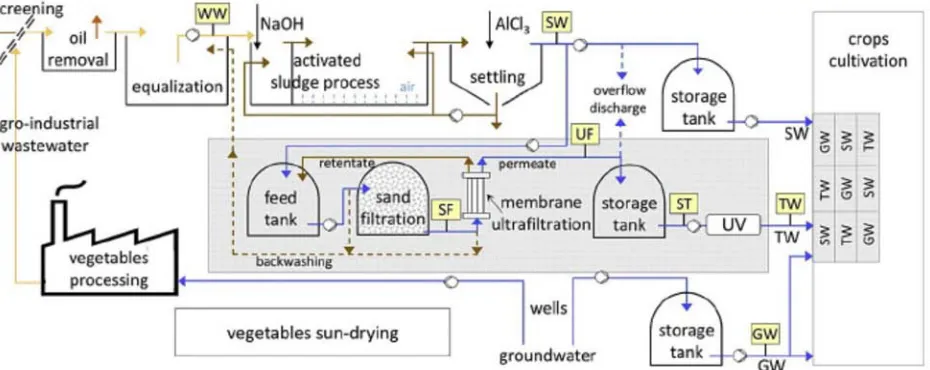
As an illustration, in USA, WR is a usual operation. Several manners are accessible for recycling sewage liquids to give water for industry, irrigation (see Figure 1) [41, 42], and drinking provision, included in additional usages, even if restricted evaluations of WR propose that it considers for a low portion (<1 percent) of US WR. Water repair for non-drinking usages is well set up, with methodology conceptions and remediation techniques that are usually adopted by societies, specialist, and regulatory authorities [9, 33].
Figure 1. The WR Scheme, Including Wastewater Production, Treatment Processes, and Test Field Arrangement. Tertiary Treatments Are in a Grey Background, and Sampling Points Are Identified [41].
2.2. Water Characteristics and Wastewater Repair Applied Science
The actual essence of WR proposes that almost whatever matter utilized or expelled by human beings possesses the ability to exist at certain level in the remediated water. Current analytical methods permit identification of chemical and biological pollutants at degrees that can be distant under human and ecological health concern. Thus, if wastewater begins to be portion of a recycling project, the effects of wastewater components on planned uses must be taken into account in the conception of the remediation techniques. Certain components, like salinity, sodium, and boron, possess the capacity to influence agricultural and landscape irrigation [41, 42] uses if they exist at levels that surpass fixed minimums. Certain compounds, like microbial pathogens [44] and trace organic chemicals, possess the capacity to influence human health, relying on their level and the ways and time of contact. Furthermore, not only are the compounds themselves crucial to take into accounting but as well the constituents into which they can convert through remediation. Pathogenic microorganisms [44-46] are a specific center of WR remediation techniques due to their severe human health impacts, and viruses require particular focus founded on their low infectious degree, small size, and resistance to disinfection [9, 47-53].
A series of treatment choices, comprising engineered and managed natural treatment manners, exists to mitigate microbial and chemical pollutants in reclaimed water, facilitating a multitude of process combinations that may be designed to meet specific water quality objectives. Advanced treatment processes are as well able of addressing current water quality problems related to drinking recycling implicating emerging pathogens [44] or trace organic chemicals. Advances in membrane filtration have made membrane-based techniques [54] specifically interesting for WR applications. Nevertheless, restricted cost-effective concentrate disposal alternatives hinder the application of membrane technologies for WR in inland
communities [9, 47].
Natural systems are used in most drinking WR systems to give an environmental buffer. Nevertheless, it cannot be established that such “natural” barriers give any public health safeguard that is not as well accessible by other engineered techniques (e.g., advanced treatment processes, reservoir storage) [9, 39, 55].
2.3. Quality Assurance
Recycling methods must be conceived with treatment trains that comprise reliability and robustness. Redundancy fortifies the reliability of pollutant elimination, specifically crucial for pollutants with acute affects, while robustness uses mixtures of techniques that address a large range of pollutants. Recycling methods conceived for applications with possible human contact must comprise redundant barriers for pathogens [44] that produce waterborne diseases. Drinking reuse methods must use diverse manners that may work as barriers for several kinds of chemicals, taking into account the large variety of physiochemical characteristics of chemical pollutants [9, 47].
Reclamation facilities must develop controlling and operational plans to respond to variability, equipment malfunctions, and operator error to ensure that reclaimed water released meets the appropriate quality standards for its usage. Redundancy and quality reliability assessments, comprising process control, water quality monitoring, and the capacity to divert water that does not meet predetermined quality targets, are essential components of all reuse systems. A key aspect implicates the identification of readily measureable efficiency criteria (e.g., surrogates), which are utilized for operational monitoring and as a trigger for corrective action [9, 47].
2.4. Appreciating the Hazards
however, well-confirmed principles and processes exist for evaluating the hazards of diverse WR uses. Complete protection is a worthy objective of society; nevertheless, in the estimation of protection, certain level of hazard should be regarded sustainable. To estimate these hazards, the principles of risk recognition, exposure assessment, dose-response assessment, and hazard characterization can be employed. Risk assessment screening manners enable estimates of potential human health effects for circumstances where dose-response data are lacking. In spite of the fact that risk assessment will be a crucial input in decision making, it only constitutes one of several such inputs, and risk management decisions comprise a range of additional factors, like cost, equitability, social, legal and regulatory factors, and qualitative public preferences [9, 47].
2.5. Evaluating the Hazards of Drinking Recycling in Context
It is convenient to compare the hazard of water produced by drinking reuse projects with the hazard linked with the water supplies that are currently in usage [39]. Researchers [9] have presented the results of an original comparative analysis of potential health hazards of drinking recycling in the context of the hazards of a classical potable water supply derived from surface water that receives a small percentage of treated wastewater. These researchers [9] compared the evaluated hazards of a common potable water source usually perceived as safe against the evaluated hazards of two other drinking recycling scenarios. They proposed that the hazard from 24 selected chemical pollutants in the two drinking recycling scenarios does not overpass the hazard in common existing water supplies. The findings are useful in giving perspective on the relative significance of diverse groups of chemical products in potable water.
As an illustration, disinfection by-products (DBPs) [50, 56-58], in particular nitrosodimethylamine (NDMA), and perfluorinated chemicals deserve particular consideration in WR projects since they constitute a more dangerous human health hazard than do pharmaceuticals and personal care products. Regardless of uncertainties inherent in the analysis, these findings show that following proper diligence and using designed advanced treatment trains and/or natural engineered treatment, drinking reuse systems may give safeguard from trace organic pollutants comparable to what the public experiences in several potable water supplies today [9].
Concerning the pathogens [44, 59, 60], despite the fact that there is a big level of uncertainty, researchers [9] proposed that the hazard from drinking recycling does not seem to be any higher, and may be orders of magnitude lower, than currently experienced in at least some current (and approved) potable water treatment systems. State-of-the-art water treatment trains for drinking reuse must be convenient to treat the worries of microbial pollution if finished water is protected from recontamination during storage and transport and if multiple barriers and quality assurance strategies are in place to ensure reliability of the treatment processes [9].
2.6. Ecological Applications of WR
Presently, few studies have documented the environmental hazards linked with the purposeful usage of reclaimed water for ecological improvement. WR for the purpose of ecological enhancement is a relatively new and promising area of research; however, few projects have been completed. As environmental enhancement projects with reclaimed water increase in number and scope, the amount of research conducted concerning the ecological hazard must as well augment, so that the potential benefits and any issues linked with the recycling use may be identified [9, 47].
2.7. Costs
Financial costs of WR are largely changing since they are dependent on site-specific factors. Financial costs are affected by size, location, incoming water quality, expectations and/or regulatory needs for product water quality, treatment train, method of concentrate disposal, extent of transmission lines and pumping requirements, timing and storage requirements, costs of energy, subsidies, and the complexity of the permitting and approval process. Capital costs in particular are site specific and can vary markedly from one community to another. Data on reuse costs are limited in the published literature [9,39,61].
3. WR for a “Closed Water Cycle”
Method
of Water Treatment and Reuse [15].
Figure 2. “Closed Water Cycle” Manner [15].
4. Electron Beam Treatment for Drinking
WR
Wang et al. [57] studied a manner for eliminating bromate and perfluorooctanoic acid (PFOA) from synthetic water conceived to simulate a treated wastewater intended for drinking WR. In the absence of oxygen, an exponential model was able to relate bromate concentration to absorbed dose. Nevertheless, a more complex model was required to show PFOA defluorination, so Wang et al. [57] developed a model that supposed generation of one partially defluorinated intermediate and employed this model to illustrate the link between free fluoride concentration and absorbed dose. They showed that nitrate negatively influenced the elimination of bromate and the dose constant was inversely proportional to the nitrate concentration as predicted by a simple model that supposes the presence of radical scavengers. In contrast, the presence of nitrate enhanced the decomposition of PFOA, probably due to production of oxidizing radicals or by other reactions of nitrate degradation products. Fulvic acid and alkalinity exerted negligible effects on bromate elimination. Fulvic acid inhibited the defluorination performance, perhaps because of the scavenging of oxidizing radicals such as the hydroxyl radical (●OH). They also observed that alkalinity accelerate PFOA defluorination, probably due to the generation and reactivity of the carbonate radical (CO3
-● ). As pH augmented from 5.0 to 7.3, the dose constant for bromate
removal augmented from 0.45 kGy-1 to 0.69 kGy-1; however, it scarcely varied when pH was further augmented to 9.0. In the presence of oxygen, both pollutants were decomposed less efficiently and illustrated more complex patterns of degradation. Finally, they concluded that pretreatment to remove dissolved oxygen would perhaps be required to apply electron beam in practice for degradation of bromate and PFOA [57].
5. WR Methods: Energy Consumptions
and Related Greenhouse Gas
Emissions
0.511 kWh/m3 and 0.43 kgCO2e/m3, respectively. Centralized WR systems had prohibitively elevated energy consumptions (1.224-1.914 kWh/m3) and greenhouse gas emissions (0.72-0.83 kgCO2e/m3). The decentralized WR systems, greywater reuse and rainwater harvesting systems, all employed for non-potable purposes, had comparable or more elevated energy demands than the conventional process (0.246-0.970 kWh/m3 after adjustment), even if evaluated
greenhouse gas emissions from these processes were lower than the conventional process (0-0.33 kgCO2e/m3 after adjustment). Taking into account the hidden environmental benefit (0.357 kWh/m3) from decrease of pollutant release, the energy demand of greywater reuse drops far below that of the conventional system, proposing that decentralized WR is the key to an energy-efficient water management with minimal impact on climate change [25].
Figure 3. System Boundaries of the Conventional Water Treatment System and Different Types of WR Systems Examined in [25].
6. Centralized WR System with Multiple
Applications in Urban Areas
Chen et al. [40] have established that the growth of WR in China has positive correlations to local water resource availability and gross domestic product (GDP) levels, and the WR rate in some megacities has already reached 35-60%. Centralized WR systems have largely acquired approval. Therefore, a centralized WR framework with three utilization patterns is proposed. Particularly, a multiple-utilization model that applies a hierarchical use structure is observed to be practicable for satisfying multiple water quality requirements. Additional patterns address environmental and cascading ways in maximizing the value of reclaimed water use. A case study in a Chinese megacity, Tianjin, is demonstrated where a large-scale centralized WR project with a multiple barrier
treatment approach and a hierarchical distribution and use structure has contributed to WR development in a safe, reliable and economical manner. Such study may be useful to water authorities and practitioners for long-term urban water management in other rapidly developing cities and regions that have encountered similar water-related issues [40].
7. Direct Drinking Recycling of
Reclaimed Water
into a raw water supply, such as in potable water storage reservoirs or a groundwater aquifer, resulting in mixing and
assimilation, thus providing an environmental buffer [31, 71-77].
Table 2. Fundamental Definitions Used in Direct Drinking Reuse [31].
Term Description
Direct potable reuse
The introduction of highly treated reclaimed water either directly into the potable water supply distribution system downstream of a water treatment plant, or into the raw water supply immediately upstream of a water treatment plant. Introduction could either be into a service reservoir or directly into a water pipeline. The water used by consumers could be therefore diluted reclaimed water originating from municipal wastewater.
Indirect potable reuse The planned incorporation of reclaimed water into a raw water supply, such as in potable water storage reservoirs or a groundwater aquifer, resulting in mixing and assimilation, thus providing an environmental buffer.
Integrated water resources planning
A process that promotes the coordinated development and management of water, land, and related resources to maximize the resultant economic and social welfare in an equitable and sustainable manner.
The fundamental distinction between indirect and direct potable reuse is that direct potable reuse does not comprise temporal or spatial separation such as natural (environmental) buffers between the reclaimed water introduction and its distribution to the end consumer [78-81]. In the extreme case, direct potable reuse consists of pipe-to-pipe blending of reclaimed water and potable water. Few direct potable reuse applications have been reported worldwide, although the extraction of water for potable purposes from rivers containing substantial quantities of wastewater effluent is fairly common (de facto potable reuse) [82-89]. There are no direct potable reuse applications in the US [31].
Asano et al. [31] mentioned three case studies to give a glimpse of different aspects of direct potable reuse: (1) a historical example (1956-57) in Chanute, Kansas, (2) a current international example in Windhoek, Namibia, and (3) a past direct potable reuse demonstration project in the US.
8. Logically Imposed Sequence: Water
Treatment, Wastewater Treatment,
and WR
In terms of environmental chemical reactions, water treatment, wastewater treatment and WR processes may be resumed as follows:
For water treatment:
Surface Water → Drinking Water (1)
For wastewater treatment:
Wastewater → Treated Water (2)
For WR:
Treated Water + αSurface Wate→ Drinking Water (3)
Considering Eq. (3), WR process should employ Treated Water mixed with Surface Water at a certain proportion α. This fraction α depends on the degree of purity of the Treated Water assuring the dilution effect. These equations [(1)-(3)] imply that WR should not employ at any case only Wastewater, for safeguard reasons and psychological effects. Moreover, WR should be obviously more sophisticated than both Water Treatment (Eq. (1)) and Wastewater Treatment
(Eq. (2)) since pathogens contamination and chemicals presence can be there most elevated. The passage from Eq. (2) to Eq. (3) is called Indirect Potable Reuse [37].
When Wastewater Treatment will be sufficiently developed, Eq. (2) may become:
Wastewater → Drinking Water (4)
Eq. (4) means that Treated Water is now Drinking Water and Wastewater Treatment becomes WR. This context is called Direct Potable Reuse [37].
There is an interesting environmental concept suggested in [37]. Instead of “waste” water term, researchers proposed the word “used” water (Figure 4). They explained this adoption by the fact that water on the globe is the same quantitatively since God Has Created Earth, and there is only its quality which varies with space and time depending on its usage types and water/waste(used)water treatment processes [2].
Figure 4. “Used” Water Instead of “Waste” Water New Concept Suggestion [37].
On the other hand, there is a worrying fact about surface water (raw water) quality. Since pharmaceutical products and cosmetics substances at varying levels are found in surface water and more dangerously in tap water, the [37]’s new concept of used water may further find its justification. Consequently, should we assist to a new formulation of water treatment technology?
For water treatment/wastewater treatment/WR:
This will be feasible if water treatment/wastewater treatment/WR would be merged in a super and standardized water/wastewater treatment technology, as a future trend. As the best available technology (BAT) of water/wastewater treatment and seawater desalination, simulation of the open sky seawater distillation was previously suggested [2].
9. Conclusion
The main important points drawn from this review may be listed as:
WR gives opportunities to shift towards a more efficient and sustainable water supply system. Several infrastructural and technological arrangements exist, with the local governing constraints – comprising land availability, water markets, technological development, existing infrastructure, energy availability, public acceptability and freshwater availability – often determining which form of WR system is or should be implemented.
Public perception is commonly found to act as a crucial barrier to the application of WR schemes. Public objection may be partially attributed to the lack of empirical evidence from existing schemes demonstrating system success and safety to public health. The lack of information may restrict the development of further schemes which are unable to progress upon past experiences. In addition, widespread variety in WR arrangements and applications demonstrates the requirement for local constraints to be appropriately represented when considering the costs and benefits of a new scheme. This is particularly a complex issue when integrating this new form of infrastructure within the existing ones. Appropriate policies are also needed for the development of new decentralised WR technologies. Policy can trigger the creation of artificial niche markets which recognise the need to protect such emerging technologies and infrastructural arrangements from market forces. The establishment of appropriate water quality regulation could also encourage the emergence of WR technology and be subsequently slackened when systems have aproven tracked record and are publicly acceptable.
In a general manner, direct reuse of wastewater for drinking purposes is intelligibly restricted; however, indirect reuse fordrinking purposes takes place constantly and on a worldwide basis. Indirect drinking reuse is more acceptable to the public than direct potable reuse as the water loses its identity as it moves through a river, lake, or aquifer. Indirect reuse, by virtue of the residence time in the water course, reservoir, or aquifer, often provides additional treatment and offers an opportunity for controlling the quality and taking adequate measures before the water is ready for distribution. In some instances, however, water quality may actually be degraded as it passes through the environment.
WR process should employ treated water mixed with surface water at a certain proportion. This fractiondepends on the degree of purity of the treated water assuring the dilution effect. WR should not employ at any case only wastewater, for safeguard reasons and psychological effects.
Moreover, WR should be obviously more sophisticated than both water treatment and wastewater treatment since pathogens contamination and chemicals presence can be there most elevated.
There is a worrying fact about surface water quality. Since pharmaceutical products and cosmetics substances at varying levels are found in in tap water, should we assist to a new formulation of water treatment technology? This will be feasible if water treatment/wastewater treatment/WR would be merged in a super and highly standardized water/wastewater treatment technology, as a future trend.
References
[1] D. Ghernaout, Environmental principles in the Holy Koran and the Sayings of the Prophet Muhammad, Am. J. Environ. Prot. 6 (2017) 75-79.
[2] D. Ghernaout, The best available technology of water/wastewater treatment and seawater desalination: Simulation of the open sky seawater distillation, Green Sustain. Chem. 3 (2013) 68-88.
[3] D. Ghernaout, B. Ghernaout, On the concept of the future drinking water treatment plant: Algae harvesting from the algal biomass for biodiesel production––A Review, Desalin. Water Treat. 49 (2012) 1-18.
[4] D. Ghernaout, B. Ghernaout, Sweep flocculation as a second form of charge neutralisation – A Review, Desalin. Water Treat. 44 (2012) 15-28.
[5] D. Ghernaout, M. W. Naceur, B. Ghernaout, A review of electrocoagulation as a promising coagulation process for improved organic and inorganic matters removal by electrophoresis and electroflotation, Desalin. Water Treat. 28 (2011) 287-320.
[6] D. Ghernaout, M. W. Naceur, Ferrate (VI): In situ generation and water treatment – A review, Desalin. Water Treat. 30 (2011) 319-332.
[7] D. Ghernaout, B. Ghernaout, M. W. Naceur, Embodying the chemical water treatment in the green chemistry – A review, Desalination 271 (2011) 1-10.
[8] J. Wilcox, F. Nasiri, S. Bell, M. Saifur Rahaman, Urban water reuse: A triple bottom line assessment framework and review, Sustain. Cities Soc. 27 (2016) 448-456.
[9] Water reuse: Potential for expanding the nations water supply through reuse of municipal wastewater, Committee on the Assessment of Water Reuse as an Approach for Meeting Future Water Supply Needs, Water Science and Technology Board, Division on Earth and Life Studies, National Research Council of the National Academies, The National Academies Press, Washington, DC, 2012.
[10] P. Bilotta, R. L. R. Steinmetz, A. Kunz, R. Mores, Swine effluent post-treatment by alkaline control and UV radiation combined for water reuse, J. Clean. Prod. 140 (2017) 1247-1254.
[12] D. Goodwin, M. Raffin, P. Jeffrey, H. M. Smith, Collaboration on risk management: The governance of a non-potable water reuse scheme in London, J. Hydrol. (2017), (in press) [13] M. H. Lamoree, J. G. M. Derksen, S. C. van der Linden, C. A.
Uijterlinde, P. de Voogt, Efficiency of removal of compounds with estrogenic activity during wastewater treatment: Effects of various removal techniques (Ch. 15), Xenobiotics in the urban water cycle, Mass flows, environmental processes, mitigation and treatment strategies, Environmental pollution (Vol. 16), D. Fatta-Kassinos, K. Bester, K. Kümmerer (Eds.), Springer Science+Business Media B. V., New York, 2010.
[14] D. Barceló, M. Petrovic, J. Alemany, Problems and needs of sustainable water management in the Mediterranean area: Conclusions and recommendations (p. 295), Waste water treatment and reuse in the Mediterranean region, D. Barceló, M. Petrovic (Eds.), Springer-Verlag Berlin Heidelberg, 2011. [15] M. Prisciandaro, M. Capocelli, V. Piemonte, D. Barba, Process
analysis applied to water reuse for a “closed water cycle” approach, Chem. Eng. J. 304 (2016) 602-608.
[16] S. Vajnhandl, J. V. Valh, The status of water reuse in European textile sector, J. Environ. Manag. 141 (2014) 29-35.
[17] D. Ghernaout, A. Badis, G. Braikia, N. Matâam, M. Fekhar, B. Ghernaout, A. Boucherit, Enhanced coagulation for algae removal in a typical Algeria water treatment plant, Environ. Eng. Manag. J. (Article in Press). 2017.
[18] D. Ghernaout, A. Boucherit, Review of coagulation’s rapid mixing for NOM removal, J. Res. Develop. Chem., 2015, DOI: 10.5171/2015.926518.
[19] D. Ghernaout, A. I. Al-Ghonamy, M. W. Naceur, A. Boucherit, N. A. Messaoudene, M. Aichouni, A. A. Mahjoubi, N. A. Elboughdiri, Controlling coagulation process: From Zeta potential to streaming potential, Am. J. Environ. Prot. 4 (2015) 16-27.
[20] D. Ghernaout, A. I. Al-Ghonamy, A. Boucherit, B. Ghernaout, M. W. Naceur, N. Ait Messaoudene, M. Aichouni, A. A. Mahjoubi, N. A. Elboughdiri, Brownian motion and coagulation process, Am. J. Environ. Prot. 4 (2015) 1-15. [21] D. Ghernaout, S. Moulay, N. Ait Messaoudene, M. Aichouni,
M. W. Naceur, A. Boucherit, Coagulation and chlorination of NOM and algae in water treatment: A review, Intern. J. Environ. Monit. Analy. 2 (2014) 23-34.
[22] D. Ghernaout, The hydrophilic/hydrophobic ratio vs. dissolved organics removal by coagulation - A review, J. King Saud Univ. – Sci. 26 (2014) 169-180.
[23] S. M. Hocaoglu, Evaluations of on-site wastewater reuse alternatives for hotels through water balance, Resour. Conserv. Recy. 122 (2017) 43-50.
[24] C. Makropoulos, E. Rozos, I. Tsoukalas, A. Plevri, G. Karakatsanis, L. Karagiannidis, E. Makri, C. Lioumis, C. Noutsopoulos, D. Mamais, C. Rippis, E. Lytras, Sewer-mining: A water reuse option supporting circular economy, public service provision and entrepreneurship, J. Environ. Manag. (2017), (in press).
[25] J. Chang, W. Lee, S. Yoon, Energy consumptions and associated greenhouse gas emissions in operation phases of urban water reuse systems in Korea, J. Clean. Prod. 141 (2017) 728-736.
[26] B. J. Blunt, A. Singh, L. Wu, M. Gamal El-Din, M. Belosevic, K. B. Tierney, Reuse water: Exposure duration, seasonality and treatment affect tissue responses in a model fish, Sci. Total Environ. 607-608 (2017) 1117-1125.
[27] A. D. McEachran, D. Shea, E. G. Nichols, Pharmaceuticals in a temperate forest-water reuse system, Sci. Total Environ. 581-582 (2017) 705-714.
[28] Q. K. Tran, D. Jassby, K. A. Schwabe, The implications of drought and water conservation on the reuse of municipal wastewater: Recognizing impacts and identifying mitigation possibilities, Water Res. 124 (2017) 472-481
[29] G. Almeida, J. Vieira, A. S. Marques, A. Kiperstok, A. Cardoso, Estimating the potential water reuse based on fuzzy reasoning, J. Environ. Manag. 128 (2013) 883-892.
[30] G. W. H. Simons, W. G. M. Bastiaanssen, W. W. Immerzeel, Water reuse in river basins with multiple users: A literature review, J. Hydrol. 522 (2015) 558-571.
[31] T. Asano, F. L. Burton, H. L. Leverenz, R. Tsuchihashi, G. Tchobanoglous, Direct potable reuse of reclaimed water (Ch. 24), Water Reuse: Issues, technologies, and applications, Metcalf & Eddy, Inc., McGraw-Hill, New York, 2007. [32] J. Savković-Stevanović, Waste water management systems (Ch.
1), Waste water – treatment technologies and recent analytical developments, F.S.G. Einschlag, L. Carlos (Eds.), InTech, Rijeka, Croatia, 2013.
[33] L. Garcia-Cuerva, E. Z. Berglund, A. R. Binder, Public perceptions of water shortages, conservation behaviors, and support for water reuse in the U.S., Resour. Conserv. Recy. 113 (2016) 106-115.
[34] City of San Diego Water Reuse Study 2005, Water reuse goals, opportunities and values, American Assembly Workshop I, October 6-7, 2004,
https://www.sandiego.gov/sites/default/files/legacy/water/pdf/ purewater/aa1wp.pdf (accessed on 11/08/17).
[35] Water reuse potential in California, June 2014. http://pacinst.org/wp-content/uploads/2014/06/ca-water-reuse. pdf (accessed on 11/08/17).
[36] S. M. Jones, Nanofiltration rejection of contaminants of emerging concern from municipal water resource recovery facility secondary effluents for potable reuse applications, PhD Thesis, University of Arkansas, 2016.
[37] Water reuse for a thirsty World – Tapping your future. https://www.youtube.com/watch?v=u_u-KjOxgGQ (accessed on 12/08/17).
[38] Office of Water Policy Webinar recording August 20, 2015, SB536 Study Report Overview,
https://www.youtube.com/watch?v=_QgHOGFxChw (accessed on 12/08/17).
[39] S. B. Sadr Ghayeni, P. J. Beatson, R. P. Schneider, A. G. Fane, Water reclamation from municipal wastewater using combined microfiltration-reverse osmosis (ME-RO): Preliminary performance data and microbiological aspects of system operation, Desalination 116 (1998) 65-80.
[41] P. Vergine, C. Salerno, A. Libutti, L. Beneduce, G. Gatta, G. Berardi, A. Pollice, Closing the water cycle in the agro-industrial sector by reusing treated wastewater for irrigation, J. Clean. Prod. 164 (2017) 587-596.
[42] K. Gomes, Irrigation with wastewater (Ch. 10), Wastewater management, Oxford Book Company, Jaipur, India, 2009. [43] J. A. Cortacáns, Water reuse planning and management: the
point of view of a contractor-operator, Desalination 218 (2008) 74-80.
[44] G. Fongaro, A. Kunz, M. E. Magri, C. D. Schissi, A. Viancelli, L. S. Philippi, C. R. M. Barardi, Settling and survival profile of enteric pathogens in the swine effluent for water reuse purpose, Int. J. Hyg. Envir. Heal. 219 (2016) 883-889.
[45] N. S. Grigg, Water, wastewater, and stormwater infrastructure management, 2nd Ed., Taylor & Francis Group, LLC, Boca Raton, Florida, 2012.
[46] G. Bitton, Wastewater microbiology, 3rd Ed., John Wiley & Sons, Inc., Hoboken, New Jersey, 2005.
[47] T. Cazurra, Water reuse of south Barcelona’s wastewater reclamation plant, Desalination 218 (2008) 43-51.
[48] D. Ghernaout, A. Badis, B. Ghernaout, A. Kellil, Application of electrocoagulation in Escherichia Coli culture and two surface waters, Desalination 219 (2008) 118-125.
[49] D. Ghernaout, B. Ghernaout, From chemical disinfection to electrodisinfection: The obligatory itinerary?, Desalin. Water Treat. 16 (2010) 156-175.
[50] A. Boucherit, S. Moulay, D. Ghernaout, A. I. Al-Ghonamy, B. Ghernaout, M. W. Naceur, N. Ait Messaoudene, M. Aichouni, A. A. Mahjoubi, N. A. Elboughdiri, New trends in disinfection by-products formation upon water treatment, J. Res. Develop. Chem., 2015, DOI: 10.5171/2015.628833.
[51] D. Ghernaout, Microorganisms’ electrochemical disinfection phenomena, EC Microbiology 9 (2017) 160-169.
[52] B. Ghernaout, D. Ghernaout, A. Saiba, Algae and cyanotoxins removal by coagulation/flocculation: A review, Desalin. Water Treat. 20 (2010) 133-143.
[53] D. Ghernaout, B. Ghernaout, A. Kellil, Natural organic matter removal and enhanced coagulation as a link between coagulation and electrocoagulation, Desalin. Water Treat. 2 (2009) 209-228.
[54] D. Ghernaout, A. El-Wakil, Requiring reverse osmosis membranes modifications – An overview, Am. J. Chem. Eng. 5 (2017) 81-88.
[55] O. Thomas, M.-F. Pouet, Industrial wastewater quality monitoring (Ch. 4.2), Wastewater quality monitoring and treatment, P. Quevauviller, O. Thomas, A. van der Beken (Eds.), John Wiley & Sons, Ltd., Chichester, UK, 2006.
[56] D. Ghernaout, M. W. Naceur and A. Aouabed, On the dependence of chlorine by-products generated species formation of the electrode material and applied charge during electrochemical water treatment, Desalination 270 (2011) 9-22. [57] L. Wang, B. Batchelor, S. D. Pillai, V. S. V. Botlaguduru, Electron beam treatment for potable water reuse: Removal of bromate and perfluorooctanoic acid, Chem. Eng. J. 302 (2016) 58-68.
[58] Y. Tan, T. Lin, F. Jiang, J. Dong, W. Chen, D. Zhou, The shadow of dichloroacetonitrile (DCAN), a typical nitrogenous disinfection by-product (N-DBP), in the waterworks and its backwash water reuse, Chemosphere 181 (2017) 569-578. [59] M. H. Gerardi, M. C. Zimmerman, Wastewater pathogens,
John Wiley & Sons, Inc., Hoboken, New Jersey, 2005. [60] M. H. Gerardi, Wastewater bacteria, John Wiley & Sons, Inc.,
Hoboken, New Jersey, 2006.
[61] G. A. Raftelis, Water and wastewater finance and pricing, A comprehensive guide, 3rd Ed., Taylor & Francis Group, LLC, Boca Raton, Florida, 2005.
[62] M. M. Benjamin, D. F. Lawler, Water quality engineering, Physical/chemical treatment processes, John Wiley & Sons, Inc., Hoboken, New Jersey, 2013.
[63] E. R. Alley, Water quality control handbook, 2nd Ed., The McGraw-Hill Companies, Inc., New York, 2007.
[64] M.-L. Pype, M. G. Lawrence, J. Keller, W. Gernjak, Reverse osmosis integrity monitoring in water reuse: The challenge to verify virus removal - A review, Water Res. 98 (2016) 384-395. [65] Water reuse demo plant gets the green light in California, 19
July 2017.
https://www.desalination.biz/news/0/Water-reuse-demo-plant-gets-the-green-light-in-California/8805/#.WXern395peA.linke din (accessed on 12/08/17).
[66] NEWater. https://en.wikipedia.org/wiki/NEWater (accessed on 12/08/17).
[67] NEWater: A Singapore Success Story.
https://www.youtube.com/watch?v=DWWU-8_4wu0 (accessed on 12/08/17).
[68] R. Bastian, D. Murray, 2012 Guidelines for Water Reuse. US EPA Office of Research and Development, Washington, DC, EPA/600/R-12/618, 2012.
[69] S. D. Richardson, S. Y. Kimura, Emerging environmental contaminants: Challenges facing our next generation and potential engineering solutions, Environ. Technol. Innov. 8 (2017) 40-56.
[70] S. Hosseinzadeh, G. Bonarrigo, Y. Verheust, P. Roccaro, S. Van Hulle, Water reuse in closed hydroponic systems: Comparison of GAC adsorption, ion exchange and ozonation processes to treat recycled nutrient solution, Aquacult. Eng. 78 (2017) 190-195.
[71] N. Pathak, L. Chekli, J. Wang, Y. Kim, S. Phuntsho, S. Li, N. Ghaffour, T. Leiknes, H. Shon, Performance of a novel baffled osmotic membrane bioreactor-microfiltration hybrid system under continuous operation for simultaneous nutrient removal and mitigation of brine discharge, Bioresource Technol. 240 (2017) 50-58.
[72] O. M. Rodriguez-Narvaez, J. M. Peralta-Hernandez, A. Goonetilleke, E. R. Bandala, Treatment technologies for emerging contaminants in water: A review, Chem. Eng. J. 323 (2017) 361-380.
[74] J. G. Herman, C. E. Scruggs, B. M. Thomson, The costs of direct and indirect potable water reuse in a medium-sized arid inland community, J. Water Process Eng. 19 (2017) 239-247. [75] B. M. Pecson, S. C. Triolo, S. Olivieri, E. C. Chen, A. N.
Pisarenko, C.-C. Yang, A. Olivieri, C. N. Haas, R. S. Trussell, R. R. Trussell, Reliability of pathogen control in direct potable reuse: Performance evaluation and QMRA of a full-scale 1 MGD advanced treatment train, Water Res. 122 (2017) 258-268.
[76] B. Zhang, X. Song, L. D. Nghiem, G. Li, W. Luo, Osmotic membrane bioreactors for wastewater reuse: Performance comparison between cellulose triacetate and polyamide thin film composite membranes, J. Membr. Sci. 539 (2017) 383-391.
[77] M. M. Saggaï, A. Ainouche, M. Nelson, F. Cattin, A. El Amrani, Long-term investigation of constructed wetland wastewater treatment and reuse: Selection of adapted plant species for metaremediation, J. Environ. Manag. 201 (2017) 120-128.
[78] D. Abdulbaki, M. Al-Hindi, A. Yassine, M. Abou Najm, An optimization model for the allocation of water resources, J. Clean. Prod. 164 (2017) 994-1006.
[79] Y. Yang, Y. S. Ok, K.-H. Kim, E. E. Kwon, Y. F. Tsang, Occurrences and removal of pharmaceuticals and personal care products (PPCPs) in drinking water and water/sewage treatment plants: A review, Sci. Total Environ. 596-597 (2017) 303-320.
[80] A. Giwa, A. Dindi, An investigation of the feasibility of proposed solutions for water sustainability and security in water-stressed environment, J. Clean. Prod. 165 (2017) 721-733.
[81] H. Wang, M. Park, H. Liang, S. Wu, I. J. Lopez, W. Ji, G. Li, S. A. Snyder, Reducing ultrafiltration membrane fouling during potable water reuse using pre-ozonation, Water Res. 125 (2017) 42-51.
[82] [A. Ding, H. Liang, G. Li, I. Szivak, J. Traber, W. Pronk, A low energy gravity-driven membrane bioreactor system for grey water treatment: Permeability and removal performance of organics, J. Membr. Sci. 542 (2017) 408-417.
[83] A. Nikoonahad, M. T. Ghaneian, A. H. Mahvi, M. H. Ehrampoush, A. A. Ebrahimi, M. H. Lotfi, S. Salamehnejad, Application of novel Modified Biological Aerated Filter (MBAF) as a promising post-treatment for water reuse: Modification in configuration and backwashing process, J. Environ. Manag. 203 (2017) 191-199.
[84] A. Bellver-Domingo, R. Fuentes, F. Hernández-Sancho, Shadow prices of emerging pollutants in wastewater treatment plants: Quantification of environmental externalities, J. Environ. Manag. 203 (2017) 439-447.
[85] L. Lin, W. Jiang, P. Xu, Comparative study on pharmaceuticals adsorption in reclaimed water desalination concentrate using biochar: Impact of salts and organic matter, Sci. Total Environ. 601-602 (2017) 857-864.
[86] M. M. M. Tin, G. Anioke, O. Nakagoe, S. Tanabe, H. Kodamatani, L. D. Nghiem, T. Fujioka, Sep. Purif. Technol. 189 (2017) 170-175.
[87] S. Bakopoulou, A. Kungolos, Investigation of wastewater reuse potential in Thessaly region, Greece, Desalination 248 (2009) 1029-1038.
[88] L. Domènech, Hug March, D. Saurí, Degrowth initiatives in the urban water sector? A social multi-criteria evaluation of non-conventional water alternatives in Metropolitan Barcelona, J. Clean. Prod. 38 (2013) 44-55.
![Table 1. Road Map for the WR Mission [9].](https://thumb-us.123doks.com/thumbv2/123dok_us/8575444.1717657/2.595.40.555.233.439/table-road-map-wr-mission.webp)
![Figure 2. “Closed Water Cycle” Manner [15].](https://thumb-us.123doks.com/thumbv2/123dok_us/8575444.1717657/5.595.77.534.96.395/figure-closed-water-cycle-manner.webp)
![Figure 3. System Boundaries of the Conventional Water Treatment System and Different Types of WR Systems Examined in [25]](https://thumb-us.123doks.com/thumbv2/123dok_us/8575444.1717657/6.595.54.546.187.528/figure-boundaries-conventional-water-treatment-different-systems-examined.webp)
![Table 2. Fundamental Definitions Used in Direct Drinking Reuse [31].](https://thumb-us.123doks.com/thumbv2/123dok_us/8575444.1717657/7.595.40.559.125.221/table-fundamental-definitions-used-direct-drinking-reuse.webp)
