http://www.sciencepublishinggroup.com/j/ijsdr doi: 10.11648/j.ijsdr.20180402.12
ISSN: 2575-1824 (Print); ISSN: 2575-1832 (Online)
Wireless Communication: Evolution and Advance Wireless
Communication
Rishabh Aggarwal
Department of Electronics and Communication, Dr. Akhilesh Das Gupta Institute of Technology & Management, Affiliated to Guru Gobind Singh Indraprastha University, Delhi, India
Email address:
To cite this article:
Rishabh Aggarwal. Wireless Communication: Evolution and Advance Wireless Communication. International Journal of Sustainable Development Research. Vol. 4, No. 2, 2018, pp. 25-30. doi: 10.11648/j.ijsdr.20180402.12
Received: February 7, 2018; Accepted: March 19, 2018; Published: September 17, 2018
Abstract:
In operation of increasing the technology day by day as increasing the complexity of telecommunication network system. As the subscriber become more interested to get the advance and easy and fastest technology of the cellular network. There is a evolution take place in order to get the advance technology in the wireless communication (1G to 5G). In addition, the main purpose of the wireless communication is to reduce the human effort. We are in the midst of major change in the wireless network and the primary objective of wireless network operation has been to satisfy the users need. As this paper represent the Generation of the wireless communication, the network architecture of wireless communication and the hardware and software logics evolution of the wireless communication, Network Security and the Future Technologies 6G and 7G.Keywords:
Evolution in Wireless Generations (1G, 2G, 3G, 4G, 5G), Network Security, Component Needs, Network Architecture, Future Technology (6G, 7G)1. Introduction
As the telecommunication network requires the automation from the network management layer. In the telecommunication field is Self-Organizing Networks which solves the automatically some management beyond simple static rules bases is required to combine high service quality with optimization of operational expenses. For this goal, we present a prototype tool that provide the user with a possibility to understand the characterization of the autonomic network management system and its uncertainties. We have examined the how wireless communication evolution takes place from several stages i.e. 1G, 2G, 3G, 4G, or 5G and is characteristics. Wireless communication is most important medium of the communication now days It can transfer through the strosphere in the atmosphere or it transfer more efficient manner so that it is important to get more evolution take place.
The need of wireless technology is need to improve more widely as there is come 5G network in our cellular network In this paper we also describe how widely the wireless communication is modifies after the 5G network that means 6G and 7G these are the future of the wireless
communication. We also describe the how to protect the data while transfer through the wireless medium this is the important need of the user there are many advancement occurs to maintain the data safe. As 5G wireless communication has several advance layer of the network security level and 6G and 7G are the safer then the 5G network. In this paper we also describe 5G network communication i.e. Architecture, Security, Transmission. 5G network is more advance then the 4G network and it is more faster and safer.
horizontal and vertical domains rather than considering only a 2D distribution.
2. Evolution of Wireless Communication
System
2.1. First-Generation Systems (1G)
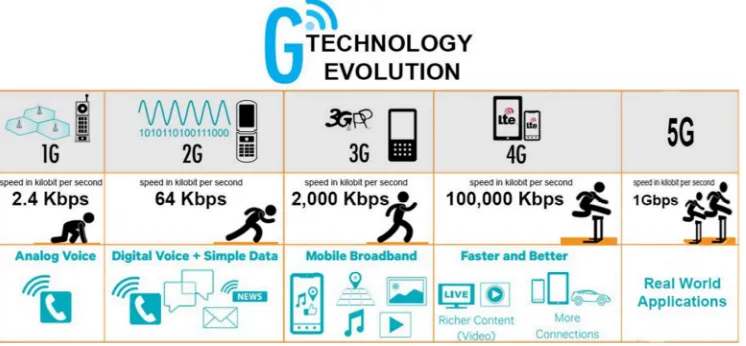
The 1st generation was pioneered for voice service in early 1980‘s, where almost all of them were analog systems using the frequency modulation technique for radio transmission using frequency division multiple access with channel capacity of 30 KHz and frequency band was 824-894 MHz which was based on a technology known as Advance Mobile Phone Service. This generation uses circuit switching and totally designed for voice calls without data services.
2.2. Second Generation Systems (2G)
The 2nd generation was accomplished in later 1990‘s. The 2G mobile communication system is a digital system; this system is still mostly used in different parts of the world. This generation mainly used for voice communication also offered additional services such as SMS and e-mail. In this generation two digital modulation schemes are used; one is time division multiple access (TDMA) and the 2nd is code division multiple access (CDMA) [7] and frequency band is 850-1900 MHz. In 2G, GSM technology uses eight channels per carrier with a gross data rate of 22.8 kbps (a net rate of 13 kbps) in the full rate channel and a frame of 4.6 milliseconds (ms) duration.
2.3. Third Generation Systems (3G)
Third generation (3G) services combine high speed mobile access with Internet Protocol (IP)-based services. The main features of 3G technology include wireless web base access, multimedia services, email, and video conferencing. The 3G W-CDMA air interface standard had been designed for ―always-onǁ packet-based wireless service, so that computer, entertainment devices and telephones may all share the same wireless network and be connected internet
anytime, anywhere. 3G systems offer high data rates up to 2 Mbps, over 5 MHz channel carrier width, depending on mobility/velocity, and high spectrum efficiency. The data rate supported by 3G networks depends also on the environment the call is being made in; 144 kbps in satellite and rural outdoor, 384 kbps in urban outdoor and 2Mbps in indoor and low range outdoor. The frequency band is 1.8 - 2.5 GHz.
2.4. Fourth Generation Systems (4G)
4G usually refers to the successor of the 3G and 2G standards. In fact, the 3GPP is recently standardizing LTE Advanced [8] as future 4G standard. A 4G system may upgrade existing communication networks and is expected to provide a comprehensive and secure IP based solution where facilities such as voice, streamed multimedia and data will be provided to users on an "Anytime, Anywhere" basis and at much higher data rates compared to previous generations. Applications such as wireless broadband access, Multimedia Messaging Service (MMS), video chat, mobile TV, HDTV content and Digital Video Broadcasting (DVB) are being developed to use a 4G network. LTE release 10, also referred to as LTE-Advanced, is claimed to be the true 4G evolution step. Earlier releases of LTE are included as integrated parts of LTE release 10, providing a more straightforward backwards compatibility and support of legacy terminals.
2.5. Fifth Generation Systems (5G)
5G is the fifth Generation Mobile Technology, it would be on ground by year 2020. 5G technology has a very high bandwidth nobody experience this high speed ever before. The 5G technologies include all type of advanced features which makes 5G technology most powerful and in huge demand in near future, as it provides high speed streaming. 5G technology includes, MP3 recording, video player, large phone memory, dialing speed, audio player and much more user never imagine [3]. With the launch of 5G a new revolution is about to begin. Pico net and Bluetooth technology has made data sharing very easy and accessible by everyone who connected with 5G.
3. Component of Wireless
Communication System
Although each protocol has different specifications and criteria, there are general characteristics and goals that each protocol tries to achieve. Several of these protocols are discussed in this survey paper as well. Below are some general guidelines these protocols try to follow:
1. Unlimited roaming and range: The location of the user with the portable device is irrelevant. No matter how far or how near a user is from the base provider, data can still be sent and received.
2. Guarantee of Delivery: All messages and data is guaranteed to be delivered regardless of where a user is located or the user’s status. Even if the portable device is turned off, when it is turned on again, the user will see a new message.
3. Dependability of Delivery: All messages are guaranteed of accurate and full transmission.
4. Notification: Notifies the user that there is data that has been sent and needs to be looked at.
5. Connectivity Options: Send and receiver are given a wide range of options not only in hardware for the portable device, but also are given options in receiving messages.
6. Millions of Users: Ability to engage millions of users. 7. Priority Alerts: Able to distinguish between messages
and data that are of higher importance than others. Able to control high-priority data traffic and do so correctly and rapidly.
8. Communication: The ability to communicate between one user to another through one portable device to another where each portable device holds reliable and user-friendly software applications.
9. Host Reconfiguration: The ability to reconfigure when changing environments. For example, Person A is carrying a Palm Pilot that uses Bluetooth. Person A enters the office where there is an entire Bluetooth network set-up and Person A’s Palm Pilot configures to the settings of the office network. The end of the day
comes, and Person A starts driving home. Person A gets home and walks inside where Person A’s home is set up with an entirely different Bluetooth network. Person A brings the Palm Pilot out and the Palm Pilot automatically reconfigures itself to the settings of the Bluetooth network in Person A’s home. Therefore, whether the Palm Pilot works in one environment and can detect when it has been moved to another environment and can set itself up wherever it is located. 10.Host Mobility: One host contains its settings on a
network – its IP address, Subnet Mask, Gateway Address, and so on. Now this one host decides to move somewhere else, this means that the host will have to change its settings all over again, but has to let others know that it has moved. Flexible mobility allows the host to come and go as it pleases and not even needing to alert others of its move. Communication with the host is still possible even if it has moved.
11.Dynamic Encapsulation: The need to register a mobile host with its base agent, perhaps using a login and logout request and alerts of activation and inactivation. This will prevent forged logins and having one’s precious date to be re-routed somewhere it should not be. As mentioned before, different protocols serve different needs and offer different services. Outlined above are general things that most protocols that support the Wireless World might already offer or are looking to offer.
4. Network Architecture
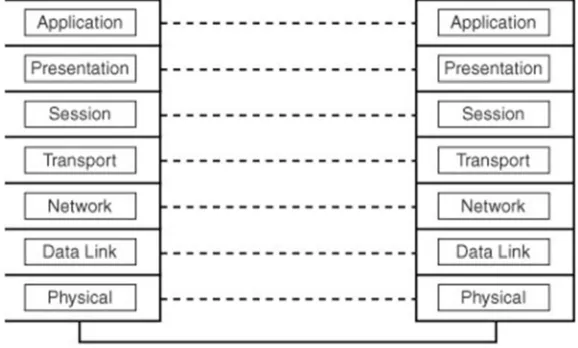
The architecture of a network defines the protocols and components necessary to satisfy application requirements. One popular standard for illustrating the architecture is the seven-layer Open System Interconnect (OSI) Reference Model, developed by the International Standards Organization (ISO). OSI specifies a complete set of network functions, grouped into layers, which reside within each network component. The OSI Reference Model is also a handy model for representing the various standards and interoperability of a wireless network.
1. Layer 7—Application layer: Establishes communications among users and provides basic communications services such as file transfer and e-mail. Examples of software that runs at this layer include Simple Mail Transfer Protocol (SMTP), HyperText Transfer Protocol (HTTP) and File Transfer Protocol (FTP).
2. Layer 6—Presentation layer: Negotiates data transfer syntax for the application layer and performs translations between different data formats, if necessary. For example, this layer can translate the coding that represents the data when communicating with a remote system made by a different vendor. 3. Layer 5—Session layer: Establishes, manages, and
terminates sessions between applications. Wireless middleware and access controllers provide this form of connectivity over wireless networks. If the wireless network encounters interference, the session layer functions will suspend communications until the interference goes away.
4. Layer 4—Transport layer: Provides mechanisms for the establishment, maintenance, and orderly termination of virtual circuits, while shielding the higher layers from the network implementation details. In general, these
circuits are connections made between network applications from one end of the communications circuit to another (such as between the web browser on a laptop to a web page on a server). Protocols such as Transmission Control Protocol (TCP) operate at this layer.
5. Layer 3—Network layer: Provides the routing of packets though a network from source to destination. This routing ensures that data packets are sent in a direction that leads to a particular destination. Protocols such as Internet Protocol (IP) operate at this layer.
6. Layer 2—Data link layer: Ensures medium access, as well as synchronization and error control between two entities. With wireless networks, this often involves coordination of access to the common air medium and recovery from errors that might occur in the data as it propagates from source to destination. Most wireless network types have a common method of performing data link layer functions independent of the actual means of transmission.
7. Layer 1—Physical layer: Provides the actual transmission of information through the medium. Physical layers include radio waves and infrared light.
Figure 3. Architecture of Communication System.
5. Architecture of 5G Communication
System
Network operators use the upgradeability to introduce value-added services more easily. Upgradeability is based on cognitive radio. Cognitive radio technologies include the ability of devices to determine their location and location information, sense spectrum used by neighboring devices, change frequency, adjust output power and even alter
terminal have access to different wireless technologies at the same time and it can also combine some features or aspects from other technologies. 5G totally focused on user-mobility as a mobile phone or terminal intelligently behave to choose stronger wireless scheme to access wireless networks
5G Architecture enables new business opportunities meeting the requirements of large variety of use cases as well as enables 5G to be future proof by means of
(i) Implementing network slicing in cost efficient way. (ii) Addressing both end user and operational services. (iii) Supporting softwarization natively.
(iv) Integrating communication and computation. (v) Integrating heterogeneous technologies.
Further advantages emerge in the areas of management, control of systems and resources. 5G networks enable the uniform management and control operations that are becoming part of the dynamic design of software architectures. They can host service executions in one or more slices.
6. Network Security
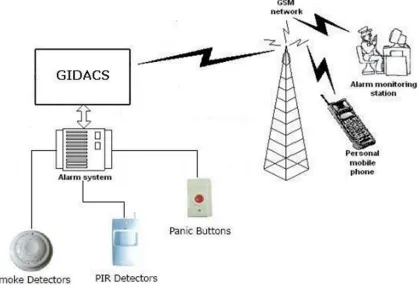
The network security is the important factor now days, as everyone is want to secure own information and is necessary to save and full information will transfer the information at the reciver end. Communication between two hosts using a network may be encrypted to maintain privacy. Honeypots essentially decoy network-accessible resources, may be deployed in a network as surveillance and early-warning
tools, as the honeypots are not normally accessed for legitimate purposes. Techniques used by the attackers that attempt to compromise these decoy resources are studied during and after an attack to keep an eye on new exploitation techniques. Such analysis may be used to further tighten security of the actual network being protected by the honeypot. A honeypot can also direct an attacker's attention away from legitimate servers. A honeypot encourages attackers to spend their time and energy on the decoy server while distracting their attention from the data on the real server. Similar to a honeypot, a honeynet is a network set up with intentional vulnerabilities. Its purpose is also to invite attacks so that the attacker's methods can be studied and that information can be used to increase network security. A honeynet typically contains one or more honeypots.
The security design of current mobile systems was geared towards the build-up of a successful ecosystem, offering trustworthy communication services to users in all corners of the world. The evolution from 2G to 3G required the addition of new security features in order maintain trustworthiness in the presence of emerging threats, such as false radio base stations and encryption in communications, among others. While the security design of 4G is much more sophisticated, the 4G security architecture is more a consequence of the need to maintain security in a flatter network architecture, where user data is more exposed at the network edges. Mobile system security has so far arguably been more of an added support function than a driver.
Figure 4. Network Security.
The updated security considerations should not only entail new trust models, where mobile infrastructures are shared by
multi-tenancy, network slicing, network virtualization and other novel technologies related to 5G architectures, which could anticipate new types of threat specific to 5G networks. This is why it is critical to control the exposure surface to such attacks, and to provide proactive mechanisms to protect against them. Autonomic self-protection capabilities in the 5G network that might defend users against infrastructure attacks (such as a distributed denial-of-service attack), as well as providing self-healing capabilities to the 5G Network, are a key aspect of the network intelligence expected in the novel 5G technologies.
7.
Future Technologies 6G and 7G
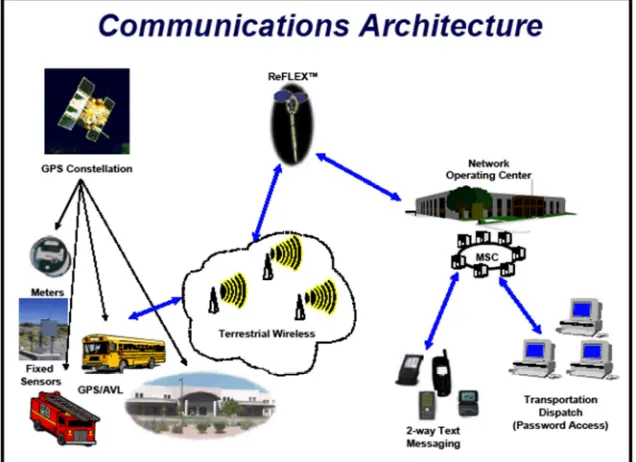
For global coverage, 6G will assimilate all wireless mobile networks by use of satellites. 6G mobile communication networks can incorporate satellite communication networks and 5G to make global coverage. 6G is totally related to satellite communication networks consist of navigation, telecommunication, and Earth imaging satellites networks. These satellite networks are used for global position, global telephony, multimedia video and for earth imaging to monitor weather information. USA, China. EU, and Russia developed these satellite systems. As 6G is not launched yet due to some issues like roaming problem because different satellite systems have different standards so roaming must be between all these networks but it is still a debatable issue. 7G wireless network is a modification of 6G but it also defines satellite functions for mobile communication. Satellite system provide voice and multimedia communication, global positional system (GPS) and weather update information. There are also some issues in 7G like if mobile phone is moving from one country to another then satellite also moving with constant speed. 7G will be launched with enhanced and improved protocols so that everyone enjoys the global communication environment
8. Conclusion
The existing 4G wireless technology has been successfully launched in different countries of the world. The main features and characteristics of the 4G technology are being analyzed and enhanced for the inclusion in the upcoming 5G technology. The 5G architecture makes use of different platforms and different layers. In this paper, an overview of emerging 5G wireless technology is provided. For better understanding of the 5G, all the previous generations are also
discussed in the paper. The performance comparison table presents the user centric approach of different generations of the wireless technology. Furthermore, main features, goals and challenges of 5G form part of this paper. As 4G is already launched, the researchers need to focus on the successful development and deployment of the 5G technology by year 2020. 5G network architecture shows the difference of different wireless generations.
References
[1] Maryam Fizza, Munam Ali Shah “ 5G Technology: An Overview of Applications, Prospects, Challenges and Beyond” Department of Computer Science, COMSATS Institute of Information technology.
[2] Jim Geier “Wireless System Architecture”, Principal Consultant, Wireless- Nets, Ltd.
[3] Kasper Apajalahti, Eero Hyvonen, Juha Niiranen, Vilho Raisanen “StaRe: Statistical Reasoning Tool for 5G Network Management” Aalto University, Semantic Computing Research Group (SeCo), Finland University of Helsinki, Department of Mathematics and Statistics, Finland Nokia Networks Research, Finland.
[4] Saddam Hossain “5G Wireless Communication Systems” Department of Electronics & Telecommunication Engineering, The People’s University of Bangladesh (PUB) Bangladesh from American Journal of Engineering Research (AJER) published in 2013.
[5] Chen, YP; Yang, YH (2007), ―A new 4G architecture providing multimode terminals always best connected services,” IEEE Wireless Communications, Volume: 14 Issue: 2 pp. 36-41.
[6] R. K. Jain, Risal Singh, ―Role of Nanotechnology in future wireless and communication systems”, National seminar proceeding, Academy of Business & Engineering Science Ghaziabad, pp-19-28, 16-17th January 2009.
[7] A. K. Pachauri and O. Singh, “5G Technology – Redefining wireless Communication in upcoming years,” vol. 1, no. 1, pp. 12–19, 2012.
[8] T. Janevski, ―Traffic Analysis and Design of Wireless IP Network, Artech House Inc., Boston, USA, 2003.
[9] 3GPP TSG RAN TR 36.913 v8.0.0, Requirements for Further Advancements for E-UTRA (LTEAdvanced).