Published online July 30, 2014 (http://www.sciencepublishinggroup.com/j/ajaf) doi: 10.11648/j.ajaf.20140204.18
ISSN: 2330-8583 (Print); ISSN: 2330-8591 (Online)
Are small scale eggplant producers efficient in resource
use?
Nsikak-Abasi A. Etim
Department of Agricultural Economics and Extension, University of Uyo, P.M.B. 1017, Uyo, Akwa Ibom State, Nigeria
Email address:
To cite this article:
Nsikak-Abasi A. Etim. Are Small Scale Eggplant Producers Efficient in Resource Use? American Journal of Agriculture and Forestry. Vol. 2, No. 4, 2014, pp. 154-158. doi: 10.11648/j.ajaf.20140204.18
Abstract: An empirical study to investigate the efficiency of resource use by small scale eggplant producers was conducted. A stochastic production frontier function which incorporates a model for the technical efficiency effect was applied. Through a multi-stage sampling method, 60 egg plant farmers were selected with the aid of questionnaire. Using the maximum likelihood estimation method, asymptotic parameters were evaluated to describe efficiency determinants. Results revealed that the mean resource use efficiency is 0.71 leaving inefficiency gap of 0.29 implying that 29 percent higher eggplant output could be achieved using the same resource combination. Land, hired labour and seeds were identified as the most critical and important efficiency determinants. Access to credit and market, and age were estimated as inefficiency determinants. Results underscore the need to formulate policies aimed at making land more accessible to farmers, provision of credit facilities and good road networks.
Keywords: EggPlant, Resources, Efficiency, Farmers
1. Introduction
According to the World Health Organization, adequate fruit and vegetable intake entails a consumption of at least 400g of fruits and vegetables per day per capita (an equivalent of 146kg per year per capita) [28]; [7]. The under consumption of fruits and vegetable is largely responsible for deaths globally. Fruits and vegetables play significant roles in human nutrition, especially as sources of vitamins (C, A, B6, thiamine, niacin; E), mineral and dietary fiber
[26];[27] and [36]. These food items are rich sources of vitamins and minerals for the normal functioning of the human body [28]. Most deaths from chronic disease in low and middle income countries arise from micronutrient deficiencies causing vitamin A, iron and iodine disorder. But the production and consumption of certain fruits and vegetables can improve mineral and vitamin intake.
One of such fruits capable of solving these problems is eggplant (Solanum spp. L). Eggplant also known as garden egg belong to the family solanaceae. According to [17], the crop develops a strong taproot with a branded root system that does not spread widely but responds positively to well drained soils of medium texture that are moderately deep and is well adapted to the tropic. The crop is bushy and
grows to a height of 120cm. Eggplant may be boiled, fried or stiffed in curries or eaten fresh. It may be prepared in form of sauce or stew and consumed with yam, plantain or rice. Nutritionally, garden egg contains water (89%), protein (14%), fibre (1.5%), carbohydrate (8.0%) and good level of vitamin B, Calcium, Phosphorus and Iron. The low consumption of fruits (eggplant inclusive) can result from low productivity due to inefficiency of resource use in production. Earlier and empirical studies by [14]; [13]; [10] and [11] suggest that efficient utilization of resources in agriculture can increase production. This study was conducted to empirically investigate efficiency of resource use by small scale eggplant producers.
level of output with a minimum quantity of inputs and can be measured either as input conserving oriented technical efficiency or output-expanding oriented technical efficiency. Output-expanding oriented technical efficiency is the ratio of observed to maximum feasible output, conditional on technical and observed input usage [18] and [2]. This study aims at using output-expanding orientation to measure technical efficiency effects.
The term frontier involves the concept of maximality in which the function sets a limit to the range of possible observations [16]. It is therefore, possible to observe points below the production frontier for firms producing below the maximum possible output, but there cannot be any point above the production frontier, given the available technology. Deviations from the frontier are attributed to inefficiency. The need to measure inefficiency effects is the major motivation for the study of frontiers. Frontier studies are classified according to the method of estimation. [19] grouped these methods into two broad categories-parametric and non-parametric methods. For the parametric methods, it can be deterministic, programming and stochastic depending on how the frontier model is specified. Many researchers, including [29] have argued that efficiency measures from deterministic models are affected by statistical noise. This however, led to the alternative methodology involving the use of the stochastic production frontier models. [1] and [21] independently proposed the idea of stochastic measurement. The major feature of the stochastic production frontier is that the disturbance term is a composite error consisting of two components, one symmetric and the other one-sided. The symmetric component, Vi, captures the random effects due to
measurement error, statistical noise and other influences outside the control of the firm and it is assumed to be normally distributed. The one-sided component Ui, captures
randomness under the control of the firm. It gives the derivation from the frontier attributed or exponential. The major weakness of the stochastic frontier model is its failure to provide an explicit distribution assumption for the inefficiency term [30].
By definition, stochastic frontier production function is
Yi = F (Xi; β) exp (Vi – Ui) I = 1, 2, …., N (1)
Where Yi is the output of the ith farm; Xi is the
corresponding (MX2) vector of conventional physical inputs; β is a vector of unknown parameter to be estimated; F(.) denotes an appropriate functional form, Vi is the
symmetric error component that accounts for random effects and exogenous shock; while, Ui<0 is a one sided error
component that measures technical inefficiency.
In recent times, econometric modeling of stochastic frontier methodology associated with efficiency estimation has been important aspect of economics research. Both time varying and cross-sectional data have been used in studies based mostly on Cobb-Douglas function and transcendental logarithmic functions that are specified either as production function or cost function to estimate individual firm
efficiency [5]; [6]; [2]; [3]; [37]; [31]; [32]; [35]; [14] and [33]. However, this study uses a Cobb-Douglas production function to estimate technical efficiency effect at farm levels by assuming a stochastic nature of production.
2. Methodology
2.1. The Study Area, Sampling and Data Collection Procedure
The study was conducted in Uyo Local Government Area, the capital city of Akwa Ibom State, Nigeria. Uyo is situated 55 kilometers inland from the coastal plain of South-East Nigeria. The area lies within the humid tropical rainforest zone with two distinct seasons – the rainy and short dry season. The annual precipitation ranges from 2000 – 3000mm per annum. According to [9], this rainfall regime received in most parts of the State encourages farming throughout the year. The area is located between latitude 5°17' and 5°27'N and longitude 7°27' and 7°58' and covers an area of approximately 35 square kilometers. The occupation of the inhabitants reflects the economic activity of the residents. The settlement pattern in Uyo is nucleated and being an administrative headquarters, majority of civil and public servants and political office holders reside there. [12] noted that these people engage in part-time farming activities and other commercial ventures within and around their homes as a way of augmenting and supplementing family income and food supplies.
Data used for this study are mainly primary and were obtained from the waterleaf farmers using questionnaire during 2013 farming season. Simple random sampling technique was employed to select a total of 60 egg plant farmers for study. Baseline information on socio-economic characteristics, input use and output levels were collected and analyzed.
2.2. The Empirical Model
The study utilized stochastic production frontier, which builds hypothesized efficiency determinants into the inefficiency error components [8]. Assuming we specified a Cobb-Douglas functional form as:
Ln (Qty) = βo + β1Ln (Land) + β2Ln (Hired Labour) + β3Ln
(Inorganic fertilizer) + β4Ln (Seeds) + β5Ln (Capital) + Vi –
Ui (2)
Where Qty is the quantity of output measured in kg; Land is the farm size measured in square meters; Hired labour is the labour employed in farm operations measured in mandays; Inorganic fertilizer is fertilizer applied on the soil measured in kg;Organic fertilizer is farm yard manure applied on the soil measured in kg; Seeds is planting materials measured in naira; Capital is the depreciation value of the implement used measured in naira.
With Vi ~ N (0, v2); and
e-ui = α
α5 (Cred) + α6 (Mkt) + Zi (3)
Where Tech is access to extension contact (dummy), Age is the age of the farmer (years); FamS is the number of persons in a household who share the same dwelling and meals; Gender is the sex of the farmer (dummy); Credit is access to credit facilities (dummy); and Mkt is access to market (dummy); Zi is an error term assumed to be randomly and normally distributed. The value of the unknown coefficients in equations (1) and (2) are jointly estimated by maximizing the likelihood function [37] and [32].
3. Results and Discussion
3.1. Maximum Likelihood and Inefficiency Estimate Results
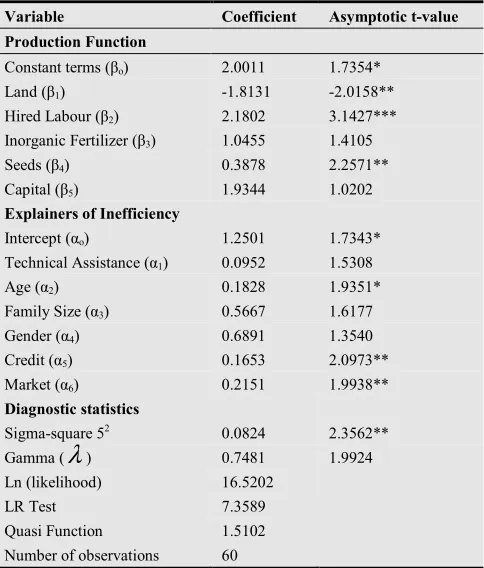
Results of the maximum likelihood and inefficiency estimate is presented in Table 1. Farm size is aimed at capturing the effect of scale production on the technical efficiency of the farm. Earlier and empirical study by [20] established a varied relationship between farm size and technical inefficiency in developing countries using the frontier production function. The sign of the land variable in this study was negatively significant (P<.01). This is explained by the fact that increased farm size diminishes the timeliness of resource use thus leading to decline in technical efficiency. [22];[4] and [11] obtained similar findings that showed inverse relationships. Results suggest the need to design policies aimed at encouraging small scale egg plant farmers to continue in production as they are the backbone of agricultural production in developing countries.
In this study, hired labour provided for various farming operations seems to be the most critical input with a coefficient of 2.1802 and is positively significant (P< .01). The relative large elasticity for hired labour is an indication of the labour intensive nature of egg plant production especially during weeding. Similar finding was reported in a recent study by [11].
Planting material is the seed used for planting. This variable is positively significant as expected. Result underscores the importance of seed as its ready availability for production tends to increase efficiency of use. Finding however suggests the need to encourage proper storage and preservation of seeds for use by local farmers. According to [11] in a recent study, such decisions will not only ensure timely availability of planting materials to farmers but will reduce the additional cost and inefficiency which would have been incurred in purchasing the seeds.
The effect of age of technical efficiency may be either positive or negative. Older farmers seem to be more experienced and would be more technically efficient than younger farmers. But regarding innovations and farming techniques, older farmers are less likely to adopt innovations and would thus, be less technically efficient than younger farmers. This study reveals that age has a positive sign and significantly impacts on technical efficiency in the model,
hence, age indexes experience and serves as a proxy for human capital implying that egg plant farmers with more years of experience in farming will be more technically skilled in management and policy decisions, and thus a higher efficiency than younger farmers. This result is synonymous with recent empirical study by [11] and [10] who posited that increased experience in cultivation may also enhance critical evaluation of the relevance of better production decisions, including utilization of productive resources.
Credit is positively signed as expected. The variable has an elasticity 0.1653 and is significant (P< .05). Result implies that accessibility and availability of credit to egg plant farmers seems to eliminate the various production constraints thus making it easier for timely and ready purchase of inputs thereby increasing productivity through efficiency. Result agree with earlier empirical studies by [23]; [4]; [13] and [11]. These studies have positively linked access to credit to agricultural productivity. [25] however posited that one of the key problem associated with small holder farmers inaccessibility to agricultural credit.
Market captures egg plant farmers’ access to market and serves as a proxy for development. The variable was positive and significant (P< .10). Farms located farer from the market are believed to be less technically efficient than farms nearer the market. This is because farms located farer from the market will not only add to production and marketing cost but also impacts on various farming operations. Result conforms with earlier findings by [10] and [11].
Table 1. Maximum likelihood Estimates and inefficiency function
Variable Coefficient Asymptotic t-value
Production Function
Constant terms (βo) 2.0011 1.7354*
Land (β1) -1.8131 -2.0158**
Hired Labour (β2) 2.1802 3.1427***
Inorganic Fertilizer (β3) 1.0455 1.4105
Seeds (β4) 0.3878 2.2571**
Capital (β5) 1.9344 1.0202
Explainers of Inefficiency
Intercept (αo) 1.2501 1.7343*
Technical Assistance (α1) 0.0952 1.5308
Age (α2) 0.1828 1.9351*
Family Size (α3) 0.5667 1.6177
Gender (α4) 0.6891 1.3540
Credit (α5) 0.1653 2.0973**
Market (α6) 0.2151 1.9938**
Diagnostic statistics
Sigma-square 52 0.0824 2.3562**
Gamma (
λ
) 0.7481 1.9924Ln (likelihood) 16.5202
LR Test 7.3589
Quasi Function 1.5102
3.2. Resource-Use Efficiency
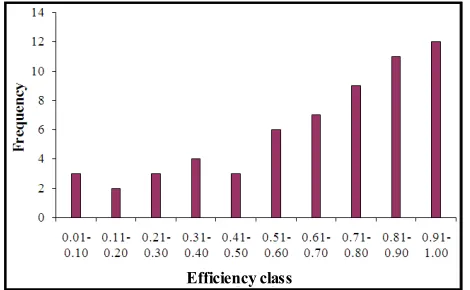
One important feature of the stochastic production frontier is its ability to estimate individual farm specific technical efficiency. The farm-specific resource use efficiency indices is shown in figure 1. The efficiency indices across eggplant farms vary considerably as the technical efficiencies of all the sampled eggplant farms are less than one. This means that no egg plant farm reached the frontier threshold. From the figure, the most efficient egg plant producer in terms of resource use has an efficiency index 0.92 and the least efficient an index of 0.04. The fact that none of the producers reached the frontier threshold suggest that producers may have encountered some technical, production and/or environmental problems, they were unable to completely overcome [34] and [14]. In small scale farming, resources are mostly allocated to various uses on the basis of their shadow values, which is the amount by which the contribution could be raised if an additional unit of the input is used, thereby preventing the producers from reaching the maximum production efficiency, [24]; [2] and more recently [11]. The mean resource-use efficiency is 0.71 leaving an inefficiency gap of 0.29 meaning that about 29 percent increase in output could be achieved using the same input combination.
Efficiency class
Figure 1. Farm specific technical efficiency
4. Conclusion
This study identified the factors affecting the use of resources by eggplant farmers. Specifically, it estimated the determinants of technical efficiency among small scale eggplant producers. The mean efficiency index was 0.71 suggesting that egg plant output could be increased by producers using the same input mix. Findings also reveal that the size of farmland; hired labour and planting materials were the major efficiency determinants. Results show that all the sampled eggplant farms were operating below the frontier threshold. Result suggests the need to formulate policies aimed at providing credit facilities to egg plant farmers. Roads leading to farms should also be more accessible to allow for ready and easy disposal of farm products.
References
[1] Aigner, D. J., Lovell, C. A. K. & Schmidt, P. (1977). Formulation and estimation of stochastic frontier production function study. J. Agric. Econ., 41:61-74.
[2] Ali, M. (1996). Quantifying the socio-economic determinants of sustainable crop production: An application of wheat cultivation in the Tarui of Nepal. Agric Econs., 14:45-60.
[3] Apezteguia, B. I. & Garate, M. P. (1997). Technical efficiency in the Spanish agro and food industry. Agric. Econ., 16:185-92.
[4] Aye, G. C. & Mungatana, E. D. (2010). Technical efficiency of traditional and hybrid maize farmers in Nigeria: Comparison of alternative approaches. African Journal of Agricultural Research, 5(21):2909-2917.
[5] Bagi, F. S. &Huang, C. I. (1983). Estimating production technical efficiency for individual farms in Tenesse. Can. J. Agric. Econ., 31:249-56.
[6] Bagi, F. S. (1984). Stochastic frontier production function and farm-level technical efficiency in West Tenessee. J. Agric. Econ., 6:48-55.
[7] Banwat, M. E., Lar, L. A., Daboer, J., Audu, S. and Lassa, S. (2012). Knowledge and intake of fruit and vegetables consumption among adults in an urban community in North Central Nigeria. The Nigerian Health Journal, 12(1):12-15.
[8] Coelli, J. T. & Battese, G. (1996). Identification of factors that influence the technical inefficiency of Indian farmers. Australian Journal of Agricultural Economics, 40(2):103-128.
[9] Etim, N. A. & Ofem, B. (2005). Urban farming and household waste management in Uyo urban: Implications for environmental harmony. Nigerian Journal of Agriculture, Food and Environment, 2(2):74-58.
[10] Etim, N. A. & Okon, S. (2013). Sources of technical efficiency among subsistence maize farmers in Uyo, Nigeria. Journal of Agricultural and Food Sciences, 1(4):48-53.
[11] Etim, N. A. & Udoh, E. J. (2014). Identifying Sources of Efficiency among Resource Poor Indigenous Vegetable Farmers in Uyo, Nigeria. International Journal of Food and Agricultural Economics, 2(1): 33-39.
[12] Etim, N. A., Azeez, A. A. & Asa, U. A. (2006). Determinants of urban and peri-urban farming in Akwa Ibom State. Global Journal of Agricultural Sciences, 5(1):13-16.
[13] Etim, N. A., Thompson, D. & Onyenweaku, C. E. (2013). Measuring efficiency of yam (Dioscorea spp) production among resource poor farmers in rural Nigeria. Journal of Agricultural and Food Sciences, 1(3):42-47.
[14] Etim, N. A., Udoh, E. J. & Awoyemi, T. T. (2005). Measuring technical efficiency of urban farms in Uyo metropolis. Global Journal of Agricultural Sciences, 4(1):91-95.
[16] Forsund, F. R., Lovell, C. A. K. & Schmidt, P. (1980). A survey of frontier production functions and their relationships to efficiency measurement. J. Econ., 134:54-25.
[17] IFA (International Fertilizer Industry Association). (1992). International World Fertilizer Use Manual Limburgerhof, Germany.
[18] Jondrow, J. C. A., Lovell, L. S. & Schmidt, P. (1982). On the estimation of technical inefficiency in the stochastic frontier production function model. J. Econ., 19:233-238.
[19] Kalaitzandonakes, N. G., Xiang, W. S. & Jianahun, M. (1992). Relationship between technical efficiency and farm size revisited. Can. J. Agric. Econ., 40:427-442.
[20] Lundvall, K. & Battese, G. E. (2000). Farm size, age and efficiency: Evidence from Kenyan manufacturing firms. Journal of Development Studies, 35(3):146-163.
[21] Meeusen, W. & Van den Broek, J. (1977). Efficiency estimation from Cobb-Douglas production function with composed error. Int. Eco. Rev., 18:435-44.
[22] Msuya, E. E., Hisano, S. & Nariu, T. (2008). Explaining productivity variation among small holder maize farmers in Tanzania.
[23] Muhammed, I. J. (2009). Efficiency analysis of cotton-wheat and rice: Wheat systems in Punjab, Pakistan. Unpublished Ph.D. Thesis, University of Agriculture, Faisalabad.
[24] Parikh, A., Ali, F. & Shah, M. K. (1995). Measurement of economic efficiency in agriculture. American Journal of Agricultural Economics, 77:675-85.
[25] Philip, D., Nkonya, E., Pender, J. & Oni, O. A. (2009). Constraints to increasing agricultural productivity in Nigeria: A review. Nigeria Strategy support Program. Paper No. NSSP 006. International Food Policy Research Institute, Washington DC.
[26] Quebedeaux, B. & Bliss, F. A. (1988). Horticulture and Human health. Contributions of fruits and vegetables. Proc. 1st Intl. Symp. Hort and Human Health. Prentice Hall, Englewood, NJ.
[27] Quebedeaux, B. & Eisa, H. M. (1990). Horticulture and Human health. Contributions of fruits and vegetables. Proc.
2nd Intl. Symp. Hort. And Human Health. Hortscience 25:1473-1532.
[28] Ruel, M. T., Nicholas M. & Lisa, S. (2011). Patterns of fruit and vegetable consumption in sub-Saharan Africa. FAO/WHO Workshop on Fruits and Vegetables for Health, 1st – 3rd September, 2004, Japan (Online). Available at www.who.mt../en/. Accessed 21/5/2011.
[29] Schmidt, P. (1976). On the statistical estimation of parametric frontier production functions. Rev. Econ. Stat., 58:238-239.
[30] Sharma, K. R., Leung, P. S. & Zaleski, H. M. (1999). Technicalities allocative and economic efficiencies in swine production in Hawaii. A comparison of parametric and non parametric approaches. Agric. Econ., 20:23-35.
[31] Udoh, E. J. & Akintola, J. O. (2001a). Measurement of the technical efficiency of crop farms in the South Eastern region of Nigeria. Nigerian Journal of Economics and Social Studies, 43(1):93-104.
[32] Udoh, E. J. & Akintola, J. O. (2001b). land management and resource-use efficiency among farmers in South-Eastern Nigeria. Elshaddai Global Limited, Ibadan, Nigeria.
[33] Udoh, E. J. & Etim, N. A. (2006). Cocoyam Farms in Akwa Ibom State, Nigeria. A Stochastic Production Frontier Approach. Journal of Sustainable Development in Agriculture and Environment, 2:41-48.
[34] Udoh, E. J. (2000). Land Management and Resource – use efficiency among farmers in South-Eastern Nigeria. Unpublished Ph.D. Dissertation. Department of Agricultural Economics, University of Ibadan. Nigeria.
[35] Udoh, E. J. (2005). Technical inefficiency in Vegetable Farms of Humid Region: An Analysis of Dry Season Farming by Urban Women in South-south Zone, Nigeria. Journal of Agriculture & Social Science, 1(2): 80-85.
[36] Wargovich, M. J. (2000). Anticancer properties of fruits and vegetables. Hort Science, 35:573-575.