Four pitfalls in sleep and memory research and how to avoid them
Dezso Nemeth1,2,3,*, Emilie Gerbier4,*, Karolina Janacsek2,3,*
1 Lyon Neuroscience Research Center (CRNL), INSERM U1028, CNRS UMR5292,
Université Lyon 1, Université de Lyon, Lyon, France
2 Institute of Psychology, ELTE Eotvos Lorand University, Budapest, Hungary
3 Institute of Cognitive Neuroscience and Psychology, Research Centre for Natural Sciences,
Hungarian Academy of Sciences, Budapest, Hungary
4 Université Côte d’Azur, CNRS, BCL, Nice, France
* These authors contributed equally to this work.
AuthorNote: Correspondence and requests for material should be addressed to Prof. Dezso
Nemeth, CRNL – Lyon Neuroscience Research Center, Université Claude Bernard Lyon 1,
Lyon, France. Address: CRNL – Centre Hospitalier Le Vinatier – Bâtiment 462 – 95 Bd Pinel
Abstract
Understanding the complex relationship between sleep and memory is one of the biggest
challenges in neuroscience. Thousands of studies on memory consolidation suggest that sleep
triggers offline memory processes, resulting in less forgetting in declarative memory and
performance improvement in non-declarative memory. However, an increasing number of
contradictory findings reveal potential issues with how research is conducted in this field, that
weaken the reliability of these results. Here we describe four methodological pitfalls with
respect to experimental designs and statistical analyses that should be avoided in order to unveil
the true effect of sleep on memory consolidation: non-optimal experimental designs, task
complexity, fatigue effect in repetitive tasks, and data analysis and availability. We then offer
solutions that can be used in future research of sleep-dependent consolidation and also more
broadly in memory research.
Introduction
There is a great common interest for sleep in modern societies. The critical influence of
sleep on our health and some aspects of our cognition is revealed both by sheer self-observation
and by science; moreover, our modern lifestyle and new technologies affect our sleep habits
and quality in new ways every day, increasing the prevalence of sleep deprivation and bad sleep
hygiene. Memory is also a focus of societal interest, with respect to education and learning on
one side of the developmental spectrum, and to aging and Alzheimer’s disease on the other.
Following this great interest in sleep as well as in memory, the effect of sleep on memory has
gained an increasing amount of attention in psychology and neuroscience research in the last
two decades, with thousands of dedicated publications. Additionally, a number of theories and
models explaining the effect of sleep on memory have also been developed (Ackermann &
Rasch, 2014; Antony, Schönauer, Staresina, & Cairney, 2019; Boyce, Williams, &
Adamantidis, 2017; Diekelmann & Born, 2010; Diekelmann, Wilhelm, & Born, 2009; Feld &
Born, 2017; Lewis & Durrant, 2011; Mednick, Cai, Shuman, Anagnostaras, & Wixted, 2011;
Saletin & Walker, 2012; Siegel, 2001; Stickgold & Walker, 2005, 2013; Tononi & Cirelli, 2006;
Tononi & Cirelli, 2014; Walker, 2005). In this article the focus will lie on the effect of sleep on
memory consolidation. That is, how sleeping after having learned something – e.g., new
vocabulary or playing the piano – increases subsequent memory, compared to an equivalent
time spent without sleep.
According to the often-cited empirical studies (e.g., Gais, Lucas, & Born, 2006; Walker,
Brakefield, Hobson, & Stickgold, 2003) and reviews on this topic (Diekelmann et al., 2009;
King, Hoedlmoser, Hirschauer, Dolfen, & Albouy, 2017; Rasch & Born, 2013), in healthy
adults declarative memories are less forgotten after an episode of sleep than after a similar
episode of wakefulness, whereas non-declarative memories are improved after sleep. The
“While memory formation is not the only function of sleep, it seems to be the most important
(...)” (Born & Wilhelm, 2012, p. 192) or that "(...) active system consolidation might be an
evolutionary conserved function of sleep.” (Vorster & Born, 2015, p. 103). Here we claim that
such statements, particularly for non-declarative memory, are not supported by solid evidence,
at least partly due to experimental and methodological issues. Indeed, there have been
discussions as to the actual impact of sleep on memory consolidation (e.g., Mantua, 2018; Pan
& Rickard, 2015; Vertes & Siegel, 2005). A non-negligible number of studies did not actually
find sleep-related consolidation effects, especially for non-declarative memory (e.g., Csabi,
Varszegi-Schulz, Janacsek, Malecek, & Nemeth, 2014; Nemeth et al., 2010; Robertson,
Pascual-Leone, & Press, 2004; Song, Howard, & Howard, 2007; Viczko, Sergeeva, Ray, Owen,
& Fogel, 2018; Wilson, Baran, Pace-Schott, Ivry, & Spencer, 2012). In addition, the
correlations observed between sleep physiology and memory consolidation are often not
replicated across studies and are sometimes too numerous to reliably interpret the significant
ones. Moreover, they sometimes go in the opposite direction as to what is expected (Mantua,
2018).
Given this controversial state of the art, we propose here a synthetic methodological
guideline for future research on sleep-related consolidation. Such a comprehensive guideline is
lacking so far, hindering the progress in our understanding of the effect of sleep on memory in
fields ranging from psychology to biology and neuroscience. We highlight four critical pitfalls
that could be responsible for the contradictory findings in the literature, and then propose
solutions to prevent them and guide future research.
Pitfall 1: Non-optimal experimental designs
In this section we identify four areas that could benefit from improvements in the
1a) Studies with pathological populations
Studies investigating the effect of sleep disorders (e.g., primary insomnia, obstructive
sleep apnea, sleep-disordered breathing) on sleep-related consolidation typically compare a
pathological group with a control healthy group and often use only an PM-AM design (for
reviews, see Ahuja et al., 2018; Cellini, 2017). In such designs, learning takes place in the
evening and performance is tested in the following morning (e.g., Backhaus et al., 2006; Csabi
et al., 2014). Importantly, however, if patients show a weaker performance than the control group (that is, less off-line improvement in non-declarative memory or more forgetting in declarative memory), one cannot disentangle whether it is caused by the actual overnight sleep (i.e., state-dependent consolidation) or by a trait-dependent effect of the sleep disturbances on memory processes involving consolidation but perhaps also encoding and retrieval. (Ahuja et al., 2018; Csábi, Benedek, Janacsek, Katona, & Nemeth, 2013; Rosenzweig et al., 2015;
Wallace & Bucks, 2013).
Solutions
Studies comparing sleep-disordered populations and healthy controls should also
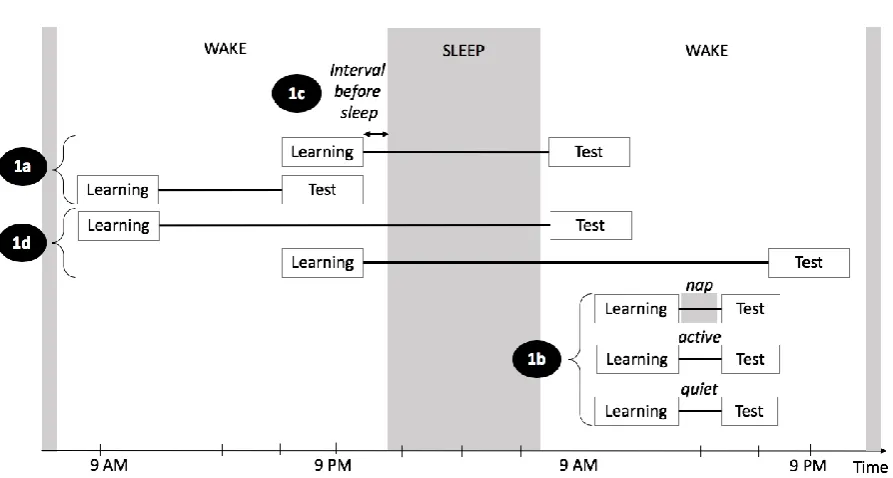
include an AM-PM condition, that is, learning in the morning and testing in the evening. To
demonstrate that the pathology specifically affects sleep-related consolidation, we need to
observe not only that test performance or improvement in the PM-AM (sleep) condition is lower
in the pathological group than in the control group, but also that test performance or
improvement in the AM-PM (wake) condition is similar in both groups. If the overall results
are the same in the sleep-disordered and in the control groups, then one can conclude that the
sleep pathology does not affect sleep-related consolidation. If test performance or improvement
of the pathological group is affected both in the PM-AM and in the AM-PM conditions, then
specifically related to sleep. Such design has been conducted only in a few studies.For instance,
Nissen et al. (2011) compared the effect of PM-AM vs. AM-PM conditions on consolidation of
procedural and declarative memory in insomniac and healthy participants. They observed
similar consolidation over the wake interval in both groups. However, whereas in the control
group consolidation was higher in the sleep than in the wake condition, in the insomniac group
it was comparable in the wake and in the sleep conditions. This indicates that insomnia in this
group prevented sleep-related consolidation in procedural and declarative memory.
Figure 1: Illustration of the four areas of Pitfall 1 (non-optimal experimental designs). 1a refers to studies with
pathological populations, 1b refers to appropriate control conditions in napping studies, 1c refers to time interval
between the end of the task and bedtime, and 1d refers to time-of-day effects.
1b) Appropriate control conditions in napping studies
Napping studies typically compare changes in performance following an interval that
includes daytime sleep with an interval that includes awake activities. Such design however
For example, reducing external interferences during the post-learning interval may be sufficient
to produce off-line consolidation (e.g., Mednick et al., 2011; Wamsley, 2019).
Solutions
Adding a carefully controlled quiet wake condition (e.g., under dim light while keeping
eyes open to avoid falling asleep) helps to distinguish whether sleep is a specific state that
triggers off-line improvement (i.e., Sleep > Quiet Rest) or a non-specific state that only protects
memories from interferences (i.e., Sleep = Quiet Rest). The benefits of such design has been
just recently recognized. Studies using such design led to mixed findings, with some studies
showing more consolidation in the nap condition than in the quiet wake condition (Piosczyk et
al., 2013; Schichl, Ziberi, Lahl, & Pietrowsky, 2011; Schönauer, Geisler, & Gais, 2014) and
others showing that quiet rest produced effects on memory consolidation similar to those
observed in sleep conditions (Mednick, Makovski, Cai, & Jiang, 2009; Simor, Zavecz, et al.,
2019), suggesting that sleep per se may not be necessary for consolidation but rather only
provides a favorable environment. Recent observations that memory reactivations and replay
occur not only during sleep but also during quiet rest (Craig & Dewar, 2018; Schapiro,
McDevitt, Rogers, Mednick, & Norman, 2018; Wamsley, 2019) further highlight the need for
such control conditions. (Note that a quiet rest condition would theoretically also be informative
in a PM-AM design as discussed in 1a, although it might be extremely difficult to avoid falling
asleep in a quiet environment during the night. Therefore, sleep deprivation studies typically
use an active wake condition during the night.)
1c) Time interval between the end of the task and bedtime
The duration of the interval between the task and sleep onset may vary across
experiments, conditions and individuals, potentially hindering the assessment of the true effect
learning task and sleep onset, the smaller the consolidation effects (Press, Casement,
Pascual-Leone, & Robertson, 2005; Robertson, Press, & Pascual-Pascual-Leone, 2005; Walker et al., 2003). A
longer interval may be associated with more retroactive interference if the subject engages in
activities that interfere with the learned information by recruiting the same cognitive processes
or neural network.
Solutions
Attention should be paid to this issue when designing experiments. Experiments should
control the duration of the interval between the experimental task and bedtime, as well as the
participants’ activities during this interval. Additionally, if experiments aim to minimize
retroactive interference (and thus to observe “pure” effects of sleep), participants should go to
bed as soon as possible after the learning tasks. Such designs are more feasible when
participants sleep in the lab during the experiment. If, however, participants sleep at home after
the learning session, at least post-experiment questionnaires or mobile actigraphy should be
employed to assess the duration of this interval and the activities performed, and this
information should be appropriately taken into account in data analysis.
1d) Time-of-day effects
It has been shown that learning and memory performance is affected by the time of day
when the memory task is performed (Schmidt, Collette, Cajochen, & Peigneux, 2007).
Time-of-day effects can lead to potential confounds in sleep-related consolidation studies. For
example, a greater off-line improvement in a PM-AM condition compared to an AM-PM
condition may be, at least partially, caused by weaker performance in the evening (when
learning takes place in the PM-AM condition) due to circadian effects or fatigue (Keisler, Ashe,
& Willingham, 2007), and a better performance after a night’s sleep in the morning when
participants are well rested. In this case, it is unclear how much sleep per se contributes to
Solutions
These potential time-of-day or circadian effects are not easy to control because in
humans sleep typically occurs during the night (although see Tucker et al. (2017) for an inverted
12-hour schedule with sleep occurring during daytime). A possible solution is to focus on the
effect of napping on learning and memory performance, as in this case training and testing occur
at the same time in the nap and awake groups (see 2b). Note, however, that daytime sleep and
night sleep can affect memory differently (Payne et al., 2015).
When focusing on the effects of nighttime sleep on memory consolidation, e.g., in a
PM-AM vs. AM-PM design, additional control groups should be tested to disentangle the
circadian effects from the effect of sleep per se. Thus, a full design would include groups in
AM-PM (12h Wake), PM-AM (12h Sleep), PM-PM (24h Sleep early) and AM-AM (24h Sleep
late) conditions (e.g., Fenn, Nusbaum, & Margoliash, 2003; Hallgato, Győri-Dani, Pekár,
Janacsek, & Nemeth, 2013; Talamini, Nieuwenhuis, Takashima, & Jensen, 2008; Tucker,
McKinley, & Stickgold, 2011). A difference in learning performance when learning takes place
during the evening (in PM-AM and PM-PM conditions) vs. in the morning (in AM-PM and
AM-AM conditions) would indicate potential circadian effects and preclude further
interpretation about the effect of sleep on consolidation. The pattern of results required to
demonstrate a beneficial effect of sleep without any time-of-day effect is an absence of
difference during the learning session in the four conditions, and the following pattern of
performance during the testing session: PM-AM > AM-PM and PM-PM = AM-AM. It should
be noted, however, that sleep shortly after learning may be more beneficial to consolidation
than sleep that occurs later after learning during the 24-h interval (e.g., Gais et al., 2006;
Pitfall 2: Task complexity
A great difficulty in sleep and memory research, and in cognitive neuroscience and
psychology in general, is that practically every task involves several cognitive processes (e.g.,
Jacoby, 1991; Sigman & Dehaene, 2005). The learning/memory scores that are used to assess
behavioral performances typically reflect a mixture of these cognitive processes (Cohen,
Pascual-Leone, Press, & Robertson, 2005). For example, even a simple perceptual-motor
learning task may require processing of perceptual stimuli, their serial order and/or their
transitional probabilities, perceptual-motor coordination, selective attention, and other
processes/functions. However, different types of consolidation processes may be involved
depending on which cognitive processes are involved in a given task, and to what extent (e.g.,
Conte & Ficca, 2013; King et al., 2017; Stickgold, 2013; Stickgold & Walker, 2013). It is highly
plausible that sleep affects the distinct cognitive processes differently, and this is sometimes
neglected in current sleep and memory research. Moreover, other external factors such as
subject characteristics may also influence sleep-dependent consolidation.
Solutions
Since there are no process-pure learning/memory tasks, attention should be paid to the
specific cognitive processes that are involved in a particular task. We recommend that future
research aiming at understanding the specific effect of sleep on consolidation should
disentangle these different cognitive processes using experimental designs and data-analyses,
and examine whether they are differentially affected by sleep. For example, within procedural
learning tasks, allocentric vs. egocentric representations (Viczko et al., 2018), perceptual vs.
motor components of learning (Hallgato et al., 2013), acquisition of statistical vs. sequential
regularities (Simor, Zavecz, et al., 2019) can be disentangled, and may be differently affected
great variety of variables, including individual characteristics, motivation, and strategies,
should also be assessed and controlled for (Conte & Ficca, 2013).
Pitfall 3: Fatigue effect in repetitive tasks
Some studies, specifically those investigating non-declarative procedural learning, use
tasks that involve continuous practice with a series of repetitions of the same action, for
example, pressing keys (M. J. Nissen & Bullemer, 1987). Learning is measured as the
improvement in accuracy or in reaction time to perform the task. Usually, the performance at
the end of the training session serves as a baseline to measure improvement at the test session
that takes place after an interval occupied by sleep or wakefulness. Yet, after a certain amount
of time spent performing the task, the subject’s observed improvement is less marked, which
can be interpreted as a reactive inhibition effect that reflects the built-up of fatigue over the
trials (e.g., Brawn, Fenn, Nusbaum, & Margoliash, 2010; Pan & Rickard, 2015). This effect
often results in smaller improvement or even an increase in reaction times as the task progresses.
This effect then disappears after a certain period of time spent without performing the task.
Thus, the actual performance after extended practice is not representative of genuine expertise
in the task and, therefore, comparing the performance at the test session with that of the end of
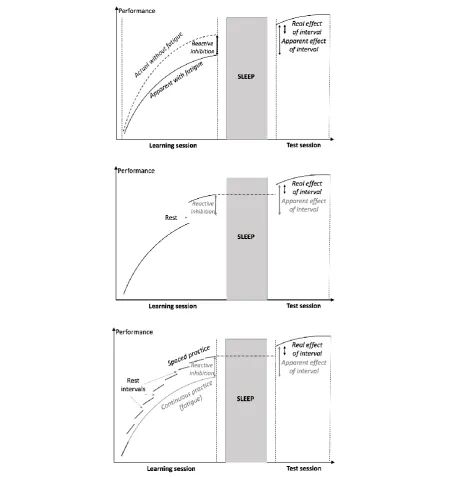
the training session may lead to illusory sleep-related effect. Figure 2 (upper panel) illustrates
this issue. In several cases, after eliminating this reactive inhibition effect by releasing the
presumed fatigue, the sleep-related off-line improvement was no longer observed (e.g., Cai &
Rickard, 2009; Rickard, Cai, Rieth, Jones, & Ard, 2008). Although this issue is primarily
relevant in procedural learning studies, it is possible that reactive inhibition also affects
performance in declarative memory studies, particularly if they include repetitive presentations
Solutions
To address this issue, we highlight solutions that concern both experimental designs and
data analyses.
Experimental design solutions
a) Using a post-rest performance at the end of the training session as a baseline. Resting
for a few minutes after the training session appears to be sufficient to wash out the effect of
reactive inhibition on performance. Measures of performance after a break is therefore a more
appropriate baseline to assess subsequent off-line consolidation (e.g., Brawn et al., 2010; Simor,
Zavecz, et al., 2019). Figure 2 (middle panel) illustrates this solution.
b) Learning through spaced practice rather than massed practice. Introducing regular
short rest intervals during the training session (often termed spaced practice) impedes the
accumulation of reactive inhibition compared to experimental designs that use massed practice
in which such rest intervals are not included (e.g., Brawn et al., 2010; Rickard et al., 2008;
Figure 2: The fatigue effect (upper panel), the short rest solution (middle) and the spaced-practice solution
(lower)
Data analysis solutions
a) Using curve fitting methods. Here we highlight two such methods. First, a
function-based model (e.g., a power function for reaction time improvement) can be elaborated on the
training session and used to predict future performance, enabling the comparison between the
predicted and the actual outcomes measured during the test session. This way, one avoids
improvement, at the end of the training phase (Pan & Rickard, 2015). Second, a function can
be fitted to the training session data and then a continuity test can be used in the test session to
evaluate whether the performance is a simple continuation from the training session or whether
there is an abrupt change between the sessions (see details on these approaches in Pan &
Rickard, 2015).
b) Performing computational modeling. Using computational models on trial-by-trial
data can help overcome the issue of fatigue by directly including reactive inhibition as a separate
parameter in the model. For instance, in a probabilistic sequence learning task, Török et al.
(2017) used such model allowing the estimation of the actual magnitude of learning,
independent of the effect of reactive inhibition. Such models can be used in a wide range of
learning and memory tasks, including finger tapping and other sequence learning tasks.
c) Excluding data from the second part of each task block. Because of fatigue,
performance declines between the first and the second half of a given task block. Using only
the data from the first part of the blocks would reflect a more accurate estimation of genuine
expertise in the task (Nemeth et al., 2013; Rickard et al., 2008).
Pitfall 4:Data analyses and availability
The sleep-related consolidation studies could benefit from an update in data analysis
practices; which are currently evolving in the scientific community in general.
4a) Determining sample size and reporting non-significant results
In the field of sleep-related consolidation, studies typically use samples with around 20
participants per group, often between 12 and 20 (e.g., Gais et al., 2006; Wagner, Hallschmid,
Rasch, & Born, 2006) and in some studies even less (e.g., Csabi et al., 2015), which may be
due to complicated or demanding study designs, difficulties recruiting clinical populations, or
being determined by a priori power analyses that are based on the expected effect sizes. The
resulting small sample sizes may involve a lack of power when using inferential statistics,
potentially leading to Type 2 errors, that is, not detecting an effect that exists. On the other
hand, a common but inappropriate practice when additional data is collected until a significant
effect is reached (p-hacking) potentially leads to Type 1 errors, that is, the detection of an effect
that does not exist. In addition, if one wants to conclude that sleep has no effect on some aspects
of memory consolidation, such conclusion cannot be drawn by showing non-significant results
in classical statistical analysis approaches (t-test, ANOVA, correlation, etc.). Of note, such
non-significant effects are often observed when consolidation results in stabilization of the acquired
knowledge without forgetting or performance improvement (i.e., no performance change). Such
consolidation effects can be present independently of sleep and, thus, the present pitfall may be
relevant for a wider range of neuroscience and psychology studies, outside those focusing on
sleep per se.
Solutions
a) Before data collection. It has long been recommended in guidelines (e.g., American
Psychological Association) that experimenters should determine the sample size before starting
the experiment by computing power analyses based on the magnitude of the effect size
estimated or found in previous studies that observed similar effects.
b) During data collection. For particularly costly experimental protocols, Bayesian
analyses (Dienes, 2016; Dienes, Coulton, & Heather, 2018; Dienes & Mclatchie, 2018;
Wagenmakers et al., 2018) computed in the course of data collection can be used to know
whether there is enough evidence in favor of a given a priori defined effect so that one can stop
data collection (Rouder, 2014; Schönbrodt, Wagenmakers, Zehetleitner, & Perugini, 2017).
c) After data collection. Bayesian analyses, in particular the Bayes Factors, are rarely
whereas they are increasingly reported in other areas of psychology and neuroscience. The
Bayes Factor indicates an odd ratio of relative probabilities in favor of the null hypothesis (i.e.,
the absence of a difference between the conditions or group means) vs. in favor of the alternative
hypothesis (i.e., the difference between the conditions or group means) (Jarosz & Wiley, 2014;
Rouder, Speckman, Sun, Morey, & Iverson, 2009). Bayesian statistics allow a more
fine-grained quantitative evaluation of the effect of sleep on consolidation and, contrary to p-value
based inferential statistics, enable the demonstration of the absence of an effect (Bogacz,
Wagenmakers, Forstmann, & Nieuwenhuis, 2009; Dienes, 2014). This is useful in the sleep and
memory literature in cases where there is no sleep effect or no change in performance (neither
forgetting nor improvement).
4b) Correlations between sleep parameters and memory consolidation
Beyond the comparison of groups or conditions, conclusions for the effect of sleep are
often based on correlations between behavioral performances and sleep polysomnographic
parameters (e.g., Scullin, 2013; Simor, Zavecz, et al., 2019). However, it has been raised that
some of these correlation analyses are a consequence of suboptimal statistical practices, leading
to spurious correlations (e.g., Mantua, 2018; Pan & Rickard, 2015). Small sample sizes can also
lead to such spurious correlations. When sufficiently large sample sizes are used, they may
disappear. For example, Ackermann et al. (2015) did not find any significant correlation
between sleep and memory performance in a sample of 929 participants.
Solutions
The correlations to be computed should be planned a priori and corrected for multiple
comparisons in order to avoid increases in Type 1 errors (Abdi, 2007). Non-significant planned
correlations should also be systematically reported (Forstmeier, Wagenmakers, & Parker,
performance, Bayesian approaches should be used to draw conclusions in favor of the null
hypothesis instead of reporting non-significant results (see 4a).
4c) Access to and re-analysis of previous data
Other fields of neuroscience using techniques such as neuroimaging (fMRI) have
engaged in open science initiatives by, for example, depositing raw data in open-access
databases (e.g., OpenfMRI; Poldrack & Gorgolewski, 2017), which has recently been extended
to other neuroimaging and electrophysiology methods such as EEG as well (OpenNEURO;
Gorgolewski, Esteban, Schaefer, Wandell, & Poldrack, 2017). However, sleep and memory
research is lagging behind with respect to this practice. Making data publicly available enables
the re-analysis of old data when new analysis techniques and/or new theories are developed.
For example, it has only recently been recognized that the rapid-eye-movement (REM) stage
of sleep is not a unified state; instead there are at least two different types of REM, each of them
with different characteristics (Simor, Gombos, Blaskovich, & Bódizs, 2017; Simor, van Der
Wijk, Gombos, & Kovács, 2019). Access to previous sleep EEG data would make it possible
to specifically test the role of these two REM types in memory consolidation. Additionally,
these open databases can also support reliable synthesis of the data through meta-analyses with
larger sample sizes. Thus, overall, publicly available sleep EEG and behavioral data could
resolve previous issues of spurious results and can further advance the field.
Solutions
To maximize the benefits of previous research in the scientific community, we suggest
that researchers engage in open science (Nosek et al., 2015) and make data publicly available.
There are several online open repositories available for such purposes, such as Open Science
research with EEG, polysomnographic and behavioral data would greatly benefit sleep and
memory research.
Conclusion
We highlighted four critical methodological pitfalls that impede research in the field of
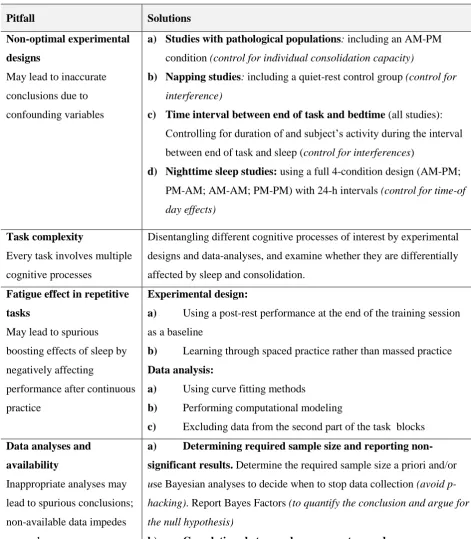
sleep and memory and we offered solutions to prevent them. They are presented in Table 1. We
believe that following the recommendations of the present guideline can contribute to more
reliable results in future studies of this field so that the genuine effect of sleep on memory can
be established. The present article can also help bridge gaps between disciplines (e.g., cognitive
psychology, neuropsychology, biology, neuroscience) that have different research traditions in
order to make outstanding progress in our understanding of the links between memory and sleep
and to provide answers to the society’s interest on this topic. We also suggest that some of the
pitfalls described here (i.e., the fatigue effect, task complexity, and statistical and data
availability issues) are relevant not only in sleep research but also in memory research more
Table 1: Summary of the pitfalls and their solutions
Pitfall Solutions
Non-optimal experimental
designs
May lead to inaccurate conclusions due to confounding variables
a) Studies with pathological populations: including an AM-PM
condition (control for individual consolidation capacity)
b) Napping studies: including a quiet-rest control group (control for
interference)
c) Time interval between end of task and bedtime (all studies):
Controlling for duration of and subject’s activity during the interval between end of task and sleep (control for interferences)
d) Nighttime sleep studies: using a full 4-condition design (AM-PM;
PM-AM; AM-AM; PM-PM) with 24-h intervals (control for time-of day effects)
Task complexity
Every task involves multiple cognitive processes
Disentangling different cognitive processes of interest by experimental designs and data-analyses, and examine whether they are differentially affected by sleep and consolidation.
Fatigue effect in repetitive
tasks
May lead to spurious boosting effects of sleep by negatively affecting
performance after continuous practice
Experimental design:
a) Using a post-rest performance at the end of the training session as a baseline
b) Learning through spaced practice rather than massed practice
Data analysis:
a) Using curve fitting methods
b) Performing computational modeling
c) Excluding data from the second part of the task blocks
Data analyses and
availability
Inappropriate analyses may lead to spurious conclusions; non-available data impedes research progress
a) Determining required sample size and reporting
non-significant results. Determine the required sample size a prioriand/or
use Bayesian analyses to decide when to stop data collection (avoid
p-hacking). Report Bayes Factors (to quantify the conclusion and argue for
the null hypothesis)
b) Correlations between sleep parameters and memory
consolidation. Plan correlation analyses of interest in advance, correct
for multiple comparisons, and report non-significant planned comparisons
c) Access to and re-analysis of previous data. Make data
Acknowledgements
This research was supported by the National Brain Research Program (project
2017-1.2.1-NKP-2017-00002); Hungarian Scientific Research Fund (NKFIH-OTKA K 128016, PI: D. N.,
NKFIH-OTKA PD 124148, PI: K.J.); Janos Bolyai Research Fellowship of the Hungarian
Academy of Sciences (to K. J.); IDEXLYON Fellowship (to D.N). We are grateful to Kate
Schipper and Teodora Vekony for her help and comments on the manuscript.
References
Abdi, H. (2007). Bonferroni and Šidák corrections for multiple comparisons. Encyclopedia of
measurement and statistics, 3, 103-107.
Ackermann, S., Hartmann, F., Papassotiropoulos, A., de Quervain, D. J., & Rasch, B. (2015).
No associations between interindividual differences in sleep parameters and episodic
memory consolidation. Sleep, 38(6), 951-959.
Ackermann, S., & Rasch, B. (2014). Differential effects of non-REM and REM sleep on
memory consolidation? Current Neurology and Neuroscience Reports, 14(2), 430.
Ahuja, S., Chen, R. K., Kam, K., Pettibone, W. D., Osorio, R. S., & Varga, A. W. (2018).
Role of normal sleep and sleep apnea in human memory processing. Nature and
science of sleep, 10, 255.
Albouy, G., Fogel, S., Pottiez, H., Nguyen, V. A., Ray, L., Lungu, O., . . . Doyon, J. (2013).
Daytime sleep enhances consolidation of the spatial but not motoric representation of
motor sequence memory. PloS One, 8(1), e52805.
Antony, J. W., Schönauer, M., Staresina, B. P., & Cairney, S. A. (2019). Sleep spindles and
Backhaus, J., Junghanns, K., Born, J., Hohaus, K., Faasch, F., & Hohagen, F. (2006).
Impaired declarative memory consolidation during sleep in patients with primary
insomnia: influence of sleep architecture and nocturnal cortisol release. Biological
Psychiatry, 60(12), 1324-1330.
Bogacz, R., Wagenmakers, E.-J., Forstmann, B. U., & Nieuwenhuis, S. (2009). The neural
basis of the speed-accuracy tradeoff. Trends in Neurosciences, 33(1), 10-16.
Born, J., & Wilhelm, I. (2012). System consolidation of memory during sleep. Psychological
Research, 76(2), 192-203.
Boyce, R., Williams, S., & Adamantidis, A. (2017). REM sleep and memory. Current
Opinion in Neurobiology, 44, 167-177.
Brawn, T. P., Fenn, K. M., Nusbaum, H. C., & Margoliash, D. (2010). Consolidating the
effects of waking and sleep on motor-sequence learning. The Journal of neuroscience,
30(42), 13977-13982.
Brown, H., & Maylor, E. A. (2017). Memory consolidation effects on memory stabilization
and item integration in older adults. Psychonomic bulletin & review, 24(4),
1032-1039.
Cai, D. J., & Rickard, T. C. (2009). Reconsidering the role of sleep for motor memory.
Behavioral Neuroscience, 123(6), 1153.
Cellini, N. (2017). Memory consolidation in sleep disorders. Sleep Medicine Reviews, 35,
101-112.
Cohen, D. A., Pascual-Leone, A., Press, D. Z., & Robertson, E. M. (2005). Off-line learning
of motor skill memory: A double dissociation of goal and movement. PNAS, 102(50),
18237-18241.
Conte, F., & Ficca, G. (2013). Caveats on psychological models of sleep and memory: a
Craig, M., & Dewar, M. (2018). Rest-related consolidation protects the fine detail of new
memories. Scientific Reports, 8(1), 6857.
Csábi, E., Benedek, P., Janacsek, K., Katona, G., & Nemeth, D. (2013). Sleep disorder in
childhood impairs declarative but not nondeclarative forms of learning. Journal of
Clinical and Experimental Neuropsychology, 35(7), 677-685.
Csabi, E., Benedek, P., Janacsek, K., Zavecz, Z., Katona, G., & Nemeth, D. (2015).
Declarative and Non-declarative Memory Consolidation in Children with Sleep
Disorder. Frontiers in Human Neuroscience, 9, 709. doi:10.3389/fnhum.2015.00709
Csabi, E., Varszegi-Schulz, M., Janacsek, K., Malecek, N., & Nemeth, D. (2014). The
consolidation of implicit sequence memory in obstructive sleep apnea. PloS One,
9(10), e109010.
Diekelmann, S., & Born, J. (2010). The memory function of sleep. Nature Reviews
Neuroscience, 11(2), 114-126.
Diekelmann, S., Wilhelm, I., & Born, J. (2009). The whats and whens of sleep-dependent
memory consolidation. Sleep Medicine Reviews, 13(5), 309-321.
Dienes, Z. (2014). Using Bayes to get the most out of non-significant results. Frontiers in
Psychology, 5. doi:10.3389/fpsyg.2014.00781
Dienes, Z. (2016). How Bayes factors change scientific practice. Journal of Mathematical
Psychology, 72, 78-89.
Dienes, Z., Coulton, S., & Heather, N. (2018). Using Bayes factors to evaluate evidence for
no effect: examples from the SIPS project. Addiction, 113(2), 240-246.
Dienes, Z., & Mclatchie, N. (2018). Four reasons to prefer Bayesian analyses over
significance testing. Psychonomic bulletin & review, 25(1), 207-218.
Feld, G. B., & Born, J. (2017). Sculpting memory during sleep: concurrent consolidation and
Fenn, K. M., Nusbaum, H. C., & Margoliash, D. (2003). Consolidation during sleep of
perceptual learning of spoken language. Nature, 425(6958), 614-616.
Forstmeier, W., Wagenmakers, E. J., & Parker, T. H. (2017). Detecting and avoiding likely
false‐positive findings–a practical guide. Biological Reviews, 92(4), 1941-1968.
Gais, S., Lucas, B., & Born, J. (2006). Sleep after learning aids memory recall. Learning and
Memory, 13(3), 259-262.
Gorgolewski, K., Esteban, O., Schaefer, G., Wandell, B., & Poldrack, R. (2017).
OpenNeuro—a free online platform for sharing and analysis of neuroimaging data.
Organization for Human Brain Mapping. Vancouver, Canada, 1677.
Hallgato, E., Győri-Dani, D., Pekár, J., Janacsek, K., & Nemeth, D. (2013). The differential
consolidation of perceptual and motor learning in skill acquisition. Cortex, 49(4),
1073-1081.
Jacoby, L. L. (1991). A process dissociation framework: Separating automatic from
intentional uses of memory. Journal of Memory and Language, 30, 513-541.
Jarosz, A. F., & Wiley, J. (2014). What are the odds? A practical guide to computing and
reporting Bayes factors. The Journal of Problem Solving, 7(1), 2.
Keisler, A., Ashe, J., & Willingham, D. T. (2007). Time of day accounts for overnight
improvement in sequence learning. Learning and Memory, 14(10), 669-672.
King, B. R., Hoedlmoser, K., Hirschauer, F., Dolfen, N., & Albouy, G. (2017). Sleeping on
the motor engram: the multifaceted nature of sleep-related motor memory
consolidation. Neuroscience and Biobehavioral Reviews, 80, 1-22.
Lewis, P. A., & Durrant, S. J. (2011). Overlapping memory replay during sleep builds
cognitive schemata. Trends in cognitive sciences, 15(8), 343-351.
Mantua, J. (2018). Sleep Physiology Correlations and Human Memory Consolidation: Where
Mednick, S. C., Cai, D. J., Shuman, T., Anagnostaras, S., & Wixted, J. T. (2011). An
opportunistic theory of cellular and systems consolidation. Trends in Neurosciences,
34(10), 504-514.
Mednick, S. C., Makovski, T., Cai, D., & Jiang, Y. V. (2009). Sleep and rest facilitate implicit
memory in a visual search task. Vision Research, 49(21), 2557-2565.
Nemeth, D., Janacsek, K., Király, K., Londe, Z., Németh, K., Fazekas, K., . . . Csányi, A.
(2013). Probabilistic sequence learning in mild cognitive impairment. Frontiers in
Human Neuroscience, 7, 318. doi:10.3389/fnhum.2013.00318
Nemeth, D., Janacsek, K., Londe, Z., Ullman, M. T., Howard, D. V., & Howard, J. H., Jr.
(2010). Sleep has no critical role in implicit motor sequence learning in young and old
adults. Experimental Brain Research, 201(2), 351-358.
doi:10.1007/s00221-009-2024-x
Nissen, C., Kloepfer, C., Feige, B., Piosczyk, H., Spiegelhalder, K., Voderholzer, U., &
Riemann, D. (2011). Sleep-related memory consolidation in primary insomnia.
Journal of Sleep Research, 20(1 Pt 2), 129-136.
Nissen, M. J., & Bullemer, P. (1987). Attentional requirements of learning: Evidence from
performance measures. Cognitive Psychology, 19, 1-32.
Nosek, B. A., Alter, G., Banks, G. C., Borsboom, D., Bowman, S. D., Breckler, S. J., . . .
Christensen, G. (2015). Promoting an open research culture. Science, 348(6242),
1422-1425.
Pan, S. C., & Rickard, T. C. (2015). Sleep and motor learning: is there room for
consolidation? Psychological Bulletin, 141(4), 812.
Payne, J. D., Kensinger, E. A., Wamsley, E. J., Spreng, R. N., Alger, S. E., Gibler, K., . . .
Stickgold, R. (2015). Napping and the selective consolidation of negative aspects of
Piosczyk, H., Holz, J., Feige, B., Spiegelhalder, K., Weber, F., Landmann, N., . . .
Voderholzer, U. (2013). The effect of sleep‐specific brain activity versus reduced
stimulus interference on declarative memory consolidation. Journal of Sleep Research,
22(4), 406-413.
Poldrack, R. A., & Gorgolewski, K. J. (2017). OpenfMRI: Open sharing of task fMRI data.
Neuroimage, 144, 259-261.
Press, D. Z., Casement, M. D., Pascual-Leone, A., & Robertson, E. M. (2005). The time
course of off-line motor sequence learning. Cognitive Brain Research, 25(1), 375-378.
Rasch, B., & Born, J. (2013). About sleep's role in memory. Physiological Reviews, 93(2),
681-766. doi:10.1152/physrev.00032.2012
Rickard, T. C., Cai, D. J., Rieth, C. A., Jones, J., & Ard, M. C. (2008). Sleep does not enhance
motor sequence learning. Journal of Experimental Psychology: Learning, Memory,
and Cognition; Journal of Experimental Psychology: Learning, Memory, and
Cognition, 34(4), 834.
Rieth, C. A., Cai, D. J., McDevitt, E. A., & Mednick, S. C. (2010). The role of sleep and
practice in implicit and explicit motor learning. Behavioural Brain Research, 214(2),
470-474.
Robertson, E. M., Pascual-Leone, A., & Press, D. Z. (2004). Awareness modifies the
skill-learning benefits of sleep. Current Biology, 14(3), 208-212.
doi:10.1016/j.cub.2004.01.027
Robertson, E. M., Press, D. Z., & Pascual-Leone, A. (2005). Off-line learning and the primary
motor cortex. Journal of Neuroscience, 25(27), 6372-6378.
Rosenzweig, I., Glasser, M., Polsek, D., Leschziner, G. D., Williams, S. C., & Morrell, M. J.
(2015). Sleep apnoea and the brain: a complex relationship. The Lancet Respiratory
Rouder, J. N. (2014). Optional stopping: No problem for Bayesians. Psychonomic bulletin &
review, 21(2), 301-308.
Rouder, J. N., Speckman, P. L., Sun, D., Morey, R. D., & Iverson, G. (2009). Bayesian t tests
for accepting and rejecting the null hypothesis. Psychonomic bulletin & review, 16(2),
225-237. doi:doi:10.3758/pbr.16.2.225
Saletin, J. M., & Walker, M. P. (2012). Nocturnal mnemonics: sleep and hippocampal
memory processing. Frontiers in Neurology, 3, 59.
Schapiro, A. C., McDevitt, E. A., Rogers, T. T., Mednick, S. C., & Norman, K. A. (2018).
Human hippocampal replay during rest prioritizes weakly learned information and
predicts memory performance. Nature communications, 9(1), 3920.
Schichl, M., Ziberi, M., Lahl, O., & Pietrowsky, R. (2011). The influence of midday naps and
relaxation-hypnosis on declarative and procedural memory performance. Sleep and
Hypnosis, 13(1-2), 7-14.
Schmidt, C., Collette, F., Cajochen, C., & Peigneux, P. (2007). A time to think: circadian
rhythms in human cognition. Cognitive Neuropsychology, 24(7), 755-789.
Schönauer, M., Geisler, T., & Gais, S. (2014). Strengthening procedural memories by
reactivation in sleep. Journal of Cognitive Neuroscience, 26(1), 143-153.
Schönbrodt, F. D., Wagenmakers, E.-J., Zehetleitner, M., & Perugini, M. (2017). Sequential
hypothesis testing with Bayes factors: Efficiently testing mean differences.
Psychological Methods, 22(2), 322.
Scullin, M. K. (2013). Sleep, memory, and aging: the link between slow-wave sleep and
episodic memory changes from younger to older adults. Psychology and Aging, 28(1),
105.
Siegel, J. M. (2001). The REM sleep-memory consolidation hypothesis. Science, 294(5544),
Sigman, M., & Dehaene, S. (2005). Parsing a cognitive task: a characterization of the mind's
bottleneck. PLoS Biology, 3(2), e37.
Simor, P., Gombos, F., Blaskovich, B., & Bódizs, R. (2017). Long-range alpha and beta and
short-range gamma EEG synchronization distinguishes phasic and tonic REM periods.
Sleep, 41(3), zsx210.
Simor, P., van Der Wijk, G., Gombos, F., & Kovács, I. (2019). The paradox of rapid eye
movement sleep in the lights of oscillatory activity and cortical synchronization during
phasic and tonic microstates. Neuroimage, 116066.
Simor, P., Zavecz, Z., Horvath, K., Elteto, N., Török, C., Pesthy, O., . . . Nemeth, D. (2019).
Deconstructing procedural memory: Different learning trajectories and consolidation
of sequence and statistical learning. Frontiers in Psychology, 9, 2708.
Song, S., & Cohen, L. G. (2014). Practice and sleep form different aspects of skill. Nature
communications, 5, 3407.
Song, S., Howard, J. H., Jr., & Howard, D. V. (2007). Sleep does not benefit probabilistic
motor sequence learning. Journal of Neuroscience, 27(46), 12475-12483.
doi:10.1523/jneurosci.2062-07.2007
Stickgold, R. (2013). Parsing the role of sleep in memory processing. Current Opinion in
Neurobiology, 23(5), 847-853.
Stickgold, R., & Walker, M. P. (2005). Memory consolidation and reconsolidation: what is
the role of sleep? Trends in Neurosciences, 28(8), 408-415.
Stickgold, R., & Walker, M. P. (2013). Sleep-dependent memory triage: Evolving
generalization through selective processing. Nature Neuroscience, 16(2), 139-145.
Talamini, L. M., Nieuwenhuis, I. L., Takashima, A., & Jensen, O. (2008). Sleep directly
following learning benefits consolidation of spatial associative memory. Learning and
Tononi, G., & Cirelli, C. (2006). Sleep function and synaptic homeostasis. Sleep Medicine
Reviews, 10(1), 49-62. doi:10.1016/j.smrv.2005.05.002
Tononi, G., & Cirelli, C. (2014). Sleep and the price of plasticity: from synaptic and cellular
homeostasis to memory consolidation and integration. Neuron, 81(1), 12-34.
Török, B., Janacsek, K., Nagy, D. G., Orbán, G., & Nemeth, D. (2017). Measuring and
filtering reactive inhibition is essential for assessing serial decision making and
learning. Journal of Experimental Psychology: General, 146(4), 529.
Tucker, M., McKinley, S., & Stickgold, R. (2011). Sleep optimizes motor skill in older adults.
Journal of the American Geriatrics Society, 59(4), 603-609.
Tucker, M., Morris, C. J., Morgan, A., Yang, J., Myers, S., Pierce, J. G., . . . Scheer, F. A.
(2017). The relative impact of sleep and circadian drive on motor skill acquisition and
memory consolidation. Sleep, 40(4), zsx036.
Vertes, R. P., & Siegel, J. M. (2005). Time for the sleep community to take a critical look at
the purported role of sleep in memory processing. Sleep, 28(10), 1228-1229.
Viczko, J., Sergeeva, V., Ray, L. B., Owen, A. M., & Fogel, S. M. (2018). Does sleep
facilitate the consolidation of allocentric or egocentric representations of implicitly
learned visual-motor sequence learning? Learning and Memory, 25(2), 67-77.
Vorster, A. P., & Born, J. (2015). Sleep and memory in mammals, birds and invertebrates.
Neuroscience and Biobehavioral Reviews, 50, 103-119.
Wagenmakers, E.-J., Marsman, M., Jamil, T., Ly, A., Verhagen, J., Love, J., . . . Epskamp, S.
(2018). Bayesian inference for psychology. Part I: Theoretical advantages and
practical ramifications. Psychonomic bulletin & review, 25(1), 35-57.
Wagner, U., Hallschmid, M., Rasch, B., & Born, J. (2006). Brief sleep after learning keeps
Walker, M. P. (2005). A refined model of sleep and the time course of memory formation.
Behavioral and Brain Sciences, 28(1), 51-104.
Walker, M. P., Brakefield, T., Hobson, J. A., & Stickgold, R. (2003). Dissociable stages of
human memory consolidation and reconsolidation. Nature, 425(6958), 616-620.
Wallace, A., & Bucks, R. S. (2013). Memory and obstructive sleep apnea: a meta-analysis.
Sleep, 36(2), 203-220.
Wamsley, E. J. (2019). Memory consolidation during waking rest. Trends in cognitive
sciences, 23(3), 171-173.
Wilson, J. K., Baran, B., Pace-Schott, E. F., Ivry, R. B., & Spencer, R. (2012). Sleep
modulates word-pair learning but not motor sequence learning in healthy older adults.