A Comprehensive Study on Fuzzy Inference
System and its Application in the field of
Engineering
Sheena A D, M. Ramalingam, B. Anuradha
*
Research Scholar, Anna University Chennai & Assistant Professor, JSRREC, Chennai
**
Rtd. Director, Institute of Remote Sensing, Anna University Chennai & Principal, JCE Chennai
*** Professor & Head, MIET, Chennai
Abstract - This paper presents a study report on Fuzzy Control and Fuzzy Inference System (FIS) highlighting the application for Engineering projects. Based on the project focus, FIS model is very much helpful to identify a project performance evaluation. The reasoning processes of a structure of fuzzy rules, the knowledge base of the system is excellent. By applying this, with reasoning it is practical to have a quantitative assessment of the progress of projects and challenges by visualization. In addition, it is possible to identify the positives and negatives of the planning and execution process for making decisions where improvement is required. Fuzzy concepts are determined in this paper clearly and this FIS will be helpful for proper Management solutions.
Keywords - Fuzzy Model, Fuzzy Inference System, Fuzzy Rules, Application
I. INTRODUCTION
Fuzzy Inference Systems are one of the most prominent applications of fuzzy logic and fuzzy sets theory. A fuzzy inference system (FIS) is a system that uses fuzzy set theory to map inputs to outputs to visualize the outcome by prediction and the types of FIS are Mamdani and the Sugeno model. Rule generation is the main factor and the conditions are analyzed and given for rule base. FIS offers a high performance and a good generalization capability to get an optimum solutions. The rule base clarity is an important aspect and is the main advantage of fuzzy inference systems.
II. HISTORY OF FUZZY ORIGIN AND ITS APPLICATION
In 1985, Interest in fuzzy systems was sparked by Seiji Yasunobu and Soji Miyamoto of Hitachi, who provided simulations that demonstrated the feasibility
of fuzzy control systems for the Sendai railway. When railway lines were opened in 1987, fuzzy systems were used to control accelerating, braking, and stopping; Takeshi Yamakawa demonstrated an "inverted pendulum" through a set of simple dedicated fuzzy logic chips, in experiment in which a vehicle tries to keep a pole mounted on its top by a hinge. Yamakawa made the demonstration by mounting a wine glass containing water and even a live mouse to the top of the pendulum while the system maintained stability in both cases. Likewise, Japanese engineers developed a fuzzy systems for industrial and consumer applications. Japan established the Laboratory for International Fuzzy Engineering (LIFE) in 1988 for the cooperative arrangement for 48 companies to undergo fuzzy research.
III. FUZZY RESEARCH AND
IMPLEMENTATION
system, 13 fuzzy rules were used in this Canon camera. Mitsubishi designed an industrial air conditioner by using 25 set of fuzzy heating rules and 25 set of cooling rules. A temperature sensor provides input, the fuzzy controller heats and cools five times faster, reduces power consumption by 24%, increases temperature stability by a factor of two, and uses fewer sensors. Other applications are in Image Processing, improving handwriting recognition; optical fuzzy systems; robots, voice-controlled robot helicopters, rehabilitation robotics to provide patient specific solutions of blood pressure control heart rate and so on. Fuzzy control is used for energy-efficient motors by the US Environmental Protection Agency, NASA has studied fuzzy control for automated space docking while launching and also results show that a fuzzy control system can greatly reduce fuel consumption. Companies started working on fuzzy logic for use in low-power refrigerators, improved automotive transmissions, and energy-efficient electric motors. Boeing, General Motors, Allen-Bradley, Chrysler, Eaton,
and Whirlpool are companies implemented Fuxxy on their machines effectively. Maytag introduced an "intelligent" dishwasher based on a fuzzy controller and a "one-stop sensing module" in 1995. Also wide applications of Fuzzy were used for temperature measurement, a conductivity sensor is used to measure detergent level from the ions present in the wash; a turbidity sensor that measures scattered and transmitted light to measure the soiling of the wash; and a magnetostrictive sensor to read spin rate. The system determines the optimum wash cycle for any load to obtain the best results with the least amount of energy, detergent, and water. It even adjusts for dried-on foods by tracking the last time the door was opened, and estimates the number of dishes by the number of times the door was opened. So this Fuzzy gives very interesting information in the challenging world. Research and development is also continuing on fuzzy applications in software in all the fields of Engineering, trendy in Civil and Mechanical division.
IV. FUZZY INFERENCE SYSTEM – MAMDANI MODEL
Mamdani's effort was based on Lotfi Zadeh's 1973 paper on fuzzy algorithms for complex systems and decision processes. The Mamdani Model helps to
And the flowchart represents the study of Mamdani Model.
Fig. 1 Flowchart for Fuzzy Inference System for Mamdani Model
Fig. 2 Diagram showing Mamdani FIS Model with crisp inputs
A. Creating fuzzy rules
Fuzzy rules are given as a collection of set of rules to make a decision concerning the classification of an input or determining an output. Fuzzy rules are given as in the following
Mamdani Model
Determining fuzzy rules
Fuzzification
Membership Functions
Output Distribution
Mamdani
Model
Defuzzification
OUTPUT DISTRIBUTION
1) Fuzzy Rulesif (input1 is membership function (MF)1) and/or (input2 is membership function(MF)2) and/or (input3 is membership function(MF)3) then (output membership function(MF)).
Statement:
if temperature is low and humidity is low climate is chill then room is cold.
This statement indicates membership functions if low temperature (input1 is membership function (MF)1), low humidity (input2 is membership function (MF)2) , climate is chill (Input3 is membership function (MF)3) and the room temperature is cold (output1). This process of taking an input such as temperature and processing it through a membership function to find what we mean by "Low" temperature is called fuzzification and Fuzzy Rules are defined by using condition "and" / "or" in the fuzzy Rule. Here, Fuzzy logic determines and concludes the Temperature is cold so its now required to on the room heater and in vice versa. In nowadays, the Air Conditioner has inbuilt technology of Fuzzy in it, so that it becomes automatic.
Fuzzification is the input membership functions represent fuzzy concepts such as "High" or "Low", "Aged" or "youth", "hot" or "Cold", etc. Fuzzy rule, we use the concept of "and", "or", and at times "not". Fuzzy combinations are also called "T-norms".
The fuzzy "and" is as:
µAUB(x) = Max(µA(x),µB(x)) …..(i)
where µA is read as "the membership in class A" and
µB is read as "the membership in class B".
The fuzzy "or" is as:
µA∩B(x) = Min(µA(x),µB(x)) …..(ii)
where µA is read as "the membership in class A" and
µB is read as "the membership in class B".
The fuzzy "NOT" is as:
µAc(x) = 1 - µA(x) …… (iii)
where µA is read as "the membership in class A" and
µB is read as "the membership in class B".
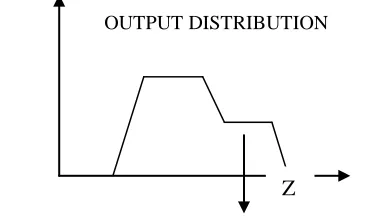
Defuzzification is carried out by Center of mass and by Mean of maximum and the concepts are shown below.
1. Center of mass is the method considers the output distribution found in that section with one crisp number by taking its center of mass
where z is the center of mass, uc is the membership at
at value zj.
Fig. 3 Defuzzification based on the Center of Mass
2. Mean of maximum is the method considers the output distribution and finds its mean of maxima.
where z is the mean of maximum, zj is the point at
which the membership function is at maximum, and l is defined as the number of times the output distribution reaches the maximum level.
Fig. 4 Defuzzification based on the Mean of maximum
OUTPUT DISTRIBUTION
Z
V. FUZZY INFERENCE SYSTEM – SUGENO
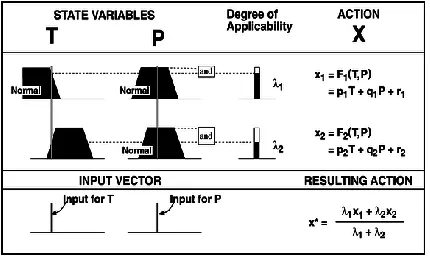
The main difference is that the output is not computed ie, there is no output membership function. As an alternative the output is a crisp number computed by multiplying each input by a constant value and then adding up the results obtained.
Fig. 5 Sugeno FIS for two Input values
The major effect in Sugeno Model is the determination of the coefficients p, q, and r and the algorithm can be optimized in this Sugeno model, so its widely used in applications.
VI. FIS MODEL APPLICATIONS IN THE RECENT PROJECTS
FIS is used in wide areas of applications in Mathematics, Science and Engineering. Also, in biodiversity projects and any sort of real problems can be sort out by studying the evaluation rate. This FIS can be used in broad areas such as Flood Mapping, Runoff Mapping, Groundwater Modelling, Water Level Depletion, Drought Analysis, Traffic Mapping, Environmental Monitoring, Ocean Monitoring, Coastal Study, Vegetation Study, Crop Mapping, Agriculture, Healthy Crops, Forestation Mapping, Water Resources study, Mapping of Water Bodies Level in - Ponds, Lakes, Rivers, Mapping of Minerals, Medical Applications and many more. Few application using FIS model is discussed below as: To handle the subjectivity of decision makers assessments, fuzzy logic has been applied and a new ranking method on the basis of fuzzy inference system (FIS) is proposed for supplier selection problem (Atefeh Amindoust et al., 2012). A fuzzy-logic-based diagnosis system was developed to determine the effect of pH and temperature on duckweed Lemna gibba biomass production (Surindra Suthar, 2015); Mamdani fuzzy inference system (MFIS) was applied as a decision making technique to classify the Mozafati dates based on
quality. Two date parameters including the length and freshness were measured for 500 date fruits. These dates were graded by both a human expert and MFIS (N. Alavi 2013); Based on the evaluation criteria, they can be categorized based on the grading into dryness (Wulfsohn et al., 1993), firmness (Schmilovitch et al., 1995), moisture (Dull et al., 1991; Schmilovitch et al., 2003, 2006), and automatic date grading (Lee et al., 2008). AL-Janobi (1998) applied the line-scan based vision for inspecting fast moving date fruits on a grading conveyor belt, where it is capable of determining the color/quality of date fruits. Self-learning techniques such as neural networks and fuzzy logic (Zadeh, 1965) seem to represent a good approach. In recent years, more and more applications of fuzzy theory to agriculture have been reported: Chao et al. (1999). In this research Mamdani fuzzy inference system (MFIS) was applied as a decision making technique to classify the Mozafati dates based on quality (N.Alavi, 2012), Taner et al., (2015) in the paper, proposes a novel gender recognition framework based on a fuzzy inference system (FIS). Fuzzy Logic (FL) is believed to be capable of addressing the uncertainty lying in the travellers behaviour and has been sought to develop realistic behavioural models in the recent years(Salini P.S. et al., 2017), Mohd in this paper presents the development of a Final Year Project (FYP) matching system using Fuzzy Logic (FL), (Mohd Fuad Abdul Latip et al., 2017) explains under partly covered conditions, the fuzzy inference system decides which of the previous positions is more efficient. The proposed approach is implemented using experimental prototype located in Perpignan , France (A Zaher et al., 2017) explains based on the results, companies can develop their business strategies to meet the needs and expectations of potential customers from this perspective as well (Leon Oblak et al., 2017).
VII. CONCLUSION
REFERENCES
[1] AL-Janobi, A.A., 1998. Color line scan system for
grading date fruits. ASAE Annual International Meeting, Orlando, Florida, USA, 12– 16 July, ASAE Paper No. 983028.
[2] H. Naderpour and S.A. Alavi Faculty of Civil
Engineering Semnan University, Iran (2015),
Application of Fuzzy Logic in Reinforced Concrete Structures, Civil-Comp Press, 2015 Proceedings of the Fourth International Conference on Soft Computing Technology in Civil, Structural and Environmental Engineering.
[3] Jang, J.-S. R. and C.-T. Sun, Neuro-Fuzzy and Soft
Computing: A Computational Approach to Learning and Machine Intelligence, Prentice Hall, 1997.
[4] Mahalakshmi P and Ganesan K (2015), Mamdani fuzzy
rule based model to classify sites for aquaculture development, Indian J. Fish., 62 (1): 110-115, 2015. [5] Mamdani, E.H. and S. Assilian, "An experiment in
linguistic synthesis with a fuzzy logic
controller," International Journal of Man-Machine Studies, Vol. 7, No. 1, pp. 1-13, 1975.
[6] Mansour Alali, Ahmad Almogren, Mohammad Mehedi
Hassan, Iehab A.L.Rassan, Md Zakirul AlamBhuiyan, Improving risk assessment model of cyber security using fuzzy logic inference system, Computers & Security, Available online 28 September 2017, https://doi.org/10.1016/j.cose.2017.09.011.
[7] Mohd Fuad Abdul Latip, Mohd Khairul Anuar Mat
Udin, Muhammad Murtadha Othman, Ihsan Mohd Yassin et al., (2017), Implementation of fuzzy logic based final year project student supervisor matching system, International Journal of Advanced and Applied Sciences, 4(4) 2017, Pages: 159.
[8] N.Alavi (2012), Quality determination of Mozafati
dates using Mamdani fuzzy inference system, https://doi.org/10.1016/j.jssas.2012.10.001.
[9] Salini P.S., Kedia A, Dhulipala S, KrishnaSaw, Katti B.K (2017), Spatial distribution of urban trips in recently expanded Surat city through Fuzzy Logic with various clustering Techniques: A case study of
typical metropolitan city in India,
https://doi.org/10.1016/j.trpro.2017.05.245.
[10] Schmilovitch, Z., Hoffman, A., Egozi, H., Grinshpun, J., Korotin, B., 2003. System determination of single date water content by novel RF device. In: Presentation at the 2003 ASAE Annual International Conference, 27–30 July 2003, Las Vegas, Nevada, USA.
[11] Schmilovitch, Z., Zaltzman, A., Hoffman, A., Edan, Y.,
1995. Firmness sensor and system for date sorting. Applied Engineering in Agriculture 4, 554–560.
[12] Singh G, Kamal N. Machine vision system for tea
quality determination-Tea Quality Index (TQI). IOSR Journal of Engineering. 2013; 3:46–50.
[13] Sugeno, M., Industrial applications of fuzzy control, Elsevier Science Pub. Co., 1985.
[14] Surindra Suthar Rashmi Verma Shikhar
DeepKapilKumar (2015), Optimization of conditions (pH and temperature) for Lemna gibba production using fuzzy model coupled with Mamdani’s method, https://doi.org/10.1016/j.ecoleng.2015.07.006. [15] Tagarakis A, Koundouras S, et al. A fuzzy inference
system to model grape quality in vineyards. Precis Agr. 2014; 1–24.
[16] Taner DanismanIoan Marius Bilasco Jean Martinet
(2015), Boosting gender recognition performance with a fuzzy inference system, Expert Systems with Applications, Volume 42, Issue 5, 1 April 2015, Pages 2772-2784. https://doi.org/10.1016/j.eswa.2014.11.023.
[17] Tripti Rani Borah; Kandarpa Kumar Sarma, Pran Hari
Talukdar(2015), Retina recognition system using
adaptive neuro fuzzy inference system, 2015
International Conference on Computer, Communication and Control (IC4).
[18] Wulfsohn, D., Sarig, Y., Algazi, R.V., 1993. Defect sorting of dry dates by image analysis. Canadian Agricultural Engineering 35 (2), 133–139. Zadeh, L.A., 1965. Fuzzy sets. Information and Control 8, 338–353. Zaid, A., 2002. Date palm cultivation, FAO publication No. 156, Rome.
[19] Zadeh, L.A., "Outline of a new approach to the analysis of complex systems and decision processes," IEEE Transactions on Systems, Man, and Cybernetics, Vol. 3, No. 1, pp. 28-44, Jan. 1973.
[20] Zadeh, L.A., 1965. Fuzzy sets. Information and Control