ISSN: 2231-5381
http://www.ijettjournal.org
Page 2764
Semantic Web and Knowledge Management in
eHealth Care System
V. Vijayakumar#1, K. Suresh Joseph*2
#
PG Scholar, Dept. of CSE, Pondicherry University, Puducherry, India. *
Assistant Professor, Dept. of CSE, Pondicherry University, Puducherry, India.
Abstract— Data or information systems in the context, plays an
important role in the health care system domain on the web or online. In recent years, the evolution of the semantic web and knowledge management technologies for the useful of patient-centric and its overall aim is based on the well defined semantics and knowledge of the users. And it set the new context in the web based methodology. In this paper we introduce the Semantic Web and Knowledge management in eHealth Care System. We know the need of privacy in medical data. So we provide a secure anonymization technique and knowledge management to search the Anonymized data. The knowledge management concept is mainly used to improving the access of patient data or information. It also used to addressing the questions of the patients and queries about the diseases around the quality of health information from the web. We prove with the evidence that the application used in the semantic web for the eHealth fields is most trustable for the users on the web.
Keywords
—
Semantic web, Knowledge Management, eHealth care, Anonymization, Query processing.I. INTRODUCTION
In recent years, web information system usage is goes on increasing through the users gets required information from the online itself. In that eHealth care system is one of the most leading information systems on the web. For eHealth system, semantic web providing a well formed structure in order to store the patient’s information or data and maintain the information in secure manner.
In the past ten years, the process of seeking for the particular topics in the internet or web is usually difficult and complex to select the performance in the particular time. So, time consuming takes more times for most of the users, and sometimes unsuccessful due to the poor selection of keywords. To overcome the above problems, semantic web technology gets developed. The semantic web technology is designed with goal in order to make information meaningful to users and makes it easier to the machines for understand. The semantic web technology enables the use of advanced knowledge management technologies. The semantic web combines a set of new technologies with grounded knowledge representation techniques to address the needs of more formal information modelling and reasoning for information services. The semantic web is used for many purposes from a standardized way to mark up metadata. This technology is basically used for implementing the web-based knowledge bases. It is regarded as an integrator across different content,
information applications and systems. Below the semantic web structure can be represented (Figure 1).
Figure 1- The structure of semantic web
eHealth is a comparative term for healthcare practice and it is supported by electronic processes. The semantic web technology helps the communication process between the patients and the doctors on the web or online. The electronic health care system consists of the details health records of the patients, which contains all kinds of personal and medical data about certain patient or individuals, we also checking for whether the doctors are available or not? This method can be able to simplify the online availability and protect the patient’s personals details and medical records from the unauthorized persons. Every single institution has to maintain their own application and managing the patient information very securely, only the authorized persons can access their information. When eHealth records are enables that the communication of patient information details between different healthcare professionals for consultation about the patients healthcare. So many countries across the world make
Semantic Web
Semantic Association
Ontologies Logical Support
Languages Tools Applications/services
WWW and Beyond
ISSN: 2231-5381
http://www.ijettjournal.org
Page 2765
some plans to execute the eHealth care application. This application is used for gathering the people information and managing the people health status and to maintain the patient’s records with full protection.
This method is not practically applicable because collecting the information or data’s about the patient is not so easy, so we implemented some new ideas in the semantic web technology. Applying those concepts is very complex in collecting the personal information from each patient in every city, making integration and data distributed manner. For this method, eHealth data exchange method is providing efficient solution. The major part of this concept is used to pertain about privacy issues of the patient records, and it is most important issue in the electronic patient record. The main concern of this method is to provide the confidentiality of the data. While in this method, we want concern about the non-confidential data of the patients. Each medical professional may have their own diagnostic tool and consultation services to the required patients on the web. To overcome the previous methods and to maintain the standard method to exchange of information of the patients, the various coding schemes may be used in combination with international medical standards.
The main motivation of eHealth is to increase the prevention, diagnosis, treatment, monitoring management and consultation is required for the patient health care. The eHealth covers the interaction between patients and health service providers; data transmission is covered out between institution-to-institution, and peer to peer communication between the patients or health professionals. It also have to maintain the electronic health records, telemedicine services and etc. eHealth can rescue significant benefits to the entire community, through improvements in access to and world class quality of care to the patients. This method provides the overall efficiency and sustainability of the health domain.
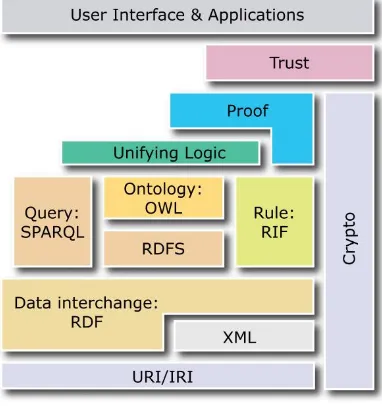
This technology is mainly used in eHealth applications for getting large data stores and making this application are intimate to the user, distributed data stores also available. It is possible by semantic web technology which relates some valid methodology; the process of semantic web process can be in step by step in detail format (figure 2) [9].
Figure 2- Semantic Web Layer Cake
ISSN: 2231-5381
http://www.ijettjournal.org
Page 2766
II. BASIC PROTOCOL
This section discuss about work done related to Semantic web and knowledge management in eHealth. The concept of the semantic web is similar but the work is slightly different:
Erdogan Dogdu [1], in the year 2009 the author presented a paper on Semantic Web in eHealth for the generic problems that is one of the most existing and the emerging set of problem. This will let the patients to know about the details and let it revolve the web databases with some security and will be retrieved when it is needed. When eHealth systems are done by the web services with distributed health system, it can be integrated with help of standard protocols & message formats. In general the Medical information system or eHealth systems retrieving data is very complex. By using Semantic web technologies are providing efficient solutions for complex and distributed data.
Pedro Lopes and Jose Luis Oliveira [2] in the year 2011 published a paper on the Semantic Web Application Framework for Health Systems Interoperability. In that they have mentioned some of the hints to carry on the application framework in an efficient manner. For developing a semantic web interoperability framework with complete software stack for the developers to deploy semantic application. The framework allows implementing a new application for health related interoperability; it helps to connect with new modern application. Framework was implemented in java and each instance are requires to execute through Apache Tomcat Server.
Mohammad Ali H. Eljinini [3] in the year 2011, published a paper as the Health – Related Information Structuring for the Semantic Web. The theme of this paper is to extract the information and structure it from the medical related websites. The designing of our own ontology in order to extract the information and structure the information available on the websites were been discussed. The purposes of the websites are thoroughly studied and the information is organized in form of hierarchy. Making it as general as possible so that it can be used for other field related searches also. Used OWL-DL to represent the ontology and an existing tool is used to map own ontology in OWL-DL language (extraction of information from websites can be automated with the help of ontology).
Dimitrios Xanthidis and Eisa Aleisa [4] in the year 2012, presented a paper on EHealth Record and Personal Privacy. The theme of this paper is it mainly focusing on the development of online database for securing the personal data of each and every patient. Gathering the pre-tested questionnaire and creating a new kind of questions are used to reveal the patient information. They make a survey and monitoring the statistical reports. More no. of peoples are directly or indirectly getting benefits for using this application. Different countries are aiming to develop this kind of application and achieving better results from the patients.
Mohit Gangwar, R S Yadav and R B Mishra [5] in the year 2012, presented a paper on Semantic Web Services for Medical Health Planning. The theme of this paper is for implementation of medical health planning the semantic web service technology is mostly helpful. Agent system is main consideration for this technology. They recognize the patient requirements and process step by step with use of service requester and service provider agent. For each patient can be search based on their disease, doctors, hospitals and its distances. This application is mainly helpful to find details about the doctor specialization, consultant fee and so on. For each patient can be search based on their disease, doctors, hospitals and its distances. This application is mainly helpful to find details about the doctor specialization, consultant fee and so on.
Dr. W. Liu and Dr. E.K. Park [6] in the year 2012, they presented a paper on EHealth Interconnection Infrastructure Challenges and Solutions Overview. The theme of this paper is it concentrates on the National eHealth Interconnection infrastructure and design guidelines are in great demand. eHealth interconnection network services that are critical to universal deployment. The solution from this paper gives the aspects of interconnection services, operational management services and security control services.
Kuo-Hui Yeh, N.W. Lo, Tzong-Chen Wu, Ta-chi Yang and Horng-Twu Liaw [7] in the year 2012, presented a paper on Analysis of an eHealth Care System with Smart Card based Authentication. The theme of this paper is for eHealthcare services different applications are available for providing efficient access and relevant information about the patient. They applied the security issues and constructing different attacking technology for checking the robustness of the CLCC scheme. For authentication purpose they checking with different condition whether the person is authorized are not.
ISSN: 2231-5381
http://www.ijettjournal.org
Page 2767
S.No Paper Title Publisher & Year Advantage Disadvantage
1 Semantic Web in eHealth
Erdogan Dogdu, ACMSE '09 March 19-21, 2009, ACM 978-1-60558-421-8/09/03
In the Semantic Web technique is most commonly used for providing successful results like large data stores and distributed application.
It provides more extensible and more flexible data storage and interoperability options for any information systems.
2
A Semantic Web Application
Framework for Health Systems
Interoperability
Pedro Lopes and Jose Luis Oliveira,
MIXHS’11, October 28, 2011, ACM 978-1-4503-0954-7/11/10
To improve the patient healthcare and managing the patient information.
Integration and Interoperability are directly intertwined. Semantic interoperability in healthcare is allowing two or more computational systems.
For developing those kind of framework for overcoming daily challenges.
3
Health – Related Information Structuring for the Semantic Web
Mohammad Ali H. Eljinini, ISWSA’11, April 18-20,11, ACM 978-1-4503-0474-0/04/2011
Provides the sophistication for the future world. An ultimate outcome has been recognized in the experiments results.
For each and every set of health issues a complete study is needed to develop the ontology. This may not be applicable in practice since the numbers of issues are emerging day by day
4 EHealth Record and Personal Privacy
Dimitrios Xanthidis and Eisa Aleisa, International Conference on
Information Technology and e-Services, IEEE 2012, 978-1-4673-1166-3/12
Only authorized persons can access the patient’s health record.
Reliability & accessibility of data. The system is user friendly.
Collecting lack of personal information about the patient.
5
Semantic Web Services for Medical Health Planning
Mohit Gangwar, R S Yadav and R B Mishra, IEEE 1st International
Conference on Recent Advances in Information Technology, 978-1-4577-0697-4/12
The main uses of semantic web services are self contained and reusable software components.
It reduces the consultant fee / conversation fee for the patients. 6 EHealth Interconnection Infrastructure Challenges and Solutions Overview
Dr. W. Liu and Dr. E.K. Park, IEEE 14th International Conference on e-Health Networking, Applications and Services, 978-1-4577-2040-6/12
This security challenges and QoS requirement arisen from ubiquitous access of the new digital healthcare function. It increases the interoperable interconnection and security aspects and service level guarantees.
This is only the trail method in the guidelines in the digital healthcare system.
The design and implementation is not gives the full solution in flexibility and simplicity issues.
7
Analysis of an eHealth Care System with Smart Card based Authentication
Kuo-Hui Yeh, N.W. Lo, Tzong-Chen Wu, Ta-chi Yang and Horng-Twu Liaw, IEEE 2012 Seventh Asia Joint Conference on Information Security, 978-0-7695-4776-3/12
In this scheme they used different phases are available for finding the matches between the patient
Cryptanalysis method is mainly used for authentication scheme
The scheme is not fulfill to the major security issues.
8 Slicing: A New Approach for Privacy Preserving Data Publishing
Tiancheng Li, Ninghui Li, Jian Zhang, and IanMolloy, IEEE transactions on knowledge and data engineering, vol. 24, no. 3 march 2012.
We show that slicing preserves better data utility than generalization
ISSN: 2231-5381
http://www.ijettjournal.org
Page 2768
III.DESIGN CONSIDERATION SWKM Algorithm:
1. Collect user’s data
2. Apply anonymization technique 3. Save Anonymized data
4. Query the server
5. Search on encrypted values 6. Retrieve the exact result
7. Ask for key while requesting file
8. If doesn’t provide correct key, then show only encrypted data.
IV.EXPERIMENTAL RESULTS
We have simulated our system in Java. We implemented and tested with a system configuration on Intel Dual Core processor, Windows XP and using Netbeans 7.0. We have used the following modules in our implementation part. The details of each module for this system are as follows. We have implemented and tested with the 5 moudles. They are: PHR Owner Module,Attribute based Access Policy Module, Data confidentiality Module,Search Engine and Verify Files. We describe the each module in details now as follows. In the first module, the main goal of our framework is to provide secure patient-centric PHR access and efficient key management at the same time. The key idea is to divide the system into multiple security domains (namely, public domains (PUDs) and personal domains (PSDs)) according to the different users’ data access requirements. The PUDs consist of users who make access based on their professional roles, such as doctors, nurses and medical researchers. In practice, a PUD can be mapped to an independent sector in the society, such as the health care, government or insurance sector. For each PSD, its users are personally associated with a data owner (such as family members or close friends), and they make accesses to PHRs based on access rights assigned by the owner. Each data owner (e.g., patient) is a trusted authority of her own PSD, who uses a KP-ABE system to manage the secret keys and access rights of users in her PSD. Since the users are personally known by the PHR owner, to realize patient-centric access, the owner is at the best position to grant user access privileges on a case-by-case basis. For PSD, data attributes are defined which refer to the intrinsic properties of the PHR data, such as the category of a PHR file. For the purpose of PSD access, each PHR file is labeled with its data attributes, while the key size is only linear with the number of file categories a user can access. Since the number of users in a PSD is often small, it reduces the burden for the owner. When encrypting the data for PSD, all that the owner needs to know is the intrinsic data properties. In the second module, we provide security using Attribute based encryption technique. In our framework, there are multiple SDs, multiple owners, multiple AAs, and multiple users. In addition, two ABE systems are involved. We term the users having read and write access as data readers and contributors, respectively. In the third module,
the owners upload ABE-encrypted PHR files to the server. Each owner’s PHR file is encrypted both under a certain fine grained and role-based access policy for users from the PUD to access, and under a selected set of data attributes that allows access from users in the PSD. Only authorized users can decrypt the PHR files, excluding the server. Knowledge management is implemented in the next module, in this module, the search engine is designed to search for information on the databases like World Wide Web. The search results are generally presented in a list of results often referred to as SERPS, or "search engine results pages". The information may consist of web pages, images, information and other types of files. Some search engines also mine data available in databases or open directories. Unlike web directories, which are maintained only by human editors, search engines also maintain real-time information by running an algorithm on a web crawler. In this module, finally admin verify the upload files details. To check who uploaded the files. What is the purpose of the files. And give authority to those files. And save the file in database.
Figure 3- ABE Key Generation Process
ISSN: 2231-5381
http://www.ijettjournal.org
Page 2769
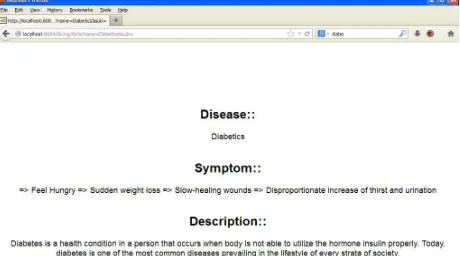
Figure 5- Users search result
Impr oved servi
ce
Redu ced risks
Self-diagn osis
Secu rity
Resu lts
Percentage 90 80 95 96 97
0 20 40 60 80 100 120
Figure 6- Results of proposed system
V. CONCLUSIONS
In this paper we have provided a better security and improvement in ehealth care system using knowledge management system. We know that the eHealth domain creates and manages the large amounts of information about patients used to both record details of patient encounters and
decisions about healthcare treatments. It is a challenge to determine the subset of this information that should be standardized to enable sharing of this information with can lead to consistent outcomes in terms of technical interoperability. The majority of health information has been aimed at sharing at the document-level and only a small amount at the atomic level. The industries are clearly demanding more information standardization at the atomic level as this is where decision-support systems can aid the healthcare provider. Semantic web technology is a web based technology that could potentially fulfill the required in the information system. The eHealth sector in adoption semantic web technologies will provide a long term gain for improved health decisions. Thus our results prove that usage of knowledge management and semantic web make the e-health system better.
VI.REFERENCES
[1] Erdogan Dogdu, “Semantic Web in eHealth”, ACMSE ’09 March 19-21, 2009.
[2] Pedro Lopes and Jose Luis Oliveira, “A Semantic Web Application Framework for Health Systems Interoperability”, MIXHS’11, October 28, 2011.
[3] Mohammad Ali H. Eljinini, “Health – Related Information Structuring for the Semantic Web”, ISWSA’11, April 18-20, 2011.
[4] Dimitrios Xanthidis and Eisa Aleisa, “EHealth Record and Personal Privacy”, International Conference on Information Technology and e-Services, IEEE 2012.
[5] Mohit Gangwar, R S Yadav and R B Mishra, “Semantic Web Services for Medical Health Planning”, IEEE 1st International Conference on
Recent Advances in Information Technology, 2012.
[6] Dr. W. Liu and Dr. E.K. Park, “EHealth Interconnection Infrastructure Challenges and Solutions Overview”, IEEE 14th International
Conference on e-Health Networking, Applications and Services, 2012. [7] Kuo-Hui Yeh, N.W. Lo, Tzong-Chen Wu, Ta-chi Yang and Horng-Twu Liaw, “Analysis of an eHealth Care System with Smart Card based Authentication”, IEEE 2012 Seventh Asia Joint Conference on Information Security, 2012.
[8] Tiancheng Li, Ninghui Li, Jian Zhang, and IanMolloy, “Slicing: A New Approach for Privacy Preserving Data Publishing” IEEE transactions on knowledge and data engineering, vol. 24, no. 3 march 2012.
[9] Semantic Web, “Layercake” diagram, see: http://www.w3.org/2001/sw/layerCake.svg