
ISSN: 2231-5381
http://www.ijettjournal.org
Page 247Integrating AHP and Genetic Algorithm Model
Adopted for Personal Selection
Mohammed Fahmy Aly #1, Hagag M.Abd El-hameed *2
#
Dr. at Department of Industrial Engineering, Fayoum University, Fayoum, Egypt. *
Assistant Lecturerat Department of Industrial Engineering, Fayoum University, Fayoum, Egypt.
Abstract - Selection of qualified persons suitable for different organization functions is a key success factor for an organization. The complexity and importance of the problem call for analytical methods rather than intuitive decisions. The personnel selection problem requires the application of multi-criteria decision making (MCDM) methods for robust recruitment. This paper has to objectives; first to proposed a MCDM method for personnel selection system based on Analytic Hierarchy Process and Genetic Algorithm (AHP-GA) and second, to apply this algorithm on a real case from an organization. As related to the first objective, Analytic Hierarchy Process (AHP) is used to solve the MCDM problem. It has been applied in numerous situations with impressive results. However, AHP has been also criticized mainly in priority derivation procedure. One of the main problems in current AHP as priority derivation procedure is; inconsistency of the judgment, accuracy and performance of the prioritization method. To solve the criticism and the AHP problems; this paper proposes more reliable model, AHP-GA. The propose framework combines the power of genetic algorithm (GA) with Analytic Hierarchy Process (AHP). The new model minimizes Euclidian distance of Least Squire Method as objective function. Effectiveness of new proposed model is verified by comparing model results with other prioritization methods in the literature. For the second objective the proposed framework is exploited to solve personal selection problem reported in an earlier study. The AHP-GA can consider the best adequate personnel dealing with the rating of both qualitative and quantitative criteria.
Keywords - Multi-criteria Decision Making (MCDM), Analytic Hierarchy Process (AHP), Genetic Algorithm (GA), Personal Selection.
I. INTRODUCTION
A. Personal selection
Personnel selection is an important part of human resources management policy in any enterprise. Personnel selection process is aimed at choosing
the best candidate to fill the defined vacancy in a company. It determines the input quality of personnel and thus plays an important role in human resource management Dursun & Karsak, [1].
It is important to develop streamlined decision-making techniques available for enterprises possessing various technological, financial, and intellectual capacities, Alvydas Balezentis, et al.
[2],which extended and applied the
MULTIMOORA method which encompasses value measurement as well as reference level methods.
To assure that the write people are placed in the right jobs, personal selection has always been an important issue for government agencies as well as private organizations. Many individuals’ attributes, e.g. organizing ability, creativity,
personality, emotional steadiness,
comprehension, leadership, general aptitude, etc., are considered for personal selection. These attributes can broadly classified into two categories; (1) subjective attributes- these attributes have qualitative definitions, e.g. Personality leadership, past expediencies and (2) objective attributes, these attributes can be assessed quantitatively, eq. general aptitude, knowledge, analytical ability etc.
The ongoing processes of globalization as well as increasing competition require improving the personnel selection process. Many enterprises, however, are not ready to facilitate the vast amount of funds for personnel selection. Hence, it is important to develop new decision-making techniques available for enterprises possessing various technological, financial, and intellectual
capacities. Consequently, more and more
ISSN: 2231-5381
http://www.ijettjournal.org
Page 248 many studies focused on personnel recruitmentproblems Dursun & Karsak,[1]; Kelemenis& Askounis,[4]; Kelemenis, et al[5].
In real-world cases most problems have more than one decision criterion. So MCDM methods have been developed to solve complex problems. The aim in MCDM is to determine overall preferences among alternative options. According to the objective, MCDM methods can be used for outranking alternatives or final decision of choice.
B. Analytic Hierarchy Process
AHP is a Multi-Attribute Decision-Making (MADM) model proposed by Saaty (1980). Given its advantages of integral structure, simple theory, and ease-of-operation, this method is often used in decision making when addressing events of uncertainty and under various evaluation criteria. For the decision-makers, the hierarchical structure contributes to provide a better understanding; however, it is often necessary to evaluate alternatives based on other criterion, in order to determine priorities. AHP contains an inherit analytical framework, wherein complex and non structural situations are divided into hierarchical elements. Then, the relative
significance of every element is scored
subjectively by numerical value, and the level of priority is obtained from these values as the factor weights [6].
The AHP framework provides a comprehensive and rational methodology, which encompasses the following steps: (1) structuring a decision problem in a hierarchy, (2) obtaining the judgment matrix based on pair-wise comparisons between alternatives and between criteria, (3) testing consistency until satisfactory, and (4) synthesizing comparisons across various levels to obtain the final weights of alternatives. Users of AHP make judgments on pair-wise comparisons according to Saaty's discrete 9- value scale method. The matrix is called a pair-wise
weighting matrix (PWM) [7].
Saaty (1980) pointed out that, AHP is an efficient auxiliary tool for addressing several issues, including generating a set of alternatives,
choosing a best policy alternative, and
determining requirements. Feng, Chen, and Jiang, [8]evaluated and selected a combination of suppliers through AHP. Chiang[9] suggested that, AHP is a dynamic solution that can successfully address change and evaluation of suppliers. Lee, Chen, and Chang [10] applied AHP to evaluate the performance of IT departments in the manufacturing industry for a standard and persuasive evaluation. Sha and Che,[11], [12],
Che, Wang, and Sha,[13] used AHP to build the solving model for supply chain network design. önüt and Soner,[14] computed the relative weights by AHP, and applied in a fuzzy environment. Many researchers used AHP as MCDM process for supplier selection problem Xinyang Deng et al., [15], Dr. P. Parthiban et al., [16] and Junyi Chai et al., [17].
In addition, the use of AHP as weighting and driving priority tool is also widespread. Bojan Srdjevic,[18] proposes a multi-criteria approach for combining prioritization methods within the AHP. The leading assumption is that for each particular decision problem and related hierarchy, AHP must not necessarily employ only one prioritization method. If more available methods are used to identify the best estimates of local priorities for each comparison matrix in the hierarchy, then the estimate of final alternatives’ priorities should also be the best possible. Ying-Ming et al.,[19] proposes a linear programming method for generating the most favorable weights (LP-GFW) from pair-wise comparison matrices, which incorporates the variable weight concept of DEA into the priority scheme of the AHP to
generate the most favorable weights.
Ramanathan,[20] use data envelopment analysis (DEA) to generate local weights of alternatives from pair-wise comparison judgment matrices used in the AHP. Based on the above discussions, AHP is an efficient method of solving the relative significance under several evaluation criteria.
C. Draw Backs of AHP
Despite its wide acceptance, AHP has been criticized on the ground that decision makers (DMs) often cannot provide strictly consistent comparisons. This problem is of a particular concern when the numbers of criteria and
alternatives are large. In Saaty's work,
consistency is verified by the Consistency Ratio (CR) that indicates the probability that the matrix ratings are randomly generated. The rule of thumb is that a CR over 0.1 indicates the pair-wise comparison matrix (PWM) should be revised. To deal with the problem of inconsistent comparisons of judgment and performance of the prioritization method, GA is used and new prioritization model (AHP-GA) is developed.
D.Genetic Algorithm
ISSN: 2231-5381
http://www.ijettjournal.org
Page 249 of natural selection and the exchange of geneticinformation, the species with the optimal fitness will govern the world. The GA is often used as a search algorithm, which is based on the biological principles of selection, reproduction and mutation Wang[23]; Wang et al., [24]; Mohamad et al.,[25]. searches an optimal solution to the problems by manipulating a population of strings (chromosomes) that represent different potential solutions, each corresponding to a sample point from the search space. For each generation, all the populations are evaluated based on their fitness. An individual with a larger fitness has a higher chance of evolving into the next generation. By searching many peaks simultaneously, GA reduces the possibility of trapping into a local minimum. GA works with acceding of parameters instead of parameters themselves. The coding of parameters helps the genetic operator to evolve the current state into the next state with minimum computations. GA evaluates the fitness of each string to guide its search instead of the explicit optimization function. There is no need for computations of derivatives or other auxiliary knowledge. Finally, GA explores the search space where the probability of finding improved performance is high.
GA has been applied to many problems in various domains such as improve weighting
methods. Fong. et.al.[26] integrates GA
mechanism and case-based reasoning (CBR) system to assist in assigning the suitable weights to each level of Balanced Score Cards (BSC). Based on the BSC design, the study proposed a three-level feature weights design to enhance CBR’s inference performance. GA is employed to facilitate weighting all of levels in BSC and to determine the most appropriate three-level feature weights. Pavlos and Nikolaos[27] proposed an innovating strategy planning for enterprise resources allocation based on a performance measurement view using BSC and genetic algorithm.
E. Decision Matrix (DM)
A decision matrix is a list of values in rows and columns that allow an analyst to systematically identify, analyze, and rate the performance of relationships between sets of values and information. A decision matrix evaluates and prioritizes a list of options. The team first establishes a list of weighted criteria and then evaluates each option against those criteria. This is a variation of the L-shaped matrix [28].
Elements of a decision matrix show decisions based on certain decision criteria. The matrix is useful for looking at large masses of decision factors and assessing each factor’s relative significance. Decision matrix is used to describe a multi-criteria decision analysis (MCDA) problem. An MCDA problem, where there are M alternative options and each need to be assessed on N criteria, can be described by the
decision matrix which has M rows and N
columns, or M × N elements as shown in table 1.
TABLE 1: EXAMPLE OF DECISION MATRIX COMPARISON
C 1 C 2 C 3 …. C N
A 1 x11 x12 x1N
A 2 X21
A 3
…… Xij =
….
A M XM1 XMN
C for Criterion, A for Alternative
F. Work Objective
This paper has two objectives, the first is to develop a new and more reliable model AHP-GA prioritization model to determine and optimize the weights of AHP. The proposed model combines between AHP and GA. The new model minimizes Euclidian distance of Least Squire Method as objective function. Effectiveness of new proposed model is measured by comparing model results with AHP original model and with other prioritization methods in the literature. The second objective is to apply the developed model on a real problem which is the personnel selection according to a given criteria. It provides a reference for an enterprise to select personnel using AHP-GA model.
II. MATERIALS AND METHODS
This paper used AHP prioritization tool which contains several methods. In this section we describe and discuss the tools used to develop the new model. Procedure and steps of the new model also discussed in this section.
A. Analytic Hierarchy Process Prioritization Methods
Analytic hierarchy process has many
ISSN: 2231-5381
http://www.ijettjournal.org
Page 250 Square. The following part discusses thesemethods.
1. Average Normalized Columns (ANC)
The decision weights for each preferential matrix can be obtained after the consistency check by
the aforementioned methods related to
eigenvector and consistency ratios. Consequently, the final decision weights of the alternatives can be aggregated by a series of multiplications of the rearrangements of the preferential matrixes, average of normalized columns (ANC) one of these methods. If we have consistent matrix ANC is to divide the elements of each column by the sum of the column and then add the element in each resulting row to form average normalized matrix A*, and divide this sum by the number of elements in the row (n). This is a process of averaging over the normalized columns. In mathematical form, the vector of priorities can be calculated as follows [29]:
i=
1 ij
∑ ij
, , = 1,2, … (1)
We can conceder this method an approximation of EV, Consistency ratio (CR) can be calculated from the following equations [29]:
CR = [( max – n) / (n – 1)] / RI (2)
λmax=
1 ( ij w)i
wi n
i=1
(3)
Where: CR consistency ratio, n matrix size, max
maximum Eigen-value, w is the item weight
referring to priority vector and RI random index. Where RI, could be selected according to matrix size (n) as shown in table 2.
TABLE2: RANDOM INDEX VALUES [29].
n 1 2 3 4 5 6 7 8 9 10
RI 0 0 0.58 0.9 1.12 1.24 1.32 1.41 1.45 1.49
Some distance minimizing methods such as the least squares method (LSM), logarithmic least square method (LLS) are of the possible tools for computing the priorities of the alternatives. All these are optimization methods.
2. Direct Least Square
In the DLS method the objective is to find a consistent ratio-scale matrix which minimizes the
Euclidean distance from consistent ratio-scale matrix. That is, [30]
ij− i j
(4)
. . i= 1
The nonlinear optimization problem in this equation has no special tractable form and therefore is difficult to solve numerically.
B. Proposed AHP-GA Prioritization Model
1.Driving Criteria Weight Vector
In solving optimization problem for deriving priorities by using AHP-GA, it involves three operators which are selection, crossover, and mutation. In this model these operators are selected as follow, rank selection for selection, one point crossover for crossover and uniform mutation for mutation. In order to ensure that only the best population always survives, elitism has also been applied as an additional selection strategy.
Chromosome Representation
This model is using a set of binary numbers (binary encoding) for each population or chromosome in initial population. Then this binary numbers translated to real numbers or (Permutation encoding) for fitness calculation. Real numbers are used because it is more natural and useful representation of priorities in AHP.
Initialization
The initial population of candidate solution is generated randomly across the search space. Search space is the space for all possible feasible solutions. Every solution can be marked by its value of the fitness of the problem. Random numbers are used for initial population to give AHP-GA starting point. Each single population is generating randomly based on number of criteria or alternative in AHP hierarchy setting.
Fitness Function
ISSN: 2231-5381
http://www.ijettjournal.org
Page 251 (TD) equation used as an objective function to beoptimized. Once an offspring population is created or the population is initialized, the fitness values of candidate solution are evaluated.
( ) = = ij−
i j
/
(6)
After calculate each initial population fitness function, that chromosome will set as parent. That parent also will produce offspring and store the offspring chromosome. Besides that, that parent also will go to selection step.
Parameter Setting
By using GA, parameter setting is the important part in getting the better result. The performance of GA is greatly dependent on its turning of parameter. This model proposes a new parameter setting, Population size, 1000, Crossover rate 50% and mutation rate 10 %.
Flow chart that shows procedure of AHP-GA prioritization model in deriving priorities and normalizing of decision matrix is presented in figure 1.
2.Decision Matrix Normalization
Calculate the normalized decision matrix for positive criteria using the following equation [31]:
ij=
rij
r* j
= 1, … . .5, = 1, … .7 (7)
Where: r*j is a maximum number of r in the column of j.
And for negative criteria:
ij=
r jmin
rij
= 1, … . .5, = 1, … .7 (8)
Using the following formula to evaluate each alternative, Pi:
i=∑ j ij i=1… 5, j=1… 7 (9) Where: xij is the score of the i
th
alternative with respect to the jth criteria, wj is the weighted criteria.
FIGURE1: AHP-GA Procedure for Deriving Priorities and DM Normalization.
III. VERIFICATION OF PROPOSED MODEL
Two examples are used to illustrate and verify the potential applications of the proposed AHP-GA model. The illustration presents the advantages of
the proposed model and verifies model
consistency with the previous work.
En
R
e
g
e
n
e
ra
ti
o
n
Start
Setup the
Pair-wise comparison
Parent Initial dev = 1
Fitness
Selection
Crossover
Reproductio
Mutation
Elitism
Output Priorities,
New
Fitness
Y
N dev < ε Input Decision matrix,
Normalized Decision
Output Normalized
Decision
Alternative
ISSN: 2231-5381
http://www.ijettjournal.org
Page 252 Example (1)In this example, a case has been conducted based on data that are taken from Bojan’s study [18]. Bojan’s study proposes a multi-criteria approach for combining prioritization methods within the AHP. Prioritization methods used in this example are Additive normalization (AN), Eigenvector
(EV), Weighted Least-Squares (WLS),
Logarithmic Least-Square (LLS), Logarithmic Goal Programming (LGP), Fuzzy Preference Programming (FPP) and Analytical Hierarchy Presses Genetic Algorithm (AHP-GA).
The selected case is reservoir storage allocation problem. The analyzed problem is allocating the surface water reservoir storage to multiple uses. A global economical goal is defined as the most profitable use of reservoir, and six purposes are considered as decision alternatives: electric power generation (A1); irrigation (A2); flood protection (A3); water supply (A4); tourism and
recreation (A5); and river traffic (A6).
Alternatives are evaluated across five economical criteria of different metrics: gain in national income (C1); earning foreign exchange (C2); improvement of the balance of payment (C3); import substitution (self-sufficiency) (C4); and gain in regional income (C5). P1 is the matrix where criteria are compared by importance with respect to the goal, and matrices containing judgments of alternatives with respect to criteria C1, C2,…., C5 are referred to as P2,…., P6, respectively as shown in table3[18].
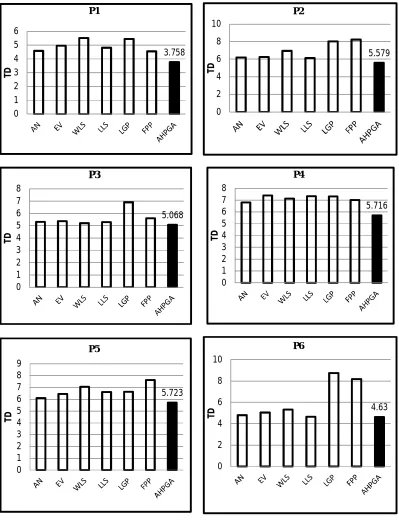
The results of this case, reservoir storage allocation problem (figure 2) shows that, AHP-GA prioritization model produces the smaller or close to zero the value of TD (as comparing criteria) for every single matrix (i.e. P1, P2… and P6). These results also show that the integrated AHP-GA model can be used to estimates priorities for both situation of inconsistency and consistency of the judgment.
TABLE3: COMPRESSION MATRICES FOR RESERVOIR STORAGE ALLOCATION PROBLEM [18].
Criteria (P1)
A1 A2 A3 A4 A5
A1 1 2 5 3 2
A2 1/2 1 7 3 3
A3 1/5 1/7 1 1/4 1/5
A4 1/3 1/3 4 1 3
A5 1/2 1/3 5 1/3 1
National income (P2)
A1 A2 A3 A4 A5 A6
A1 1 5 3 6 7 5
A2 1/5 1 1/7 1/2 2 2
A3 1/3 7 1 7 3 4
A4 1/6 2 1/7 1 1/2 1
A5 1/7 1/2 1/3 2 1 2
A6 1/5 1/2 1/4 1 1/2 1
Regional income (P6)
A1 A2 A3 A4 A5 A6
A1 1 1/5 1/3 1/6 1/3 1
A2 5 1 2 1/5 2 4
A3 3 ½ 1 1 2 3
A4 6 5 1 1 1 7
A5 3 ½ ½ 1 1 5
A6 1 1/4 1/3 1/7 1/5 1
Foreign exchange (P3)
A1 A2 A3 A4 A5 A6
A1 1 4 6 7 2 2
A2 1/4 1 2 2 1 1/3
A3 1/6 1/2 1 2 1/6 1
A4 1/7 1/2 1/2 1 1/5 1/7
A5 1/2 1 6 5 1 1
A6 1/2 3 1 7 1 1
Balance of payment (P4)
A1 A2 A3 A4 A5 A6
A1 1 3 7 6 3 4
A2 1/3 1 5 2 3 ½
A3 1/7 1/5 1 ¼ 1/7 1/3
A4 1/6 ½ 4 1 ½ 2
A5 1/3 1/3 7 2 1 2
A6 1/4 2 3 1/2 1/2 1
Import substitution (P5)
A1 A2 A3 A4 A5 A6
A1 1 3 9 7 4 3
A2 1/3 1 3 6 2 1/3
A3 1/9 1/3 1 ½ ¼ 1/5
A4 1/7 1/6 2 1 1/6 1/6
A5 ¼ ½ 4 6 1 ½
ISSN: 2231-5381
http://www.ijettjournal.org
Page 253FIGURE 2: Total deviations for deferent prioritization methods
Example (2)
In this case, the study has been conducted based on data that are taken from example used in study of Delgado-Galván et al. [32] which uses AHP Eigen-value method (EVM) for assessing externalities in water leakage management.
Results of this example (figure3) show that, in general AHP-GA model is a good prioritization model for AHP priority vector generation. AHP-GA model gives better solutions (minimum TD value and the same ranking) in case of moderate consistent and inconsistent pair-wais compression matrices. The AHP-GA results in case of height consistent matrices not the best solution. Results 3.758
0 1 2 3 4 5 6
TD
P1
5.579
0 2 4 6 8 10
TD
P2
5.068
0 1 2 3 4 5 6 7 8
T
D
P3
5.716
0 1 2 3 4 5 6 7 8
T
D
P4
5.723
0 1 2 3 4 5 6 7 8 9
T
D
P5
4.63
0 2 4 6 8 10
TD
ISSN: 2231-5381
http://www.ijettjournal.org
Page 254 of examples one and two shows that, AHP-AGmodel has better results and the smallest value of TD over the other prioritization methods in case of moderate consistent and inconsistent matrices.
FIGURE 3: Water leakage management problem results
IV.PERSONNEL SELECTION USING AHP-GA MODEL
Personnel selection directly and significantly affects the quality of employees, and hence, it has always been an important topic for organizations, including public agencies and private enterprises. Various approaches have been developed to help organizations make best personnel selection decisions to place the right people in the right jobs[31].
In this section Alireza Afshari et al.[31] application is solved using proposed AHPGA model. AHPGA model used to select and consider suitable criteria and personnel in one of a sector of Telecommunication’s Company. The way of data collection that is applied for this phase is questionnaire. By using seven criteria like below, Telecommunication Company wants to sort five people which have passed the exam. These criteria have been mentioned in table 4 as follows:
TABLE 4: CRITERIA NAME USED IN THIS CASE [31]
The weights of criteria have been computed by using comparison matrix. Meanwhile, Data was gathered from five expert’s opinion with
questionnaire in one of sector of
Telecommunication Company by using scale values of 1-5 as shown in table 5 and the resulted weights is shown in table 6 [31].
TABLE 5: SPECIFYING THE SCALE VALUE OF 1-5
Intensity of importance
Definition
1 Equal importance
2 Moderate importance
3 Strong importance
4 Very strong
5 Extreme importance
TABLE 6 : WEIGHTS OF CRITERIA BY COMPARISON MATRIX
C
rit
er
ia C1 C2 C3 C4 C5 C6 C7
AHP-GA Weights
C1 1 2 2 4 3 2 3 0.2305
C2 0.5 1 1 3 2 1 2 0.1836
C3 0.5 1 1 3 2 1 2 0.1523
C4 0.25 0.33 0.33 1 0.5 0.33 2 0.0547
C5 0.25 0.50 0.5 2 1 0.5 1 0.0977
C6 0.5 1 1 3 2 1 2 0.1836
C7 0.33 0.50 0.50 0.50 1 0.5 1 0.0820
Table 7 presents the decision matrix for personnel selection which is extracted from [31] with; where, C means Criteria and P means Personnel.
TABLE 7: THE DECISION MATRIX FOR PERSONNEL
SELECTION [31]
Criteria
Personnel C1 C2 C3 C4 C5 C6 C7
P1 4 7 3 2 2 2 2
P2 4 4 6 4 4 3 7
P3 7 6 4 2 5 5 3
P4 3 2 5 3 3 2 5
P5 4 2 2 5 5 3 6
In this case of study, criteria have positive and the normalized decision matrix calculated using equation 7. Normalized decision matrix is shown in table8.
0 1 2 3 4 5
CR = 0.0257 CR = 0.0018 CR = 0.1024
Total Deviation
EVM AHPGA
Criteria Explanation
C1 Ability to work in different
business units
C2 Past experience
C3 Team player
C4 Fluency in a foreign language
C5 Strategic thinking
C6 Oral communication skills
ISSN: 2231-5381
http://www.ijettjournal.org
Page 255TABLE 8: NORMALIZED DECISION MATRIX FOR PERSONNEL SELECTION CASE STUDY [31].
Criteria
Personnel C1 C2 C3 C4 C5 C6 C7
P1 0.5714 1.000 0.5000 0.4000 0.4000 0.4000 0.2857
P2 0.5714 0.5714 1.0000 0.8000 0.8000 0.6000 1.0000
P3 1.0000 0.8571 0.6667 0.4000 1.0000 1.0000 0.4286
P4 0.4286 0.2857 0.8333 0.6000 0.6000 0.4000 0.7143
P5 0.5714 0.2857 0.3333 1.0000 1.0000 0.6000 0.8571
Accoutering to the proposed model, the final ranking for all personals is shown in the following table.
Table 9: the final personnel ranking
P1 0.549
P2 0.703
P3 0.828
P4 0.502
P5 0.568
The synthesis scores of personnel’s are shown in table 9. Obviously, personnel P3 are the highest scores and are the best choice then P3, P5, P1, P4 then P2 is the least score. This result is in agreement with the last result of [31].
V. CONCLUSION
Personnel selection is an important part of human resources management policy in any enterprise. Personnel selection process is aimed at choosing the best candidate to fill the defined vacancy in a company. It determines the input quality of personnel and thus plays an important role in human resource management. Hence, it is important to develop streamlined decision-making techniques available for enterprises possessing various technological, financial, and intellectual capacities. In this study we have extended and applied the AHP-GA method which encompasses value measurement as well as reference level methods.
AHP has been criticized on the ground that decision makers (DMs) often cannot provide strictly consistent comparisons. This problem is of a particular concern when the numbers of criteria and alternatives are large. So, the purpose of this paper is to develop new and more reliable prioritization model to deal with this problem,
and to improve accuracy and performance of AHP method. The propose framework combines
the power of genetic algorithm (GA) with Analytic Hierarchy Process (AHP) to develops
the new (AHP-GA) model. AHP-GA
prioritization model accuracy and applicability are validated by comparing its results with other prioritization methods reported in the literature. AHP-GA model results are in close agreement with other prioritization methods results.
The following conclusions may be drawn from this paper:
1) Analytic Hierarchy Process (AHP) using
average normalizing column (ANC) as
weighting method is an acceptable
prioritization method and gets acceptable results in this work.
2) The proposed AHP-GA prioritization model
is a successful and applicability prioritization tool. In general AHP-GA model gives acceptable (logic ranking of criteria) and more accurate results (minimum total deviation value) in the two cases used to verify the model in this work.
3) In case of high consistent matrix (CR< 0.003), the AHP-GA results lead to the same ranking
of criteria compared with another
prioritization methods and optimization
techniques used to optimize AHP. Although that, the total error (TD value) may be greater than the TD values of the other methods. So, AHP-GA model may need some modification in GA parameter setting and this is a recommendation for future work.
4) The proposed AHP-GA model gives good
results in case of consistent matrices within the range tested in this paper.
ISSN: 2231-5381
http://www.ijettjournal.org
Page 256 ACKNOWLEDGMENTThe Authors thankfully acknowledge to Dr. Khaled hosni, assistant lecturer, faculty of engineering, fayoum university.
REFERENCES
[1] Dursun, M., & Karsak, E. "A fuzzy MCDM approach
for personnel selection" Expert Systems with
Applications, Vol.37, pp. 4324–4330, 2010.
[2] Alvydas Balez entis, Tomas Balez entis, Willem K.M.
Brauers "Personnel selection based on computing with words and fuzzy MULTIMOORA" Expert Systems with Applications, Vol. 39, pp. 7961–7967, 2012. [3] Zavadskas, E. K., Turskis, Z., Tamošaitiene, J., &
Marina, V. "Multi-criteria selection of project managers by applying grey criteria" Technological and Economic Development of Economy, Vol. 14, Issue 4, pp. 462-477, 2008.
[4] Kelemenis, A., & Askounis, D. A new TOPSIS-based multi-criteria approach to personnel selection. Expert Systems with Applications, Vol.37, pp.4999–5008, 2010.
[5] Kelemenis, A., Ergazakis, K., & Askounis, D. Support managers’ selection using an extension of fuzzy TOPSIS. Expert Systems with Applications, Vol.38, pp.2774–2782, 2011.
[6] H.S. Wang, Z.H. Che, Chienwen Wu.,Using analytic
hierarchy process and particle swarm optimization
algorithm for evaluating product plans.Expert Systems
with Applications. Vol.37, pp. 1023–1034, 2010.
[7] I-Tung Yang, Wei-Chih Wang, Tzu-I Yang. Automatic
repair of inconsistent pair-wise weighting matrices in
analytic hierarchy process. Automation in
Construction, Vol.22, pp.290–297, 2012.
[8] Feng, D. Z., Chen, L. L., & Jiang, M. X.,"Vendor selection in supply chain system: An approach using fuzzy decision and AHP" In International conference on services systems and services management, proceedings of ICSSSM’05, Vol.1, pp.721–725, 2005. [9] Chiang, Z.,"A dynamic decision approach for
long-term vendor selection based on AHP and BSC" Lecture Notes in Computer Science, Vol.3645, pp.257–265, 2005.
[10] Lee, A. H. I., Chen, W. C., & Chang, C. J. "A fuzzy AHP and BSC approach for evaluating performance of IT department in the manufacturing industry in Taiwan" Expert System of Application, Vol.34, No.1, pp.96–107, 2008.
[11] Sha, D. Y., & Che, Z. H. "Virtual integration with a criteria partner selection model for the multi-echelon manufacturing system" International Journal of Advanced Manufacturing Technology, Vol.25, pp.793– 802, 2006a.
[12] Sha, D. Y., & Che, Z. H. "Supply chain network design: Partner selection and production/distribution planning using a systematic model" Journal of the Operational Research Society, Vol.57, pp.52–62, 2006b.
[13] Che, Z. H., Wang, H. S., & Sha, D. Y. " A multi-criterion interaction oriented model with proportional rule for designing supply chain networks"Expert Systems with Applications, Vol. 33, pp.1042–1053, 2007.
[14] önüt, S., & Soner, S. "Transshipment site selection using the AHP and TOPSIS approaches under fuzzy environment" Waste Management, Vol. 9, pp. 1552- 1559, 2008.
[15] Xinyang Deng, Yong Hu, Yong Deng, &Sankaran
Mahadevan,"Supplier selection using AHP
methodology extended by D numbers" Expert Systems with Applications Vol.41, pp. 156–167, 2013.
[16] Dr. P. Parthiban , H.abdul Zubar, Chintamani P.Garge,
"A Multi Criteria Decision making Approach for
suppliers selection"Procedia Engineering
Vol.38,pp.2312 – 2328, 2012.
[17] Junyi Chai, James N.K. Liu, Eric W.T.
Ngai"Application of decision-making techniques in supplier selection: A systematic review of literature" Expert Systems with Applications Vol.40,pp. 3872– 3885, 2013.
[18] Bojan Srdjevic, “Combining Different Prioritization
Methods in the Analytic Hierarchy Process Synthesis” Computers and Operations Research, Vol.32, No.7, pp.1897-1919, 2005.
[19] Ying-Ming, W., Celik P. and Ying L., “A Linear
Programming Method for Generating the Most Favorable Weights from a Pair-Wise Comparison Matrix” Computers and Operations Research, Vol.35, No.12, pp.3918-3930, 2008.
[20] Ramakrishnan Ramanathan, “Data Envelopment
Analysis for Weight Derivation and Aggregation in the Analytic Hierarchy Process”Computers and Operations Research, Vol.33, No.5, pp.1289-1307, 2006. [21] Holland, J.H.: Adaptation in Natural and Artificial
Systems. University of Michigan Press, Ann Arbor (1975)
[22] Goldberg, D.E.: Genetic Algorithms in Search,
Optimization, and Machine Learning. Addison-Wesley Longman Publishing Co., Inc., Boston (1989) [23] Wang, Y.: Using genetic algorithm methods to solve
course scheduling problems. Expert Systems with Applications. Vol.25, No.1,pp. 39–50, 2003.
[24] Wang, J., Chang, T., Chen, J.: An enhanced genetic algorithm for bi-objective pump scheduling in water supply. Expert Systems with Applications. Vol.36, No.7, pp. 10249 –10258, 2009.
[25] Mohamad, M.S., Omatu, S., Deris, S., Misman, M.F., Yoshioka, M.: A multi-objective strategy in genetic algorithms for gene selection of gene expression data. Artificial Life and Robotics Vol.13, No.2, pp.410–413, 2009.
[26] Fong-Ching, Y. and Chaochang, C., “A Hierarchical
Design of Case-Based Reasoning in the Balanced
Scorecard Application”Expert Systems with
Applications, Vol.36, No.1, pp.333-342, 2009.
[27] Pavlos, D. and Nikolaos, M., “A Genetic Approach for
Strategic Resource Allocation Planning”, Computer Management Science, Vol.6, No.3, pp.269-280, 2009.
[28] Excerpted from Nancy R. Tague’s The Quality
Toolbox. ASQ. Second Edition, ASQ Quality Press, 2004, pages 219-223[Online].
[29] Hambali, A., Mohd, S., Ismail N. and Nukman, Y., “Use of Analytical Hierarchy Process (AHP) for
Selecting the Best Design Concept”, Journal
Technology, Vol.49, No.1, pp.1-18, 2008.
[30] Zakaria, N. F., Mohamed, H. D., and Razak AB,
“Deriving Priority in AHP using Evolutionary Computing Approach”, WSEAS transactions on information science and applications, Vol.7, No.5, pp.714-724, 2010.
[31] Alireza Afshari, Majid Mojahed and Rosnah Mohd
Yusuff,”Simple Additive Weighting approach to Personnel Selection problem”, International Journal of Innovation, Management and Technology, Vol. 1, No. 5, 2010.
[32] Delgado-Galván, X., Pérez-García, R., Izquierdo, J. and
Mora-Rodríguez, J. “An Analytic Hierarchy Process for
Assessing Externalities in Water Leakage


![TABLE 8: NORMALIZED DECISION MATRIX FOR PERSONNEL SELECTION CASE STUDY [31].](https://thumb-us.123doks.com/thumbv2/123dok_us/8602510.1724508/9.612.154.458.77.201/table-normalized-decision-matrix-personnel-selection-case-study.webp)
